The Effect of External Pressure, Management
Commitment, and Accessibility Towards
Transparency of Financial Reporting
Bambang Jatmiko* and Muhammad Budi Setiawan
Abstract
Research Aims: This study aims to examine and empirically prove the Effects of External Pressure, Management Commitment, and Accessibility of Financial Statements on Transparency of Financial Reporting in Regional Work Units in Yogyakarta City.
Design/Methodology/Approach: The methodology used is survey with purposive sampling. The respondents of this study consists of 74 people. The analytical tool used in this study is multiple linear regression using the SPSS.
Research Findings: The test results indicate that external pressures, management commitment, and accessibility of financial statements have a positive effect on financial reporting transparency.
Theoretical contribution/Originality: this research filled the research gap related to the issue of determinants of transparency of financial reporting in local governments which has got minimal attention from researchers.
Practitioner/Policy implication: departing from the results of this study, it is recommended to increase the transparency of financial reporting, external pressure, management commitment and accessibility must be encouraged. Research limitation/Implication: This research was only conducted in the city of Yogyakarta, so it has weak external validity. The generalization of this study results does not represent a broader scope.
Keywords: Accessibility; Financial Statements; External Pressure; Management Commitment
Introduction
Based on Indonesian Law No. 14 of 2008 concerning Openness of Public Information, public bodies have the obligation to release public
information on every activity carried out. The intended public bodies are the executive, legislative, judiciary, and other bodies related to the administration of the state. That way, the central and regional governments must be public and transparent to the community. In addition, the Minister of Home Affairs Instruction No.
188.52/1797/SJ/2012 concerning Transparency in Regional Budget Management (TPAD) also requires the Regional Government to manage regional finances transparently. With this awareness, the public
demanded the government to be more transparent in financial reporting. Openness of government through various types of media is a form of public accountability (Jacobs & Schillemans, 2016).
AFFILIATION:
Department of Accounting Universitas Muhammadiyah Yogyakarta. Yogyakarta. Indonesia.
*CORRESPONDENCE: [email protected]
THIS ARTICLE IS AVALILABLE IN:
http://journal.umy.ac.id/index.php/ai
DOI:10.18196/jai.2101140
CITATION:
Jatmiko, B., & Setiawan, M. B. (2020). The Effect of External Pressure, Management Commitment, and Accessibility Towards Transparency of Financial Reporting. Journal of Accounting and Investment, 21(1), 114-124.
Transparency in government makes the wishes of the community more understood by the government (McIvor, McHugh, & Cadden, 2002); (Da Cruz, Tavares, Marques, Jorge, & de Sousa 2016). Transparency of financial reporting is expected by the public to be able to conduct oversight of government performance. Even so, there are many obstacles faced by local governments in realizing financial report transparency. According to Purnamasari (2015), the absence of specific penalties clearly makes the implementation of transparency still difficult to optimize. Developed countries, like the United States, have experienced failure in doing transparency (Shkabatur, 2012). This proves that there is a need for external factors that compel an organization to have transparency in the preparation of financial reporting. External pressure is an impetus or pressure originating from outside the organization that is able to exert influence in carrying out a policy. The examples are regulations from higher institutions or demands from the public regarding financial reporting transparency. The lack of management commitment on transparency in financial reporting certainly affects the financial reporting itself. There is a need for mutual agreement among government officials wanting to be more open to the public. Organizational culture is one of the causes of the lack of transparency in government financial statements (Bolivar, Munoz, & Hernandez, 2013). That way, management's commitment also certainly affects the transparency of financial reporting (Gabriel, 2017).
The responsibility of local governments as public sector organizations should be vertical and horizontal. Vertical accountability is an accountability to a higher authority, for example between the local government and the central government. Horizontal accountability is an accountability to the wider community (Mardiasmo, 2002). As an urban area and a city that is labelled as a city of Education, Yogyakarta City has a culture of society that has a high political awareness. This is proven by community participation in the 2017 City Election (Pilwalkot) of Yogyakarta City that reached 78% (source: tribunjogja.com). From this high number of participations, the people of Yogyakarta City wish for a clear, honest, and transparent government that works for a more developed and prosperous society. Besides that, the Yogyakarta City Government won Fairly Qualified Opinions (WTP) award nine times in a row from the DIY Representative Finance Inspection Board (BPK) (source: antaranews.com).
Table 1 BPK Opinions on Local Government Financial Report (LPKD) in Regency and City of Special Region of Yogyakarta
No. Entities LKPD Opinions
2013 2014 2015 2016 2017
1 Bantul WTP DPP1 WTP DPP WTP2 WTP WTP
2 Gunungkidul WDP3 WDP WTP WTP WTP
3 Kulonprogo WTP DPP WTP DPP WTP WTP WTP
4 Sleman WTP WTP WTP WTP WTP
5 Yogyakarta City WTP DPP WTP DPP WTP WTP WTP
Source: http://yogyakarta.bpk.go.id/
This research is conducted in the Special Region of Yogyakarta, which is a special area that receives special privileges fund from the central government. External parties, such as the legislature, have formed a special committee to oversee the use of privileged funds (Atmasari, 2016). The purpose of this study is to examine external pressures, management commitment, and accessibility to the transparency of government financial statements. The social impact of this research is to increase community participation in overseeing government by getting information on the results of transparency carried out by the government.
Literature Review and Hypotheses Development
According to Donaldson and Davis (1991), Stewardship Theory is a situation where stewards do something based on the attitude of serving the interests of others. They do not have personal interests but rather prioritize the interests of the wider community.
The attitude of serving as an attitude replaces personal interests with service as the basis for ownership and use of power. Management in the public sector must be based on the attitude to serve others as well as possible. Public sector organizations are not for profit purposes but they should provide good services on behalf of others. Although there is no doubt that public sector organizations need a source of income to run an organization, however, profit is not the main orientation. Stewardship theory is more in line with cases in public sector organizations because the relationship between the two is based on the service.
External pressure is able to provide impetus for an organization to do what is expected by parties outside the organization. In this case, the local government will certainly pay attention to the aspirations of various groups. Pressure from the community for the realization of a transparent government must be given serious attention from the local government as the party that gets the mandate from the community. Many cases of corruption make people aware that those who sit as public officials have the potential to commit these crimes. That awareness requires the public to participate more and oversee government performance. Pressure from the community is able to make the government more public to the community. Openness of information provided by the government is able to provide public confidence in government performance. Research by Halmawati and Mustin (2015), Purnamasari (2015), also Basuki and Ridha (2012) have also proven that external pressures have a significant positive effect on financial reporting transparency.
occur, where the pressure comes from the outside of the organization. For example, the government regulations (regulations). These changes will result in a low understanding of the organization in transforming into new regulations, and result in practices in organizations that are only formalities. From the explanation above, the researcher derived the hypothesis as follows:
H1: External pressure has a significant positive effect on financial reporting transparency.
In realizing financial reporting transparency, management commitment from all elements in the organization is needed. Without management's commitment to continue to improve their performance, everything will be difficult to achieve. Research by Halmawati and Mustin (2015) shows that management commitment has a significant effect on financial reporting transparency. These studies are different from research from Purnamasari (2015) which states that management commitment does not significantly influence financial transparency. This could have happened because of the low integrity of Regional Working Unit (RWU) employees in the Situbondo district government environment. In addition, loyalty to achieve organizational goals and a sense of love for their duties is still low. The difference in results makes the writer want to reexamine the effect of management's commitment to financial reporting transparency. From the explanation above, it reveals the following hypothesis:
H2: Management commitment has a significant positive effect on financial reporting transparency.
Ease of obtaining information is needed by the community. In accordance with Law No. 14 of 2008 concerning Transparency of Public Information, the central government and regional governments must provide the widest possible space for the public to be able to access financial information. The preparation and management of good financial statements need to be accompanied by the ease which the community is able to access them. At present, there are many media that can be utilized by the government to publish financial information, such as printed media, electronic media, and the internet. According to Hehanussa (2015), Accessibility of financial statements also has a significant effect on financial reporting transparency. Transparency and accountability will be effective if the presentation is easy to read and understand and also easy for the public to access. Saragih (2015) also proves that financial statement accessibility has a significant positive effect on financial reporting transparency. From the explanation above, the following hypotheses are derived:
H3: The accessibility requirement has a significant positive effect on financial reporting
transparency.
H1+
H2+
H3+
reporting transparency with external pressures, management commitment, and financial statement accessibility. In order to make it easier to understand this framework, a conceptual framework is provided as shown in Figure 1.
Figure 1 Conceptual Framework
Research Method
The object of this research is the Regional Work Unit (RWU) in the Government of the City of Yogyakarta which includes the financial office of the Office and the Regional Financial and Asset Management Agency. The data obtained in this research is a field survey using all original data collection methods. The type of data used in this study is primary data, in the form of a questionnaire. The sample selection of respondents uses purposive sampling. Respondent criteria are: (1). Employees who carry out the function of accounting/financial administration in RWU; (2). Respondents in this study are the heads of the financial and financial staff subsections, and each RWU is determined by cluster sampling of 5 people as respondents. The reason for choosing the sample is because the employee in the position knows about financial reporting. Questionnaires were given to respondents to find out information about the effects of external pressures, management commitment, and accessibility to financial reporting transparency.
Variable Operationalisation
Measurement of the external pressure variable uses indicators developed by Basuki and Ridha (2012) related to external pressures, namely: the issuance of laws and regulations related to transparency, demands of the Governor/Regent/Mayor, reports in the mass media, public criticism increase, NGO attention and demands from employers or business community. The measurement of management commitment variables uses indicators developed by Basuki and Ridha (2012) related to management commitment, namely: the desire of top management, the need for improvement, the improvement of the education standards of members of the organization, the ethical culture building, the needs of RWU1 and community participation. Indicators to measure the accessibility
External Pressure
Management Commitment
Accessibility of Financial Statement
of financial statements are: open for mass media, easy to access, and the availability of information (Yuliani 2017). Measurement of transparency variables uses indicators developed by Basuki and Ridha (2012) related to financial reporting transparency, namely: conveying the success and failure of RWU through financial reports, providing accurate and timely financial reports, providing financial information about inputs; outputs; and outcomes openly, and providing access to parties who have an interest in the financial statements. This study uses multiple regression to test the hypothesis proposed.
Result and Discussion
Based on the results of the questionnaire that has been distributed, the data obtained are described in table 1 which shows the number of samples and the rate of the returned questionnaire answered by respondents. Table 1 shows that out of the 105 questionnaires distributed to respondents, a total of 92 were returned. However, out of the 92 returned questionnaires, there were 18 incomplete questionnaires. That way, the total number of questionnaires that are complete and can be processed later are 74 copies or in other words, it has 70% response rate or return rate.
Table 1 Samples and Returns
Description Total
Total of distributed questionnaires 105
Number of not returned questionnaires 13
Number of returned questionnaires 92
Number of not filled in completely questionnaires (flawed) 18
Total of questionnaires to be processed 74
Response Rate 70%
The validity test in this study used was the Pearson correlation. The results of the validity test showed that all items in question for each variable (external pressure, management commitment, accessibility of financial statements, and transparency of financial reporting) have values above 0.25. It can be concluded that all variable items are said to be valid.
The reliability test in this study used the Cronbach Alpha (α). The reliability test results
showed that all variables (external pressure, management commitment, financial statement accessibility, and financial reporting transparency) have values above 0.6. It can be concluded that all variables in this study can be said to be reliable.
The classic assumption test in this study consists of a normality test, a multicollinearity test, and a heteroscedasticity test. Normality test shows the Asymp value. Sig. (2-tailed)
of 0,200> α (0.50). It can be concluded that the data is normally distributed. All variables
pressure, management commitment, and accessibility of financial reports) on the heteroscedasticity test show the value of sig. above 0.05. It could be concluded that each independent variable in the regression model did not occur in the variance from the residuals of one observation to another.
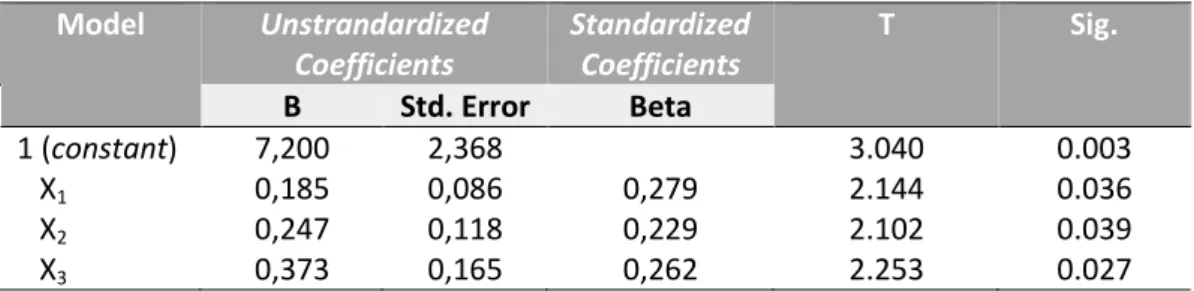
Results of Individual Parameter Specifications (t-test)
This test was conducted to determine whether the independent variable partially influences the dependent variable.
Table 2 Hypothesis Test Results
Model Unstrandardized
Coefficients
Standardized Coefficients
T Sig.
B Std. Error Beta
1 (constant) X1
X2 X3
7,200 0,185 0,247 0,373
2,368 0,086 0,118 0,165
0,279 0,229 0,262
3.040 2.144 2.102 2.253
0.003 0.036 0.039 0.027
External Pressure and Transparency of Financial Reporting
From the first hypothesis test, the regression coefficient value is 0.185 with a significance value of 0.036 <alpha 0.05. Thus, it can be interpreted that external pressures affect the transparency of financial reporting. Therefore, it can be concluded that the first hypothesis is valid. External pressure in this case is related to pressure originating from outside the RWU; such as government regulations, demands of the mayor/regent, community, NGOs and so on. Pressure from the outside of the RWU is certainly expected to force RWU officials to increase transparency. Laws or regulations put pressure on government officials to work on the transparency because they own strong legitimacy and legal consequences if they are not implemented. The demands of the Mayor/Regent to implement transparency have also been complied with. RWU employees are assistants from regional heads, so they have to obey higher officials in their work.
Public criticism and NGO pressure on the government regarding financial reporting transparency have also been responded well. The community, as a party that gives the mandate, has the right to demand transparency in financial reporting. Mass media coverage has also been taken into consideration. Demands from entrepreneurs or the business community have also been responded well. Entrepreneurs or business communities have bargaining value and consideration in efforts to develop the economy in the regions.
Management Commitments and Financial Reporting Transparency
From the second hypothesis test, the regression coefficient value is 0.247 with a significance value of 0.039 <alpha 0.05. Thus, it can be interpreted that management's commitment affects the transparency of financial reporting. Therefore, it can be concluded that the second hypothesis is valid. Management's commitment in this matter is the internal awareness of management itself in seeking transparency in financial reporting. Without awareness in the internal management, transparency will certainly be difficult to be realized properly. Improvements in staff skills, especially in the financial sector, as well as continuing education in dealing with environmental changes, have also been carried out to achieve transparency. It is also to provide internal management awareness in building ethical culture so that leadership with integrity could be essential to realize transparency. RWU leaders require community participation in carrying out work programs. Without community participation, government programs will be difficult to be achieved as expected.
The results of this study are in line with the research conducted by Basuki and Ridha (2012) that states management commitment has a positive effect on financial reporting transparency. The results are also the same as the results of research from Halmawati and Mustin (2013) which shows that management commitment has a positive effect on financial reporting transparency. However, this study is different from the results of the research from (Purnamasari, 2015) which states that management commitment does not have a significant positive effect on financial reporting transparency.
The effect of financial statement accessibility on financial reporting transparency
From the third hypothesis test, the coefficient value obtained by the regression coefficient value is 0.373 with a significance value of 0.27 <alpha 0.05. Thus, it can be interpreted that the accessibility of financial statements affects the transparency of financial reporting. Then it can be concluded that the third hypothesis is valid. Accessibility of financial statements is facilities provided by the government for the parties who have an interest in being able to access information, especially related to finance. Accessibility in this case is related to the ease of people on being able to access, information availability, and being open through mass media. The ease in providing access to financial reporting has also been well achieved.
Conclusion
This study aims to examine and empirically prove the Effects of External Pressure, Management Commitment, and Accessibility of Financial Statements on Transparency of Financial Reporting in Regional Work Units (RWU) in Yogyakarta City. The methodology used is survey with purposive sampling. The sample consists of 74 people. Based on the test, it can be concluded that external pressures, management commitment, and accessibility of financial statements affect the transparency of financial reporting.
The suggestions proposed are intended for the government and for further research. In order to increase transparency of financial reporting, the government needs to have a shared commitment. There is a need to increase staff capacity and ongoing education so that in technical implementation, RWU officials are able to file financial records, process, prepare, and submit financial reports to the stakeholders properly. There is also a need to build an ethical culture in the RWU environment to create integrity in carrying out its duties and functions. For further research, factors that affect transparency, such as the presentation of financial statements and environmental uncertainty, could be added so that it can expand insights for researchers and readers.
The implications of this study have an impact on economic and social aspects. The openness of the program has an impact on increasing community participation in community economic development programs, especially MSMEs. In addition, this research has an impact on increasing the active role of the community in overseeing government programs and holding them accountable for each policy.
This research has limitations that require improvement and development for further research. From the research model used, it is known that the independent research variables used can only affect the dependent variable by 34.3%. While the remaining 65.7% is explained by other variables that are not examined. This means that the ability of independent variables in influencing the dependent variable is low. The data used in the analysis came from instruments filled in based on respondents' perceptions using a questionnaire and the data were received without direct interviews being conducted. This will cause problems if the respondent's perception is different from the actual condition.
References
Atmasari, N. (2016). Dana Keistimewaan DIY: DPRD Bentuk Pansus Pengawas Danais. Harian Jogja. 2016. Received from:
https://jogjapolitan.harianjogja.com/read/2016/01/13/510/680332/dana-keistimewaan-diy-dprd-bentuk-pansus-pengawasan-danais
Basuki, H., & Ridha, M. A. (2012). Pengaruh Tekanan Eksternal, Ketidakpastian Lingkungan, Dan Komitmen Management Terhadap Penerapan Transparansi Pelaporan Keuangan. SNA Akuntansi 15 Banjarmasin.
Bolivar, M. P. R., Munoz, L. A., & Hernandez, A. M. L. (2013). Determinants of Financial
Transparancy in Government. International Public Management Journal 16(4): 557–602.
https://doi.org/10.1080/10967494.2013.849169
Da Cruz, N. F., Tavares, A. F., Marques, R. C., Jorge, S., de Sousa, L. (2016). Measuring
Local Government Transparency. Public Management Review 18 (6): 866–93.
https://doi.org/10.1080/14719037.2015.1051572
Donaldson, L., & Davis, J. H. (1991). Stewardship Theory or Agency Theory: CEO Covernance and Shareholders Return. Australian Journal of Management, 16(1),
49-64. https://doi.org/10.1177/031289629101600103
Gabriel, A. G. (2017). Transparancy and Accountability in Local Government: Levels of Commitment of Municipal Councillors in Bongabon in The Philipines. Asia Pacific Journal of Public Administration, 39(3): 217-223.
https://doi.org/10.1080/23276665.2017.1368902
Halmawati, & Mustin, F. A. (2015). Penerapan Transparansi Pelaporan Keuangan dalam Perspektif Tekanan Eksternal dan Komitmen Organisasi. Seminar Nasional Ekonomi Manajemen dan Akuntansi (SNEMA) Fakultas Ekonomi Universitas Negeri Padang. Received from:
http://fe.unp.ac.id/sites/default/files/unggahan/21.%20Halmawati%2C%20Farah%
20Asalin%20Mustin%20%28hal%20547-557%29_0.pdf
Hehanussa, S. J. (2015). Pengaruh Penyajian Laporan Keuangan Daerah dan Aksesibilitas Laporan Keuangan Daerah Terhadap Transparansi dan Akuntabilitas Pengelolaan Keuangan Daerah Kota Ambon. Conference In Business, Accounting, and Management (CBAM), 2(1): 82-90.
http://jurnal.unissula.ac.id/index.php/cbam/article/view/294/241
Jacobs, S., & T. Schillemans. 2016. Media and Public Accountability: Typology and Exploration. Policy & Politics, 44 (1): 23–40.
https://doi.org/10.1332/030557315x14431855320366
Mardiasmo. (2002). Akuntansi Sektor Publik. Yogyakarta: Penerbit Andi.
McIvor, R., McHugh, M. & Cadden ,C. (2002). Internet Technologies: Supporting
Transparancy in The Public Sector. The International of Public Sector Management, 15(3):
170-187. https://doi.org/10.1108/09513550210423352
Purnamasari, R. W. D. (2015). Pengaruh Sumber Daya Manusia, Tekanan Eksternal, Komitmen Manajemen Terhadap Transparansi Pelaporan Keuangan. Jurnal Ilmu & Riset Akuntansi.
Saragih, C. A. (2015). Pengaruh Penyajian Laporan Keuangan Daerah dan Aksesibilitas Laporan Keuangan Daerah Terhadap Transparansi dan Akuntabilitas Pengelolaan Keuangan Daerah Kabupaten Simalungun. JOMFEKON, 2 (2): 1-6.
https://jom.unri.ac.id/index.php/JOMFEKON/article/view/8831
Shkabatur, J. (2012). Transparancy With (out) Accountability: Open Government in the United States. 31 Yale Law & Policy Review. Received from:
Yuliani, N. L. (2017). Pengaruh Penyajian Laporan Keuangan, Karakteristik Kualitatif, Aksesibilitas dan Pengendalian Internal Terhadap Transparansi Laporan Keuangan Pemerintah Daerah. Jurnal Bisnis dan Ekonomi, 24(1): 1-14.