S T U D Y P R O T O C O L
Open Access
The effects of linagliptin on endothelial
function and global arginine bioavailability
ratio in coronary artery disease patients
with early diabetes: study protocol for a
randomized controlled trial
Norbert J. Tripolt
1, Felix Aberer
1, Regina Riedl
3, Barbara Hutz
1, Jasmin Url
1, Gudrun Dimsity
2, Andreas Meinitzer
4,
Tatjana Stojakovic
4, Ronald Hödl
5, Marianne Brodmann
2, Franz Hafner
2and Harald Sourij
1,6*Abstract
Background:Patients with type 2 diabetes (T2DM) are at increased risk for macrovascular events as well as for microvascular complications. There is evidence that in patients with coronary artery disease (CAD), about 35 % suffer from manifest T2DM. Early glucose-lowering intervention in subjects with T2DM has been demonstrated to be beneficial in terms of cardiovascular risk reduction. But thus far, no data are available regarding investigating the impact of linagliptin treatment in patients with early diabetes on cardiovascular endpoints or surrogate parameters. Therefore, the aim of this study is to investigate the effects of linagliptin in CAD patients with early T2DM on various cardiovascular surrogate measurements including mechanical and biochemical endothelial function assessments.
Methods/design:Forty-two subjects with early diabetes and CAD are included in this investigator-driven, randomized, placebo-controlled, double-blind, phase IV, single-center study. Participants will be randomized to receive either linagliptin (5 mg) administered once daily per os or placebo for 12 weeks. Before and after the intervention, evaluation of endothelial function (flow-mediated dilatation and biochemical biomarkers) and a Meal Tolerance Test are performed.
Discussion:Cardiovascular surrogate parameters, such as endothelial function, are able to provide insights into the potential mechanisms of the cardiovascular effects of antihyperglycemic agents. Currently ongoing trials do not specifically focus on early diabetes as a target of intervention and we therefore believe that our study will contribute to a better understanding of the cardiovascular effects of dipeptidylpeptidase-4 (DPP-4) inhibitors in early diabetes.
Trial registration:NCT02350478. Registered 26 January 2015. Protocol date/version 24 October 2014/version 2.4 EudraCT number: 2013-000330-35
Keywords:Linagliptin, DPP-4 inhibitor, Endothelial function, Global arginine bioavailability ratio, Coronary artery disease, Type 2 diabetes mellitus
* Correspondence:[email protected]
1
Department of Internal Medicine, Division of Endocrinology and
Diabetology, Cardiovascular Diabetology Research Group, Medical University of Graz, Graz, Austria
6Center for Biomarker Research in Medicine, CBmed, Graz, Austria
Full list of author information is available at the end of the article
Background
Patients with type 2 diabetes (T2DM) are at increased risk of macrovascular events as well as of microvascular complications [1]. It is well-known that the pathophysio-logic process of T2DM starts many years before the diagnosis can be made on the basis of elevated fasting blood glucose or pathologic glucose tolerance evaluation [2], and in particular the data from the United Kingdom Prospective Diabetes Study (UKPDS) and the UKPDS post-trial monitoring highlighted the importance of an early glucose-lowering intervention in patients with T2DM for the reduction of future microvascular and macrovascular complications [3, 4]. We [5, 6], and in particular the Euro Heart Survey on Diabetes and the Heart [7], have demonstrated that disturbances of glu-cose metabolism are present in approximately two thirds of patients with CAD, and current joint guidelines of the European Society of Cardiology (ESC) and the European Association for the Study of Diabetes (EASD) recom-mend screening for dysglycemic states in this patient population [8].
Dipeptidylpeptidase-4 (DPP-4) inhibitors increase en-dogenous glucagon-like peptide-1 (GLP-1) levels and GLP-1 in turn increases insulin release from pancreatic beta cells in a glucose-dependent manner as well as sup-pressing glucagon secretion from pancreatic alpha cells. Investigations in T2DM patients have shown that this drug class lowers both fasting and postchallenge or post-meal glucose levels, and hence glycosylated hemoglobin (HbA1c), and is well-tolerated.
However, the lowering of the surrogate measurement HbA1c level has not necessarily turned out to translate into a reduced number of cardiovascular events in patients with T2DM and, therefore, the American Food and Drug Administration (FDA) [9] and the EMA (European Medicines Agency) [10] issued in 2008 and 2010, respectively, guidance for new glucose-lowering drugs, requiring at least the proof of cardiovascular safety. Three cardiovascular outcome trials with the DPP-4 inhibitors alogliptin, saxagliptin and sitagliptin have been published to date [11–13] and have demon-strated cardiovascular safety albeit not cardiovascular superiority to usual diabetes care without DPP-4 inhibi-tors. Two outcome trials with linagliptin (CAROLINA [14] and CARMELINA - NCT01897532) are underway, of which the former is performed in subjects with early diabetes.
A major limitation of the published studies is that they included primarily patients with longstanding diabetes (median duration of between 7.1 and 11.6 years in EXAMINE, SAVOR-TIMI53 and TECOS) while data from the UKPDS suggest that patients benefit most from an early glucose-lowering intervention rather than a later intervention in the course of the disease. The
cardiovascular impact of DPP-4 inhibitors in early treat-ment remains unclear and there is currently no ongoing trial in this patient population given the low event rate and the need for long-term follow-up.
A well-known and validated cardiovascular surrogate parameter for future cardiovascular events is endothelial dysfunction. We and others have shown previously that endothelial dysfunction is present in patients with CAD and early diabetes and can be improved by pharmaco-logic intervention [15, 16]. Data on the effect of DPP-4 inhibitors on endothelial function are sparse and the re-sults of these trials are conflicting. While Nakamura et al. [17] demonstrated an improvement of endothelial function with sitagliptin, Ayaori and coworkers [18] showed a worsening of endothelial function with the same drug. However, none of these trials was performed in a placebo-controlled fashion.
Therefore, we aim to perform a randomized, placebo-controlled, double-blind trial investigating the effect of the DPP-4 inhibitor linagliptin on endothelial function and further biochemical markers of vascular function, which will help to better understand the cardiovascular effects of DPP-4 inhibitors in early diabetes.
Aim of the study
The aim of our current study is to investigate the ef-fects of linagliptin in CAD patients with early T2DM on various cardiovascular surrogate measurements in-cluding mechanical and biochemical endothelial func-tion assessments.
Methods/design Design
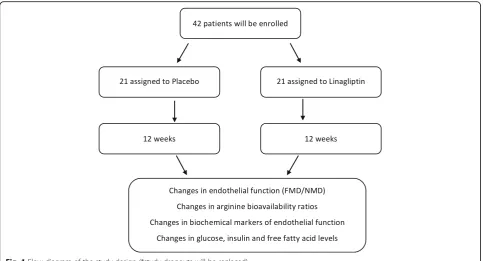
This is an investigator-driven, prospective, randomized, placebo-controlled, double-blind, phase IV, single-center study to evaluate the effect of linagliptin 5 mg once daily on cardiovascular surrogate measures in patients with early diabetes and CAD (Fig. 1). The trial was approved by the Ethics Committee of the Medical University of Graz (25-295 ex 12/13) and is con-ducted at the Division of Endocrinology and Diabetol-ogy at the Medical University of Graz (academic hospital), Austria. All participants are asked to pro-vide written informed consent before entering the study. Clinical trial authorization has been obtained from the Austrian Agency for Health and Food Safety (AGES) (EudraCT number: 2013-000330-35). Import-ant protocol modifications will be reported to the local Ethics Committee of the Medical University of Graz and, if necessary, to the AGES. This study follows the international recommendations for inter-ventional trials (see the Standard Protocol Items:
Rec-ommendations for Interventional Trials (SPIRIT)
Inclusion and exclusion criteria
Participants for the trial are aged 40 to 80 years with early T2DM (i.e., 2-h glucose post oral glucose exposure (75 mg) > 200 mg/dl or T2DM treated with diet only or on a stable dose of metformin monotherapy), a recent glycosylated hemoglobin (HbA1c) level of between 6.0 (42 mmol/mol) and 9.0 % (75 mmol/mol) and coronary atherosclerosis (diagnosed either by coronary angiog-raphy or coronary computer tomogangiog-raphy).
The exclusion criteria are: acute coronary syndrome or a cerebrovascular event within the previous 4 weeks; Body Mass Index (BMI) > 35.0 kg/m2; serum creatinine level > 2.5 mg/dl; aspartate aminotransferase (AST)/ala-nine aminotransferase (ALT) more than threefold the upper limit of normal; heart failure more severe than NYHA class II; uncontrolled hypertension (blood pres-sure above 165/100 mmHg); treatment with orally administered steroids; use of a new-onset statin or angiotensin converting enzyme (ACE) inhibitor within the previous 6 weeks; known malignancy; known intoler-ance to DPP-4 inhibitors; any antidiabetic therapy except metformin; and pregnant or breastfeeding women. We amended the reduction of the lower boundary of the range of HbA1c level from 6.5 (48 mmol/mol) to 6.0 % (42 mmol/mol) after the enrollment of 10 subjects to increase the recruitment rate.
Primary objective
The primary objective of this trial is to determine whether 12-week linagliptin treatment is associated with
an improvement in endothelial function in patients with early diabetes.
Secondary objective
1. To investigate the effect of linagliptin treatment on arginine bioavailability ratios (global arginine bioavailability ratio (GABR) and arginine to ornithine ratio)
2. To study the impact of linagliptin treatment on biochemical markers of endothelial function (soluble vascular cell adhesion molecule-1 (sVCAM-1) and soluble intercellular adhesion molecule-1 (sICAM-1) 3. To evaluate the Area Under Curve (AUC) of
glucose, insulin and free fatty acids (FFA) during the Meal Tolerance Test (MTT)
Outcome measurements
The primary outcome is the difference in endothelial function measured by FMD (flow-mediated dilatation) before and after 12 weeks of treatment with linagliptin or matched placebo.
The secondary outcome measures are GABR, arginine to ornithine ratio, sVCAM-1 level, sICAM-1 level and AUC of glucose, insulin and FFA during the MTT.
Interventions
[image:3.595.57.541.87.348.2]and placebo are supplied by Boehringer Ingelheim as bulkware study medication. The study capsules, lina-gliptin and placebo are identical in appearance and all are tasteless and colorless. The pharmacy at the Med-ical University of Graz, Austria packs the medication as 12-week supplies for study participants and labels the study medication according to current regulatory requirements.
Patients are asked not to adjust their antidiabetic treat-ment during the study period. However, if glycemic con-trol appears to be inappropriately high during these 12 weeks, additional glucose-lowering drugs may be used at the discretion of the principal investigator. Un-less contraindicated, the first choice for rescue medica-tion should be a sulfonylurea.
The subjects are instructed to return all unused or partly-used medication and packaging from medication at the follow-up visit. Tablets are counted at the end of the 12 weeks of the treatment period to verify medica-tion adherence. Significant nonadherence is defined as missing 20 % or more doses of trial medication during the 12 weeks of the treatment period. In the case of study medication noncompliance, participants would continue to be followed to their last visit. These data would not be part of the per-protocol analysis but would form part of an intention-to-treat (ITT) analysis.
Withdrawal of consent and major protocol violations will lead to an early study termination for the subject
Eligibility and recruitment
The study population will consist of 48 subjects with early diabetes and CAD. Subjects are identified from the outpatient clinic at the Department of Endocrinology and Diabetology, the Division of Cardiology, via primary care and advertisements. The clinic staff informs pa-tients about the possibility of being enrolled in this study. No study-related procedures are undertaken be-fore obtaining informed consent. Then, the study team explains the study procedures in detail and asks the par-ticipant about their willingness to participate in this re-search study. After informed consent is signed and obtained, participants are given a signed copy of the In-formed Consent Document and are assigned a screening identification number. Any use of study samples that is outside the scope of the objectives of this protocol will be submitted for prior review and approval by the ap-propriate Institutional Review Board.
Screening
Screening of participants consists of the evaluation of inclusion and exclusion criteria. After informed consent is obtained, a numbered subject folder is created for potential participants, including information about medical history, physical examination and their actual
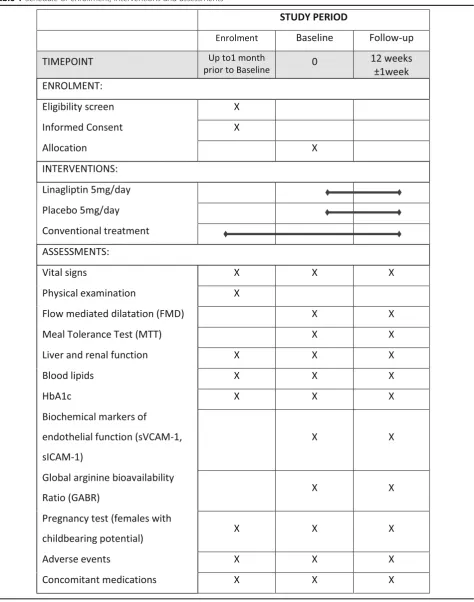
medication. Glycosylated hemoglobin (HbA1c), serum creatinine and AST/ALT levels obtained from venous blood are checked by laboratory investigation. Women of reproductive potential undergo urine pregnancy test-ing. Eligible subjects are scheduled for the following study visits (Table 1).
Randomization and blinding
Participants are randomized to one of the two study arms (intervention versus placebo) in the ratio 1:1 in real time by using the web-based randomization tool “Randomizer for Clinical Trials”(https://www.randomizer.at/). The soft-ware’s compliance with Good Clinical Practice (GCP) has been confirmed by the Austrian Agency for Health and Food Safety (AGES). The randomization plan is designed by the Institute of Medical Informatics, Statistics and Documentation, Medical University Graz, Austria, which passes the treatment codes to the Pharmacy of the Univer-sity Hospital Graz for adequate labeling and blinding of the medication. The labels of the study medication display the name of the trial, the name of the investigational me-dicinal product and contact details of the principal investi-gator. Subject numbers are assigned sequentially as each subject enters the study. The study is subject- and investigator-blinded during the treatment periods from visit 2 until the end of the study. In the rare case of a re-quirement to unblind study medication, the principal in-vestigator needs to give permission for unblinding. The unblinding list is held by the Institute of Medical Inform-atics, Statistics and Documentation, Medical University of Graz, which is not involved in study investigations.
Reporting procedure for all adverse events
All adverse events (AE), serious (SAE) and nonserious, are collected, documented and reported on the appropri-ate Case Report Forms (CRFs)/SAE Reporting Forms once informed consent has been signed and this will end 28 days after completing the trial. The following infor-mation is recorded:
Participant details Adverse event description Start date of event End date of event Outcome of event Severity of event Treatment required
Relationship to study drug (i.e., causality/relatedness) Assessment of relatedness to other suspect drug or device
Action taken with study drug
Whether subject withdrawn due to an adverse event Whether the event is serious
Table 1Schedule of enrollment, interventions and assessments
AEs considered to be related to study medication as judged by a medically qualified investigator are followed until resolution or the event is considered stable. All re-lated AEs that result in a subject’s withdrawal from the study or are present at the end of the study are followed up until a satisfactory resolution occurs.
Reporting procedure for serious adverse events
The investigator reports any SAEs and nonserious AEs which are relevant for reported SAEs and AEs of Special Interest to Boehringer Ingelheim, Pharmacovigilance Unique Entry Point, which will subsequently report the SAE to the Ethics Committee and local authorities.
Physical measurements
Anthropometric measurements are performed on each participant at each study visit. Weight is measured with the patient standing and then registered after rounding it to the nearest 500 grams. Height is measured using a metric tape with the patient standing against the wall, and the value marked by a ruler placed horizontally on the vertex of the patient’s head. BMI is estimated using the weight in kilograms divided by the second power of the height expressed in meters. Blood pressure is taken using an automated sphygmomanometer Boso Medicus Uno (Bosch & Sohn GmbH, Juningen, Germany) after a 5-min rest in sedentary body position. Number of beats per min is measured from the radial artery by manual palpation.
Measurement of flow-mediated dilatation (FMD) of the brachial artery
Endothelium-dependent FMD following reactive hyperemia and endothelium-independent nitroglycerin-mediated dila-tation (NMD) following administration of glyceryl trinitrate (GTN) are examined in the brachial artery by a trained physician according to the guidelines described by Coretti et al. [19]. Vasodilatation of the right brachial artery is mea-sured using a 9–14 MHz, linear array, high-resolution transducer (ACUSON S2000 ultrasound system, SIEMENS Healthcare, 91052 Erlangen, Germany). After a 5-min rest in the supine position the brachial artery is examined in a longitudinal plane above the antecubital fossa by continu-ous grayscale imaging in a segment with definitive intimal interfaces between the lumen and the vascular wall. The distance between the two intimal interfaces is measured at least three times in the end-diastolic phase using echocar-diographic (ECG). A blood pressure cuff is placed on the forearm and inflated to a pressure of 250 mmHg for 5 min. The postischemic diameter of the brachial artery is taken 45 s after cuff release. At least 15 min later, the diameter between the two intimal lines is recorded immediately be-fore and 3 min after sublingual administration of 0.4 mg GTN. FMD diameter is calculated as the average of the
three diameter measurements following reactive hyperemia. FMD and NMD are calculated as the percentage change in diameter compared to baseline.
Meal Tolerance Test (MTT)
The MTT is performed after an overnight fast (apart from water). A standard-gauge cannula is placed into a subcutaneous vein for blood sampling. In order to prevent blood clotting in the cannula and to keep the cannula working it will be occasionally flushed with sterile normal saline. Study medication will be given (time−15 min) before the meal. A pre-meal blood sam-ple will be taken (−5 min) and then all subjects are asked to drink Fortimel compact (10 kcal/kg) over a period of 2−4 min (time 0 min). During the meal test further blood samples will be taken at 15, 30, 60 and 120 min. All samples are used for determination of glucose, insu-lin and FFA levels. The blood at each time point is placed into a fluoride oxalate tube (1 ml) for plasma glu-cose and into a serum tube for insulin and FFA.
Laboratory measurements
Insulin and c-peptide will be measured by chemilumines-cence on an ADVIA Centaur system (Siemens Healthcare Diagnostics, Eschborn, Germany). Lipoproteins will be sep-arated using a combined ultracentrifugation-precipitation method (β-quantification). Cholesterol, triglyceride and phospholipid levels will be determined enzymatically (DiaSys, Holzheim, Germany). Apolipoprotein (apo) AI, apo B and lipoprotein(a) levels will be measured by immu-noturbidimetry (Greiner, Flacht, Germany). Lipoprotein analyses will be performed on an Olympus AU640 analyzer (Olympus Diagnostika, Hamburg, Germany). Free fatty acids (FFA) will be measured enzymatically (Wako Chem-ical, Neuss, Germany). Routine parameters will be deter-mined using a cobas® analyzer (Roche Diagnostics, Mannheim, Germany). Inflammatory markers, such as sVCAM-1 and sICAM-1, will be measured by enzyme-linked immunosorbent assays.
Arginine bioavailability ratios
arginine bioavailability ratio (GABR) will be calculated from arginine divided by the sum of (ornithine plus L-citrulline). The L-arginine to L-ornithine ratio will be calcu-lated by dividing the L-arginine by the L-ornithine levels.
Statistical considerations
A detailed Statistical Analysis Plan (SAP) will be pre-pared. Before unblinding and locking the data for statis-tical analysis, a review of all data will take place and the SAP will be finalized and approved. Should the SAP and this protocol differ, the methods in the SAP will prevail.
Definition of analysis populations
Study participants who withdraw their informed consent are excluded from the study and will not be included in any statistical analysis.
The analysis populations are defined as follows: The ITT population will include all randomized patients with a recorded primary outcome measure (i.e., the baseline and follow-up FMD measurement). All pa-tients will be analyzed according to the randomized treatment group. The primary analysis will be performed on the ITT population.
The per-protocol population will consist of all patients with recorded baseline and follow-up FMD measure-ments and study medication compliance > 80 %. Non-compliance is defined as missing 20 % or more doses of trial medication during the 12-week treatment period.
The safety population will include all patients who re-ceived at least one dose of the study medication. The study participants will be analyzed according to the treatment received.
General aspects
The analysis of the collected data in the study will be performed using SAS v9.4. Continuous variables will be presented as means, standard deviation (SD), median and minimum and maximum; for categorical data, fre-quencies and relative frefre-quencies will be used.
Demographic and baseline characteristics
The demographic and baseline characteristics will be
summarized and compared between the groups
descriptively.
Analysis of the primary outcome
The primary outcome, the change in endothelial func-tion measured by FMD at baseline and after 12 weeks of treatment with linagliptin or placebo will be analyzed using analysis of covariance (ANCOVA) with FMD at week 12 as the dependent variable, and the baseline FMD and treatment group as covariates. A two-sided p value of < 0.05 is considered to indicate statistical significance.
Analysis of the secondary outcomes
For the secondary outcomes, arginine bioavailability ra-tios (GABR, arginine to ornithine ratio), biochemical markers of endothelial function (sVCAM-1, sICAM-1) and the evaluation of AUC of glucose, insulin and FFA during the MTT, group comparisons will be performed using parametric or nonparametric methods for un-paired data (as appropriate). Comparisons within groups will be performed using a pairedttest or the Wilcoxon rank-sum test.
Analysis of the safety parameters
Safety parameters will be summarized as interval or cat-egorical summaries as appropriate. Listings and sum-mary tables of AEs will be presented by treatment group and relationship, seriousness and intensity.
Missing data handling
All available data will be used in the analysis and data summaries. There will be no imputation of any missing data. The reason that data are missing will be docu-mented and reported.
Sample size
The sample size was estimated using the free calculator available from http://www.quantitativeskills.com/sisa/ calculations/samsize.htm. For the sample size estimation we assumed a relative 30 % improvement of endothelial function in the linagliptin group and no changes from baseline to week 12 in the placebo group. Although ef-fect sizes and SDs vary substantially, we based our esti-mation on a baseline FMD of approximately 5.0 % and a SD of 1.5 % (absolute % FMD) [22] a total of 42 subjects will be needed to detect this difference with a two-sided alpha of 0.05 and a power of 0.90. For every subject dropping out during the study (withdrawal of consent, lost to follow-up) an additional subject will be enrolled to make sure the trial is adequately powered. To con-sider a dropout rate of approximately 15–20 %, we will randomize a maximum of 50 subjects.
Data collection
Electronic Case Report Form (eCRF)
Study data will be captured on a web-based open source eCRF (OpenClinica).
the eCRF is password-protected and the password is only given to site personnel. Data generated throughout the study are monitored, and the eCRFs are checked against the subject records for accuracy and accuracy. Following completion of the eCRFs, the data are checked electronically for consistency and plausibility by prede-fined range checks. If necessary, automatic queries are generated for questionable data.
Data quality control
The research assistant and the investigators meet monthly to review the study progress and procedures and to discuss any AEs or dropouts. In view of the small sample size, short study period and phase of the trial, a Data Monitoring Committee, interim analysis and stop-ping guidelines were not including in the trial design. The data collection, management, analysis, interpret-ation and production of publicinterpret-ations is independent of the funding bodies and other competing interests. The trial results will be disseminated via journal publication and conference presentation without exposing the iden-tity of the trial subjects.
Monitoring
Monitoring is undertaken according to ICH Good Clin-ical Practice guidelines and the study monitoring plan. The study monitor is suitably trained, qualified and ex-perienced to perform this task. Data are evaluated for compliance with the protocol and accuracy in relation to source documents. The following data are assessed:
Written informed consent
Flow chart filled in for included and excluded subjects Trial progress
Primary and secondary outcome collection Severe adverse events
Drug accountability of the study treatment
Discussion
A great variety of antidiabetic agents are available for T2DM treatment. These treatments differ in their mech-anisms of drug action and their long-term outcomes. The FDA and the EMA require cardiovascular trials for all new antihyperglycemic drugs in order to prove the safety of these agents. Cardiovascular surrogate parame-ters, such as endothelial function, cannot replace out-come trials but are able to provide insights into the potential mechanisms of the cardiovascular effects of antihyperglycemic agents. Moreover, currently ongoing trials do not specifically focus on early diabetes as a tar-get of intervention and we therefore believe that our study will contribute to a better understanding of cardio-vascular effects of DPP-4 inhibitors in early diabetes.
Trial status
The trial is currently enrolling patients. As of 28 February 2016, 80 % of the patients have been en-rolled in the study.
Additional file
Additional file 1:SPIRIT checklist. (PDF 74 kb)
Abbreviations
ACE:Angiotensin converting enzyme; AE: Adverse event; AGES: Austrian Agency for Health and Food Safety; ALT: Alanine transaminase; ANCOVA: Analysis of covariance; AST: Aspartate transaminase; AUC: Area Under Curve; BMI: Body Mass Index; CAD: Coronary artery disease; CV: Coefficient of variance; DPP-4: Dipeptidylpeptidase-4; ECG: echocardiography; eCRF: Electronic Case Report Form;
EDTA: Ethylenediaminetetraacetate; EMEA: European Medicines Agency; FDA: Food and Drug Administration; FFA: Free fatty acids; FMD: Flow-mediated dilatation; GABR: Global arginine bioavailability ratio; GLP-1: Glucagon-like-peptide-1; GTN: Glyceryl trinitrate; HbA1c: Glycosylated haemoglobin; ITT: Intention-to-treat; MTT: Meal Tolerance Test; NMD: Nitroglycerin-mediated dilatation; SAE: Serious adverse event; SAP: Statistical Analysis Plan; SD: standard deviation; sICAM-1: soluble intercellular adhesion molecule-1; SUSAR: Suspected unexpected serious adverse reaction; sVCAM-1: Soluble vascular cell adhesion molecule-1; T2DM: Type 2 diabetes mellitus; UKPDS: United Kingdom Prospective Diabetes Study;
Acknowledgements
We thank Nutricia Austria for the provision of the Fortimel compact drinks used in the Meal Tolerance Test.
Funding
This study is funded as an investigator-initiated study by Boehringer Ingelheim RCV, Vienna, Austria.
Availability of data and materials Additional file 1. The SPIRIT checklist.
Authors’contributions
HS, FH, MB and NJT designed the study protocol, GD and BH have made a substantial contribution to data acquisition. NJT and HS wrote the clinical protocol and obtained authorization from the Ethics Committee and wrote the manuscript. HS calculated the sample size for this trial and RR planned the statistical analysis. HS is the principal investigator of the trial. All authors made a substantial contribution to the conception and design of the manuscript. All authors read and approved the final manuscript.
Authors’information
NJT: Project Manager, Medical University of Graz, Department of Internal Medicine, Division of Endocrinology and Diabetology, Cardiovascular Diabetology Research Group, Auenbruggerplatz 15, 8036 Graz, Austria. FA: Attending Physician, Medical University of Graz, Department of Internal Medicine, Division of Endocrinology and Diabetology, Cardiovascular Diabetology Research Group, Auenbruggerplatz 15, 8036 Graz, Austria. RR: Statistician, Medical University of Graz, Institute for Medical Informatics, Statistics and Documentation, Auenbruggerplatz 2, 8036 Graz, Austria. BH: Study Nurse, Medical University of Graz, Department of Internal Medicine, Division of Endocrinology and Diabetology, Cardiovascular Diabetology Research Group, Auenbruggerplatz 15, 8036 Graz, Austria. JU: Study Nurse, Medical University of Graz, Department of Internal Medicine, Division of Endocrinology and Diabetology, Cardiovascular Diabetology Research Group, Auenbruggerplatz 15, 8036 Graz, Austria.
TS: Responsible for Laboratory Analysis, Medical University of Graz, Clinical Institute of Medical and Chemical Laboratory Diagnostics, Auenbruggerplatz 15, 8036 Graz, Austria.
RH: Chief of Medicine, Center for Cardiovascular Rehabilitation St. Radegund, Quellenstrasse 1, 8061 St. Radegund, Austria.
MB: Professor, Medical University of Graz, Department of Internal Medicine, Division of Angiology, Auenbruggerplatz 15, 8036 Graz, Austria.
FH: Attending Physician, Medical University of Graz, Department of Internal Medicine, Division of Angiology, Auenbruggerplatz 15, 8036 Graz, Austria. HS: Principal Investigator, Associate Professor, Medical University of Graz, Department of Internal Medicine, Division of Endocrinology and Diabetology, Cardiovascular Diabetology Research Group, Auenbruggerplatz 15, 8036 Graz, Austria.
Competing interests
The authors declare that they have no competing interests.
Consent for publication
Consent for publication forms a specific part of the consent for participation. It has been obtained from all participants.
Ethics approval and consent to participate
The trial was approved by the Ethics Committee of the Medical University of Graz (25-295 ex 12/13). All participants are asked to provide written informed consent before entering the study. Clinical trial authorization has been obtained from the Austrian Agency for Health and Food Safety (AGES) (EudraCT number 2013-000330-35). Important protocol modifications will be reported to the local Ethics Committee of the Medical University of Graz and if necessary to the AGES.
Availability of the final trial dataset
Only the principle investigator and his study team will have access to the completed dataset and they will collectively decide who will have access to the data and how the data will be used. Results shall be submitted for publication in peer-reviewed journals and conferences. These will be prepared by the principal investigator and the research team.
Author details
1Department of Internal Medicine, Division of Endocrinology and
Diabetology, Cardiovascular Diabetology Research Group, Medical University of Graz, Graz, Austria.2Department of Internal Medicine, Division of
Angiology, Medical University of Graz, Graz, Austria.3Medical University of Graz, Institute for Medical Informatics, Statistics and Documentation, Graz, Austria.4Clinical Institute of Medical and Chemical Laboratory Diagnostics,
Graz, Austria.5Center for Cardiovascular Rehabilitation, St. Radegund, Austria. 6
Center for Biomarker Research in Medicine, CBmed, Graz, Austria.
Received: 27 April 2016 Accepted: 28 September 2016
References
1. Stratton IM, Adler AI, Neil HA, Matthews DR, Manley SE, Cull CA, et al. Association of glycaemia with macrovascular and microvascular complications of type 2 diabetes (UKPDS 35): prospective observational study. BMJ. 2000;321(7258):405–12.
2. U.K. prospective diabetes study 16. Overview of 6 years’therapy of type II diabetes: a progressive disease. U.K. Prospective Diabetes Study Group. Diabetes. 1995;44(11):1249-58.
3. Effect of intensive blood-glucose control with metformin on complications in overweight patients with type 2 diabetes (UKPDS 34). UK Prospective Diabetes Study (UKPDS) Group. Lancet. 1998;352(9131):854-65.
4. Holman RR, Paul SK, Bethel MA, Matthews DR, Neil HA. 10-year follow-up of intensive glucose control in type 2 diabetes. N Engl J Med. 2008;359(15): 1577–89. doi:10.1056/NEJMoa0806470.
5. Saely CH, Drexel H, Sourij H, Aczel S, Jahnel H, Zweiker R, et al. Key role of postchallenge hyperglycemia for the presence and extent of coronary atherosclerosis: an angiographic study. Atherosclerosis. 2008;8:8.
6. Wascher TC, Sourij H, Roth M, Dittrich P. Prevalence of pathological glucose metabolism in patients undergoing elective coronary angiography. Atherosclerosis. 2004;176(2):419–21. doi:10.1016/j.atherosclerosis.2004.06.001.
7. Bartnik M, Ryden L, Ferrari R, Malmberg K, Pyorala K, Simoons M, et al. The prevalence of abnormal glucose regulation in patients with coronary artery disease across Europe. The Euro Heart Survey on diabetes and the heart. Eur Heart J. 2004;25(21):1880–90. doi:10.1016/j.ehj.2004.07.027.
8. Ryden L, Standl E, Bartnik M, Van den Berghe G, Betteridge J, de Boer MJ, et al. Guidelines on diabetes, pre-diabetes, and cardiovascular diseases: executive summary. The Task Force on Diabetes and Cardiovascular Diseases of the European Society of Cardiology (ESC) and of the European Association for the Study of Diabetes (EASD). Eur Heart J. 2007;28(1):88–136. doi:10.1093/eurheartj/ehl260.
9. FDA. Guidance for industry diabetes mellitus—evaluating cardiovascular risk in new antidiabetic therapies to treat type 2 diabetes. In: Administration USDoHaHSFaD, editor. New Hampshire: U.S. Department of Health and Human Services Food and Drug Administration Center for Drug Evaluation and Research; 2008. p. 5.
10. EMA. Guideline on the investigation of bioequivalence. London: European Medicines Agency; 2010.
11. Zannad F, Cannon CP, Cushman WC, Bakris GL, Menon V, Perez AT, et al. Heart failure and mortality outcomes in patients with type 2 diabetes taking alogliptin versus placebo in EXAMINE: a multicentre, randomised, double-blind trial. Lancet. 2015;385(9982):2067–76. doi:10.1016/S0140-6736(14)62225-X. 12. Udell JA, Bhatt DL, Braunwald E, Cavender MA, Mosenzon O, Steg PG, et al.
Saxagliptin and cardiovascular outcomes in patients with type 2 diabetes and moderate or severe renal impairment: observations from the SAVOR-TIMI 53 Trial. Diabetes Care. 2015;38(4):696–705. doi:10.2337/dc14-1850. 13. Green JB, Bethel MA, Armstrong PW, Buse JB, Engel SS, Garg J, et al. Effect
of sitagliptin on cardiovascular outcomes in type 2 diabetes. N Engl J Med. 2015. doi:10.1056/NEJMoa1501352.
14. Marx N, Rosenstock J, Kahn SE, Zinman B, Kastelein JJ, Lachin JM, et al. Design and baseline characteristics of the CARdiovascular Outcome trial of LINAgliptin versus glimepiride in type 2 diabetes (CAROLINA(R)). Diab Vasc Dis Res. 2015;12(3):164–74. doi:10.1177/1479164115570301.
15. Akcakoyun M, Kargin R, Tanalp AC, Pala S, Ozveren O, Akcay M, et al. Predictive value of noninvasively determined endothelial dysfunction for long-term cardiovascular events and restenosis in patients undergoing coronary stent implantation: a prospective study. Coron Artery Dis. 2008; 19(5):337–43. doi:10.1097/MCA.0b013e328301ba8e.
16. Sourij H, Zweiker R, Wascher TC. Effects of pioglitazone on endothelial function, insulin sensitivity, and glucose control in subjects with coronary artery disease and new-onset type 2 diabetes. Diabetes Care. 2006;29(5): 1039–45. doi:10.2337/diacare.2951039.
17. Nakamura K, Oe H, Kihara H, Shimada K, Fukuda S, Watanabe K, et al. DPP-4 inhibitor and alpha-glucosidase inhibitor equally improve endothelial function in patients with type 2 diabetes: EDGE study. Cardiovasc Diabetol. 2014;13:110. doi:10.1186/s12933-014-0110-2.
18. Ayaori M, Iwakami N, Uto-Kondo H, Sato H, Sasaki M, Komatsu T, et al. Dipeptidyl peptidase-4 inhibitors attenuate endothelial function as evaluated by flow-mediated vasodilatation in type 2 diabetic patients. J Am Heart Assoc. 2013;2(1):e003277. doi:10.1161/JAHA.112.003277.
19. Corretti MC, Anderson TJ, Benjamin EJ, Celermajer D, Charbonneau F, Creager MA, et al. Guidelines for the ultrasound assessment of endothelial-dependent flow-mediated vasodilation of the brachial artery: a report of the International Brachial Artery Reactivity Task Force. J Am Coll Cardiol. 2002;39(2):257–65. 20. Roth M. Fluorescence reaction for amino acids. Anal Chem. 1971;43(7):880–2. 21. Schwarz EL, Roberts WL, Pasquali M. Analysis of plasma amino acids by
HPLC with photodiode array and fluorescence detection. Clin Chim Acta. 2005;354(1-2):83–90. doi:10.1016/j.cccn.2004.11.016.