Contents lists available atScienceDirect
Physics
Letters
B
www.elsevier.com/locate/physletb
Study
of
giant
dipole
resonance
in
hot
rotating
light
mass
nucleus
31
P
Debasish Mondal
a,
∗
,
Deepak Pandit
a,
S. Mukhopadhyay
a,
b,
Surajit Pal
a,
Srijit Bhattacharya
c,
A. De
d,
N. Dinh Dang
e,
f,
N. Quang Hung
g,
Soumik Bhattacharya
a,
b,
S. Bhattacharyya
a,
b,
Balaram Dey
h,
Pratap Roy
a,
K. Banerjee
a,
b,
1,
S.R. Banerjee
iaVariableEnergyCyclotronCentre,1/AF-Bidhannagar,Kolkata700064,India
bHomiBhabhaNationalInstitute,TrainingSchoolComplex,Anushaktinagar,Mumbai400094,India cDepartmentofPhysics,BarasatGovernmentCollege,Kolkata700124,India
dDepartmentofPhysics,RaniganjGirls’College,Raniganj713358,India
eQuantumHadronPhysicsLaboratory,RIKENNishinaCenterforAccelerator-BasedScience,RIKEN,2-1Hirosawa,WakoCity,Saitama351-0198,Japan fInstituteofNuclearScienceandTechnique,Hanoi122100,Vietnam
gInstituteofFundamentalandAppliedSciences,DuyTanUniversity,HoChiMinhCity700000,Vietnam hSahaInstituteofNuclearPhysics,1/AF-Bidhannagar,Kolkata700064,India
i(Ex)VariableEnergyCyclotronCentre,1/AF-Bidhannagar,Kolkata700064,India
a
r
t
i
c
l
e
i
n
f
o
a
b
s
t
r
a
c
t
Articlehistory:
Received21May2018
Receivedinrevisedform3July2018 Accepted27July2018
Availableonline30July2018 Editor: V.Metag
Keywords:
Isovectorgiantdipoleresonance Statisticaltheoryofnucleus BaF2detectors
An exclusive systematic study of the giant dipole resonance (GDR) parameters has been performed in very light mass nucleus 31P in the temperature range of ∼0.8–2.1 MeV and average angular
momentum of∼11–16 ¯h.The high-energy
γ
rays fromthe decay ofthe GDR, evaporated neutrons andγ
-raymultiplicitieshavebeenmeasured. Theangulardistributionofhigh-energyγ
rayshasalso beenmeasuredat Ebeam=42 MeV.TheGDRparameters,nuclearleveldensityparameterandnucleartemperaturewerepreciselydeterminedbysimultaneousstatisticalmodelanalysisofhigh-energy
γ
ray andevaporatedneutronspectra.Itisobservedthatthemeasuredwidthremainsroughlyconstantupto atemperatureof∼1.6 MeV.Moreover,thethermalpairingplaysnoroleindescribingtheGDRwidth inthisopen-shelllightnucleusattheabove-mentionedtemperatures andangularmomenta.Thepresent measurementsprovideanexcellentplatformtoextendtheapplicabilityoftheexistingtheoreticalmodels downtotheverylightmassnuclei.©2018TheAuthors.PublishedbyElsevierB.V.ThisisanopenaccessarticleundertheCCBYlicense (http://creativecommons.org/licenses/by/4.0/).FundedbySCOAP3.
The isovector giant dipole resonance (IVGDR or commonly
knownas GDR)is a memberof abroad familyof collective res-onancesinnucleicalledgiantresonances[1,2].Macroscopically,it isconceivedastheout-of-phaseoscillationofprotonandneutron fluids,whilemicroscopically,itisdescribedasthecoherent excita-tionof1 particle–1 hole(1p–1h) configurationsacrossone major shell. The short lifetime of this resonance makes it an excellent probeto studythe nuclear properties atextremeconditions, e.g. nuclear shapesanddeformations at hightemperature and angu-larmomentum [3–10], fissiontime scale [11–13], isospinmixing [14–20], the ratio of nuclear shear viscosity to entropy volume density[21,22] etc.
*
Correspondingauthor.E-mailaddress:[email protected](D. Mondal).
1 Presentaddress:DepartmentofNuclearPhysics,ResearchSchoolofPhysicsand
Engineering,TheAustralianNationalUniversity,ACT0200,Australia.
AfterthefirstobservationoftheGDR builton thenuclear ex-citedstatesinheavy-ion fusionreactionsnearly fourdecadesago [23], a greatwealthofdatahasbeenaccumulatedovertheyears regarding the properties of the GDR parameters [1,24–27]. It is
observed that the GDR energy remains roughly constant at the
ground-state value with increasing nuclear temperature (T) and angular momentum (J), while the width increases with both T
and J. It is worth mentioning, in this context, that in a heavy-ion fusion reaction, the compound nucleus (CN) is populated at high J alongwiththeintrinsicexcitation.Itis,therefore,very dif-ficult to disentangle the effects of T and J on the GDR width. Researchers have also used inelasticscattering to studythe GDR [28–30].Inthiscase,theCNispopulatedatlow angular momen-tumbutwithabroadrangeofexcitationenergy.Anotherexcellent technique to studythe exclusive temperature dependence of the GDR is using the light-ioninduced fusion reaction, in which the CNispopulatedatadefinite initialexcitationenergyandasmall distribution of J as compared to that obtained in the heavy-ion
https://doi.org/10.1016/j.physletb.2018.07.052
GDR lineshape isthe superpositionof thelineshapes ofan en-sembleofnucleihavingdifferentdeformations[35–39].Thismodel predicts the J dependence quite well. However, it deviates from the measured data at low as well as hightemperatures. At low temperatures, it is observed that the GDR width remains at the ground-statevalueup to T
∼
1 MeV and increasesthereafter[33,34],whereasathightemperatures(T
>
2.
5 MeV)thewidth satu-rationoftheGDRisstill underdebate[40–44].Inthiscontext,it shouldbehighlightedthat,byincludingthethermalpairinginthe TSFMcalculations,theGDRwidthhasrecentlybeenfairlywell de-scribedatT<
1.
5 MeV inopen-shellnuclei[45].Interestingly,the microscopic phonon damping model (PDM) [46,47], which states thattheGDRwidtharisesowingtothecouplingoftheGDRstate tothenon-collective phstates(quantalwidth)aswell aspp andhhstates(thermalwidth),describesthemeasuredwidthquitewell atbothlowandhighT,whereitpredictsasaturationoftheGDR width.Recently,a phenomenologicalmodel,calledcritical temper-atureincludedfluctuationmodel(CTFM),hasbeenproposed[33]. Accordingtothismodel,theGDRwidthremains constantuptoa criticaltemperature andincreases thereafter.This model also re-producestheGDRwidthatlowaswellashighT and J quitewell [33,34,48,49].
The conclusions drawn so farare mainly based onthe
exper-imental studies in medium andheavy mass nucleiin which the
GDRstrengthiswellconcentrated.However,veryfewexperiments existbelowthemass A
∼
100 [7,34,44,49–54] and,especially be-lowA∼
50 [55],wheretheGDRischaracterizedbyitsown promi-nent features, e.g. configurational splitting [56], isospin splitting [57,58], etc. In this mass region there are some studies related toisospin mixingathightemperatures [14–20] and Jacobishape transitions[59–64].However,anexclusiveandsystematicstudyof thevariationoftheGDRparameterswithT and J isstillabsent.InthisLetter, we presentthe firstexclusive studyofthe GDR width in A
∼
30 mass region, utilizing the light-ion beam (α
).The GDR and nuclear level density (NLD) parameters have been
determined properly by simultaneous statistical model analysis
of the measured high-energy
γ
ray and neutron spectra. Theangular momentum of the CN has been determined by
mea-suring the low-energy
γ
-ray multiplicities. The angular distribu-tionofhigh-energyγ
rays hasbeen performedtodeterminethe bremsstrahlungcomponent. The presentstudyprovides an excel-lent testing ground for the existing theoretical models in their applicationdowntoverylight-massnuclei.The experiments were performed at the Variable Energy
Cy-clotron Centre (VECC), Kolkata. A self-supporting 27Al target was bombarded witha pulsed 4He beam ofenergies Ebeam
=
28, 35,42 MeVfromK-130cyclotron.Theinitialexcitationenergiesofthe CN31P were34.1,40.2,and46.2 MeV,respectively.Itshouldagain beemphasizedthat,duetotheavailabilityof4He beam,31P could bepopulatedbelowthecriticalangularmomentum Jcr
=
19h¯
[65]fortheJacobishape transition, alreadyobservedinthe same nu-cleus[64].Inaddition,theCNwaspopulatedjustabovethecritical angular momentum Jc
=
10.
5 h¯
[31]. Therefore the effect of Jcastle typegeometry.Themultiplicity filterwas alsoemployedas a start trigger for the time of flight (TOF) measurement, which was used toreject theneutronbackground.As the energyofthe GDRisrelativelylargeforlightnuclei,theyieldof
γ
rays issmall in the GDR region. Therefore, special cares were taken to sup-press the background events, especially the cosmic backgrounds. The cyclotronrf timespectrum was recordedwithrespectto the multiplicity filtertominimizetherandomcoincidences.The spec-trometerwas surroundedby a10 cmthick passiveleadshield to block theγ
-raybackgrounds.Thecosmicmuonswererejectedby usingtheir hit-patterninthe highlygranular LAMBDA array [66]. Inaddition,thedatawererecordedonlywhenatleastonedetec-tor of the LAMBDA array above a threshold of
∼
4 MeV fired incoincidencewithboththetopandbottommultiplicity filters.This techniquesignificantlyreducesthebackgroundevents.Theangular distributionofhigh-energy
γ
rayswas measuredatθ
=
55◦,90◦, 125◦forEbeam=
42 MeV.Intheoff-lineanalysisdifferentangular-momentum-gated high-energy
γ
spectra were reconstructed bythe cluster summingtechnique [66].The pile-up eventswere re-jected byusingthepulseshapediscrimination(PSD) method per-formedbycollectingthechargeovertwotimegatesof50 ns(short gate)and2 μs(longgate).Theevaporatedneutronenergyspectra were measured, in coincidence with the
γ
-ray multiplicities, by usinga liquid-scintillator-basedneutronTOF detector[68] (5 di-ameter,5length),whichwasplacedatadistanceof150 cmfrom the target position and at an angle of 150◦ withrespect to the beamdirection.ThePSDtechniquecomprisingoftheTOFandzero cross-over time (ZCT) was utilized for the n−
γ
discrimination.ThemeasuredTOFspectrawereconvertedto
angular-momentum-gated neutronenergy spectraby takingthe prompt
γ
peak as a time reference.Thespectrawere thenconvertedfromthe labora-tory frameto the center ofmass (CM) frame.The typical energy resolution of the present set-up is of∼
17% at 1 MeV. The de-tailedenergy-dependentneutrondetectionefficiencycanbefound inRef. [68].The angular momentum of the CN was determined from the
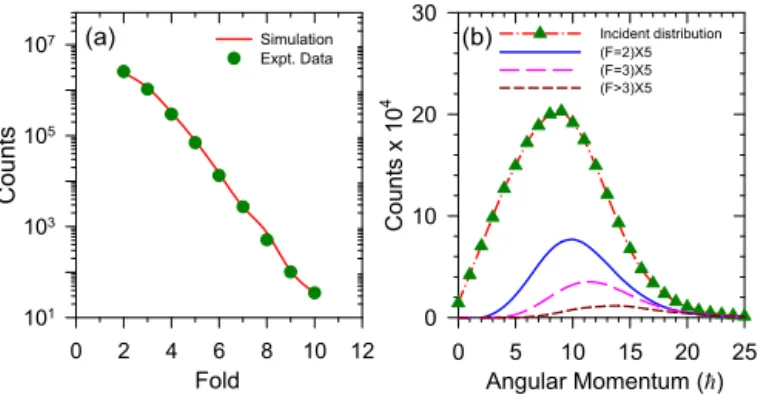
measured fold distribution (number ofmultiplicity detectorfired in each event) by using the geant simulations. A detailed
simu-lation was necessary to account forthe data recordingcondition (top–bottom coincidence), whichselects aslightly higherangular momentumspace. A triangulardistributionof
γ
-raymultiplicitieswas thrown with an adjustable peak and a width, which were
determined by comparing the measured and simulated fold
dis-tributions. TheseareshowninFig.1along withtheincidentand different fold-gatedangular momentum distributions. The details ofthistechniquearedescribedinRef. [67].Thesimulatedangular momentum distributionswere thenincorporatedinthestatistical model code cascade [69]. As the isospin splitting is crucial for
GDR in light nuclei, thestatistical modelanalysiswas performed
by using a version of the cascade code, which was modified to
us-Fig. 1.(a) Experimental(greensymbols)andsimulated(redline)folddistributions for31P populatedatinitialexcitationenergyof46.2 MeV.(b) Incidentanddifferent fold-gatedangularmomentumdistributions.(Forinterpretationofthecolorsinthe figure(s),thereaderisreferredtothewebversionofthisarticle.)
Fig. 2.Variationofa1(Eγ)withtheγ rayenergy.Thegreensolidcirclesare ex-perimentally determined,whilethe redsolid lineis theoretically calculatedfor
E0=5.3 MeV.
ingthereciprocityrelationassumingaLorentzianphotoabsorption crosssectionintheinversechannelgivenby
σ
abs(
Eγ)
=
4
π
e2h¯
mpcN Z A SG
GEγ2
(
E2γ
−
E2G)
2+
2GE2γ
,
(1)where N and Z are the neutronand protonnumbers and mp is
theprotonmass.SG, EG,and
G aretheGDRfractionoftotal
en-ergyweighteddipolesumrule,theenergyandthewidth, respec-tively.The variation of EG along thedecay cascadewas properly
takencare of.The GDR parameters were extractedby comparing themeasured high-energy
γ
rays withthe statistical model cal-culationsalongwithabremsstrahlungcomponentparametrizedasσ
=
σ
0exp(
−
Eγ/
E0)
andfoldedwiththeresponsefunctionoftheLAMBDA array. At Ebeam
=
42 MeV the slope parameter E0 wasdetermined fromthe measured angular distribution ofthe high-energy
γ
rays,whichisslightlyforwardpeakedintheCM frame because of the non-statistical bremsstrahlung component. In the CMframetheγ
rayangulardistributionwasassumedtohavethe formW(
Eγ,
θ )
=
W0(
Eγ)
[
1+
a1(
Eγ)
P1(
cosθ )
+
a2(
Eγ)
P2(
cosθ )
]
.Inthenucleon–nucleonframeofreferencethebremsstrahlungwas assumedto be isotropic and the slope parameter E0 was
deter-minedbycomparingthemeasuredandcalculateda1
(
Eγ)
(Fig.2).Theextractedslope parameters were roughlyconsistent withthe systematics E0
=
1.
1[
(
Ebeam−
Vc)/
Ap]
0.72,with Vc and Ap beingtheCoulombbarrierandprojectilemass,respectively[70].Atother beam energies, E0 was guided by this prescription and the
vi-sualinspectionofmeasured
γ
raysabove Eγ∼
25 MeV.Itshouldbeemphasized herethat themainingredient ofstatisticalmodel calculations is the NLD, which was properly determined in the
Fig. 3.Differentfold-gated high-energyγ rayspectra(left panel)and the evap-oratedneutronenergyspectra(rightpanel)for31P.Thegreensolidsymbolsare experimentallymeasuredspectra,whiletheredsolidlinesarethecorresponding resultsofthestatisticalmodelcalculations.
present study. In the cascade code, the level density was taken
basedonFermigasmodelgivenas
ρ
(
E∗,
J)
=
2J+
1 12 3/2√
aexp
(
2√
aU
)
U2
,
(2)where
=
(
1+
δ
1J2+
δ
2J4)
is the deformable liquid dropmoment of inertia;
=
2Ir/
h¯
2, Ir=
2/
5M R2 is the rigid bodymoment of inertia and
δ
1,δ
2 are the deformability coefficients.The quantity U
=
E∗−
−
Erot is the intrinsic excitationen-ergy with
and Erot
=
J(
J+
1)/
being the pairing andro-tational energies, respectively. The parameter a is the NLD pa-rameter, which is proportional to the single particle density of states at the Fermi surface. According to the prescription by Ig-natyuk andReisdorf [71,72], the NLD parameter is givenas a
=
˜
a
(
A)
[
1+
US{
1−
exp(
−
γ
U)
}]
. Following Ref. [55], in which, the authors performed a detailed studyof NLD in light-mass nuclei, theasymptoticNLDparameterwas takenasa˜
(
A)
=
0.
04543r30A+
0
.
1246r2 0A2
3
+
0.
1523r0A 13.Thenumericalco-efficientsforthe
sur-face andcurvature terms are slightly different from those given by Reisdorf [72]. The shell damping factor
γ
is 0.
054 MeV−1 [73] and the ground-stateshell correctionS is
−
2.
23 MeV.As˜
a depends onboth temperature andangular momentum [73,74],
it was determined by varying the r0 parameter to match the
measured neutron spectra.It should be emphasized that a given fold-gated high-energy
γ
andneutron spectra were analyzedsi-multaneously so that theGDR and theNLD parameters could be
determinedin aconsistentway.The best-fitparameterswere ex-tracted by using the
χ
2 minimization technique. The measuredγ
and neutron spectra along with the best-fit statistical model calculationsare shownin Fig.3. In order to emphasizethe GDR region, the linearized spectra are shown in Fig. 4 by using the quantityσ
absexp(
Eγ)
=
σ
abs(
Eγ)
Yexp(
Eγ)/
Ycal(
Eγ)
, where Yexp(
Eγ)
andYcal
(
Eγ
)
arethe experimentalandthebest-fitcascadespec-tra, whereas
σ
abs(
Eγ)
is the Lorentzian absorption cross sectionFig. 4.Differentfold-gatedlinearizedγrayspectrafor31P.Thegreensolidsymbols areexperimentallymeasuredσabsexp(Eγ)(seethetext),whiletheredsolidlinesare thecorrespondingLorentzianshavingtheGDRparametersasshowninTable1.
whereU
=
E∗−
Erot−
EG−
.Weremarkherethat,31P beinga
lightnucleus,theGDRdecayispredominantlyfromtheCNandthe averagingover thedecay cascadereducesthetemperatureatthe highestinitialexcitation energyby only 2%,which iswell within theexperimentalerrorsestimatedconsideringtheuncertaintiesin NLDparameter, J,andEG.
ItisinterestingtonotethattheGDRbuiltontheexcitedstates of 31P fully exhausts the dipole strength, i.e. the GDR remains verymuchcollectiveinthislightnucleus.Moreover,theenergyof theGDR, exceptatthelowesttemperature, remains roughly con-stant ataround 17.5 MeV. The slightlyhighervalue of EG atthe
lowest temperature is due to a bit higher value of the NLD pa-rameterrequiredforfittingtheneutronevaporationspectrum.We remarkherethat,themeasured GDRenergies arelower thanthe ground-statevalue of19.3 MeV obtainedby fittingthemeasured photoabsorption cross section with a single Lorentzian [75]. The GDRwidth,ontheotherhand,remainsroughlyconstantataround 7.5 MeVupto T
∼
1.
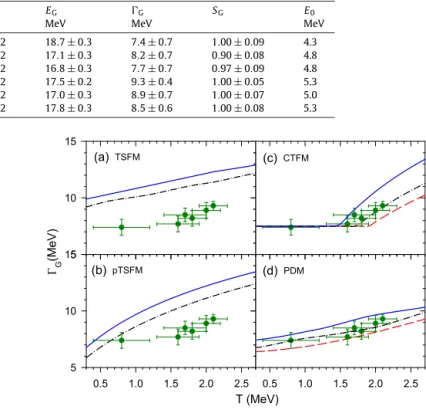
6 MeV andgraduallyincreaseswithT there-after.In Fig. 5 the measured GDR widths are compared with the
results of calculations within different models and plotted as a
function of T. As the measured angular momentum varies from
11
.
0–15.
9¯
h, the calculations have been performed for J=
11.
5 and15.
5h¯
.Moreover,theresultsofcalculationswithintheCTFMand PDM have also been shown for J
=
0 h¯
to visualize theFig. 5.ComparisonofthemeasuredGDRwidthwithpredictionsbydifferentmodels asafunctionofT at J=11.5h¯(blackdot-dashedline)and J=15.5h¯(bluesolid line)(measuredrangeofangularmomentum).Theredlong-dashedlinesinpanels (c)and(d)arethepredictionsat J=0h¯.
explicit T dependence. Within the TSFM (Fig. 5a), the GDR
ap-parent line shape at a given T and J was calculated as the
weighted averageofthevariouslineshapescorrespondingto dif-ferentnucleardeformations;theweightbeingtheBoltzmann fac-torexp
(
−
F(β,
γ
,
J)/
T)
,whereβ
,γ
are thedeformation param-eters. The free energy F was calculatedconsidering only the de-formedliquiddropenergyas31P isanopen-shellnucleusandtheeffect of the shell correction is expected to be negligible above
T
∼
1.
5 MeV [76]. It is obvious from Fig. 5a that the results of TSFM calculations overpredict the measured widths. As can also beseenfromFig.5b,thephenomenologicalthermalshape fluctu-ation model(pTSFM) [31] failstoreproducethemeasuredwidths even afterassumingtheground-statewidthof∼
3.
8 MeV, which wastakenforboth120Sn and208Pb todescribethewidthsinthesemassregionsinRef. [31].Interestingly,theTSFMandpTSFMcould describe themeasuredwidthabove T
∼
1.
5 MeV inmediumand heavy massnuclei. However, in the light massregion, these two models arenot ableto describethe measuredwidths evenup toT
∼
2.
1 MeV.In Fig. 5c the CTFM calculations are presented. Within this model,theGDRwidthremainsconstantattheground-statevalue uptoacriticaltemperatureTc
=
0.
7+
37.
5/
A duetotheGDRin-ducedfluctuationandincreasesthereafter.Inthesecalculationsthe ground-stateGDRwidth(
gs)for31P wastakenas7.5 MeV,which
is abit higherthan thevalue of 6.3 MeVobtainedby fittingthe measured photoabsorption crosssection witha single Lorentzian [75].However,theviscoushydrodynamicmodelofAuerbachet al. [77] yields
gs
=
7.
5 MeV andthemeasureddatawell belowthecritical temperature are also around this value. Hence
gs was
takenas7.5 MeV.Interestingly,theCTFMreproducesthetrendof measured GDRwidthsquitewellwith Tc of
∼
1.
9 MeV predictedFig. 6.(a)Protonand(b)neutronpairinggapsasfunctionsoftemperatureat differ-entangularmomentacalculatedwithinBCSandBCS1(seetext).
J increasestheGDRwidthfromtheground-statevaluebeforethe criticaltemperature.
ThemeasuredGDRwidthsarecomparedwiththeresultsofthe microscopicPDMcalculationsperformedasafunctionof T and J
withoutthe inclusion of thermal pairing (Fig. 5d). Regarding the latter,thecalculationswithintheBCStheory aswellastheBCS1 one,whichincludesthequasiparticlenumberfluctuation,atfinite
T and J [78] werecarriedout.Theparameters GZ forprotonand GN forneutron pairing interactions were chosen so thatthe
val-uesofthe correspondingpairing gaps (
Z and
N) atT
=
0 are2.3 MeVand1.85 MeV,respectively,basedontheodd–evenmass differences.TheresultsofcalculationsshowthatincreasingT and
J breaksthepairssothatnopairinggapsremainatT
>
0.
25 MeV and J>
11.
5h¯
(Fig. 6).Thisallows ustocarry out thePDM cal-culationswithoutthermalpairing.The single-particleenergiesfor protonsandneutronswerecalculatedwithinthedeformedWood– Saxonpotentialswithβ
=
0.
1 obtainedbyfittingthe photoabsorp-tion cross section using the prescription of Junghans et al. [79]. Thetwoparameters F1 andF2 forthecouplingoftheGDRtothenon-collectivephandpp(orhh)configurations,respectively,were chosensothatthewidthoftheGDRobtainedatT
=
0 and J=
0h¯
is equalto around 6.3 MeV (the experimental ground-state GDR width),whereasitsvalueatT
=
0.
8 MeV and J=
11.
5h¯
matches thecorrespondingexperimentaldatapoint.Thevaluesofthese pa-rametersarekept unchangedthroughoutthecalculationsatall Tand J. The GDR energy at J
=
0¯
h is set equal to ground-state valueof19.3 MeV,whereasat J=
0h¯
itis18.0 MeVcomparable totheexperimentalvalues.Astheagreementbetweentheoryand experimentis fairly good,it could be inferred that, pairing plays noroleinthepresentlightnucleus,leavingonlytheeffectof an-gularmomentumontheGDRwidthinit.Itshouldbehighlighted here,thatbothCTFMandthePDM coulddescribetheGDRwidth asa functionofT and J formediumandheavy massnucleiand presentworkpointstowardstheuniversalityofthesemodels.Insummary,anexclusive,systematicmeasurementoftheGDR
parameters has been performed using the light-ion
α
beam invery light-mass nucleus 31P. The angular momentum of the CN
hasbeenpreciselydeterminedbymeasuringthelow-energy
γ
-ray multiplicities.The GDR,nuclear leveldensityparameters and nu-clear temperatures have been accurately determined from a si-multaneousstatisticalmodelanalysisofthemeasuredhigh-energyγ
spectra andthe neutron spectra.The experimentally extracted widthsremains roughly constantup to 1.6 MeVtemperatureand graduallyincreasesthereafter. Themeasured widthscould bede-scribed very well within the CTFM and PDM, thereby asserting
their universality in describing GDR widthas a function of
tem-perature andangular momentum. Moreover, the paring gaps are
found tovanish inthe ranges of T and J considered inthis ex-periment, therefore,have no effect on the measured GDR width contrarytothatobservedinmediumandheavyopen-shellnuclei.
Acknowledgements
The authors are thankful to VECC cyclotron staffs for smooth
running of the accelerator during the experiment. The
PDM-related calculations were performed on the RIKEN
HOKUSAI-GreatWave Systemandsupportedby theVietnam National
Foun-dation forScience and Technology Developmentunder the Grant No. 103.04-2017.69.
References
[1]M.N. Harakeh, A. van der Would, Giant Resonances: Fundamental High-FrequencyModeofNuclearExcitation,ClarendonPress,Oxford,2001. [2]P.F.Bortignon,A.Bracco,R.A.Broglia,GiantResonances:NuclearStructureat
FiniteTemperature,HarwoodAcademicPublishers,Amsterdam,1998. [3]J.J.Gaardhøje,etal.,Phys.Rev.Lett.53(1984)148.
[4]C.A.Gossett,etal.,Phys.Rev.Lett.54(1985)1486. [5]D.R.Chakrabarty,etal.,Phys.Rev.Lett.58(1987)1092. [6]A.Stolk,etal.,Phys.Rev.C40(1989)R2454. [7]J.H.Gundlach,etal.,Phys.Rev.Lett.65(1990)2523. [8]R.F.Noorman,etal.,Phys.Lett.B292(1992)257. [9]J.P.S.vanSchagen,etal.,Phys.Lett.B308(1993)231. [10]DeepakPandit,etal.,Phys.Rev.C87(2013)044325. [11]M.Thoennessen,etal.,Phys.Rev.Lett.59(1987)2860. [12]P.Paul,etal.,Annu.Rev.Nucl.Part.Sci.44(1994)65. [13]I.Diószegi,etal.,Phys.Rev.C63(2000)014611. [14]M.N.Harakeh,etal.,Phys.Lett.B176(1986)297. [15]J.A.Behr,etal.,Phys.Rev.Lett.70(1993)3201. [16]M.Kici ´nska-Habior,etal.,Nucl.Phys.A731(2004)138. [17]E.Wójcik,etal.,ActaPhys.Pol.B38(2007)1469. [18]A.Corsi,etal.,Phys.Rev.C84(2011)041304(R). [19]S.Ceruti,etal.,Phys.Rev.Lett.115(2015)222502. [20]DebasishMondal,etal.,Phys.Lett.B763(2016)422. [21]N.D.Dang,Phys.Rev.C84(2011)034309.
[22]DebasishMondal,etal.,Phys.Rev.Lett.118(2017)192501. [23]J.O.Newton,etal.,Phys.Rev.Lett.46(1981)1383. [24]K.A.Snover,Annu.Rev.Nucl.Part.Sci.36(1986)545. [25]J.J.Gaardhøje,Annu.Rev.Nucl.Part.Sci.42(1992)483. [26]A.Schiller,etal.,At.DataNucl.DataTables93(2007)549. [27]D.R.Chakrabarty,etal.,Eur.Phys.J.A52(2016)143. [28]E.Ramakrishnan,etal.,Phys.Rev.Lett.76(1996)2025. [29]T.Baumann,etal.,Nucl.Phys.A635(1998)428. [30]P.Heckman,etal.,Phys.Lett.B555(2003)43. [31]DimitriKusnezov,etal.,Phys.Rev.Lett.81(1998)542. [32]S.Mukhopadhyay,etal.,Phys.Lett.B709(2012)9. [33]DeepakPandit,etal.,Phys.Lett.B713(2012)434. [34]BalaramDey,etal.,Phys.Lett.B731(2014)92. [35]M.Gallardo,etal.,Phys.Lett.B191(1987)222. [36]J.M.Pacheco,etal.,Phys.Rev.Lett.61(1988)294. [37]Y.Alhassid,etal.,Phys.Rev.Lett.61(1988)1926. [38]O.E.Ormand,etal.,Phys.Rev.Lett.77(1996)607. [39]P.Arumugam,etal.,Phys.Rev.C69(2004)054313. [40]A.Bracco,etal.,Phys.Rev.Lett.62(1989)2080. [41]G.Enders,etal.,Phys.Rev.Lett.69(1992)249. [42]M.P.Kelly,etal.,Phys.Rev.Lett.82(1999)3404. [43]O.Wieland,etal.,Phys.Rev.Lett.97(2006)012501. [44]M.Ciemala,etal.,Phys.Rev.C91(2015)054313. [45]A.K.RhineKumar,etal.,Phys.Rev.C91(2015)044305. [46]N.D.Dang,etal.,Phys.Rev.Lett.80(1998)4145. [47]N.D.Dang,etal.,Nucl.Phys.A636(1998)427. [48]C.Ghosh,etal.,Phys.Rev.C94(2016)014318. [49]S.Ceruti,etal.,Phys.Rev.C95(2017)014312. [50]M.Kici ´nska-Habior,etal.,Phys.Rev.C36(1987)612. [51]G.Viesti,etal.,Phys.Rev.C40(1989)R1570. [52]M.Kici ´nska-Habior,etal.,Phys.Rev.C45(1992)569. [53]Z.M.Drebi,etal.,Phys.Rev.C52(1995)578. [54]S.K.Rathi,etal.,Phys.Rev.C67(2003)024603. [55]M.Kici ´nska-Habior,etal.,Phys.Rev.C41(1990)2075. [56]R.A.Eramzhyan,etal.,Phys.Rep.136(1986)229. [57]S.Fallieros,etal.,Nucl.Phys.A147(1970)593. [58]J.D.Vergados,Nucl.Phys.A239(1975)271.
[59]M.Kici ´nska-Habior,etal.,Phys.Lett.B308(1993)225. [60]A.Maj,etal.,Nucl.Phys.A731(2004)319.