Virtually everyone has rented something at one time or another. With renting, just like owning, you get to use the asset. What distinguishes renting or leasing from owning is that when you rent, you don’t actually obtain ownership of the thing being rented and must return it to the owner at the end of the agreement. ● Firms lease all types of capital equipment as an alternative to purchasing it. For example, they lease com-puters, trucks, and railroad cars. The U.S. Navy has even leased minesweepers. The total amount spent on leasing by U.S. companies now exceeds $400 billion annually. ● Why lease—why not pur-chase? Some companies lease because they think they can avoid investing in equip-ment that faces the risk of rapid obsolescence, whereas others think that they are conserving their cash. As we learn in this chapter, these and many other reasons for leasing are subject to quantitative analysis, which reduces the decision down to an analysis of the net present value of leasing versus owning.
LEARNING OBJECTIVES After reading this chapter, you should be able to 1. Describe the basic
charac-teristics of a term loan. 2. Calculate the principal
and interest components of an installment loan. 3. List and define the
basic types of lease arrangements.
4. Calculate the net advan-tage of leasing versus purchasing an asset. 5. Describe the potential
sources of economic ben-efit derived from leasing versus purchasing.
TERM LOANS
Term loansgenerally share three common characteristics: They (1) have maturities of 1 to 10 years; (2) are repaid in periodic installments (such as quarterly, semiannual, or annual payments) over the life of the loan; and (3) are usually secured by a chattel mortgage on equipment or a mortgage on real property. The principal suppliers of term credit are com-mercial banks, insurance companies, and (to a lesser extent) pension funds.
We will consider briefly some of the more common characteristics of term loan agreements.
Maturities
Commercial banks generally restrict their term lending to 1- to 5-year maturities. Insurance companies and pension funds with their longer-term liabilities generally make loans with 5- to 15-year maturities. Thus, the term lending activities of commercial banks actually complement rather than compete with those of insurance companies and pension funds. In fact, commercial banks very often cooperate with both insurance companies and pension funds in providing term financing for very large loans.
Collateral
Term loans are generally backed by some form of collateral. Shorter-maturity loans are frequently secured with a chattel mortgage(a mortgage on machinery and equipment) or with securities such as stocks and bonds. Longer-maturity loans are frequently secured by mortgages on real estate.
There is also a form of term credit that requires no collateral that can be used by only the largest blue-chip companies. These unsecured medium-term notes (MTNs) were cre-ated as a result of the introduction of shelf registration by the Securities and Exchange Commission in 1982. Shelf registration permits companies to file a single registration statement for a series of similar issues. Once registered, the MTNs can be sold as funds are required, giving the issuer a ready source of term financing. The key thing to recognize here is that unsecured term financing, like similar forms of unsecured short-term financing (e.g., commercial paper) is available to only the most creditworthy borrowers.
Chapter 24 contains a discussion of two sources of intermediate term financing: term loans and leases. Intermediate term financing consists of all those sources of financing with maturi-ties longer than 1 year and shorter than 10 years. This maturity range is bracketed by short-term sources of financing such as bank notes, trade credit, and commercial paper (discussed in Chapter 18) and long-term sources of financing
such as bonds and stock (discussed in Chapters 7, 8, and 14).
Our discussion of term loans, an important source of financ-ing for machinery and equipment, will focus on the various
sources of term financingand their basic characteristics as well as the calculation of installment payments(including the decomposi-tion of those payments into their principal and interest compo-nents). We then categorize leases as operatingor financial leases
and focus on the latter, because operating leases are short-term in nature. We evaluate the merits of leasing versus purchasingby first evaluating the viability of purchasing via the project’s net present value and then analyzing the incremental benefits of leas-ing by calculatleas-ing the net advantage of leasing.
This chapter will emphasize these principles:Principle 1: The Risk-Return Trade-Off—We won’t take on additional risk unless we expect to be compensated with additional return; Principle 2: The Time Value of Money—A dollar received today is worth more than a dollar received in the future; Principle 3: Cash—Not Profits—Is King; Principle 4: Incremental Cash Flows—It’s only what changes that counts; and Principle 8: Taxes Bias Business Decisions.
C H A P T E R P R E V I E W
Term loans
Loans that have maturities of 1 to 10 years and are repaid in periodic installments over the life of the loan; usually secured by a chattel mortgage on equipment or a mortgage on real property. O B J E C T I V E 1
Restrictive Covenants
In addition to requiring collateral, the lender in a term loan agreement often places restric-tions on the borrower that, when violated, make the loan immediately due and payable. These restrictive covenants are designed to prohibit the borrower from engaging in any activities that would increase the likelihood of loss on the loan. There are some common restrictions:
1. Working-capital requirement.This restriction takes the form of a minimum current ratio, such as 2 to 1 or 31⁄
2to 1, or a minimum dollar amount of net working capital. The actual requirement would reflect the norm for the borrower’s industry, as well as the lender’s desires.
2. Additional borrowing.This type of restriction requires the lender’s approval before any additional debt can be issued. Furthermore, a restriction on additional borrowing is often extended to long-term lease agreements, which are discussed later in this chapter.
3. Periodic financial statements.A standard covenant in most term loan agreements includes a requirement that the borrower supply the lender with financial statements on a regular basis. These generally include annual or quarterly income statements and balance sheets.
4. Management.Term loan agreements sometimes include a provision that requires prior approval by the lender of major personnel changes. In addition, the borrower may be required to insure the lives of certain key personnel, naming the lender as beneficiary.
We have presented only a partial listing of restrictions commonly found in term loan agreements. The number and form of such provisions are limited only by the scope of the law and the imagination of the parties involved. It should be noted, however, that restrictive covenants are subject to negotiation. The specific agreement that results reflects the relative bargaining strengths of the borrower and lender. Marginal borrowers are more likely to find their loan agreements burdened with restrictive covenants than more creditworthy borrowers.
Term loan agreements can be very technical and are generally tailored to the situation. Therefore, it is difficult to generalize about their content. However, many banks rely on standardized worksheetsor checksheetsto aid in the preparation of the document.
When we determine the loan payments for an installment loan, we are solving for a series of annuity payments (installment or loan payments) whose present value equals the face value of the loan when discounted using the borrowing rate on the loan. Thus, we are valuing a series of future cash flows. The valuation process uti-lizes a number of our Principles:Principle 1: The Risk-Return Trade-Off—We won’t take on additional risk unless we expect to be compensated with addi-tional returncomes into play in determining the rate of interest for the loan. Principle 2: The Time Value of Money—A dollar received today is worth more than a dollar received in the futureprovides the basis for finding the pres-ent value of future paympres-ents. Finally,Principle 3: Cash—Not Profits—Is King tells us that what matters to both the lender and borrower is the cash received and cash paid.
Loan Participations among Banks
The demand for loans is not evenly dispersed across banks; heavier demand is placed on large money center banks and banks in regions of the country that are experiencing strong economic growth. This frequently means that these banks cannot provide all the necessary funds, so they share the loan demand with one or more participating banks. This shared lending has grown rapidly in recent years and has served to promote the flow of funds from banks with excess lending capacity to those with excess loan demand. The participating banks work out an agreement and receive a certificate of participation, which states that the lead bank will pay a portion of the loan cash flows as they are received.
Eurodollar Loans
Eurodollar loansare intermediate term loans made by major international banks to busi-nesses based on foreign deposits that are denominated in dollars. These loans are generally made in amounts ranging from $1 million to $1.5 billion with the rate based on a certain amount above the London Interbank Offered Rate (LIBOR). The rate on these loans is adjusted periodically (generally every 6 months), and there is a wide range of maturities. Eurodollar lending has become a major source of commercial lending with the total vol-ume of lending being measured in trillions of dollars.
The attraction of the Eurodollar market relates to the fact that this market is subject to very limited official regulation. It has been suggested, in fact, that some investors use the market to avoid home country taxes. For example, Eurobonds (which are long-term bonds sold outside the country in whose currency the bond is denominated) are sold in bearer rather than registered form. This means that there is no record of who owns the bonds and receives the interest payments.
Eurodollar loans
Intermediate term loans made by major international banks to businesses based on foreign deposits that are denominated in dollars.
1. How is a term loan distinguished from other forms of financing?
2. What are the common types of restrictions placed on borrowers when using term loans?
LOAN PAYMENT CALCULATION
Repayment Schedules
Term loans are generally repaid with periodic installments, which include both an interest and a principal component. Thus, the loan is repaid over its life with equal annual, semian-nual, or quarterly payments.
To illustrate how the repayment procedure works, let us assume that a firm borrows $15,000, which is to be repaid in five annual installments. The loan will carry an 8 percent rate of interest, and payments will be made at the end of each of the next 5 years. The fol-lowing diagram shows the cash flows to the lender:
Year
0 1 2 3 4 5
$(15,000) A1 A2 A3 A4 A5
O B J E C T I V E 3
The $15,000 cash flow at period zero is placed in parentheses to indicate an outflow of cash by the lender, whereas the annual installments, A1through A5, represent cash inflows (of course, the opposite is true for the borrower). The lender must determine the annual installments that will give an 8 percent return on the outstanding balance over the life of the loan. This problem is very similar to the internal rate of return problem encountered in Chapter 9, where we discussed capital-budgeting decisions and had to determine the rate of interest that would make the present value of a stream of future cash flows equal to some present sum. Here we want to determine the future cash flows whose present value, when discounted at 8 percent, is equal to the $15,000 loan amount. Thus, we must solve for those values of A1through A5whose present value when discounted at 8 percent is $15,000. In equation form,
(24-1)
Where we assume equal annual installments,A,for all 5 years, we can solve for Aas follows:
or
(24-2)
The term that is divided into that $15,000 loan amount is the present value factor for a 5-year annuity carrying an 8 percent rate of interest. Thus,
Therefore, if the borrower makes payments of $3,756.57 each year, then the lender will receive an 8 percent return on the outstanding loan balance. To verify this assertion, check Table 24-1, which contains the principal and interest components of the annual loan pay-ments. We see that the $3,756.57 installments truly provide the lender with an 8 percent return on the outstanding balance of a $15,000 loan.
A = $15,000 3.993 = $3,756.57 A = $15,000 a 5 t=1 1 (1 + .08)t = $15,000 PVIF8%, 5 yrs $15,000 = Aa 5 t=1 1 (1 + .08)t $15,000 = a 5 t=1 At (1 + .08)t
1. What factors does a lender use to calculate the installment payments for a loan? 2. How is loan payment calculation similar to the internal rate of return
calcula-tion for a capital-budgeting project?
LEASES
Leasing provides an alternative to buying an asset to acquire its services. Although some leases involve maturities of more than 10 years, most do not. Thus, lease financing is clas-sified as a source of intermediate term credit. Today, virtually any type of asset can be acquired through a lease agreement. The recent growth in lease financing has been phe-nomenal, with more than $200 billion in assets (based on original cost) now under lease in the United States.
A leaseis simply a contract between a lessee,who acquires the services of a leased asset by making a series of payments to the lessor,who is the owner of the asset. The con-tract provides the lessee with the right to use the asset for the term of the lease agreement; at the end of the term of the lease, the lessee must return the asset to the lessor. However, leases frequently contain an option for the lessee to purchase the asset at the termination of the lease agreement. Lessees can be just about anyone (an individual, a business, or a gov-ernment agency). Lessors are generally the manufacturer of the leased asset or an inde-pendent leasing company.
The primary difference between leasing and buying an asset relates to the rights that transfer to the lessee versus the owner. The lessee obtains the right to use the asset up until the term of the agreement. The owner, on the other hand, receives both the right to use the asset and the title to the asset so that, when he or she decides to sell, the owner can dispose of the asset and realize the proceeds from its sale.
Types of Lease Arrangements
There are three major types of lease agreements: direct leasing, sale and leaseback, and leveraged leasing. Most lease agreements fall into one of these categories. However, the particular lease agreement can take one of two forms. (1) The financial leaseconstitutes a noncancelable contractual commitment on the part of the firm leasing the asset (the lessee) to make a series of payments to the firm that actually owns the asset (the lessor) for use of the asset. (2) The operating lease differs from the financial lease only with respect to its cancelability. An operating lease can be canceled after proper notice to the lessor any time during its term. Thus, operating leases are by their very nature sources of short-term financing. The balance of this chapter is concerned with the financial lease, which provides the firm with a form of intermediate-term financing most comparable with debt financing.
TABLE 24-1
Term Loan Amortization Schedule
End of Installment Principal Remaining
Year Paymenta Interestb Repaymentc Balanced
t A It Pt RBt 0 — — — $15,000.00 1 $3,756.57 $1,200.00 $2,556.57 12,433.43 2 3,756.57 995.47 2,761.10 9,682.33 3 3,756.57 774.59 2,981.98 6,700.35 4 3,756.57 536.03 3,220.54 3,479.81 5 3,756.57 278.38 3,478.19 1.62e
aThe annual installment payment. A,is found as follows:
bAnnual interest expense is equal to 8 percent of the outstanding loan balance. Thus, for year 1, the interest expense,I t, is found
as follows:
It.08($15,000) $1,200
cPrincipal repayment for year t, P
t, is the difference in the loan payment,A,and interest for the year. Thus, for year 1, we compute PtAI1,$3,756.57 $1,200 $2,556.57
dThe remaining balance of the end of year 1,RB
1is the difference in the remaining balance for the previous year,RB0and the
principal payment in year 1,P1. Thus, at the end of year 1,
RB1RB0P1$15,000 $2,556.57 $12,443.43
eThe $1.62 difference in RB
4and P5is due to rounding error. A= $15,000 a 5 t=1 1 (1+.08)t =$3,756.57 Lease
A contract between a lessee, who acquires the services of a leased asset by making a series of rental payments to the lessor, who is the owner of the asset. Lessee and lessor
The user of the leased asset, who agrees to make periodic lease or rental payments to the lessor, who owns the asset.
Financial lease
A noncancelable contractual commitment on the part of the firm leasing the asset (the lessee) to make a series of payments to the firm that actually owns the asset (the lessor) for use of the asset.
Operating lease
A lease agreement (see financial lease) in which the lessee can cancel the agreement at any time giving proper notice to the lessor.
In the jargon of the leasing industry, a financial lease can take one of two basic forms: a net leaseor a net-net lease.In a net lease agreement, the lessee firm assumes the risk and burden of ownership over the term of the lease. That is, the lessee must maintain the asset, as well as pay insurance and taxes on the asset. A net-net lease requires that the lessee meet all the requirements of the net lease as well as return the asset, still worth a preestablished value,to the lessor at the end of the lease term.
Direct Leasing
In a direct lease,the firm acquires the services of an asset it did not previously own. Direct leasing is available through several financial institutions, including manufacturers, banks, finance companies, independent leasing companies, and special-purpose leasing compa-nies.1In the lease arrangement, the lessor purchases the asset and leases it to the lessee. In the case of a manufacturer lessor, however, the lessor has already produced the asset.
Sale and Leaseback
A sale and leaseback arrangementarises when a firm sells land, buildings, or equipment that it already owns to a lessor and simultaneously enters into an agreement to lease the property back for a specified period under specific terms. The lessor involved in the sale and leaseback varies with the nature of the property involved and the lease period. When land is involved and the corresponding lease is long term, the lessor is generally a life insurance company. If the property consists of machinery and equipment, then the maturity of the lease will probably be intermediate term, and the lessor could be an insurance com-pany, commercial bank, or leasing company.
The lessee firm receives cash in the amount of the sales price of the assets sold and the use of the asset over the term of the lease. In return, the lessee must make periodic rental payments through the term of the lease and give up any salvage or residual value to the lessor.
Leveraged Leasing
In the leasing arrangements discussed thus far, only two participants have been identified: the lessor and lessee. In leveraged leasing, a third participant is added: the lender, who helps finance the acquisition of the asset to be leased. From the viewpoint of the lessee, there is no difference in a leveraged lease, direct lease, or sale and leaseback arrangement. However, with a leveraged lease, the method of financing used by the lessor in acquiring the asset receives specific consideration. The lessor generally supplies equity funds up to 20 to 30 percent of the purchase price and borrows the remainder from a third-party lender, which may be a commercial bank or an insurance company. In some arrangements, the les-sor firm sells bonds, which are guaranteed by the lessee. This guarantee serves to reduce the risk and thus the cost of the debt. The majority of financial leases are leveraged leases.
Leases and Financial Reporting
Any lease that meets one or more of the following criteria is a capital leaseand must be included in the body of the balance sheet of the lessee according to the Financial Accounting Standards Board (FASB). All other lease agreements are classified as operat-ing leasesfor accounting purposes. In a capital lease:
1Many leasing companies specialize in the leasing of a single type of asset. For example, several firms lease computers
exclu-sively, and others lease only automobiles.
Net and net-net leases In a net lease agreement, the les-see assumes the risk and burden of ownership over the term of the lease. This means that the lessee must pay insurance and taxes on the asset as well as maintain the operating condition of the asset. In a net-net lease, the lessee must, in addition to the requirements of a net lease, return the asset to the lessor at the end of the lease still worth a preestablished value.
Sale and leaseback arrangement
An arrangement arising when a firm sells land, buildings, or equipment that it already owns and simultaneously enters into an agreement to lease the prop-erty back for a specified period under specific terms.
1. The lease transfers ownership of the property to the lessee by the end of the lease term. 2. The lease contains a bargain repurchase option.
3. The lease term is equal to 75 percent or more of the estimated economic life of the leased property.
4. The present value of the minimum lease payments equals or exceeds 90 percent of the excess of the fair value of the property over any related investment tax credit retained by the lessor.
The last two requirements are the most stringent elements in the board’s statement. The first two have been applicable to most leases for many years because of the Internal Revenue Service’s “true” lease requirements. However, the last two apply to most financial leases written in the United States. As a result, the board now requires capitalization of all leases meeting one or more of these criteria.
Table 24-2 is a sample balance sheet for the Alpha Manufacturing Company. Alpha has entered into capital leases whose payments have a present value of $4 million.
Note that the asset “leased property” is matched by a liability, “capital lease obliga-tions.” The specific entries recorded for the lease obligations equal the present value of minimum lease payments the firm must pay over the term of the lease. The discount rate used is the lower of either the lessee’s incremental borrowing rate or the lessor’s implicit interest rate (where that rate can be determined).
Operating leases are not disclosed in the body of the balance sheet. Instead, these lease obligations must be reported in a footnote to the balance sheet.
The Lease-versus-Purchase Decision
The lease-versus-purchase decision is a hybrid capital-budgeting problem that forces the analyst to consider the consequences of alternative forms of financing on the investment decision. When we discussed capital budgeting in Chapter 9 and the cost of capital in Chapter 12, we assumed that all new financing would be undertaken in accordance with the firm’s optimal capital structure. When analyzing an asset that is to be leased, the analysis must be altered to consider financing through leasing as opposed to the use of the more traditional debt and equity sources of funds. Thus, the lease-versus-purchase decision requires a standard capital-budgeting type of analysis, as well as an analysis of two alternative financing packages.The lease-purchase decision involves the analysis of two basic issues:
1. Should the asset be purchased using the firm’s optimal financing mix? 2. Should the asset be financed using a financial lease?
TABLE 24-2
Alpha Manufacturing Company Balance Sheet, December 31, 2000 (Millions of Dollars)
Assets 2000
Current assets $14
Plant and equipment 20
Leased property (capital leases) ___4
Total $38______
Liabllities and stockholders’ equity
Current liabilities $ 8
Long-term debt 9
Capital lease obligations 4
Stockholders’ equity ___17
The answer to the first question can be obtained through an analysis of the project’s
NPV, following the method laid out in Chapter 9. There are times when it might be advan-tageous to lease an asset, even when the NPVfor its purchase is negative. The cost savings of a lease may more than offset the negative NPV of purchase. For example, the Alpha Manufacturing Co. is considering the acquisition of a new computer-based inventory and payroll system. The computed net present value of the new system based on normal pur-chase financing is $40, indicating that acquisition of the system through purchasing or ownership is not warranted. However, an analysis of the cost savings resulting from leasing the system (referred to here as the net advantage of leasing, or NAL) indicates that the lease alternative will produce a present value cost saving of $60 over normal purchase financing. Therefore, the net present value of the system if leased is $20 (the net present value if leased equals the NPVof a purchase plusthe net advantage of leasing, or $40 $60). Thus, the system’s services should be acquired via the lease agreement.
The Lease-Purchase Algorithm
Figure 24-1 contains a flow chart that can be used in performing lease-purchase analyses. The analyst first calculates the net present value of purchasing,NPV(P).If the project’s net present value is positive, then the left branch of Figure 24-1 should be followed. Tracing through the left branch, we now compute NAL. If NAL is positive, the lease alternative offers a positive present-value cost advantage over normal purchase financing, and the asset should be leased. Should NALbe negative, then the purchase alternative should be selected. If NPV(P)is negative, then return to the top of Figure 24-1 and go to the right side of the flow chart. The only hope for the project’s acceptance at this point is a favorable set of lease terms. In this circumstance, the project would be acceptable and thus leased only
if NALwere large enough to offset the negative NPV(P)[that is, where NALwas greater than the absolute value of NPV(P)or, equivalently, where NALNPV(P)0].2
1. Define a leaseand identify the participants. What are the principal differences between asset ownership and asset leasing?
2. How does an operating lease differ from a financial lease? 3. Describe the three major types of lease agreements.
4. What requirements has FASB established for reporting leases on a firm’s financial statements?
2That is,NAL NPV(L) NPV(P), where NPV(L)is the net present value of the asset if leased. Thus, the sum of NPV(P)and NALis the net present value of the asset if leased.
A primary motivating factor behind leasing is the opportunity to transfer the tax consequences of ownership (i.e., interest and depreciation expense) from a firm that is either not currently paying taxes because of prior year losses or is paying them at a very low rate to another firm (the lessor), who is paying taxes at a much higher rate. This is a direct application of Principle 8: Taxes Bias Business Decisions.
The lease-versus-purchase problem is analyzed using the equations 24-3 and 24-4 found in Table 24-3. The first equation is simply the net present value of purchasing the proposed project, discussed in Chapter 9. The second equation calculates the net present value advantage of leasing, or NAL. NAL represents an accumulation of the cash flows (both inflows and outflows) associated with leasing as opposedto purchas-ing the asset. Specifically, through leaspurchas-ing, the firm avoids certain operatpurchas-ing expenses,
Ot, but incurs the after-tax rental expense,Rt(1 T). By leasing, furthermore, the firm loses the tax-deductible expense associated with interest,TIt, and depreciation,T Dt. Finally, the firm does not receive the salvage value from the asset, Vn, if it is leased, but it does not have to make the initial cash outlay to purchase the asset,IO. Thus, NAL reflects the cost savings associated with leasing, net of the opportunity costs of not purchasing.
Note that the after-tax cost of new debt is used to discount the NALcash flows other than the salvage value,Vn. This is justified because the affected cash flows are very nearly riskless and certainly no more risky than the interest and principal accruing to FIGURE 24-1
Lease-Purchase Analysis
Lease
Lease Compute NPV(P)
Compute NAL Compute NAL
Is NPV(P) ≥ 0?
Is NAL > 0? Yes
Yes
Lease the asset
Lease the asset Purchase the asset
No No Is NAL > 0? Is NAL + t) ≥ 0? Reject Yes No Yes No Reject
TABLE 24-3
Lease-Purchase Model Equation One—Net present value of purchase [NPV(P)]:
(24-3)
where ACFtthe annual after-tax cash flow in period tresulting from the asset’s purchase (note that ACFnalso includes any after-tax salvage value expected from the project).
Kthe firm’s cost of capital applicable to the project being analyzed and the particular mix of financing used to acquire the project.
IOthe initial cash outlay required to purchase the asset in period zero (now).
nthe productive life of the project. Equation Two—Net advantage of leasing (NAL):
(24-4) where Otany operating cash flows incurred in period tthat are incurred only when the asset is
purchased. Most often this consists of maintenance expenses and insurance that would be paid by the lessor.
Rtthe annual rental for period t.
Tthe marginal tax rate on corporate income.
Itthe tax-deductible interest expense forfeited in period tif the lease option is adopted. This represents the interest expense on a loan equal to the full purchase price of the asset being acquired.a
Dtdepreciation expense in period tfor the asset.
Vnthe after-tax salvage value of the asset expected in year n.
Ksthe discount rate used to find the present value of Vn. This rate should reflect the risk inherent in the estimated Vn. For simplicity the after-tax cost of capital (K) is often used as a proxy for this rate. Also, note that this rate is the same one used to dis-count the salvage value in NPV(P).
IOthe purchase price of the asset, which is not paid by the firm in the event the asset is leased.
rbthe after-tax rate of interest on borrowed funds (i.e.,rbr(1 T) where ris the before-tax borrowing rate for the firm). This rate is used to discount the relatively certain after-tax cash flow savings that accrue through the leasing of the asset. aThis analysis makes the implicit assumption that a dollar of lease financing is equivalent to a dollar of loan. This form of
equiv-alence is only one of several that might be used.
NAL = a n t=1 Ot(1 - T) - Rt(1 - T) - T* It - T * Dt (1 + r b)t Vn (1 + K s)n + IO NPV(P) = a n t=1 ACFt (1 + K)t - IO
the firm’s creditors (which underlie the rate of interest charged to the firm for its debt).3 Because Vnis not a risk-free cash flow but depends on the market price for the leased asset in year n, a rate higher than r is appropriate. Because the salvage value of the leased asset was discounted using the cost of capital when determining NPV(P), we use this rate here when calculating NAL.
3The argument for using the firm’s borrowing rate to discount these tax shelters goes as follows: The tax shields are relatively
free of risk in that their source (depreciation, interest, rental payments) can be estimated with a high degree of certainty. There are, however, two sources of uncertainty regarding these tax shelters: (1) the possibility of a change in the firm’s tax rate or the tax benefits of leasing, and (2) the possibility that the firm might become bankrupt at some future date. If we attach a very low probability to the likelihood of a reduction in the tax rate, then the prime risk associated with these tax shelters is the possibility of bankruptcy wherein they would be lost forever (certainly, all tax shelters after the date of bankruptcy would be lost). We now note that the firm’s creditors also faced the risk of the firm’s bankruptcy when they lent the firm funds at the rate r. If this rate r
reflects the market’s assessment of the firm’s bankruptcy potential as well as the time value of money, then it offers an appropri-ate rappropri-ate for discounting the interest shelters generappropri-ated by the firm. Note also that the Otcash flows are generally estimated with a high degree of certainty (in the case in which they represent insurance premiums they may be contractually set) such that ris appropriate as a discount rate here also. Of course,ris adjusted for taxes to discount the after-tax cash flows.
Case Problem in Lease-Purchase Analysis
The Waynesboro Plastic Molding Company (WPM) is now deciding whether to purchase an automatic casting machine. The machine will cost $15,000 and for tax purposes will be depreciated toward a zero salvage value over a 5-year period. However, at the end of 5 years, the machine actually has an expected salvage value of $2,100. Because the machine is depreciated toward a zero book value at the end of 5 years, the salvage value is fully tax-able at the firm’s marginal tax rate of 50 percent. Hence the after-tax salvage value of the machine is only $1,050.4The firm uses the simple straight-line depreciation method to depreciate the $15,000 asset toward a zero salvage value. Furthermore, the project is expected to generate annual cash revenues of $5,000 per year over the next 5 years (net of cash operating expenses but before depreciation and taxes). For projects of this type, WPM has a target debt ratio of 40 percent that is impounded in its after-tax cost-of-capital esti-mate of 12 percent. Finally, WPM can borrow funds at a before-tax rate of 8 percent. STEP 1: COMPUTING NPV(P)—Should the Asset Be Purchased?The first step in analyzing the lease-purchase problem involves computing the net present value under the purchase alternative. The relevant cash flow computations are presented in Table 24-4.
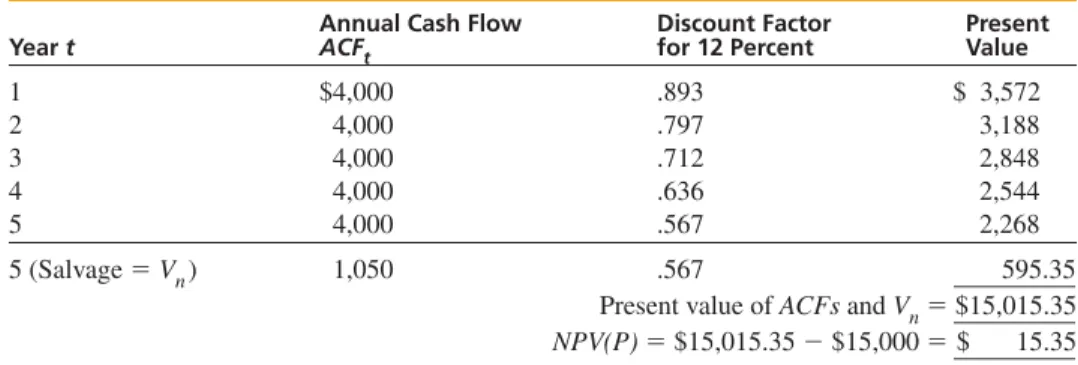
The NPV(P)is found by discounting the annual cash flows (ACFt) in Table 24-3 back to the present at the firm’s after-tax cost of capital of 12 percent, adding this sum to the present value of the salvage value, and subtracting the initial cash outlay. These calcula-tions are shown in Table 24-5. The project’s NPV(P)is a positive $15.35, indicating that the asset should be acquired.
The second question concerns whether the asset should be leased. This can be answered by considering the net advantage to leasing (NAL).
STEP 2: COMPUTING NAL—Should the Asset Be Leased?The computation of NALis shown in Table 24-6. The resulting NALis a negative $1,121, which indicates that leasing is not preferred to the normal debt-equity method of financing. In fact, WPM will be $1,121 worse off, in present value terms, if it chooses to lease rather than purchase the asset.
Calculating NALinvolves solving equation 24-4 presented earlier in Table 24-3. To do this, we first estimate all those cash flows that are to be discounted at the firm’s after-tax cost of debt,rb. These include Ot(1 T),Rt(1 T),ItT, and TDt.
The operating expenses associated with the asset that will be paid by the lessor if we lease—that is, the Ot—generally consist of certain maintenance expenses and insurance. WPM estimates them to be $1,000 per year over the life of the project. The annual rental or lease payments,Rt, are given and equal $4,200.
4The problem example is a modification of the example from R. W. Johnson and W. G. Lewellen, “Analysis of the Lease-or-Buy
Decision,”Journal of Finance27 (September 1972): 815–23.
TABLE 24-4
Computing Project Annual After-Tax Cash Flows (ACFt) Associated with Asset Purchase
Year
1 2
Book Cash Book Cash
Profits Flow Profits Flow
Annual cash revenues $ 5,000 $ 5,000 $ 5,000 $ 5,000
Less: depreciation ______(3,000) ______— ______(3,000) ______—
Net revenues before taxes $ 2,000 $ 5,000 $ 2,000 $ 5,000
Less: taxes (50%) ______(1,000)→ ______(1,000) ______(1,000)→ ______(1,000)
Year
3 4 5
Book Cash Book Cash Book Cash
Profits Flow Profits Flow Profits Flow
$ 5,000 $ 5,000 $ 5,000 $ 5,000 $ 5,000 $ 5,000 (3,000) — (3,000) — (3,000) — ______ ______ ______ ______ ______ ______ $ 2,000 $ 5,000 $ 2,000 $ 5,000 $ 2,000 $ 5,000 (1,000)→ (1,000) (1,000)→ (1,000) (1,000)→ (1,000) $ 4,000____________ $ 4,000____________ $ 4,000____________
The interest tax shelter lost because the asset is leased and not purchased must now be estimated. This tax shelter is lost because the firm does not borrow any money if it enters into the lease agreement. Table 24-1 contains the principal and interest components for a 5-year $15,000 loan. Note that the interest column supplies the needed information for the interest tax shelter that is lost if the asset is leased,It.5
Earlier when we computed NPV(P), we found this to equal $15.35. Because NPV(P)is positive, the purchase would increase shareholder wealth. Now, substituting the results of our calculations into equation 24-4 produces the NALof $1,121. Because NAL is nega-tive, the asset should not be leased.
Note that the lease payments used in this example were made at the end of each year. In practice, lease payments are generally made at the beginning of each year (that is, they constitute an annuity duerather than an ordinary annuity, as used here). The NALfor the example used here is even more negative if we assume beginning of year lease payments. That is, with beginning of year payments NAL $1,495. You can easily verify this result as follows: Note first that changing from a regular annuity to an annuity due affects only the first and last annuity payments. In this example, this means that the first lease payment of $2,100 (after tax) is paid immediately such that its present value is $2,100. However, the final lease payment is now made at the beginning of year 5 (or at the end of year 4). The present value of the fifth-year after-tax lease payment is therefore $2,100 .822 $1,726. To summarize, by changing from a regular annuity set of lease payments to an annuity due, we must include a $2,100 immediate cash flow at time t 0, and we exchange this for the fifth-year present-value after-tax lease payment of $1,796. Therefore, the NALwith annuity due lease payments is NAL(annuity due) (1,121) 1,726 2,100 (1,425). Hence, if the lease payments are an annuity due, the asset should be purchased [because NPV(P) $15.35] and not leased (because NAL $1,425).
Let’s recap the lease-purchase analysis: First the project’s net present value was computed. This analysis produced a positive NPV(P)equal to $15.35, which indicated that the asset should be acquired. On computing the net advantage to leasing, we found that the financial lease was not the preferred method of financing the acquisition of the asset’s services. Thus, the asset’s services should be purchased using the firm’s normal financing mix.
5Technically the firm does not lose the interest tax shelter on a $15,000 loan if it leases. In fact, the firm would lose the tax
shel-ter on only that portion of the $15,000 purchase price that it would have financed by borrowing, for example, 40 percent of the $15,000 investment, or $6,000. However, if the firm leases the $15,000 asset, it has effectively used 100 percent levered (nonowner) financing. This means that the leasing of this project uses not only its 40 percent allotment of levered (debt) financ-ing, but an additional 60 percent as well. Thus, by leasing the $15,000 asset the lessee forfeits the interest tax shelter on a 40 percent or $6,000 loan plus an additional 60 percent of the $15,000 purchase price, or an additional $9,000 loan. In total, leasing has caused the firm to forgo the interest tax savings on a loan equal to 100 percent of the leased asset’s purchase price. Once again, we note that this analysis presumes $1 of lease financing is equivalent to $1 of loan financing.
Our analysis of the lease-purchase choice found in Tables 24-4, 24-5, and 24-6 illus-trates the application of a number of basic principles of finance. In Table 24-4, we are care-ful to identify the cash-flow consequences of asset ownership even though this requires that we evaluate profits for purposes of determining tax liabilities. This illustrates the use of Principle 3: Cash—Not Profits—Is King.We then discount the cash flows associated
Annual Cash Flow Discount Factor Present
Year t ACFt for 12 Percent Value
1 $4,000 .893 $ 3,572 2 4,000 .797 3,188 3 4,000 .712 2,848 4 4,000 .636 2,544 5 4,000 .567 2,268 5 (Salvage Vn) 1,050 .567 _________595.35
Present value of ACFsand Vn_________$15,015.35
NPV(P)$15,015.35 $15,000 _________$ 15.35
TABLE 24-5 Calculating NPV(P)
TABLE 24-6 Computing NAL
Overview: To solve for NAL, we use equation 24-4, which was discussed in Table 24-3. This equation contains three terms and is repeated below for convenience.
Term 1 Term 2 Term 3
Step 1: Solving for term 1 After-Tax
Operating Tax
Expenses After-Tax Tax Shelter Shelter on Discount
Paid by Rental on Loan Deprecia- Factore Present
Year Lessora Expenseb Interestc tiond Value
t Ot(1 T) Rt(1 T) ItT DtT Sum DF PV 1 $500 $2,100 $600 $1,500 $3,700 .9615 $ 3,558 2 500 2,100 498 1,500 3,598 .9246 3,326 3 500 2,100 387 1,500 3,487 .8890 3,100 4 500 2,100 268 1,500 3,368 .8548 2,879 5 500 2,100 140 1,500 3,240 .8219 2,662 15,525
Step 2: Solving for term 2 $ 596
Step 3: Term 3 IO $15,000
Step 4: Calculate NAL$15,525 $596 $15,000 ________________$ 1,121
aAfter-tax lessor-paid operating expenses are found by O
t(1 T) $1,000(1 .5) $500. bAfter-tax rent expense for year 1 is computed as follows:R
t(1 T) $4,200(1 .5) $2,100.
cInterest expense figures were calculated in Table 24-1 for a $15,000 loan. For year 1 the interest tax shelter is 0.5 $1,200 $600. dThe tax shelter from depreciation is found as follows:D
tT $3,000 0.5 $1,500. eBased on the after-tax borrowing rate, i.e., .08 (1 .5) .04
fK
swas estimated to be the same as the firm’s after-tax cost of capital, 12 percent.
c Vn (1 + K s)nd = $1,050 (1 + .12)5 = $1,050 * .567f = = a n t=1 Ot(1 - T) - Rt(1 - T) - It * T- Dt * T (1 + r b)t NAL = a n t=1 Ot(1 - T) - Rt(1 - T) - It * T- Dt * T (1 + rb)t Vn (1 + Ks)n + IO
with both purchasing and leasing which reflects Principle 2: The Time Value of Money— A dollar received today is worth more than a dollar received in the future.In Table 24-5, we see two principles at work. First, we are careful to properly adjust all expenses for their tax consequences, which reflects Principle 8: Taxes Bias Business Decisions.Finally, we discount the after-tax expenses associated with leasing versus purchasing, using the firm’s borrowing rate, and discount the salvage value using the firm’s weighted average cost of capital. Using a higher rate to discount the riskier salvage value reflects Principle 1: The Risk-Return Trade-Off—We won’t take on additional risk unless we expect to be com-pensated with additional return.
1. Describe the process used when evaluating the lease-versus-purchase decision. 2. Why are the NALcash flows discounted using the firm’s after-tax cost of
bor-rowing rather than the firm’s cost of capital?
THE ECONOMICS OF LEASING VERSUS PURCHASING
Let’s now review briefly the economic attributes of leasing and purchasing. Figure 24-2 summarizes the participants and transactions involved in leasing (the right side of the fig-ure) and purchasing (the left side). In purchasing, the asset is financed via the sale of securities and the purchaser acquires title to the asset (including both the use and salvage value of the asset). In leasing, the lessee acquires the use value of the asset but uses the lessor as an intermediaryto finance and purchase the asset. The key feature of leasing as opposed to purchasing is the interjection of a financial intermediary (the lessor) into the scheme used to acquire the asset’s services. Thus, the basic question that arises in lease-purchase analysis is one of “Why does adding another financial intermediary (the lessor) save the lessee money?” Some of the traditional answers to this question are discussed subsequently. As you read through each, simply remember that the lessee is hiring the les-sor to perform the functions associated with ownership that he or she would perform if the asset were purchased. Thus, for the lease to be “cheaper” than owning, the lessor must be able to perform these functions of ownership at a lower cost than the lessee could perform them and be willing to pass a portion of these savings along to the lessee in the form of lower rental rates.
Potential Benefits from Leasing
6Several purported advantages have been associated with leasing as opposed to debt financ-ing. These benefits include flexibility and convenience, lack of restrictions, avoiding the risk of obsolescence, conservation of working capital, 100 percent financing, tax savings, and availability of credit.
Flexibility and Convenience
A variety of potential benefits are often included under the rubric of flexibility and con-venience. It is argued, for example, that leasing provides the firm with flexibility because it allows for piecemeal financing of relatively small asset acquisitions. Debt financing of 6The contributions of Paul P. Anderson in the preparation of this discussion are gratefully acknowledged.
such acquisitions can be costly and difficult to arrange. Leases, conversely, may be arranged more quickly and with less documentation.
Another flexibility argument notes that leasing may allow a division or subsidiary manager to acquire equipment without the approval of the corporate capital-budgeting committee. Depending on the firm, the manager may be able to avoid the time-consuming process of preparing and presenting a formal acquisition proposal.
A third flexibility advantage relates to the fact that some lease payment schedules may be structured to coincide with the revenues generated by the asset, or they may be timed to match seasonal fluctuations in a given industry. Thus, the firm is able to synchronize its lease payments with its cash cycle—an option rarely available with debt financing.
Arguments for the greater convenience of leasing take many forms. It is sometimes stated that leasing simplifies bookkeeping for tax purposes because it eliminates the need to prepare time-consuming depreciation tables and subsidiary fixed asset schedules. Finally, leasing allows the firm to avoid the “problems” and “headaches” associated with ownership. Executives often note that leasing “keeps the company out of the real estate business.” Implicit in this argument is the assumption that the firm’s human and material resources may be more profitably allocated to its primary line of business and that it is bet-ter to allow the lessor to deal with the obligations associated with ownership.
It is difficult to generalize about the validity of the various arguments for greater flexi-bility and convenience in leasing. Some companies, under specific conditions, may find leasing advantageous for some of the reasons listed earlier. In practice, the trade-offs are likely to be different for every firm. The relevant issue is often that of shifting functions. By leasing a piece of capital equipment, the firm may effectively shift bookkeeping, dis-posal of used equipment, and other functions to the lessor. The lessee will benefit in these situations if the lessor is able to perform the functions at a lower cost than the lessee and is willing to pass on a portion of the savings in a lower lease rate.
FIGURE 24-2
Comparison of Purchasing with Simple Financial Lease Agreement
Purchaser Lessor (retains Lessee
salvage value)
Lease agreement (use value of asset)
Lease payments Securities (e.g., stocks, bonds, or notes) $ Net proceeds from sale of securities Capital markets (e.g., a commercial bank or life insurance company)
1. Use value 2. Salvage value Purchasing $ Purchase price of equipment Securities (e.g., stocks, bonds, or notes) $ Title 1. Use value 2. Salvage value $ Purchase price of equipment Equipment dealer Title $ Net proceeds from sale of securities Leasing
The arguments that follow should be viewed in a similar vein. In many cases, the ben-efits the firm is able to attain are not worth the cost. Compounding the problem is the fact that it is often difficult for a lessee firm to quantify such cost-benefit trade-offs.
Lack of Restrictions
Another suggested advantage of leasing relates to the lack of restrictions associated with a lease. Unlike term loan agreements or bond indentures, lease contracts generally do not contain protective covenant restrictions. Furthermore, in calculating financial ratios under existing covenants, it is sometimes possible to exclude lease payments from the firm’s debt commitments. Once again, the extent to which lack of restrictions benefits a lessee will depend on the price it must pay. If a lessor views its security position to be superior to that of a lender, it may not require a higher return on the lease to compensate for the lack of restrictions on the lessee. Conversely, if the prospective lessee is viewed as a marginal credit risk, a higher rate may be charged.
Avoidance of Risk of Obsolescence
Similar reasoning applies to another popular argument for leasing. This argument states that a lease is advantageous because it allows the firm to avoid the risk that the equipment will become obsolete. In actuality, the risk of obsolescence is passed on to the lessee in any financial lease. Because the original cost of the asset is fully amortized over the basic lease term, all of the risk is borne by the lessee. Only in a cancelable operating lease is it some-times possible to avoid the risk of obsolescence.
A related argument in favor of leasing states that a lessor will generally provide the firm with better and more reliable service to maintain the resale value of the asset. The extent to which this is true depends on the lessor’s own cost-benefit trade-off. If the lessor is a manufacturing or a leasing company that specializes in a particular type of equipment, it may be profitable to maintain the equipment’s resale value by ensuring that it is properly repaired and maintained. Because of their technical and marketing expertise, these types of lessors may be able to operate successfully in the secondary market for the equipment. Conversely, bank lessors or independent financial leasing companies would probably find it too expensive to follow this approach.
Conservation of Working Capital
One of the oldest and most widely used arguments in favor of leasing is the assertion that a lease conserves the firm’s working capital. The conservation argument runs as follows: Because a lease does not require an immediate outflow of cash to cover the full purchase price of the asset, funds are retained in the business.
It is clear that a lease does require a lower initial outlay than does a cash purchase. However, the cash outlay associated with the purchase option can be reduced or eliminated by borrowing the down payment from another source. This argument leads us directly into the next purported advantage of lease financing.
One Hundred Percent Financing
Another alleged benefit of leasing is embodied in the argument that a lease provides the firm with 100 percent financing. It is pointed out that the borrow-and-buy alternative generally involves a down payment, whereas leasing does not. Given that investors and creditors are reasonably intelligent, however, it is sensible to conclude that they consider similar amounts of lease and debt financing to add equivalent amounts of risk to the firm. Thus, a firm uses up
less of its capacity to raise nonequity funds with debt than with leasing. In theory, it could issue a second debt instrument to make up the difference—that is, the down payment.
Tax Savings
It is also argued that leasing offers an economic advantage in that the tax shield generated by the lease payments usually exceeds the tax shield from depreciation that would be avail-able if the asset were purchased. The extent to which leasing provides a tax-shield benefit is a function of many factors. The NALequation (24-4), discussed earlier, is the basis for weighing these differences in tax shields.
Ease of Obtaining Credit
Another purported advantage of leasing is that firms with poor credit ratings are able to obtain assets through leases when they are unable to finance the acquisitions with debt cap-ital. The counterargument is that the firm will certainly face a high lease interest rate to compensate the lessor for bearing this higher risk of default.
Why Do Firms Lease?
Several researchers have asked firms why they use financial leases as opposed to purchas-ing. For example, in a study by Ferrara, Thies, and Dirsmith7the following factors were found to affect the leasing decision:
Factor Rank Percent of Respondents
Implied interest rate 1 52
Threat of obsolescence 2 37
Income taxes 3 33
Maintain flexibility 4 12
Conserve working capital 5 12
Less restrictive financing 6 6
Off balance sheet finance 7 7
Interestingly, the factor most often mentioned was the implied cost of financing. That is, 52 percent of the lessees considered the cost of lease financing to be an important factor in determining their decision to use lease financing. This factor was followed by concern over the risk of obsolescence followed by tax considerations. In light of the theoretical sig-nificance given to tax considerations in the theoretical literature on lease financing, it is interesting to note that only 33 percent of the respondents felt that tax considerations were a factor in their decision to lease.
Ferrara, Thies, and Dirsmith also provide evidence concerning the motives underly-ing a firm’s decision to use lease financunderly-ing and its financial characteristics.8Specifically, they observed that smaller and financially weaker firms tended to justify the use of lease 7W. L. Ferrara, J. B. Thies, and M. W. Dirsmith, “The Lease-Purchase Decision,” National Association of Accountants, 1980,
Cited in “Leasing—A Review of the Empirical Studies,”Managerial Finance15, 1 and 2 (1989): 13–20.
8Anderson and Bird also investigated the reasons why lessees lease. They used a survey in which the respondents were asked to
indicate both the extent to which they agreed or disagreed with the advantages attributed to leasing and the extent to which a particular advantage was important to their lease decisions. One of the purported advantages to leasing was the following: “All things considered, leasing is less expensive than debt as a means of acquiring equipment.” The respondents accorded the lowest agreement rating to this statement (that is they disagreed that this was true), yet they ranked this same statement third in overall importance in terms of their decision to lease. The authors interpret this finding as evidence that lessees believe that it is impor-tant that the cost of leasing be less than the cost of debt financing, but they do not expect to find this to be so in practice.
financing based on qualitative benefits. These included flexibility, the conservation of working capital, financing restrictions, off balance sheet financing, and transference of the risk of obsolescence. Conversely, larger and financially stronger firms tended to base their leasing decisions on more quantitative considerations. That is, this latter group tended to use more formal comparisons of the cost of leasing versus other forms of intermediate-term financing.
1. How is the net advantage of leasing related to the net present value of pur-chasing an asset?
2. What are some of the potential benefits to the use of lease financing? 3. What are the most important reasons firms give for using lease financing?
O B J E C T I V E 1
HOW FINANCIAL MANAGERS USE THIS MATERIAL
Firms can and do lease just about everything. So, how do they decide when to lease? The answer is that for big-ticket items, a formal analysis is used, along the lines of the net advantage of leasing model discussed in this chapter. However, for smaller expenditures, often no formal model is used.
When you discuss the decision to lease with a financial analyst, he or she will often cite the types of points we made in our discussion of the potential benefits from leasing. That is, leasing is simply easier than purchasing because of internal controls within the firm regarding asset purchases. In addition, it is commonplace to hear analysts suggesting that, by leasing, the firm can avoid the risk of obsolescence. As we learned earlier, how-ever, the firm simply transfers the risk of obsolescence to the lessor (presumably for a fee). Analysts also point out that, by leasing, the firm has to invest less of its own money as there is no associated down payment (or at least a minimal one). Once again, we know that this ignores the fact that the firm receives only the use value and not the salvage value of the asset through the lease and often uses more financial leverage (nonowner financing) than it would if it purchased the asset. The point is that many of the potential advantages of leas-ing fail to make the leasleas-ing alternative truly comparable to purchasleas-ing the asset. So, when analyzing a lease financing alternative, be careful to compare “apples to apples” and not be fooled by the claims of an overly zealous lessor.
S U M M A R Y
Intermediate financing is any source of financing with a final maturity greater than 1 year but less than 10. The two major sources of intermediate financing are term loans and financial leases.
Term loans are available from commercial banks, life insurance companies, and pension funds. Although the specifics of each agreement vary, they share a common set of general characteristics. These include:
1. A final maturity of 1 to 10 years 2. A requirement of some form of collateral
3. A body of restrictive covenants designed to protect the security interests of the lender
4. A loan amortization schedule whereby periodic loan payments, comprised of both principal and interest components, are made over the life of the loan.
Eurodollar loans, 24-4 Financial lease, 24-6 Lease, 24-6 Lessee, 24-6 Lessor, 24-6 Net leases, 24-7 Net-net leases, 24-7 Operating lease, 24-6
Sale and leaseback arrangement, 24-7 Term loans, 24-2
S T U D Y Q U E S T I O N S
24-1. What characteristics distinguish intermediate-term debt from other forms of debt instruments? 24-2. List and discuss the major types of restrictions generally found in the covenants of term loan agreements.
24-3. Define each of the following: a. Direct lease
b. Sale and leaseback arrangement c. Net-net lease
d. Operating lease
24-4. How are financial leases handled in the financial statements of the lessee firm? 24-5. List and discuss each of the potential benefits from lease financing.
Go To:
http://www.prenhall.com/keown
for downloads and current events associated with this chapter
Term loans generally require the borrower to repay them by making level monthly, quarterly, or annual payments or installments. These payments include two components: (1) the interest owed on the loan balance outstanding at the time of the last loan payment, and (2) the difference in the install-ment payinstall-ment and the interest component. This difference goes toward reducing the principal amount of the loan.
Installment payments are calculated using present value analysis. They constitute the periodic (monthly, quarterly, annual, and so on) payment whose present value, when discounted back to the present using the loan rate of interest, equals the face amount of the loan.
There are three basic types of lease arrangements: 1. Direct lease
2. Sale and leaseback 3. Leveraged lease
The lease agreement can further be classified as a financial or an operating lease; we focused on the financial lease. Current reporting requirements of the FASB virtually ensure the inclusion of all financial leases in the body of the lessee firm’s balance sheet.
The lease-versus-purchase decision is a hybrid capital-budgeting problem wherein the ana-lyst must consider both the investment and financing aspects of the decision. The method we rec-ommend for analyzing the lease-versus-purchase choice involves first calculating the net present value of the asset if it were purchased. Next we calculate the net advantage of leasing over purchasing.
Many and varied factors are often claimed to be advantages of leasing versus the firm’s usual debt-equity financing mix. However, a complete lease-purchase analysis using a model similar to the one discussed here is needed to provide a rational basis for uncovering the true advantages of lease financing.
O B J E C T I V E 2
O B J E C T I V E 3
O B J E C T I V E 4
O B J E C T I V E 5
S E L F - T E S T P R O B L E M S
ST-1. (Analyzing a term loan) Calculate the annual installment payment and the principal and inter-est components of a 5-year loan carrying a 10 percent rate of interinter-est. The loan amount is $50,000. ST-2. (Analyzing an installment loan) The S. P. Sargent Sales Company is contemplating the pur-chase of a new machine. The total cost of the machine is $120,000 and the firm plans to make a $20,000 cash down payment. The firm’s bank has offered to finance the remaining $100,000 at a rate of 14 percent. The bank has offered two possible loan repayment plans. Plan A involves equal annual installments payable at the end of each of the next 5 years. Plan B requires five equal annual pay-ments plus a balloon payment of $20,000 at the end of year 5.
a. Calculate the annual payment on the loan in plan A.
b. Calculate the principal and interest components of the plan A installment loan. c. Calculate the annual installments for plan B where the loan carries a 14 percent rate. ST-3. (Lease versus purchase analysis) Jensen Trucking, Inc., is considering the possibility of leasing a $100,000 truck-servicing facility. This newly developed piece of equipment facilitates the cleaning and servicing of diesel tractors used on long-haul runs. The firm has evaluated the possible purchase of the equipment and found it to have an $8,000 net present value. However, an equipment leasing com-pany has approached Jensen with an offer to lease the equipment for an annual rental charge of $24,000 payable at the beginning of each of the next 5 years. In addition, should Jensen lease the equipment, it would receive insurance and maintenance valued at $4,000 per year (assume that this amount would be payable at the beginning of each year if purchased separately from the lease agreement). Also, for sim-plicity you may assume that tax savings are realized immediately. Additional information pertaining to the lease and purchase alternatives is found in the following table:
Acquisition price $100,000
Useful life (used in analysis) 5 years
Salvage value (estimated) $0
Depreciation method Straight-line
Borrowing rate 12%
Marginal tax rate 40%
Cost of capital (based on a target debt/total 16% asset ratio of 30%)
a. Calculate the net advantage of leasing (NAL) the equipment. b. Should Jensen lease the equipment?
S T U D Y P R O B L E M S ( S E T A )
24-1A. (Calculation of balloon payment for a term loan) The First State Bank has offered to lend $325,000 to Jamie Tulia to help him purchase a group home for handicapped persons. The bank loan officer (Chris Turner) has structured the loan to include four installments of $50,000 each, followed in year 5 by a balloon payment. The loan is to carry a 10 percent rate of interest with annual com-pounding. What is the fifth-year balloon payment?
24-2A. (Calculating lease payments) Apple Leasing, Inc., calculates its lease payments such that they provide the firm with a 12 percent pre-tax return. The firm has been asked to quote rental pay-ments on a $100,000 piece of equipment which is to include 10 paypay-ments spread over the next 9 years (the first payment is made immediately upon signing of the agreement with the remaining payments coming at the end of each of the next 9 years). What amount should Apple quote on the lease?
24-3A. (Installment payments) Compute the annual payments for an installment loan carrying an 18 percent rate of interest, a 5-year maturity, and a face amount of $100,000.
24-4A. (Principal and interest components of an installment loan) Compute the annual principal and interest components of the loan in problem 24-3A.
24-5A. (Cost of an intermediate-term loan) The J. B. Marcum Company needs $250,000 to finance a new minicomputer. The computer sales firm has offered to finance the purchase with a $50,000 down payment followed by five annual installments of $59,663 each. Alternatively, the firm’s bank has offered to lend the firm $250,000 to be repaid in five annual installments based on an annual rate of interest of 16 percent. Finally, the firm has arranged to finance the needed $250,000 through a loan from an insurance company requiring a lump-sum payment of $385,080 in 5 years.
a. What is the effective annual rate of interest on the loan from the computer sales firm? b. What will the annual payments on the bank loan be?
c. What is the annual rate of interest for the insurance company term loan?
d. Based on cost considerations only, which source of financing should Marcum select? 24-6A. (Cost of intermediate-term credit) Charter Electronics is planning to purchase a $400,000 burglar alarm system for its southwestern Illinois plant. Charter’s bank has offered to lend the firm the full $400,000. The note would be paid in one payment at the end of 4 years and would require payment of interest at a rate of 14 percent compounded annually. The manufacturer of the alarm sys-tem has offered to finance the $400,000 purchase with an installment loan. The loan would require four annual installments of $140,106 each. Which method of financing should Charter select? 24-7A. (Lease-versus-purchase analysis) S. S. Johnson Enterprises (SSJE) is evaluating the acquisi-tion of a heavy-duty forklift with 20,000- to 24,000-pound lift capacity. SSJE can purchase the fork-lift through the use of its normal financing mix (30 percent debt and 70 percent common equity) or lease it. Pertinent details follow:
Acquisition price of the forklift $20,000
Useful life 4 years
Salvage value (estimated) $ 4,000
Depreciation method Straight-line
Annual cash savings before tax and depreciation from the forklift $ 6,000 Rate of interest on a 4-year installment loan 10 percent
Marginal tax rate 50 percent
Annual rentals (4-year lease) $ 6,000
Annual operating expenses included in the lease $ 1,000
Cost of capital 12 percent
a. Evaluate whether the forklift acquisition is justified through normal purchase financing. b. Should SSJE lease the asset?
24-8A. (Installment loan payment) Calculate the annual installment payments for the following loans: a. A $100,000 loan carrying a 15 percent annual rate of interest and requiring 10 annual
pay-ments.
b. A $100,000 loan carrying a 15 percent annual rate of interest with quarterly payments over the next 5 years. (Hint:Refer to Chapter 5 for discussion of semiannual compounding and discounting.)
c. A $100,000 loan requiring annual installments for each of the next 5 years at a 15 percent rate of interest. However, the annual installments are based on a 30-year loan period. In year 5, the balance of the loan is due in a single (balloon) payment. (Hint:Calculate the install-ment payinstall-ments using n 30years. Next use the procedure given in Table 24-1 to determine the remaining balance of the loan at the end of the fifth year.)
I N T E G R A T I V E P R O B L E M
Early in the spring of 2000, the Jonesboro Steel Corporation (JSC) decided to purchase a small com-puter. The computer is designed to handle the inventory, payroll, shipping, and general clerical func-tions for small manufacturers like JSC. The firm estimates that the computer will cost $60,000 to