PYRIDINE AND BENZOISOTHIAZOLE BASED PYRAZOLINES:
SYNTHESIS, CHARACTERIZATION, BIOLOGICAL ACTIVITY,
MOLECULAR DOCKING AND ADMET STUDY
Pintu G. Pathare
[a], Sunil U. Tekale
[a], Manoj G. Damale
[b], Jaiprakash N.
Sangshetti
[c], Rafique U. Shaikh
[d], László Kótai
[e], Rajendra P. Pawar
[a]*Keywords: Pyrazolines; antioxidant; antimicrobial; molecular docking.
Synthesis, characterization, antioxidant and antimicrobial activities of novel pyrazolines and phenylpyrazoline containing substituted pyridine and piperazine benzoisothiazole moieties have been reported. When these synthesized compounds were exposed for antioxidant screening, some among them exhibited prominent DPPH radical scavenging activity and superoxide radical (SOR) scavenging activity where ascorbic acid used as standard. During the antimicrobial screening compounds, some derivatives were found to be very active against
Cryptococcus neoformans, which was supported on the basis of higher free binding energies with methionyl-tRNA synthetase.
* Corresponding Authors
E-Mail: [email protected]
[a] Department of Chemistry, Deogiri College, Station Road,
Aurangabad, MS 431 005, India
[b] Department of Pharmaceutical Chemistry, Shri. Bhagwan
College of Pharmacy, Aurangabad, MS 431003, India.
[c] Y. B. Chavan College of Pharmacy, Dr. Rafiq Zakaria
Campus, Aurangabad, MS 431001, India.
[d] Department of Botany, Poona College of Arts, Commerce,
and Science, Pune, MS 411001, India.
[e] Research Centre for Natural Sciences, Budapest, H-1519
Hungary.
INTRODUCTION
Pyrazolines, a class of five-membered heterocycles, is recognized for never-ending research and development in terms of therapeutic potential. As a result, pyrazolines have become an obvious core of numerous drugs having diverse
activities.1 The broad spectrum of activities shown by the
pyrazolines encourages searchers to modify their structures by building with some biologically important heterocyclic compounds like alkyl, aromatic, heterocyclic rings and other groups at different positions on the ring which helps to create a novel class of desired compounds.
Pyrazoline and its analogs act as significant pharmacies and synthons in the field of organic chemistry and drug
designing. They are well-acknowledged for
pharmacologically interesting heterocyclic systems through
recent literature survey.2 Pyrazolines possess a wide range
of biological properties such as anticancer,3-5
anti-inflammatory,6 antibacterial,7 anti-depressive and
anticonvulsant,8 antimicrobial,9 antinociceptives10 and
enzyme inhibitors.11 Thus pyrazolines are well recognized
for various biological activities.12,13 Hence, synthesis of new
heterocycles bearing pyrazolines remains the core area of research. Numerous methods were developed for the synthesis of pyrazoline and their synthetic counterparts, among which the classical method involves cyclization of the Michael acceptor unit (chalcone) with hydrazine hydrate or phenylhydrazine in the presence of cyclizing agents like
acetic acid or simple heating procedure.14
Thus, considering the biological significance of pyrazolines and in continuation of our efforts in the
development of biologically active entities;15-17 in the
present work, we report the synthesis, characterization, antimicrobial and antioxidant activities of some novel pyrazolines bearing pyridine and benzoisothiazole containing piperazine moiety.
The results of biological activities were supported by molecular docking studies. ADMET study was performed to know the drug-likeness and toxicity profile of the synthesized compounds.
MATERIALS AND METHODS
Melting points were recorded in an electrothermal melting point apparatus and were uncorrected. The consumption of starting material and formation of the products was monitored on silica precoated thin layer chromatography plate using 40 % ethyl acetate : n-hexane as the mobile phase. FTIR spectra were recorded using KBr pellets (100
mg) on Shimadzu FT-IR spectrophotometer. 1H and 13C
NMR spectra were recorded on Bruker 400 MHz spectrometer and chemical shifts were expressed in δ ppm with reference to tetramethylsilane (TMS) as the internal standard.
In the antimicrobial activity, the zones of inhibition and the antioxidant activity performed spectrophotometrically were expressed as mean ± SD of three replicates.
General procedure for the synthesis of pyrazolines
A mixture of chalcone (0.7g, 0.16 mol) and hydrazine hydrate (1.0 mL) or phenylhydrazine in ethanol (1.0 mL)
was stirred for 2 h at 25-35 oC. Sometimes heating at 45-50
oC was required for dehydration. The precipitated solid was
2-((4-(4,5-Dihydro-3-phenyl-1H-pyrazol-5-yl)-2-methoxyphen-oxy)methyl)-3,4-dimethoxypyridine (1)
1H NMR (400 MHz, DMSO-d
6) δ ppm 2.89 (dd, J = 10.4
& 10.8 Hz, 1H), 3.39 (dd, J = 10.4 & 10.8 Hz, 1H), 3.72
(3H, s), 3.77 (3H, s), 3.90 (3H, s), 4.78 (t, 1H), 5.08 (s, 2H),
6.85 (d, J = 8.4 Hz, 1H), 7.00 (s, 1H), 7.04 (d, J = 8.4 Hz,
1H), 7.14 (d, J = 5.6 Hz, 1H), 7.31 (d, J = 6.8 Hz, 1H),
7.37 (t, J = 7.2 Hz, 2H) , 7.50 (s, 1H, -NH), 7.61 (d, J =
7.6 Hz, 2H), 8.20 (d, J = 5.6 Hz, 1H); 13C NMR (101.3 MHz,
CDCl3) δ ppm 41.2, 54.9, 55.2, 61.42, 62.58, 68.11, 107.65,
109.61, 114.65, 116.4(2), 118.51, 118.94, 127.44, 130.21, 134.70, 144.66, 145.79, 148.07, 149.85, 149.95, 154.16,
157.61, 158.75; ESIMS m/z 420.4 [M + H]+.
2-(5-(4-((3,4-Dimethoxypyridin-2-yl)methoxy)-3-methoxyphe-nyl)-4,5-dihydro-1H-pyrazol-3-yl)phenol (2)
1H-NMR (400 MHz, DMSO-d
6) δ ppm 3.07 (dd, J =10.8
Hz & 11.2 Hz, 1H); 3.56 (dd, J = 10.4 Hz & 11.2 Hz, 1H);
3.72 (s, 3H); 3.77 (s, 3H); 3.90 (s, 3H); 4.8 (t, 1H); 5.03 (s,
2H); 6.87-6.91 (m, 2H); 7.03 (s, 1H); 7.07 (d, J = 8.4 Hz,
1H); 7.15 (d, J = 5.6 Hz, 1H); 7.22 (t, J = 8.0 Hz, 2H); 7.29
(d, J =7.6 Hz, 1H); 8.21 (d, J = 5.6 Hz, 1H); 10.19 (s, 1H);
11.18 (s, 1H); 13C NMR (101.3 MHz, CDCl
3) δ ppm 41.51;
55.59; 55.7; 61.4; 62.5; 68.1; 107.6; 109.6; 114.6; 116.4(2); 118.5; 118.9; 127.4; 130.2; 134.7; 144.6; 145.7; 148.0;
149.8; 149.9;154.1; 157.6; and 158.7; ):FT-IR (KBr) cm-1
761, 825, 1163, 1224, 1352, 1496, 1591 & 1516; ESIMS
m/z 436.4 [M + H]+.
2-(5-(4-((3,4-Dimethoxypyridin-2-yl)methoxy)-3-methoxyphe-nyl)-4,5-dihydro-1H-pyrazol-3-yl)-4-methylphenol (3)
1H NMR (400 MHz, DMSO-d
6) δ ppm 2.23 (s, 3H), 3.05
(dd, J = 10.8 & 11.2, 1H), 3.31 (dd, J = 10.4 & 10.6, 1H), 3.75 (s, 3H), 3.78 (s, 3H), 3.90 (s, 3H), 4.99 (t, 1H), 5.06 (s,
2H), 6.45 (bs, 2H), 6.77 (d, J = 8.4 Hz, 1H), 6.95 (d, J = 7.2
Hz, 1H), 7.07 (d, J = 7.6 Hz, 1H), 7.11-7.16 (m, 3H), 7.59
(s, 1H), 8.22 (d, J = 5.6 Hz, 1H); 13C NMR (101.3 MHz,
CDCl3) δ ppm 20.69, 31.19, 55.69, 55.91, 61.55, 68.19,
77.34, 107.74, 109.73, 113.95, 117.42, 118.54, 120.77, 123.64, 130.70, 131.03, 133.18, 142.67, 144.82, 145.89, 148.53, 149.87, 150.09, 154.14, 158.8; ESIMS m/z 450.4
[M+H]+.
2-((4-(4,5-Dihydro-3-(2-methoxyphenyl)-1H-pyrazol-5-yl)-2-methoxyphenoxy)methyl)-3,4-dimethoxypyridine (4)
1H NMR (400 MHz, DMSO-d
6) δ ppm 2.91 (dd, J = 10.8
& 11.2 Hz, 1H), 3.38 (dd, J = 10.4 & 10.8 Hz, 1H), 3.71 (s,
3H), 3.74 (s, 3H), 3.75 (s, 3H), 3.87 (s, 3H), 4.69 (t, 1H),
5.00 (s, 2H), 6.85 (d, J = 7.2 Hz, 1H), 6.92 (t, 2H), 6.97 (s,
1H), 7.02 (dd, J = 5.2 & 4.4 Hz, 1H), 7.12 (d, J = 5.6 Hz,
1H), 7.27 (d, J = 7.6 Hz, 1H), 7.30 (d, J =2.8 Hz, 1H), 7.62
(d, J = 7.6 Hz, 1H), 8.19 (d, J = 5.6 Hz, 1H); ESIMS m/z
450.4 [M + H]+ .
2-((4-(3-(4-Fluorophenyl)-4,5-dihydro-1H
-pyrazol-5-yl)-2-methoxyphenoxy)methyl)-3,4-dimethoxy pyridine (5)
1H NMR (400 MHz, DMSO-d
6) δ ppm 2.84 (dd, J = 10.8
& 10.8 Hz, 1H), 3.39 (dd, J = 9.6.4 & 10.4 Hz, 1H), 3.71 (s,
3H), 3.74 (s, 3H), 3.77 (s, 3H), 3.90 (s, 3H), 4.66 (t, 1H),
5.08 (s, 2H), 6.88 (d, J = 7.2 Hz, 1H), 6.92 (t, 2H), 6.97 (s,
1H), 7.02 (dd, J = 5.2 & 4.4 Hz, 1H), 7.11 (t, J = 8.0 Hz,
2H), 7.15 (d, J = 5.6 Hz, 1H), 7.55 (dd, J = 5.6 & 4.8 Hz,
2H), 8.23 (d, J = 5.6 Hz, 1H); 41.32, 55.76, 59.64, 64.17,
71.99, 105.8, 109.51, 114.27, 115.29, 115.42, 118.44, 126.15, 126.54, (127.48, 127.58 F-C) , 129.03, 129.06, 135.56, 147.51, 148.75, 149.86, 150.11, 154.18, 161.55
(F-C), 164.0 (F-(F-C), 164.19; ESIMS m/z 438.3 [M + H]+ .
6-(5-(4-((3,4-Dimethoxypyridin-2-yl)methoxy)-3-methoxyphe- nyl)-4,5-dihydro-1H-pyrazol-3-yl)-2H-benzo[b][1,4]oxazin-3(4H)-one (6)
1H NMR (400 MHz, DMSO-d
6) δ ppm 2.79 (dd, J = 9.2 &
9.6 Hz, 1H), 3.71 (s, 3H), 3.76 (s, 3H), 3.79 (dd, J = 10.8 &
10.8 Hz, 1H), 3.90 (s, 3H), 4.59 (s, 2H), 4.75 (s, 2H) 5.02 (s,
2H), 6.85 (d, J = 7.2 Hz, 1H), 6.94 (d, J = 8.4 Hz, 1H), 6.95
(s, 1H), 7.05 (d, J = 8.4 Hz, 1H), 7.09 (d, J = 8.4 Hz, 1H),
7.14 (d, J = 5.6 Hz, 1H), 7.25 (s, 1H), 7.41 (s, 1H), 8.22 (d,
J = 5.6 Hz, 1H), 10.21 (s, 1H), 10.77 (s, 1H), 13C NMR
(101.3 MHz, CDCl3) δ ppm 41.55, 55.65, 55.78, 61.48,
63.99, 67.16, 67.93, 107.70, 109.69, 113.04, 114.04, 116.57, 118.49, 122.17, 126.57, 127.60, 135.39, 144.18, 144.67, 145.77, 147.88, 149.79, 149.99, 150.73, 158.87, 165.57;
FT-IR (KBr) cm-1 1597, 1521, 1498, 1354, 1228, 1166, 828,
767; ESIMS m/z 491.4 [M + H]+.
2-((4-(4,5-Dihydro-3-phenyl-1H-pyrazol-5-yl)-2-methoxyphen-oxy)methyl)-4-methoxy-3,5-dimethylpyridine (7)
1H NMR (400 MHz, DMSO-d
6) δ ppm 2.22 (s, 3H), 2.25
(s, 3H), 2.89 (dd, J = 10.4 & 10.8 Hz, 1H), 3.39 (dd, J =
10.4 & 10.8 Hz, 1H), 7.04 (d, J = 8.4 Hz, 1H), 3.73 (s, 6H),
4.78 (t, 1H), 5.08 (s, 2H), 6.85 (d, J = 8.4 Hz, 1H), 7.00 (s,
1H), 7.04 (d, 1H), 7.31 (d, J = 6.8 Hz, 1H), 7.37 (t, J = 7.2
Hz, 2H), 7.50 (s, 1H, -NH), 7.61 (d, J = 7.6 Hz, 2H), 8.20
(s, 1H); 13C NMR 101.3 MHz, CDCl
3) δ ppm 10.7, 13.2,
41.3, 55.8, 59.7, 64.1, 72.1, 109.3, 114.3, 118.5, 125.8(2), 126.2, 126.6, 128.4(2), 128.6, 132.7, 135.7, 147.6, 148.8,
149.9, 151.2, 154.2, 164.2; ESIMS m/z 418.3[M + H]+ .
2-(5-(4-((4-Methoxy-3,5-dimethyl pyridin-2-yl)methoxy)-3-methoxy phenyl) -4,5-dihydro-1H-pyrazol-3-yl)phenol (8)
1H NMR (400 MHz, DMSO-d
6) δ ppm 2.20 (s, 3H), 2.24
(s, 3H), 2.98 (dd, J = 12.8 & 11.2 Hz, 1H), 3.54 (dd, J =
10.4 & 10.4 Hz, 1H), 3.72 (s, 6H), 4.77(t, J = 10.0 Hz, 1H),
5.07(s, 2H), 6.85 - 6.89 (m, 3H), 7.02 (s, 1H), 7.05 (d, J =
8.0 Hz, 1H), 7.20 (t, J = 8.0 Hz, 1H), 7.27 (d, J = 8.0 Hz,
1H) , 7.75 (s, 1H, -NH), 8.19 (s, 1H), 11.15 (s, 1H, -OH);
13C NMR (101.3 MHz, CDCl
3) δ ppm 10.7, 13.21, 41.4,
55.8, 59.7, 62.5, 71.9, 109.6, 114.3, 116.3(2), 118.5, 118.9, 126.2, 126.6, 127.4, 130.1, 134.8, 147.7, 148.7, 149.9, 154.0,
2-(5-(4-((4-Methoxy-3,5-dimethylpyridin-2-yl)methoxy)-3-methoxyphenyl)-4,5-dihydro-1H-pyrazol-3-yl)-4-methylphenol (9)
1H NMR (400 MHz, DMSO-d
6) δ ppm 2.20 (s, 3H), 2.24
(s, 3H), 2.36 (s, 3H), 2.99 (dd, J = 12.8 & 11.2 Hz, 1H),
3.54 (dd, J = 10.4 & 10.4 Hz, 1H), 3.72 (s, 6H), 4.77 (t, 1H),
5.08 (s, 2H), 6.85-6.89 (m, 2H), 7.02 (s, 1H), 7.05 (d, J =
8.0 Hz, 1H), 7.20 (t, J = 7.6 Hz, 1H), 7.27 (d, J = 8.0 Hz,
1H), 7.75 (s, 1H, -NH), 8.19 (s, 1H), 11.15 (s, 1H, -OH); 13C
NMR (101.3 MHz, CDCl3) δ ppm 10.74, 13.21, 31.12,
41.49, 55.81, 59.72, 62.5, 71.9, 109.6, 114.3, 116.3, 118.5, 118.9, 126.2, 126.6, 127.4, 130.1(2), 134.8, 147.7, 148.7, 149.9, 154.0, 154.1, 157.5, 164.1; ESIMS m/z 448.4 [M + H]+.
2-((4-(3-(4-Fluorophenyl)-4,5-dihydro-1H-pyrazol-5-yl)-2-methoxyphenoxy)methyl)-3,4-dimethoxypyridine (10)
1H NMR (400 MHz, DMSO-d
6) δ ppm 2.22 (3H, s), 2.25
(3H, s), 2.84 (1H, dd, J = 10.8 & 10.8 Hz), 3.37 (1H, dd, J
= 10.8 &10.8 Hz), 3.73 (6H, s), 4.78 (1H, t, J = 10.4 Hz),
5.08 (2H, s), 6.85 (1H, d, J = 8.4 Hz), 7.00 (1H, s), 7.05 (1H,
d, J = 8.4 Hz), 7.22 (1H, t, J = 8.0 Hz), 7.49 (1H, s), 7.65
(1H, t, J = 6.8 Hz), 8.20 (1H, s); 13C NMR (101.3 MHz) in
CDCl3)δ ppm 10.7, 13.1, 41.3, 55.7, 59.6, 64.1, 71.9, 109.5,
114.2, 115.2, 115.4, 118.4, 126.1, 126.5, (127.4,127.5), (129.03, 129.06), 135.5,147.5, 148.7, 149.8, 150.1, 154.1, 161.5 (F-C), 164.0 (F-C), 164.1; ESIMS m/z 436.3 [M + H]+.
6-(5-(4-((4-Methoxy-3,5-dimethylpyridin-2-yl)methoxy)-3- methoxyphenyl)-4,5-dihydro-1H-pyrazol-3-yl)-2H-benzo[b][1,4]oxazin-3(4H)-one (11)
1H NMR (400 MHz, DMSO-d
6) δ ppm 2.22 (s, 3H), 2.25
(s, 3H), 2.78 (dd, J = 11.2 & 11.2 Hz, 1H), 3.34 (dd, J =
12.8 Hz & 12.8 Hz, 1H), 3.73 (s, 3H), 3.74 (s, 3H), 4.59 (s,
2H), 4.75 (t, J = 10.8 Hz, 1H), 5.08 (s, 2H), 6.85 (d, J = 8.0
Hz, 1H), 6.93 (d, J = 8.4 Hz, 1H), 7.0 (s, 1H), 7.05 (d, J =
8.0 Hz, 1H), 7.09 (d, J = 8.8 Hz, 1H), 7.25 (s, 1H), 7.40 (s,
1H, -NH), 8.2 (s, 1H), 10.79 (bs, 1H); 13C NMR (101.3
MHz, CDCl3) δ ppm 10.7, 13.2, 41.5, 55.7,59.7, 63.8, 67.0,
71.7, 109.7, 113.0, 114.2, 116.4, 118.5, 122.0, 126.2, 126.5, 126.6, 127.4, 135.5, 144.1, 147.5, 148.6, 149.8, 150.6, 154.0,
164.2, 165.6; ESIMS m/z 490.3 [M + H]+ .
3-(4-(4-(4-(4,5-Dihydro-3-phenyl-1H-pyrazol-5-yl)-2-methoxy-phenoxy)butyl)piperazin-1-yl)benzo[d]isothiazole (12)
1H NMR (400 MHz, DMSO-d
6) δ ppm 1.61 (m, 2H), 1.75
(m, 2H), 2.45 (t, 2H), 2.59 (bpeak, 4H), 2.98 (dd, J = 11.2
Hz & 11.2 Hz, 1H), 3.63 (dd, J = 10.4 Hz & 11.2 Hz, 1H),
3.43 (bpeak, 4H), 3.75 (s, 3H), 3.97 (t, 2H), 4.78 (t, 1H),
6.86 (d, J = 2.4Hz, 1H), 6.93 (d, J = 8.4 Hz, 1H), 7.01 (t, J
= 2.4 Hz, 1H), 7.31 (t, J = 7.2 Hz, 1H), 7.43 (t, J = 6.8 Hz,
2H), 7.52 (d, J = 3.6 Hz, 1H, -NH), 7.56 (t, J = 5.4 Hz, 1H),
7.62 (d, J = 7.2 Hz, 2H), 8.05 (d, J = 8 Hz, 2H); ESIMS
m/z 542.4 [M + H]+.
2-(5-(4-(4-(4-(Benzo[d]isothiazol-3-yl)piperazin-1-yl)butoxy)-3-methoxyphenyl)-4,5-dihydro-1H-pyrazol-3-yl)phenol (13)
1H-NMR (400 MHz, CDCl
3) δ ppm 1.61 (m, 2H), 1.75 (m,
2H) H2, 2.42 (t, 2H), 2.59 (m, 4H), 2.98 (dd, J = 11.6 &
11.2 Hz, 1H), 3.43 (bpeak, 4H), 3.56 (dd, J = 10.4 & 10.4
Hz, 1H), 3.76 (s, 3H), 3.97 (t, 2H), 4.78 (t, 1H), 6.86-6.95
(m, 4H ), 7.03 (d, J = 2.4 Hz, 1H), 7.23 (t, J = 8.0 Hz, 1H),
7.29 (dd, J = 1.2 & 8.4 Hz, 1H), 7.43 (t, J = 8.0 Hz, 1H),
7.56 (t, J = 8.0 Hz, 1H), 7.78 (d, J = 8.0 Hz, 1H), 8.04 (d,
J = 8.4 Hz, 2H), 11.18 (s, 1H), 8.17 (d, J = 8.0 Hz , 2H); 13C
NMR (101.3 MHz, CDCl3) δ ppm 23.2, 27, 41.6, 49.9(2),
52.9(2), 55.9, 58.1, 62.6, 68.7, 109.7, 113.0, 116.4, 118.6, 118.9, 120.4, 127.37, 127.60, 123.7, 123.8, 127.4, 127.4, 127.9, 130.2, 134.3, 148.1, 149.6, 152.6, 154.2, 157.6,
163.8; FT-IR(KBr) cm-1 758, 838, 1137, 1236, 1253, 1375,
1484, 1592 & 1514; ESIMS m/z 558.4 [M + H]+ .
3-(4-(4-(4-(3-(4-Fluorophenyl)-4,5-dihydro-1H-pyrazol-5-yl)-2-methoxyphenoxy)butyl)piperazin-1-yl) benzo[d]isothiazole (14)
1H NMR (400 MHz, DMSO-d
6) δ ppm 1.74 (m, 2H), 1.90
(m, 2H), 2.51 (t, 2H), 2.66 (m, 4H), 3.00 (dd, J = 9.2 Hz &
9.2 Hz, 1H), 3.42 (dd, J = 10.8 Hz & 10.8 Hz, 1H), 3.56 (t,
4H), 3.85 (s, 3H), 4.06 (t, 1H), 4.88 (t, 2H), 6.87 (d, J = 8.0
Hz, 1H), 6.93 (d, J = 8.4 Hz, 1H), 6.99 (d, J = 2.4 Hz, 1H),
7.21 (t, 1H), 7.43 (t, 1H), 7.51 (d, J = 3.6 Hz, 2H), 7.65
(dd, J = 5.2 Hz & 5.6 HZ, 2H), 8.05 (d, J = 8.4 Hz, 2H); 13C
NMR (101.3 MHz, CDCl3) δ ppm 23.2, 27.0, 41.5, 49.95(2),
52.9(2), 55.9, 58.1, 64.2, 68.7, 109.7, 112.7, 115.3, 115.5, 118.5, 120.4, 123.8(2), 127.4, 127.6, 127.7, 127.9, 129.1, 135.0, 148.0, 149.6, 150.4, 152.6, 162.0 (F-C), 163.8,
164.0(F-C); ESIMS m/z 560.4 [M + H]+.
6-((R)-5-(4-(4-(4-(Benzo[d]isothiazol-3-yl)piperazin-1-yl)but- oxy)-3-methoxyphenyl)-4,5-dihydro-1H-pyrazol-3-yl)-2H-benzo[b][1,4]oxazin-3(4H)-one (15)
1H NMR (400 MHz, DMSO-d
6) δ ppm 1.61 (m, 2H), 1.74
(m, 2H), 2.42 (t, 2H), 2.59 (bpeak, 4H), 2.77 (dd, J = 10.8
Hz & 10.8 Hz, 1H), 3.31 (dd, J = 10.4 & 10.2 Hz, 1H), 3.33
(bpeak, 4H), 3.75 (t, 3H), 3.96 (t, 2H), 4.59 (s, 2H), 4.69 (t,
1H), 6.84 (d, J = 8.4 Hz, 2H), 6.926 (d, J = 7.6 Hz, 2H),
6.98 (d, J = 1.2 Hz, 1H), 7.08 (d, J = 8.0 Hz, 1H), 7.263 (d,
J = 1.6 Hz, 1H), 7.41-7.45 (m, 2H), 7.55 (t, 1H), 8.05 (d, J
= 8.0 Hz, 2H), 13C NMR (101.3 MHz, CDCl
3) δ ppm 23.2,
27.0, 41.6, 49.9(2), 52.9(2), 55.9, 58.1, 63.9, 67.1, 68.7, 109.8, 112.9, 116.5, 118.5, 120.4(2), 122.2, 123.7, 123.8, 126.5, 127.4, 127.5, 127.9, 134.9, 144.2, 147.9, 149.5, 150.7,
152.6, 163.8, 165.6; ESIMS m/z 613.4 [M + H]+.
3-(4-(4-(4-(3-(3-(4-Fluorophenyl)-1-isopropyl-1H-indol-6-yl)- 4,5-dihydro-1H-pyrazol-5-yl)-2-methoxyphenoxy)butyl)-piperazine-1-yl)benzo[d]isothiazole (16)
1H NMR (400 MHz, DMSO-d
6) δ ppm 1.51 (d, 6H), 1.62
(m, 2H), 1.74 (m, 2H), 2.42 (m, 2H), 2.59 (bpeak, 4H), 2.95
(dd, J = 11.2 Hz & 10.8 Hz, 1H), 3.43 (bpeak, 4H), 3.50 (dd,
J = 10.4 & 10.4 Hz, 1H), 3.76 (s, 3H), 3.97 (d, 2H), 4.78 (t,
1H), 4.81 (m, 1H), 6.89 (m, 3H), 7.03 (s, 1H), 7.24-7.32 (m,
3H), 7.43 (t, 1H), 7.56 (t, 1H), 7.62 (t, 2H), 7.71 (dd, J =
5.6 Hz & 5.6 Hz, 2H), 7.85 (s, 1H), 7.95 (s, 1H), 8.05 (d, J
= 7.2 Hz, 2H); 13C NMR (101.3 MHz, CDCl
23.2, 27.1, 42.0, 47.3, 49.9(2), 52.9(2), 55.9, 58.2, 63.9, 68.8, 109.7, 110.0, 112.9, 115.4, 115.6, 116.6, 117.9, 118.1, 118.6, 120.1, 120.4, 121.8, 123.7, 123.8, 125.1, 126.0, 127.4, 127.9(2), 128.7, 128.8, 131.4, 135.6, 136.3, 147.9, 149.6,
152.6, 152.9, 163.8; ESIMS m/z 717.6 [M + H]+ .
3-(4-(4-(4-(4,5-Dihydro-1,3-diphenyl-1H-pyrazol-5-yl)-2-meth-oxyphenoxy)butyl)piperazin-1-yl)benzo[d]isothiazole (17)
1H NMR (400 MHz, CDCl
3) δ ppm 1.72 (m, 2H), 1.88 (m,
2H), 2.47 (t, d, J = 7.2 Hz, 2H), 2.67 (bpeak, 4H), 3.14 (dd,
J = 7.6 Hz & 7.6 Hz, 1H), 3.56 (bpeak, 4H), 3.77-3.84 (m,
4H), 4.04 (t, J = 6.8 Hz, 2H), 5.18 (dd, J = 8.0 Hz & 8.0 Hz,
1H), 6.78 (t, J = 7.6 Hz, 1H), 6.82-6.87 (m, 3H), 7.09 (d, J
= 8.0 Hz 2H), 7.17 (t, J = 8.0 Hz, 2H), 7.32-7.40 (m, 4H),
7.46 (t, J = 7.6 Hz, 1H), 7.73 (d, J = 7.2 Hz, 2H), 7.80 (d,
J = 8.0 Hz, 1H), 7.90 (d, J = 8.0 Hz, 1H); 13C NMR
( CDCl3) δ ppm23.3, 27.1, 43.6, 50.0(2), 52.9(2), 55.9, 58.2,
64.6, 68.7, 109.0, 113.1, 113.4(2), 118.0, 119.1, 120.5, 123.7, 123.8, 125.6(2), 127.4, 127.9, 128.4(2), 128.7(2), 132.7, 135.2, 145.1, 146.8, 147.7, 149.9, 152.6, 163.8;
ESIMS m/z 618.5 [M + H]+ .
3-(4-(4-(4-(3-(4-Fluorophenyl)-4,5-dihydro-1-phenyl-1H-pyra-zol-5-yl)-2-methoxyphenoxy) butyl)piperazin-1-yl)benzo[d]iso-thiazole (18)
1H NMR (400 MHz, DMSO-d
6) δ ppm 1.73 (m, 2H), 1.89
(m, 2H), 2.50 (t, 2H), 2.69 (bpeak, 4H), 3.11 (dd, J = 7.6 Hz
& 7.2 Hz, 1H), 3.56 (bpeak, 4H), 3.75-3.88 (m, 4H), 4.04 (t,
J = 7.2 Hz, 2H), 5.19 (dd, J = 8.0 Hz, 8.0 Hz, 1H), 6.73 (t,
J = 7.6 Hz, 1H), 6.84 (d, J = 8.8 Hz, 2H), 7.08 (d, J = 4.4
Hz, 2H), 7.32-7.36 (m, 2H), 7.42-7.47 (m, 2H), 7.55-7.58
(m, 2H), 7.80 (d, J = 8.0 Hz, 1H), 7.18 (t, J = 7.6 Hz, 2H),
7.36 (t, J = 7.2 Hz, 2H), 7.47 (t, J = 7.6 Hz, 1H), 7.71 (t, J
= 7.6 Hz, 2H), 7.81(d, J = 8.4 Hz, 1H), 7.90 (d, J = 8.0 Hz,
1H); ESIMS m/z 636.5 [M + H]+ .
3-(4-(4-(4-(3-(3-(4-Fluorophenyl)-1-isopropyl-1H-indol-6-yl)- 4,5-dihydro-1-phenyl-1H-pyrazol-5-yl)-2-methoxyphenoxy)-butyl)piperazin-1-yl)benzo[d]isothiazole (19)
1H NMR (400 MHz, DMSO-d
6) δ ppm 1.58 (m, 6H), 1.72
(m, 2H), 1.89 (m, 2H), 2.49 (t, 2H), 2.67 (bpeak, 4H), 3.23
(dd, J = 10.8 Hz & 11.2 Hz, 1H), 3.56 (bpeak, 4H), 3.79 (s,
3H), 3.90 (dd, J = 10.2 Hz & 10.8 Hz, 1H), 4.03 (t, 2H),
4.73 (m, 1H), 5.15 (dd, J = 9.6 Hz & 9.6 Hz, 1H), 6.74-6.90
(m, 5H), 7.09-7.20 (m, 5H), 7.32-7.36 (m, 2H), 7.42-7.47 (m,
2H), 7.55-7.58 (m, 2H), 7.80 (d, J = 8.0 Hz, 1H), 7.91 (dd,
J = 8.4 Hz & 5.6 Hz, 2H), 7.94 (s, 1H); 13C NMR (101.3
MHz, CDCl3) δ ppm 22.8(2), 27.1, 44.2, 47.3, 50.0(2),
52.9(2), 55.98, 58.2, 64.6, 68.7, 109.1, 110.1, 113.1, 113.3(2), 115.5, 115.7, 116.7, 117.6, 118.0, 118.7, 120.0, 120.5(2), 121.8, 123.8, 123.8, 125.0, 126.0, 127.4(2), 128.0, 128.7, 128.8, 131.4, 131.4, 135.7, 136.3, 145.6, 147.7, 148.4, 150.0, 152.7, 160.1, 162.6, 163.9; ESIMS m/z 793.7
[M+H]+.
RESULT AND DISCUSSIONS
In this communication, two new series of pyrazoline containing substituted chloromethyl pyridine and alkoxy linkage side chain containing benzoisothiazole represented
as in Schemes 1 and 2. The essentials of synthesized
compounds were confirmed by their physical properties and
spectroscopic techniques like 1H NMR, 13C NMR, Mass
spectroscopy and FT-IR.
Substituted chloromethylpyridines were treated with vanillin at room temperature in the presence of potassium carbonate and DMF used as a solvent to get aldehydes. These aldehydes were reacted further with different acetophenones, as shown in Table 1, in the presence of 30 % aq. KOH solution where ethanol used as a solvent in the reaction to form the respective chalcones. Pyrazolines were synthesized by refluxing chalcones with hydrazine hydrate in the presence of ethanol as the solvent.
Scheme 1. Synthesis of pyrazoline compounds (1-11).
Spectroscopic data confirmed the assigned structure for
1-19, where its 1H NMR, 13C NMR and mass spectroscopy
where disappearance of the C=C bond two trans proton
coupling having J value ~16.0 Hz of chalcones and
formation of three peaks displayed in pyrazoline (δ ~2.8, 3.4
and a triplet at ~4.7 ppm (D2O-exchangeable, 1H, NH)).
13C-NMR shows signals corresponding to respective types
of carbon in different chemical shifts of pyrazoline compounds details of the chemical shift were captured in the
characterization part.
Ethanol
Pyrazoline compounds 1-11
1. Vanillin/ K2CO3 / DMF 2. Dichloromethane / water
aq. KOH solution 30% / Ethanol
Acetophenones 2-(chloromethyl)
pyridine Aldehydes
Chalcones
1. R4=R1=OMe, R2=R3=H 2. R4=R2=Me, R1=OMe, R3=H Cl
N R
O N
H O O CH3
R
O N
O
CH3 O
NH2NH2
N O
O
N N H CH3
R
Scheme 2. Synthesis of pyrazoline and phenyl pyrazoline compounds (12-19): Reaction conditions a) K2CO3/DMF/1,4-dibromobutane,
dichloromethane and water. b) K2CO3/DMF/3-(piperazin-1-yl)benzo[d]isothiazole, isopropyl alcohol. c) 30% aq. solution of KOH. d)
NH2NH2/ethanol/ e) PhNHNH2, EtOH,
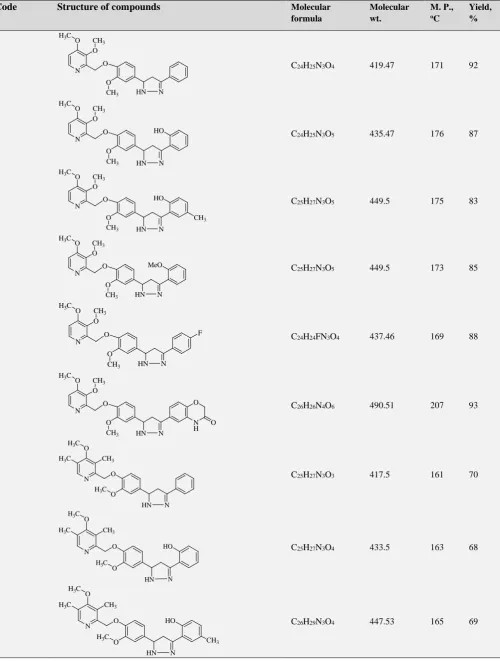
Mass spectroscopy gives corresponding [M+1] molecular ion peak at their corresponding molecular weight, as shown in Table 1. The IR spectrum of compounds showed a broad
band at ~3446 cm-1 recognized for -OH group and the
characteristic N=N band was assigned at 1591 cm-1 two
strong bands at ~1650 cm-1 and ~1607 cm-1 referring to
carbonyl and carbon-carbon double bond disappearance confirmed the formation of pyrazolines compounds.
The synthesized compounds were assigned on the basis of
1H NMR, 13C NMR, mass and IR spectral analytical studies
to confirm the proposed structures. Physical constant data were tabulated in Table 1.
Molecular docking
To study binding conformations of the synthesized compounds, the Autodock Vina program was used for docking pyrazoline derivatives into the active sites of
methionyl-tRNA synthetase. The AutoDock Tools 1.5.4
(ADT) was used to prepare the input files for docking.18 The
crystal structure of Thermus thermophilus methionyl-tRNA
synthetase reveals two RNA-binding modules. All water molecules and ions were removed from the protein crystallographic structures; polar hydrogens were added and partial atomic charges were assigned by Kollman united
charges method.19-21
Sidechains of lysine, arginine, and histidine residues were protonated while the carboxylic groups of glutamic and aspartic acid were deprotonated. For each ligand, nonpolar hydrogens were merged, Gasteiger charges were assigned and rotatable bonds were set up. The structures were then saved in the corresponding pdbqt file required for the Autodock.
Antioxidant activity
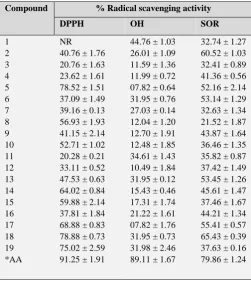
Antioxidant potential of the synthesized compounds was measured in terms of DPPH, OH and superoxide radical (SOR) scavenging activity carried out using reported
methods.22 following the procedure as discussed in our
previous publications.16 The results of antioxidant activity
are summarized in Table 2. The detailed procedure for the
antioxidant activity is provided in the supplementary material.
Antimicrobial screening
To confirm the inhibitory activity, the hit compounds were re-tested against the strains in a dose-response assay to determine the minimum inhibitory concentration (MIC) of the compounds. Samples were prepared in DMSO and
water to a final testing concentration of 32 μg mL-1 or 20
μM in 384-well, non-binding surface plate (NBS) for each bacterial/fungal strain, in duplicate (n=2), and keeping the final DMSO concentration to a maximum of 1 % DMSO. All the sample-preparation was done using liquid handling robots. All bacteria were cultured in cation-adjusted Mueller Hinton broth (CAMHB) at 37 °C overnight. A sample of each culture was then diluted 40-fold in fresh broth and incubated at 37 °C for 1.5-3 h. The resultant mid-log phase
cultures were diluted (CFU mL-1 measured by OD600),
added to each well of the compound containing plates giving
a cell density of 5×10⁵ CFU mL-1 and a total volume of 50
μL. All the plates were covered and incubated at 37 °C for
18 h without shaking.
O O N
N N S
H
CH3
H3C
O OH
O OH
O H O
H
Br
O O N
N N S
CH3
O
R
a. b.
c
O O N
N N S
CH3 N
R HN
O O N
N N S
CH3
N
R N
Pyrazolinecompounds
12-16
PhenylPyrazolinecompounds
17-19
vanillin Bromobutoxybenzaldehyde Benzoisothiazolpiperazine benzaldehyde
d
Table 1. Physical constant of the synthesized compounds.
Code Structure of compounds Molecular
formula
Molecular wt.
M. P.,
oC
Yield, %
1
N O
O H3C
O CH3
O
CH3 HN N
C24H25N3O4 419.47 171 92
2
N O
O H3C
O CH3
O CH3
HO
HN N
C24H25N3O5 435.47 176 87
3
N O
O H3C
O CH3
O CH3
HO
HN N
CH3
C25H27N3O5 449.5 175 83
4
N O
O H3C
O CH3
O CH3
MeO
HN N
C25H27N3O5 449.5 173 85
5
N O
O H3C
O CH3
O
CH3 HN N
F C
24H24FN3O4 437.46 169 88
6
N O
O H3C
O CH3
O CH3
N H O
O N
HN
C26H26N4O6 490.51 207 93
7 N O
O H3C
CH3 O H3C
H3C
HN N
C25H27N3O3 417.5 161 70
8 N O
O H3C
CH3 O H3C
H3C
N HO
HN
C25H27N3O4 433.5 163 68
9
N O
O H3C
CH3 O H3C
H3C
HO
CH3
HN N
10
N O
CH3
H3C
O
O
F
HN N
H3C
H3C
C25H26FN3O3 435.49 166 70
11 N O
O
H3C
CH3
O
H3C
H3C
N H O
O
HN N
C27H28N4O5 488.54 225 72
12 O
O
N N S
N CH3
H
N N C31H35N5O2S 541.71 163 69.8
13 O
O
N N S
N
HO
CH3
N H N
C31H35N5O3S 557.71 171 78
14 O
O
N N S N
CH3 HN N
F
C31H34FN5O2S 559.7 160 79
15 O
O
N N S
N
N CH3
H N
O H
N O
C33H36N6O4S 612.74 171 78
16
O O
N N S N
CH3
N H3C CH3
F HN N
C42H45FN6O2S 716.91 172 80
17
S N N N
O O
CH3 N N
C37H39N5O2S 617.8 168 71
18 N S
N N
O O
CH3 N N
F
19
O O
CH3 N
H3C CH3
F
N N
N N
N S
C48H49FN6O2S 793.01 174 70
Table 2. Radical scavenging profile of the synthesized compounds
Compound % Radical scavenging activity
DPPH OH SOR
1 NR 44.76 ± 1.03 32.74 ± 1.27
2 40.76 ± 1.76 26.01 ± 1.09 60.52 ± 1.03
3 20.76 ± 1.63 11.59 ± 1.36 32.41 ± 0.89
4 23.62 ± 1.61 11.99 ± 0.72 41.36 ± 0.56
5 78.52 ± 1.51 07.82 ± 0.64 52.16 ± 2.14
6 37.09 ± 1.49 31.95 ± 0.76 53.14 ± 1.29
7 39.16 ± 0.13 27.03 ± 0.14 32.63 ± 1.34
8 56.93 ± 1.93 12.04 ± 1.20 21.52 ± 1.87
9 41.15 ± 2.14 12.70 ± 1.91 43.87 ± 1.64
10 52.71 ± 1.02 12.48 ± 1.85 36.46 ± 1.35
11 20.28 ± 0.21 34.61 ± 1.43 35.82 ± 0.87
12 33.11 ± 0.52 10.49 ± 1.84 37.42 ± 1.49
13 47.53 ± 0.63 31.95 ± 0.12 53.45 ± 1.26
14 64.02 ± 0.84 15.43 ± 0.46 45.61 ± 1.47
15 59.88 ± 2.14 17.31 ± 1.74 37.46 ± 1.67
16 37.81 ± 1.84 21.22 ± 1.61 44.21 ± 1.34
17 68.88 ± 0.83 07.82 ± 1.76 55.41 ± 0.57
18 78.88 ± 0.73 31.95 ± 0.73 65.43 ± 0.39
19 75.02 ± 2.59 31.98 ± 2.46 37.63 ± 0.16
*AA 91.25 ± 1.91 89.11 ± 1.67 79.86 ± 1.24
*AA: ascorbic acid. Results represented here are the mean of
n=3±SD. NR: No reaction under the experimental conditions.
Fungi strains were cultured for 3 days on yeast extract-peptone dextrose (YPD) agar at 30 °C. A yeast suspension
of 1 x 10⁶ to 5 x 10⁶ CFU mL-1 (as determined by OD530)
was prepared from five colonies. The suspension was subsequently diluted and added to each well of the compound containing plates giving a final cell density of
fungi suspension of 2.5 ×10³ CFU mL-1 and a total volume
of 50 μL. All plates were covered and incubated at 35 °C for
24 h without shaking.
Colistin and Vancomycin were used as positive bacterial inhibitor standard for gram-negative and gram-positive bacteria, respectively. Fluconazole was used as a positive
fungal inhibitor standard for C. Albicans and C. neoformans.
The antibiotics were provided in 4 concentrations, with 2 above and 2 below its MIC value, and plated into the first 8 wells of column 23 of the 384-well NBS plates. The quality control (QC) of the assays was determined by the
antimicrobial controls and the Z'-factor (using positive and
negative controls). Each plate was deemed to fulfill the
quality criteria (pass QC) if the Z'-factor was above 0.4, and
the antimicrobial standards showed the full range of activity, with full growth inhibition at their highest concentration, and no growth inhibition at their lowest concentration.
M1000 Pro monochromator plate reader. The percentage of growth inhibition was calculated for each well using the negative control (media only) and positive control (bacteria without inhibitors) on the same plate as references. The significance of the inhibition values was determined by
modifying Z-scores, calculated using the median of the
samples (no controls) on the same plate. Samples with
inhibition values above 80 % and Z-score above 2.5 for
either replicate (n=2 on different plates) were classed as
actives, whereas samples with inhibition values between 50
– 80 % and Z-score below 2.5 for either replicate (n=2 on
different plates) were classed as partially active.
Table 3. Material assays for antimicrobial activity
Material Code Brand Catalogue
No.
Compound
preparation Plate PP Corning 3364
Assay plates NBS 384w Corning 3640
Growth
media-bacteria CAMHB
Bacto
Laboratories 212322
Culture agar-fungi YPD Becton
Dickinson 242720
Growth
media-fungi YNB
Becton
Dickinson 233520
Resazurin
Sigma-Aldrich R7017
Percentage growth inhibition of individual samples was calculated based on negative controls (media only) and positive controls (bacterial media without inhibitors). The percentage of growth inhibition was calculated for each well using the negative control (media only) and positive control (without inhibitors) on the same plate. The growth rates for all bacteria and fungi have a variation of -/+ 10 %, which lies is within the expected normal distribution of microbial
growth.
Molecular docking
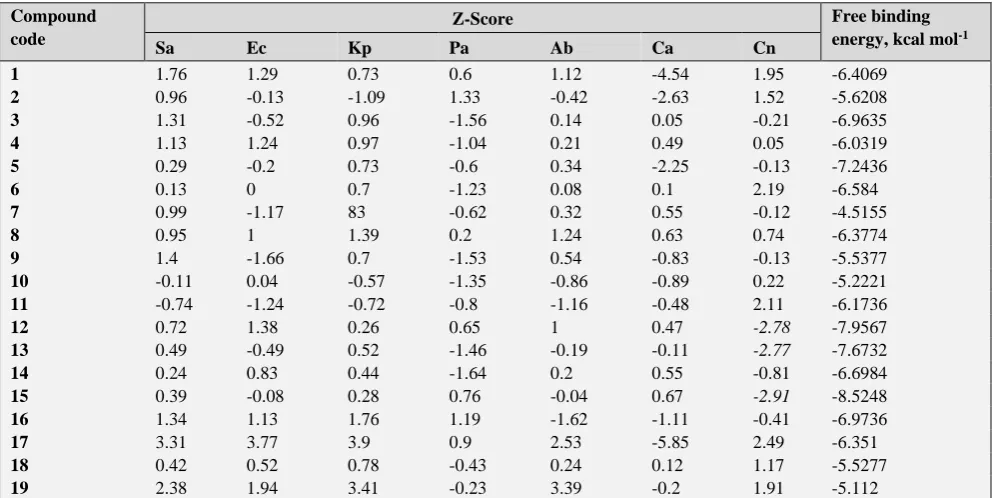
The synthesized compounds were docked against the active site of Thermus thermophilus methionyl-tRNA synthetase using Autodock vina docking tool whose results were expressed in terms of docking scores (Table 8). Analysis of docking interaction reveals that the pyrazoles
bearing benzoisothiazole ring (12, 13 and 15) were the most
active compounds against methionyl-tRNA synthetase. Results of observed antimicrobial activities are in good agreement for these tilted compounds in terms of higher
negative values of Z-scores.
The benzisothiazole linked pyrazolines 12, 13 and 15 bind
Table 4. Standards for antimicrobial activity
Sample Sample ID Full MW Stcok conc.
µg mL-1
Solvent Source
Colistin Sulfate MCC_000094:02 1400.63 10.0 DMSO Sigma; C4461
Vancomycin HCL MCC_000095:02 1485.71 10.0 DMSO Sigma; 861987
Fluconazole MCC_008383:01 306.27 2.56 DMSO Sigma; F8929
Table 5. Bacterial and fungal species used along with abbreviations
ID Batch Microbe Strain Description
GN_001 02 Escherichia coli ATCC 25922 FDA control strain
GN_003 02 Klebsiella pneumoniae ATCC 700603 MDR
GN_034 02 Acinetobacter baumannii ATCC 19606 Type strain
GN_042 02 Pseudomonas aeruginosa ATCC 27853 Quality control strain
GP_020 02 Staphylococcus aureus ATCC 43300 MRSA
FG_001 01 Candida albicans ATCC 90028 CLSI reference
FG_002 01 Cryptococcus neoformans ATCC 208821 Type strain
All antibiotic controls displayed inhibitory values within the expected range.
Table 6. Brief results of antimicrobial activity
Strain ID Microba Antibiotic Pass / Fail
GN_001:02 E. coli Colistin Pass
GN_003:02 K. pneumoniae Colistin Pass
GN_034:02 A. baumannii Colistin Pass
GN_042:02 P. aeruginosa Colistin Pass
GP_020:02 S. aureus (MRSA) Vancomycin Pass
FG_001:01 C. albicans Fluconazole Pass
FG_002:01 C. neoformans (H99) Fluconazole Pass
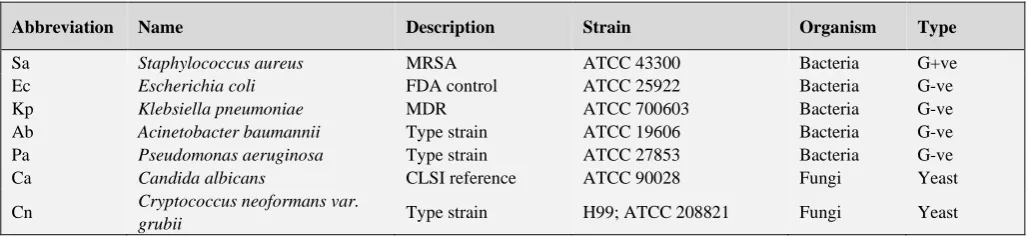
Table 7. Different bacteria, fungi and abbreviations used for antimicrobial activity
Abbreviation Name Description Strain Organism Type
Sa Staphylococcus aureus MRSA ATCC 43300 Bacteria G+ve
Ec Escherichia coli FDA control ATCC 25922 Bacteria G-ve
Kp Klebsiella pneumoniae MDR ATCC 700603 Bacteria G-ve
Ab Acinetobacter baumannii Type strain ATCC 19606 Bacteria G-ve
Pa Pseudomonas aeruginosa Type strain ATCC 27853 Bacteria G-ve
Ca Candida albicans CLSI reference ATCC 90028 Fungi Yeast
Cn Cryptococcus neoformans var.
grubii Type strain H99; ATCC 208821 Fungi Yeast
The 2H-1,4-benzoxazin-3(4H)-one derivatives 15
(-8.5243) interacts with the polar and charged amino acid residues THR55 and GLU54 with a carbonyl oxygen atom and an oxygen atom of oxazine at the distance of 1.90, 1.93 and 1.93 Å to form conventional hydrogen bond interactions. The charged amino acid ASP50 and hydrophobic amino acid TYR13 form conventional hydrogen bond interactions with pyrazole nitrogen and methoxyl oxygen atom with a distance of 1.87 and 1.90 Å, respectively. The polar amino acid HIS22 and ASP260 amino acid interact with a methoxyl hydrogen atom and the hydrogen atom of the piperazine ring to form a C-H bond and conventional hydrogen bond interactions.
The aliphatic amino acids VAL226, ILE261, GLY288,
LEU290, and charged amino acid LYS297 interact with π electron cloud to form π-donor hydrogen and π-alkyl interactions (Figure 1).
The benzoisothiazole derivative 12 (-7.9567) interacts
Table 8. In vitro activity and molecular docking of synthesized compounds
Compound code
Z-Score Free binding
energy, kcal mol-1
Sa Ec Kp Pa Ab Ca Cn
1 1.76 1.29 0.73 0.6 1.12 -4.54 1.95 -6.4069
2 0.96 -0.13 -1.09 1.33 -0.42 -2.63 1.52 -5.6208
3 1.31 -0.52 0.96 -1.56 0.14 0.05 -0.21 -6.9635
4 1.13 1.24 0.97 -1.04 0.21 0.49 0.05 -6.0319
5 0.29 -0.2 0.73 -0.6 0.34 -2.25 -0.13 -7.2436
6 0.13 0 0.7 -1.23 0.08 0.1 2.19 -6.584
7 0.99 -1.17 83 -0.62 0.32 0.55 -0.12 -4.5155
8 0.95 1 1.39 0.2 1.24 0.63 0.74 -6.3774
9 1.4 -1.66 0.7 -1.53 0.54 -0.83 -0.13 -5.5377
10 -0.11 0.04 -0.57 -1.35 -0.86 -0.89 0.22 -5.2221
11 -0.74 -1.24 -0.72 -0.8 -1.16 -0.48 2.11 -6.1736
12 0.72 1.38 0.26 0.65 1 0.47 -2.78 -7.9567
13 0.49 -0.49 0.52 -1.46 -0.19 -0.11 -2.77 -7.6732
14 0.24 0.83 0.44 -1.64 0.2 0.55 -0.81 -6.6984
15 0.39 -0.08 0.28 0.76 -0.04 0.67 -2.91 -8.5248
16 1.34 1.13 1.76 1.19 -1.62 -1.11 -0.41 -6.9736
17 3.31 3.77 3.9 0.9 2.53 -5.85 2.49 -6.351
18 0.42 0.52 0.78 -0.43 0.24 0.12 1.17 -5.5277
19 2.38 1.94 3.41 -0.23 3.39 -0.2 1.91 -5.112
The polar amino acid THR55 and hydrophobic amino acid TYR13 interacts with pyrazole nitrogen atoms and phenoxy oxygen atom to form conventional hydrogen bond interaction with a distance of 2.00 and 2.52 Å respectively.
The π-electron clouds of benzoisothiazole and phenoxy
rings create π-sulfur, π-π stacked and π-alkyl interactions with various distances (Figure 2).
CONCLUSION
In summary, the present article reports a novel series of pyrazolines from chalcones and hydrazine hydrate or phenylhydrazine in the presence of ethanol as the alcoholic solvent. All structures of the newly synthesized molecules
were characterized by spectroscopic data - 1H NMR, 13C
NMR, Mass, and IR. Further, these newly synthesized compounds were evaluated for antioxidant and antimicrobial
activity. Compounds 5, 18 and 19 were found to be
potentially active antioxidants in terms of the DPPH radical
scavenging assay, whereas 2 and 18 compounds showed
better activity by superoxide radical (SOR) scavenging
assay method in but less as compared with the standard
ascorbic acid. Compounds 12, 13 and 15 were partially
active against Cryptococcus neoformans var. grubii fungi.
The molecular docking study and in-vitro antibacterial and
antifungal activity suggested that 12, 13 and 15 are the most
active among all synthesized derivatives and will serve as excellent leads in the antimicrobial and antioxidant drug discovery process.
ACKNOWLEDGMENTS
The authors are thankful to "Antimicrobial screening was performed by The Community for Antimicrobial Drug Discovery, funded by the Welcome Trust, UK and the University of Queensland, Australia, for providing the results of antimicrobial activities.
REFERENCES
1Varghese, B., Al-Busafi, S. N., Suliman, F. E. O., Al-Kindy, S. M.
Z. Unveiling a versatile heterocycle: pyrazoline - A review, RSC Adv., 2017, 7, 46999-47016. DOI: 10.1039/C7RA08939B. 2Singh, P., Singh, J., Pant, G. J., Rawat, M. S. M., 2-Pyrazolines as
biologically active and fluorescent agents: An Overview.
Anti-cancer Agents Med. Chem., 2018, 18(10), 1366-1385. DOI: 10.2174/1871520618666180313153407
3George, R. F., Fouad, M. A. and Gomaa, I. E. O., Synthesis and
cytotoxic activities of some pyrazoline derivatives bearing phenyl pyridazine core as new apoptosis inducers. Eur. J. Med. Chem., 2016, 112, 48-59. DOI: 10.1016/j.ejmech.2016.01.048
4Johnson, M., Younglove, B., Lee, L., LeBlanc, R., Holt, H., Hills,
P., Mackay, H. N., Brown, T., Susan, L. M., Moses, L. Design, synthesis, and biological testing of pyrazoline derivatives of combretastatin-A4. Bioorg. Med. Chem. Lett.,
2007, 17(21), 5897-5901 DOI: 10.1016/j.bmcl.2007.07.105.
5Insuasty, B., Tigreros, A., Orozco, F., Quiroga, J., Abonia, R.,
Nogueras, M., Sanchez, A. and Cobo, J., Synthesis of novel pyrazolic analogs of chalcones and their 3-aryl-4-(3-aryl-4,5-dihydro-1H-pyrazol-5-yl)-1-phenyl-1H-pyrazole derivatives
as potential antitumor agents. Bioorg. Med. Chem., 2010, 18, 4965-4974. DOI: 10.1016/j.bmc.2010.06.013
6Suresh, K., Bawa, S., Drabu, S., Kumar, R., Gupta, H., Biological
activities of pyrazoline derivatives: A recent development.
Recent Patent Anti-infect. Drug Discov., 2009, 4, 154-163.
7Sasikala, R., Thirumurthy. K., Mayavel, P., Thirunarayanan, G.,
Eco-friendly synthesis and antimicrobial activities of some 1-phenyl-3(5-bromothiophen-2-yl)-5-(substituted phenyl)-2-pyrazolines, Org. Med. Chem. Lett., 2012, 2, article No. 20,DOI: 10.1186/2191-2858-2-20
8Ruhoglu, O., Özdemira, Z., Çalis, U., Gümüsel, B., Bilgin, A. A.
Synthesis of and pharmacological studies on the antidepressant and anticonvulsant activities of some 1,3,5-trisubstituted pyrazolines. Arzneim-Forsch./Drug Res., 2005,
55(8), 431-436.
9Govindaraju, M., Mylarappa, B. N., Ajaykumar, K., Synthesis of
novel pyrazole derivatives and their efficacy as antimicrobial agents. Int. J. Pharm. Pharm. Sci., 2013, 5(4), 734-737.
10Tabarelli, Z., Rubin, M. A., Berlese, D. B., Sauzem, P. D., Missio,
T. P., Teixeira, M. V., Sinhorin, A. P., Martins, M. A. P., Zanatta, N., Bonacorso, H. G. and Mello, C. F., Antinociceptive effect of novel pyrazolines in mice, Braz. J. Med. Biol. Res., 2004, 37, 1531-1540. DOI: 10.1590/S0100-879X2004001000013
11Carrion, M. D., Lopez Cara, L. C., Encarnacion, M. C., Victor, T.,
Germaine, E., Dario, A. C., Espinosa, A., Gallo, M. A., Entrena, A., Pyrazoles and pyrazolines as neural and inducible nitric oxide synthase (nNOS and iNOS) potential inhibitors (III), Eur. J. Med. Chem. 2008, 43, 2579-2591.
DOI: 10.1016/j.ejmech.2008.01.014
12Akranth, M., Rahmat A., Tauquir, A., Rikta, S., Tanwar, O.,
Mymoona, A., Shaquiquzzaman, M., Mumtaz, A., Pyrazolines: A biological review. Mini-Rev. Med. Chem.,
2013, 13(6), 921-931. DOI: 10.2174/1389557511313060012 13Shaharyar, M., Siddiqui, A. A., Ali, M. A., Sriram, D. and
Yogeeswari, P., Synthesis and in vitro antimycobacterial activity of N1-nicotinoyl-3-(4'-hydroxy-3'-methyl phenyl)-5-[(sub)phenyl]-2-pyrazolines. Bioorg. Med. Chem. Lett., 2006,
16(15), 3947-3949 DOI: 10.1016/j.bmcl.2006.05.024
14Rahman, M. A., Chalcone: A valuable insight into the recent
advances and potential pharmacological activities. Chem. Sci. J.,2011, 29, 1-16.
15Kauthale, S., Tekale, S., Damale, M., Sangshetti, J., Pawar, R.,
Synthesis, biological evaluation, molecular docking, and ADMET studies of some isoxazole-based amides. Med. Chem. Res., 2018, 27(2), 429-441. DOI: 10.1007/s00044-017-2070-z
16Kauthale, S., Tekale, S., Damale, M., Sangshetti, J., Pawar, R.,
Synthesis, antioxidant, antifungal, molecular docking and ADMET studies of some thiazolyl hydrazones. Bioorg. Med. Chem. Lett., 2017, 27(16), 3891-3896. DOI:
10.1016/j.bmcl.2017.06.043
17Deshmukh, S. U., Kharat, K. R., Yadav, A. R., Shisodia, S. U.,
Damale, M. G., Sangshetti, J. N., Pawar, R. P. Synthesis of
novel α‐aminophosphonate derivatives, biological evaluation
as potent antiproliferative agents and molecular docking.
Chem. Select, 2018, 3(20), 5552-5558 DOI: 10.1002/slct.201800798
18Trott, O., Olson, A. J., AutoDock Vina: Improving the speed and
accuracy of docking with a new scoring function, efficient optimization and multithreading. J. Comput. Chem., 2010, 31(2), 455-461.DOI: 10.1002/jcc.21334
19Morris, G. M., Huey, R., Lindstrom, W., Sanner, M. F., Belew, R.
K., Goodsell, D. S., Olson, A. J., AutoDock4 and Auto DockTools4: Automated docking with selective receptor flexibility. Comput. Chem., 2009, 30, 2785-2791. DOI:
10.1002/jcc.21256
20Sanner M. F. Python: A programming language for software integration and development,J. Mol. Graph. Model., 1999,
21Bas, D. C., Rogers, D. M., Jensen, J. H., Very fast prediction and
rationalization of pKa values for protein-ligand complexes,
Proteins, 2008, 73, 765-783. DOI: 10.1002/prot.22102 22Roberta, R., Luciana, G. M., Luciana, C. C., Glaucia, P.,
Evaluation of the antioxidant properties of the brazilian cerrado fruit annona crassiflora (araticum). J. Food Sci., 2006,
71, 102. DOI: 10.1111/j.1365-2621.2006.tb08882.x