International Journal Advances in Social Science and Humanities
Available online at: www.ijassh.com
CASE STUDY
Correa Holguín David Alejandro et. al. |March 2014 | Vol.2 | Issue 3|24-32 24
Networks in Strengthening Community-based Ecotourism in the Sierra
Norte of Oaxaca, Mexico
Correa Holguín David Alejandro
1*, Rosas Baños Mara
21 National Polytechnic Institute, Interdisciplinary Research Center for Regional Integral Development Unit Oaxaca,
Hornos núm. 1003, Col. Noche Buena, 71230 Santa Cruz Xoxocotlán, Oaxaca, México.
2 National Polytechnic Institute, Center of Researches in Economics, Management and Society, Lauro Aguirre 120,
esquina Sor Juana Inés de la Cruz, col. Agricultura, Del. Miguel Hidalgo, C. P. 11360. México D. F.
*Corresponding Author: E-mail [email protected]
Abstract
Ecotourism is one of the most promising economic activities to achieve sustainable development in rural communities. However, despite the increase of environmental awareness that has been built up in society, this activity is far from being an economic activity capable of removing from rural communities that practice of poverty, which has forced communities to implement strategies to strengthen this activity. The aim of this paper is to analyze the factors that have led to the formation of two networks of ecotourism and the contribution to strengthening community-based ecotourism projects in the Sierra Norte region of Oaxaca, México. 58 questionnaires were applied to the workforce and key informants from the 11 community ecotourism enterprises which belong to the two networks. A map and a social network analysis were made using the UCINET software. The conclusion was drawn that ecotourism networks have generated bridging social capital, which has improved resource mobilization for infrastructure development, training and promotion, and generated new resources such as market information, logistics and certifications, increasing over time.
Keywords: Networks, Ecotourism, Social capital, Public policy, Community organization.
Introduction
Tourism is the largest industry worldwide representing 10% of employment and 11% of the global GDP it “has, as such, a large and growing impact both on towns and on nature” (WWF, 2001), therefore it has become necessary to reorientation the market towards alternatives such as Nature Tourism which incorporate elements such as the reduction of poverty in rural zones and the conservation of natural areas, which produces a more sustainable form of tourism in comparison to the negative elements generated by the social and natural systems of the traditional tourism of sun and beach, otherwise known as mass tourism [1].
According to the World Organization of Tourism, Nature Tourism can be divided into two sub-markets. The first one is adventure tourism, which is targeted more towards sport activities with a high degree of excitement and adrenaline. The second one is ecotourism, which is more focused on the observation and enjoyment of nature and cultural elements, the concept of
which is the result of the integration of sustainable development and tourism [2]. However, the understanding of the concept of ecotourism has been as complex, inconsistent and diverse as its implementation [2-6]. It is precisely this which has aroused interest in the field of research on a global level, with studies relating to areas such as conservation [7] socioeconomic implications [4], processes of social change [8]; its adoption for productive diversification [9] impacts on community development [10], and influence of public policy [11].
Correa Holguín David Alejandro et. al. |March 2014 | Vol.2 | Issue 3|24-32 25 such programs [13], giving priority to an
indigenous business development vision which is focused on competitiveness [3,14]. This contrasts with the social, culture and historical worldview of the indigenous peoples, since, for them "competition makes life more complex in an economic sense: if you want to have, measure your strength, your resources, your ability with others and all this becomes, in reality, a daily war " [15]. This in turn raises "the compartencia", seen as a form of resistance to a confrontational imposition, and as a way to share power, capacity and information [15].
From this perspective, the joining of diverse communities with ecotourism business in the Sierra Norte of Oaxaca has reacted unexpectedly to official outlines for indigenous development which promote, among other things, business competitiveness to build a dynamic economy and generate employment [14]. The response has come with the emergence of two organizations whose working way is the networks of ecotourism: Expediciones Sierra Norte (Northern Sierra Expeditions), which integrates six communities of
the Mancomunados Towns, and the Red Integradora de Ecoturismo Sierra Juárez de Oaxaca-REDSJO (Integrative Network of Ecotourism Sierra Juarez of Oaxaca) composed by five communities, both networks located in three the municipalities of the region Sierra Norte Of Oaxaca (Tab. 1). The aim of this paper is to analyze the factors that have led to the formation of networks of ecotourism and their contribution to the strengthening of community-based ecotourism projects in the region Sierra Norte of Oaxaca. 58 questionnaires were applied to the workforce and key informants from 11 community ecotourism enterprises in the Sierra Norte, the results were mapped and a social network analysis was conducted using the UCINET software. It is concluded that ecotourism networks have generated bridging social capital, which has improved resource mobilization for infrastructure development, training and promotion, and generated new resources such as market information, logistics and certifications, which are increasing over time.
Tab. 1: Location of the study units
Community Municipality Network of ecotorurism
Amatlan San Miguel Amatlán Expediciones Sierra Norte
Cuajimolollas San Miguel Amatlán Expediciones Sierra Norte
Llano Grande San Miguel Amatlán Expediciones Sierra Norte
Benito Juárez Santa Catarina Lachatao Expediciones Sierra Norte
La Nevería Santa Catarina Lachatao Expediciones Sierra Norte
Latuvi Santa Catarina Lachatao Expediciones Sierra Norte
Capulálpam Capulálpam de Méndez REDSJO
Ixtlan Ixtlan de Juárez REDSJO
El Punto Santa Catarina Ixtepeji REDSJO
Nexicho Santa Catarina Ixtepeji REDSJO
Lachatao Santa Catarina Lachatao REDSJO
Social Capital and Networks
Elinor Ostrom [16] showed that there are rural areas where individual rationality does not always lead to the much-cited "tragedy of the commons", since individuals who share a property are able to create institutions that allow them to make appropriate use of the natural resources. This type of alternative rationality is identified in various rural communities with communal property systems. Rosas M, Barkin D [17], highlighting attributes between the resource owners such as trust and reciprocity [16]. Pretty and Smith [18] identified a positive relationship between the trust and conservation present in the communities. Other studies such as Jones [8] have shown how trust among community members is positively associated with the
development of an ecotourism center Tunami Tenda, in Gambia. Likewise it has been found that the constitution of strongly based institutions depends on trust, coordination and social capital [7]. Reciprocity has also been positively associated with increased job opportunities in communities, through family relations, although it can vary from one community to another due to changing relations with marketing interests [19].
Correa Holguín David Alejandro et. al. |March 2014 | Vol.2 | Issue 3|24-32 26 group can profit by joining another group and
acting corporately. Within the groups there may be ties of cooperation at the micro level which are only practised among its members at the community level, known as bonding social capital [20-22]. On the other hand, groups can interact with external agents via cooperative ties on macro levels in what is known as bridging social capital [20, 21]. From this perspective Durston [23] proposed that social capital can build a "ladder" to link to community groups or organizations with government institutions.
Through the networks, the actors (individuals, organizations or institutions) are connected to exchange resources through vertical and horizontal hierarchical levels in a series of bridge-type bonds. Woolcoock and Narayan [20] emphasize the importance of vertical associations, ie those that occur between actors located at different levels such as those that exist between community organizations, businesses and government institutions. This type of link allows access to new resources between actors of varying levels, in what is known as bridging social capital [20, 23, 24]. Dense networks of social exchange are a crucial condition for the emergence of a generalized reciprocity norm. Woolcoock and Narayan [20] emphasize the importance of both vertical and horizontal partnerships between people, in addition to the relationships that exist within and between organizational entities such as community groups and businesses. Therefore the network is the level at which relationships create social capital:
Bonding: Relationships, which can range from kinship, friendship, membership of a social class, etc.., That "gather agents of similar status and power" where intra relationships are strong ties in a dense network, which can even bring consequences such as exclusion or the seeking of benefits at only a sectarian level [20,21]. The links between people with similar resources determine the effective conservation of those resources, reflecting a similarity to the social structure [25].
Bridging: Relations in a vertical network linking "unequal agents in asymmetric relations of hierarchy and dependence." These bonds are weak bonds that are an intra connection type, ie it is when connections are set up with other agents [20,21,26] These links give the possibility of obtaining new resources between people of unequal resources at different positions in the social structure [25].
The coordinated action of social action is oriented to both the conservation of resources (bonding component) and to obtaining new resources (bridging component) [25]. In matters of poverty reduction it has been found that the main function of these networks is to reduce risk and uncertainty, ie through reliable individuals who are willing to cooperate with others that only a minority can survive, thrive and expand to establish a network between them. For example in creating new development opportunities through projects or businesses networks are mentioned that can share knowledge, and markets to improve the chances of survival [20].
Methods
58 interviews were conducted amongst the workforce and key informants from 11 community ecotourism enterprises in the Sierra Norte from interviews on social capital [27, 28] contextualized to ecotourism. With this information, a mapping [29] and social network analysis (ARS) was produced using the UCINET software [30] to obtain social capital indicators which include:
Nodal Degree (G): The number of neighboring nodes of a given node i representing its connectivity [31]. It follows that the higher G the greater the capital of the node in question [25].
Centrality of Betweenness (B): It is an indicator of how often node i appears in the shortest path connecting two network nodes. It is an indicator of the capacity exercised as a lead intermediary [25], that is, to have the possibility of controlling the flow of such information or resources.
Introduced as attributes these indicators were processed in the Net Draw charting software using a matrix of 2 modes1.
Results
The study area is located in the Sierra Norte region of Oaxaca state, which is considered to be a Priority Terrestrial Region of the South-East of Mexico [32]. Because of its physiographic characteristics and interconnected environments this region allows an important biotic diversity which has little fragmentation and where the cloud forests are the largest and best preserved of Mexico [32].
The Sierra Norte comprises of 68 municipalities of which almost 80% are ranked among degrees of
1Is the matrix of relationships between two actors of the (n x m) type
Correa Holguín David Alejandro et. al. |March 2014 | Vol.2 | Issue 3|24-32 27 high and very high marginalization [33]. Here the
following ecotourism centers are located: “Ecoturixtlan” managed by the community of Ixtlán; “Turismo Ecológico Capulalpam Mágico” maneged by the community of Capulalpam; “San Miguel Amatlan – Yagaa-tzi ” managed by the community of Amatlan; “San Antonio Cuajimolollas – Yaa-Cuetzi” managed by the community of Cuajimolollas; “Llano Grande” managed by the community of the same name; “Comite de Ecoturismo de San Pedro Nexicho” managed by the community of Nexicho; “Ecoturismo Comunal Santa Catarina Ixtepexi” managed by the communities El Punto, Santa Catarina and La Cumbre; Latuvi managed by the community of the same name; “Expediciones Lachatao” managed by the community of Lachatao; “Benito Juarez-Yaat-yana” managed by the community of Benito Juárez; and finally “La Nevería – Latzi-belli” managed by the communituy of La Nevería.
The workers that provide the service of ecotourism were elected by the assemblies of each community to carry out work coordination, administration and management for each center of ecotourism. This form of organization was founded in the social relations that establish the system of responsibility, which consists of a series of community responsibilities, recognized and respected by members of the community [34].
Linked Actors on the Networks
Within the framework of community organization for production and services the ecotourism networks are also developed, the first of these is Expediciones Sierra Norte, which is a Social Solidarity Society (SSS), created in 1998. This network serves as the official tour operator for community ecotourism enterprises belonging to the Mancomunado towns of Benito Juarez, The Nevería, Cuajimolollas, Llano Grande, Amatlán and Latuvi. The second is the Red Integradora de Ecoturismo Sierra Juárez de Oaxaca (RESDJO), formed in 2009 as Sociedad Anonima de Capital Variable, consisting of the community ecotourism enterprises Capulalpam, Ecoturixtlan, La Cumbre Ixtepeji Lachatao, and Nexicho.
The results show links between the community ecotourism enterprises that make the networks (Expediciones Sierra Norte represented by blue circles and REDSJO represented by green circles in Fig. 1) and the actors who have provided resources to encourage ecotourism in the communities, among which were found: 1) Government institutions (orange squares Fig. 1): Government institutions are at three levels
Federal, State and Municipal, that have provided funding for infrastructure, training and promotion, among which are the Secretary of Tourism of the State of Oaxaca (SEDETUR), the National Commission for the Development of Indigenous Peoples (CDI), the National Forestry Commission (CONAFOR), Secretary of Environment and Natural Resources (SEMARNAT), the Ministry of Social Development (SEDESOL), the National Commission of Natural Protected Areas (CONANP), Secretary for Rural Development (SEDER) and the Ministry of Economy. 2) Educational Institutions (cyan squares in Fig. 1): Educational institutions which are collaborating in projects, studies, tourist routes, intellectual material and information for the dissemination of ecotourism in the Sierra Norte. Among these are the University of Texas, University of Wisconsin, Technological University of the Mezquital Valley (UTVM), National Autonomous University of Mexico (UNAM), Technological Institute of Oaxaca Valley (ITVO) and the Interdisciplinary Research Centre for Regional Integral Development Unit Oaxaca (CIIDIR). 3) ecotourism networks (red triangles Fig. 1): These are organizations that promote and link collective community ecotourism enterprises in different regions of the country, besides being a means of collective management support offered by various units of government. Among these are the Alternative Indigenous Tourism Network of Mexico (RITA2);4) Non-governmental organizations (yellow squares Fig. 1) which are national and international associations which have provided funds for the start of ecotourism projects and consulting, among which are the Wildlife Fund (WWF), Canada Foundation and Congregation Mariana Trinitarian; 5) External “Managers” (purple squares Fig. 1): People who have established a close relationship with the communities and have contributed substantially to the initiation and pursuit of ecotourism projects through contacts with government institutions and providing expertise. Notable names are Martin Ruiz Camino (Secretary of Tourism of the State of Oaxaca 1992-1998), Pablo Ruiz Lavalle, John M. Vinar (Televisa Corporation reporter) and Enrique Astorga (Chilean citizen); 6) Private businesses (black squares Fig. 1): which have made trade agreements for the promotion and attraction of tourists to the places where ecotourism is conducted. To be found at the tour operators in the city of Oaxaca and the Oaxaca
2The RITA is a civil association that currently represents 150
Correa Holguín David Alejandro et. al. |March 2014 | Vol.2 | Issue 3|24-32 28 Hotels Association; 7) Groups of
communities(white square Fig. 1): The Mancomunados towns, which are formed by the communities of Santa Catarina Lachatao, Benito Juarez, San Miguel Amatlán, La Neveria, Cuajimolollas, San Antonio and San Isidro Llano Grande, through representatives who have decided to make every effort on behalf of
ecotourism businesses that they manage, in addition to contributions to building material for cabins and to dissemination of the services, and 8) the Media (magenta square Fig. 1): who have served as a means of local broadcast through free advertising. For example XLGLO Community Radio "The Voice of the Sierra" based in the town of Guelatao, Ixtlan.
Fig. 1: Bridging social capital network in the
ecotourism of the Sierra Norte3.
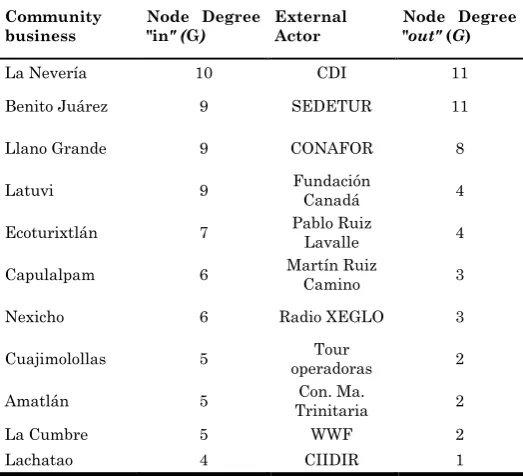
Tab. 2: Main actors in the community-bases ecoturism of the Sierra Norte
Community
business Node Degree "in" (G) External Actor Node Degree "out" (G)
La Nevería 10 CDI 11
Benito Juárez 9 SEDETUR 11
Llano Grande 9 CONAFOR 8
Latuvi 9 Fundación Canadá 4
Ecoturixtlán 7 Pablo Ruiz Lavalle 4
Capulalpam 6 Martín Ruiz Camino 3
Nexicho 6 Radio XEGLO 3
Cuajimolollas 5 Tour
operadoras 2
Amatlán 5 Trinitaria Con. Ma. 2
La Cumbre 5 WWF 2
Lachatao 4 CIIDIR 1
It was found that from established connections between actors in and out (Tab. 2) there flowed resources as support for training (29%),
3 Made with NetDraw, Borgatti, S.P., 2002. NetDraw Software for
Network Visualization. Analytic Technologies: Lexington, KY. (available at https://sites.google.com/site/netdrawsoftware/home)
infrastructure and / or remodeling (28%), promotion (26%), management and contacts (5%), market information (3%) and others (9%). The type of resources generated through bridging social capital was not only limited to the above aspects, since the networks were able to mobilize other resources that have permited the modernization of the internal organization of community businesses creating exclusive areas of self-managed promotion, certification, logistics and access to market information. The results of this investigation suggest this as one of the best achievements that has generated social capital as the flow of information between businesses and external stakeholders has enabled organizations to acquire skills that allow them to build strengths to provide better service and to be competitive from the perspective of cooperative relationship dynamics.4.2 Effect of the networks in the social capital
Correa Holguín David Alejandro et. al. |March 2014 | Vol.2 | Issue 3|24-32 29
Tab. 3: Power of readership
Network of ecotourism Nodal Degree
(D)
Betweenness centrality (B)
Expediciones Sierra Norte 6 33.648
REDSJO 3 2.823
In comparison, Expediciones Sierra Norte is perceived as having greater importance than REDSJO both for its nodal degree (D) and its betweenness centrality (B) (Tab. 3), ie, the first gives a dynamic of greater impact inn attracting resources for the businesses that are part of this network, thus its capital is higher than the REDSJO. However, the interviews revealed that Expediciones Sierra Norte is a network with more experience because it was created in 1998, while the REDSJO was established in 2009. Because of this difference consideration was taken to correlate the time variable of the businesses belonging to the network of ecotourism (t) and the nodal degree (G).
Tab. 4: Correlation of varibles
G t
G Pearson´s correlation 1 .630*
Sig. (two tail) 0.038
N 11
t Pearson´s correlation 1
Sig. (two tail)
N
*Correlation is significant at a level of 0.05 (two-tailed)
The significant positive correlation between these variables (Tab. 4) indicates that the longer the membership of the networks the greater the nodal degree. Therefore it can be inferred that ecotourism networks have an effect at least in the number of external actors with which ecotourism businesses are connected. In terms of bridging social capital, networks can maintain and improve links across time, increasing their access to new resources to encourage ecotourism, as coordinated and collaborative action permit the combination of the social capital of each community into a single entity, as the network.
For example, Expediciones Sierra Norte has an operations office in the historic center of the city of Oaxaca where they maintain direct contact with the national and international market. They have also created a corporate identity and its own brand of nature tourism highlighting achievements and certifications in the Mexican ecotourism standard NMX-133 and the distinctive
"M" for quality in tourist services. Resource management in Expediciones Sierra Norte has facilitated access to government programs to fund areas such as promotion, training, remodeling and expansion, as a collective social business. Also in the distribution market it has innovated tourist routes or "packages" where tourists can visit all or most communities, benefiting not only the activities that have to do with ecotourism, but others such as selling food and crafts. All this has been possible thanks to the combined efforts of the six communities that make up this network, because it "would otherwise be difficult and expensive to form and it would be very time-consuming to individually perform each step ... we do not see ourselves as separate parts but as a whole, if there is support for something we try to make it for everyone and not just for one ... we do not compete with anyone or among ourselves, because every community has something different which may please the tourist "(In an interview with Saul Cruz, La Nevería ecotourism coordinator, conducted by David Correa in September of 2012).
Likewise, REDSJO was formed with similar objectives to Expediciones Sierra Norte and with the need to integrate other community enterprises in the region. Among the most important steps that have been achieved since its recent creation, are training in areas of food service, hospitality and financing for a vehicle transporting tourists. However what is remarkable is the objective REDSJO has for strengthening small businesses with the larger ones, because in terms of tourist affluence Ecoturixtlan y Capulalpam receives more than 50 % of all tourists coming to the Sierra Norte.
In addition the providing of expertise and collective management has enhanced the chances for the survival of ecotourism businesses in the Sierra Norte. During field work in this same region three abandoned centers of ecotourism were observed, one of them the Yavesía community which had conflicts with Expediciones Sierra Norte and which was not joined with any other network. In a similar case the ecotourism business community Lachatao was also separated from Expediciones Sierra Norte, but, unlike Yavesia, it joined the REDSJO and is currently operational.
Correa Holguín David Alejandro et. al. |March 2014 | Vol.2 | Issue 3|24-32 30 only refer to financial capital, but also can include
market information, contacts, etc., which also become valuable when carrying out the activity and are not necessarily quantifiable. However, future research should explore the relationship between social capital and financial capital [35-38].
Conclusions
The objective of this research was to identify the social capital generated by networks organized as a form of strengthening ecotourism in the communities in the Sierra Norte region of Oaxaca, Mexico. The results show that the networks have improved aspects of the organization such as market information, promotion, logistics and certifications. The networks have allowed these businesses to strengthen their cooperative ties, which have increased as the years pass. This characteristic allows an increase in levels of bridging social capital, improving access to new resources to meet market challenges.
Networks are a means of transferring knowledge between different community businesses. Such cooperative rationality expressed quality between different communities and ecotourism enterprises, since the goal of networking is that all communities can join this activity and increase their rate of visitors a year, improve your services or simply get not abandon this activity. Expediciones Sierra Norte is the most experienced network in the Sierra Norte and has served as a model for the formation of the REDSJO. Its power as an intermediary leadership has helped strengthen the promotion aspects, quality, certification, logistics and market information. Expediciones Sierra Norte is a successful network in terms of organization and promises to become the platform for the consolidation of ecotourism in the Mancomunados towns.
The RESJO is a young network has not yet developed a significant trading power, but nevertheless, is serving to strengthen its ecotourism businesses in areas such as logistics
and sales. If it did not exist it is likely that some of the businesses that make up this network would have already abandoned this activity. That is why its most important contribution is, through cooperation and knowledge transfer to join communities with extensive experience in ecotourism with those which are relatively new or that have not taken off because of organizational problems.
In this study the bridging social capital that generated the networks has resulted in improvements in aspects of the organization for community businesses. There is however, a need to evaluate the relationship needed to maintain the said capital and the effective rate of tourists who visit these ecotourism sites. The inhabitants of the Sierra Norte see this activity positively as generating direct and indirect economic benefit and creating employment which contributes to the family economy . Ecotourism has also contributed to the appreciation of their culture and identity as a people rich in history, food and natural resources.
For now ecotourism is an activity that has been driven by a significant number of actors, but still does not represent a major trigger for development. In this respect networks can help overcome the difficulties of the market and develop ecotourism to become a truly relevant activity in economic, social and ecologic terms.
Acknowledgements
This research is the result of the master's thesis entitled "Networks and the consolidation of Community Ecotourism Project in the Northern Sierra of Oaxaca", which was held at the Interdisciplinary Research Centre for Regional Integral Development Unit Oaxaca (CIIDIR-Oaxaca) of the National Polytechnic Institute (IPN) with funds from the same institution and the National Council of Science and Technology (CONACYT). Special thanks to Expediciones Sierra Norte, REDSJO and all communities by its help during the research.
References
1. SECTUR, (2007) Elementos para Evaluar el Impacto Económico, Social y Ambiental del Turismo
de Naturaleza en México.
http://www.sectur.gob.mx/work/models/sectur/Resou rce/15035 /turismo_de_naturaleza.pdf. (Acceced September 2011).
2. Ross S, Wall G (1999) Ecotourism: towards
congruence between theory and practice.
http://planet.botany.uwc.ac.za/nisl/Gwen's%20Files/ Biodiversity/Chapters/Info%20to%20use/ecotourism theorypracticeRoss.pdf. (Acceded December 2011).
3. Pérez AM, Juárez J P, Ramírez B, Cesar F (2008) Turismo rural y empleo rural no agrícola en la Sierra Nororiente del estado de Puebla: caso red de
Turismo Alternativo Totaltikpak, A.C.
www.ejournal.unam.mx/rig/RIG071/
RIG000007106.pdf. (Accesed October 2011) p.59. 4. Mbaiwa J (2008) The Realities of Ecotourism
Correa Holguín David Alejandro et. al. |March 2014 | Vol.2 | Issue 3|24-32 31 5. Carballo A (2001) Concepción y perspectiva del
ecoturismo en México. México, D.F.
http://www.juridicas.unam.mx/publica/
librev/rev/derhum/cont/52/pr/pr34.pdf (Accesed November 2011)
6. Guerrero R (2010) Ecoturismo Mexicano: la promesa, la realidad y el futuro. Un análisis situacional mediante estudios de caso. El Periplo Sustentable, 37-67.
7. Stronza A, Pêgas F (2008) Ecotourism and conservation: Two cases from brazil and peru. Human Dimensions of Wildlife, 263-279.
8. Jones S (2005) Community-based ecotourism: The significance of social capital. Annals of Tourism Research, 303-324.
9. Moskwa E (2011) Ecotourism in the rangelands: landholder perspectives on conservation. Journal of Ecotourism, 175-186.
10.Iwara E, Eteng J, Ushie A (2009) Socio-economic implications of eco-tourism developmen in Plateu State, Nigeria. Journal of Sustainable Development in Africa, 246-264.
11.Lee S, Jamal T (2008) Environmental justice and environmental equity in tourism: Missing links to sustainability. Journal of Ecotourism, 44-67.
12.SECTUR (2006) El turismo de Naturaleza: Retos y Oportunidades. México D.F.
13.López G, Palomino B (2008) Politicas públicas y ecoturismo en comunidades indígenas de México. www.teoriaypraxis.uqroo.mx/doctos/Numero5/Lopez -Palomino.pdf. (Accesed November 2011).
14.UNAM (2008) Los pueblos indígenas y los indicadores de bienestar y desarrollo."Pacto del Pedregal".http://www.nacionmulticultural.unam.mx /Portal/Central/EDITORIAL/pdfs/080422_onu_infor me-es.pdf. (Acceced September 2011).
15.Martínez J (2004) Culturas populares e indígenas. Diálogos en la acción, 335-354.
16.Ostrom E (2002) Reformulating the Commons. Ambiente & Sociedade, 1-21.
17.Rosas M, Barkin D, (2009) Racionalidades alternas
en la teoría económica.
http://www.izt.uam.mx/economiatyp/números/núme ros /31/articulos_PDF/31_3_articulo.pdf. (Accesed December 2011).
18.Pretty J, Smith D (2004) Social capital in biodiversity conservation and management. Conservation Biology, 631-638.
19.Pérez J (1996) Economía comunitaria y capital social. La cara oculta la globalización en Centroamérica. Estudios Sociológicos.
20.Woolcoock M, Nayaran D (2006) Social Capital: Implications for Development Theory, Research, and Policy. En Bebbington, Woolcock, Guggenheim, & Olson, The search for empowerment (págs. 31-61). United States: Kumarian Press, Inc.
21.Aguila J, Sen S, (2009) Comparing
conceptualizations of social capital. J. Community Practice, 17(4):424-443.
22.Dale A, Newman L (2008) Social capital: A necessary and sufficient condition for sustainable community development? Oxford University Press and Community Development Journal, 5-21.
23.Durston J (2002) El capital social campesino en la gestión del desarrollo rural. Santiago de Chile: Comisión Económica para América Latina y el Caribe (CEPAL).
24.Durston J (2000) ¿Que es el capital social comunitario?. Santiago de Chile: Publication of the United Nations.
25.Machin J (2011) Redes Sociales e Incidencia en Politicas Públicas. Estudio Comparativo México -Colombia. INDESOL-SEDESOL. México, D.F. 26.Ostrom E, Ahn T (2003) Una perspectiva del capital
social desde las ciencias sociales: capital social y acción colectiva. Revista Mexicana de Sociología, 155-233.
27.Schweizer, T. Schnegg, M. & Berzborn, S., 2002. A Quiestionarie to elicit personal networks in Southern California. Ethnographic Methods.
28.Forni, P. Siles, M. & Barreiro, L., 2004. ¿Qué es el Capital Social cómo Analizarlo en contextos de Exclusión Social y Pobreza?. JSRI Research Report #35, The Julian Samora Resarch Institute, Michigan State University, East Lansing, Michigan. 29.Clark L (2006) Manual para el Mapeo de Redes como una Herramienta de Diagnóstico. La Paz, Bolivia: Centro Internacional de Agricultura Tropical-CIAT.
30.Borgatti SP, Everett MG, Freeman LC (2002) UCINET for Windows: Software for Social Network Analysis. Harvard, MA: Analytic Technologies. 31.Monsalve M (2008) Análisis de redes sociales: un
tutorial.
http://homepage.cs.uiowa.edu/~mmonsalv/bio/SNA. pdf. (Acceced May 2012).
32.Arriaga L, Espinoza JM, Aguilar C, Martínez E, Gómez y L, Loa E (2000) Regiones terrestres prioritarias de México. Escala de trabajo 1:1 000 000. Comisión Nacional para el Conocimiento y uso de la Biodiversidad. México D.F.
33.CANAPO (2012) Programa Nacional de Población 2008-2012. Consejo Nacional de Población. México, D.F.
34.Carlsen L (1999) Autonomía indígena y usos y costumbres: la innovación de la tradición. Chiapas, 2-16. México.
35.Castro U (2008) Economía de México y desarrollo
sustentable. México
Correa Holguín David Alejandro et. al. |March 2014 | Vol.2 | Issue 3|24-32 32 36.Juárez J, Ramírez B (2010) Turismo rural y
desarrollo territorial en espacios indígenas de México. Análisis de la infraestructura de alojamiento. Espaço & Geografia , 37-71.
37.Wasserman S, Faust K (1994) Social network analysis: Methods and applications. Cambridge, New York: Cambridge University Press.
38.World Wildlife Fund., (2001) Directrices para el
desarrollo del turismo comunitario.