ARTIGO ORIGINAL
Paediatric Invasive Pneumococcal Disease Before
Universal Vaccination: 1995 - 2015
Doença Invasiva Pneumocócica Pediátrica Antes da
Vacinação Universal: 1995 - 2015
1. Unidade de Infeciologia e Serviço de Urgência. Hospital Pediátrico. Centro Hospitalar e Universitário de Coimbra. Coimbra. Portugal. 2. Serviço de Patologia Clínica. Centro Hospitalar e Universitário de Coimbra. Coimbra. Portugal.
3. Departamento de Pediatria. Faculdade de Medicina. Universidade de Coimbra. Coimbra. Portugal.
Autor correspondente: Muriel Ferreira. [email protected]
Recebido: 19 de novembro de 2016 - Aceite: 27 de março de 2017 | Copyright © Ordem dos Médicos 2017
Muriel FERREIRA1, Henrique OLIVEIRA2, Nuno Costa e SILVA2, Luís JANUÁRIO1, Fernanda RODRIGUES1,3
Acta Med Port 2017 Jun;30(6):457-462 ▪ https://doi.org/10.20344/amp.8493
RESUMO
Introdução: A vacina conjugada pneumocócica foi introduzida no mercado privado português em 2001, atingindo ao longo dos anos coberturas moderadamente elevadas. Em julho de 2015 foi integrada no Programa Nacional de Vacinação. O objetivo deste estudo foi caracterizar a doença invasiva pneumocócica num hospital pediátrico antes da vacinação universal.
Material e Métodos: Análise retrospetiva dos processos clínicos de todas as crianças com identificação de Streptococcus pneumoniae por cultura e/ou por biologia molecular (disponível desde 2008), em produtos obtidos de locais estéreis, de janeiro 1995 a junho 2015, avaliando dados demográficos, clínicos e microbiológicos. Os serotipos estão disponíveis desde 2004.
Resultados: Ao longo destes 20 anos identificámos 112 casos de doença invasiva pneumocócica, com idade mediana de 15 meses (1 mês - 15 anos). A mediana de casos/ano foi 4, com valores máximos entre 2001 - 2002 (8/ano) e 2007 - 2012 (7 - 11/ano). A identificação ocorreu maioritariamente em hemocultura (72), líquido cefalorraquidiano (24), líquido pleural (11) e outros (5). Os diagnósticos mais frequentes foram pneumonia (38%), bacteriemia oculta (34%) e meningite (21%). Ao longo do período em análise, observou-se um aumento do diagnóstico de pneumonia e aumento ligeiro de bacteriemia oculta, tendo-se mantido relativamente constante o de meningite.
Discussão: Nas últimas duas décadas não se observou redução do número de casos de doença invasiva pneumocócica, tendo ocorrido um aumento da identificação de pneumococo em pneumonia e bacteriemia oculta, para o qual poderão ter contribuído a introdução dos métodos de biologia molecular e a realização de mais hemoculturas. Os serotipos vacinais foram predominantes. Conclusão: Esta analise retrospetiva pré vacinação universal, contribuirá para avaliar o impacto da vacinação na população pediátrica portuguesa.
Palavras-chave: Criança; Infecções Pneumocócicas; Portugal; Vacinas Conjugadas; Vacinas Pneumocócicas ABSTRACT
Introduction: Pneumococcal conjugate vaccine was introduced in the private market in Portugal in 2001, reaching over the years a moderately high coverage. In July 2015, it was included in the National Immunisation Program. The aim of this study was to characterize invasive pneumococcal disease in a pediatric hospital before universal use of the vaccine.
Material and Methods: Retrospective analysis of medical records of all children with Streptococcus pneumoniae identified by culture and/or molecular biology (available since 2008), in products obtained from sterile sites, from January 1995 to June 2015. We evaluated demographic, clinical and microbiological data. Serotype results are available since 2004.
Results: Over those 20 years, 112 invasive pneumococcal disease cases were identified, with a median age of 15 months (1 month - 15 years). The median number of cases /year was 4, the highest between 2001 - 2002 (8/year) and 2007 - 2012 (7 - 11/year). The identification occurred mostly in blood culture (72), cerebrospinal fluid (24), pleural fluid (11) an others (5). The most frequent diagnoses were pneumonia (38%), occult bacteraemia (34%) and meningitis (21%). Over the period under review, there was an increase of pneumonia and slight increase of OB, with meningitis cases remaining relatively unchanged.
Discussion: In the last two decades, there was no reduction in the number of cases of invasive pneumococcal disease. There was an increase in isolates from pneumonia and occult bacteraemia that might be due to the introduction of molecular biological methods for Streptococcus pneumoniae detection. Vaccine serotypes were predominant.
Conclusion: This retrospective analysis before universal vaccination will contribute to evaluate the impact of vaccination in the Portuguese pediatric population.
Keywords: Child; Pneumococcal Infections; Pneumococcal Vaccines; Portugal; Vaccines, Conjugate
INTRODUCTION
Streptococcus pneumoniae (S. pneumoniae) is a Gram-positive bacteria involved in a wide range of diseases affecting both children and adolescents, from common infections such as acute otitis media and sinusitis, to less frequent and potentially severe diseases such as pneumonia, occult bacteraemia (OB), sepsis and meningitis.1 Pneumococci has become as the most frequent
cause of invasive bacterial diseases affecting children
under the age of two in some countries upon the release of the universal vaccine against Haemophilus influenza type b and meningococcal group c bacteria.2
ARTIGO ORIGINAL in Lisbon and in Coimbra.
3,4 More than 90 serotypes are
known, even though most patients are affected by only a small number.1
The 23-valent pneumococcal polysaccharide vaccine (PPV23; Pneumo23®) was the first pneumococcal vaccine
ever marketed in Portugal1,5 and is recommended for at-risk
populations; a recent assessment carried out in a central hospital at the North of Portugal showed a low vaccination rate in this population.6
The 7-valent pneumococcal conjugate vaccine (PCV-7, Prevenar®, Wyeth) was approved in 2001 for community
pharmacies and was for the first time marketed as a non-copayment prescription medicine. The 10-valent conjugate vaccine (Synflorix®, GSK) was released in 2009 and the
7-valent was replaced by the 13-valent conjugate vaccine (PCV-13, Prevenar13®, Pfizer) in 2010. Its use has been
recommended by the Comissão de Vacinas (Vaccine Advisory Committee) of the Sociedade Portuguesa de Pediatria from 2010 onwards.5
Significantly decreased prevalence of invasive pneumococcal disease (IPD), of pneumococcal colonisation and non-invasive disease caused by vaccine serotypes in vaccinated and in unvaccinated individuals (herd immunity) has been found with the introduction of conjugate vaccines. In addition, an increased prevalence of IPD caused by vaccine serotypes and nasopharyngeal carriage of non-vaccine serotypes (serotype replacement) has been found and colonisation rates have remained almost unchanged.2,7,8
A national prospective study on IPD monitoring in childhood was carried out in 2006 by the Sociedade de Infecciologia Pediátrica of the Sociedade Portuguesa de Pediatria and a decreased overall IPD incidence has been found in Portugal (MJ Brito, personal communication). Recent laboratorial data showed that this was mainly due to a significant reduction in the number of patients affected by the additional serotypes in PCV-10 and PCV-13 (1, 5, 7F), particularly serotype 1 in older children and affected by the additional serotypes in PCV-13 (3, 6A, 19A), particularly serotype 19A in younger children. Serotypes in PCV-13 remained significantly involved in IPD, corresponding to 63.2% of pneumococci isolated in Portugal in 2011 - 2012.9 PCV-13 vaccine was available free of charge in Portugal from 2010 for at-risk populations and was included into the Portuguese National Vaccination Programme (PNV) from July 2015.
For this reason, there are no accurate data on the evolution of the vaccine coverage rate, even though an approximately 80% rate is estimated in 2007 and around 60% in 2014 (Brito MJ, personal communication).10 An assessment carried out by the SINUS – Módulo de vacinação in the Central region of Portugal showed a 69% coverage rate with at least three doses at 24 months in 2008 and 73% in 2011 (by courtesy of Viveiros D, unpublished data).
Our study aimed at the characterisation of the presence of IPD in the population admitted to a paediatric hospital
Figure 1 – Annual distribution of emergency attendances and percentage of blood cultures carried out at the Emergency Department. Years 2012 - 2014: data regarding blood culture were unavailable.
Number of emergency attendances % blood cultures
1995
40,000 0.0
0.5
45,000 1.0
1.5
50,000 2.0
2.5 55,000
3.0 3.5 6,000
4.0 3.9%
1.1%
65,000 4,5
1996 1997 1998 1999 2000 2001 2002 2003 2004 2005 2006 2007 2008 2009 2010 201
1
ARTIGO ORIGINAL before the inclusion of PCV-13 into the PNV.
MATERIAL AND METHODS
This was a retrospective and descriptive study of the clinical records of children and adolescent patients diagnosed with IPD and attending the Emergency Department at a paediatric hospital between 1 Jan 1995 and 30 Jun 2015 (20.5 years).
The Department treats a population of approximately 389,000 children and adolescents living in the Central region of Portugal (INE, Censos 2011)11 and is the tertiary
reference centre, also including secondary and primary healthcare.
IPD has been diagnosed as the isolation of S. pneumoniae from a normally sterile biological product (blood, cerebrospinal fluid [CSF], pleural and peritoneal fluid, abscess fluid).
The following variables were analysed: demographic and clinical variables, immunisation status and microbiological data, including isolation site and culture method (standard methods used in the Microbiology Laboratory) and/or C - reactive protein (CRP), available from 2008 onwards at the Institute of Microbiology, Faculty of Medicine, Lisbon University. Serotyping is available from 2004 at the Institute of Microbiology, Faculty of Medicine, Lisbon University. Data on hospital admissions (1995-2014) and blood cultures carried out at the Emergency Department between 1995 and 2011 were also analysed (Department of Statistics and Microbiology Laboratory at the Centro
Hospitalar de Coimbra / Centro Hospitalar da Universidade
de Coimbra -CHC/CHUC) and the presence of any change
in microbiological testing method over the study period was looked for.
The statistical analysis was carried out using the SPSS®
software for Windows, version 22. Pearson’s correlation coefficient was obtained in order to assess the trend in the number of patients diagnosed with IPD and statistical significance was considered when p < 0.05.
RESULTS
An increasing number of emergency episodes has been found over the study period, particularly from 2011 onwards and coincided with the move to new hospital premises and with the extension of the attendance age up to the age of 18, with stable numbers remaining ever since, in line with what has been found regarding the percentage of blood cultures vs. the overall number of hospital admissions, showing a progressive increase, particularly from 2006 and having reached 3.9% in 2011 (Fig.1).
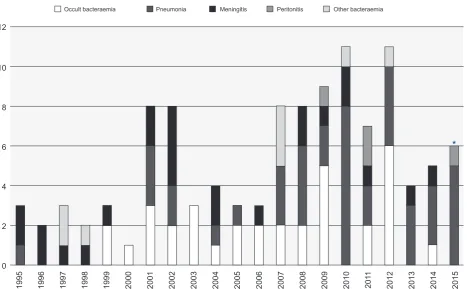
Over the 20.5-year period, 112 patients were diagnosed with IPD, showing an increasing trend (R = 0.565; p = 0.008). A median annual number of four patients with IPD has been found, higher over two periods (eight patients/ year in 2001 and 2002, and 8-11 patients/year in 2007 to 2012) (Fig.2).
All the patients in this group were Caucasian, showing a mild male predominance (55%).
Patient’s age distribution ranged between one month and
Figure 2 – Annual distribution of the number of patients and IPD diagnoses * Data no later than June 2015
Occult bacteraemia Pneumonia Meningitis Peritonitis Other bacteraemia
1995
0 2 4 6 8 10 12
1996 1997 1998 1999 2000 2001 2002 2003 2004 2005 2006 2007 2008 2009 2010 201
1
ARTIGO ORIGINAL 15 years, with a 15-month median and two-year and seven months mean age. IPD was more frequently diagnosed
between the age of six and 24 months and 36.6% of the patients were diagnosed over the first year of life, 64.3% up to the age of two and 85.7% up to the age of six.
Data on patient’s immunisation status were not available in 19.6% of the patients and, from the remaining patients, 46.4% were unvaccinated and 34% were given at least one dose of PCV. Three vaccinated children presented with the disease caused by a single vaccine serotype and only one completed the whole immunisation schedule for the age (a three-year old girl who had completed a 3-dose PCV-13 schedule [2, 4 and 12 months] presented with pneumonia associated with the isolation of a serotype 3 pneumococcus in blood culture; the presence of immunodeficiency had been ruled out).
The identification of the pneumococcus was obtained in blood culture (n = 72), CSF (n = 24), pleural fluid (n = 11), abscess fluid (n = 3; one patient with a retro-orbital abscess and two patients with plastron appendicitis) and peritoneal fluid (n = 2). Pneumococci were isolated from more than one biological product (blood culture + CSF, n = 5; blood culture + pleural fluid, n = 1) (Table 1). Pneumonia, occult bacteraemia and meningitis were amongst the most frequent diagnoses found (Table 1). IPD has been detected from culture or by molecular biology, as shown in Table 1. An increasing number of patients diagnosed with OB and pneumonia has been found over the study period, with a decreasing number of patients diagnosed with meningitis. The distribution of diagnoses throughout the years is shown in Fig. 2.
An increasing number of patients (grouped into five-year
periods) diagnosed with pneumonia has been found (Table 2) (R = 0.949; p = 0,051), in addition to a mild increase in the number of patients with OB (R = 0.666; p = 0.334), showing an unchanged number of patients diagnosed with meningitis throughout the study period. Eleven patients with pneumonia and three with meningitis were diagnosed by CPR over the study period.
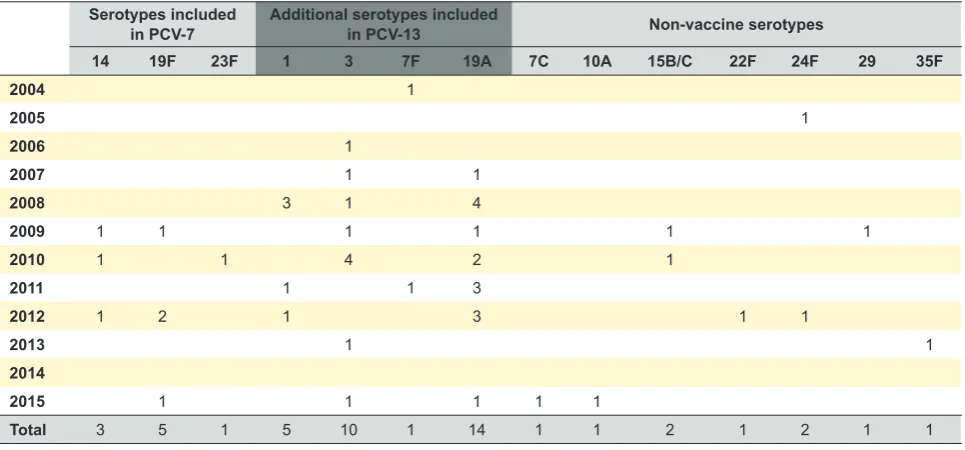
Serotype identification was available for 44% of the patients (49/112 and 19A and 3 serotypes were more frequently found [Table 3]).
Four patients died over the study period, caused by the presence of meningitis. Hearing impairment (n = 6), delayed psychomotor development (n = 5), hydrocephalus (n = 3) and cranial nerve palsy (n = 1) were among the most frequently found complications.
DISCUSSION
The epidemiology of pneumococcal disease has changed over the past few decades with the introduction of pneumococcal conjugate vaccines, leading to a significantly decreased incidence of IPD caused by vaccine serotypes both in vaccinated and unvaccinated patients. Despite the phenomenon of ‘serotype replacement’, the significant reduction in the number of patients infected with vaccine serotypes largely overpassed those infected with non-vaccine serotypes.12-15
Only in 2014 did IPD become a mandatory notifiable disease in Portugal.17 A prospective study carried out by
the Grupo de Estudo da Doença Invasiva Pneumocócica
(Study Group on Invasive Pneumococcal disease) of
the Sociedade de Infeciologia Pediátrica / Sociedade
Portuguesa de Pediatria (SPP) found that overall IPD
Table 1 - Patient’s diagnosis and biological product used for the identification of S. pneumoniae
Diagnosis n (%) Pneumococcal isolate (n) Identification by molecular biology (n) Pneumonia 42 (37.5%) Pleural fluid (11)
Blood culture (26) Pleural fluid (11) Occult bacteraemia 38 (33.9%) Blood culture (38)
Meningitis 24 (21.4%) CFS (24)
Blood culture (5) CFS (3)
Appendicitis
Primary peritonitis 4 (3.6%) Abscess fluid (2)Peritoneal fluid (2) Orbital cellulitis
Retro-orbital abscess 2 (1.8%) Blood culture (1)Abscess fluid (1) Sepsis 1 (0.9%) Blood culture (1) Endocarditis 1 (0.9%) Blood culture (1)
CSF: Cerebrospinal fluid
Table 2 - Evolution of main diagnoses over time
Diagnosis (n) 1995 - 1999 2000 - 2004 2005 - 2009 2010 - 2015 Rp
Occult bacteraemia 2 10 13 9 R = 0.666p = 0.334
Pneumonia 1 6 10 25 R = 0.949p = 0.051
ARTIGO ORIGINAL
incidence ranged between 6.3 and 4.6/100,000 children and adolescents, from 2006 to 2014 (Brito MJ, personal communication).
Two Portuguese studies on a single hospital’s experience have been published: one study carried out in 2007 in a group-II hospital in Lisbon found an incidence rate of 11.8:100,00018 and another study carried out in the Northern region of Portugal involved 32 patients with IPD throughout a 13-year period (2000 - 2012), which has made more difficult the analysis of an evolution trend.19
Our study covered a longer period of time and the number of patients with IPD remained unchanged throughout the years, even though data regarding a long period of time should be carefully analysed and compared, as changes in procedures may have had some contribution, namely regarding the more frequent use of blood cultures and new molecular biology laboratory techniques (the use of CRP for pneumococcus from 2008 onwards), allowing for the identification of bacteria that were not previously identified, namely in pleural fluid and in CSF of patients on antibiotic therapy. The fact that no identification has been carried out on whether or not a larger number of blood cultures is associated with the presence of OB or other diseases was also a limitation to the analysis.
A lower use of blood cultures has been found in OB by some North-American centres upon universal pneumococcal vaccination, due to the significantly decreased incidence of the disease.20 This was not found in our study, due to the fact that the vaccine was not included in the PNV and therefore with a lower and uneven coverage. In addition, reasons related to the epidemiological monitoring of a vaccine-preventable disease may also have contributed. The most frequently isolated serotypes are included in PCV-13 (75.5%; 37/49) and these were mainly serotypes 3 and 19A, in line with those more frequently isolated in Portugal.9 The small number of serotypes available did not allow for the analysis of serotype evolution and distribution
by the affected age groups. Secular trends (1990-2013) in pneumococcal serotypes in pre and post-vaccine times in regions of Spain with no universal vaccination were analysed by Fenoll A et al. and no impact on the incidence of IPD caused by some vaccine serotypes has been found related to low vaccine coverage, leading to the need for universal immunisation schedules in order to obtain any benefit on IPD.21
One child in our study with an adequate immunisation schedule was diagnosed with IPD related to vaccine serotype 3. Different patients with parapneumonic pleural effusion caused by serotype 3 S. Pneumoniae were described by Antachopoulos et al. in 2014; five from a total of 15 patients were children who were given the recommended PCV-13 schedule.22 Previous serological testing had already
shown three-times lower levels of IgG antibody against this serotype, when compared to the remaining vaccine serotypes in vaccinated children.23,24
CONCLUSION
This retrospective analysis allowed for the assessment of IPD evolution over a 20-year period, before and upon the approval of pneumococcal conjugate vaccines and immediately before its universal introduction in Portugal. No clear trend of reduction in the number of patients in this population has been found, even though considering that a long period has been analysed, which made more difficult any data homogeneous analysis, namely due to the introduction of new diagnostic laboratory techniques over the past few years, a higher number of blood cultures and due to the fact that a small number of cases were involved in the study.
The recent inclusion of PCV-13 in the PNV will certainly have a contribution for a best control of the disease in Portugal and these data are relevant for the assessment of IPD evolution in childhood and the impact in other age groups related to herd immunity.
Table 3 - Serotype annual distribution, grouped by PCV-7 serotypes, PCV-13 additional serotypes and non-vaccine serotypes Serotypes included
in PCV-7 Additional serotypes included in PCV-13 Non-vaccine serotypes
14 19F 23F 1 3 7F 19A 7C 10A 15B/C 22F 24F 29 35F
2004 1
2005 1
2006 1
2007 1 1
2008 3 1 4
2009 1 1 1 1 1 1
2010 1 1 4 2 1
2011 1 1 3
2012 1 2 1 3 1 1
2013 1 1
2014
2015 1 1 1 1 1
ARTIGO ORIGINAL OBSERVATIONS This was presented as an oral communication at the 16º Congresso Nacional de Pediatria, Oct 2015, Albufeira
HUMAN AND ANIMAL PROTECTION
The authors declare that the followed procedures were according to regulations established by the Ethics and Clinical Research Committee and according to the Helsinki Declaration of the World Medical Association.
DATA CONFIDENTIALITY
The authors declare that they have followed the protocols of their work centre on the publication of patient data.
CONFLICTS OF INTEREST
Fernanda Rodriguesattended advisory boards and was speaker in Symposia organized by GSK and Pfizer and fees were given to the Associação de Saúde Infantil de Coimbra (ASIC).
ASIC’s research projects led by Fernanda Rodrigues were supported by Pfizer.
The remaining authors declare that there were no conflicts of interest in writing this manuscript.
FINANCIAL SUPPORT
The authors declare that there was no financial support in writing this manuscript.
REFERENCES
1. Pilishvili T, Brendan N, Moore MR. Pneumococcal disease. In: VPD surveillance manual. 5th ed. 2012:1-11. [consultado 2016 set 16].
Disponível em: https://www.cdc.gov/vaccines/pubs/surv-manual/chpt11-pneumo.pdf.
2. Kaplan SL, Mason EO Jr, Wald ER, Schutze GE, Bradeley JS, Tan TQ, et al. Decrease of invasive pneumococal infections in children among 8 children’s hospitals in the United States after the introduction of the 7-valent pneumococcal conjugate vaccine. Pediatrics. 2004;113:443-9. 3. De Lencastre H, Kristinsson KG, Brito-Avô A, Sanches IS, Sá-Leão R,
Saldanha J, et al. Carriage of respiratory tract pathogens and molecular epidemiology of Streptococcus pneumoniae colonization in healthy children attending day care centers in Lisbon, Portugal. Microb Drug Resist.1999;5:19-29.
4. Rodrigues F, Foster D, Caramelo F, Serranho P, Gonçalves G, Januário L, et al. Progressive changes in pneumococcal carriage in children attending daycare in Portugal after 6 years of gradual conjugate vaccine introduction show falls in most residual vaccine serotypes but no net replacement or trends in diversity. Vaccine. 2012;30:3951-6.
5. Recomendações sobre vacinas: actualização 2014. Comissão de Vacinas da Sociedade de Infecciologia Pediátrica e Sociedade Portuguesa de Pediatria. 2014: 13-18. [consultado 2016 set 16]. Disponível em: http://www.spp.pt/UserFiles/file/Comissao_de_Vacinas/ RECOMENDACOES_SOBRE_VACINAS_EXTRA_PNV_2014%20 _1_%20FINAL.pdf.
6. Tendais-Almeida M, Ferreira-Magalhães M, Alves I, Tavares M, Azevedo I. Vacinação contra infecções por Streptococcus pneumoniae em crianças e adolescentes de alto risco para doença invasiva pneumocócica. Acta Med Port. 2015;28:583-9.
7. Pilishvili T, Lexau C, Farley MM, Hadler J, Harrison LH, Bennett NM, et al. Sustained reductions in invasive pneumococcal disease in the era of conjugate vaccine. J Infect Dis. 2010;201:32-41.
8. Miller E, Andrews NJ, Waight PA, Slack MP, George RC. Herd immunity and serotype replacement 4 years after seven-valent pneumococcal conjugate vaccination in England and Wales: an observational cohort study. Lancet Infect Dis. 2011;11:760-8.
9. Aguiar SI, Brito MJ, Horácio AN, Lopes JP, Ramirez M, Melo-Cristino J. Grupo de estudo da DIP da Secção de Infecciologia Pediátrica da SPP. Decreasing incidence and changes in seotype distribution of invasive pneumococcal disease in persons aged under 18 years since introduction of 10-valent and 13-valent conjugate vaccines in Portugal, July 2008 to June 2012. Euro Surveill. 2014;19:20750.
10. Recomendações sobre vacinas extra programa nacional de vacinação. Comissão de Vacinas da Sociedade de Infecciologia Pediátrica e Sociedade Portuguesa de Pediatria. [consultado 2016 set 16]. Disponível em: http://www.spp.pt/UserFiles/file/Comissao_de_Vacinas/ Recomendacoes%20sobre%20vacinas%20extra%20PNV%202015-2016.pdf.
11. Instituto Nacional de Estatística. Statistical information. Lisbon: INE. [consultado 2016 set 16]. Disponível em: http://www.ine.pt/
12. Moore MR, Whitney C. Use of pneumococcal disease epidemiology
to set policy and prevent disease during 20 years of the emerging infections program. Emerg Infect Dis. 2015;21:1551-6.
13. Knol MJ, Wagenvoort GH, Sanders EA, Elberse K, Vlaminclx BJ, de Melker HE, et al. Invasive pneumococcal disease 3 years after introduction of 10-valent pneumococcal conjugate vaccine, the Netherlands. Emerg Infect Dis. 2015;21:2040-4.
14. Diawara I, Zerouali K, Katfy K, Zaki B, Belabbes H, Najib J, et al. Invasive pneumococcal disease among children younger than 5 years of age before and after introduction of pneumococcal conjugate vaccine in Casablanca, Morocco. Int J Infect Dis. 2015;40:95-101.
15. Verani JR, Domingues CM, de Moraes JC, Brazilian Pneumococcal Conjugate Vaccine Effectiveness Study Group. Indirect cohort analysis of 10-valent pneumococcal conjugate vaccine effectiveness against vaccine-type and vaccine-related invasive pneumococcal disease. Vaccine. 2015;33:6145-8.
16. Varon E, Cohen R, Béchet S, Doit C, Levy C. Invasive disease potential of pneumococci before and after the 13-valent pneumococcal conjugate vaccine implementation in children. Vaccine. 2015;33:6178-85. 17. SINAVE. Doenças de Notificação Obrigatória. Despacho 5687-A-2014
de 29 de Abril. [consultado 2016 set 16 ]. Disponível em: https://dre.pt/ application/dir/pdf2sdip/2014/04/082000001/0000200020.pdf. 18. Neves JF, Rodrigues P, Peres A, Constantino C, Cunha F. Doença
pneumocócica invasiva na era vacinal. Acta Pediatr Port. 2008;39:206-10.
19. Pereira H, Preto C, Sousa M, Dias F, Gaspar E. Doença pneumocócica invasiva: treze anos de experiência num hospital de grupo II. Acta Pediatr Port. 2014;45:193-7.
20. Simon AE, Lukacs SL, Mendola P. National trends in emergency department use of urinalysis, complete blood count, and blood culture for fever without a source among children aged 2 to 24 months in the pneumococcal conjugate vaccine 7era. Pediatr Emerg Care. 2013;29:560-7.
21. Fenoll A, Granizo J, Giménez MJ, Yuste J, Aguilar L. Secular trends (1990-2013) in serotypes and associated non-susceptibility of S. pneumoniae isolates causing invasive disease in the pre-/post-era of pneumococcal conjugate vaccines in Spanish regions without universal paediatric pneumococcal vaccination. Vaccine. 2015;33:5691-9. 22. Antachopoulos C, Tsolia MN, Tzanakaki G, Xirogionni A, Dedousi
O, Markou G, et al. Parapneumonic pleural effusions caused by Streptococcus pneumoniae serotype 3 in children immunized with 13-valent conjugated pneumococcal vaccine. Pediatr Infect Dis J. 2014; 33:81-3.
23. Yeh SH, Gurtman A, Hurley DC, Block SL, Schwartz RH, Patterson S, et al. Immunogenicity and safety of 13-valent pneumococcal conjugate vaccine in infants and toddlers. Pediatrics. 2010;126:e493-505. 24. Snape MD, Klinger CL, Daniels ED, John TM, Layton H, Rollinson L,