ISSN: 2147-611X
www.ijemst.com
Planning
Skills of
the
Prospective
Elementary
School
Teachers
in
Mathematics Course
Elif Kilicoglu
Hatay Mustafa Kemal University
To cite this article:
Kilicoglu, E. (2019). Planning skills of the prospective elementary school teachers in
mathematics course
.
Journal of Education in Mathematics, Science and Technology
(IJEMST), 7
(4), 349-366.
This article may be used for research, teaching, and private study purposes.
Any substantial or systematic reproduction, redistribution, reselling, loan, sub-licensing,
systematic supply, or distribution in any form to anyone is expressly forbidden.
Authors alone are responsible for the contents of their articles. The journal owns the
copyright of the articles.
Volume 7, Number 4, 2019
ISSN: 2147-611X
Planning Skills of the Prospective Elementary School Teachers in
Mathematics Course
Elif Kilicoglu
Article Info
Abstract
Article History
Received: 03 January 2019
In this study, it was aimed to analyze mathematics course planning skills of the prospective elementary school teachers. Another aim of this study was to investigate predictivity of the prospective teachers‟ planning skills towards their professional beliefs. The prospective teachers were asked to plan the micro-lesson to be taught to reveal this aim. The study was carried out with 120 prospective elementary school teachers studying as 3rd graders at a state university. Lesson plan form was developed as a data collection tool by the researcher. This form consisted of three stages which were before the lesson, during the lesson and after the lesson. The researcher participated in the process, and the lessons were video-recorded. Therefore, observations of the researcher and the video-recordings were used as data collection instruments in this study as well. The data obtained were analyzed based on content analysis. Findings of the study revealed that the prospective teachers had insufficient and inconsistent planning skills. Furthermore, the prospective teachers were even not aware of their behaviors. It was observed that the prospective teachers did not pay enough attention to mathematical language, to mathematical skills and to mathematical expressions and their levels of awareness on this matter were quite low.
Accepted: 19 September 2019
Keywords
Teacher education Prospective teachers Professional development Detailed teaching planning
Mathematics education Geometry education
Introduction
Individuals encounter mathematics before elementary school. Individuals who enter the world of mathematics through numbers or daily shopping calculations without realizing deal with complex subjects of mathematics in the coming years. Mathematics is a science which is explained with numbers in the simplest terms, but which contains concepts and relations between concepts rather than numbers and which is based on abstract methods. Mathematics which we face in almost all fields of life from industry to technology and from art to science, and it is a field which improves with collective effort of societies. To gain a place in an individual‟s life for such a strong field is definitely not an easy process. Individuals‟ adopting the goal of using mathematics in their future life that they face in their preschool education is a responsibility to be taken. Achieving this goal alone is utopic for most of us. Therefore, what do individuals need to achieve this? There can be many answers to this problem. But one of the most common answers is undoubtedly a presence who helps in teaching and guides to teaching: teacher.
One of the most important indicators of commenting on teachers' professional skills can be student achievement. When the studies on the academic achievement of the students were examined, it was found that the success in mathematics was generally low. For example, Papanastasiou (2002) reported that low achievement in mathematics was influenced by multiple factors rather than by one factor. According to him, it is important to determine what these factors are. This can be the first step to identifying the obstacles to students' achievements. Concrete indicators of students' achievements are available for each country in the TIMMS reports. As in these reports, mathematics achievement is low for our country. There are studies supporting the same result in different years (Aydın, Sarier & Uysal, 2012; Askar & Olkun, 2005; Berberoglu, 2007). This is a concrete indicator of the questioning of teaching. The first persons responsible for teaching are teachers. Hence, students' successes can predict how effectively teachers use their professional skills. Teacher training planning is one of the professional skills and this skill is of great importance in shaping the lesson. A good plan is necessary for the success of the business. In other words, planning of education is related to student achievement. If you want your students to succeed, you should plan your lesson well. Courses such as mathematics in particular are full of activities and should be. The activities require good planning. Considering that planning affects student achievement, how effective teachers can use planning skills becomes even more important. Because achieving student success is one of the universal aims of education systems.
There are several studies revealing that teachers‟ beliefs form their instructional preferences and naturally their classroom practices (Eley, 2006; Levin & He, 2008; Richardson, 2003). Another matter that these studies share in common is that educational beliefs have impact on planning or decision making skills of teachers or prospective teachers. Therefore, according to Kilpatrick, Swafford & Findell (2001, p.31) educational quality is directly related to teachers‟ course planning skills by preparing mathematics that students are required to learn. According to Abrosse, Clement, Philipp and Chauvot (2004), teachers' professional beliefs are effective in their decisions on shaping a lesson. The attitude of the teacher directly affects the student's belief. There are studies suggesting that the mathematical beliefs of the individual affect learning (Kloosterman and Stage, 1992). Hence, teacher practices or plans developed by teachers can reflect their professional skills. It can be claimed that there are few studies on this topic in Turkey. It can be suggested that among the studies about teacher training are mostly classroom practices that provide rich data. In this study, it was aimed to scrutinize planning skills of the prospective teachers. Another aim of the research was to reveal that planning skills of the prospective teachers are correlated with their professional beliefs. The research questions were created as follows in accordance with the aim of the study:
1. How are mathematics course planning skills of prospective elementary school teachers?
2. Do planning skills of prospective elementary school teachers provide insight about their professional development?
Theoretical Framework
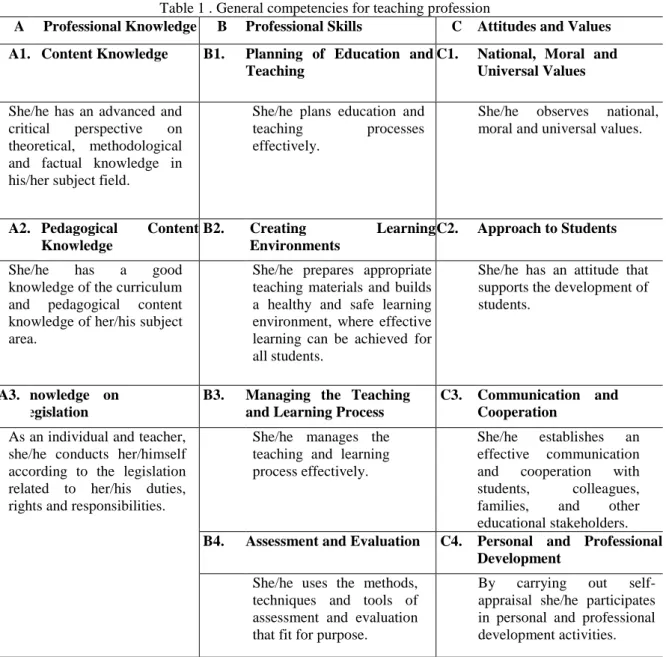
personal and professional development were described by the Turkish Ministry of National Education (MoNE) in 2017 (Table 1).
Table 1 . General competencies for teaching profession
A Professional Knowledge B Professional Skills C Attitudes and Values
A1. Content Knowledge B1. Planning of Education and Teaching
C1. National, Moral and Universal Values
She/he has an advanced and critical perspective on theoretical, methodological and factual knowledge in his/her subject field.
She/he plans education and teaching processes effectively.
She/he observes national, moral and universal values.
A2. Pedagogical Content Knowledge
B2. Creating Learning Environments
C2. Approach to Students
She/he has a good knowledge of the curriculum and pedagogical content knowledge of her/his subject area.
She/he prepares appropriate teaching materials and builds a healthy and safe learning environment, where effective learning can be achieved for all students.
She/he has an attitude that supports the development of students.
A3. Knowledge on Legislation
B3. Managing the Teaching and Learning Process
C3. Communication and Cooperation
As an individual and teacher, she/he conducts her/himself according to the legislation related to her/his duties, rights and responsibilities.
She/he manages the teaching and learning process effectively.
She/he establishes an effective communication and cooperation with students, colleagues, families, and other educational stakeholders. B4. Assessment and Evaluation C4. Personal and Professional
Development
She/he uses the methods, techniques and tools of assessment and evaluation that fit for purpose.
By carrying out self-appraisal she/he participates in personal and professional development activities.
Countries ought to follow the necessities of the time and technological innovations, briefly, they should follow the developing world. Teacher competencies that are required by our educational system are classified into three sections – professional knowledge, professional skills and attitudes and values – as can be seen in Table 1. These three sections are interrelated, and each is a rich structure complementing the other. These structures consist of 11 sub-competencies and 65 indicators describing these competencies. While professional knowledge includes content knowledge, knowledge of content education and knowledge of legislation, professional skills are rather related to competencies of teachers about planning education, creating learning settings, managing learning process and measuring and assessing the process. On the other hand, attitudes and values are related to personal and professional development, communication and collaboration, national and moral values and attitude towards students.
the process. The explanations show that these four structures are dynamic with each other. Although it is systematic, teachers can plan lesson plans according to their own style in their classrooms. The researchers consider it more logical to plan the course in a more specific way rather than referring to the introduction, development and conclusion section. For example, Kablan (2012) stated that the suitability of the chosen teaching method to gain, the suitability of the process to the method, the effectiveness of the selected teaching material, the contribution of teaching activity to learning, the contribution of real life examples to learning, or the suitability of the learning plan as criteria for preparing a lesson plan. This planning, where the criteria are enriched instead of classical planning, requires teachers to demonstrate their superior skills. As a matter of fact, Bilen (2002) states that increasing the quality of teaching is possible with effective planning skills. Cruickshank and Metcalf (1993) stated that success will be achieved through planned activities rather than ordinary things, and this was later proved by Konyalioglu, Konyalioglu and Isik (2003).
Particularly in recent years, reform movements in every phase of instructional levels have often become one of the current issues. This dynamic process in education has necessitated innovations and improvements in higher education, and the courses in bachelor‟s degree program and their contents were updated in 2018. The course of “Mathematics Education” in the program of elementary school teaching is given with different contents in two academic semesters of the 3rd grade. While aim of mathematics, its basic principles, its history, content and aim of the program, learning theories, mathematical skills, related topics of the program and sample activities suitable for the topics are taught in the first semester, a course that includes the way of teaching topics and learning outcomes related to learning domains in mathematics and doing practice with activities is taught in the second semester. Mathematics education has an important place in basic education. According to Umay (2003), mathematics is one of the building blocks of basic education and perhaps the most important because it improves the human's ability to think, which the basic feature is. This shows that mathematical knowledge and skills have a critical importance in the education of elementary school teachers.
Method
Model of the Research
The current study was formed according to qualitative research approach, and it is a case study as it was aimed to reveal course planning skills of prospective elementary school teachers. In qualitative studies, a case is observed in its regular setting, and definition of the thing described as a case is important (Denzin & Lincoln, 2000, p. 215).
Sample
The study was carried out on prospective teachers studying as 3rd graders at elementary education department of a state university in 2017-2018 academic year. All of the four active separate classes were included in the study. Each class was grouped in fours and threes. 33 groups and 120 students participated in the research in total. As the researcher was responsible of the course herself, she endeavored to make them eager for the study. Consequently, it was ensured that all of the students participated in the study voluntarily. The data regarding the subjects of the research were presented in Table 2.
Table 2. Details of the sample
Class Number of Students Number of Groups
3-A 37 10
3-B 36 10
3-C 25 7
3-D 22 6
Sum 120 33
& Gul, 2007). Therefore, it can be stated that the subjects of the research were selected through purposeful sampling method.
It was thought that groups in threes and fours, depending on the classroom size, in determining the student groups would be suitable for implementing this research. On the other hand, the learning outcomes in sub-learning domains and course times were taken into consideration, too. In addition to these, number of course weeks excluding exam weeks was considered in determining number of groups in each class division. Two domain experts and students were asked for their opinions, and sample groups were decided as shown in Table 1. According to the table, there are 10 groups in branches A and B, 7 groups in branch C and 6 groups in branch D. The differentiation of the number of groups is related to the class size, but the lack of reports of some groups caused them to be excluded. Therefore, the number of groups is different.
Data Collection Tools and Implementation Process
Basically two data collection tools were employed in the study. The first one was the videos that had recorded students‟ practices and the other was the lesson plans developed by the students. Furthermore, the data obtained by the researcher during these practices were also used to contribute to the data of the study. Since the researcher is already responsible for the course during the application process, she has a good command of the application and data collection process.
Lesson plan form. The lesson plan forms developed by the researcher consisted of three stages which were before the lesson, during the lesson and after the lesson. The planning of three-stage courses were given theoretically and practically in the course of Mathematics Education-I in 2017-2018 fall term, and the students were asked to develop their own plans regarding their practices in the course of Mathematics Education-II in the spring semester. In the period before the implementation period, the students were informed about how to make a lesson plan with the help of the academician in charge of the lesson. In fact, the course of that period was processed in this way. After the students are given theoretical knowledge about planning skills, what to do in a lesson plan is explained. Afterwards, practices related to primary school achievements were made and the course was ended with criticism and feedback. In some courses, students created the plan themselves and in some courses they analyzed the previously created plan. Thus, it can be suggested that the students had prior knowledge about writing a plan before the implementation. Firstly, the students were asked to explain details of the courses they had planned, to tell what they aimed and to report it. Next, they were asked to write about the way of teaching to be applied in their lessons. After their practices, they were asked to evaluate the lesson they had taught. Then, they were informed about how they should act in each phase of the practice reports and about what they should pay attention both by the researcher and the brief reminders in the draft plan. This form that the prospective teachers filled provided the researcher with rich data about their self-awareness.
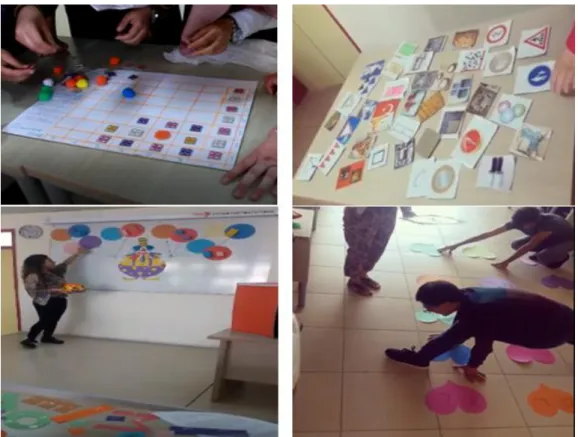
The implementation process consisted of three stages which were receiving plans for before-lesson, teaching lesson and making evaluations after lesson. Each group was given 40 minutes to teach lesson, and they were asked to plan the lessons pretending that they were teaching to both prospective teachers and elementary school students. Moreover, the students were encouraged to make brief explanations like experts during their lessons. Figure 1 shows some of the visuals related to the implementation process. Necessary precautions were taken to make sure that group members would work and practice responsibly. Practices of the groups were recorded with a camera positioned on a tripod and located in back corner of the classroom – especially suitable place to capture whole practice period. Video recordings provide convenience for the researcher since it is possible to check the parts that are possible to be overlooked, and they contribute to the reliability of the studies in that other researchers can analyze them (Goodnough, 2011; Toptas, 2008). In this study, video-recordings were included in the analysis with observation notes of the researcher in a manner that could support during lesson planning skills of the students.
Figure 1. Implementation process
Data Analysis
Both document and video analysis were employed in this research. The videos obtained were transmitted into written documents by being transcribed, and all documents were analyzed via content analysis method. Content analysis is reaching concepts and relations which are often used in case studies and which can be summarized explanatorily (Yildirim & Simsek, 2011, p. 227). The forms and video analysis - transcriptions obtained from the student groups were content analyzed; they were revised by the researcher again and again in order to prevent possible deficiencies or mistakes. The lesson content forms consisted of three stages which were before the lesson, during the lesson and after the lesson. However, it was supposed that it would be more suitable to analyze video-recordings with during lesson reports as they represented the students‟ expressions. The videos of the course presentations of the students were compared with the course reports. Necessary notes were kept for each video. Students' reports and course adaptations were compared with the help of these notes. To prevent the bias of the researcher, randomly selected course videos were also reviewed by other researchers. Therefore, each section was analyzed separately, and codes and categories were created meticulously. The categories were paid attention to be thorough expressions that were believed to reflect planning skills of the students ideally. In the analysis of the data, the evaluation rubric created by the researcher was created separately for each department. In the evaluation, it was examined whether they took every stage of the course, what they paid attention to and what they did not pay attention to. During the course, attention was paid to how the students shape the process, what they pay attention to at the entrance, what they do to ensure the flow of the process, how the activities are prepared, how much the acquisitions and narratives overlap, the use of time, class management, and the appropriate use of mathematical language. At the end of the course, students were asked to realize the degree to which they have realized their pre-lesson plans.
Creation of the Categories
When the groups‟ reports for before and during lesson were analyzed, 4 themes and 19 categories which were 5, 7, 4, 3 respectively were created. Sample cases were given in Table 3. Furthermore, definitions related to each category were explained following Table 3 in order to make explicit under which category the expressions on each of these two headings would be evaluated (see Appendix 1). When the prospective teachers‟ skills of planning after the lesson were analyzed, 11 categories were found in total. Definitional explanations related to the categories were presented below. Furthermore, examples of group reports included in the categories were shown in Table 4 (see Appendix 2).
Reliability and Validity of the Study
In order to control the functioning of the implementation process of the study, another expert was also occasionally participated in the course, and information about feedback and functioning was used. This is a condition that affects the validity of the study. In addition, the reliability of the research is related to the reliability of the data analysis. For this reason, the codes and categories created by the researcher were created
by another researcher. Coding reliability was obtained by using
( ) formula proposed by Miles & Huberman (1994, p. 64) and the reliability was found 90%. It was discussed until a consensus was reached for the situations where there was disagreement. Moreover, the categories and data obtained were given to another researcher, and the researcher was asked to express his opinion about the appropriateness of using these codes under the relevant categories.
Findings
In this section, the prospective teachers‟ skills of planning “before the lesson”, “during the lesson” and “after the lesson” were analyzed comparatively. Giving the data of before the lesson and during the lesson together was found convenient as it was thought that this would enable the research to be understood better. However, their skills of planning after the lesson were given under a separate heading comparatively with these two skills.
Skills of Planning “Before the Lesson” and “During the Lesson”
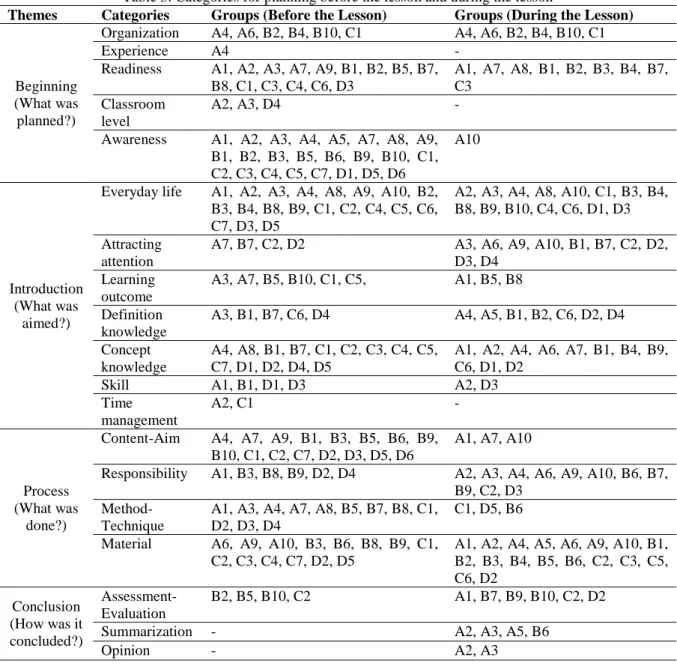
Analyses related to the prospective teachers‟ skills of planning before the lesson and planning during the lesson were given in Table 3. In Table 3, each category was considered in itself on the basis of group, and groups‟ plans of before the lesson and their teaching processes were compared. 6 group reports (A4, A6, B2, B4, B10, C1) planning a systematic process such as generating all ideas before the lesson and assessing them, rehearsing the draft lesson plan and improving the necessary points following the rehearsal were identified. When these groups‟ teaching was analyzed, it was seen that there was an organized lesson in all of their presentations. However, this was not stated in other groups‟ reports at all. There was only one group which expressed that deciding for an organized structure would only be possible by asking experienced teachers‟ opinions and received help from teachers already working (A4). For example, before the lesson, the A4 group said,
It is important to follow a systematic path to the acquisition. Possible paths should be determined for this. We took the help of an experienced teacher for our own presentation, advantage of the ideas of different teachers, help from textbooks or other books, and rehearsed… Before the lesson, we constantly discussed how we can improve.
There was evidence that this group followed these paths during class. There were groups which stated that determination of students‟ readiness levels is important in enacting the plan (A1, A2, A3, A7, A9, B1, B2, B5, B7, B8, C1, C3, C4, C6, D3). When these groups‟ teaching was carefully analyzed, some of them (A1, A7, B1, B2, B7, C3) did what they stated, but some of them (A2, A3, A9, B5, B8, C1, C4, C6, D3) did not. Contrarily, some groups (A8, B3, B4) took this into consideration even though they had not stated in their plans before the lesson. On the other hand, only three of the 33 groups (A2, A3, D4) emphasized in their plans before the lesson that classroom level should be taken into consideration, yet none of them considered classroom level during their teaching. For example, group B3 stated the following during the course for the acquisition (He/she estimates angle measurements and checks by measuring the estimated angle) of 4th grade level:
is more appropriate to move on to teaching basis acquisition… The student readiness for new topics is necessary to success.
However, this group did not mention them in the pre-class report and completed the report using general expressions. Another significant finding of the research was towards analyzing awareness of the students. Although 24 of the 33 groups taking part in the study – this is the majority – could forecast in which subjects students would have difficulty or concepts they would get confused or the problems that would be encountered in using materials before the lesson, they paid no attention to this situation during the lesson. It was revealed that only members of one group (A10) had not planned this before the lesson, but it considered the circumstances where students would make mistakes or have difficulty during the lesson.
Table 3. Categories for planning before the lesson and during the lesson
Themes Categories Groups (Before the Lesson) Groups (During the Lesson)
Beginning (What was planned?)
Organization A4, A6, B2, B4, B10, C1 A4, A6, B2, B4, B10, C1
Experience A4 -
Readiness A1, A2, A3, A7, A9, B1, B2, B5, B7, B8, C1, C3, C4, C6, D3
A1, A7, A8, B1, B2, B3, B4, B7, C3
Classroom level
A2, A3, D4 -
Awareness A1, A2, A3, A4, A5, A7, A8, A9, B1, B2, B3, B5, B6, B9, B10, C1, C2, C3, C4, C5, C7, D1, D5, D6
A10
Introduction (What was
aimed?)
Everyday life A1, A2, A3, A4, A8, A9, A10, B2, B3, B4, B8, B9, C1, C2, C4, C5, C6, C7, D3, D5
A2, A3, A4, A8, A10, C1, B3, B4, B8, B9, B10, C4, C6, D1, D3 Attracting
attention
A7, B7, C2, D2 A3, A6, A9, A10, B1, B7, C2, D2,
D3, D4 Learning
outcome
A3, A7, B5, B10, C1, C5, A1, B5, B8 Definition
knowledge
A3, B1, B7, C6, D4 A4, A5, B1, B2, C6, D2, D4 Concept
knowledge
A4, A8, B1, B7, C1, C2, C3, C4, C5, C7, D1, D2, D4, D5
A1, A2, A4, A6, A7, B1, B4, B9, C6, D1, D2
Skill A1, B1, D1, D3 A2, D3
Time management
A2, C1 -
Process (What was
done?)
Content-Aim A4, A7, A9, B1, B3, B5, B6, B9, B10, C1, C2, C7, D2, D3, D5, D6
A1, A7, A10
Responsibility A1, B3, B8, B9, D2, D4 A2, A3, A4, A6, A9, A10, B6, B7, B9, C2, D3
Method-Technique
A1, A3, A4, A7, A8, B5, B7, B8, C1, D2, D3, D4
C1, D5, B6 Material A6, A9, A10, B3, B6, B8, B9, C1,
C2, C3, C4, C7, D2, D5
A1, A2, A4, A5, A6, A9, A10, B1, B2, B3, B4, B5, B6, C2, C3, C5, C6, D2
Conclusion (How was it concluded?)
Assessment-Evaluation
B2, B5, B10, C2 A1, B7, B9, B10, C2, D2
Summarization - A2, A3, A5, B6
Opinion - A2, A3
the concept of mathematical pattern, at the beginning of the lesson, they told a student's schedule until he came to school in the morning and emphasized that he/she was constantly doing the same thing. In this way, they said that
we would prevent the student from seeing the concept of pattern as a terrible mathematical term. This situation is not included in the pre-lesson plans of the students, it is seen that they pass directly to the lecture. Just one of the groups stating that associating relevant learning outcome with previous or next learning outcomes was important (B5) paid attention to this matter during the lesson to a certain degree. However, two groups (A1 and B8) paid particular attention to relations between learning outcomes during their teaching even though they had not mentioned this in their plans before the lesson. Only three of the groups (B1, C6, D4) expressing that giving definitions of concepts included in learning outcomes was necessary made use of definitions during the lesson, whereas just four of the groups having noted that concepts included in learning outcomes needed to be constructed on or associated with the previously learnt concepts (A4, B1, D1, D2) did what they had intended to do. On the other hand, there were some groups being sensitive to use definitions (A4, A5, B2, D2) and concepts (A1, A2, A6, A7, B4, B9, C6) that had not been written in their plans (see Table 3). Part of the course presentation of A1 group members is as follows:
Do the cat-building activity with your students, because this activity will give your students the opportunity to activate their prior knowledge of geometric shapes, so you can summarize the previous acquisition… You will also be the basis for the new acquisition with this activity (The activity is done)… Starting with the geometric shape and switching to the concept of geometric objects will reveal the relationship between these two concepts. It is important to emphasize the concepts of shape and object.
As can be seen, the A1 group pays attention to the relationship between the acquisitions during the lesson and attaches importance to concept knowledge. But they never mentioned them in their pre-lesson report:
we will explain the lessons starting from the close environment and keep the prediction skill at the forefront. We make sure that students are active. We will use the question-answer method…
On the other hand, only one of the groups (D3) enacted its plan with regard to the skills to be gained by the students during teaching the relevant topics. However, one group (A2) attached importance to skills although it had not stated this matter in its plans. It was interesting that merely two groups (A2, C1) hazarded an opinion on time to be spent in teaching topics; however, neither of the groups was careful about time management during the lesson.
Except for one of the groups claiming the importance of identifying aims of activities to be used in practices of the prospective teachers and of describing especially the points to be emphasized (A7), all of the other groups (A4, A9, B1, B3, B5, B6, B9, B10, C1, C2, C7, D2, D3, D5, D6) did not pay attention to this matter in their real practices. Some expressions of these groups are as follows:
I must be aware of the concepts I have to focus on when giving the acquisition, if we don't want students to be confused, we need to know in advance what concepts we will tell, the teacher should go prepared for the lesson to avoid confusion of the concept as equity and equality, there are concepts that can be confused with each other we must pay attention to this…
Some of the groups having planned to teach using materials (A6, B8, C1, C4, C7, D5) could not make this, while some others (A1, A2, A4, A5, B1, B2, B4, B5, C5, C6) used materials during their lessons even though they had not identified this in their plans. Contrarily, some groups (A9, A10, B3, B6, B9, C2, C3, D2) used materials during their teaching as they had planned before the lesson.
Finally, the groups had not given sufficient information about assessment and evaluation before the lesson, and merely some groups (A1, B7, B9, B10, C2, D2) paid attention to this during their lessons. It was observed that the two groups (B2, B5) having included assessment and evaluation in their plans before the lesson did not stick to their plans. On the other hand, a few groups (A1, B7, B9, D2) did not neglect assessment and evaluation during their practices though they had not paid attention to this before the lesson.
Apart from the categories existing before the lesson, there were also some categories developed during the lesson. It was concluded from the data obtained during the lesson that some groups (A2, A3) attached importance to opinions of the students, while some others (A2, A3, A5, B6) stated that summarizing at the end of the lesson was important and they summarized the topic briefly. In addition to this, all of the groups tried to teach topics doing activities, but some of them (A3, A5, A6, A7, B1, B3, B8, B9, B10, C1, C2, C6, D4) needed particularly reinforcement activities to construct knowledge in students‟ minds. For example, the C2 for teaching the concept of edge and corner; they made their entrance with the story activity and made presentations with various activities. Later, they used different activities such as song activity, paper-pen activity, pasta activity to increase the permanence of the learned information. They stated that these activities were important in reinforcing the subject.
Skills of Planning “After the Lesson”
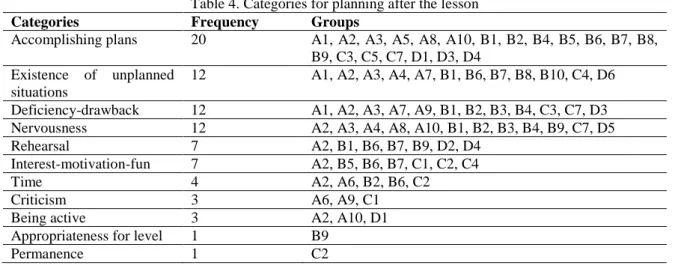
The data of each group included in the research were analyzed in itself, and analyses regarding the prospective teachers‟ skills of planning “after the lesson” were presented in Table 4.
Table 4. Categories for planning after the lesson
Categories Frequency Groups
Accomplishing plans 20 A1, A2, A3, A5, A8, A10, B1, B2, B4, B5, B6, B7, B8, B9, C3, C5, C7, D1, D3, D4
Existence of unplanned situations
12 A1, A2, A3, A4, A7, B1, B6, B7, B8, B10, C4, D6 Deficiency-drawback 12 A1, A2, A3, A7, A9, B1, B2, B3, B4, C3, C7, D3
Nervousness 12 A2, A3, A4, A8, A10, B1, B2, B3, B4, B9, C7, D5
Rehearsal 7 A2, B1, B6, B7, B9, D2, D4
Interest-motivation-fun 7 A2, B5, B6, B7, C1, C2, C4
Time 4 A2, A6, B2, B6, C2
Criticism 3 A6, A9, C1
Being active 3 A2, A10, D1
Appropriateness for level 1 B9
Permanence 1 C2
When Table 4 was examined, it was found that 20 groups (A1, A2, A3, A5, A8, A10, B1, B2, B4, B5, B6, B7, B8, B9, C3, C5, C7, D1, D3, D4) claimed that they achieved their plans exactly. When the lessons of these groups were scrutinized, it was seen that some of them practiced differently from the learning outcomes or deficiently. On the other hand, 12 groups stated that they encountered with unplanned situations during their lessons, but they were able to cope with them. Some groups (A1, A2, A3, A7, A9, B1, B2, B3, B4, C3, C7, D3) told that they experienced deficiencies and problems during the lesson, and most of them (A2, A3, B1, B2, B3, B4, C7) expressed that this was generally because of nervousness. However, the others claimed that this stemmed from misconceiving learning outcomes, from forgetting some parts or from confused concepts (field-shape, circle-round, etc.).
(A6, A9, C1) criticized their own teaching and identified behaviors they would avoid if a second chance was given.
Three groups (A2, A10, D1) expressed that they realized importance of being active in lessons. It was understood that none of these three groups touched on the students‟ responsibility. When the lessons of these three groups were examined, it was revealed that solely one group (A10) encouraged the students to be active during the lesson and reminded them their responsibilities. Furthermore, although many groups did not teach appropriately to the students‟ level, just one group (B9) realized this. Finally, it was merely detected by one group (C2) that permanence in teaching should be during the lesson.
Discussion
In this study, mathematics course planning skills of prospective elementary school teachers were analyzed. This research presents some data regarding the way of prospective teachers‟ forming a lesson. Therefore, relations among their pre-lesson plans, their teaching during the lesson and their evaluations after the lesson were interpreted, and they were presented holistically. If these data are generally analyzed, it can give opinion about beliefs, views on teaching, instructional roles and even educational styles of the prospective teachers. The findings of the research revealed that there was deficiency and inconsistency in planning skills of the prospective teachers in general. Furthermore, the prospective teachers could not realize the deficiencies they caused even though they taught the lessons designed by themselves.
The prospective teachers‟ plans of “before the lesson” and of “during the lesson” were analyzed, and what they paid most attention to in starting the lessons. 6 groups primarily taught the lesson holistically and claimed that a strategy was necessary to form the lesson (Table 3). In the lesson observations of these groups, it was actually seen that they paid special attention to the organized structure they produced. There was only one group which suggested the idea of benefiting from experience in order to design a lesson. It is interesting that just one group considered this idea if it is regarded that the prospective teachers had no teaching experience before. On the other hand, almost half of the research groups believed that having information about readiness levels of the students and about their classroom levels was crucial for developing target behaviors to be taught (Table 3). It has frequently been emphasized that prior knowledge and level of the students are significant (Aydemir, 2018; Long, Iatarola & Conger, 2009; Roth, Crans, Carter, Ariet & Resnic, 2001; Tatar & Dikici, 2008). When teaching of these groups was analyzed, it was found that some of them took aforementioned concepts into consideration while some others did not (Table 3). Probably one of the most significant findings of the research was awareness of the prospective teachers about students or learning outcomes. In other words, the fact that the prospective teachers were aware of the situations where students would have difficulty and of the points to be considered affected their lesson plans. Thus, Scraw (2009), Veenman, Van Hout-Wolters and Afflerbach (2006) suggested in their studies that being aware of knowing would undoubtedly be beneficial and be basis of future learnings. In the current study, a great majority of the research groups (n=24) did not pay attention to situations that students would have difficulty in during the lesson even though they were aware of this. This is actually weird, isn‟t it?
The data related to what the prospective teachers aimed were regarded as introduction stage. In this stage, everyday life, attracting attention and concept knowledge were the most frequently stated expressions by the groups both before and during the lesson. Most of the prospective teachers mentioned the importance of attracting students‟ attention and interest to lesson for associating everyday life with learning outcomes and for enabling students‟ active participation. In most of the groups these expressions were included during the lesson (Table 3). Learning outcome, concept and definition knowledge are pretty significant terms to help students adopt target behaviors (Morali, Koroglu & Celik, 2004; Pugalee, 2001; Warren, 2006). These terms have important place in mathematical language. The data of the current study revealed that the students did not attach enough importance to these terms. When plans of the groups were analyzed in detail, what primarily attracted our attention was that the prospective teachers did not regard relations between learning outcomes, made definitions illogically and did not know meanings of definitions exactly. To put it more explicitly, the prospective teachers included the concepts that should not have been used rather than the concepts contained by the learning outcomes, and so they made the lessons more complicated. For instance, let‟s share self-criticism of a group in its plan after the lesson:
Indeed, this can be a sign that they were not able to act in a planned way. There are certainly multiple reasons of this situation; however, it can be claimed that one of the reasons was their not being able to make a decent plan. Planning is an important task for teaching. Eley (2006) suggested that planning and reporting were significant approaches in teaching, and they were necessary to improve teaching.
Mathematical skills are as important as mathematical language for teaching or learning mathematic effectively. Another finding of the current study was that the prospective teachers did not place enough emphasis on mathematical skills. It was observed that just 4 groups mentioned mathematical skills before the lesson, and all of these groups except for one ignored mathematical skills in their lesson observations (Table 3). It is a known fact that mathematical skills are crucial for school success starting from early ages of life (Unutkan, 2007). Thus, this finding was found quite disappointing. One of the categories appearing in this section was time management. The prospective teachers‟ not making predictions about time management or their not doing anything regarding this during the lesson caused them to have problems during the process. In fact, time management is among the problems mentioned most frequently by the experienced teachers (Halat 2008; Kose, 2011; Temiz 2005). That the prospective teachers did not have any suggestions about time management may cause this problem to be permanent. Therefore, it can be claimed that the prospective teachers should eliminate this problem by themselves before blaming the educational system.
The data related to what the prospective teachers planned to do were given under the theme of process. In this section, we saw that the prospective teachers explained aim or content of the activities before the lesson (Table 3). However, it was found that all of the groups except for one disregarded aim and content of the activities during the lesson. Even some groups deviated from the aims of the activities, and also they did not realize this. There were some groups which suggested that students‟ being active and that giving responsibility to the students during teaching were important. Nevertheless, solely one of these groups regarded this during the lesson. On the other hand, there were some groups which showed how responsibility can be given to the students during the lesson even though they had not planned this before the lesson (Table 3). It is not pleasing that just one group among 10 research groups paid attention to this. Role of the students in teaching process is significant for an effective mathematics teaching (Ryan, Gheen & Midgley, 1998). Additionally, the categories where the groups were clustered intensively under this theme were method-technique and material. It was interesting that the groups often preferred using materials during the lesson, yet it was not the same for method-technique. Furthermore, it was observed that while the groups sorted the methods-techniques to be used randomly before the lesson, they did not employ these methods-techniques during the lesson and generally taught the lesson through direct instruction. For instance, one of the groups stated that they had planned
to influence multiple intelligence types by developing activities which would appeal to different intelligence types before the lesson, but they ignored this during the lesson. It was quite surprising that the students disregarded the things they had stated in their plans before the lesson during the lesson. Finally, the data related to assessment-evaluation were evaluated under a theme in the analysis of the prospective teachers‟ plans. Assessment and evaluation are not only the basic terms of education, but they are also indispensable concepts for teacher training. Several strong studies claiming that teachers, prospective teachers, briefly, other components of instruction are insufficient in this matter are available (Birgin & Baki, 2012; Chappuis & Stiggins, 2002; Turnuklu, 2004; Yildiz & Uyanik, 2004). The data of the present study supports these studies, too. Only few of the groups made explanation about assessment and evaluation (Table 3). The groups except for some ( ) disregarded this during the lesson. This number is quite small for such an important concept of education. On the other hand, just few of the groups asked the students‟ opinions about their practices. Statement of one of these groups was as follows: I ask students to tell what they think about the lesson and even about my own teaching that day at the end of the lesson, which enables me to assess myself. Like the prospective teacher expressed, it is necessary for the teachers to be assessed in order to improve themselves. Particularly assessments of students have importance of first-hand source.
On the other hand, it was found that the data related to “attracting attention” and “arousing interest” were not sufficiently stated in any stages of the lesson. Therefore, it can be claimed that it was one of the points ignored by the prospective teachers. However, the proficiency in teachers‟ ability to teach is connected to the degree they are able to use this concept. Similar things can be suggested about students‟ being active as well. Importance of giving students responsibility in educational process is certainly not open to any dispute. In fact, there are several studies having supported this (Bacon, 1993; Cunningham, 2004; Celik, 2002, p. 2; Hassel & Lourey, 2005; Lewis, 2001; Saritas, 2006; www.tll.mit.edu, 2018). It was disappointing that just 3 groups presented data about importance of this matter. Finally, placing emphasis on expressions almost never mentioned as well as the concepts frequently used in the research became more of an issue. For instance, appropriateness for lesson and permanence. Appropriateness for lesson had been disregarded before and during the lesson, but this matter was not handled at the end of the process. Particularly ignoring significant concepts like permanence in education is disadvantageous for teacher development. Permanence in education is an essential structure to sustain success, and it is probably a matter which is searched most popularly and which arouses researchers‟ interests. That the prospective teachers ignored such an important factor is intolerable.
Kablan (2012) stated that preparing a lesson plan is not an ordinary task but should be based on a certain systematic. It also argues that the course sections need to be elaborated in order to make more precise planning rather than the introduction, development and conclusion. This is similar to the sensitivity of the measuring instrument. As the units in the measurement tool increase, its sensitivity increases and it is accepted that it performs the measurement process better. The lesson plan is similar. The more details you go into, the more sensitive and purposeful a lesson you're planning. Therefore, Kablan (2012) deemed it necessary to evaluate the criteria such as the suitability of the acquisition and the method and daily life, effectiveness of the material, contribution of the activity to learning. In this study, the students were asked to make detailed planning and research data were analyzed accordingly. The analysis show that students are lacking in terms of suitability of the acquisition and method.
Conclusion and Implications
It was aimed to reveal planning skills of the prospective teachers in this study. Thus, readers can have an idea about how lesson plans in students‟ minds are. In this study, basically results regarding professional developments of the prospective teachers, mathematics instruction and training of the prospective teachers were revealed. Accordingly, some implications were discussed.
The findings of the research hazard an opinion about professional developments of the prospective teachers. When group reports of the prospective teachers were analyzed, it was found that most of them made inconsistent explanations, that is to say, they either did not do what they had stated or had not stated the things they did. Moreover, they were not aware of these inconsistencies at the end of the process. As prospective teachers will be one of the main characters of educational process in the future, it can be indicated that this is not pleasant for the future. Furthermore, when it is considered that teachers play a vital role in students‟ learning, this becomes more desperate. All of these attitudes have a negative impact on beliefs towards teaching profession. What is worrying about this matter is that the prospective teachers were not aware of these problems. In a study conducted by Ozabacı and Acat (2005), prospective teachers‟ perceptions related to features of their self-development were studied, and characteristics of their ideal teacher perceptions were compared. As a result of this comparison, it was concluded that perceptions of the prospective teachers were away from their perceptions of an ideal teacher. According to the researchers, this finding was important in terms of posing an obstacle for being a good teacher. In the current study; however, there were inconsistencies even in the prospective teachers‟ perceptions related to their professional development. Therefore, it is recommended that studies aiming to stimulate awareness of the prospective teachers regarding their personal development be carried out.
Subject matter education is a concept referring that teachers understand what they teach, and developing it is not a usual event, but a difficult and comprehensive process. Hence, it is suggested that prospective teachers should be trained more comprehensively about subject matter education before starting their practicum.
Finally, the data obtained from the current research resulted in the fact that there is something wrong about teacher training. That the prospective teachers‟ thoughts regarding the way of forming the process were unsettled supports this idea. This presents clear data to educators and even to programmers that change is necessary. The groups with which the research was conducted had received the course of “General Mathematics” for two semesters before receiving the course of “Mathematics Education”. This course is offered for one semester in the new curriculum. It was concluded from the results of the research that time allocated to mathematics education is inadequate. Thus, it is recommended that the mathematics course be included in the program for a longer time and be revised especially in terms of content.
References
Askar, P., & Olkun, S. (2005). PISA 2003 sonucları acısından okullarda bilgi ve iletisim teknolojileri kullanımı. Eurasian Journal of Educational Research, 19, 15-34.
Aydemir, T. (2008). The readiness level of preservice primary school teachers in new primary school mathematics curriculum relating to numbers concept area (Unpublished master thesis). Pamukkale University, Denizli.
Aydın, A., Sarıer, Y., & Uysal, S. (2012). The comparative assessment of the results of PISA mathematical literacy in terms of socio-economic and socio-cultural variables. Education and Science, 37(164), 20-30. Birgin, O., & Baki, A. (2012). An investigation of the purposes of the measurement and assessment practice of
primary school teachers within the context of the new mathematics curriculum. Education and Science,37(165), 152-167.
Chappuis, S., & Stiggins, R. J. (2002). Classroom assessment for learning. Educational Leadership, 60(1), 40-44.
Council for the Accreditation of Educator Preparation [CAEP]. (2012). Elementary mathematics specialist (Advanced preparation). Reston, VA: Author.
Celik, V. (2002). Sinif yonetimi. Ankara: Nobel Publication.
Denzin, K., & Lincoln, S. (2000). The sage handbook of qualitative research (3rd ed.). London: Sage Publications.
Eley, M. G. (2006). Teachers‟ conceptions of teaching, and the making of specific decisions in planning to teach. Higher Education, 51(2), 191-214.
Ernest, P. (1989). The knowledge, beliefs and attitudes of the mathematics teacher: A model. Journal of Education for Teaching,15(1), 13-34.
Goodnough, K. (2011). Examining the long‐ term impact of collaborative action research on teacher identity and practice: the perceptions of K–12 teachers. Educational Action Research, 19(1), 73-86.
Guven, S., & Ozerbas, M., A. (2016). Ogretim ilke ve yontemleri. Ankara: Pegem Publications.
Halat, E. (2007). The views of elementary school teachers on the new elementary school mathematics curriculum. Afyon Kocatepe University Journal of Social Science, 9(1), 63-99.
Ilgan, A. (2013). Effective professional development for teachers. Usak University Journal of Social Science, 6, 41-56. Retrieved December, 12, 2018 from http://dergipark.gov.tr/usaksosbil/issue/21642/232634. Kablan, Z. (2012). The effects of level of cognitive learning and concrete experience on teacher candidates'
lesson planning and application skills. Education and Science, 37(163), 239-253.
Kloosterman, P., & Stage F. (1992). Measuring beliefs about mathematical problem solving. School Science and Mathematics, 92, 109-115.
Kose, E. (2011). Evaluation of 2005 elementary mathematics curriculum according to educational criticism model.Adnan Menderes Universitesi Egitim Fakultesi Egitim Bilimleri Dergisi, 2(2), 1-11.
Lanier, J. E. (1984). Research on teacher education (Occasional Paper No. 80). East Lansing: Michigan State University, Institute for Research on Teaching.
Levin, B., & He, Y. (2008). Investigating the content and sources of teacher candidates' personal practical theories (PPTs). Journal of Teacher Education, 59(1), 55-68.
Long, M. C., Iatarola, P., & Conger, D. (2009). Explaining gaps in readiness for college-level math: The role of high school courses. Education Finance and Policy, 4(1), 1-33.
Miles, M. B., & Huberman, A. M. (1994). Qualitative Data Analysis (2nd ed), CA: Sage Publications.
Moralı, S., Koroglu, H., & Celik, A. (2004). Trainee mathematics teachers‟ misconceptions and attitudes towards abstract mathematics course: a sample of Buca faculty of education. Journal of Gazi Education Faculty,24(1), 161-175.
National Council of Teachers of Mathematics [NCTM]. (2002). Principles and standards for school mathematics. Reston, VA: Author.
National Research Council. [NRC]. (2001). Adding it up: Helping children learn mathematics. J. Kilpatrick, J. Swafford, and B. Findell (Eds.). Mathematics Learning Study Committee, Center for Education, Division of Behavioral and Social Sciences and Education. Washington, DC: National Academy Press.
Ozabacı, N., & Acat, B. M. (2005). A comparative study of ideal and self characteristics of teacher candidates. Kuram ve Uygulamada Egitim Yonetimi Dergisi, 11(2), 211-236.
Ozen, Y., & Gul, A. (2007). Population-sampling issue on social and educational research studies. Journal of Kazım Karabekir Education Faculty, 15, 394-422.
Pajares, M. F. (1992). Teachers‟ beliefs and educational research: Cleaning up a messy construct. Review of educational research, 62(3), 307-332.
Pugalee, D., K. (2001). Writing, mathematics, and metacognition: looking for connections through students‟ work in mathematical problem solving. School Science and Mathematics, 101(5), 236–45.
Richardson, V. (2003). Preservice teachers‟ beliefs. In J. Raths & A. C. McAninch (Eds.), Teacher beliefs and classroom performance: The impact of teacher education (Vol. 6, pp. 1-22). Greenwich, CT: Information Age Publishing.
Roth, J., Crans, G., Carter, R., Ariet, M., & Resnick, M. (2000). Effect of high school course-taking and grades on passing a college placement test. The High School Journal,84(2), 72-87. Retrieved September, 22, 2018 from http://www.jstor.org/stable/40364406.
Ryan, A. M., Gheen, M. H., & Midgley, C. (1998). Why do some students avoid asking for help? An examination of the interplay among students' academic efficacy, teachers' social–emotional role, and the classroom goal structure. Journal of Educational Psychology, 90(3), 528-535.
Sarıtas, M. (2006). Ogretmen adaylarının degerlendirmelerine gore sınıfta istenmeyen ogrenci davranıslarını degistirmek ve duzeltmek amacıyla yararlanılan stratejiler. Uludag Universitesi Egitim Fakultesi Dergisi, 19(1). 167-187.
Schraw, G. (2009). A conceptual analysis of five measures of metacognitive monitoring. Metacognition and Learning, 4(1), 33-45.
Tatar, E., & Dikici, R. (2008). Learning difficulties in mathematics education. Mustafa Kemal University Journal of Social Sciences Institute, 5(9), 183-193.
Temiz, N. (2005). İlkogretim 4. sınıf matematik dersi yeni ogretim programının yansımaları. 14. Ulusal Egitim Bilimleri Kongresi Bildiriler Kitabı icinde (pp. 356-361), Denizli. Retrieved October, 18, 2018 from https://www.pegem.net/Akademi/kongrebildiri_detay.aspx?id=100794.
Toptas, V. (2008). Analysis of the teaching–learning process by the activities applied during geometry teaching. Elementary Education Online, 7(1), 91-110.
Turnuklu, E. B. (2003). Mathematics teachers‟ assessment styles in Turkey and England. Journal of Education Faculty of Hacettepe University, 24, 108-118.
Umay, A. (2003). Mathematical reasoning ability. Hacettepe University Journal of Education, 24, 234-243. Unutkan, O. P. (2007). A study of pre-school children‟s school readiness related to skills of
mathematics. Journal of Education Faculty of Hacettepe University, 32, 243-254.
Veenman, M. V., Van Hout-Wolters, B. H., & Afflerbach, P. (2006). Metacognition and learning: Conceptual and methodological considerations. Metacognition and Learning, 1(1), 3-14.
Warren, E. (2006). Comparative mathematical language in the elementary school: A longitudinal study. Educational Studies in Mathematics,62(2), 169–189.
Yıldırım, A., & Simsek, H. (2011). Nitel arastirma yontemleri. Ankara: Seckin Publication.
Yıldız, I., & Uyanık, N. (2004). On measurement and evaluation in mathematics teaching. Kastamonu Education Journal, 12(1), 97-104.
Zeybek, Z., & Acıl, E. (2018). Investigating seventh grade students‟ mathematical communication skills: Student journals. Turkish Journal of Computer and Mathematics Education, 9(3), 476-512.
Author Information
Elif Kilicoglu
Hatay Mustafa Kemal University
Department of Mathematics and Science Education, Faculty of Education, 31060, Hatay, Turkey
Appendix 1. Before and During the Lesson Categories and Sample Cases
Themes Categories Sample Cases
Beginning (What was planned?)
Organization Primarily, we generated ideas on previous learning outcomes, and everybody shared their own ideas and activities they found. Then, we selected the activities that were most suitable to the learning outcome. Experience We got opinions of different elementary school teachers about our
activities.
Readiness We are going to lead in with mnemonic activities.
Classroom-level We are going to develop various activities regarding classroom-level. We are going to arrange the activities based on the learning outcomes, so we are going to take cognitive levels of the students into consideration.
Awareness We may have difficulty in behaving suitable to children‟s level and in simplifying the topic because we can easily understand and shape the topic in our minds, but this may not be so easy for them.
Introduction (What was aimed?)
Everyday life The students are fostered to realize what relevant objects resemble and where they are used in everyday life. We know that they do not examine the things they use in everyday life consciously, and we would like to raise their awareness.
Attracting attention
We are going to begin the lesson with a story to remind them the geometric shapes they have already learned and to attract their attention.
Learning outcome
Particularly, we are going to enable them to comprehend the differences between surfaces of “cones, cylinders and spheres” and “cubes, rectangular prisms, square prisms and triangular prisms”. Our aim is to provide them not to have difficulty in learning further learning outcomes.
Definition knowledge
We are going to teach the concept “angle”, but we are not going to use concepts like ray and point as there is no explicit definition in our learning outcome.
Concept knowledge
It should be emphasized that the concepts equity and equality are not the same.
Skill Before introducing the term corner, the students are fostered to guess the term through an activity. Two students are positioned different points of the classroom in such a way that they create right angle. They are asked to walk through the road they have been positioned, and location of their meeting point is asked. Corner is taught with this method.
Time management
The students will have difficulty in using protractor and drawing angles with it as they will see it for the first time, and this results in waste of time.
Process (What was done?)
Content-Aim Our aim to do activities such as ... is to teach right angle and other types of angle.
Responsibility We are paying attention to the students‟ being active.
Method-Technique
The methods and techniques used are instruction method, discovery learning, educational games, musical training, and individualized teaching.
Material ... finally the students are encouraged to make a non-standard measuring instrument, and necessity of standard measures related to its use is reached.
Conclusion (How was it concluded?)
Assessment-Evaluation
learning outcomes and choosing the most suitable ones, deciding how to practice the things learnt, rehearsing for getting opinion on practices, organization.
Experience; benefiting from experiences of more experienced people in planning lessons, getting opinions. Readiness; activating students‟ prior knowledge and assessing their knowledge towards the concept to be learnt, reminding them previous learning outcomes, considering cognitive levels of students, associating prior knowledge with new information.
Classroom level; preparing activities according to classroom level and suitability of explanations or of concepts to be used for explanations to classroom level.
Awareness; being able to guess students‟ confusion, to express where they will have difficulty, to guess difficulties to be had in using materials (Note: It was not questioned if answers in this category were true or not).
Everyday life; making lesson attractive and enjoyable, and sometimes consolidating learning outcomes by this way.
Attracting attention; attracting students‟ focus on lesson through the things they are interested in, attracting their attention to lesson.
Learning outcome; paying attention to learning outcomes in preparing activities, associating relevant learning outcome with previous or next learning outcomes, considering concepts that are included or not included in learning outcomes.
Definition knowledge; giving definitions of concepts related to learning outcome, being careful about trying not to use definitions particularly for some learning outcomes.
Concept knowledge; paying attention to similarities and differences among concepts and to their explanations, associating concepts.
Skill; behaviors supposed to be gained by the students.
Time management; waste of time resulting from difficulty of using materials and from activity management and from content of learning outcomes.
Content-Aim; explaining aim of the planned activities, stating the matters required to be emphasized in practice, revealing the points to be highlighted.
Responsibility; ensuring that students are active, enabling them to undertake responsibility.
Method-Technique; functionalizing types of multiple intelligences by developing activities addressing to different intelligence areas (A3), employing various methods and techniques such as question-answer, instruction, discussion, musical training, individualized teaching and brainstorming.
Appendix 2. After the Lesson Categories and Sample Cases
Categories Sample Cases
Accomplishing plans All plans were accomplished.
Existence of unplanned situations There were various student views that had not been planned before. Some students changed directions of the shapes during forming a pattern. The teacher intervened in and corrected their misunderstanding. Incompleteness-drawback We completed the incomplete parts incisively. The problems appeared in
the plan surprised us, but they did not surpass teaching, and negative situations were removed through the examples given.
Nervousness We got nervous during the lesson along with having fun before the lesson.
Rehearsal We did everything we had wanted before the lesson with the help of rehearsals.
Interest-motivation-fun We observed that participation and interest of the class was high. Thus, we could reflect our target outcomes, the points to be emphasized and distinguishing situations.
Time We exceeded the time we had planned before the lesson because the activities took a long time. In other words, we could have taken short the box material if we had done it again.
Criticism It was our mistake that we did not conduct an activity to activate the students. The reason was our anxiety to digress from the learning outcomes.
Being active We did all activities with active participation in sufficient time.
Appropriateness for level … we had problems since music we chose was not appropriate to their levels ...
Permanence We suppose that as the activities and games we conducted provided permanent learning, this knowledge will be permanent in their future life.
Accomplishing plans; putting all actions having been planned before the lesson into practice.
Existence of unplanned situations; experiencing situations except from actions having been planned before the lesson and appearance of unexpected circumstances during teaching.
Deficiency-drawback; deficiencies originating from oversight during teaching, technological failures, deficiencies resulting from shortage of time and drawbacks due to misconceived learning outcomes.
Nervousness; getting nervous during teaching, getting nervous for fear of forgetting planned actions and getting nervous because of insufficient rehearsals.
Rehearsal; benefits of rehearsing before the lesson, disadvantages of not rehearsing.
Interest-motivation-fun; advantageous cases provided by students‟ being active during the lesson, by types of activities and by games.
Time; sufficiency of time allocated to teaching.
Criticism; self-directed interpretations about the situations recorded during teaching. Being active; the state of students‟ participation during the lesson.