Original Research Article
A prospective study for the assessment of thyroid function by pre and
post supervised exercise protocol in newly diagnosed patients of
subclinical hypothyroidism
Dharmendra Jhavar, Naresh K. Patel*, V. P. Pandey
INTRODUCTION
Subclinical hypothyroidism is biochemically defined as an elevated serum TSH level along with a serum free T4 and T3 levels within the population reference range.1 The
incidence of subclinical hypothyroidism varies among populations and ranges from 3 to 15%, with a higher
incidence associated with increasing age and female sex.2,3 The relationship between serum thyrotropin (TSH)
and free T4 is such that a small decrease in free T4 results in a relatively large increase in serum thyrotropin, which can subsequently lead to a thyrotropin level that is above the reference range while the free T4 level is still within the reference range. In cases of progression to overt
ABSTRACT
Background: The presence of raised serum TSH with serum free T4 and T3 within the reference range falls in subclinical hypothyroidism. It is a well-known fact that exercise affects the activity of thyroid glands and the production of their hormones. Author studied the effect of regular exercise in patients of newly diagnosed subclinical hypothyroidism. Pre and post-exercise thyroid function tests were evaluated to decide about the necessity to start thyroid replacement therapy or to adopt wait and watch policy.
Methods: Study enrolled 100 newly diagnosed subclinical hypothyroidism patients attending this tertiary care hospital and randomised them in two groups, one group was subjected to regular physical exercise of 45-60 minutes daily along with supervised treadmill exercise stage 0 for 45-60 minutes once weekly followed by re-evaluation of thyroid function test after 30 days and second group was re-evaluated for thyroid function test without exercise after 30 days.
Results: Thyroid profile parameters were compared and analysed by paired ‘t’ test, statistically significant increase in serum T3 (p value <0.05) and serum T4 (p value <0.05), along with significant reduction in TSH level (p value <0.05) were found in exercise group, while in non-exercise group changes in thyroid profile parameters were statistically not significant. There was significant reduction in mean weight in exercise group (p value <0.05), while in non-exercise group changes in weight were not significant.
Conclusions: Present study concluded that regular physical exercise can improve thyroid function in patients of newly diagnosed subclinical hypothyroidism and convert them to euthyroid state.
Keywords: Exercise, Subclinical hypothyroidism, Treadmill
Department of Medicine, M. G. M. Medical College, Indore, Madhya Pradesh, India
Received: 09 January 2019
Revised: 25 January 2019
Accepted: 30 January 2019
*Correspondence:
Dr. Naresh K. Patel,
E-mail: [email protected]
Copyright: © the author(s), publisher and licensee Medip Academy. This is an open-access article distributed under the terms of the Creative Commons Attribution Non-Commercial License, which permits unrestricted non-commercial use, distribution, and reproduction in any medium, provided the original work is properly cited.
hypothyroidism, the TSH level typically continues to rise and the free T4 level falls below the reference range. In this respect, subclinical hypothyroidism can be seen as a mild thyroid failure, which is caused by autoimmune thyroid disease in most of the cases.
A thyrotropin level of 10mIU/L is commonly used to distinguish between mild and more severe subclinical hypothyroidism.4,5 Approximately 75% of patients with
subclinical hypothyroidism have a thyrotropin level above 5mIU/L but less than 10mIU/L.3
The risk of progression of subclinical hypothyroidism to overt hypothyroidism is approximately 2 to 6% per year.2
The risk is higher among women than men among persons with higher thyrotropin levels, those with higher levels of antibodies to thyroid peroxidase, and those with low-normal free T4 levels.2,6,7
According to European Thyroid Association (ETA) Guideline 2013, subclinical hypothyroidism is classified in two categories according to serum TSH level: mildly increased TSH levels (4.0-10.0mU/L) and more severely increased serum TSH value (>10U/L).8
It is a well-known fact that exercise affects the activity of thyroid glands and the production of their hormones.9 It
has been observed that exercise greatly affect the level of circulating thyroid hormone and effect of regular physical exercise of medium-intensity on thyroid function in patients already undergoing treatment for hypothyroidism can improve the thyroid function.10
Author studied the effect of regular exercise in patients of newly diagnosed subclinical hypothyroidism and pre and post-exercise thyroid function tests were evaluated to decide about the necessity to start thyroid replacement therapy or to adopt wait and watch policy.
METHODS
A prospective observational study was carried out in this Tertiary Care Hospital. The study was approved by institutional review board and scientific review committee of this institution.
Author enrolled 100 patients of newly diagnosed subclinical hypothyroidism of age group 18-50 years attending outpatient department and randomized them in two groups, one group was subjected to regular physical exercise of 45-60 minutes daily along with supervised treadmill exercise stage 0 for 45-60 minutes once weekly followed by re-evaluation of thyroid function test after 30 days and second group was re-evaluated for thyroid function test without exercise after 30 days.
Routine investigations all patients included in study such as complete blood count, liver function test, renal function test, lipid profile and serum electrolytes were essentially within normal limits.
Patients not willing to participate and expressed inability to come for follow up, patients already started thyroxine replacement therapy, age <18 years or >50 years, prisoners and orphans, pregnant women and with psychiatric illness anti-TPO antibody positive, dyslipidemia and goitre, comorbid illnesses like diabetes mellitus, chronic kidney disease, chronic liver disease, coronary artery disease, metabolic syndrome were excluded. Reference range used:
• T3: 0.8-1.9ng/ml,
• T4: 5.0-13.0μg/dl,
• TSH: 0.35-5.0mIU/ml.
Criteria for diagnosis of subclinical hypothyroidism. Refer to elevated levels of thyroid-stimulating hormone (TSH range 5-10IU/ml) in serum in the presence of normal serum levels of thyroxine (T4 range 5.0-13.0mIU/ml).
The discrete data were assessed in number and percent. Statistical methods such as mean, standard deviation, median, confidence interval, paired t-test were used. The baseline thyroid function tests were correlated with thyroid function tests after 30 days. The statistical significance assessed by SPSS version 10.
RESULTS
A total of 100 patients of newly diagnosed subclinical hypothyroidism were enrolled in prospective study. Majority of the patients were in the age group 31-40 years and 41-50 years of age as shown in Table 1.
Table 1: Distribution of patients according to age group.
Age group
Exercise group
Non-exercise group Total
No. % No. % No. %
≤ 20 years 4 8 1 2 5 5 21-30 years 12 24 11 22 23 23 31-40 years 21 42 15 30 36 36 41-50 years 13 26 23 46 36 36 Total 50 100 50 100 100 100
Table 2:Distribution of patients according to gender.
Sex
Exercise group
Non-exercise
group Total
No. % No. % No. %
Male 4 8 5 10 9 9
Female 46 92 45 90 91 91
Total 50 100 50 100 100 100
patients were in exercise group and 50 patients were in non-exercise group. Mean serum T3, T4 and TSH values were analyzed after 30 days in both groups.
Figure 1: Comparison of mean thyroid profile parameter between baseline and 30 days among
exercise group.
Figure 1 shows comparison of mean thyroid profile parameters in the exercise group at baseline (at the time of recruitment) and after 30 days. At baseline mean T3 was 1.09±0.25ng/ml and mean T4 was 8.27±1.79µg/dl, while after 30 days mean T3 was 1.29±0.30ng/ml and mean T4 was 9.40±1.67µg/dl in exercise group. Mean serum T3 and T4 values were increased in exercise group after 30 days as shown in Table 3.
Table 3:Comparison of thyroid hormone value
between baseline and 30 days in among exercise group.
Thyroid profile
Mean±SD Test of
significance
Baseline 30 days
Mean T3 1.09±0.25 1.29±0.30 t =-5.7, p=0.000, df=49
Mean T4 8.27±1.79 9.40±1.67 t =-7.6, p=0.000, df=49
Mean TSH 6.85±1.28 5.62±1.63 t=9.2, p=0.000, df=49
The difference in mean T3 and mean T4 were found statistically significant (p-value = 0.000 in both), showing a higher mean serum T3 and mean T4 after 30 days as compared to baseline. At baseline mean serum TSH was 6.85±1.28mIU/ml, while after 30 days it was 5.62±1.63mIU/ml in exercise group. Mean serum TSH value decreased in exercise group after 30 days as shown in Table 3.
The difference was found statistically significant (p-value=0.000), showing a lower mean serum TSH after 30 days as compared to baseline.
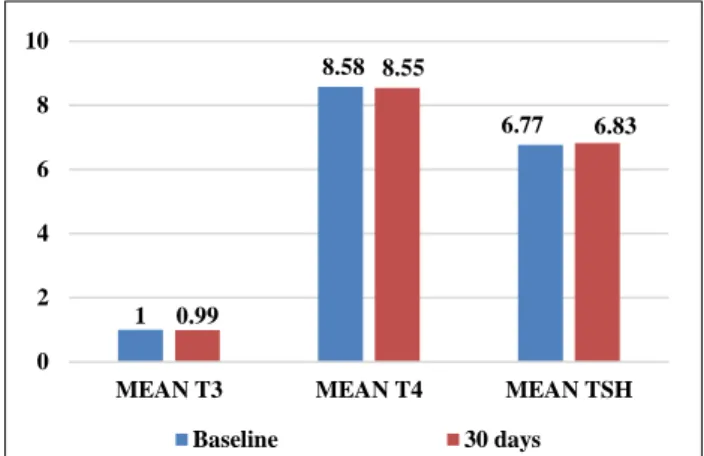
Figure 2 shows comparison of mean thyroid profile parameters in non-exercise group at baseline and after 30
days. At baseline mean T3, mean T4 and mean TSH were 1±0.34ng/ml, 8.58±1.81µg/dl and 6.77±1.33mIU/ml respectively in non-exercise group.
Figure 2: Comparison of mean thyroid profile parameter between baseline and 30 days among
non-exercise group.
While after 30 days mean T3, mean T4 and mean TSH were 0.99±0.32ng/ml, 8.55±1.86µg/dl and 6.83±1.38mIU/ml respectively as shown in Table 4. There was no significant difference in mean T3, mean T4 and mean serum TSH value in non-exercise group (p value=0.620, 0.853, 0.98 respectively) as shown in Table 4.
Table 4: Comparison of thyroid hormone value
between baseline and 30 days in among non-exercise group.
Thyroid profile
Mean±SD Test of
significance
Baseline 30 days
Mean T3 1±0.34 0.99±0.32 t=0.49,
p=0.620, df=49
Mean T4 8.58±1.81 8.55±1.86 t = 0.18, p=0.853, df=49
Mean TSH 6.77±1.33 6.83±1.38 t=-1.6,
p=0.098, df=49
Table 5: Comparison of mean weight between baseline and 30 days in among exercise group and
non-exercise group.
Mean weight±SD Test of significance
Baseline 30 days
Exercise
group 53.41±7.36 52.49±7.23
t=11.4,
p=0.000, df=49
Non-exercise group
55.42±6.80 55.61±6.82 t=-1.3,
p=0.188, df=49
In exercise and non-exercise group baseline mean weight (in kg) was 53.41±7.36 and 55.42±6.80 respectively. After 30 days, mean weight (in kg) in exercise and non-exercise group was 52.49±7.23 and 55.61±6.82
1.09
8.27
6.85
1.29
9.4
5.62
0 2 4 6 8 10
MEAN T3 MEAN T4 MEAN TSH
Baseline 30 days
1
8.58
6.77
0.99
8.55
6.83
0 2 4 6 8 10
MEAN T3 MEAN T4 MEAN TSH
respectively. There was significant reduction in mean weight in exercise group (p-value=0.000), while changes in non-exercise group in not significant statistically (p-value=0.188) as shown in Table 5.
DISCUSSION
According to European Thyroid Association guidelines for management of subclinical hypothyroidism 2013, young patients of age <65 years with serum TSH level 5-10mU/l with serum free T4 within normal range and otherwise asymptomatic, not having comorbidity and anti-TPO antibody negative, doesn’t recommend starting thyroxine replacement therapy rather to follow up with thyroid function test after 3-6 month.8
Galbo H studied the hormonal response to exercise.9
Exercise increases the level of all hormone either by direct gene activation or 2nd messenger except insulin,
insulin level decrease after acute exercise. Exercise greatly increases the level of adrenaline and noradrenaline which in turn regulate the many other hormones.
ACTH, aldosterone, angiotensin, antidiuretic hormone, cortisol, dehydroepiandrosterone, estrogen, progesterone, follicle stimulating hormone, glucagon, growth hormone, insulin-like factor-1, prolactin, testosterone, thyroxine, triiodothyronine and vitamin D level increases after exercise.
Ciloglu F et al, studied exercise intensity and its effects on thyroid hormones.10 Thyroid hormones were
investigated in 60 males well-trained athletes by performing bicycle ergometer at 45% (low intensity), 70% (moderate intensity) and 90% (high intensity). These exercise intensities were selected according to maximum heart rate. After each intensity level, blood sample were withdrawn and serum T4, free T4, total T3, free T3 and TSH values were measured.
The results of this study showed that exercise performed at the anaerobic threshold caused the most prominent changes in the amount of any hormone values.11
In a study done by Bansal A et al, serum TSH values was found significantly decreased in patients of regular exercise group (P<0.001) as compared to non-exercise group (P=0.43).12 Serum T3 and T4 values were also
found to be significantly raised in regular exercise group post-interventionally but not in non-exercise group. Mean weight was also found to be decreased in regular exercise group post-interventionally.
Present study revealed significant reduction in mean weight in exercise group (P=0.000), which in turn decrease the basal metabolic rate and requirement of thyroid hormones. There significant increase in mean serum T3 and mean T4 value along with significant
decrease in mean serum TSH value in exercise group post interventionally.
CONCLUSION
This study demonstrated statistically significant reduction in mean TSH in exercise group patients after 30 days along with increase in serum T3 and serum T4 value. While in non-exercise group, no statistically significant changes in thyroid profile parameters were seen. Reduction in mean weight in exercise group post interventionally was also statistically significant. This study provides valuable input to closely monitor the thyroid function and wait and watch before starting thyroid replacement therapy in newly diagnosed asymptomatic subclinical hypothyroidism patients, having no goitre and negative for thyroid autoantibodies.
So, this study concluded that regular physical exercise can improve thyroid function in patients of newly diagnosed subclinical hypothyroidism and convert them to euthyroid state. However, the results need confirmation by multicentric randomized control trials on larger population.
ACKNOWLEDGEMENTS
Authors would like to acknowledge hospital faculty members and staff for their invaluable contribution.
Funding: No funding sources Conflict of interest: None declared
Ethical approval: The study was approved by the by institutional review board and scientific review committee of M. G. M. Medical College, Indore, Madhya Pradesh, India
REFERENCES
1. Garber JR, Cobin RH, Gharib H, Hennessey JV, Klein I, Mechanick JI, et al. American Association of Clinical Endocrinologists and American Thyroid Association Taskforce on hypothyroidism in adults KA: clinical practice guidelines for hypothyroidism in adults: cosponsored by the American Association of Clinical Endocrinologists and the American Thyroid Association. Thyroid. 2012;22(12):1200-35.
2. Vanderpump MP, Tunbrldge WM, French J, Appleton D, Bates D, Clark F, et al. The incidence of thyroid disorders in the community: a twenty‐
year follow‐up of the Whickham survey. Clin Endocrinol. 1995;43(1):55-68.
3. Canaris GJ, Manowitz NR, Mayor G, Ridgway EC. The colorado thyroid disease prevalence study. Arch Inter Med. 2000;160(4):526-34.
disease and mortality. JAMA. 2010;304(12):1365-74.
5. Surks MI, Ortiz E, Daniels GH, Sawin CT, Col NF, Cobin RH, et al. Subclinical thyroid disease: scientific review and guidelines for diagnosis and management. JAMA. 2004;291(2):228-38.
6. Huber G, Staub JJ, Meier C, Mitrache C, Guglielmetti M, Huber P, et al. Prospective study of the spontaneous course of subclinical hypothyroidism: prognostic value of thyrotropin, thyroid reserve, and thyroid antibodies. J Clin Endocrinol Metab. 2002;87(7):3221-6.
7. Somwaru LL, Rariy CM, Arnold AM, Cappola AR. The natural history of subclinical hypothyroidism in the elderly: the cardiovascular health study. J Clin Endocrinol Metab. 2012;97(6):1962-9.
8. Pearce SH, Brabant G, Duntas LH, Monzani F, Peeters RP, Razvi S, et al. 2013 ETA guideline: management of subclinical hypothyroidism. Euro Thyroid J. 2013;2(4):215-28.
9. Galbo H. The hormonal response to exercise. Diab/Metab Rev. 1986;1(4):385-408.
10. Ciloglu F, Peker I, Pehlivan A, Karacabey K, İlhan N, Saygin O, et al. Exercise intensity and its effects on thyroid hormones. Neuroendocrinol Letters. 2005;26(6):830-4.
11. Opstad PK, Falch D, Öktedalen O, Fonnum F, Wergeland R. The thyroid function in young men during prolonged exercise and the effect of energy and sleep deprivation. Clin Endocrinol. 1984;20(6):657-69.
12. Bansal A, Kaushik A, Singh CM, Sharma V, Singh H. The effect of regular physical exercise on the thyroid function of treated hypothyroid patients: An interventional study at a tertiary care center in Bastar region of India. Arch Med Heal Sci. 2015;3(2):244.
Cite this article as: Jhavar D, Patel NK, Pandey VP. A prospective study for the assessment of thyroid function by pre and post supervised exercise protocol in newly diagnosed patients of subclinical