International Journal of Research in Engineering and Applied Sciences(IJREAS)
Available online at http://euroasiapub.org/journals.php Vol. 7 Issue 9, September-2017, pp. 43~47
ISSN (O): 2249-3905, ISSN(P): 2349-6525 | Impact Factor: 7.196
Foundry Sand as Partial Replacement for Cement in Concrete
Dr. Mohammed Ilyas Anjum
Professor & Head, Department of Civil Engineering, Ghousia College of Engineering,
Ramanagaram, Karnataka -562159, India
Abstract
The cost of cement and its consumption is drastically increasing thereby increasing the cost of concrete. The consumption of cement in 2015 in India was around 288 million metric tons and that worldwide was around 4193 million metric tons. It is necessary to explore means and materials that can be used to supplement the quantity of cement in concrete so as to make it sustainable besides reducing the cost of concrete. Researches all over the world are exploring various such materials. If an otherwise waste material can be used in concrete, it meets the aim of cost reduction as well as reduce its disposal problems. With this objective, a study was conducted by partially replacing the cement quantity by waste foundry sand at 5%, 10%, 15% and 20%. The workability of fresh concrete, compressive and indirect tensile strength properties of hardened concrete were determined. Based on the test results it is found that replacing cement by about 15% with foundry sand provides higher compressive and tensile strength.
Keywords: Cement, Foundry Sand, Concrete, Compressive Strength, Tensile Strength, Workability
INTRODUCTION
Concrete is a composite construction material composed of cement, aggregate (generally a coarse aggregate made of gravels or crushed rocks such as limestone, or granite, plus a fine aggregate such as sand), water, and/or admixtures. The objective is to mix these materials traditionally to make concrete that is easy to transport, place, compact, finish and to give a strong and durable
product. Foundry sand is high quality silica sand that is a byproduct from the production of both
ferrous and nonferrous metal castings. Huge quantity of foundry sand is disposed off leading to
environmental concerns. As such it was attempted to explore the possibility of using foundry sand as a partial substitute for cement in concrete, which can lead to cement sustainability as well as reduce environmental pollution due to foundry sand disposal. Based on the results obtained after conducting various tests, it is observed that up to 15% replacement of cement by foundry sand in concrete provides the desirable compressive and tensile strength.
EXPERIMENTAL WORK Materials used
Cement
International Journal of Research in Engineering and Applied Sciences(IJREAS)
Vol. 7 Issue 9, September-2017
ISSN (O): 2249-3905, ISSN(P): 2349-6525 | Impact Factor: 7.196
Table 1 Properties of cement
Fine Aggregates
The basic properties of fine aggregates used in this study are shown in Table 2.
Table 2 Properties of fine aggregates
Coarse Aggregates
The basic properties of coarse aggregates used in this study are shown in Table 3.
Table 3 Properties of coarse aggregates
Foundry Sand
The waste foundry sand was obtained from a metal industry. The physical properties of foundry sand are given in the Table 4.
Table 4 Properties of foundry sand
LABORATORY TESTS CONDUCTED
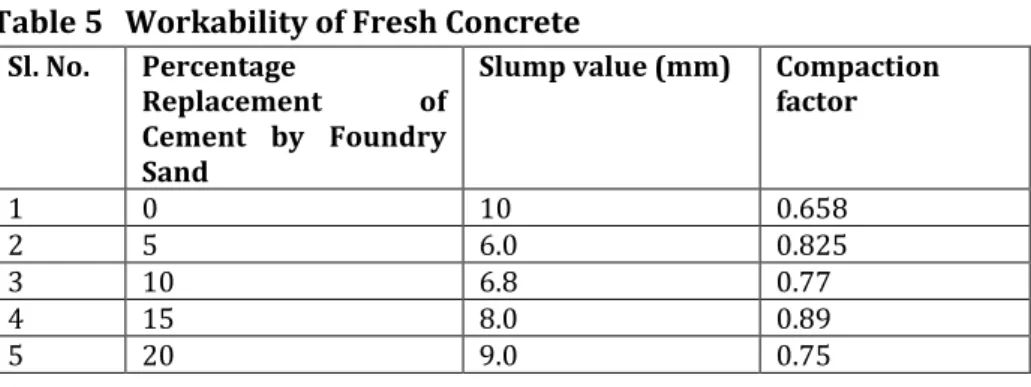
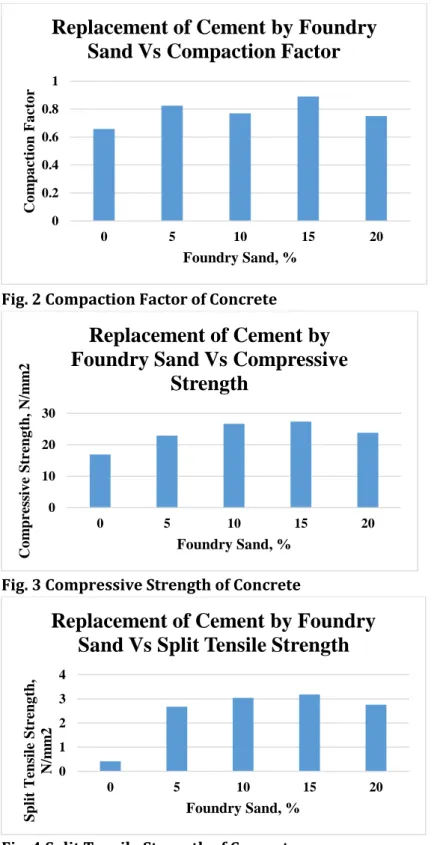
The conventional M-20 concrete mix was designed using the materials listed above. The tests such as Workability by slump, Compaction factor on fresh and Compressive strength & Split tensile strength at 28 days of curing of hardened concrete were conducted. The cement content was then replaced by 5%, 10%, 15% and 20% of foundry sand, prepared the specimens and the above tests were repeated. The test results are presented in Table 5 to 7. The results are also presented in
Property Result
Specific gravity 2.78
Normal consistency 32%
Initial setting time 40 min
Compressive strength 4.26 N/mm2
Property Result
Type Uncrushed (natural)
Specific gravity 2.65 Bulk density 4.13 g/cc Moisture content 0.14%
Property Result
Specific gravity 2.60
Water absorption 1.10 %
Fineness modulus 8.31
Flakiness index 29.36%
Elongation index 26.71%
Property Result
Compression strength 0.16 N/mm2
International Journal of Research in Engineering and Applied Sciences(IJREAS)
Vol. 7 Issue 9, September-2017
ISSN (O): 2249-3905, ISSN(P): 2349-6525 | Impact Factor: 7.196
Table 5 Workability of Fresh Concrete
Sl. No. Percentage
Replacement of Cement by Foundry Sand
Slump value (mm) Compaction factor
1 0 10 0.658
2 5 6.0 0.825
3 10 6.8 0.77
4 15 8.0 0.89
5 20 9.0 0.75
Table 6 Compressive Strength of Concrete at 28 Days
Sl. No. Percentage
Replacement of Cement by Foundry Sand
Compressive Strength (N/mm2)
1 0 16.87
2 5 22.89
3 10 26.67
4 15 27.33
5 20 23.78
Table 7 Split Tensile Strength of Concrete at 28 Days
Sl. No. Percentage Replacement of Cement by Foundry Sand
Split Tensile Strength=
(2P/3.14dl) (N/mm^2)
1 0 0.41
2 5 2.68
3 10 3.041
4 15 3.183
5 20 2.758
Fig. 1 Slump Value of Concrete
0 2 4 6 8 10 12
0 5 10 15 20
Slu
m
p
v
a
lue (
m
m
)
Foundry Sand, %
International Journal of Research in Engineering and Applied Sciences(IJREAS)
Vol. 7 Issue 9, September-2017
ISSN (O): 2249-3905, ISSN(P): 2349-6525 | Impact Factor: 7.196
Fig. 2 Compaction Factor of Concrete
Fig. 3 Compressive Strength of Concrete
Fig. 4 Split Tensile Strength of Concrete
CONCLUSIONS
1. The slump test results on fresh concrete shows that least slump value is obtained at 5% replacement of cement by foundry sand and thereafter it increases and attains the same slump
0 0.2 0.4 0.6 0.8 1
0 5 10 15 20
Co
m
pa
ct
io
n
F
a
ct
o
r
Foundry Sand, %
Replacement of Cement by Foundry
Sand Vs Compaction Factor
0 10 20 30
0 5 10 15 20
Co
m
press
iv
e
Str
eng
th,
N/m
m
2
Foundry Sand, %
Replacement of Cement by
Foundry Sand Vs Compressive
Strength
0 1 2 3 4
0 5 10 15 20
Sp
lit
T
ens
ile
Str
eng
th,
N/m
m
2
Foundry Sand, %
International Journal of Research in Engineering and Applied Sciences(IJREAS)
Vol. 7 Issue 9, September-2017
ISSN (O): 2249-3905, ISSN(P): 2349-6525 | Impact Factor: 7.196
2. The 28 days Compressive strength increases when replacement of cement by foundry sand increases up to 15% and then decrease.
3 The Tensile strength increases when replacement of foundry sand increases up to 15% and then decrease.
4 As per the results, partial replacement of cement by foundry sand up to 15% is feasible in making concrete.
5. The concrete mixes with cement replaced by foundry sand may require high superplasticizer dosage in order to maintain good workability.
ACKNOWLEDGEMENT
The author would like to acknowledge the work carried out by Nikhil Nishant, Danish Ahamed, MD. Kalam Azad Ansari and Mohammed Sahil, final year students of Department of Civil Engineering, Ghousia College of Engineering, Ramanagaram.
REFERENCES
Rafat Siddique, Geert de Schutter, Albert Noumowe (2013): Effect of used-foundry Sand on the Mechanical Properties of Concrete, Construction and Building Materials, Vol. 23, pp 976–980.
Sohail Md, Abdul Wahab, Arfath Khan Md. (2013): A Study on the Mechanical Properties of Concrete by Replacing Sand with Waste Foundry Sand, CED, NITS, Volume 3, Issue 11, November.
Tarun R. Naik, Viral M. Patel, Dhaval M.Parikh, and Mathew P. Tharaniyil: Utilization of used Foundry Sand in Concrete, University of Wisconsin –Milwaukee.
Eknath P. Salokhe, D. B. Desai: Application of Foundry Waste Sand in Manufacture of Concrete, IOSR-JMCE, ISSN: 2278-1684, PP: 43-48.
Dushyant R. Bhimani, Prof. Jayeshkumar Pitroda, Prof. Jaydevbhai J. Bhavsar (2013): A Study on Foundry Sand: Opportunities for Sustainable and Economical Concrete, International Journal Global Research Analysis, (GRA), Volume: 2, Issue: 1, January , ISSN No 2277 – 8160, pp-60-63.
IS 10262-2009: Recommended Guidelines for Concrete Mix Design, Bureau of Indian Standards, New Delhi.