Volume 3, Issue 1, January 2014
Page 393
ABSTRACT
Over last 10-15 years data mining practices have briskly employed in various fields. Input data for such miscellaneous applications not only varies but is also complex i.e. huge as well as heterogeneous in nature. Many data mining applications are restricted to mine only a specific type of data. Moreover, these applications use solitary technique of data mining to discover knowledge. Combined mining is a novel approach to mine complex data. It embraces three different framework viz. multi-source combined mining, multi-method combined mining, and multi-feature combined mining. The outcome of combined mining process is termed as combined patterns, which are indisputably more informative than simple association rules. Domain knowledge plays vital role in data mining applications. Out of various ways of representing domain knowledge, ontology is effective one. The combined patterns can be converted into more practicable information if one processes them with the help of domain knowledge. The purpose of this work is to study the impact of incorporating domain knowledge in post mining process of combined patterns. So we will initially formalize user’s knowledge & goals using rules, schema and then filter the extracted combined patterns using various operators.
Keywords:Combined Mining, Multi Source Combined Mining, Multi Method Combined Mining, Multi Feature Combined Mining, Ontology, Rule schema, Operators.
1. INTRODUCTION
Data mining by now is being widely used in many areas such as public services, telecom, share market, shopping malls, health care and many more. In up-to-the-minute epoch, developers are also concerned about the various types of data sources involved in applications. These days, data sources entail heterogeneous data for example transactional data, XML documents, text files etc. Also the transactional data sources may hold multiple features. To handle such multi-featured and heterogeneous data sources, the process of mining needs to be generalized. The combined mining approach does the same. Following are some scenarios which elaborate need for novel approaches of mining.
The transactional data sources involved in data mining applications may have multiple features. Combined mining selects the features from all sources which has more importance, and incorporate them into resultant patterns. Such patterns are known as combined patterns (as they contain multiple features from heterogeneous data sources). Sometimes the data to be mined can be distributed or volume of data can be so large that it is impossible to scan the whole data. Combined mining scans each data source separately and then combine the generated patterns.
As known, there are many methods of data mining for example association rule mining, classification, clustering, summarization, prediction, etc. But many times outcome of a single method may not be useful in required perspective. Combined mining make use of multiple methods to generate patterns which reveal real meaning of data by taking up the advantages of multiple method.
These scenarios form base for three important frameworks of combined mining, which are multi-feature mining, multi source mining and multi method mining [1]. The patterns extracted by using one or more of these frameworks on ad hoc basis can be made more informative, only if they are post processed against the domain knowledge. To make combined patterns more practicable here we are implementing schemas, rules and operators along with ontology representation of domain knowledge.
The remaining part of this paper is organized as follows. In section 3, brief idea of multi-source mining has been reviewed. Section 4 and 5 helps to elaborate multi-feature and multi-method combined mining approaches. A preamble to
An Approach for Post Mining of Combined
Patterns
Mrs.S.R.Bhagwat1, Prof. H.A.Hingoliwala2
1
Department of Computer Science, PG Student,Jayavantrao Sawant College of Engineering,Pune,India. 2
Volume 3, Issue 1, January 2014
Page 394
ontology is given in section 6. Section 7 gives brief idea about proposed methodology and current status of work. Section 8 concludes the paper.
2. LITERATURE SURVEY
Combined mining concept introduced in [1] enforce to make use of more than one mining techniques at the same time. Integrated use of classification and association rule mining was also done in [6]. A new concept CAR, Class Rule Analysis was commenced. The integration of classification and done by mining a special subset of association rules, i.e. CARs. Classifier built is more accurate than that produced by the simple classification system.
To work with complex, huge, and heterogeneous data many efforts has been taken. Association rules are generally extracted from transactional data with a single set. In [2], a novel approach for extracting combined association rules was proposed. Combined association rules were prearranged as rule sets, each of which is composed of a number of single combined association rules. To achieve this, association rule mining was done in two steps, 1) rule generation and 2) definition of new interestingness measures. In rule generation, the frequent item-sets were discovered among item-set groups to improve efficiency. Then new interestingness measures were defined to discover more actionable knowledge.
This project uses the concepts of combined association rules, combined rule pairs, and combined rule clusters which are described in [3]. The concepts were proposed to mine actionable patterns from data. Also combined pattern mining is extended to use complex data i.e. multiple, heterogeneous data sets in [1].
Impact-targeted activity data is widely seen in many areas such as insurance, customer debt, social security, and counter terrorism. Some techniques for recognizing impact-targeted activities in imbalanced data had been developed in [4]. The imbalanced data structure differentiates impact targeted activity data from traditional data. Impact-targeted activities may lead to a specific impact of interest to the application domain. This effort introduced approaches to identify three types of frequent activity patterns: 1) impact-oriented activity patterns 2) impact-contrasted activity patterns, and 3) sequential impact-reversed activity patterns.
Many times extracted patterns are useful to miner but they may not be of interest to business. In order to satisfy the need of particular business application these patterns need to be treated by various interestingness metrics so that they reveal importance as well as concerns to the required perspective. An effective DDID-PD framework was developed in [5] for improving effectiveness of patterns. Such patterns are known as actionable patterns. Interestingness matrices need to be developed by taking into account many aspects such technical performance, business performance, domain knowledge, end user experience as well as organizational & social factors. Evaluation of interestingness measures may lead to design of an expert system as one of the way of developing them is to learn by past experiences.
Association rule mining applications often yields a huge amount of patterns. To use only important ones out of these is usually very difficult. Hence, post-processing has essential role in the mining process. In [7] four post-processing tasks: pruning, summarizing, grouping and visualization subsisted. But these post processing errands focused only on statistics of the patterns.
Ontology can play various roles in an organization viz. for communication among people and organizations, for inter-operability among systems, for benefits of system engineering. Also ontology assist in the process of building and maintaining knowledge based software systems. Ontology is introduced late in [8] and since then they are vigorously used even in data mining applications for constructing required knowledge base.
In [9], the author had presented a new solution for local association rule mining by integrating user beliefs and expectations. Here the rule schema formalism helps the user to focus the search for interesting rules. The local mining algorithm does not extract all rules and then post-process them, but instead, searches interesting rules in the environs of what the user expects or believes.
A novel approach was applied in [10] for post mining of huge set of association rules by integrating domain expert knowledge in the post processing step. Here the quality of the filtered rules was validated by the domain expert at various points in the interactive process.
3. MULTI-SOURCE COMBINED MINING
Volume 3, Issue 1, January 2014
Page 395
4. MULTI-FEATURE COMBINED MINING
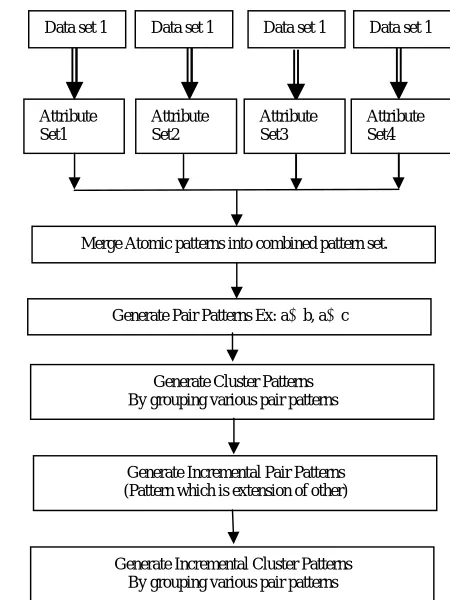
Multiple data sources with homogeneous patterns are easy to handle, but data sources with multiple feature-set needs to be handled with special management. In multi-feature combined mining, atomic patterns (generated from a single source) are merged together to form combined patterns which are often more informative. Following are some types of combined patterns.
A. Pair patterns can be formed by combining two atomic patterns. They are of form {A1 B1, A2 B2} where A1 and A2 are same but B1 and B2 are different or vice versa. Measure Ipair, is used to measure the interestingness of pair pattern.
B. Cluster patterns, are formed by organizing many similar or related atomic or pair patterns together. They take the form,{A1 B1,A2 B2,AN BN}. Measure Icluster defines how interested is the cluster of patterns.
C. Some patterns can take form of extension of other patterns. For example, {A1, B1 C1} can be thought of an extension of {A1 C1}. Such patterns are combined to form incremental pair patterns.
D. Many patterns which are extension of one another can be grouped together to form Incremental cluster patterns, as {A1 Z1, A1, B1 Z1, A1, B1, C1 Z1 ...}.
Figure 1: Multi source Combined Mining Figure 2: Multi Feature Combined Mining
5. MULTI-METHOD COMBINED MINING
In many situations the patterns discovered by a particular method do not serve to user’s perspective. Here one finds need of using more than one mining methods in order to discover more informative patterns. Multiple methods can be used in
Identify a suitable dataset or partition, D1
Mine D1 for initial discovery
Identify next datasets for mining depending on the results of initial mining
Data set 1
Data set 2
Data set 3
Data set n
Mined
Pattern1
Mined
Pattern2
Mined
Pattern3
Mined
Patternn
Merge Atomic patterns into combined pattern set.
Improve pattern action ability to generate deliverables.
Data set 1
Attribute Set1
Attribute Set2
Attribute Set3
Attribute Set4
Merge Atomic patterns into combined pattern set.
Generate Pair Patterns Ex: ab, ac
Generate Cluster Patterns By grouping various pair patterns
Generate Incremental Pair Patterns (Pattern which is extension of other)
Generate Incremental Cluster Patterns By grouping various pair patterns
Volume 3, Issue 1, January 2014
Page 396
parallel, serially or in closed loop fashion.
5.1Parallel multi-method combined mining
In this approach various mining techniques are used in parallel on different or same data sets.
Initially different, independent data sources are mined using different data mining techniques, to find out respective atomic pattern sets.
Then these patterns are merged together to form combined pattern.
5.2Serial multi-method combined mining
Here various data mining techniques are used one by one. Outcome of one technique is treated by another technique to discover in depth knowledge. This method works as follows.
Initially the Multi-source is mined using a suitable method to obtain pattern set, say P1.
After studding the initial pattern set, next suitable method is selected and P1 is again mined using it to discover next level pattern P2.
Various techniques are applied according to domain knowledge and output requirement
5.3Closed loop multi-method combined mining
This approach takes into account the impact of one technique on other. Practically feedback from next method can be used to refine the results of previous method. So one can easily observe that in closed loop approach, the decision (whether the pattern is interested or not) does not depend upon a particular method but also on other methods used in the process. Closed loop mining can be carried out as follows.
Initial pattern set P1 is formed by following the process of serial multi-method mining. At the end of this step some samples may not be identified. This is due to the limitations and conditions applied on various mining techniques. The patterns in P1 are checked for their validity. Some samples may not be valid to patterns. A separate data set is formed using such exceptional samples, say D x. This dataset is again mined by multiple methods to discover new pattern P2. Process of step 2 repeated as many times required by miner to discover patterns P1, P2... Pk.
All patterns are then merged to form combined pattern.
6.
ONTOLOGY FOR DOMAIN KNOWLEDGE REPRESENTATION
There are many tools and forms available for representation of knowledge. Knowledge specification language is used to build “is-a organization” of database attributes. This type of organization is called as “Item taxonomy”. Practically, user might want to use concepts that are more expressive and accurate than generalized concepts and that result from relationships other than the “is-a” relation. Ontology helps here. It includes the features of taxonomies but adds more representation power. So we can say that, taxonomy is simply a hierarchical categorization or classification of items in a domain. On the contrary, an ontology is a specification of several characteristics of a domain, defined using an open vocabulary [10].
The knowledge specification languages like General Impressions (GI), Reasonably Precise Concepts (RPC), and Precise Knowledge (PK) can be extended by the use of ontology concepts. This is used to strengthen the integration of user knowledge in the post processing task. To construct Ontology we need to define three types of concepts.
6.1 Leaf Concepts
A leaf concept is defined such that, each leaf concept is associated to one item in the database.
6.2 Generalized concepts
Generalized concepts are defined such that the concepts subsume other concepts in the ontology. A generalized concept is connected to the database through its subsumed concepts.
6.3 Restricted concepts
Restriction concepts are described using logical expressions defined over items and depend on the user individually.
Volume 3, Issue 1, January 2014
Page 397
Figure 3: Extract of ontology for clothing shop database
7. PROPOSED METHODOLOGY
The combined mining methodology provides three diverse frameworks viz. multi-source combined mining, multi-feature combined mining and multi-method combined mining. Proposed work will effort on multi source and multi feature combined mining frameworks. These frameworks can be applied on heterogeneous, complex datasets data sets on ad hoc basis. This process will discover “combined patterns” form input data sets.
Figure 4: Process of combined Mining.
The “combined patterns” are surely more informative than simple association rules. But many times practically they may not be constructive for specific circumstances. The usefulness of combined patterns for a specific
Ontology
Formal Trousers
Flat Front Jeans Cargo Plated
Casual Trousers Trousers
Shirts
Formal Shirts Casual Shirts
Full Sleeves Half Sleeves T -Shirt
Data set 1 Data set 2.. ..Data set n
Attribute selection
Important attributes from all included data sets
Association rule mining
Atomic patterns
Merging
(Paired, Incremental paired, Cluster, Incremental cluster)
Volume 3, Issue 1, January 2014
Page 398
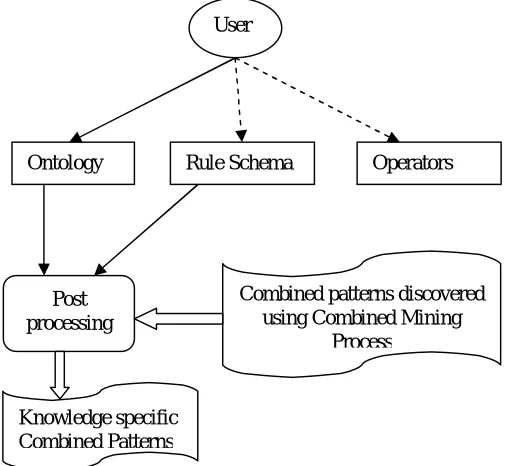
business problem or condition can be increased by indulgence with domain knowledge. To strengthen the incorporation of domain knowledge in post-mining process it is represented with the help of ontology. The post processing of combined patterns is planned to be done in two steps.
A. Formation of domain knowledge base:
Domain knowledge offers a general view over user knowledge in database domain, and user expectations express the prior user knowledge over the discovered rules. In this stride, the domain knowledge and goals are formalized using rules and schema.
B. Application of domain knowledge for post mining process:
The next pace is to improve the efficacy of combined patterns. The combined patterns discovered by combined mining process can be filtered using operators and with indulgence of domain knowledge (represented using ontology). From above discussion it clear that user plays important role in mining as well as in post mining process. User has to decide on ad hoc basis about the framework to be used for mining. On the other side he also contributes to build domain knowledge. After discovery of combined patterns domain knowledge will be incorporated for their post processing. The overall interaction of user in whole process is depicted in following figure.
Figure 5: Post processing of combined patterns using Ontology.
Figure 6: Role of user in mining, domain knowledge building and post mining.
8. Conclusion
This paper reviews process of combined mining as well as it also introduces idea of incorporating domain knowledge for post processing of “Combined patterns”. Multi-source combined mining approach handle of huge and heterogeneous input datasets. Multi-feature combined mining framework helps to extract important features from a range of input.
User
Ontology Rule Schema Operators
Combined patterns discovered using Combined Mining
Process Post
processing
Knowledge specific Combined Patterns
Data set 1 Data set 2.. ..Data set
Combined Mining
Combined Patterns
User
Domain knowledge Base
Post processing
Volume 3, Issue 1, January 2014
Page 399
Multi-method combined mining merge advantages of various data mining methods. Implementation of the multi-source and multi-feature frameworks of combined mining has been done and results are satisfied.
Knowledge can be represented in several formats. Ontology helps to represent domain knowledge in form of “Is – a” relationships. Currently the implementation of combined mining module has been finished using testing data set. The extracted combined rules are going to be indulged against the domain knowledge in order to make them more revealing.
REFERENCES
[1]L. Cao, Y. Zhao, and C. Zhang,”Combined Mining: Discovering Informative Knowledge in Complex Data”, IEEE Transactions on Systems, Man, and Cybernatics—PART B: CYBERNETICS, VOL. 41, NO. 3, JUNE 2011, 699 [2]H. Zhang, Y. Zhao, L. Cao, and C. Zhang, “Combined association rule mining,” in Proc. PAKDD, 2008, pp. 1069–
1074.
[3] Y. Zhao, H. Zhang, L. Cao, C. Zhang, and H. Bohlscheid, “Combined pattern mining: From learned rules to actionable knowledge,” in Proc. AI, 2008, pp. 393–403.
[4]L. Cao, Y. Zhao, and C. Zhang, "Mining impact-targeted activity patterns in imbalanced data," IEEE Trans. Knowl. Data Eng., vol. 20, no. 8, pp. 1053-1066, Aug. 2008.
[5] Cao L and Zhang C. Domain-Driven Data Mining: A Practical Methodology, International Journal of Data Warehousing and Mining, 2(4):49-65, 2006.
[6]B. Liu, W. Hsu, and Y. Ma, “Integrating classification and association rule mining,” in Proc. 4th Int. Conf. Knowl. Discov. Data Mining (KDD), 1998, pp. 80–86.
[7]B. Baesens, S. Viaene, and J. Vanthienen, “Post-Processing of Association Rules,” Proc. Workshop Post-Processing in Machine Learning and Data Mining: Interpretation, Visualization, Integration, and Related Topics with Sixth ACM SIGKDD, pp. 20-23, 2000.
[8] M. Uschold and M. Grul ninger, ”Ontologies: Principles, Methods, and Applications,” Knowledge Eng. Rev., vol. 11, pp. 93-155, 1996.
[9] Local Mining of Association Rules with Rule Schemas Andrei Olaru Claudia Marinica Fabrice Guillet LINA, Ecole Polytechnique de l'Universite de Nantes rue Christian Pauc BP 50609 44306 Nantes Cedex 3 E-mail: [email protected], fclaudia.marinica, [email protected]