230
Copyright © 2011-15. Vandana Publications. All Rights Reserved.
Volume-5, Issue-4, August-2015
International Journal of Engineering and Management Research
Page Number: 230-234
Biosorption of Reactive Blue 19 Dye using dried Azolla Filiculoides
Davoud Balarak
Department of Environmental Health, Health Promotion Research Center, School of Public Health, Zahedan University of Medical Sciences, Zahedan, IRAN
ABSTRACT
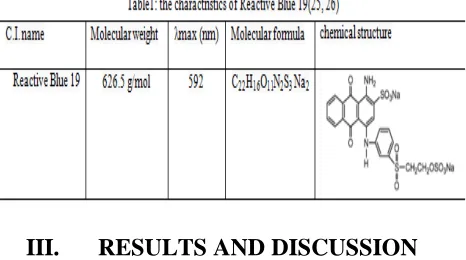
Industrial wastewater is one of the major environmental pollutants. Discharge of the colorful industrial waste into the receptive waters leads to eutrophication and has mutagenic and carcinogenic properties In order to understand the biosorption of Reactive Blue 19 (RB19) textile dye on dried Azolla filiculoides, batch experiments were conducted under various conditions. Adsorption isotherms were examined by Freundlich, Langmuir isotherm that finally showed the both models closely fitted the experimental results. The maximum monolayer adsorption capacities of Azolla biomass are 13.74 mg/g at 273 K, 14.98 mg/g at 298 K and 16.44 at 318 K, respectively. The results showed that the removal ratio of RB19 reached 95.4% from wastewater containing 50 mg/L RB19, indicating that the biomass could be used as a potential biosorbent for the removal of RB19 from aqueous solution.
Keywords--- Azolla filiculoides, Reactive Blue 19, Biosorption, Kinetic Mechanism
I.
INTRODUCTION
Colour is the first contaminant to be recognized in water and has to be removed from wastewater before discharging it into water bodies(1, 2). Dyes can be classified as anionic (acid dyes), cationic (basic dyes), and non-ionic (disperse dyes)(3, 4). Dyes are used extensively in the textile, leather, paper, plastic and other industries(5, 6). Reactive dye production is characterized by the great losses that are caused by the high solubility of the dyes, which also creates an economical and environmental problem(7). Untreated disposal of this colored water into the receiving water body either causes damage to aquatic life or to human beings by mutagenic and carcinogenic effect(8, 9). As a matter of fact, the discharge of such effluents is worrying for both toxicological and environmental reasons(10). Various techniques like
precipitation, membrane filtration, coagulation, electrochemical, ion exchange, chemical oxidation, adsorption, etc. are used for the removal of dyes from wastewater(11, 12). Adsorption is a procedure of choice for the removal of dyes from wastewater(13, 14). The major advantages of this technique are its low generation of residues and the possibility of its adsorbent being recycled and reused. Several effective, selective, and cheaper adsorbent materials were developed such as waste orange peel, banana pith, rice husk, Lemna minor, Azolla filiculoides, powdered activated sludge(15, 16). Azolla, a floating water fern, grows quickly over the water surface, forming a dense mat, and therefore poses many negative effects to aquatic ecology(17, 18). However, using Azolla as a bioabsorbent to remove pollutant from the industrial effluents would be a “win–win” solution for both environmental problems(19, 20). Recently Azolla has been used for the treatment effluents(21). However, a few reports have also suggested that Azolla is capable of removing dyes from aqueous solution(22). In this study, dried Azolla filiculoides was used as a biosorbent to remove Reactive Blue 19 (RB19) as a target pollutant from aqueous solution. The aim was to study the effects influencing biosorption of RB19 on dried A. filiculoides using batch experiments under different experimental conditions, including pH, biosorbent dosage, contact time, temperature and initial RB19 concentrations.
II.
MATERIALS AND METHODS
231
Copyright © 2011-15. Vandana Publications. All Rights Reserved.
powder in double distilled water. Dye solutions of different initial concentrations were prepared by diluting the stock solution in appropriate proportions.
Azolla Filiculoides was collected from Anzali wetland, Iran. The collected materials were then washed several times with distilled water to remove all dirt particles. The washing process was continued till the wash water contained no color. The washed materials were then dried at 50 ℃ for 12 h. The dried materials were then ground, using steel mill. The adsorbent was sieved through 1-2 mm sieve. The crushed particles were then treated with 0.1M HCl for 5 h followed by washing with distilled water and then kept for shaded dry. The resultant biomass was subsequently used in sorption experiments.
Batch adsorption experiments were performed using 200 ml glass bottles with addition of 4 g Azolla filiculoides and 100 mL of RB19 solution of increased initial concentrations (C0) from 10 to 60 mg/L. The glass bottles were sealed and placed within a temperature control box to maintain water temperature. The pH of the samples was adjusted by adding 0.1 M HCl or 0.1 M NaOH to each 200 ml of the prepared solution to pH 5. The pH of solutions was measured with a pH meter. In the experiments on the effect of temperature, the temperature was held at 273, 293, and 313 K and the pH was fixed at 5. At the end of the equilibrium period, the suspensions were separated for later analysis of the dye concentration. The amount of RB19 adsorption at equilibrium q e (mg/g) was calculated from the following equation(23):
qe = (C0 − Ct )V/W
Where C0 and Ce (mg/L) are the liquid-phase concentrations of dye at initial and equilibrium, respectively, V (L) the volume of the solution and W (g) is the mass of adsorbent used. The concentration of RB19 after and before adsorption was determined using a spectrophotometer (λmax = 592 nm). The procedures of kinetic experiments were identical with those of equilibrium tests. The effect of contact time on the amount of dye adsorbed was investigated at 298 K temperatures and at different concentration (25, 50, 100 and 200 mg/L).The amounts of dye adsorbed on biomass at any time t, were calculated from the concentrations in solutions before and after adsorption. At any times, the amount of RB19 adsorbed (mg/g) (qt) onto Biomass was calculated from the mass balance equation as follows(24):
qt = (C0 − Ct )V/W
Where qt is the amount of adsorbed dye on biomass at any time (mg/g); C0 and Ct are the initial and liquid-phase concentrations of RB19 at any time (mg/L), respectively; V (L) is the volume of RB19 solution, and W (g) is the mass of adsorbent used.
III.
RESULTS AND DISCUSSION
Adsorption isotherms
The adsorption equilibrium isotherm is important for describing how the adsorbate molecules distribute between the liquid and the solid phases when the adsorption process reaches an equilibrium state. The adsorption isotherms of RB19 on Azolla biomass at 273, 298, and 318 K are shown in Fig. 1, respectively. As seen from Fig. 1, equilibrium uptake increased with the increasing of equilibrium RB19 concentrations at the range of experimental concentration.
This is a result of the increase in the driving force from the concentration gradient. In the same conditions, if the concentration of RB19 in solution was bigger, the active sites of Azolla biomass were surrounded by much more RB19 ions, and the process of adsorption would carry out sufficient. Therefore, the values of qe
Fig. 1. Adsorption isotherms of RB19 adsorption onto Azolla biomass at different temperatures
232
Copyright © 2011-15. Vandana Publications. All Rights Reserved.
The analysis of the isotherm data by seeing how well different models can accommodate them is an important step in establishing a model that can be successfully used for design purposes. Adsorption equilibrium is a dynamic concept achieved when the rate at which molecules adsorb onto a surface is equal to the rate at which they desorb. At equilibrium, no change can be observed in the concentration of the solute on the solid surface or in the bulk solution, a situation characteristic of the entire system, including solute, adsorbent, solvent, temperature, pH, and so on. The equilibrium adsorption isotherm is vital to the design of adsorption systems, and its shape provides information about the homogeneity and heterogeneity of the adsorbent surface. Moreover, the correlation of the equilibrium data with either theoretical or empirical equations is essential to practical operation. The isotherm data were fitted to the Langmuir and Freundlich. The Langmuir model assumes that there is no interaction between the adsorbate molecules and the adsorption is localized in a monolayer. The Langmuir isotherm represented by the following linear equation(27):
Where Ce (mg/L) is the concentration of RB19 at equilibrium, qe (mg/g) the amount of adsorbate adsorbed per unit mass of adsorbate, qmax(mg/g) is the maximum adsorption capacity corresponding to monolayer coverage, and KL (L/mg) is the Langmuir constant. The values of qmax and KL can be calculated from plotting Ce/qe versus Ce. In order to determine if the adsorption process is favorable or unfavorable, a dimensionless constant separation factor or equilibrium parameter RL
The value of RRLR indicates the type of the isotherm; which is unfavorable (RRLR >1), linear (RRLR =1), favorable (0<RRL R<1) or irreversible (RRLR=0).
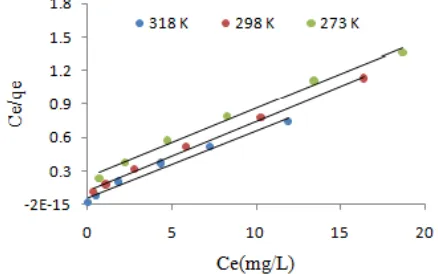
The Langmuir plots for RB19 adsorption onto Azolla biomass are obtained in Fig. 2, and the parameters are shown in Table 2. The correlation coefficients of the isotherms are all higher than 0.99 at the three temperatures, thereby indicating that the Langmuir isotherm fits the equilibrium data very well. The values of qRmaxR for Azolla biomass increase with increasing temperature, indicating the adsorption process is endothermic. The maximum monolayer adsorption capacities of Azolla biomass are 13.74 mg/g at 273 K, 14.98 mg/g at 298 K and 16.44 at 318 K, respectively. The calculated values of RRLR are all in
the range of 0.012–0.042, thereby confirming that the three adsorption processes are all favorable. These results demonstrate that the surface of Azolla biomass is homogeneous and a monolayer of RB19 covers the surface after adsorption.
The Freundlich isotherm model is an empirical relationship describing the adsorption of solutes from a liquid to a solid surface, and assumes that different sites with several adsorption energies are involved. The linear form of Freundlich equation is given as(29, 30):
Where qReR is the RB19 concentration on Azolla biomass at equilibrium, CReR(mg/L) is the concentration of RB19 in solution at equilibrium, KRFR (mg/g (mg/L) 1/n) and 1/n are Freundlich constants related to adsorption capacity and adsorption intensity, respectively. Higher value for KRFR indicates higher affinity for adsorbate and the values of the empirical parameter 1/n lie between 0.1 < 1/n < 1, indicating favorable adsorption. Freundlich constants are calculated from the slope and intercept in Fig. 3, and are given in Table 2. The correlation coefficients (RP
2
P
>0.97) reflects that the experimental data agree with the Freundlich model. The values of 1/n was 0.241, 0.312 and 0.368 at 273, 298 and 318 K are all smaller than 1, so they represent the favorable removal conditions.
The validity of the models was determined by calculating the average relative error (ARE) and standard deviation (S.D., %) using(31, 32):
233
Copyright © 2011-15. Vandana Publications. All Rights Reserved.
Fig. 2. Langmuir isotherms for RB19 adsorption onto Azolla biomass at different temperatures
, is defined according to the following equation(28):
Fig. 3. Freundlich isotherms for RB19 adsorption onto Azolla biomass at different temperatures
IV.
CONCLUSIONS
Filiculoides biomass was studied in batch mode and it was strongly dependent on initial concentration and temperature. High initial concentration and temperature favor the RB19 adsorption on the biomass. The isotherm study indicates that adsorption data fit well with both the
Langmuir and Freundlich models. RL values from Langmuir model and 1/n from Freundlich model indicate that the removal of NR on the HNTs is favorable. The study showed that Azolla biomass could be used as a new and efficient adsorbent material for the removal of RB19 from aqueous solution.
REFERENCES
[1] Zazouli MA, Balarak D, Mahdavi Y. Effect of Azolla filiculoides on removal of reactive red 198 in aqueous solution. J Adv Environ Health Res. 2013; 1(1):1-7. [2] Safa Y, Bhatti HN. Adsorptive removal of direct textile dyes by low cost agricultural waste: Application of factorial design analysis. Chem Engin J. 2011; 12(167):35–41.
[3] Tan C-y, Li G, Lu X-Q, Chen Z-l. Biosorption of Basic Orange using dried A. filiculoides. Ecol Engin. 2010; 5(36):1333–40.
[4] Garg VK, Renuka G, AnuBala Y, Rakesh K, Dye removal from aqueous solution by adsorption on treated sawdust, Bioresour. Technology. 2003; 89(3):121-7. [5] Ponnusami V, Krithika V, Madhuram R, Srivastava SN. Biosorption of reactive dye using acid-treated rice husk: Factorial design analysis. J Hazardous Mat. 2007; 8(142):397–403.
[6] Padmesh TVN, Vijayaraghavan K, Sekaran G, Velan M. Application of Azollarongpong on biosorption of acid red 88, acid green 3, acid orange 7 from synthetic solutions. Chem Engin J. 2006; 11(122):55-63.
[7] Dogan M, Abak H, Alkan M. Biosorption of Methylene Blue from Aqueous Solutions by Hazelnut Shells: Equilibrium, Parameters and Isotherms. Water Air Soil Poll. 2008; 192(1-4): 141-53.
[8] Ghanizadeh G, Asgari G. Removal of Methylene Blue Dye from Synthetic Wastewater with Bone Char. Health & Environmental. 2009;2(2):102-12.
[9]Toor M, Jin B. Adsorption characteristics, isotherm, kinetics, and diffusion of modified natural bentonite for removing diazo dye. Chemical Engineering 2011(187):79-88.
[10] Zazouli MA, Yazdani J, Balarak D, Ebrahimi M, Mahdavi Y. Removal Acid Blue 113 from Aqueous Solution by Canola. Journal of Mazandaran University Medical Science.2013:23(2);73-81.
[11] Low KS, Lee CK, Tan BF. Quaternized wood as sorbent for reactive dyes. Biochem Biotechnol. 2000;87:233-45.
234
Copyright © 2011-15. Vandana Publications. All Rights Reserved.
[14] Mane VS ,Mall ID. Kinetic and equilibrium isotherm studies for the adsorptive removal of Brilliant Green dye from aqueous solution by rice husk ash, J. Environ. Manage.2007: 84 ;390–400.
[15] R Han, J Zhang, P Han, Y Wang, Study of equlibrium, kinetic and thermodynamic parameters about methylene blue adsorption onto natural zeolite, Chem. Eng. J.2009; 145;96–504.
[16] Nepradit S,Thiravetyan P, Towprayoon S, Adsorption of three azo reactive dyes by metal hydroxide sludge: effect of temperature, pH and electrolytes, J. Colloid Interf. Sci. 2004:270: 255–261.
[17] Zazouli MA, Balarak D. Phytodegradation potential of bisphenolA from aqueous solution by Azolla Filiculoides: journal Iranian journal of environmental health science and engineering. 2014;10:14-20.
[18] Zazouli MA, Balarak D, Mahdavi Y. Application of Azolla for 2, 4, 6-Trichlorophenol (TCP) Removal from aqueous solutions. Hyhiene sciences. 2014;2(4):17-24. [19] Diyanati RA, Yousefi Z, Cherati JY, Balarak D. The ability of Azolla and lemna minor biomass for adsorption of phenol from aqueous solutions. J Mazandaran Uni Med Sci. 2013; 23(106).17-23.
[20] Zazouli MA, Balarak D, Mahdavi Y. Application of azollafiliculoides biomass for 2-Chlorophenol and 4-Chrorophenol Removal from aqueous solutions. Iran J Health Sci. 2013; 1(2):20-30.
[21] Zazouli MA, Balarak D, Mahdavi Y. Pyrocatechol Removal from Aqueous Solutions by Using Azolla filiculoides. Health Scope. 2013; 2(1):1-6.
[22] Zazouli M, Balarak D, Mahdavi Y, Karimnejad F. Application of Azolla Filiculoides biomass for Acid blue 15 dye (AB15) Removal from aqueous solutions. JBRMS. 2014; 1 (1) :29-37.
[23] Cestar AR, Vieira ES, Vieira GS, Almeida LE. The removal of anionic dyes from aqueous solutions in the presence of anionic surfactant using aminopropylsilica—A kinetic study.Journal of Hazardous Materials :2006;138:133–141.
[24] Suna D, Zhanga X, Wub Y, Liu X. Adsorption of anionic dyes from aqueous solution on fly ash.Journal of Hazardous Materials;2010; 181;335–342.
[25] Gök Ö, Özcan AS, and Özcan A. Adsorption behavior of a textile dye of Reactive Blue 19 from aqueous solutions onto modified bentonite. Applied Surface Science.2010; 256(17): 5439-43.
[26] Fanchiang JM, and Tseng DH. Degradation of anthraquinone dye C.I. Reactive Blue 19 in aqueous solution by ozonation. Chemosphere. 2009;77(2) 214-21. [27] Diyanati RA, Yousefi Z, Cherati JY, Balarak D. Comparison of phenol adsorption rate by modified Canola and Azolla: An Adsorption Isotherm and Kinetics Study.Journal of Health & Development. 2014; 3(3);17-25. [28] Balarak D, Pirdadeh F, Mahdavi Y. Biosorption of Acid Red 88 dyes using dried Lemna minor biomass. Journal of Science, Technology & Environment Informatics 2015, 01(02), 81–90.
[29] Joghatayi A, Mahdavi Y, Balarak D. Biosorption of Reactive blue 59 dyes using dried Azolla filiculoides biomass. Scholars Journal of Engineering and Technology 2015; 3(3B):311-318.
[30] Diyanati RA, Balarak D. Survey of efficiency agricultural weast in removal of acid orang 7(AO7) dyes from aqueous solution: kinetic and equilibrium study: Iranian journal of health sciences. 2013;2(1):35-40.
[31] Khaled A, Nem AE, El-Sikaily A, Abdelwahab O. Removal of Direct N Blue- 106 from artificial textile dye effluent using activated carbon from orange peel: adsorption isotherm and kinetic studies, J. Hazard. Mater. 2009: 165 ;100–110.