AN EXPLORATORY STUDY ON
THE MANAGEMENT OF SERVICES
PROCUREMENT PROCESS
FOR DIFFERENT SERVICES
ANG PEI YIN
A thesis submitted in partial fulfilment of the
requirements of the University of Bolton for the
degree of Doctor of Philosophy
!
Abstract
This research is focused on the management of services procurement particularly on the services procurement process. The Services industry has been perceived to be growing in importance in the emerging business market. However, from the literature review, research in this subject area is rather limited. This thesis focuses on gaining detailed insights about services including: 1) how services has been defined, 2) what are the characteristics of services, 3) how services are being managed, 4) what are the services procurement processes, 5) the challenges in managing the services and the anticipation of growth and future for the services industry. In order to gain more insight and detailed information, the “case study” has been selected as the research method in collecting the data. It is one of the research methods that allow greater insights and discussion on the selected subject area. Seven companies have been selected for interview sessions whereby each company represented a case study. Data that was collected was analysed through template analysis.
The main aim of this research is to develop a best practice framework for services procurement. The research has developed a conceptual framework of a services procurement process based on the discussion in the literature review. From the literature reviews, it is inferred that different companies might have different procurement processes between raw materials/goods/products and services. However, from findings of the field research, almost all of the companies are maintaining the same procurement process for both raw materials/goods/products and services. This applies to all the case studies of Case Study A, B, C, D, E, F & G. Moreover, some of the companies interviewed in this research project argue that several types of services may be applied to a simpler procurement process when compared to a more complicated services type. This research will evaluate, compare and refine the services procurement process between the conceptual framework that has been developed from literature review and the services procurement process in the fieldwork. A refined and validated services procurement process has been proposed as a Best Practice Framework.
!
Acknowledgement
I would like to express my deepest gratitude to Dr. Julian Coleman my research supervisor, for his patient guidance, enthusiastic encouragement and insightful critiques of this research work. I would also like to thank Dr. Lakshmi Vedanthachari, for his advice during the early stage of my research work. My grateful thanks are also extended to Mr. Edward for his advice and assistance in keeping my work progress.
I would also like to extend my thanks to the University of Bolton for granting this remarkable opportunity in pursuing my PhD with the University. Although the work-study schedule in the university was hectic, it was filled with lots of joy and memorable moments. The environment in the university, the numerous peer discussions and sharing sessions organized by the university have trained me well to be grounded in my PhD research work.
!
TABLE of CONTENT
ABSTRACT I
ACKNOWLEDGEMENT II
LIST OF TABLES X
LIST OF FIGURES XI
!
1! INTRODUCTION 1!
1.1! THE CLASSIFICATION OF BUSINESS SECTORS IN CURRENT WORLD ECONOMY! 3!
1.1.1! PRIMARY SECTOR! 4!
1.1.2! SECONDARY SECTOR! 4!
1.1.3! TERTIARY SECTOR! 4!
1.1.4! SUMMARY! 6!
1.2! THE GROWTH OF SERVICES! 7!
1.2.1! SUMMARY! 9!
1.3! THE SERVICES ECONOMY! 10!
1.3.1! THE LARGEST ECONOMIES IN OECD COUNTRIES! 10!
1.3.2! THE AVERAGE GDP GROWTH WITHIN THE OECD COUNTRIES! 11! 1.3.3! THE GDP GROWTH IN PRIMARY, SECONDARY AND TERTIARY SECTOR! 11! 1.3.4! THE CONTRIBUTION OF THE SERVICES SECTOR WITHIN OECD COUNTRIES! 11! 1.3.5! THE CONTRIBUTION OF SERVICES ECONOMY WITHIN THE WORLD ECONOMY! 12!
1.3.6! SUMMARY! 14!
1.4! THE DEFINITION OF SERVICES! 15!
1.5! SERVICE PROCUREMENT! 16!
1.6! THE CHALLENGES IN SERVICE PROCUREMENT! 17!
1.7! RESEARCH GAP! 19!
1.8! RESEARCH AIM AND OBJECTIVES! 22!
1.9! RESEARCH SCOPE! 23!
1.10! CONTRIBUTION OF KNOWLEDGE! 24!
1.11! STRUCTURE OF THE THESIS! 25!
2! LITERATURE REVIEW 26!
2.1! WHAT ARE SERVICES?! 26!
2.2! THE CHARACTERISTICS OF SERVICES! 29!
2.2.1! INTANGIBILITY! 29!
2.2.2! HETEROGENEITY! 30!
2.2.3! INSEPARABILITY / SIMULTANEOUSLY! 31!
2.2.4! PERISHABILITY! 32!
2.3! THE EXAMPLE OF SERVICES! 33!
2.4! THE CLASSIFICATION OF SERVICES! 35! 2.4.1! COMPONENT SERVICE, SEMI-MANUFACTURED SERVICE, CONSUMPTION SERVICE
AND INSTRUMENTAL SERVICE! 37!
2.4.2! BUSINESS-TO-BUSINESS SERVICES, BUSINESS-TO-CUSTOMER, INTERNAL SERVICES, PUBLIC SERVICES AND NON-FOR-PROFIT SERVICES! 38!
2.4.3! PROPERTY, PEOPLE AND PROCESS! 39!
!
2.4.6! GENERIC SERVICES AND PROFESSIONAL SERVICES! 40!
2.4.7! PURE SERVICES AND NON-PURE SERVICES! 40!
2.4.8! MRO SERVICES AND PRODUCTION SERVICES! 41!
2.4.9! SUMMARY! 41!
2.5! PROCUREMENT VS.PURCHASING! 43!
2.6! THE SERVICES PROCUREMENT! 44!
2.7! THE PROCUREMENT PROCESS OF SERVICES! 46!
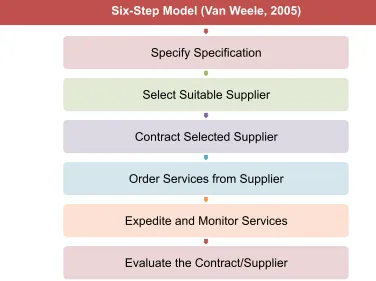
2.7.1! SIX-STEP MODEL (VAN WEELE, 2005)! 47!
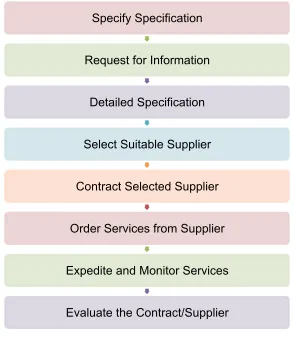
2.7.2! EXTENDED PURCHASING PROCESS (EIGHT-STEP MODEL)
(VALK AND ROZEMEIJER, 2009)! 48!
2.7.3! FOUR PURCHASING PROCESS (FITZSIMMONS ET AL., 1998)! 50! 2.7.4! FOUR-PHASE PURCHASING PROCESS (EDVARDSSON, 1990)! 51!
2.7.4.1! Phase 1: Need Detection! 51!
2.7.4.2! Phase 2: Selection! 51!
2.7.4.3! Phase 3: Implementation! 52!
2.7.4.4! Phase 4: Final Consumption and Evaluation! 52! 2.7.5! EIGHT PURCHASING PROCESS (ANDERSSON AND NORMAN, 2002)! 53!
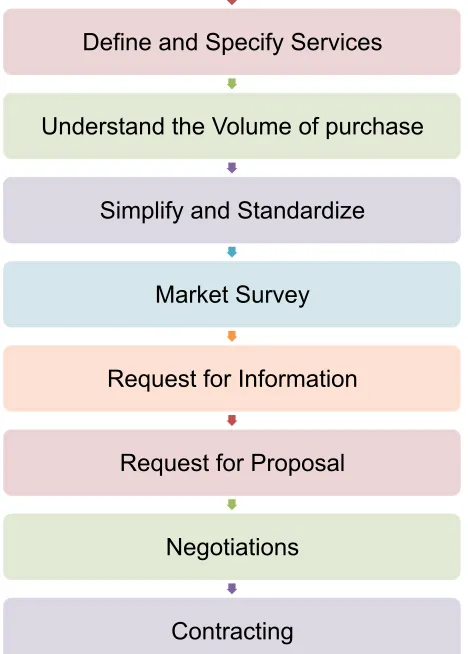
2.7.5.1! Define and Specify Services! 53!
2.7.5.2! Understand the Purchase Volume! 54!
2.7.5.3! Simply and Standardization! 54!
2.7.5.4! Market Survey! 54!
2.7.5.5! Request for Information! 55!
2.7.5.6! Request for Proposal! 55!
2.7.5.7! Negotiation! 56!
2.7.5.8! Contracting! 56!
2.7.6! ORGANIZATIONAL BUYING PROCESS FOR PROFESSIONAL SERVICES
(DAY AND BARKSDALE, 1994)! 57!
2.7.6.1! Recognizing a Need or Problem! 58!
2.7.6.2! Defining Goals! 58!
2.7.6.3! Identifying the Initial Consideration Set! 58!
2.7.6.4! Refining the Consideration Set! 59!
2.7.6.5! Evaluating the Consideration Set! 59!
2.7.6.6! Selecting the Professional Service Provider! 59! 2.7.6.7! Evaluating the Quality of Service Delivery! 59! 2.7.6.8! Evaluating the Quality of the Outcome (“Product”)! 60!
2.7.7! SUMMARY! 61!
2.7.7.1! Six-Step Model (Van Weele, 2005)! 62!
2.7.7.2! Extended Purchasing Process (Eight-Step Model)
(Valk and Rozemeijer, 2009)! 62!
2.7.7.3! Four Purchasing Process (Fitzsimmons et al., 1998)! 62! 2.7.7.4! Four-Phase Purchasing Process (Edvardsson, 1990)! 63! 2.7.7.5! Eight Purchasing Process (Andersson and Norman, 2002)! 63! 2.7.7.6! Organizational buying Process for Professional Services
(Day and Barksdale, 1994)! 63!
2.7.7.7! Summary! 64!
2.8! THE CHALLENGES IN SERVICES PROCUREMENT! 66! 2.8.1! SERVICES CHARACTERISTICS COMPLICATES SERVICES PROCUREMENT! 68!
2.8.2! HUMAN KNOWLEDGE IN SERVICES! 69!
2.8.3! NON-STRATEGIC SERVICES! 69!
2.8.4! SERVICES IS PERCEIVED LESS COMPLEX, LESS SUPPORT WITH INEXPERIENCE BUYERS!
! ! 70!
2.8.5! SERVICES SPECIFICATIONS DIFFICULTIES! 71!
2.8.6! SERVICES EVALUATION DIFFICULTIES! 73!
!
2.10! RESEARCH JUSTIFICATION! 78!
2.11! LITERATURE CONCEPTUAL FRAMEWORK! 83!
2.12! RESEARCH AIMS,OBJECTIVES &RESEARCH GAPS! 84!
2.13! DIAGRAM OF RESEARCH QUESTIONS THAT FULFIL THE RESEARCH OBJECTIVES AND
IDENTIFIED RESEARCH GAPS! 85!
3! RESEARCH METHOD 86!
3.1! RESEARCH PHILOSOPHY! 88!
3.1.1! POSITIVISM! 89!
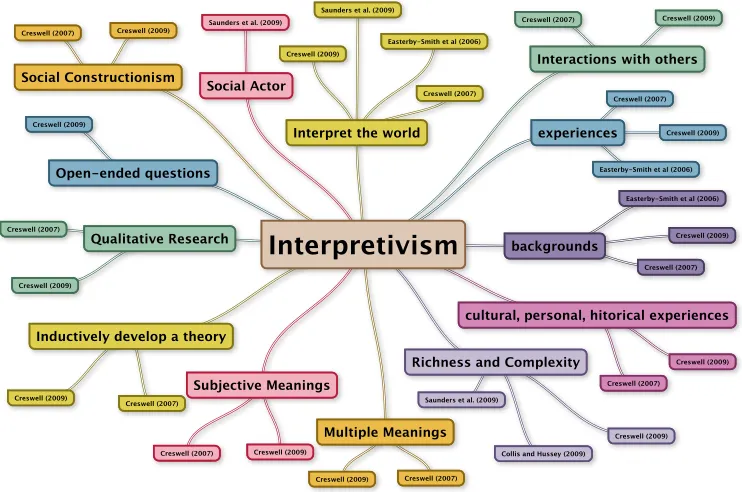
3.1.2! INTERPRETIVISM! 91!
3.1.3! RESEARCH PHILOSOPHY JUSTIFICATION! 93!
3.2! RESEARCH APPROACHES! 95!
3.2.1! DEDUCTIVE APPROACHES! 95!
3.2.2! INDUCTIVE APPROACH! 96!
3.2.3! RESEARCH APPROACHES JUSTIFICATION! 96!
3.3! RESEARCH STRATEGY! 98!
3.3.1! SURVEY RESEARCH! 98!
3.3.2! EXPERIMENTAL RESEARCH! 99!
3.3.3! ETHNOGRAPHY! 100!
3.3.4! GROUNDED THEORY! 101!
3.3.5! CASE STUDIES! 102!
3.3.6! ACTION RESEARCH! 103!
3.3.7! RESEARCH STRATEGY JUSTIFICATION! 104!
3.3.7.1! Survey! 104!
3.3.7.2! Experiment! 105!
3.3.7.3! Ethnography! 105!
3.3.7.4! Grounded Theory! 106!
3.3.7.5! Case Study! 106!
3.3.7.6! Action Research! 107!
3.4! RESEARCH METHOD! 108!
3.4.1! QUANTITATIVE, QUALITATIVE AND MIXED METHODS! 108!
3.4.1.1! Quantitative Research Method! 108!
3.4.1.2! Qualitative Research Method! 109!
3.4.1.3! Multiple Methods / Mixed Methods! 110!
3.4.2! DATA COLLECTION! 112!
3.4.2.1! Questionnaires! 113!
3.4.2.2! Interview! 114!
3.4.2.3! Observation! 115!
3.4.3! DATA ANALYSIS! 116!
3.4.3.1! Analysing Quantitative Data! 116!
3.4.3.2! Analysing Qualitative Data! 117!
3.5! RESEARCH METHOD JUSTIFICATION! 119!
3.5.1! DATA COLLECTION! 119!
3.5.1.1! Secondary Data Collection! 119!
3.5.1.2! Primary Data Collection! 120!
3.5.2! DATA ANALYSIS! 121!
3.6! RESEARCH SAMPLE SIZE! 122!
3.7! THE PROPOSED RESEARCH METHOD FRAMEWORK! 123!
4! DATA COLLECTION AND ANALYSIS 124!
4.1! CASE STUDY A! 130!
4.1.1! THE BACKGROUND OF THE COMPANY! 131!
4.1.1.1! The Business Nature! 131!
4.1.1.2! Mission / Vision! 132!
!
4.1.2! THE PROCUREMENT INFLUENCE IN MANAGEMENT! 134!
4.1.3! THE PROCUREMENT MANAGEMENT! 135!
4.1.3.1! Core & Supplementary Business! 135!
4.1.3.2! The Management of Procurement / Purchasing! 136! 4.1.3.3! Centralized / Decentralized Procurement System! 137!
4.1.3.4! Services Categorization! 137!
4.1.3.5! Services Expenditure! 137!
4.1.4! THE PROCUREMENT TEAM! 138!
4.1.5! THE PROCUREMENT DIFFICULTIES! 138!
4.1.5.1! Lengthy Tendering Process! 138!
4.1.5.2! Difficulties In Specifying Criteria For Service Provider Selection! 139!
4.1.6! THE PROCUREMENT PROCESS! 139!
4.1.7! THE PROCUREMENT FUTURE! 141!
4.2! CASE STUDY COMPANY B! 143!
4.2.1! THE BACKGROUND OF THE COMPANY! 144!
4.2.1.1! The Business Nature! 144!
4.2.1.2! Mission / Vision! 144!
4.2.1.3! Organizational Hierarchy! 144!
4.2.2! THE PROCUREMENT INFLUENCE IN MANAGEMENT! 145!
4.2.3! THE PROCUREMENT MANAGEMENT! 146!
4.2.3.1! Core & Supplementary Business! 146!
4.2.3.2! The Management of Procurement / Purchasing! 147! 4.2.3.3! Centralized / Decentralized Procurement System! 148!
4.2.3.4! Services Categorization! 148!
4.2.3.5! Services Expenditure! 148!
4.2.4! THE PROCUREMENT TEAM! 148!
4.2.5! THE PROCUREMENT DIFFICULTIES! 149!
4.2.6! THE PROCUREMENT PROCESS! 149!
4.2.7! THE PROCUREMENT FUTURE! 151!
4.3! CASE STUDY COMPANY C! 153!
4.3.1! THE BACKGROUND OF THE COMPANY! 154!
4.3.1.1! The Business Nature! 154!
4.3.1.2! Mission / Vision! 154!
4.3.1.3! Organizational Hierarchy! 154!
4.3.2! THE PROCUREMENT INFLUENCE IN MANAGEMENT! 155!
4.3.3! THE PROCUREMENT MANAGEMENT! 156!
4.3.3.1! Core & Supplementary Business! 156!
4.3.3.2! The Management of Procurement/Purchasing! 157! 4.3.3.3! Centralized and decentralized Procurement! 158!
4.3.3.4! Services Categorization! 158!
4.3.3.5! Services Expenditure! 159!
4.3.4! THE PROCUREMENT TEAM! 159!
4.3.5! THE PROCUREMENT DIFFICULTIES! 159!
4.3.5.1! Complication in measuring the outcome! 160! 4.3.5.2! Complicated considerations to change services provider! 161!
4.3.5.3! Government Policy! 161!
4.3.5.4! Loss of Competency! 161!
4.3.6! THE PROCUREMENT PROCESS! 162!
4.3.7! THE PROCUREMENT FUTURE! 163!
4.4! CASE STUDY COMPANY D! 166!
4.4.1! THE BACKGROUND OF THE COMPANY! 167!
4.4.1.1! The Business Nature! 167!
4.4.1.2! Mission / Vision! 167!
4.4.1.3! Organizational Hierarchy! 168!
!
4.4.3! THE PROCUREMENT MANAGEMENT! 171!
4.4.3.1! Core & Supplementary Business! 171!
4.4.3.2! The Management of Procurement / Purchasing! 171! 4.4.3.3! Centralised / Decentralised Procurement System! 174!
4.4.3.4! Services Categorization! 174!
4.4.3.5! Services Expenditure! 174!
4.4.4! THE PROCUREMENT TEAM! 174!
4.4.5! THE PROCUREMENT DIFFICULTIES! 175!
4.4.5.1! Lack of integration! 175!
4.4.6! THE PROCUREMENT PROCESS! 176!
4.4.7! THE PROCUREMENT FUTURE! 178!
4.5! CASE STUDY COMPANY E! 180!
4.5.1! THE BACKGROUND OF THE COMPANY! 181!
4.5.1.1! The Business Nature! 181!
4.5.1.2! Mission / Vision! 181!
4.5.1.3! Organizational Hierarchy! 181!
4.5.2! THE PROCUREMENT INFLUENCE IN MANAGEMENT! 182!
4.5.3! THE PROCUREMENT MANAGEMENT! 183!
4.5.3.1! Core & Supplementary Business! 183!
4.5.3.2! The Management of Procurement / Purchasing! 184! 4.5.3.3! Centralised / Decentralised Procurement System! 185!
4.5.3.4! Services Categorization! 185!
4.5.3.5! Services Expenditures! 185!
4.5.4! THE PROCUREMENT TEAM! 186!
4.5.5! THE PROCUREMENT DIFFICULTIES! 186!
4.5.5.1! Concern on Sole Service Providers! 186!
4.5.5.2! Critical to be facilitated through Technology and Information System! 187!
4.5.6! THE PROCUREMENT PROCESS! 187!
4.5.7! THE PROCUREMENT FUTURE! 189!
4.6! CASE STUDY COMPANY F! 191!
4.6.1! THE BACKGROUND OF THE COMPANY! 192!
4.6.1.1! The Business Nature! 192!
4.6.1.2! Mission / Vision! 192!
4.6.1.3! Organizational Hierarchy! 192!
4.6.2! THE PROCUREMENT INFLUENCE IN MANAGEMENT! 194!
4.6.3! THE PROCUREMENT MANAGEMENT! 195!
4.6.3.1! Core & Supplementary Business! 195!
4.6.3.2! The Management of Procurement / Purchasing! 195! 4.6.3.3! Centralised / Decentralised Procurement System! 200!
4.6.3.4! Services Categorization! 200!
4.6.3.5! Services Expenditures! 200!
4.6.4! THE PROCUREMENT TEAM! 200!
4.6.5! THE PROCUREMENT DIFFICULTIES! 200!
4.6.5.1! Dated System, Tools and Comprehensive Electronic System! 201!
4.6.5.2! Unclear Service Requirements! 201!
4.6.5.3! Change Management! 202!
4.6.5.4! Problem Escalation! 203!
4.6.6! THE PROCUREMENT PROCESS! 204!
4.6.7! THE PROCUREMENT FUTURE! 207!
4.7! CASE STUDY COMPANY G! 212!
4.7.1! THE BACKGROUND OF THE COMPANY! 213!
4.7.1.1! The Business Nature! 213!
4.7.1.2! Mission / Vision! 213!
4.7.1.3! Organizational Hierarchy! 213!
!
4.7.3! THE PROCUREMENT MANAGEMENT! 215!
4.7.3.1! Core & Supplementary Business! 215!
4.7.3.2! Centralised / Decentralised Procurement System! 215!
4.7.3.3! Services Categorization! 216!
4.7.3.4! Services Expenditure! 216!
4.7.4! THE PROCUREMENT TEAM! 216!
4.7.5! THE PROCUREMENT DIFFICULTIES! 216!
4.7.6! THE PROCUREMENT PROCESS! 216!
4.7.7! THE PROCUREMENT FUTURE! 217!
4.8! THE SUMMARY OF THE CASE STUDIES! 219!
4.8.1! SUMMARY OF THE CASE STUDY A! 223!
4.8.2! SUMMARY OF THE CASE STUDY B! 227!
4.8.3! SUMMARY OF THE CASE STUDY C! 231!
4.8.4! SUMMARY OF THE CASE STUDY D! 235!
4.8.5! SUMMARY OF THE CASE STUDY E! 239!
4.8.6! SUMMARY OF THE CASE STUDY F! 243!
4.8.7! SUMMARY OF THE CASE STUDY G! 248!
4.8.8! CROSS CASE ANALYSIS BY THEME! 251!
4.9! RESEARCH OBJECTIVES,RESEARCH QUESTION,RESEARCH ANALYSIS AND
DISCUSSION! 257!
4.9.1! RESEARCH OBJECTIVES AND JUSTIFICATIONS! 257!
4.9.2! RESEARCH QUESTIONS JUSTIFICATION THROUGH RESEARCH FINDINGS! 259! 4.9.2.1! R.Q1.How do companies manage their procurement process for services?! 259! 4.9.2.2! R.Q2.Are these procurement processes managed effectively and efficiently?!
! ! 261!
4.9.2.3! R.Q3. Do they have different procurement process or a standardized
procurement process for different types of services?! 262! 4.9.2.4! R.Q4. How closely do companies practice actually follow the conceptual
framework based on the literature?! 268!
5! CONCLUSION AND RECOMMENDATION 289!
5.1! CONCLUSION! 289!
5.2! RECOMMENDATIONS! 296!
5.2.1! CONSIDERATIONS IN MANAGING SERVICES PROCUREMENT PROCESSES! 296!
5.3! FUTURE WORK! 305!
6! REFERENCES 306!
APPENDIX 1.1 PRIMARY, SECONDARY AND TERTIARY SECTORS 317!
APPENDIX 1.2: STAGES OF ECONOMY ACTIVITY 318!
APPENDIX 1.3: PRE-INDUSTRIAL SOCIETY, INDUSTRIAL SOCIETY AND
POST-INDUSTRIAL SOCIETY 319!
PRE/INDUSTRIAL!SOCIETY! 319!
INDUSTRIAL!SOCIETY! 319!
POST/INDUSTRIAL!SOCIETY! 320!
APPENDIX 1.4: GROSS DOMESTIC PRODUCT (GDP), CURRENT PURCHASING
POWER PARTIES (PPPS) 321!
APPENDIX 1.5: GROSS DOMESTIC PRODUCT (GDP), VOLUME 322!
APPENDIX 1.6: CONTRIBUTION TO GROSS VALUE ADDED (GVA) GROWTH BY
!
APPENDIX 1.7: GROSS VALUE ADDED BY ACTIVITY, 2007 324!
APPENDIX 1.8: THE CURRENT AND FUTURE OUTLOOK FOR SERVICES
(SERVICE PMI) 325!
SUMMARY! 329!
APPENDIX 3.1: RESEARCH PROCESS (SAUNDERS ET AL., 2009) 330!
APPENDIX 3.2: RESEARCH PROCESS (COLLIS AND HUSSEY, 2009) 331!
APPENDIX 3.3: THE SUMMARY OF RESEARCH STRATEGIES 332!
APPENDIX 3.4: COMPARISON BETWEEN QUANTITATIVE AND QUALITATIVE
DATA COLLECTION TECHNIQUES AND DATA ANALYSIS PROCEDURES. 335!
!
List%of%Table
s
!
Table 1.1: Summary of the Economy Sector from Various Economists 6
Table 2.1: List of Services Examples 33
Table 2.2: The Classification of Services 36
Table 2.3: Previous Literature on Specific Area of Services Purchasing 76 Table 2.4: Previous Literature on Specific Types of Services 77 Table 3.1: Research Philosophies / Paradigms / Worldviews 89 Table 3.2: Quantitative and Qualitative Data Collection Methods 112 Table 4:1 Theme /Codes & Sub Themes/Sub Codes 129 Table 4.2: Summary of Data Collection & Methods for Case Study A 130 Table 4.3: Summary of Data Collection & Methods for Case Study B 143 Table 4.4: Summary of Data Collection & Methods for Case Study C
Source: Author 153
Table 4.5: Summary of Data Collection & Methods for Case Study D Source: Author
166
Table 4.6: Summary of Data Collection & Methods for Case Study E 180 Table 4.7: Summary of Data Collection & Methods for Case Study F 191 Table 4.8: Summary of Data Collection & Methods for Case Study G 212 Table 4.8.1: Data Collection Summary (Case Study) Source: Author 219 Table 4.8.2: Company Profile Summary (Case Study) 220 Table 4.8.3 Summary of the interview questions in several themes and
codes
221
Table 4.8.4: Summary of Case Study A 223
Table 4.8.5: Summary of Case Study B 227
Table 4.8.6: Summary of Case Study C 231
Table 4.8.7: Summary of Case Study D 235
Table 4.8.8: Summary of Case Study E 239
Table 4.8.9: Summary of Case Study F 243
Table 4.8.10: Summary of Case Study G 248
Table 4.8.11: Cross Case Analysis by Theme 251
Table 5.1: Summary of the Comparison of Procurement Processes between The Literature Reviews and the Field Research
!
List%of%Figures
!
Figure 1.1: Gross Value Added by Activity 13
Figure 1.2: Gross Value Added (GVA) by Activity 14
Figure 1.3: Research Gaps 21
Figure 1.4: Research Aims and Objectives 22
Figure 1.5: The Structure of the Thesis 25
Figure 2.1 Procurement and Purchasing Differences 43 Figure 2.2: Six-Step Model (Van Weele, 2005) 47 Figure 2.3: Extended Purchasing Process (Eight-Step Model) (Valk
and Rozemeijer, 2009) 50
Figure 2.4: Four Purchasing Process (Fitzsimmons et al., 1998) 51 Figure 2.5: Four-Phase Purchasing Process (Edvardsson, 1990) 53 Figure 2.6: Eight Purchasing Process (Andersson and Norman, 2002) 57 Figure 2.7: Organizational buying Process for Professional Services
(Day and Barksdale, 1994)
60
Figure 2.8: The Summary of Procurement Process for Services 61 Figure 2.9: The Summary of The Challenges in Services Procurement 74 Figure 2.10: Matrix on Challenges in Services Procurement within
Each Services Procurement Process (based on literature reviews) 82 Figure 2.11: Services Procurement Process Conceptual Framework
based on Literature Review
83
Figure 2.12 Research Aims, Objectives & Research Gaps 84
Figure 2.13: Diagram of Research Questions that fulfil the Research Objectives and
Identified Research Gaps 85
Figure 3.1: Research Process 87
Figure 3.2 Positivist Philosophical Stances 91
Figure 3.3: Interpretivism Philosophical Stances 93 Figure 3.4: Mono Method and Multiple Methods 112 Figure 3.5: Summary of Data Collection Method Interview 115
Figure 3.6: Literature Review Resources 120
Figure 3.7: Research Method Framework 123
Figure 4.1: Data Collection – Case Study Interview Process 127
Figure 4.2: Template Analysis Techniques 129
Figure 4.1.1: Company A Mission, Vision and Strategy 132 Figure 4.1.2: Organizational Hierarchy for Company A 134 Figure 4.1.3: The Procurement Process for Company A 140 Figure 4.2.1: Organizational Hierarchy for Company B 145 Figure 4.2.2: The Procurement Process for Company B Source:
Author
150
Figure 4.3.1: The Procurement Process for Company C 163 Figure 4.4.1: The Guiding Principles and Values in Company D
Source: Author
168
!
Figure 4.6.2: The Procurement Process for Company F 206 Figure 4.7.1: Organizational Hierarchy for Company G 214 Figure 4.7.2: The Procurement Process for Company G 217 Figure 4.9.1: Research Objectives and Discussions 258 Figure 4.9.4.1: The Procurement Process for Company A 269 Figure 4.9.4.2: Similar Procurement Process for Services between
Case Study A and the Conceptual Framework of Organizational Buying Process for Professional Services (Day and Barkdale, 1994)
270
Figure 4.9.4.3: The Procurement Process for Company B 271 Figure 4.9.4.4: Similar Procurement Process for Services between
Case Study B and the Conceptual Framework of Eight Purchasing Process (Andersson and Norman, 2002)
272
Figure 4.9.4.5: The Procurement Process for Company C 274 Figure 4.9.4.6: Similar Procurement Process for Services between
Case Study C and the Conceptual Framework either the Eight
Purchasing Process (Andersson and Norman, 2002) or the Extended Purchasing Process (Eight-Step Model) (Valk and Rozemeijer, 2009)
276
Figure 4.9.4.7: The Procurement Process for Company D 278 Figure 4.9.4.8: Similar Procurement Process for Services between
Case Study D and the Conceptual Framework of the Extended Purchasing Process (Eight-Step Model) (Valk and Rozemeijer, 2009)
280
Figure 4.9.4.9: The Procurement Process for Company E 281 Figure 4.9.4.10: Similar Procurement Process for Services between
Case Study E and the Conceptual Framework of the Organizational Buying Process for Professional Services (Day and Barkdale, 1994)
282
Figure 4.9.4.11: The Procurement Process for Company F 284 Figure 4.9.4.12: Similar Procurement Process for Services between
Case Study E and the Conceptual Framework of the Eight Purchasing Process (Andersson and Norman, 2002)
285
Figure 4.9.4.13: The Procurement Process for Company G 286 Figure 4.9.4.14: Summary of Procurement Process for Companies in
Case Study: Company A, B, C, D, E, F, & G
287
Figure 5.1: Summary of Difficulties in Managing Service Procurement from the Case Studies
294
Figure 5.2: Purchasing Product Portfolio and Supplier Portfolio 302 Figure 5.3: Procurement Processes for Services summarises the
procurement process for services from the literature review and the field research perspective
!
1
Introduction&
The current economic condition and the intense rivalry between competitors have made many companies seek new ways to reduce costs to enhance their profitability and cash flow (Karff, 2011). Many organizations have managed to gain savings by optimizing the usage of goods and materials. Currently, most if not every organization has been seeking ways to maximize savings in services expenditures while driving the growth in the services industry (Emptoris, 2012).
From the literature context, “services” has been defined as “any kind of supply where the main component is a task of some kind, rather than the provision of
some tangible good or material” (Bailey et al., 2008, p.365). It can be described
as an activity, a process, the performance or experience that is performed to satisfy the needs and requirements of customers. For example in a manufacturing company, Information & Communication Technology (ICT), Human Resource (HR), Logistics and Warehouse Operations may be considered as services if the manufacturing company has outsourced these functions to third party experts. It has been argued that these services are not the core activities for the company but yet play an important role in supporting the business functions.
!
The importance of the services industry in the global economy is evident from the acquisitions made in the services markets. Strategic acquirers are actively involved in seeking growth opportunities primarily in the financial services, technology, energy and utilities sectors. Smith (2010), the owner of procurement excellence portal and editor at spend matters journal in Europe has spent the last twenty years in the consulting and line management surrounding the public sector, business and financial services sector. His involvement in these sectors was mostly services. He argues that with the growth in outsourcing, services procurement is the next major growth area (Smith, 2010).
!
1.1 The Classification of Business Sectors in Current World Economy
This section briefly describes the economic theory that classifies the world economy. This classification is important as it describes the process of industrialization and highlights the servitization. The prominence on the services sector is vital as this research is based on this subject area.
The services sector has been emerging over the past three decades. In the early 1900s, it has been suggested that only three out of every ten workers in the United States (U.S.) were employed in the services sector. The remaining workers were active in the agriculture and industry sectors. Around 1950, employment in the services sector has accounted for fifty percent of the total workforce. Today the services sector employ eight out of ten of the total workforce. Over the past 90 years, it has been witnessed that society has evolved from a predominantly manufacturing-based industry to a services-based industry (Fitzsimmons and Fitzsimmons, 2008).
!
employment, Jean Fourastié (1949) supports the argument from Allan Fisher (1935) and Clark (1957) that the development of the economy process would first shift from agriculture production to manufacturing and finally to the services. This observation was known as the Clark-Fisher (Fitzsimmons and Fitzsimmons, 2008) and three-sector (Ferrante, 2005, p.380) hypothesis. The hypotheses have lead to a classification of the economics by noting the activities in major workforces. These hypotheses have been recognized as an economic theory over the years. They divide economies into the following three sectors (Jain, 2010, p.73; Mahadevia, 2008, p.77; Ferrante, 2005, p.380; Szirmai, 2005, p.258; Kalirajan and Sankar, 2003, p. 174; Roul, 2003, p.23; Leseure, 1999; Glynn and Booth, 1996, p.53):
I. Primary Sector II. Secondary Sector III. Tertiary Sector
1.1.1 Primary Sector
According to Ferrante (2005, p.380), the Primary Sector of the economy is the sector whose economic activities generates or extracts raw materials from the natural environments. Industries in this sector may include the production of crops, non-food crops, fishing, hunting forestry and mining (Szirmai, 2005, p.258).
1.1.2 Secondary Sector
The Secondary Sector of the economy is described as the sector whose economic activities transfer raw materials into manufactured goods. Manufacturing, construction, providing gas, electricity and water are considered part of the secondary sector. (Ferrante, 2005, p.380)
1.1.3 Tertiary Sector
!
According to Szirmai (2005, p.258), primary and secondary sectors produce goods while the tertiary sector primarily produce intangibles like communication, information, movements of goods and people from place to place or financial transactions. Primary, Secondary and Tertiary sectors form a chain of production that provides customers with finished goods or services (BBC GCSC BiteSize, 2012) as illustrated in Appendix 1.1 Primary, Secondary and Tertiary Sectors. Many economists such as Allan Fisher, Colin Clark and Jean Fourastié have limited the economy into three major sectors whereby the tertiary sector is simply services. But Fitzsimmons and Fitzsimmons (2008) have considered the suggestion of Foote and Hatt (1953) to subdivide the services sector into three categories:
I. Tertiary (Domestic Services)
II. Quaternary (Trade and Commerce Services)
III. Quinary (Refining and Extending Human Capabilities)
Therefore, the world economy can be described in five stages: Primary, Secondary, Tertiary, Quaternary and Quinary as illustrated in Appendix 1.2: Stages of Economy Activity
Despite the identified economy sectors, Bell (1973) has suggested to classify the economic activities as Pre-Industrial Society, Industrial Society and Post-industrial Society as illustrated and discussed in detail in Appendix 1.3: Pre-Industrial Society, Pre-Industrial Society and Post-industrial Society.
!
1.1.4 Summary
From the discussion above, the economic sectors can be summarized in Table 1.1: Summary of the Economic Sectors from Various Economists. It is concluded that economic sectors can be classified into three major sectors: Primary, Secondary and Tertiary (Fisher, 1935; Clark, 1957; Jean Fourastié, 1949). Instead, Bell (1973) classifies industrialization stages as Pre-industry Society, Industrial Society and Post-Industrial Society. Fitzsimmons and Fitzsimons (2008) agreed with Foote and Hatt (1953) to further classified the services sector as Tertiary (Domestic Services), Quaternary (Trade and Commerce Services) and Quinary (Refining and Extending Human Capability).
Economist/A
uthor Economy Sector Allan Fisher
(1935)
Primary Secondary Tertiary Colin Clark
(1940) Jean Fourastié (1949) Fitzsimmons and Fitzsimmons (2008)
Primary Secondary
Tertiary (Domestic Services)
Quaternary (Trade and Commerce Services) Quinary (Refining and Extending Human Capability)
Nelson N. Foote and Paul K. Hatt (1953)
Primary Secondary
Tertiary (Domestic Services)
Quaternary (Trade and Commerce Services) Quinary (Refining and Extending Human Capability) Daniel Bell
(1973)
Pre-Industrial Society
Industrial
Society Post-industrial Society
Table 1.1: Summary of the Economy Sector from Various Economists. Source: Authors
!
1.2 The Growth of Services
This section highlights the growth in services from the literature perspective. Different authors have identified and explained the evolution of services respectively.
Gummesson (1994) and Markus (n.d.) have suggested that the services sector has grown from manufacturing-based since the 1950s, mid-20th century. The growth was due to various factors including automation of manufacturing processes and the introduction of electronics and information technology (IT). In Markus’s opinion, IT was the major enabler while globalization was one of the drivers for this structural change (Markus, n.d.). Léo and Philippe (2007) have stated that over the last two centuries, employment in tertiary activities has undergone a fairly steady growth in most of the developed countries. It has been a long evolution, which started with the detriment of agricultural employment, and recently it has influenced the manufacturing industry as well. Indeed, the decline of industrial employment has started as early as the 1950s in Anglo-Saxon countries such as USA and UK. The trend spreads to France, Japan and Germany in the late 1970s. In recent years, the tertiary sector was employing the major part of the active populations in most of the Organization for Economic Co-operation and Development (OECD) countries.
!
factors that contributed to the rapid growth of business services industry in recent years.
Murray and Katobe (1999) have supported that the changes in economy, especially the increased utilization of outsourcing and the trend towards the “servitization” of industrial goods have eventually raised the share of services in the total purchasing volumes. Companies have been spending more on business services (Schmitt, 2011; Ellram et al., 2004). The increasing expenditures have greatly influenced the growth of the economy. Business services acquisitions have involved significant investments of money, workforce and time. Hence, it has a substantial effect on the performance of an enterprise (Schmitt, 2011; Mitchell, 1994).
Wirtz and Ehret (2009) have stated that one of the drivers in services demand was due to the transformation of manufacturing. The growth has been acknowledged through the delegation of services activities to the external services providers with the outsourcing contracts (Wirtz and Ehret, 2009; Woelfl, 2005).
!
Van Weele (2005) has suggested that organizations should strongly focus on the purchasing of business services in the organization’s total procurement (Schmitt, 2011). Schmitt (2011) and Day and Barksdale (1994) have suggested the supplier selection in business services purchasing as one of the most important decisions and probably the most expensive mistake a buying company could afford. Poor decision-making in services procurement could result in poor performance of the organizations. On the other hand, good decision-making could have a significant and positive impact on the performance of the organizations (Schmitt, 2011; Soriano, 2001). Schmitt (2011) and Bales and Fearon (1995) have claimed that if services were purchased more efficiently, the opportunity to increase an organization’s profits could be tremendous. Indeed, Stradford and Tjura (2003) have stressed that there could be cost-saving potentials in the purchasing of business services. The services purchasing potential could be greater than the potential in purchasing of materials and commodities. Schmitt (2011) and Stradford and Tjura (2003) have suggested that the potential of cost savings from effective business services acquisition could range from 10 to 29 percent as compared to effective material buying which could only save 5 to 17 percent. Schmitt (2011) and Ellram et al. (2004) have proposed that opportunities to cut back could be greater in services purchasing than material purchasing. Effectiveness and Efficiency in services purchasing could be the next potential area for cost reduction within an organization.
1.2.1 Summary
!
1.3 The Services Economy
With the growing importance of services activities, the services economy has been greatly affected by the growth in the world economy. This section provides an overview on the services sector in the current world economy. It briefly describes the increasing growth and importance of the services sector in the global economy.
Organization for Economic Co-operation and Development (OECD) is the international economic organization that has been founded since 1961 to stimulate and overview the economic progress and world trade (OECD, 2012). Countries that have committed to democracy have joined the platform to identify problems, discuss and analyse, identify good practices and promote policies in solving the economic challenges. OECD was officially established in 1961 when the United States and Canada joined the Organization for European Economic Cooperation (OEEC) members. Today, there are a total of 40 OECD member countries worldwide including some of the minor players on the world economy decades ago: China, India and Brazil have gathered to address the challenges faced by the world economy (OECD, 2012). With the latest statistics, the OECD countries have accounted for approximately 80 percent of world trade and investment. The economic statistics from OECD is representative due to its massive contribution to the world economy. The following will discuss on the largest economies in the OECD countries, the average GDP growth within the OECD countries, the GDP growth in Primary, Secondary and Tertiary Sector, and the contribution of the services sector within OECD countries and subsequently the contribution of services economy within the world economy.
1.3.1 The Largest Economies in OECD Countries
!
Power Parties (PPPs) The Seven Largest Economies in the OECD, Percentage of OECD Total, 2010.
1.3.2 The Average GDP Growth Within The OECD Countries
The total GDP has been growing in all OECD countries in nearly all years since 1990. Since the establishment in 1961, the GDP rate for OECD has shown the largest fluctuation during the first and second old shocks (1973 and 1979), the first and second Gulf War (in the 1980s and start of 1990s) as well as during the financial crisis in 2000 and the latest crisis that has started since 2007 (OECD, 2012). The growth has not been evenly spread across all the economic activities. Some of the economic activities have been growing faster than expected while some have appeared to decline in importance. Refer to Appendix 1.5: Gross Domestic Product (GDP), Volume for average annual growth rates between 2000 and 2010 in the OECD countries.
1.3.3 The GDP Growth In Primary, Secondary And Tertiary Sector
Despite the large economy size of OECD countries in the world economy and its annual growth, GDP has been the convenient way to show how the growth had been changing by separating the economy into the primary, secondary and tertiary sectors: agriculture, manufacturing industry and services respectively. The OECD National Account At Glance 2011 report demonstrated that services have accounted for more than half of the Gross Value Added (GVA) in the OECD countries (OECD, 2011c). Value added has reflected the contribution of labour and capital to the production. Appendix 1.6: Contribution to Gross Value Added (GVA) Growth by Activity Percentage, 2007 that illustrates the percentage of total activity in 2007 across OECD countries.
1.3.4 The Contribution Of the Services Sector Within OECD Countries
!
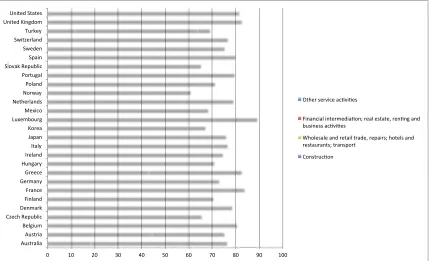
further stated that there were a total of 27 out of 40 OECD countries that were receiving revenues from the services economy. Hence, it was concluded that more than half of the OECD countries were considered as a services economy countries.
1.3.5 The Contribution Of Services Economy Within The World Economy
!
Figure 1.1: Gross Value Added by Activity Percentage of Total Activity 2007
Source: Adopted from OECD (2010) ‘OECD National Account At Glance 2009: Gross Value Added by Activity: Percentage of Total Activity, 2007’
http://www.oecd-ilibrary.org/sites/9789264067981-en/index.html?contentType=/ns/Book,/ns/StatisticalPublication&itemId=/content/
!
Figure 1.2: Gross Value Added (GVA) by Activity Percentage by All Types of Services, 2007
Source: Adopted from OECD (2010) ‘OECD National Account At Glance 2009: Gross Value Added by Activity: Percentage of Total Activity, 2007’
http://www.oecd-ilibrary.org/sites/9789264067981-en/index.html?contentType=/ns/Book,/ns/StatisticalPublication&itemId=/content/
book/9789264067981-en&containerItemId=/content/serial/22200444&accessItemIds=&mimeType=text/ html
1.3.6 Summary
With the GDP size in the OECD countries and the continuous GDP growth in services, it can be concluded that services are critically important. The discussions above could infer that the current world economy is subjected to the performance of the services sector. In other words, the world economy can be recognized as the services economy. Indeed, it is clear that the services sector is growing in importance, as it is the major contributor in the global market and economy. Refer to Appendix 1.8 for more details with regards the current and future outlook for services growth (Service PMI). The following section briefly describes the term “services”.
!
1.4 The Definition of Services
Services could be defined as “any kind of supply where the main component is a task of some kind, rather than the provision of some tangible good or material” (Bailey et al., 2008, p.365).
Valk and Rozemeijer (2009) have described services as the business services that has exchanged between organizations include the Information and Information and Communication Technology (ICT) services, consultancy, cleaning, marketing and legal support.
Fitzsimmons et al. (1998) has stressed that a services was “an experience and
cannot be duplicated”.
!
1.5 Service Procurement
Services procurement has been defined as the buying and management of services from a third party or external vendor. It may seem easy to define services but it could be rather complicating and challenging when defining them. Services have ranged from routine tasks of cleaning, catering, secretarial or security or toward the more complex type of services such as the legal, accounting and finance, sales and marketing, Information and Communication Technology (ICT), human resource (HR) and consulting. Although there are plenty of definitions in describing services, the definitions are not able to comprehend a complete range of services types. Furthermore, different companies may have identified the similar types of services as different types of services. It is supported that the term services procurement is recognized when the companies embark on the predictable next wave of the services spend segmentation. It is therefore essential to contemplate the term services procurement due to its growing importance within the economy.
!
1.6 The Challenges in Service Procurement
From the discussion in the literature review, several challenges in services procurement have been identified. These challenges include:
Services procurement is difficult to evaluate in performance evaluation Services procurement specification is more difficult, less precise and less
accurate
It involves high levels of human participation, knowledge and time Inexperienced buyers
Services purchasing decisions require professional skills Limited support from information systems professionals Non-strategic Purchases
Decentralized procurement process in services
Services procurement is perceived less complex but in reality not Underestimate of Services Procurement
!
that the procurement process has ignored the professionalism and expertise from the purchasing department. Furthermore, the services purchasing function has been recommended to have high investment of time, money and people (Schmitt, 2011; Schiele, 2005; Day and Barksdale, 1994; Mitchell, 1994). The impact of poor purchasing decisions in services might be far greater as compared to goods (Schiele, 2005; Soriano, 2001; West, 1997; Mitchell, 1994). Ellram et al. (2004) has argued that poor services purchasing has been largely contributed from by lack of sourcing from professional purchasers. This has clearly shown that the decision-making in services procurement has been highly based on the knowledge and experience of the buyers/purchaser. Therefore, decision making for services procurement could be argued as judgmental, subjective and resource-intensive. Sometimes it could be time consuming. Hence, it can be concluded that there is limited standardized approaches in managing the procurement of services.
!
1.7 Research Gap
The discussion in previous literature has arrived at a conclusion that the research on services procurement has been rather limited. The research on services has been rather focused on a specific type of services or a specific process of services procurement. This research will discuss in detail the identification of the research gap faced by the challenges of services and the review of the previous literature in services procurement.
Valk and Rozemeijer (2009) have proposed an extended procurement process for business services. Two major problems have been identified in the purchasing of services: (1) specifying the services and defining specific content of a services level agreement and (2) difficulties in services evaluation. As a result from research, two additional steps have been proposed and extended with the combination of the Van Weele’s Six-Steps Model. Indeed this research idea has been conceptually developed but it is still lacking on empirical validation. Hence, there is a research gap whereby the proposed model lacks validation.
!
challenged. Furthermore, Werr and Pemer (2007) have suggested that the procurement process for the similar types of services may show similar patterns. Werr and Pemer (2007) have suggested the extension of research in future studies based on the argument of similar pattern for the similar types of services. Day and Barksdale (1994) have suggested a future research for the purchasing of different types of professional services. This research has proposed an organizational-buying process for professional services. With the conceptual model of this organizational-buying process, Day and Barksdale (1994) have proposed this conceptual framework to be capable of facilitating programmatic research in the future. Indeed, it has been encouraged for the professional services and client firm to examine the buying process at a closer range. Fitzsimmons et al. (1998) has suggested that the classification of services is essential. Fitzsimmons et al. (1998) has argued that once the services have been classified, the purchasing process of similar business services could be facilitated by the similar approach in managing services-purchasing process. Fitzsimmons et al. (1998) concluded that the decision process for services might vary depending on the types of services to be purchased. From the discussion above, it is clearly shown that there is a potential gap in investigating the procurement processes for different types of services as suggested by various researchers including Valk and Rozemeijer (2009); Lian and Laing (2005); Werr and Pemer (2007); Day and Barksdale (1994) and Fitzsimons et al. (1998), suggesting for future research.
!
Figure 1.3: Research Gaps Source: Author
Therefore this research aims to explore and critically evaluate the different procurement process for different types of services to address the research gaps. A best practice framework/model will be proposed to assist organizations in adopting the most appropriate procurement processes for services, which will in turn optimize the potential savings from services procurement.
Research Gap ONE:
The procurement process for services is conceptually developed but it is lacking on empirical validation
Research Gap TWO:
!
1.8 Research Aim and Objectives
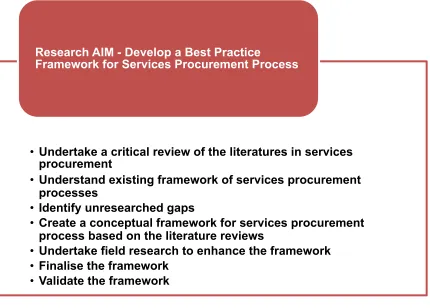
The main aim of this research is to critically evaluate the management of services purchasing particularly the services procurement process for different services.
Figure 1.4: Research Aims and Objectives Source: Author
• Undertake a critical review of the literatures in services
procurement
• Understand existing framework of services procurement
processes
• Identify unresearched gaps
• Create a conceptual framework for services procurement
process based on the literature reviews
• Undertake field research to enhance the framework
• Finalise the framework
• Validate the framework
Research AIM - Develop a Best Practice
!
1.9 Research Scope
This research proposes to evaluate the services procurement process particularly within the manufacturing and services-based companies. The researcher selects both manufacturing and services-based companies to evaluate the different procurement processes within the manufacturing and services-based businesses. The reason in selecting manufacturing companies is because the organizations have well defined the procurement of traditional goods (non services). Furthermore the potential savings in services is higher. Rosen (1998) has observed that for a typical manufacturing organization, services could account for 30 to 70 percent of value added.
Furthermore, according to BIS Department for Business Innovation & Skills (2011), large companies/enterprises that have more than 500 employees and generate an annual turnover of more than €100m were expected to gain more savings if the procurement of these services was managed effectively and efficiently. Whereas for organizations that had fewer than 500 employees with an annual turnover not exceeding €100m and/or with an annual balance sheet total not exceeding €86m, the potential savings was argued to be less as compared to the larger organizations.
!
1.10 Contribution of Knowledge
!
1.11 Structure of the Thesis
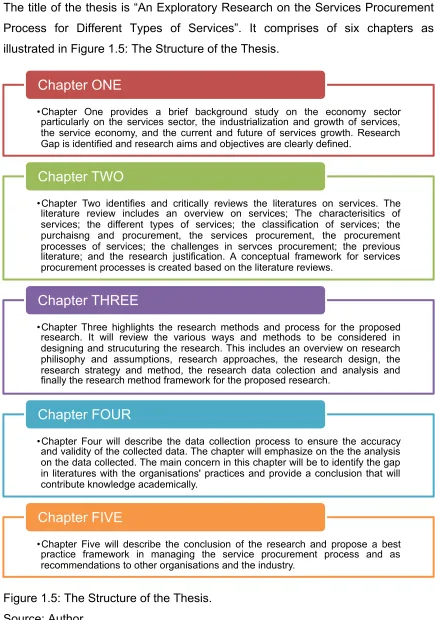
The title of the thesis is “An Exploratory Research on the Services Procurement Process for Different Types of Services”. It comprises of six chapters as illustrated in Figure 1.5: The Structure of the Thesis.
Figure 1.5: The Structure of the Thesis. Source: Author
The following Chapter TWO demonstrates the critical analysis of literatures in services procurement.
• Chapter One provides a brief background study on the economy sector particularly on the services sector, the industrialization and growth of services, the service economy, and the current and future of services growth. Research Gap is identified and research aims and objectives are clearly defined.
Chapter ONE
• Chapter Two identifies and critically reviews the literatures on services. The literature review includes an overview on services; The characterisitics of services; the different types of services; the classification of services; the purchaisng and procurement, the services procurement, the procurement processes of services; the challenges in servces procurement; the previous literature; and the research justification. A conceptual framework for services procurement processes is created based on the literature reviews.
Chapter TWO
• Chapter Three highlights the research methods and process for the proposed research. It will review the various ways and methods to be considered in designing and strucuturing the research. This includes an overview on research philisophy and assumptions, research approaches, the research design, the research strategy and method, the research data colection and analysis and finally the research method framework for the proposed research.
Chapter THREE
• Chapter Four will describe the data collection process to ensure the accuracy and validity of the collected data. The chapter will emphasize on the the analysis on the data collected. The main concern in this chapter will be to identify the gap in literatures with the organisations' practices and provide a conclusion that will contribute knowledge academically.
Chapter FOUR
• Chapter Five will describe the conclusion of the research and propose a best practice framework in managing the service procurement process and as recommendations to other organisations and the industry.
!
2
Literature&Review&
This chapter critically reviews the literature on services, the characteristics of services, the management of services procurement, the challenges in services procurement, and the different services procurement processes. The literature is discussed in detailed and summarized in a conceptual framework.
2.1 What are Services?
This section briefly describes the definitions of services from different authors. The rise of the services economy has intensified debate about the conceptual foundations of services (Wirtz and Ehret, 2009). Ellram et al. (2004) argue that the services-producing sector is essentially defined as everything apart from manufacturing and farming. This includes transportation, communication, utilities, wholesale trade, retail trade, finance, insurance and real estate, public administration and its services. With the growing supply of business services, the lines between services and manufacturing are becoming blurred (Wirtz and Ehret, 2009). Lusch and Vargo (2008) suggest that some services types are defined as the main entity of economic exchange while physical goods are essential to enable services provisions. Johnston and Morris (1985) support the notion that manufacturing companies may provide various services with some tangible goods. Many scientists have describe the “total offering” to include various combination of intangible services and physical goods that are required in fulfilling the customers’ requirements (Godlevskaja et al., 2011). Therefore, it is argued that there is confusion when defining services.
In the academic researches, there have been various attempts and studies in defining and categorizing services (Schmitt, 2011; Sonmez and Moorhouse, 2010; Araujo and Spring, 2006).
Hill (1977) argues that a good services is “capable of being the subject of a transaction between economic units and poses a change in the condition of a person, a unit or a good, that is brought about as a result of an activity of another
!
Kotler (1980) describes services as “being not a physical thing but rather an
energy expenditure”.
Lovelock (1991) defines services as “a process or performance rather than a
thing”.
Edvardsson (1997) states that services are “parts of a wider concept of a product, which may consist of goods, services, software or a combination
thereof”.
West (1997) claims that a service is “a performance that cannot be seen, felt,
tasted, inspected, or touched”.
Fitzsimmons et al. (1998) stress that a services is “an experience and cannot be
duplicated”.
Vargo and Lusch (2004a) state that a service is “an application of specialized competences like skills and knowledge through deeds, processes and
performances for the benefit of another entity or the entity itself”.
Bailey et al. (2008, p.365) define services as “any kind of supply where the main component is a task of some kind, rather than the provision of some tangible
good or material”.
Valk and Rozemeijer (2009) describe business services as services that are exchanged between organizations including the Information and Communication Technology (ICT) services, consultancy, cleaning, marketing and legal support.
Wirtz and Ehret (2009) state that the national statistics have categorized the former support operation of the manufacturing activities, the maintenance and repair operation (MRO) as a type of services.
!
Goodman and Steadman (2002) claim that the diversity of services-producing sector can be demonstrated from the economic activities that constitute a broad class of services. The economic activities may be primarily physical (e.g. auto repairs); intellectual (e.g. education); aesthetic (e.g. arts and museums) or otherwise of experiential value (e.g. recreation) (Goodman and Steadman, 2002). Goodman and Steadman (2002) added, the services-producing industries might function by changing a physical object (as in auto repairs); the consumer’s self (e.g. education and healthcare); an organization (e.g. management consultancy); or may have no such readily apparent object (as in legal representation and professional sports). Therefore, it is argued that there is no single and a clear-cut concept that describes all types of services in the services-producing industry (Sonmez and Moorhouse, 2010; Goodman and Steadman, 2002).
!
2.2 The Characteristics of Services
Zeithaml et al. (1985) and Wirtz and Ehret (2009) argue that the characteristics of Intangibility, heterogeneity, inseparability and perishability (IHIP) are often used to describe and differentiate goods from services. Schmitt (2011) and Hill and Neely (1988) added that services could be characterized by intangibility, inseparability of production and consumption, difficulty of standardization and perishability. This section particularly focuses on the discussion on the various services characteristics. Zeithaml et al. (1985) summarized various services attributes based on a total of forty-six publications, which were collected and written by thirty-three authors between 1963-1983 (Godlevskaja et al., 2011). It is concluded that services are characterized as IHIP (Godlevskaja et al., 2011; Sonmez and Moorhouse, 2010; Valk and Rozemeijer, 2009; Kasper et al., 2006; Lian and Angus, 2004; Anderssona and Norrman, 2002; Axelsson and Wynstra, 2002; Gronroos, 2000; West, 1997; Zeithaml and Bitner, 1996; Hill and Neeley, 1988; Zeithml et al., 1985; Lovelock, 1983; Shostack, 1977; Berry, 1980). The characteristics of Inseparability can also be described as simultaneity by some other literatures (Fitzsimmons et al., 1998). This research uses both interchangeably but both denote the similar description. These four characteristics have great influence towards the purchasing process whereby some of elements in services characteristics influence the services purchasing process to become more difficult, more important and different in comparison to goods (Van der Valk et al., 2005; Axelsson and Wynstra, 2002).
2.2.1 Intangibility
!
(Van Weele and Valk, 2010; Valk and Rozemeijer, 2009; Fitzsimmons et al., 1998; Stock and Zinszer, 1987; Schonberger, 1978). It is claimed that the intangibility of services could complicate the pre-purchase process of services, during the purchasing process, during the evaluation of alternative services offers or after the purchasing process when the companies are evaluating their services provider’s performance (Van Weele and Valk, 2010; Valk and Rozemeijer, 2009). Furthermore the purchaser’s expertise for the services purchasing often complicates the purchasing process (Day and Barksdale, 1994). Novice buyers tend to be assigned to manage the services purchasing process instead of the professional buyers in goods and products purchasing (Smeltzer and Odgen, 2002). As a result, services providers may require educating the buying companies about what can be achieved considering the project budgetary and constraints at the time. The intangibility of services may appear difficult for the customers (Fitzsimmons and Fitzsimmons, 2008). When buying a product, the customer is able to see it, feel it and test the performance before the purchase. Indeed for services, the customers rely heavily on the reputation of the services providers. Therefore the characteristics of services often make it more difficult for consumers to make the services purchasing decision (Burton, 1990). Consumers may get confused in selecting a specific services provider or to observe the brand alternatives in a product class. Therefore, services marketers often assist the consumers in constructing a frame of reference that is also applicable to both business and business settings. Schonberger (1978) claims that services purchase decisions can be differentiated depending on the tangibility of services to be purchased (Fitzsimmons et al., 1998). Generally, services have been labelled as intangible but tangibility of services may still vary. Due to services intangibility, it is believed that purchasing services carries much higher risks compared to purchasing manufacturing goods (Sonmez and Moorhouse, 2010; Fitzsimmons et al., 1998; Mitchell, 1998a; Mitchell, 1998b). Fitzsimmons et al. (1998) believes that other characteristic of services such as inseparable, heterogeneity and perishability arise from the intangibility of services.
2.2.2 Heterogeneity
!
Heterogeneity in services describes services as an experience that is unable to be duplicated exactly for each customer (Fitzsimmons et al., 1998). Therefore heterogeneity of services implies a high diversity (Van Weele and Valk, 2010). It is convinced that the combination of the intangible nature of services and the customer as a participant in services delivery may result in variation of services from one customer to another (Fitzsimmons and Fitzsimons, 2008). As an example, the consultancy may be varied depending on the group of consultants’ working experiences. Consultants’ past experiences are different depending on their education, the skill sets they have equipment themselves with, the individual’s knowledge and problem-solving experiences. Furthermore, the introduction of machine automation has strengthened personalization that eliminates the relatively routine impersonal tasks. Therefore personal attention in the rest of the task has increased. These personal attentions on work could have created opportunities for variability in the provided services. This has perceived a variation of quality in services. Unless customers are satisfied with the variation, customers may demand to be treated fairly equally. Therefore, the development of standards in services is very important including employee trainings to ensure each customer receive fair treatment. Consistency has been the key towards excellent services quality control.
2.2.3 Inseparability / Simultaneously
!
sellers. Therefore the services quality is a combined responsibility between the services provider and the buyer.
2.2.4 Perishability
Services perishability identify that if a services is not performed, it is a loss of opportunity (Fitzsimmons et al., 1998). For example, an empty airline seat, an unoccupied hospital or hotel room or an hour without patient in the day of a dentist is considered a lost of opportunity. Van Weele and Valk (2010) comment that if the services are not consumed at the time of production, the services are lost. This explains that services cannot be put on stock and therefore services are perishable.
!
2.3 The Example of Services
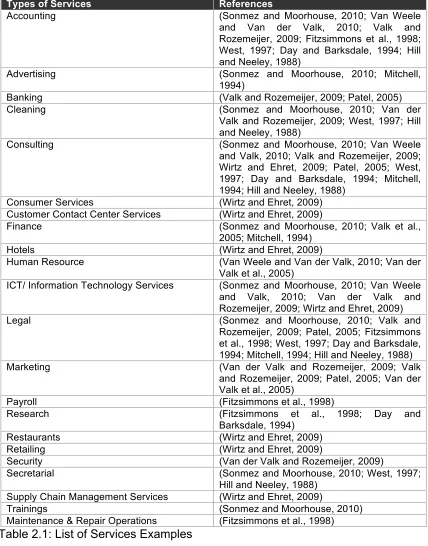
This section briefly describes the examples of services that are provided by various authors. The most commonly found key term of services is business services (Valk and Rozemeijer, 2009; Valk et al., 2005) and professional services (Sonmez and Moorhouse, 2010; Van Weele and Valk, 2010; Valk and Rozemeijer, 2009; Patel, 2005; Day and Barksdale, 1994; Mitchell, 1994). Table 2.1 list the example of services.
Types of Services References
Accounting (Sonmez and Moorhouse, 2010; Van Weele and Van der Valk, 2010; Valk and Rozemeijer, 2009; Fitzsimmons et al., 1998; West, 1997; Day and Barksdale, 1994; Hill and Neeley, 1988)
Advertising (Sonmez and Moorhouse, 2010; Mitchell, 1994)
Banking (Valk and Rozemeijer, 2009; Patel, 2005) Cleaning (Sonmez and Moorhouse, 2010; Van der
Valk and Rozemeijer, 2009; West, 1997; Hill and Neeley, 1988)
Consulting (Sonmez and Moorhouse, 2010; Van Weele and Valk, 2010; Valk and Rozemeijer, 2009; Wirtz and Ehret, 2009; Patel, 2005; West, 1997; Day and Barksdale, 1994; Mitchell, 1994; Hill and Neeley, 1988)
Consumer Services (Wirtz and Ehret, 2009) Customer Contact Center Services (Wirtz and Ehret, 2009)
Finance (Sonmez and Moorhouse, 2010; Valk et al., 2005; Mitchell, 1994)
Hotels (Wirtz and Ehret, 2009)
Human Resource (Van Weele and Van der Valk, 2010; Van der Valk et al., 2005)
ICT/ Information Technology Services (Sonmez and Moorhouse, 2010; Van Weele and Valk, 2010; Van der Valk and Rozemeijer, 2009; Wirtz and Ehret, 2009)
Legal (Sonmez and Moorhouse, 2010; Valk and
Rozemeijer, 2009; Patel, 2005; Fitzsimmons et al., 1998; West, 1997; Day and Barksdale, 1994; Mitchell, 1994; Hill and Neeley, 1988) Marketing (Van der Valk and Rozemeijer, 2009; Valk
and Rozemeijer, 2009; Patel, 2005; Van der Valk et al., 2005)
Payroll (Fitzsimmons et al., 1998)
Research (Fitzsimmons et al., 1998; Day and
Barksdale, 1994)
Restaurants (Wirtz and Ehret, 2009)
Retailing (Wirtz and Ehret, 2009)
Security (Van der Valk and Rozemeijer, 2009)
Secretarial (Sonmez and Moorhouse, 2010; West, 1997; Hill and Neeley, 1988)
Supply Chain Management Services (Wirtz and Ehret, 2009)
Trainings (Sonmez and Moorhouse, 2010)
Maintenance & Repair Operations (Fitzsimmons et al., 1998)
!