Does Identity Influence How Learners Seek Support?
Vivienne Newton and Sarah Telfer
School of Education and Psychology University of Bolton
Abstract
This article presents a research case study of learners attending a university in the North West of England. This university attracts learners of all ages from diverse backgrounds; many fall into the classification of ‘non-traditional’ students who do not possess the identity associated with those who typically progress to university. Compared to middle-class social agents who see progression to University as natural, students from low participation groups may feel that their background
influences upon their university experience. Their perceived social class may direct their friendship groups, engagement with university activities and academic literacy and study skills acquisition (Bourdieu & Passeron, 1990). For these learners, the support services encountered during their early experiences of university can play a significant part in their retention and long-term outcomes.
The primary aim of this study explores the use of support facilities at university and examines any obstacles there are to their use; investigating the need for support is a secondary aim. The study investigates social class, habitus and learner identity and scrutinises the role these factors play in the acquisition of academic literacy and study skills. It evaluates research into the effective academic literacy models and considers what inventions have been implemented in other universities. It seeks to offer valuable insight into the individual student learning experience at one university through evaluating how learners identify themselves and how this may impact upon their academic literacy and study skills acquisition. Predominantly qualitative data has been used to investigate the social, economic and educational backgrounds of students and whether students feel prepared when arriving at university. Through a thematic analysis of topics raised during a series of focus groups, the support mechanisms that students have engaged with and possible links between social background and skills competency have been explored. Conclusions indicate that although many students do successfully engage with the current services on offer at this university, considering perceived identity and an academic literacies approach may increase engagement and positive outcomes.
Introduction
The primary aim of this study is to explore the use of study skills support facilities at a university in the North West of England and to examine any barriers to their implementation. It studies the influence of the current support services upon the development and enhancement of students’ academic literacy skills such as: writing style, spelling, grammar, punctuation, use of English and referencing. In terms of students arriving at university prepared for the level of studies expected of them, it explores if social class and background should be a factor considered as part of learner support services. The study aims to explore coping mechanisms and preparedness for university among students from a variety of different social backgrounds.
Tinto (1987) proposes that student withdrawal from courses may serve as ‘a barometer of the social and intellectual health’ of an educational institution, as much as the students' experiences. He considers that variations in policy are necessary for different types of students, suggesting that effective retention lies in the institution’s commitment to the students in relation to the quality of student interaction and integration into their department or faculty. He suggests that the content, structure, and evaluation methods for assessment of student retention and departure need to be considered, along with the use of assessment information for developing effective retention programs. It can therefore be suggested that learner identity and social health is a vital aspect that Higher Education (HE) tutors need to consider when improving student support.
Learner Identity
Learner identity can be conceptualised from a sociocultural perspective, being viewed as a socially constructed, dynamic product of the social, historical and political contexts of an individual learner’s lived experiences. Learners’ histories are defined in part by their membership in a range of different social groups such as: gender, social class, religion and race and even their geographical region (Hall, 2012). Learner identity is linked to social identity which encompasses participant roles, positions, relationships, reputations, and other dimensions of social personae, which are conventionally linked to epistemic and affective stances (Ochs, 1996). Learners also acquire a second layer of social group memberships developed through their involvement in educational institutions such as academic schools or faculties and social institutions through university clubs or societies. Social theorist Pierre Bourdieu calls this our ‘habitus’ (Bourdieu, 1984).
HE students, it could be suggested, approach their academic study with the perceptions, knowledge and evaluations associated with their learner identity and habitus, and for more non-traditional HE students, this may affect both their metacognitive skills and academic literacy skills.
Academic Literacy among non-traditional students
development of study and writing skills (Lillis, 2001). This model seeks to rectify those who have issues with producing pieces of extended written work by providing additional study skills through coaching or mentoring outside of the taught curriculum. However, it can be argued, that this approach serves to reinforce the elitist perception of university; those who do not arrive with these skills are seen to be lacking. In addition, by basing success purely on, often lengthy, pieces of written work, the contribution to education that may be gained from the experience of a more diverse student population is ignored by not employing varied assessment techniques.
Recent education policy makers have encouraged widening participation and opened higher education opportunities to those who have additional needs due to ‘non-traditional’ backgrounds; “groups of young and mature people who would not have previously considered doing a degree” (Reay et al., 2001, p.858). Students who have a long-term health or mental health condition or Specific Learning Disability (SpLD) as defined under the 2010 Equality Act, can access the Disabled Students’ Allowances (DSA). This is additional funding to enable them to access the support needed to attend university, provided regardless of background and/or circumstance. Students will have a needs assessment and be given repayable funding for study related equipment, travel and non-medical help. However, from the 2016-17 academic year, changes were introduced to the DSA system which placed more financial burden on HE providers, who will now have to fund band 1 and 2 non-medical helpers and Specialist Transcription Services (Johnson, 2015). As a result, state funding will only be provided for equipment and the specialised non-medical help required at band 3 and 4, which is required by far fewer students. Disability Rights UK (2015) argues that if a student does not arrive at university with the funding that enables them to access the support necessary to attain success, this incentivises the provider to reject the applicant or restricts user choice. Another issue faced by HE providers with a widening participation agenda is the need for support is not just applicable to those with diagnosed SpLD and disabilities, but to students who speak English as a second language (ESOL) or those who may have undeclared or undiagnosed learning needs. Furthermore, those with work experience, who have good subject awareness and excel in practical application of theory, may struggle to convert this knowledge into high quality written work. These students may not possess the skills necessary for success; in short, they are unable to write in the academic English needed to be successful in the ‘essayist literacy’ approach to assessment within HE (Lillis & Tuck, 2016, p.32).
backgrounds is being overlooked in HE, this may extend beyond assessment methods, and include a lack of inclusion in the whole HE community.
Social diversity in HE and the concept of ‘Habitus’
A theme in much of the research surrounding literacy in HE is the impact the composition of the HE community can have of the sense of belonging felt by the non-traditional students within that community and the concept of education as a form of social transition. One of the areas highlighted by recent research is that, although widening participation has been part of the political landscape of education for some time, there is little evidence to indicate that the student demographic at Russell Group universities has undergone any noteworthy changes (Byrom, 2009). The Sutton Trust (Jerrim, 2013) report discusses that those from typically middle class families are three times more likely to enter one of the leading universities compared to their working-class counterparts. Furthermore, those from disadvantaged backgrounds score lower on the Programme for International Student Assessment (PISA) reading test and demonstrate less advanced cognitive skills. However, students from state schools who do achieve the entry requirements for Russell Group universities are more inclined to choose to continue their education at post-1992 institutions. The reasons for this are not clear; Byrom (2009) suggests that a contributing factor may be the sense of social belonging felt by the individual or “fit” (ibid, p. 211). This idea of ‘not belonging’ is supported by Bourdieu and Passeron (1990) who maintain that access is not restricted by the institutions themselves, but by the attitudes of those who would not have traditionally sought HE because university is not somewhere they belong. Those from the middle classes see educational progression as natural and belong to a ‘habitus (ibid) which see university as part of their cultural inheritance. This habitus comes about because of the interaction between cultural, economic, symbolic and social backgrounds which, when combined, form a disposition (Reay, 2004). However, habitus is not a fixed state, but one which can transform when exposed to cultural, social, symbolic and economic exchanges within new social spaces or fields (Bourdieu & Passeron, 1990). This suggests that, to enable those from non-traditional backgrounds to be successful in the transition into HE, attention needs to be paid to helping them to negotiate the new experiences at the early stages and to adopt the necessary skills, including academic language and literacy, to enable them to develop a sense of belonging. One place where non –traditional students could be helped to make the transition and develop a sense of belonging would be through academic support on issues such as academic literacy. But how do non-traditional students view such support and how are they engaging with it?
Exploring Academic Literacy at the University
The purpose of this case study was to gain further insight into the factors that influence acquisition of academic literacy skills at one particular University and addressed the following research
questions:
1. What relationship is there between social background and feeling prepared for HE?
2. How does the manner in which support services are being provided affect the way in which students engage with them?
Methodology
An action research approach was adopted in undertaking this research project which offers recommendations to improve the delivery of study skills support services, to enhance student performance and improve retention. This study collected statistical data around student
to give a deeper understanding of the quantitative statistics and enabled the researcher to draw more grounded conclusions.
In the 2014/15 academic year, the author carried out a pilot study with a smaller sample group of students to examine whether students felt their confidence with study skills had increased through accessing study skills sessions. For this study, quantitative data was collected via an online
questionnaire open between 16th November and 18th December 2015. distributed using a non-probability snowball sampling method thus encompassing different genders, ethnicities, socio-economic classes and cultures. The period was chosen to ensure first year students would have had sufficient Semester 1 experience to enable them to answer the questions, whilst ensuring that results would be returned and analysed within the timeframe specified for this research project. A link to this was circulated via social media and through email to student academic representatives, clubs and society officers and academic staff requesting that they forward a link onto their peers and students. The questionnaire included an option for students to participate in further research as part of a focus group. In the design and delivery of the research process of this study, the Code of Practice for Ethical Standards in Research involving Human Participants (University of Bolton, 2006) has been referred to and informed consent completed, submitted, authorised, stored and used in accordance with this guidance.
Qualitative data was collected using a free text box at the end of the questionnaire to identify key themes to be used to inform discussion in semi-structured focus groups. Four semi-structured 30-minute focus groups were conducted with between 12 and 15 participants in each. The three prompts below were given, with 10 minutes’ discussion allowed for each section.
• How did you feel about your study skills in your first few weeks of your course?
• What study support are you aware of or did you access?
• What might have improved your academic literacy/study skills?
Intervention was minimal during the focus groups and any non-relevant topics of conversation were disregarded in writing up the conversations. A thematic analysis of the transcript was carried out, identifying significant comments, coding them and grouping them together.
Data Analysis
172 valid answers were received, which represented 3% of the student population. The figures indicate there are female respondents than male and 41% of respondents in the research were aged 24 or less. This can be compared to Higher Education Authority (HEA) statistics for the provider which indicates there are 2% more male students and of 67% of students are under 25. There may be several reasons why the figures differ; the statistics from HEA are for 2014/15 or the data
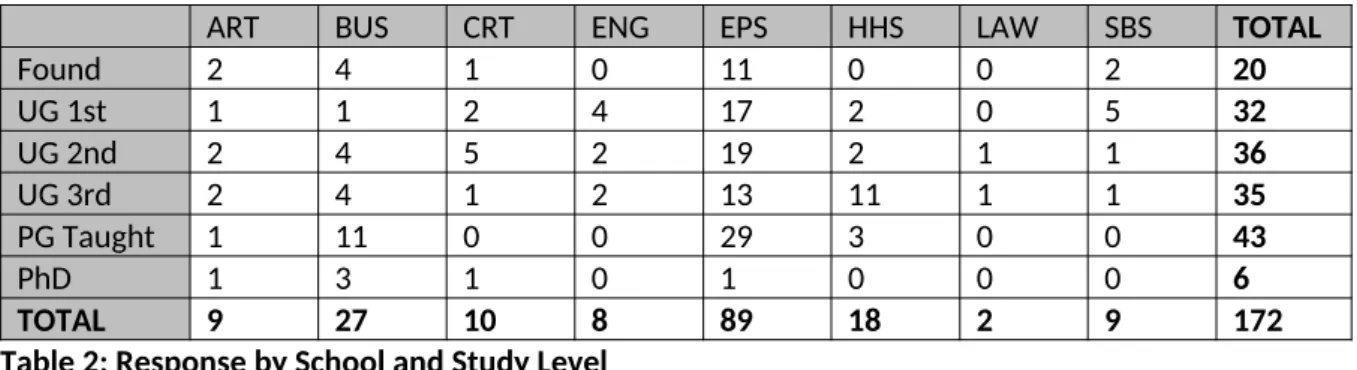
collected in this study is a mix of full and part time students, whereas the HEA data refers to full time students only. In terms of representing the whole student body, a high proportion of responses were from the School of Education and Psychology, therefore, this research may be best viewed as a case study of this area.
17-24 25-34 35-44 45-54 55+ TOTAL
Male 29 21 9 9 0 68
Female 41 33 19 9 2 104
ART BUS CRT ENG EPS HHS LAW SBS TOTAL
Found 2 4 1 0 11 0 0 2 20
UG 1st 1 1 2 4 17 2 0 5 32
UG 2nd 2 4 5 2 19 2 1 1 36
UG 3rd 2 4 1 2 13 11 1 1 35
PG Taught 1 11 0 0 29 3 0 0 43
PhD 1 3 1 0 1 0 0 0 6
TOTAL 9 27 10 8 89 18 2 9 172
Table 2: Response by School and Study Level
This study collected and analysed a range of data to establish if individual or multiple factors indicated a preference for support methods or awareness and engagement with the current offer. Conversations with the student population indicate that some students engage with informal peer assisted study groups, either face to face or via social media, and the evidence gathered in this study intends to establish how commonplace this practice is. The formal mechanisms offered by the university follow the study skills model in the form of non-subject specific workshops on a range of typical skills, such as essay structure, critical thinking, referencing and plagiarism, and are delivered by non-academic staff. More subject specific sessions, which echo elements of the academic
socialisation model, are provided by the University’s trainee teachers, but the method of delivery is a ‘bolt-on’ deficit approach. Finally, one to one sessions are available; generic guidance from specialist support staff, subject specific from trainee teachers or peer assisted pastoral support. Although there may be some elements of academic socialisation, these sessions take the approach of identifying and rectifying a deficit and are done in isolation from the students’ formal subject lectures.
The University prides itself on widening access to HE and unlocking individual potential by providing responsive teaching supported by its research and student centred initiatives. With the institutions success in attracting part time students and those from BME Groups, it has highlighted that through working alongside partner schools and colleges that the widening participation agenda is being embraced by the organisation. These factors may suggest that this university offers those currently, or at risk of being, unemployed a realistic opportunity to change direction through education. This may be supported by the quantitative data collected in this study, which indicates 26% of
Key Findings from Quantitative Data
Despite the evidence that students attending this university in the North West of England come from a diverse range of backgrounds, over two thirds of students agreed that their prior experience had sufficiently prepared them for university. One of the University’s key targets for development is the improvement of retention figures, however it can be argued that this area is challenging as much remains unknown about the dropout process in HE, research failing to distinguish between drop out due to academic failure, or voluntary withdrawal (Tinto, 1975). Lowe and Cook (2003) identified that often poor retention of students within the first year can be directly linked to the unrealistic
expectations developed by students prior to arrival. To address this issue, they suggested improved communication with students in the pre-university period to ensure that they experience
“appropriate academic, attitudinal and social preparation” (ibid, p.75). The fact that students in this study felt their prior experience had been a good preparation, may be an indication that the
teaching and learning methods and course structure at the University consider different student backgrounds. It may also indicate that a social constructivist approach is taken to embedding study skills and academic literacy within learning and appropriate scaffolding is being provided to learners (Vygotsky, 1978).
The Indices of Multiple Deprivation (IMD) (Department for Communities and Local Government, 2015) place the community in which the University is located as one of the 15% most deprived areas in England; a factor which is backed up by the statistics obtained during this study. Through
examining the declared family income, a high number of participants were grouped in the lower three social classes; Traditional working class, Emergent service workers and Precariat (Savage et al., 2013). It can be argued these are the classes with least advantage; reduced household income or reliant on benefits with moderate or negligible savings, more likely to rent their home or own a home with a value of £127,000 or less. They are also likely to have a more limited social and cultural capital that those in higher social classes and are less likely to be university educated. The
importance of social and cultural capital is that it determines position within and ability to influence society or “the set of actually usable resources and powers” (Bourdieu, 1984, p.114).
likely to be younger and from ethnic minority groups than the other low income classes (Savage et al., 2013). In considering what impact perceived social class may have, a mean average of 46% of respondents identified themselves as being within the first three classes agreed or strongly agreed that they were happy with their level of study skills.
Precariat Emergent service workers
Traditional working class
New affluent workers
Technical middle class
Established middle class
Elite
% of respondent s from each Social Class
43% 44% 52% 59% 45% 62% 75%
Overall responses split by Social Class
17% 12% 17% 22% 6% 23% 3%
Class as defined by Savage et al ., 2013
Table 3: Students who are happy with their level of study skills by social class.
This may indicate a link between socio-economic status and having the necessary levels of academic literacy and study skills to feel able cope with university level studies. Those who come from backgrounds of low income, limited social networks and lack of exposure to cultural experiences may not have acquired the skills necessary for HE. It could be argued that those with the higher levels of social and cultural capital contribute to becoming part of a more education focused Community of Practice (Wenger, 1999). Therefore, those exposed to ‘high’ culture such as visiting museums, theatres and galleries or exposed to a wider range of social contacts are more likely to feel equipped for studying at university.
This argument may be reinforced by examining those who are most content with their own level of academic literacy and study skills. The happiest group by economic income were those in the £30-40,000 bracket, with 94% of the respondents in this group agreeing or strongly agreeing that they were happy with their level of study skills and academic literacy. In general terms, this income bracket fits with the New Affluent Worker class, who are economically secure, socially and culturally aware, with a high level of emergent cultural capital. Where respondents have a family income below £25,000, 42%, representing a mean average of the lowest three income brackets, were happy with their current study skills level.
£0-8k £8-15k £15-25k £25-30k £30-40k £40-65k £65k +
% of respondent s from each Social Class
45% 41% 39% 76% 94% 40% 86%
Overall responses split by Social Class
21% 21% 14% 14% 18% 4% 7%
Another feature, which links to economic wellbeing and social class, is the consideration of social belonging. For students from the middle classes, university is a ‘rite of passage’, a stage between living with parents and complete independence and the opportunity to pursue both educational and social experiences. For those from non-traditional backgrounds, they may have to consider other factors; living expenses may necessitate part time work and family commitments may result in them being time poor. Although socialising with university friends is not essential to obtaining a degree, those who miss out on this experience may struggle to form friendship groups which extend their reach into successful learning support mechanisms (Department for Business, Innovation and Skills (BIS), 2014)
Key Findings from Qualitative Data
Eight key themes were isolated through thematic analysis, identified in the table below, which also indicates how often the theme occurred. Three of these themes have been considered in detail.
Com mun icatio n Acad emic cour
se ICT
Pr e-Unive
rsity
Leve l 5-8
stude nts
Inde pend
ent l earn
ing
Co-lo cate
d Se rvice
s
Supp ort S
ervic es 0 5 10 15 20 25 30 35 40 45
Qualitative Data Themes
Communication
Highlighted in students’ comments were issues around communication about study support services and there were both positive and negative comments. For some students, the support services were better that they anticipated, particularly those who had studied elsewhere.
There’s lots of availability of help in the University, you get a response in a day or so. Other universities aren’t like that. (Quote F4-13)
Those who were less positive about the services drew attention to the fact that either there was too much information given or they had not explicitly been told about the services available.
I think students would feel much better about coming into university if they knew the services were available. (Quote F2-34)
There is a crossover with other themes here; support services were not promoted as part of their academic course and students were expected to become independent learners without guidance of how to do this. It may be argued that those who emphasised being unaware of the support services available support the view put forward by Lowe and Cook (2003). These authors argue that students are not sufficiently prepared for university life in that they do not appreciate that the onus is upon them to seek out opportunities to develop as independent learners. They also suggest that academic staff may not be sympathetic in their teaching approaches to learners who have yet to develop the skills necessary to becoming independent learners.
Academic course
There were several sub-themes identified within this section: academic staff training, consistency of approach, and timing of interventions. Lea and Street (1998) highlight that embedding skills within the field of study through academic literacy has important benefits for the learner and this is echoed by the thoughts of one student:
I feel these sessions should be integrated into course contents. (Quote QQ-6)
However, the focus group discussions seemed to indicate that only some subjects incorporated study skills in the course content, overtly at least.
There doesn’t appear to be University wide consistency on this. (Quote F1-18)
It may be that the enculturation of students into the academic discourse is subtle and that students did not identify that they had developed study skills.
If the university had a set plan for every lecturer to deliver in the first few weeks, then everyone would get the same information. (Quote F2-28)
However, it is a concern that some students identified themselves, or each other, as having difficulties and felt they did not receive guidance from academic staff to access support. This situation may be compounded further by learners coming from diverse backgrounds, who do not originate from the habitus that sees progression to university as natural (Bourdieu & Passeron, 1990). As identified by Lea and Street (1998) the adoption of the academic literacy model requires not only buy in from academic staff but a substantial commitment in terms of their time. The comments received via these focus groups are not sufficient to support such an investment without further research, but they may be an indication that more of a partnership approach could be needed between academic and support staff. Whether this is delivery of study skills sessions within the course timetable by support staff or whether it is a move to an academic socialisation model utilising subject specific texts to locate learning, again would require further research. Highlighted by the comments however, is that some academic staff training in identifying individual need and working more closely with support staff to deliver differentiation in the classroom may be required.
Independent learning
This area has grouped together comments under the general theme of independent learning. Several students mentioned their own levels of confidence either with their academic studies or in general.
It’s like you are left to your own devices. (Quote QQ-2)
This is likely to be because of the widening participation policies may result in students lacking the social and cultural capital that makes them feel they belong within the university community (Bourdieu & Passeron, 1990). Comments relating to feeling alone, not wanting to stand out or just ‘getting by’ were common. It may also indicate that the teaching and learning processes at
university are not highlighting effectively to students the skills that they have developed. The comment “I guess I’ve kind of ‘bumbled’ through” from a third-year participant suggests that the student does not recognise the skills they had developed as they progressed through the course. This theme also links very strongly with the expectations of university; students may expect the support levels to be like those in school and college and feel let down when they are not.
We were told about other services and expected to access them ourselves. (Quote F2-15)
Therefore, it may be necessary to stress to students early in the academic course the need to develop self-directed learning habits
… in which individuals take the initiative, with or without the help of others, in diagnosing their learning needs, formulating learning goals, identifying human and material resources for learning, choosing and implementing appropriate learning strategies, and evaluating learning outcomes.
(Knowles, 1975, p.18)
Limitations of this study
The quantitative data indicates that the study skills support services were not meeting the needs of around 40% of participants in this study. However, on examination of this data, this also appears to be true of the informal academic support systems. As these are student initiated and participation is voluntary, this would raise the questions of why students would continue to access a
non-compulsory arrangement if it was not beneficial. This may suggest that the issue lies with the method of data collection. It may be that when participants have not had experience of an
individual study support service, instead of answering not applicable, they have instead responded neither agree or disagree, disagree or strongly disagreed. Unfortunately, it is impossible to tell if this is the case, however, and triangulation of the data supports the findings of this study.
Conclusion and Recommendations
It may be argued these findings are narrow because they only apply to one HE institution; however, this may be useful as a case study which in the future could be used to expand the scope to other institutions to draw findings across a wider range of providers. It would be interesting to compare to other universities who share a similar student profile and demographic. The findings of this study indicate that further research into the support of academic literacy and study skills development at this university may be warranted. Introducing early and appropriate interventions may contribute to raising attainment levels, reducing student attrition and improving retention. Evaluating the
The data gathered appears to indicate that there may be links between the social background of the non-traditional students at this university and whether they feel prepared for the level of studies required at HE. Less than half those who considered themselves to be from the lower three classes defined by Savage et al ., (2013) and/or from a family where income was less than £25,000 felt happy with their current level of study skills. When exploring how non-traditional students could be equipped with the skills they needed to progress through HE, the focus was very much on
communicating services effectively and offering them as part of the academic course. The
understanding of becoming an independent learner seemed to be very much an isolated, individual journey rather than one that followed a social constructivist approach. It may be argued that this supports Bourdieu and Passeron (1990) in their argument that the idea of ‘not belonging’ originates with the non-traditional student. This suggests that greater attention should be paid to those interventions that successfully help learners to become independent.
As identified by this study, the conclusion that a Study Skills Model focussing on supporting students around their academic studies rather than from within is not an approach that has been successful at this university. Identified by Reay et al., (2010) universities, such as this one, where a high proportion of students do not live on campus can lack a learning culture brought about by
“institutional habitus” (ibid, p.11) and that there needs to be a balance between social and learner identity. Therefore, engagement needs to begin early in academic life and develop from engaging students when coming into university for lectures. Through adopting an integrated school level approach to addressing academic literacy and study skills using personal tutoring and enhanced personal tutoring, students can be introduced in a structured manner to the habitus (Bourdieu & Passeron, 1990) needed to be successful in HE.
References
Bourdieu, P. (1984) Distinction: A Social Critique of the Judgement of Taste Cambridge MA: Harvard University Press.
Bourdieu, P. & Passeron, J.C. (1990) Reproduction in Education, Society and Culture London: Sage Publications.
Byrom, T. (2009) ‘I don’t want to go to a crummy little university’: social class, higher education choice and the paradox of widening participation. Improving School [online]. 12 (3), pp. 209-24. Available from: DOI: 10.1177/1365480209348819 [Accessed 21 April 2016].
Department for Business, Innovation and Skills (BIS). (2014) National strategy for access and student success in higher education [Online]. Available from: https://www.gov.uk [Accessed 25 April 2016]. Department for Communities and Local Government. (2015) The English Indices of Deprivation. London: The National Archives.
Disability Rights UK. (2015) DSA guidance: Our response [Online]. Available from:
https://www.disabilityrightsuk.org/news/2015/january/dsa-guidance-our-response [Accessed 07 May 2017].
Gunn, C., Hearne, S. & Subthorpe, J. (2011) Right from the Start: A Rationale for Embedding Academic Literacy Skills in University Courses. Journal of University Teaching and Learning Practice [online]. 8 (1), Available from: http://ro.uow.edu.au/jutlp/vol8/iss1/6/ [Accessed 08 May 2016].
Jerrim, J. (2013) Family Background and access to ‘high status’ universities [Online]. Available from: http://www.suttontrust.com/ [Accessed 21 April 2016].
Johnson, J. (Minister of State for Universities and Science). (2015) Disabled Students' Allowances. Written statement - HCWS347. London: Department for Business, Innovation and Skills.
Knowles, M. (1975) Self Directed Learning. A guide for learners and teachers. Englewood Cliffs: Prentice Hall/Cambridge.
Lea, M. & Street, B. (1998) Student Writing in Higher Education: An Academic Literacies Approach. Studies in Higher Education 23 (2), pp. 157-73.
Lillis, T. (2001) Student Writing: Access, Regulation, Desire London: Routledge.
Lillis, T. & Tuck, J. (2016) Academic literacies: a critical lens on writing and reading in the academy. In: Hyland, K. & Shaw, P. (eds.) The Routledge Handbook of English for Academic Purposes. Abingdon: Routledge Taylor & Francis Group, pp. 30-43.
Lillis, T. & Turner, J. (2001) Student Writing in Higher Education: Contemporary confusion, traditional concerns. Teaching in Higher Education 6 (1), pp. 57-68.
Lowe, H. & Cook, A. (2003) Mind the Gap: Are students prepared for higher education? Journal of Further and Higher Education 27 (1), pp. 53-76.
Moll, L., Amanti, C., Neff, D. & Gonzalez, N. (1992) Funds of knowledge for teaching: Using a qualitative approach to connect homes and classrooms. Theory into Practice XXXI (2), pp. 132-41. Ochs, E. (1996) Linguistic resources for socializing humanity. In: Gumperz, J. & Levinson, S. (eds.) Rethinking linguistic relativity. Cambridge: Cambridge University Press, pp. 407-38.
Reay, D. (2004) 'It's all becoming a habitus': beyond the habitual use of habitus in educational research. British Journal of Sociology of Education [online]. 25 (4), pp. 431-44. Available from: DOI: 10.1080/142569042000236934 [Accessed 23 April 2016].
Reay, D., Crozier, G. & Clayton, J. (2010) 'Fitting in' or 'standing out': working-class students in UK higher education. British Educational Research Journal 32 (1), pp. 1-19. Available from: DOI: 10.1080/01411920902878925 [Accessed 10 May 2016].
Reay, D., Davis, J., David, M. & Ball , S. (2001) Choices of Degree or Degrees of Choice? Class, 'Race' and the Higher Education Choice Process. Sociology 35 (4), pp. 855-74.
Savage, M.,; Devine, F., Cunningham, N., Taylor, M., Li, Y., Hjellbrekke, J., Le Roux, B., Friedman, S., and Miles, A. (2013) A New Model of Social Class? Findings from the BBC's Great British Class Survey Experiment. Sociology 0 (0), pp. 1-32. Available from: DOI: 10.1177/0038038513481128 [Accessed 17 April 2016].
Swales, J.M. (1990) Genre Analysis: English in academic and research settings Cambridge: Cambridge University Press.
The Deputy Prime Minister's Office. (2015) Social Mobility Indicators [Online]. Available from: www.gov.uk [Accessed 19 April 2016].
Tinto, V. (1987) Leaving college: Rethinking the causes and cures of student attrition. Chicago: University of Chicago.
University of Bolton. (2006) Research Ethics Framework [online]. Available from:
http://www.bolton.ac.uk/Students/PoliciesProceduresRegulations/AllStudents/ResearchEthics/ Home.aspx [Accessed 2 November 2015].
Vygotsky, L.S. (1978) Mind in Society Cambridge MA: Harvard University Press.
Waters, M. & Waters, A. (1992) Study Skills and Study Competence: Getting the Priorities Right. English Lanaguage Teaching (ELT) Journal 43 (3), pp. 264-73.
Wenger, E. (1999) Communities of Practice: Learning, meaning and identity Cambridge: Cambridge University Press.
Wingate, U. (2012) Using Academic Literacies and gene-based models for academic writing instuction: A 'literacy' journey. Journal of English for Academic Purposes 11 (1), pp. 23-37.