A Monthly Double-Blind Peer Reviewed (Refereed/Juried) Open Access International e-Journal - Included in the International Serial Directories
Indexed & Listed at:
VOLUME NO.3(2013),ISSUE NO.03(MARCH) ISSN 2231-5756
INTERNATIONAL JOURNAL OF RESEARCH IN COMMERCE, IT & MANAGEMENT
CONTENTS
CONTENTS
CONTENTS
CONTENTS
Sr.No.
TITLE & NAME OF THE AUTHOR (S)
Page No.
1. EXTENT OF ABSOLUTE POVERTY IN RURAL SECTOR OF HIMACHAL PRADESH: A MEASURE OF UNEMPLOYMENT
RAMNA
1 2. THE ENTREPRENEURSHIP CORE COMPETENCES FOR DISTRIBUTION SERVICE INDUSTRY
SU-CHANG CHEN, HSI-CHI HSIAO, JEN-CHIA CHANG, CHUN-MEI CHOU, CHIN-PIN CHEN & CHIEN-HUA SHEN
5 3. THE RELATIONSHIP BETWEEN MACROECONOMIC VARIABLES AND CEMENT INDUSTRY RETURNS: EMPIRICAL EVIDENCE FROM PAKISTANI CEMENT
INDUSTRY
MUHAMMAD IMRAN & QAISAR ABBAS
10
4. OUTLOOK OF MANAGEMENT STUDENTS TOWARDS EFFICIENCY OF ONLINE LEARNING-A CASE STUDY OF SHIVAMOGGA CITY, KARNATAKA STATE
SANDHYA.C, R. HIREMANI NAIK & ANURADHA.T.S
17 5. TRAFFIC RELATED MORTALITY AND ECONOMIC DEVELOPMENT
MURAT DARÇIN
21 6. SUBSCRIBER’S PERCEPTION TOWARDS CUSTOMER CARE SERVICE IN MOBILE TELECOMMUNICATION WITH SPECIAL REFERENCE TO TUTICORIN
CITY
S. ANTHONY RAHUL GOLDEN. & DR. V. GOPALAKRISHNAN
27
7. A STUDY OF WAVELET BASED IMAGE COMPRESSION ALGORITHMS
CHETAN DUDHAGARA & DR. KISHOR ATKOTIYA
31 8. A STUDY OF CONSUMER’S IMPULSE BUYING BEHAVIOUR WITH REFERENCE TO EFFECT OF PROMOTIONAL TOOL IN THE OUTLETS OF
CHHATTISGARH
DR. MANOJ VERGHESE & POOJA G. LUNIYA
37
9. STUDY OF CONSUMER BEHAVIOR IN CELL PHONE INDUSTRY
DR. ARUNA DEOSKAR
41 10. ANOTHER APPROACH OF SOLVING UNBALANCED TRANSPORTATION PROBLEM USING VOGEL’S APPROXIMATION METHOD
DILIP KUMAR GHOSH & YASHESH ZAVERI
45 11. PROBLEM OF NON-PERFORMING ASSETS OF STATE BANK OF INDIA: A CASE STUDY OF NAGPUR DISTRICT
DR. N. K. SHUKLA & M. MYTRAYE
49 12. INVESTMENT STRATEGY OF LIC OF INDIA AND ITS IMPACT ON PROFITABILITY
T. NARAYANA GOWD, DR. C. BHANU KIRAN & DR. CH. RAMAPRASADA RAO
59 13. PREDICTION OF DHAKA TEMPERATURE BASED ON SOFT COMPUTING APPROACHES
SHIPRA BANIK, MOHAMMAD ANWER & A.F.M. KHODADAD KHAN
65 14. SET THEORETIC APPROACH TO FUNDS FLOW STATEMENTS – A STUDY WITH REFERENCE TO STATE BANK OF INDIA
DR. PRANAM DHAR
71 15. STRATEGIES FOR THE SUCCESS OF BRAND EXTENDED PRODUCT : AN ANALYTICAL STUDY OF DEHRADUN DISTRICT WITH SPECIAL REFERENCE TO
FMCG
DR. AMIT JOSHI, DR.SAURABH JOSHI, DR. PRIYA GROVER & PARVIN JADHAV
80
16. VALUE ADDED TAX AND ECONOMIC GROWTH: THE NIGERIA EXPERIENCE (1994 -2010)
DR. OWOLABI A. USMAN & ADEGBITE TAJUDEEN ADEJARE
85 17. CORPORATE SOCIAL RESPONSIBILITY INITIATIVES BY POWER GRID CORPORATION OF INDIA LIMITED: A STUDY
DR. S. RAGHUNATHA REDDY & MM SURAJ UD DOWLA
90 18. METADATA MANAGEMENT IN DATA WAREHOUSING AND BUSINESS INTELLIGENCE
VIJAY GUPTA & DR. JAYANT SINGH
93 19. QUALITY OF WORK LIFE - A CRITICAL STUDY ON INDIAN HOSPITALS
B.UMA RANI & M. SARALA
97 20. BUSINESS ETHICS: WAY FOR SUSTAINABLE DEVELOPMENT OF ORGANISATION
DR. SATYAM PINCHA & AVINASH PAREEK
105 21. USE OF ICT TOOLS IN HIGHER EDUCATION
SANDEEP YADAV & KIRAN YADAV
108 22. CONSTRUCTING CONFIDENCE INTERVALS FOR DIFFERENT TEST PROCEDURES FROM RIGHT FAILURE CENSORED NORMAL DATA
V. SRINIVAS
111 23. RECOGNISING CUSTOMER COMPLAINT BEHAVIOUR IN RESTAURANT
MUHAMMAD RIZWAN, MUHAMMAD AHMAD ATHAR, MUBASHRA WAHEED, ZAINAB WAHEED, RAIMA IMTIAZ & AYESHA MUNIR
116 24. SOCIO-CULTURAL EFFECTS OF ALCOHOL CONSUMPTION BEHAVIOUR OF YOUNG COMMERCIAL DRIVERS IN SOUTH WEST NIGERIA
DR. ADEJUMO, GBADEBO OLUBUNMI
123 25. MEAN-SHIFT FILTERING AND SEGMENTATION IN ULTRA SOUND THYROID IMAGES
S. BINNY
126 26. E-TAILING, ONLINE RETAILING ITS FACTORS AND RELATIONS WITH CUSTOMER PERSPECTIVE
WASIMAKRAM BINNAL
131 27. THE KNOWLEDGE MANAGEMENT AND THE PARAMETERS OF THE TECHNOLOGICAL INNOVATION PROCESS: APPLICATION IN THE TUNISIAN CASE
MLLE MAALEJ RIM & HABIB AFFES
134 28. THE RELATIONSHIP BETWEEN CORPORATE SOCIAL RESPONSIBILITY AND CORPORATE FINANCIAL PERFORMANCE: META-ANALYSIS
ASMA RAFIQUE CHUGHTAI & AAMIR AZEEM
139 29. AN EMPIRICAL STUDY ON STRESS SYMPTOMS OF ARTS, ENGINEERING AND MANAGEMENT STUDENTS IN TIRUCHIRAPALLI DISTRICT, TAMIL NADU
S. NAGARANI
144 30. PURCHASE INTENTION TOWARDS COUNTERFEIT PRODUCT
MUHAMMAD RIZWAN, SYEDA RABIA BUKHARI, TEHREEM ILYAS, HAFIZA QURAT UL AIN & HINA GULZAR
152
CHIEF PATRON
CHIEF PATRON
CHIEF PATRON
CHIEF PATRON
PROF. K. K. AGGARWAL
Chancellor, Lingaya’s University, Delhi
Founder Vice-Chancellor, Guru Gobind Singh Indraprastha University, Delhi
Ex. Pro Vice-Chancellor, Guru Jambheshwar University, Hisar
FOUNDER
FOUNDER
FOUNDER
FOUNDER PATRON
PATRON
PATRON
PATRON
LATE SH. RAM BHAJAN AGGARWAL
Former State Minister for Home & Tourism, Government of Haryana
Former Vice-President, Dadri Education Society, Charkhi Dadri
Former President, Chinar Syntex Ltd. (Textile Mills), Bhiwani
CO
CO
CO
CO----ORDINATOR
ORDINATOR
ORDINATOR
ORDINATOR
AMITA
Faculty, Government M. S., Mohali
ADVISORS
ADVISORS
ADVISORS
ADVISORS
DR. PRIYA RANJAN TRIVEDI
Chancellor, The Global Open University, Nagaland
PROF. M. S. SENAM RAJU
Director A. C. D., School of Management Studies, I.G.N.O.U., New Delhi
PROF. M. N. SHARMA
Chairman, M.B.A., Haryana College of Technology & Management, Kaithal
PROF. S. L. MAHANDRU
Principal (Retd.), Maharaja Agrasen College, Jagadhri
EDITOR
EDITOR
EDITOR
EDITOR
PROF. R. K. SHARMA
Professor, Bharti Vidyapeeth University Institute of Management & Research, New Delhi
CO
CO
CO
CO----EDITOR
EDITOR
EDITOR
EDITOR
DR. BHAVET
Faculty, Shree Ram Institute of Business & Management, Urjani
EDITORIAL ADVISORY BOARD
EDITORIAL ADVISORY BOARD
EDITORIAL ADVISORY BOARD
EDITORIAL ADVISORY BOARD
DR. RAJESH MODI
Faculty, Yanbu Industrial College, Kingdom of Saudi Arabia
PROF. SANJIV MITTAL
University School of Management Studies, Guru Gobind Singh I. P. University, Delhi
PROF. ANIL K. SAINI
Chairperson (CRC), Guru Gobind Singh I. P. University, Delhi
DR. SAMBHAVNA
VOLUME NO.3(2013),ISSUE NO.03(MARCH) ISSN 2231-5756
INTERNATIONAL JOURNAL OF RESEARCH IN COMMERCE, IT & MANAGEMENT
DR. MOHENDER KUMAR GUPTA
Associate Professor, P. J. L. N. Government College, Faridabad
DR. SHIVAKUMAR DEENE
Asst. Professor, Dept. of Commerce, School of Business Studies, Central University of Karnataka, Gulbarga
ASSOCIATE EDITORS
ASSOCIATE EDITORS
ASSOCIATE EDITORS
ASSOCIATE EDITORS
PROF. NAWAB ALI KHAN
Department of Commerce, Aligarh Muslim University, Aligarh, U.P.
PROF. ABHAY BANSAL
Head, Department of Information Technology, Amity School of Engineering & Technology, Amity
University, Noida
PROF. A. SURYANARAYANA
Department of Business Management, Osmania University, Hyderabad
DR. SAMBHAV GARG
Faculty, Shree Ram Institute of Business & Management, Urjani
PROF. V. SELVAM
SSL, VIT University, Vellore
DR. PARDEEP AHLAWAT
Associate Professor, Institute of Management Studies & Research, Maharshi Dayanand University, Rohtak
DR. S. TABASSUM SULTANA
Associate Professor, Department of Business Management, Matrusri Institute of P.G. Studies, Hyderabad
SURJEET SINGH
Asst. Professor, Department of Computer Science, G. M. N. (P.G.) College, Ambala Cantt.
TECHNICAL ADVISOR
TECHNICAL ADVISOR
TECHNICAL ADVISOR
TECHNICAL ADVISOR
AMITA
Faculty, Government M. S., Mohali
FINANCIAL ADVISORS
FINANCIAL ADVISORS
FINANCIAL ADVISORS
FINANCIAL ADVISORS
DICKIN GOYAL
Advocate & Tax Adviser, Panchkula
NEENA
Investment Consultant, Chambaghat, Solan, Himachal Pradesh
LEGAL ADVISORS
LEGAL ADVISORS
LEGAL ADVISORS
LEGAL ADVISORS
JITENDER S. CHAHAL
Advocate, Punjab & Haryana High Court, Chandigarh U.T.
CHANDER BHUSHAN SHARMA
Advocate & Consultant, District Courts, Yamunanagar at Jagadhri
SUPERINTENDENT
SUPERINTENDENT
SUPERINTENDENT
SUPERINTENDENT
SURENDER KUMAR POONIA
CALL FOR MANUSCRIPTS
CALL FOR MANUSCRIPTS
CALL FOR MANUSCRIPTS
CALL FOR MANUSCRIPTS
Weinvite unpublished novel, original, empirical and high quality research work pertaining to recent developments & practices in the area of Computer, Business, Finance, Marketing, Human Resource Management, General Management, Banking, Insurance, Corporate Governance and emerging paradigms in allied subjects like Accounting Education; Accounting Information Systems; Accounting Theory & Practice; Auditing; Behavioral Accounting; Behavioral Economics; Corporate Finance; Cost Accounting; Econometrics; Economic Development; Economic History; Financial Institutions & Markets; Financial Services; Fiscal Policy; Government & Non Profit Accounting; Industrial Organization; International Economics & Trade; International Finance; Macro Economics; Micro Economics; Monetary Policy; Portfolio & Security Analysis; Public Policy Economics; Real Estate; Regional Economics; Tax Accounting; Advertising & Promotion Management; Business Education; Management Information Systems (MIS); Business Law, Public Responsibility & Ethics; Communication; Direct Marketing; E-Commerce; Global Business; Health Care Administration; Labor Relations & Human Resource Management; Marketing Research; Marketing Theory & Applications; Non-Profit Organizations; Office Administration/Management; Operations Research/Statistics; Organizational Behavior & Theory; Organizational Development; Production/Operations; Public Administration; Purchasing/Materials Management; Retailing; Sales/Selling; Services; Small Business Entrepreneurship; Strategic Management Policy; Technology/Innovation; Tourism, Hospitality & Leisure; Transportation/Physical Distribution; Algorithms; Artificial Intelligence; Compilers & Translation; Computer Aided Design (CAD); Computer Aided Manufacturing; Computer Graphics; Computer Organization & Architecture; Database Structures & Systems; Digital Logic; Discrete Structures; Internet; Management Information Systems; Modeling & Simulation; Multimedia; Neural Systems/Neural Networks; Numerical Analysis/Scientific Computing; Object Oriented Programming; Operating Systems; Programming Languages; Robotics; Symbolic & Formal Logic and Web Design. The above mentioned tracks are only indicative, and not exhaustive.
Anybody can submit the soft copy of his/her manuscript anytime in M.S. Word format after preparing the same as per our submission guidelines duly available on our website under the heading guidelines for submission, at the email address: [email protected].
GUIDELINES FOR SUBM
GUIDELINES FOR SUBM
GUIDELINES FOR SUBM
GUIDELINES FOR SUBMISSION OF MANUSCRIPT
ISSION OF MANUSCRIPT
ISSION OF MANUSCRIPT
ISSION OF MANUSCRIPT
1. COVERING LETTER FOR SUBMISSION:
DATED: _____________ THE EDITOR
IJRCM
Subject: SUBMISSION OF MANUSCRIPT IN THE AREA OF .
(e.g. Finance/Marketing/HRM/General Management/Economics/Psychology/Law/Computer/IT/Engineering/Mathematics/other, please specify)
DEAR SIR/MADAM
Please find my submission of manuscript entitled ‘___________________________________________’ for possible publication in your journals.
I hereby affirm that the contents of this manuscript are original. Furthermore, it has neither been published elsewhere in any language fully or partly, nor is it under review for publication elsewhere.
I affirm that all the author (s) have seen and agreed to the submitted version of the manuscript and their inclusion of name (s) as co-author (s).
Also, if my/our manuscript is accepted, I/We agree to comply with the formalities as given on the website of the journal & you are free to publish our contribution in any of your journals.
NAME OF CORRESPONDING AUTHOR:
Designation:
Affiliation with full address, contact numbers & Pin Code: Residential address with Pin Code:
Mobile Number (s): Landline Number (s): E-mail Address: Alternate E-mail Address:
NOTES:
a) The whole manuscript is required to be in ONE MS WORD FILE only (pdf. version is liable to be rejected without any consideration), which will start from the covering letter, inside the manuscript.
b) The sender is required to mention the following in the SUBJECT COLUMN of the mail:
New Manuscript for Review in the area of (Finance/Marketing/HRM/General Management/Economics/Psychology/Law/Computer/IT/
Engineering/Mathematics/other, please specify)
c) There is no need to give any text in the body of mail, except the cases where the author wishes to give any specific message w.r.t. to the manuscript. d) The total size of the file containing the manuscript is required to be below 500 KB.
e) Abstract alone will not be considered for review, and the author is required to submit the complete manuscript in the first instance.
f) The journal gives acknowledgement w.r.t. the receipt of every email and in case of non-receipt of acknowledgment from the journal, w.r.t. the submission of manuscript, within two days of submission, the corresponding author is required to demand for the same by sending separate mail to the journal.
2. MANUSCRIPT TITLE: The title of the paper should be in a 12 point Calibri Font. It should be bold typed, centered and fully capitalised.
3. AUTHOR NAME (S) & AFFILIATIONS: The author (s) full name, designation, affiliation (s), address, mobile/landline numbers, and email/alternate email address should be in italic & 11-point Calibri Font. It must be centered underneath the title.
4. ABSTRACT: Abstract should be in fully italicized text, not exceeding 250 words. The abstract must be informative and explain the background, aims, methods,
VOLUME NO.3(2013),ISSUE NO.03(MARCH) ISSN 2231-5756
INTERNATIONAL JOURNAL OF RESEARCH IN COMMERCE, IT & MANAGEMENT
5. KEYWORDS: Abstract must be followed by a list of keywords, subject to the maximum of five. These should be arranged in alphabetic order separated by commas and full stops at the end.
6. MANUSCRIPT: Manuscript must be in BRITISH ENGLISH prepared on a standard A4 size PORTRAIT SETTING PAPER. It must be prepared on a single space and
single column with 1” margin set for top, bottom, left and right. It should be typed in 8 point Calibri Font with page numbers at the bottom and centre of every page. It should be free from grammatical, spelling and punctuation errors and must be thoroughly edited.
7. HEADINGS: All the headings should be in a 10 point Calibri Font. These must be bold-faced, aligned left and fully capitalised. Leave a blank line before each
heading.
8. SUB-HEADINGS: All the sub-headings should be in a 8 point Calibri Font. These must be bold-faced, aligned left and fully capitalised.
9. MAIN TEXT: The main text should follow the following sequence:
INTRODUCTION
REVIEW OF LITERATURE
NEED/IMPORTANCE OF THE STUDY
STATEMENT OF THE PROBLEM
OBJECTIVES
HYPOTHESES
RESEARCH METHODOLOGY
RESULTS & DISCUSSION
FINDINGS
RECOMMENDATIONS/SUGGESTIONS
CONCLUSIONS
SCOPE FOR FURTHER RESEARCH
ACKNOWLEDGMENTS
REFERENCES
APPENDIX/ANNEXURE
It should be in a 8 point Calibri Font, single spaced and justified. The manuscript should preferably not exceed 5000 WORDS.
10. FIGURES & TABLES: These should be simple, crystal clear, centered, separately numbered & self explained, and titles must be above the table/figure. Sources of data should be mentioned below the table/figure. It should be ensured that the tables/figures are referred to from the main text.
11. EQUATIONS: These should be consecutively numbered in parentheses, horizontally centered with equation number placed at the right.
12. REFERENCES: The list of all references should be alphabetically arranged. The author (s) should mention only the actually utilised references in the preparation
of manuscript and they are supposed to follow Harvard Style of Referencing. The author (s) are supposed to follow the references as per the following:
•
All works cited in the text (including sources for tables and figures) should be listed alphabetically.•
Use (ed.) for one editor, and (ed.s) for multiple editors.•
When listing two or more works by one author, use --- (20xx), such as after Kohl (1997), use --- (2001), etc, in chronologically ascending order.•
Indicate (opening and closing) page numbers for articles in journals and for chapters in books.•
The title of books and journals should be in italics. Double quotation marks are used for titles of journal articles, book chapters, dissertations, reports, working papers, unpublished material, etc.•
For titles in a language other than English, provide an English translation in parentheses.•
The location of endnotes within the text should be indicated by superscript numbers.PLEASE USE THE FOLLOWING FOR STYLE AND PUNCTUATION IN REFERENCES: BOOKS
•
Bowersox, Donald J., Closs, David J., (1996), "Logistical Management." Tata McGraw, Hill, New Delhi.•
Hunker, H.L. and A.J. Wright (1963), "Factors of Industrial Location in Ohio" Ohio State University, Nigeria.CONTRIBUTIONS TO BOOKS
•
Sharma T., Kwatra, G. (2008) Effectiveness of Social Advertising: A Study of Selected Campaigns, Corporate Social Responsibility, Edited by David Crowther & Nicholas Capaldi, Ashgate Research Companion to Corporate Social Responsibility, Chapter 15, pp 287-303.JOURNAL AND OTHER ARTICLES
•
Schemenner, R.W., Huber, J.C. and Cook, R.L. (1987), "Geographic Differences and the Location of New Manufacturing Facilities," Journal of Urban Economics, Vol. 21, No. 1, pp. 83-104.CONFERENCE PAPERS
•
Garg, Sambhav (2011): "Business Ethics" Paper presented at the Annual International Conference for the All India Management Association, New Delhi, India, 19–22 June.UNPUBLISHED DISSERTATIONS AND THESES
•
Kumar S. (2011): "Customer Value: A Comparative Study of Rural and Urban Customers," Thesis, Kurukshetra University, Kurukshetra.ONLINE RESOURCES
•
Always indicate the date that the source was accessed, as online resources are frequently updated or removed.WEBSITES
THE KNOWLEDGE MANAGEMENT AND THE PARAMETERS OF THE TECHNOLOGICAL INNOVATION
PROCESS: APPLICATION IN THE TUNISIAN CASE
MLLE MAALEJ RIM
RESEARCH SCHOLAR
RESEARCH UNIT (ARTIGE)
UNIVERSITY OF SFAX (FSEGS)
SFAX
HABIB AFFES
LECTURER
FSEG SFAX
FACULTY OF ECONOMICS AND MANAGEMENT OF SFAX
SFAX
ABSTRACT
The theme of Knowledge Management is very clear in the information society. This shows the crucial role of knowledge and more specifically the interaction between tacit-explicit, systemic -autonomous and simple-complex knowledge in the emergence of organizational knowledge. The internal nature of innovations is more expensive to implement and more effective. We test the hypotheses using the knowledge management and innovation in the Tunisian companies operating in different sectors. The data on knowledge management, the cost of implementation, the effectiveness and the source of innovation were collected from a sample of 70 Tunisian companies.The method used in this research is the questionnaire. The results showed that knowledge management has a significant effect on the parameters of the innovation process.
KEYWORDS
explicit knowledge, autonomous knowledge, complex knowledge, source of innovation, cost of implementation and innovation effectiveness.
INTRODUCTION
aced with strong competition of the market, organizations are forced to remain profitable. They recognize they can increase their productivity and reduce the internal costs to be more competitive on their core business (Srivastava et al, 2006). In this context, as knowledge is considered to be a lever for a sustainable competitive advantage, it is primarily associated with new technologies of information and communication (ICT).
Chemitte (2008) has shown that the knowledge management is presented today as a major issue in the operation of organizations to develop innovation capabilities considered as sources of competitive advantage in more and more competitive markets.
These two interacting variables, namely knowledge management and innovation are closely correlated. They take a preponderant place in organizations because of their strategic implications (Cantner et al, 2009).
The objective of this research is to explain the influence of knowledge management on the parameters of the innovation process and t to describe a conceptual model that illustrates the relationships between these two variables already set and tests it in the context of the Tunisian companies.
REVIEW OF LITERATURE
THE KNOWLEDGE MANAGEMENTThe Knowledge management is not a new concept. As soon as the early 1990s, the term "knowledge management" emerged in literature as business leaders and researchers began to examine the role of knowledge in organizations and how to manage (Pesqueux, 2004).
In an attempt to better understand the typology of this concept, we use the work of Nonaka and Takeuchi (1995). According to this theory, there are two types of knowledge: tacit and explicit.
Concerning the tacit knowledge, Nonaka and Von Krogh (2009) define it as «knowledge disarticulated and embodied in experience. It concerns the unwritten knowledge transmitted by word of mouth and which remains in the heads of employees».
Indeed, explicit knowledge can be defined as the one that can be formulated in sentences (Nonaka and Von Krogh, 2009). It is codified and easily transferable by the information systems since it is easily captured and shared (Nonaka and Takeuchi, 1995).
The literature review shows that the majority of studies have used both dimensions of knowledge (tacit and explicit knowledge). However, Whetten (1989, p.110, cited by Gopalakrishnan et Bierly, 2001)1 advice «two other types which are essentially: systemic / autonomous and simple/ complex».
First, Chesbrough and Teece (1996, p.112, cited by Gopalakrishnan et Bierly, 2001)2 define «that autonomous knowledge can be developed and implemented
independently of other knowledge and organizational processes».
Second, Das and Teng (1998) consider that «systemic knowledge requires a comprehensive exchange of information to facilitate the integration of different fields of knowledge».
Finally, the complex knowledge has been defined as «the extent to which knowledge is difficult to understand and use. It is associated with sophisticated knowledge» (Pelz, 1985).
THE PARAMETERS OF THE TECHNOLOGICAL INNOVATION PROCESS
Innovation is defined as a complex development process of new knowledge by the collective learning that involves and future success. It is an interactive learning process in which participants increase their knowledge and know-how through the exchange and experimentation (Nonaka and Takeuchi, 1995; Tidd et al, 2004).
In literature, we have identified three key decision parameters in the innovation adoption process as the source of innovation, the cost of implementation and overall effectiveness.
It represents the sources of adoption whether internally and externally. For the internal mode, it refers to the adoption of developed knowledge mainly within the company which leads to develop the basic skills of the company enabling to gain more profits (Gopalakrishnan and Bierly, 2001).
Second, «internal sourcing of innovation helps with the development of the firm’s core competencies and capabilities and allow the firm to appropriate more of the profits» (Bierly and Chakrabarti, 1996a). «External sourcing of innovations saves the firm the cost of development and may increase the speed of implementing innovations » (Kessler and Chakrabarti, 1996; Gold, 1987).
The cost of innovation implementation has a strategic importance for several reasons:
VOLUME NO.3(2013),ISSUE NO.03(MARCH) ISSN 2231-5756
INTERNATIONAL JOURNAL OF RESEARCH IN COMMERCE, IT & MANAGEMENT
- «An efficient process is a critical success factor for product innovation » « (Cooper and Kleinschmidt, 1987).
The cost of implementing innovation is reduced if knowledge is transferred effectively in the various groups within the organization. Innovations are more effective in creating a sustainable competitive advantage (Grant, 1996).
HYPOTHESES
Our research aims to diagnose the effect of knowledge management on the three parameters of the innovation process. As it was illustrated in the research model, we propose that the type of knowledge should have an effect on one of the parameters of the innovation process.
THE TACIT KNOWLEDGE AND THE SOURCE OF INNOVATION
Grant (1996) found that explicit knowledge can be difficult to be seen from the outside of another organization. He added that the domestic supply of this type of knowledge helps the company to create a better basis of skills.
Moreover, Ermine (2002) found that the process that is often put forward (collections of external information followed by process of decisions or actions), justifies the preponderance of external resources and neglects some internal ones.
In fact, organizations were more effective if they could be transformed with the knowledge already contained in the memory of all the employees and business partners (Jacob and Pariat, 2000).
In literature, it is recognized that the boundaries of an organization are endless through networks it can establish. Networks are extremely important today when we know that an organization can no longer rely on internal resources to remain efficient and competitive.
The replications of internal knowledge are necessary for the preservation and development of the competitiveness of the company. They showed that the firm can improve efficiency by facilitating the dissemination of internal knowledge (Gopalakrishnan and Bierly, 2001).
Gopalakrishnan and Bierly (2001) indicated that the more explicit knowledge associated with innovation is , the less it will be an internal source of innovation. It shows that we can advance the following hypothesis.
H (1): The more explicit the knowledge associated with an innovation is , the less likely it will be internally sourced. THE EXPLICIT KNOWLEDGE AND THE COST OF IMPLEMENTATION OF INNOVATION
The process of adoption of innovations based on more tacit knowledge is a challenging process because of the lack of codifiability and the difficult to transfer learning from one innovation decision situation to another. Therefore, «the implementation process of tacit knowledge raises many problems. It is more expensive than explicit knowledge (Brown and Duguid, 1991, p.112, cited by Gopalakrishnan et Bierly, 2001)3, and it is difficult to incorporate innovations in other areas of knowledge implied due to the difficulty of transferring knowledge through "communities of practice" within the company».
H (2): The explicit knowledge has an impact on the cost of implementation of innovation. THE EXPLICIT KNOWLEDGE AND INNOVATION EFFECTIVENESS
Teece (1986) found that «when explicit knowledge is successfully implemented, it is more effective in creating a sustainable competitive advantage than innovations based on explicit knowledge, because it is more difficult for competitors to imitate». However, it is difficult for competitors to imitate because of the difficulties of development and implementation or exploitation. They require personal experience. Therefore, we can deduce that explicit knowledge is more effective than the tacit one the effectiveness of innovation.
H (3): The explicit knowledge has a positive influence on the effectiveness of innovation. THE AUTONOMOUS KNOWLEDGE AND SOURCE OF INNOVATION
Chesbrough and Teece (1996) indicated that «autonomous knowledge can be developed and implemented independently from other innovations and organizational processes». «Unaffiliated companies linked through arm’s-length contacts often cannot achieve sufficient coordination because each company wants to gain more from innovation and, therefore, is unwilling to share information freely »(Gopalakrishnan et Bierly, 2001, p.113). Every organization, due the lack of complete trust, believes the other will act in potentially opportunistic ways beyond its own ends (Das and Teng, 1998, p.113, cited by Gopalakrishnan et Bierly, 2001). There are internal and external sources of innovation.
H (4): The autonomous knowledge has a positive and significant impact on the source of innovation. THE AUTONOMOUS KNOWLEDGE AND THE COST OF IMPLEMENTATION OF INNOVATION
Mintzberg (1979, p.113, cited by Gopalkrishnan et Bierly, 2001)4 considered that «the coordination costs associated with systemic innovations are higher than those of autonomous innovations because the types of structural configurations and control mechanisms required for systemic innovations are more sophisticated and more expensive to put in place than those for autonomous innovations». «Systemic innovations require greater integration of diverse knowledge areas through liaison personnel». (Galbraith, 1973 and Mintzberg, 1979, p.113, cited by Gopalkrishnan et Bierly, 2001)5.
Successful implementation of a systemic innovation requires that many experts work together by combining their knowledge base.
H (5): The more autonomous the knowledge associated with an innovation, the lower the cost of implementation will be. THE AUTONOMOUS KNOWLEDGEAND EFFECTIVENESS OF INNOVATION
Lippman and Rumelt (1982) identified that« “causal ambiguity” can sustain a competitive advantage; i.e. if the components of a system are linked together in an intricate manner; it will be difficult for others to determine and imitate the source of the competitive advantage. Since systemic innovations have more causal ambiguity than autonomous ones, greater effort is required to implement them successfully. However, when their adoption is completed, employees are likely to perceive greater benefits to be derived from them. On the contrary, more autonomous innovations are easier to implement and employees perceive them as conferring fewer benefits».
H (6): The autonomous knowledge influence on the effectiveness of innovation THE COMPLEX KNOWLEDGE AND SOURCE OF INNOVATION
Rogers (1983, p.114, cited by Gopalakrishnan et Bierly, 2001)6 argued that complex knowledge is difficult to understand and use. Original innovations will be perceived as more complex by organizational members because of the uncertainty associated with something new. In the same way, Kogut and Zander (1993) considered that if the technologies become more complex, companies tend to transfer them to their own subsidiaries.
THE COMPLEX KNOWLEDGE AND THE COST OF IMPLEMENTATION OF INNOVATION
Kline (1985) considers that the adoption of complex knowledge is more difficult and more costly than the simple one. Generally speaking, the implementation of complex innovations tend to be messy with multiple, cumulative and convergent, parallel and divergent streams of activity commonly termed as a ‘multiple sequence pattern of adoption’ (Schroeder et al., 1989; Poole, 1981, 1983, p.114-115, cited by Gopalakrishnan et Bierly, 2001)7.
Indeed, the processes of implementation of innovation tend to see more overlap between the steps, making the process more ambiguous the process of implementation of simple innovation tends to be more orderly, and follow what has been described as "unitary sequence model" (Gopalakrishnan and Damanpour, 1994).
The implementation of simple innovation tends to be more orderly, and follow what has been described as "unitary sequence model" (Gopalakrishnan and Damanpour, 1994).
H (8): The complex knowledge has an impact on the cost of implementing of innovation. THE COMPLEX KNOWLEDGE AND EFFECTIVENESS OF INNOVATION
The complex knowledge« is more difficult to imitate by competitors. We can surmise that innovations, like resources, are more likely to confer competitive advantage to an organization when they are perceived by customers as rare, valuable and imperfectly inimitable» (Hall, 1996).
Hall (1996) argued that customers perceive complex knowledge as more valuable than simple knowledge because they are more creative and sophisticated. Therefore, complex knowledge is more likely to be a source of competitive advantage.
RESEARCH METHODOLOGY
THE SAMPLEOut of the 86 companies that were contacted, only 70 returned the questionnaires, of which 16 proved actually usable (ie a response rate of 63.3%). Our final sample consists of 70 companies
OPERATIONALIZATION OF VARIABLES
In order to deal with this variable, we used different researches such as those of Anderson and Gerbing (1991), King (1992) and Gopalakrishnan and Bierly (2001). The respondents were asked to indicate their level of perception on each item for each variable.
• AUTONOMOUS KNOWLEDGE
Literature is rich in studies that have used empirical measures of autonomous knowledge. Three items are used to measure the independent variable. They were inspired by the study of Gopalakrishnan and Bierly (2001) in which the respondents were asked to respond to statements on a 5-point Likert scale where 1 isequivalent to "very low" and 5 to "very high."
• COMPLEX KNOWLEDGE
Complex knowledge is an independent variable measured by a Likert scale where 1 is equivalent to "very low" and 5 to "very high." They were inspired by the study of Gopalakrishnan and Bierly (2001).
• SOURCE OF INNOVATION
It is a dependent variable measured by a dichotomous nominal scale. The respondents should indicate whether the source of innovation within their business is external (coded 0) or internal (coded 1). This scale is used in previous studies (Gopalakrishnan and Bierly, 2001).
• COST OF IMPLEMENTATION OF INNOVATION
The cost of implementation is a variable measured by a Likert scale where 1 is equivalent to "very low" and 5 to "very high."
• EFFECTIVENESS OF INNOVATION
The effectiveness of innovation is a dependent variable. These were inspired by the study of Gopalakrishnan and Bierly (2001). Therefore, it is measured by a Likert scale where 1 is equivalent to "very low" and 5 to "very high."
DATA ANALYSIS AND INTERPRETATION OF RESULTS
DATA ANALYSISThe information about knowledge management, the source of innovation, the cost of implementation and effectiveness of innovation have been collected from the questionnaire survey. In this research, two methods have already been used, namely the linear regression and the discriminant analysis.
• EXPLICIT KNOWLEDGE AND SOURCE OF INNOVATION
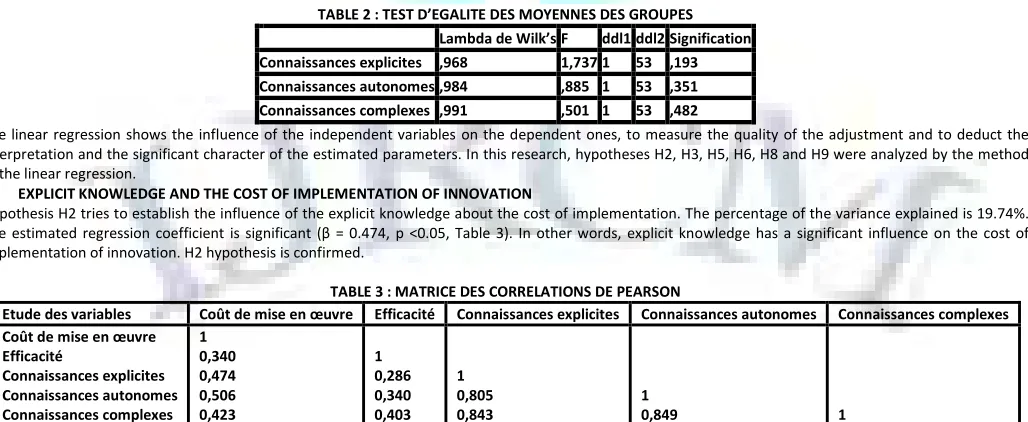
Explicit knowledge has a significant effect on the source of innovation due to its weight (1.541) in the study of the discriminant function between the two groups (hypothesis 1).Therefore, Tunisian firms tend to explain the effect of this knowledge and to consider it as the most important factor in making the nature of the source of innovation. The Chi 2 test is 1. The Statistics Fisher T attributed to this variable is 0.193. The value of Wilk's Lambda is 0.968. This hypothesis was confirmed (Table 1 and 2).
TABLE 1 : COEFFICIENTS DES FONCTIONS DISCRIMINANTES CANONIQUES STANDARDISEES Fonction
1 Connaissances explicites 1,541 Connaissances autonomes,252 Connaissances complexes -1,048
• AUTONOMOUS KNOWLEDGE AND SOURCE OF INNOVATION
The variable "autonomous knowledge" has a significant effect on the source of innovation due to its weight (, 252) in discriminating between the two groups. The Chi 2 test is 1. The value 0.984 is the proportion of the total variance in the discriminant scores not explained by the differences between the groups. The T Fisher is 0.351. The value of Wilk's lambda is high (0.984), the variable is less discriminating. Hypothesis 4 was confirmed (Table 1 and 2).
• COMPLEX KNOWLEDGE AND SOURCE OF INNOVATION
According to tables 1 and 2, "complex knowledge" has a significant effect on the source of innovation due to its weight (-1.048) in discriminating between the two groups. The T Fisher attributed to this variable is high (0.482) and more discriminating. In contrast, most of Wilk's lambda is high (0.991) and the variable is less discriminating. The Chi 2 test is 1. Hypothesis 7 was confirmed.
TABLE 2 : TEST D’EGALITE DES MOYENNES DES GROUPES Lambda de Wilk’s F ddl1 ddl2 Signification Connaissances explicites ,968 1,737 1 53 ,193 Connaissances autonomes ,984 ,885 1 53 ,351 Connaissances complexes ,991 ,501 1 53 ,482
The linear regression shows the influence of the independent variables on the dependent ones, to measure the quality of the adjustment and to deduct the interpretation and the significant character of the estimated parameters. In this research, hypotheses H2, H3, H5, H6, H8 and H9 were analyzed by the method of the linear regression.
• EXPLICIT KNOWLEDGE AND THE COST OF IMPLEMENTATION OF INNOVATION
Hypothesis H2 tries to establish the influence of the explicit knowledge about the cost of implementation. The percentage of the variance explained is 19.74%. The estimated regression coefficient is significant (β = 0.474, p <0.05, Table 3). In other words, explicit knowledge has a significant influence on the cost of implementation of innovation. H2 hypothesis is confirmed.
TABLE 3 : MATRICE DES CORRELATIONS DE PEARSON
Etude des variables Coût de mise en œuvre Efficacité Connaissances explicites Connaissances autonomes Connaissances complexes Coût de mise en œuvre
Efficacité
Connaissances explicites Connaissances autonomes Connaissances complexes
1 0,340 0,474 0,506 0,423
1 0,286 0,340 0,403
1 0,805 0,843
1
0,849 1
VOLUME NO.3(2013),ISSUE NO.03(MARCH) ISSN 2231-5756
INTERNATIONAL JOURNAL OF RESEARCH IN COMMERCE, IT & MANAGEMENT
• AUTONOMOUS KNOWLEDGE AND COST OF IMPLEMENTATION OF INNOVATIONOur research showed that Hypothesis 5 proposed that the more autonomous knowledge associated with innovation is, the lower the cost of implementation is. The regression of the variable cost of implementation of innovation explains (23.41%) of variations of the variable autonomous knowledge. The coefficient β is significant (Table 3, β = 0.506, p <0.05). For this variable, the standardized model takes the following form: Y = 0.506 X1 + ε. Hypothesis H5 is confirmed.
• COMPLEX KNOWLEDGE AND COST OF IMPLEMENTATION OF INNOVATION
The tables below indicate the regression of the variable cost of implementation of innovation that explains the rate of (14.829%) the variable complex knowledge. The estimated coefficient of regression is significant (β = 0.423, p <0.05). In other words, autonomous knowledge has a significant influence on the cost of implementation of innovation. Hypothesis H8 is confirmed.
The model is presented as follows:
Y = 0.423 X2 + ε. (1)
• EXPLICIT KNOWLEDGE AND EFFECTIVENESS OF INNOVATION
Hypothesis H3 predicts the existence of a relationship between the dependent variable (the effectiveness of innovation) and the independent variable (explicit knowledge). This is not consistent with the results of a regression between these variables as the percentage of the explained variance is very low (8.2%). The estimated coefficient of regression is significant (β = 0.286, p <0.01). In other words, explicit knowledge has a significant impact on the effectiveness of innovation. Hypothesis H3 is confirmed. In fact, the model is:
Y = 0.286 + ε X3. (2)
• AUTONOMOUS KNOWLEDGE AND EFFECTIVENESS OF INNOVATION
Hypothesis 6 predicted that autonomous knowledge has an influence on the effectiveness of innovation. Autonomous Knowledge explains 11.6% of the effectiveness of innovation. The estimated coefficient of regression β is positive and significant at the 0.05 level’s (β = 0.340, p <0.05, Table 3).The model of this variable is shown as follows:
Y = 0.340 + ε X4. (3) Hypothesis H6 is confirmed.
• COMPLEX KNOWLEDGE AND EFFECTIVENESS OF INNOVATION
Our research shows that hypothesis 9 is confirmed by the analysis of the linear regression. The percentage of the explained variance is 14.829%. The complex knowledge has a significant influence on the effectiveness of innovation ((β = 0.403, p <0.05, Table 3). The standardized model takes the following shape: Y = 0.403 + ε X5. (4) Generally, the standard model is presented as follows:
Y = 0.506 X1 0.423 0.286 X2 + 0.403 X3 0.340 X4 X5 + ε. (5)
RESULTS AND DISCUSSION
The main contribution of this paper is that we introduced and supplied a partial development of the concept of knowledge management, the source of innovation, the cost of implementation and the effectiveness of innovation.
The purpose of this exploratory study is to a develop research in the areas of knowledge management and innovation.
• EXPLICIT KNOWLEDGE
According to the results, explicit knowledge affects the nature of the source, the cost of implementation and the effectiveness of innovation. This relationship is confirmed in previous studies that have shown the link between knowledge management and innovation process. These results converge with the work of Gopalakrishnan and Bierly (2001) and that of Czarnitzki and Wastyn (2009).
• AUTONOMOUS KNOWLEDGE
The results concerning the hypothesis define the relationship between autonomous knowledge and the innovation process, regarding the nature of the source, the cost of implementation and the effectiveness of innovation, confirm very clearly the significant relation. The same result was found by Gopalakrishnan and Bierly (2001).
• COMPLEX KNOWLEDGE
The validation of the hypothesis associated with the complex relationship between knowledge and the innovation process, regarding the nature of the source, the cost of implementation and the effectiveness of innovation, shows the importance of knowledge management in improving the innovation process within the Tunisian company. This observation is coherent with that of Gopalakrishnan and Bierly (2001).
CONCLUSION
In the context of globalization of competition, accelerating of innovation, increasingly enhanced, this work examines the role of knowledge management in enterprises.
The combination of different types of knowledge aims to improve the process of technological innovation through the creation of new knowledge that will lead, eventually, to the creation of a new product or service, etc. In an environment that is constantly changing. Knowledge and innovation remains an economic major stake to assure the sustainability of companies. The literature review showed that there is a relationship between knowledge management and the technological innovation process. In this perspective, Villacicencio (2000) explains that tacit knowledge increasingly interested the researchers as far as they support a part of the creative and innovative activity of firms. The review of the literature allowed to highlight the different factors of knowledge management that influence the process of technological innovation. It is important to consider the contribution of each factor on the process of innovation.
Through the main conclusions resulting from this research, it is likely to make a real contribution at two levels:
Firstly, at the theoretical level, this research comes to enrich the literature on the subject of knowledge management in relation to the innovation process in the Tunisian companies.
Secondly, at the practical level, this study could lead managers of companies to dedicate more resources to systems of knowledge management (KM) susceptible to improve the process of technological innovation However, it is advisable to underline that the present research contains certain number of temporal limits and sampling.
On the other hand, the fact that this research is largely based on the perception of different responsible businesses, we confront a subjectivity that may generalize the results. In the end, we intend to suggest some future avenues of research. It would be interesting to study the effect of the variables including that of tacit knowledge in the presence of other control variables.
NOTES
1. Whetten (1989), cited by Gopalakrishnan et Bierly, 2001, Analysing innovation adoption using knowledge – based approach, journal of engineering and technology management, JET-M, vol (18), p.110.
2. Chesbroughand Teece (1996), cited by Gopalakrishnan et Bierly, 2001, Analysing innovation adoption using knowledge-based approach, Journal of engineering and technology management, JET-M, vol (18), p.112.
3. Mintzberg (1979), cited by Gopalkrishnen et Bierly, 2001, Analysing innovation adoption using knowledge-based approach, Journal of engineering and technology management, JET-M, vol (18),p.113.
5. Rogers (1983), cited by Gopalkrishnen et Bierly, 2001, Analysing innovation adoption using knowledge-based approach, Journal of engineering and technology management, JET-M, vol (18),p.114.
6. Schroeder et al., (1989); Poole (1981, 1983), cited by Gopalkrishnen et Bierly, 2001, Analysing innovation adoption using knowledge-based approach, Journal of engineering and technology management, JET-M, vol (18),p.114-115.
7. Schroeder et al., 1989; Poole, 1981, 1983, p.114-115, cited by Gopalkrishnen et Bierly, 2001, Analysing innovation adoption using knowledge-based approach, Journal of engineering and technology management, JET-M, vol (18),p.114-115.
REFERENCES
1. Anderson J.C., Gerbing, D.W (1991), ̋Predicting the performance of measures in a confirmatory factor analysis with a pretest assessment of their substantive validities ̋, Journal of applied psychology, vol .76, N° 5, pp.732-740.
2. Bierly, P., Chakrabar\, A.K (1996a), ̋Technological learning, strategic flexibility, and new product development in the pharmaceu\cal industry ̋, IEEE Transactions on Engineering Management, vol.43, N°4, pp.368–380.
3. Boutelitane S (2005), ̋ Management des connaissances et processus d’innova\on, Cahier de recherche, Faculté des sciences économique et de ges\on ̋. HEC Genève, 5-12.
4. Brown J.S ., Duguid, P (1991), ̋Organizational learning and communi\es-of-prac\ce: toward a unified view of working, learning, and innova\on ̋, Organization Science, vol. 2, N°1, pp.40-57.
5. Cantner, U et al (2009), ̋The use of Knowledge Management by German Innovators ̋, Journal of Knowledge Management, vol13, N°6, forthcoming. 6. Chemi`e, J (2008) : ̋Adop\on des technologies de l’informa\on géographique et ges\on des connaissances dans les organisa\ons. Applica\on à l’industrie
de l’assurance pour la ges\on des risques naturels ̋, thèse de doctorat, Mines Paris Tech, 5.
7. Chesbrough, H.W., Teece, D.J (1996), ̋When is virtual virtuous? ̋Organizing for innovation, Harvard Business Review, pp.65-73.
8. Cooper, H.G ., Klein Schmidt, E.J, (1987), ̋New products: what seperates winners from lasers? ̋, Journal of Products Innovation Management, vol .9, pp.282-294.
9. Czarnitzki, D ., Wastyn, A (2009): ̋Does professional knowledge management improve innova\on performance at the firma level? ̋, Centre for European Economic Research, 9.
10. Das, T.K ., Teng, B. (1998): ̋Between trust and control: developing confidence in partner coopera\on in alliances ̋, Academy of Management Review, vol.23, N°3, 491-512.
11. Ermine, J-L. (2002) : ̋Ini\a\on à la méthode MASK ̋, CDROM de l’université de technologie de Ttoyes. 12. Evrard. et al. (2009), ̋ Market, Etudes et Recherches en Marke\ng, Fondement, Méthodes ̋. Dunod. 13. Galbraith, J.R. (1973), ̋Designing, Complex organiza\ons ̋. Addison-Wesley, Reading, MA.
14. Gopalakrishnan, S ., Damanpour, F.(1994), ̋ Patterns of generations and adoption of innova\on in organiza\ons: con\ngency models of innova\on a`ributes ̋, Journal of Engineering and Technology Management, vol 11,pp.95-116.
15. Gopalakrishnan, S., Bierly, P. (2001), ̋Analyzing innova\on adop\on using a Knowledge –based approach ̋, Journal of engineering and technology management, JET-M, vol.18, pp.107-130.
16. Grant, R.M. (1996), ̋ Prospering in dynamically – compe\\ve environments: organiza\onal capability as knowledge integra\on ̋, Organization Science, vol.7, N°4, pp.375-387.
17. Jacob, R., Pariat, L. (2000) : ̋Gérer les connaissances : Un défi de la nouvelle compé\\vité du 21ème siècle : informa\on, connaissance, interac\on, ges\on des ressources humaines ̋, rapport de recherche commanditée, Québec, Qc : CEFRIO, http://www.cefrio;qc.ca.
18. Kessler, E.H., Chakrabar\, A.K. (1996),̋ Innova\on speed: a conceptual model of context, antecedents, and outcomes ̋, Academy of Management Review, vol.21, pp.1143–1191.
19. King, N. (1992), ̋Modeling the innovation process: an empirical comparison of approaches, Journal of occupa\onal psychology ̋, vol .65, pp.89-100. 20. Kogut, B ., Zander, U. (1993), ̋ Knowledge of the firm and the evolutionary theory of the multinational corporation, Journal of International studies, vol .24,
pp.625-645.
21. Lippman, SA ., Rumelt, ., R.P. (1982): ̋ Uncertain imitability: analysis inter firms differences in efficiency under compe\\on ̋, Belle Journal of Economis, vol .13, pp.418-438.
22. Nonaka, I ., Takeuchi, H .(1995):,̋ The Knowledge creating company: how Japanese companies create the dynamics of innova\on ̋, Oxford University Press, 284.
23. Nonaka, I., Krogh, G. (2009), ̋Tacit Knowledge and Knowledge conversion: Controversy and Advancement in Organiza\onal Knowledge Crea\on Theory ̋, Organization Science, vol .20, N° 3, pp.635-652.
24. Pelz, D.C. (1985), ̋Innova\on complexity and the sequence of innova\ng stages. Knowledge: crea\on, diffusion, u\liza\on ̋, vol .6, N°3, pp.261-291. 25. Pesqueux, J.Y. (2004) : ̋Apprentissage organisationnel, économie de la connaissance : mode ou un modèle ? ̋, cahier de LIPSOR, série recherche n°6,
http://www.cnam.fr/lipsor.
26. Porter, M. (1985), ̋Compe\\ve Advantage ̋. Free Press, New York 27. Rogers, E.M. (1983), ̋Diffusion of innova\on ̋. Free Press, New York.
28. Srivastava, N et al. (2006), ̋ Screening for intra and inter specific variability for salinity tolerance in pigeonpea (Cajanus Cajan) and its related wilds species ̋, ICRISAT, ejournal, vol .2, N° 1.
29. Teece, D.J. (1986), ̋Profiting from technological innovation: implications for integration, collaboration, licensing and public policy, Research Policy, vol .15, pp.285-305.
30. Tidd, J et al. (2006) : ̋Management de l’innovation : intégration du changement technologique, commercial et organisationnel ̋, De Boeck & Larciers, Bruxelles, Belgique.
VOLUME NO.3(2013),ISSUE NO.03(MARCH) ISSN 2231-5756
INTERNATIONAL JOURNAL OF RESEARCH IN COMMERCE, IT & MANAGEMENT
REQUEST FOR FEEDBACK
Dear Readers
At the very outset, International Journal of Research in Commerce, IT and Management (IJRCM)
acknowledges & appreciates your efforts in showing interest in our present issue under your kind perusal.
I would like to request you to supply your critical comments and suggestions about the material published
in this issue as well as on the journal as a whole, on our E-mail i.e.
for further
improvements in the interest of research.
If you have any queries please feel free to contact us on our E-mail
.
I am sure that your feedback and deliberations would make future issues better – a result of our joint
effort.
Looking forward an appropriate consideration.
With sincere regards
Thanking you profoundly
Academically yours
Sd/-