International Journal of Engineering
J o u r n a l H o m e p a g e : w w w . i j e . i rPerformance Analysis of a Repairable Robot Safety System with Standby, Imperfect
Coverage and Reboot Delay
M. Jain a, Preeti * b
a Department of Mathematics, Indian Institute of Technology, Roorkee-247667, India
b Faculty of Humanity, Physical & Mathematical Sciences, Shobhit University, Meerut-250110, India
P A P E R I N F O
Paper history:
Received 22 July 2012
Received in revised form 13 December 2012 Accepted 18 April 2013
Keywords: Robot Safety System Standby Reboot Switching
Supplementary Variable Reliability
Availability Mean Time to Failure
A B S T R A C T
The present study deals with a robot safety system composed of standby robot units and inbuilt safety unit. When the main operative unit fails, it is replaced by the standby robot unit available in the system. The concept of reboot delay is also incorporated in this study according to which the robot unit is rebooted if it is not successfully recovered. The recovery and reboot times of failed units, life time of the operative as well as standby units and the repair time are assumed be exponentially distributed. Furthermore, the repair time of partially-failed unit of total system failure is assumed to be arbitrarily distributed. The expressions for the state probabilities, availability, reliability and mean time to failure are derived with the help of Markovian and supplementary variable methods. The occurrence of standby units, imperfect coverage and reboot demonstrates the significant impact on the robot system reliability, availability and mean time to failure. A numerical illustration has been provided to validate the present model as well as to demonstrate the effects of various parameters on the performance measures of the robot safety system.
doi:10.5829/idosi.ije.2013.26.09c.14
1. INTRODUCTION 1
In industrial and production systems, different types of machines are employed in order to make the production more efficient, easier and faster. Due to advancement of technology, the automated machines used in industry have become more sophisticated, flexible and complex. They are helpful in reducing the human labor that may be dangerous in many ways. However, recent developments have made industrial robots more user-friendly, affordable, and intelligent than ever before. The robot is one of the examples of these kinds of machines which improve the grade of production and reduce the unpleasant and dangerous works. A position controlled reprogrammable, multifunctional manipulator having a number of degrees of freedom in three dimensional spaces and capable of handling materials, parts, tools or specialized device through variable programmed motion for the performance of a variety of
*Corresponding Author Email:[email protected] (Preeti)
safety unit in these systems is for the prevention of injury or accident in the workplace. Safety provision should be made to robot system particularly in the situations wherein human involvement is a must and the system safety approaches to prevent the damages and the occurrence of the accidents. Robot safety must include the usual consideration of man, machine and workstations, environment and the interface behavior. A remarkable work has been done by several researchers in the field of the robot safety system. Jiang and Cheng [1] presented a procedure analysis for the planning, installation and operation stages of adding a robot to the workplace. Dhillon and Anude [2] gave a review report about thereliability of robot safety. Dhillon and Yang [3] did an availability analysis of a robot with safety system. Again Dhillon and Yang [4] suggested formulae to perform reliability and availability analyses of a redundant robot configuration with a built-in safety system. A probabilistic analysis of robotic systems has been done by Dhillon and Fashandi [5]. Zurada et al. [6] described a neuro-fuzzy approach to robot safety which uses an integrated sensing architecture for monitoring the robot workspace, and a new detection and decision logic for regulating the safe operation of the robot. Dhillon and Li [7] discussed a stochastic analysis of a maintainable robot-safety system with common-cause failures. Oliveira et al. [8] did unavailability analysis of the safety systems under aging by supplementary variables with imperfect repair. Dhillon and Li [9] presented a mathematical model to perform availability analysis of a robot-safety system having n-redundant robots and m-redundant built-in safety units with common-cause failures. Further, a stochastic analysis of a system with redundant robots, one built-in safety unit, and common-cause failures has been explained by Dhillon and Li [10]. Kulic and Croft [11] explained strategy for ensuring safety for human–robot interaction in real-time. Probabilistic analysis of a repairable robot-safety system composed of (n-1) standby robots, a safety unit, and a switch has been considered by Dhillon and Cheng [12]. Savsar and Aldaihani [13] developed a model of machine failures in a flexible manufacturing cell (FMC) which consists of two machines served by a robot loading and loading purposes, and a pallet handing system. Vanderperre and Makhanov [14] found point availability of a robot system with internal safety device which is characterized by a safety shut-down rule and by the natural feature of standby. Gultekin et al. [15] introduced the flexibility of machines leading the robot to move cycles which are called the pure cycles in flexible robotic cells. Oh et al. [16] studied the bridge inspection robot system with machine vision. Vanderperre and Makhanov [17] discussed overall availability of a robot with internal safety device. In order to obtain the point availability of twin system, they introduced a stochastic process endowed with a time-dependent potential satisfying an
integro-differential equation. Arbuckle and Requicha [18] discussed the algorithms and simulations for a self-assembly and self-repair of arbitrary shapes of reactive robots. Kaupp et al. [19] gave a probabilistic approach human-robot communication for the collaborative decision making. Paviglianiti et al. [20] explained robust fault detection and isolation for proprioceptive sensors of robot manipulators. The reliability and availability analysis of a robot-safety system have been done by Cheng and Dhillon [21]. Sharma [22] discussed a new idea about the reliability analysis of robotic system. The optimal values of mean time between failures (MTBF) and mean time to repair (MTTR) are obtained using GAs. To enhance the relevance of the reliability study, triangular fuzzy numbers (TFNs) are developed from the computed data, using possibility theory.
If in a system, the failures are not successfully detected, located and recovered, then this situation is called the imperfect coverage. The faults, which are not covered, belong to the uncovered fault class with the probability ‘1-q’ where q is the recovery probability of the fault class. A lot of work has been done in this field by many researchers. Trivedi [23] introduced the concept of detection and imperfect coverage and their effect on the repairable systems. Optimal design of K-out-of-n: G subsystem subjected to imperfect fault coverage was presented by Amari et al. [24]. Wang and Chiu [25] did a cost benefit analysis of availability system with warm standby units and imperfect coverage. Myers [26] studied the reliability of a K-out-of-n: G system with imperfect fault coverage. Ke et al. [27] used Bayesian approach to predict the performance measures of a repairable system with detection, imperfect coverage and reboot. Hsu et al. [28] statistically studied an availability system with reboot delay, standby switching failures and an unreliable repair facility, which consists of two active components and one warm standby. The reliability characteristics of a repairable system consisting of two independent operating units by incorporating the coverage factor have been discussed by Jain et al. [29]. Xing [30] proposed an efficient method for the exact reliability evaluation of k-out-of-n systems with identical components subject to phased-mission requirements and imperfect fault coverage.
Section 2. The governing equations of the existing model in the steady state as well as in the transient state are also constructed by taking appropriate transition rates in Section 3. Various performance indices of the system are evaluated explicitly in term of steady state probabilities and for the various special cases in Section 4. In Section 5, the general expressions for the reliability and the mean time to failure of the model are evaluated in terms of the transient probabilities of the system states. Numerical illustration and sensitivity analysis are facilitated to explore the effects of various parameters on the system performance in Section 6. Finally, the concluding remarks are drawn in Section 7.
2. MATHEMATICAL DESDRIPTION
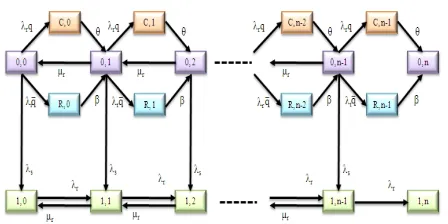
In the present investigation a robot system in which the safety unit is inbuilt has been considered by incorporating the concepts of imperfect coverage and the reboot delay. In this model we consider a robot safety system consisting of n robot units and one safety unit; out of n units, one robot unit is treated as operating unit and remaining (n-1) robot units behave like the standby units as shown in Figure 1. After the failure of operating unit, the standby robot units are switched on one by one in the system as per requirement due to failure of the operating unit. When a unit fails, it is immediately detected, located and recovered. The recovery can be successfully performed with probability q and if the recovery does not perform successfully, the system needs to be rebooted so as to facilitate uninterrupted functioning.
The following assumptions have been considered in order to develop the model:
Ø The system consists of one main operating robot unit, n-1 standby robot units and a safety unit inbuilt in the system.
Ø For the perfect functioning of the system one robot unit and a safety unit are required.
Ø After the repair, the failed unit works as good as new one.
Figure 1. Repairable robotsystem with safety unitand reboot delay
Ø The individually failed units as well as the whole failed robot safety system can be repaired.
Ø The life times of the robot units and the safety unit follow exponential distribution with parameters
r
l
andl
s.Ø The repair times of both the robot units and the safety unit are exponentially distributed with parameters
m
randm
s, respectively.Ø The times to repair of the total system are independent and identically distributed random variables following a general independent and identical distribution (i.i.d.)mj
( )
x{
j=( ) ( )
0,n,1,n}
.Ø As soon as an operating unit fails, it is instantaneously detected and sent for repair.
Ø The operating units can be successfully recovered with probability ‘q’ and the recovery may fail with the probability ‘1-q’.
Ø The system needs some time for the recovery of operating units; the recovery time of operating units is exponentially distributed with parameter ‘
q
’.Ø The whole system needs to be rebooted in case of unsuccessful recovery of a failed unit. The reboot time is exponentially distributed with mean ‘
1
/
b
’.Ø The reboot or recovery cannot be performed after the failure of the nth unit.
At time ‘t’, the system may be in any one of the following states:
(0, 0) State at which one robot and the safety unit are working normally and there is no failed robot in the system.
(0, j) State at which one robot and the safety unit is working normally and j (j=1, 2, 3, …., n-1) robots have failed.
(0, n) State at which the all robots are failed while the safety unit is working normally.
(C, j) State at which the recovery of jth (j=1, 2, 3, ….,
n-1) robot unit takes place.
(R, j) State at which the reboot of jth (j=1, 2, 3, …., n-1)
robot unit takes place.
(1, 0) State at which one robot is in working state and the safety unit is in failed state.
(1, j) State at which one active robot works whereas the safety unit and j (j=1, 2, 3, …., n-1) robots have failed.
(0, n) State at which all the robots and the safety unit are in failed state.
The following notations are used to develop the mathematical model: λr Failure rate of the operating as well as the
standby robot units.
µr Repair rate of the operating as well as the
standby robot units.
µs Repair rate of the safety unit.
θ The recovery time of the failed robot unit.
β The reboot time of the failed robot unit.
q The coverage probability of the failed robot unit.
S Laplace transform variable.
X Elapsed time of failed robot safety system.
µ(j, n)(x) Instantaneous repair rate of the server at
(j, n) state; j=0,1.
w(j, n)(x) Probability density function of repair time when
the failed robot safety system is in (j, n) state; j=0,1.
Ars The steady state availability of the robot safety
system with the working safety unit.
Ar The steady state availability of the robot safety
system with or without the working safety unit.
Rrs(s) The reliability of the robot-safety system with
functioning safety unit.
Rr(s) The reliability of the robot-safety system with
or without functioning safety unit.
MTTFrs The mean time to failure of the robot-safety
system with functioning safety unit.
MTTFr The mean time to failure of the robot-safety
system with or without functioning safety unit.
3. THE GOVERNING EQUATIONS AND ANALYSIS
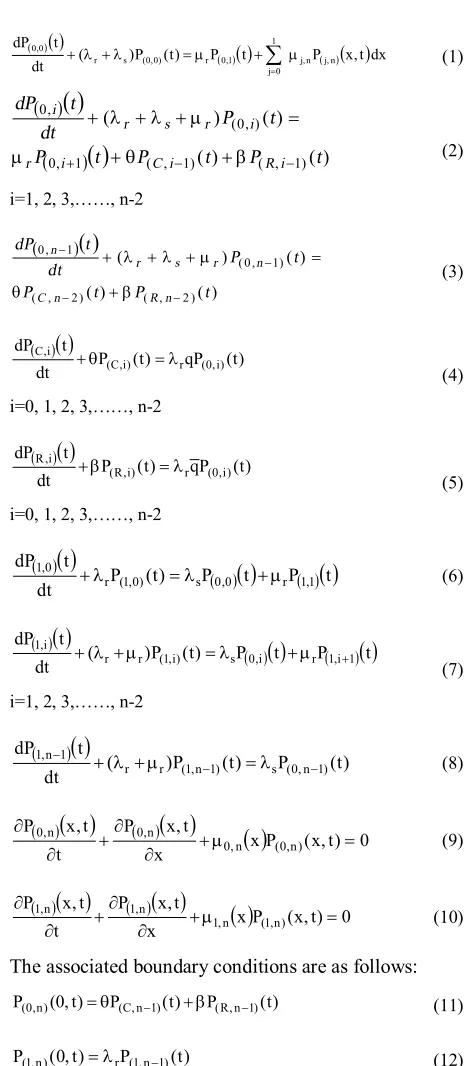
In order to obtain the general expressions for the reliability, availability and mean time to failure, it is assumed that the failure rates of robot as well the safety unit, recovery time and reboot time are constant while the failed system time are arbitrary distributed. We use the supplementary variable and Markov methods to develop these expressions. In this section the governing equations of the model have been constructed for the transient state as well as the steady state of the robot-safety system. On solving these equations, the expressions for various performance measures of the model can be computed in terms of state probabilities. Using appropriate in-flow and out-flow rates given in Figure 1, we construct the governing Chapman-Kolmogorov equations as follow. The associated boundary conditions are as follows:
( )( )
( )( )t P( )( )x,t dx
P ) t ( P ) ( dt t dP n ,j n ,j 1 0 j 1 , 0 r ) 0 , 0 ( s r 0 ,
0 + l +l =m +
å
m= (1) ( )
( )
( )( )
( ) ( ) ) ( ) ( ) 1 , ( ) 1 , ( 1 , 0 ) , 0 ( , 0 t P t P t P t P dt t dP i R i C i r i r s r i-+ +q +b
m = m + l + l +
i=1, 2, 3,……, n-2
(2) ( )
( )
) ( ) ( ) ( ) ( ) 2 , ( ) 2 , ( ) 1 , 0 ( 1 , 0 t P t P t P dt t dP n R n C n r s r n -b + q = m + l + l + (3)( )
( )
P (t) qP (t)dt t dP ) i , 0 ( r ) i , C ( i ,
C +q =l
i=0, 1, 2, 3,……, n-2
(4)
( )
( )
P (t) qP (t) dt t dP ) i , 0 ( r ) i , R ( i,R +b =l
i=0, 1, 2, 3,……, n-2
(5)
( )
( )
( )
( )
t P( )( )
t P ) t ( P dt t dP 1 , 1 r 0 , 0 s ) 0 , 1 ( r 0 ,1 +l =l +m (6)
( )
( )
( )
( )
t P( )( )
t P ) t ( P ) ( dt t dP 1 i, 1 r i, 0 s ) i , 1 ( r r i, 1 + m + l = m + l +i=1, 2, 3,……, n-2
(7)
( )
( )
( )P (t) P (t)dt t dP ) 1 n , 0 ( s ) 1 n , 1 ( r r 1 n , 1
-- + l +m =l (8)
( )
( )
( )( )
( )
xP (x,t) 0 x t , x P t t , x P ) n , 0 ( n , 0 n , 0 n ,0 +m =
¶ ¶ + ¶ ¶ (9)
( )
( )
( )( )
( )
xP (x,t) 0 x t , x P t t , x P ) n , 1 ( n , 1 n , 1 n ,1 +m =
¶ ¶ + ¶ ¶ (10)
The associated boundary conditions are as follows: ) t ( P ) t ( P ) t , 0 (
P(0,n) =q (C,n-1) +b (R,n-1) (11)
) t ( P ) t , 0 (
P(1,n) =lr (1,n-1) (12)
In limiting case whent®¥, Equations (1) to (12) become
( ) P( )
( )
x dx PP )
( ,jn ,jn
1 0 j 1 , 0 r ) 0 , 0 ( s
r+l =m + m
l
å
=
(13)
(0i,1) (C,i1) (R,i1) r ) i, 0 ( r s
r )P P P P
(l +l +m =m + +q - +b
-i=1, 2, 3,……, n-2
(14) ) 2 n , R ( ) 2 n , C ( ) 1 n , 0 ( r s
r )P P P
) i , 0 ( r ) i , C ( qP
P =l
q , i=0, 1, 2, 3,……, n-2 (16)
) i , 0 ( r ) i , R
( qP
P =l
b , i=0, 1, 2, 3,……, n-2 (17)
( )0,0 r ( )1,1 s ) 0 , 1 (
rP =lP +mP
l (18)
( )0,i r (1,i 1) s ) i , 1 ( r
r )P P P
(l +m =l +m +
i=1, 2, 3,……, n-2
(19) ) 1 n , 0 ( s ) 1 n , 1 ( r
r )P P
(l +m - =l - (20)
( )
( )
( )
xP (x) 0dx x dP ) n , 0 ( n , 0 n ,
0 +m = (21)
( )
( )
( )
xP (x) 0dx x dP ) n , 1 ( n , 1 n ,
1 +m = (22)
The associated boundary conditions are:
) 1 n , R ( ) 1 n , C ( ) n , 0
( (0) P P
P =q - +b - (23)
) 1 n , 1 ( r ) n , 1
( (0) P
P =l - (24)
The normalizing condition is given by:
(
P P P P)
1n 0 i i , R i , C i , 1 i ,
0 + + + =
å
=
(25)
From Equations (16) and (17), we have:
) i , 0 ( r ) i , C ( P q P q l =
i=0, 1, 2, 3,……, n-2
(26) ) i , 0 ( r ) i, R
( qP
P
b l =
i=0, 1, 2, 3,……, n-2
(27)
On putting these values in Equations (14), (15) and (23), we get:
(0,i1) r r (0,i) r ) i , 0 ( r s
r )P P q q P
( ÷÷ ø ö çç è æ b l b + q l q + m = m + l + l +
i=1, 2, 3,……, n-2
(28)
( ) P ,
P P
)
(lr+ls+mr (0,i)=mr 0,i+1 +lr (0,i)
i=1, 2, 3,……, n-2
(29) ) 2 n , 0 ( r ) 1 n , 0 ( r s
r )P P
(l +l +m - =l - (30)
) 1 n , 0 ( r ) n , 0
( (0) P
P =l - (31)
On solving Equations (21) and (22), we have:
( )
( )( )
úúû ù ê ê ë é x x m -=
ò
x 0 n , 0 ) n , 0 ( ) n , 0( (x) P 0exp d
P (32)
( )
( )( )
ú ú û ù ê ê ë é x x m -=ò
x 0 n , 1 ) n , 1 ( ) n , 1( (x) P 0exp d
P (33)
We know that:
( )
xdx P P 0 j jò
¥= for j= (0, n) and (1, n) (34)
Then from Equations (32) and (34), we have:
( )
( )( )
ò
ò
¥ ú ú û ù ê ê ë é x x m -= 0 x 0 n , 0 ) n , 0 ( ) n , 0( P 0exp d dx
P
( )
( )0,n ) n , 0 ( ) n , 0( P 0W
P = (35)
Similarly from Equations (33) and (34), we have:
( )
( )1,n ) n , 1 ( ) n , 1( P 0W
P = (36)
where
( )
ò
ò
( )( )
úú =ò
û ù ê ê ë é x x m -= ¥ x 0 ) n , 0 ( 0 x 0 n , 0 n ,0 exp d dx xw (x)dx
W (37)
( )
ò
ò
( )( ) úú =ò
û ù ê ê ë é x x m -= ¥ x 0 ) n , 1 ( 0 x 0 n , 1 n ,
1 exp d dx xw (x)dx
W (38)
Here, W(0, n) and W(1, n) are the mean time to repair of
the total system from the states (0, n) and (1, n), respectively. Now, on solving Equations (13)-(38), we have ( ) ( )
Õ
= = i 1 k 0 , 0 k , 0 ) i , 0( A P
P (i=1, 2, 3,……., n-1) (39)
( ) ( )1,i 0,0 )
i, 1
( K P
P = , (i=0, 1, 2, 3,……., n-1) (40)
( )0,i 1 ) i, C
( P
P =a , (i=0, 1, 2, 3,……., n-1) (41)
( )0,i 2 ) i , R ( P
( ) ( ) ( ),jn ,jn 0,0 )
n ,j
( a W P
P = , (j=0, 1) (43)
where, ( ) r s r r 1 n , 0 A m + l + l l = -( )
(0,i 1)
r r s r r i , 0 A A + m -m + l + l l
= , (i=1, 2, 3,……., n-2)
(1,n 1) r r
A - =l +m , ( )
Õ
( )-=
l
= n1
1 i i , 0 r n , 0 A
a , a( )1,n=lrK(0,n-1)
( )
(
)
(1,i 1) r r r r i , 1 A A + l m -m + l
= , (i=1, 2, 3,……., n-2)
q l =
a rq
1 , a2=lbrq
( ) ( ) ( ) ( )
Õ
Õ
å
= = -= l m + l = i 1 k k , 0 i 0 k k , 1 s 1 n 1 i r i 0 , 1 s 0 , 1 A A A K , ( ) ( ) ( ) ( ) ( )Õ
Õ
å
= -= -=- + m l
l = i 1 k k , 0 1 n i k k , 1 s 1 n 1 i r i 1 i , 1 0 , 1 s i , 1 A A K A K
(i=1, 2, 3,……., n-2)
Now, P(0, 0) can be obtained using normalizing condition
as follows:
H
P(0,0)= 1 (44)
where ( ) ( ) ( ) ( ) ( )) 1 1 ( 1 1 1 0 , , , 1 1
1 1 2 1 0,
2 1 å å å Õ -= = -= = + + a + a + + a + a + = n
i i j j n j n
n i i k i W a K A H (45)
4. THE AVAILABILITY
The availability of the robot safety system can be determined by using the steady state probabilities of the system states as follows. The availability can be obtained with the help of those states at which at least one robot unit is working properly whether the safety unit be in either working or non-working state.
The steady state availability of the robot safety system with the working safety unit is given by:
( ) ( )
(
)
å
-+ =n1
0 i i , C i , 0
rs P P
A ( ) ( ) H A 1 1 1 n 1 i i 1 k i , 0 1
1 ÷÷
ø ö ç ç è æ a + + a +
=
å
Õ
-= = (46)
The steady state availability of the robot safety system with or without the working safety unit is given by:
( ) ( ) ( )
(
)
å
-+ + =n10 i i , 1 i, C i, 0
r P P P
A ( ) ( ) ( ) H K A 1 1 1 n 1 i i 1 k 1 n 1 i i , 1 i , 0 1
1 ÷÷
ø ö ç ç è æ + a + + a +
=
å
Õ
å
-= =
-=
(47)
4. 1. Availability for Special Distributions In this section we obtain the normalizing constant H given in Equation (45) corresponding to the different repair time distributions. Some of the special cases are as follows:
a) Gamma Distribution: In this case, the probability density function is given by:
( ) ( ) ) ( e x ) x ( w x 1 n ,j ) n ,j ( n , j g G m
= g g- -m , (γ>0, j=0, 1)
where x is the time variable, Г(γ) is gamma function,
µ(j,n) is the scale parameter and γ is the shape function.
The mean time to repair of robot safety system is: ( ) ( )
ò
m g = = x0 ,jn ,jn
) n ,j
( xw (x)dx
W (48)
On putting the results of Equation (48) into Equation (45), we have:
(
)
( ) ( ) ( ) ( )) 1 1 ( 1 1 10 , ,
, 1
1
1 1 2 1 0,
2 1
å
å
å
Õ
-= = -= = m g + + a + a + + a + a + = ni i j jn jn
n i i k i a K A H (49)
b) Weibull Distribution: The probability density function in this case is given by:
( ),jn 1 ( )x )
n ,j
( (x) x e ,jn
w =m g g- -m , (γ>0, j=0, 1)
where x is the repair time variable, µ(j,n) the scale
parameter and γ the shape function. For this case, the mean time to repair of robot safety system is:
( )
( ) ÷÷ø
ö çç è æ g G g ÷ ÷ ø ö ç ç è æ m = = g
ò
xw (x)dx 1 1 1W
/ 1 x
0 ,jn ,jn
) n ,j
( (50)
On substituting the results of Equation (50) into Equation (45), we have:
(
)
( ) ( ) ( ) ( ) ) 1 1 1 1 1 ( 1 1 1 0 / 1 , , , 1 1 1 1 , 0 2 1 2 1å
å
å
Õ
-= = g -= = ÷÷ ø ö çç è æ g G g ÷ ÷ ø ö ç ç è æ m + + a + a + + a + a + = ni i j jn j n
c) Exponential Distribution: For exponential distribution, the probability density function is given by:
( ),jn ( )x )
n ,j
( (x) e ,jn
w =m -m , (γ>0, j=0, 1)
where µ(j,n) is the constant repair rate from the jth state.
The mean time to repair of robot safety system is determined as:
( )
( )
ò
=m= x
0 ,jn ,jn
) n ,j (
1 dx ) x ( xw
W (52)
Now using Equations (52) and (45), we have:
(
)
( )( ) ( )
( )
å
å
å
Õ
-= =
-= =
m +
+
a + a + + a + a + =
1
1
1
0 , ,
, 1
1
1 1
, 0 2 1 2
1
1 1 1
n
i i j jn jn
n
i
i
k i
a K
A H
(53)
5. RELIABILITY AND MEAN TIME TO FAILURE
In thissection the reliability indices of the robot safety system are evaluated by considering the transient state equations of the model. For the reliability analysis, we set µ(j, n)=0 (for j=0, 1) ; now the state transition diagram
is as shown in Figure 2.
5. 1. Governing Equations The governing equations for the reliability model are same as the governing Equations (1)-(8) for previous section along with two additional equations which are as follows:
( )
( )
( )
( )
t P( )( )
t Pdt t dP
1 n , R 1 n , C n
, 0
-- +b q
= (54)
( )
( )
P (t) dxt dP
) 1 n , 1 ( r n , 1
-l
= (55)
5. 2. The Analysis Taking Laplace transform of Equations (1)-(8) and (54)-(55) with initial condition that t=0, P(0,0)(0)=1, we have:
Figure 2. Repairable robot system for reliability analysis
( )
( )
s P 1 ) s ( P ) s( +lr+ls (0,0) = +mr 0,1 (56)
( )
( )
) s ( P
) s ( P s P ) s ( P ) s
(
) 1 i , R (
) 1 i , C ( 1 i , 0 r ) i , 0 ( r s r
-+
b
++l +l +m =m +q
i=1, 2, 3,……, n-2
(57)
) s ( P ) s ( P ) s ( P ) s
( +lr+ls+mr (0,n-1) =q(C,n-2) +b (R,n-2) (58)
(
s+q)
P(C,i)(s)=lrqP(0,i)(s)i=0, 1, 2, 3,……, n-2
(59)
(
s+b)
P(R,i)(s)=lrqP(0,i)(s)i=0, 1, 2, 3,……, n-2
(60)
(
s+lr)
P(1,0)(s)=lsP( )0,0( )
s +mrP( )1,1( )
s (61)( )
( )
s P( )( )
s P) s ( P ) s
( +lr+mr (1,i) =ls 0,i +mr 1,i+1
i=1, 2, 3,……, n-2
(62)
) s ( P ) s ( P ) s
( +lr+mr (1,n-1) =ls (0,n-1) (63)
( )
( )
s P( )( )
s P( )( )
ssP0,n =q C,n-1 +b R,n-1 (64)
( )
( )
s P (s)sP1,n =lr (1,n-1) (65)
From Equations (59) and (60), we have:
(
s)
P (s)q ) s (
P(Ci,) +rq (0,i) l
= , i=0, 1, 2, 3,……, n-2 (66)
(
s)
P (s)q ) s (
P(Ri,) +rb (0,i) l
= , i=0, 1, 2, 3,……, n-2 (67)
On putting these values in Equations (57), (58) and (64), we obtain:
( )
( )
(
)
(
)
( )) ( ) (
) 1 , 0 ( 1
, 0
) , 0 (
s P s
q s
q s
P
s P s
i r r
i r
i r s r
-+ +êëéq l+q +b l+b ûùú m
= m
+ l + l +
i=1, 2, 3,……, n-2
(68)
(
)
(
)
( )) ( )
(
) 2 , 0 ( ) 1 , 0 (
s P
s q s
q
s P s
n r
r
n r s r
-ú û ù ê
ë é
b + l b + q + l q
= m
+ l + l +
(69)
( )
( )
(
)
(
)
P( )( )
s sq s
q s
sP0,n r r ú 0,n-1
û ù ê
ë é
b + l b + q + l q
On solving the Equations (56)-(70) together with
(
)
s 1 ) s ( P ) s ( P ) s ( P ) s ( P n 0 i i , R i , C i , 1 i ,0 + + + =
å
=
(71)
we have:
( )
Õ
( )( )
( )( )
= = i 1 k 0 , 0 k , 0 ) i , 0( s A sP s
P
(i=1, 2, 3,……., n-1)
(72)
( )(s)P( )(s) K
) s (
P(1i,) = 1,i 0,0 , (i=0, 1, 2, 3,……., n-1) (73)
( )(s)
P ) s (
P(Ci,) =a1 0,i , (i=0, 1, 2, 3,……., n-1) (74)
( )(s) P ) s (
P(R,i) =a2 0,i
(i=0, 1, 2, 3,……., n-1) (75)
( ) ( )(s)
P s a ) s (
P(,jn) = ,jn 0,0 (j=0, 1) (76)
where, ( )
(
)
(
)
r s r r r 1 n , 0 s s q s q ) s ( A m + l + l + ú û ù ê ë é b + l b + q + l q = -( ) ( ) ( ) ( )(s) A s s q s q ) s ( A 1 i , 0 r r s r r r i , 0 + m -m + l + l + ú û ù ê ë é b + l b + q + l q =(i=1, 2, 3,……., n-2)
(1,n 1)(s) s r r
A - = +l +m
( ) ( )
( )(s) A s ) s ( A 1 i , 1 r r r r i , 1 + l m -m + l + =
(i=1, 2, 3,……., n-2)
( ) ( ) ( ) A( )(s) s q s q ) s ( a 1 n 1 i i , 0 r r n , 0
Õ
-= ú û ù ê ë é b + l b + q + l q =( )(s) K( )(s)
a1,n =lr 0,n-1
(
+q)
l = a s q ) s ( r
1 (s )
q ) s
( r
2 +b
l = a ( ) ( ) ( ) ( )
Õ
Õ
å
= = -= l m + l = i 1 k k , 0 i 0 k k , 1 s 1 n 1 i r i 0 , 1 s 0 ,1 A (s)
) s ( A ) s ( A ) s ( K ( ) ( ) ( ) ( ) ( )
Õ
Õ
å
= -= -=- + m l
l = i k k n i k k s n i r i i s
i A s
s A s K s A s K 1 , 0 1 , 1 1 1 1 , 1 0 , 1 ,
1 ( )
) ( ) ( ) ( ) (
for i=1. 2, 3,……., n-2
Now P(0, 0)(s) can be obtained as follows:
) s ( H 1 ) s (
P(0,0) = (77)
where
( )
(
1 ( ) ( ))
( )( ) ( )( )) ) ( ) ( 1 ( ) ( 11 1, 1 1 1 , 0 2 1 1 0 , 2 1
å
å
Õ
å
-= -= = = + a + a + + + a + a + = n i i n i i k i j n j s K s A s s s a s s s s H (78)5. 3. Performance Indices The performance measures such as reliability and the mean time to failure of robot functioning unit with or without the functioning safety unit can be obtained with the help of the Laplace transform of the governing equations of the exiting model. Now, we proceed for the same as follows: The reliability of the robot-safety system (RSS) with the functioning safety unit (FSU) is given by:
( ) ( )
(
)
å
-+
= n 1
0 i i , C i , 0
rs(s) P (s) P (s)
R
(
)
( ) ) s ( H ) s ( A ) s ( 1 ) s ( 1 1 n 1 i i 1 k i , 0 11 ÷÷
ø ö ç ç è æ a + + a +
=
å
Õ
-= =
(79)
With the help of Equation (79), the mean time to failure of RSS with FSU unit is given by:
( ) ( )
å
å
Õ
= -= = ® ÷ ÷ ø ö ç ç è æ a + + a + = = 1 0 j ) n ,j ( 1 n 1 i i 1 k i , 0 1 1 rs 0 s rs a A 1 1 ) s ( R lim MTTF (80)The reliability of RSS with or without FSU is given by:
( ) ( )
(
)
å
-+ += n 1
0 i ) i , 1 ( i , C i, 0
r(s) P (s) P (s) P (s)
R (81) ( ) ( ) ( ) ) ( ) ( ) ( ) ( ) ( 1 ) ( ) ( 1 1
1 1,
1
1 1 2 1 0,
2 1 s H s K s A s s s s n i i n i i
k i
å
å
Õ
-= -= = + a + a + + a + a + =
The mean time to failure of RSS with or without FSU is obtained by using Equation (81) as:
( ) ( ) ( )
å
å
Õ
å
6. NUMERICAL ILLUSTRATION
To demonstrate the computational tractability, a numerical illustration of the robot safety system with standby, imperfect coverage and reboot has been done in this section by taking a suitable example. For this purpose, the computer program is made in MATLAB software to evaluate various reliability indices such as availability, mean time to failure, etc.. For computational purposes, we fix the default parameters as λs=0.1, µr=2, θ=0.5, β=0.05. It is also assumed that
there are one operating robot and two standby robots in the system. The performance measures are evaluated for the different values of λr, µr and the coverage
probability (q) and the numerical results are shown in Figures 3-8.
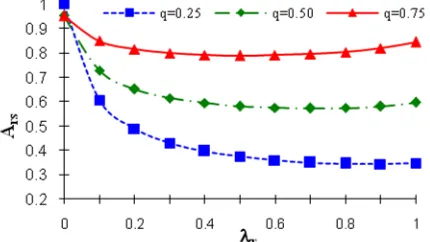
In Figures 3(a)- 6(b), the effects of the failure rate of robot λr and the repair rate of robot µr aredisplayed on
the steady state availability (Ars) of the robot safety
system with the working safety unit and the steady state availability (Ar) of the robot safety system with or
without the working safety unit for the different values of the coverage probability ‘q’. It is observed from all of these figures that Ars and Ar increase with increasing q.
From Figures 3(a) - 4(b), the variation in Ars and Ar can
be seen with respect to λr and µr for different values of q
for gamma distribution. It is observed from Figures 3(a) and 4(a) that Ars and Ar follow decreasing trend for the
increment in the values of λr whereas when the value of µr increases, Ars and Ar also increase as shown in
Figures 3(b) and 4(b).
For different values of q, we can demonstrate the changes in Ars and Ar for the increasing values of λr and
µr for exponential distribution in Figures 5(a)- 6(b). We
can see easily form 5(a) and 6(a) that Ars and Ar
decrease as λr increases and from 5(b) and 6(b), we notice the increasing trend in Ars and Ar with respect to
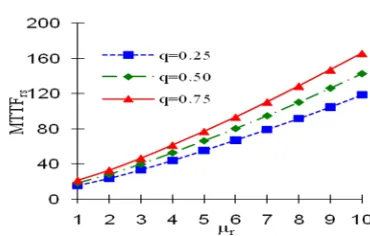
µr. Figures 7(a)- 8(b) show the effects of λr and µr on the
mean time to failure MTTFrs of the robot safety system
with the working safety unit and the mean time to failure MTTFr of the robot safety system with or
without the working safety unit for the different values of q. It can be visualized from all these figures that MTTFrs and MTTFr increase as the coverage probability ‘q’ increases. Figures 7(a) and 8(a) show the effects of
λr on MTTFrs and MTTFr; we see that MTTFrs and
MTTFr decrease fast first, then decrease slowly with the
increment in λr. The increasing trend of MTTFrs and
MTTFr is found with respect to µr in Figures 7(b) and
8(b).
From all the graphs we conclude that the steady state availability as well as the mean time to failure of the robot safety system in both cases (i) with working safety unit and (ii) with or without working safety unit increase as the values of the coverage probability ‘q’
and the repair rate (µr) of the robot increase, while
decrease as the failure rate (λr) of the robot increases.
Figure 3(a). Effect of λr on Ars by varying ‘q’ for Gamma
distributed repair time
Figure 3(b). Effect of µr on Ars by varying ‘q’ for Gamma
distributed repair time
Figure 4(a). Effect of λr on Ar by varying ‘q’ for Gamma
distributed repair time
Figure 4(b). Effect of µr on Ar by varying ‘q’ for Gamma
Figure 5(a). Effect of λr on Ars by varying ‘q’ for Exponential
distributed repair time
Figure 5(b). Effect of µr on Ars by varying ‘q’ for Exponential
distributed repair time
Figure 6(a). Effect of λr on Ar by varying ‘q’ for Exponential
distributed repair time
Figure 6(b). Effect of µr on Ar by varying ‘q’ for Exponential
distributed repair time
Figure 7(a). Effect of λr on MTTFrs by varying ‘q’
Figure 7(b). Effect of µr on MTTFrs by varying ‘q’
Figure 8(a). Effect of λr on MTTFr by varying ‘q’
7.CONCLUSION
In this investigation the reliability/availability prediction of a robot safety system incorporating various factors such as standby, coverage and reboot is done. Safety is an important component in industrial automation in which robots are widely used. The expressions for the steady state availability, reliability and the mean time to failure evaluated with the help of the steady state and the transient state probabilities by developing Markov model may be beneficial for the industrial engineers as well as the system designers in order to improve the quality and the grade of the performance of the robot system with safety provision under the techno-economic constraints. The present research work provides the study on combined effects of imperfect coverage, redundant robots and reboot on a robot safety system which is one the first steps in the scenario and it is also hoped that it will help to develop appropriate policies for the organizations that use robots quite frequently.
8. REFERENCES
1. Jiang, B. C. and Cheng, O. S., "A procedure analysis for robot system safety", International Journal of Industrial Ergonomics, Vol. 6, No. 2, (1990), 95-117.
2. Dhillon, B. and Anude, O., "Robot safety and reliability: A review", Microelectronics Reliability, Vol. 33, No. 3, (1993), 413-429.
3. Dhillon, B. and Yang, N., "Availability analysis of a robot with safety system", Microelectronics Reliability, Vol. 36, No. 2, (1996), 169-177.
4. Dhillon, B. and Yang, N., "Formulas for analyzing a redundant robot conFiguration with a built-in safety system",
Microelectronics Reliability, Vol. 37, No. 4, (1997), 557-563. 5. Dhillon, B. and Fashandi, A., "Robotic systems probabilistic
analysis", Microelectronics Reliability, Vol. 37, No. 2, (1997), 211-224.
6. Zurada, J., Wright, A. L. and Graham, J. H., "A neuro-fuzzy approach for robot system safety", Systems, Man, and Cybernetics, Part C: Applications and Reviews, IEEE Transactions on, Vol. 31, No. 1, (2001), 49-64.
7. Dhillon, B. and Li, Z., "Stochastic analysis of a maintainable robot-safety system with common-cause failures", Journal of Quality in Maintenance Engineering, Vol. 10, No. 2, (2004), 136-147.
8. Oliveira, E., Alvim, A. and Frutuoso e Melo, P., "Unavailability analysis of safety systems under aging by supplementary variables with imperfect repair", Annals of Nuclear Energy, Vol. 32, No. 2, (2005), 241-252.
9. Dhillon, B. and Li, Z., "Stochastic analysis of a system containing n-redundant robots and m-redundant built-in safety units", International Journal of Performability Engineering, Vol. 1, No. 2, (2005), 179.
10. Dhillon, B. and Li, Z., "Stochastic analysis of a system with redundant robots, one built-in safety unit, and common-cause failures", Journal of Intelligent and Robotic Systems, Vol. 45, No. 2, (2006), 137-155.
11. Kulić, D. and Croft, E. A., "Real-time safety for human–robot interaction", Robotics and Autonomous Systems, Vol. 54, No. 1, (2006), 1-12.
12. Dhillon, B. S. and Cheng, S., "Probabilistic analysis of a repairable robot-safety system composed of (n-1) standby robots, a safety unit, and a switch", Journal of Quality in Maintenance Engineering, Vol. 14, No. 3, (2008), 306-323. 13. Savsar, M. and Aldaihani, M., "Modeling of machine failures in
a flexible manufacturing cell with two machines served by a robot", Reliability Engineering & System Safety, Vol. 93, No. 10, (2008), 1551-1562.
14. Vanderperre, E. J. and Makhanov, S. S., "Point availability of a robot with internal safety device", Contemporary Engineering Sciences, Vol. 1, No. 1, (2008), 15-25.
15. Gultekin, H., Ekin Karasan, O. and Akturk, M. S., "Pure cycles in flexible robotic cells", Computers & Operations Research, Vol. 36, No. 2, (2009), 329-343.
16. Oh, J.-K., Jang, G., Oh, S., Lee, J. H., Yi, B.-J., Moon, Y. S., Lee, J. S., and Choi, Y., "Bridge inspection robot system with machine vision", Automation in Construction, Vol. 18, No. 7, (2009), 929-941.
17. Vanderperre, E. J. and Makhanov, S. S., "Overall availability of a robot with internal safety device", Computers & Industrial Engineering, Vol. 56, No. 1, (2009), 236-240.
18. Arbuckle, D. and Requicha, A. A., "Self-assembly and self-repair of arbitrary shapes by a swarm of reactive robots: Algorithms and simulations", Autonomous Robots, Vol. 28, No. 2, (2010), 197-211.
19. Kaupp, T., Makarenko, A. and Durrant-Whyte, H., "Human–
robot communication for collaborative decision making—A probabilistic approach", Robotics and Autonomous Systems, Vol. 58, No. 5, (2010), 444-456.
20. Paviglianiti, G., Pierri, F., Caccavale, F. and Mattei, M., "Robust fault detection and isolation for proprioceptive sensors of robot manipulators", Mechatronics, Vol. 20, No. 1, (2010), 162-170. 21. Cheng, S. and Dhillon, B., "Reliability and availability analysis
of a robot-safety system", Journal of Quality in Maintenance Engineering, Vol. 17, No. 2, (2011), 203-232.
22. Sharma, S., Kumar, D. and Kumar, A., "Reliability analysis of complex multi-robotic system using ga and fuzzy methodology",
Applied Soft Computing, Vol. 12, No. 1, (2012), 405-415. 23. Trivedi, K. S., "Probability and statistics with reliability,
queuing, and computer science applications", Prentice-hall Englewood Cliffs, Vol. 2002, (1982).
24. Amari, S. V., Pham, H. and Dill, G., "Optimal design of k-out-of-n: G subsystems subjected to imperfect fault-coverage",
Reliability, IEEE Transactions on, Vol. 53, No. 4, (2004), 567-575.
25. Wang, K.-H. and Chiu, L.-W., "Cost benefit analysis of availability systems with warm standby units and imperfect coverage", Applied Mathematics and Computation, Vol. 172, No. 2, (2006), 1239-1256.
26. Myers, A. F., "K-out-of-n: G system reliability with imperfect fault coverage", Reliability, IEEE Transactions on, Vol. 56, No. 3, (2007), 464-473.
27. Ke, J.-C., Lee, S.-L. and Hsu, Y.-L., "On a repairable system with detection, imperfect coverage and reboot: Bayesian approach", Simulation Modelling Practice and Theory, Vol. 16, No. 3, (2008), 353-367.
29. Jain, M., Agrawal, S. C. and Preeti, "Fuzzy reliability evolution of a repairable system with imperfect coverage, reboot and common-cause shock failure", International Journal of Engineering, Transactions C: Aspects, Vol. 25, No. 3, (2012), 231-238.
30. Xing, L., Amari, S. V. and Wang, C., "Reliability of k-out-of-n systems with phased-mission requirements and imperfect fault coverage", Reliability Engineering & System Safety, Vol. 103, (2012), 45-50.
Performance Analysis of a Repairable Robot Safety System with Standby, Imperfect
Coverage and Reboot Delay
M. Jain a, Preeti b
a Department of Mathematics, Indian Institute of Technology, Roorkee-247667, India
b Faculty of Humanity, Physical & Mathematical Sciences, Shobhit University, Meerut-250110, India
P A P E R I N F O
Paper history:
Received 22 July 2012
Received in revised form 13 December 2012 Accepted 18 April 2013
Keywords: Robot Safety System Standby Reboot Switching
Supplementary Variable Reliability
Availability Mean Time to Failure
هﺪﯿﮑﭼ
ﺮﺿﺎﺣ ﺶﻫوﮋﭘ
ﺎﺑ
ﻢﺘﺴﯿﺳ ﮏﯾ
ﯽﻨﻤﯾا تﺎﺑر ﻞﯿﮑﺸﺗ
هﺪﺷ
يﺎﻫﺪﺣاو زا
تﺎﺑور
و رﺎﮐ ﻪﺑ هدﺎﻣآ
ﺪﺣاو ﯽﻨﻤﯾا
ﺖﺳا ﯽﻧورد
.
ﯽﻣﺎﮕﻨﻫ ﻪﮐ
ﯽﻠﺻاﺪﺣاو
ﺪﺣاو،ﺪﺘﻔﯿﺑرﺎﮐزا
تﺎﺑور هدﺎﻣآ ﻪﺑ رﺎﮐ دﻮﺟﻮﻣ رد ﻢﺘﺴﯿﺳ
ﯽﻣارنآيﺎﺟ
دﺮﯿﮔ
.
مﻮﻬﻔﻣ
ﺮﯿﺧﺎﺗ رد هار
ﻢﺘﺴﯿﺳدﺪﺠﻣيزاﺪﻧا
ردﺰﯿﻧ
،ﺖﺳاهﺪﺷدراوﯽﺳرﺮﺑﻦﯾا
نآﻖﺒﻃﺮﺑﻪﮐ
ﺪﺣاوﺮﮔا
تﺎﺑور
هارهرﺎﺑود
هﺪﺷيزاﺪﻧا
رﺎﮐﺖﺳرد
هارﺮﮕﯾدرﺎﺑﮏﯾ،ﺪﻨﮑﻧ
ﯽﻣيزاﺪﻧا
دﻮﺷ
.
نﺎﻣز يدﻮﺒﻬﺑ
هارو
ﺪﺣاودﺪﺠﻣيزاﺪﻧا
،هدﺎﺘﻓارﺎﮐزا
نﺎﻣز
هدﺎﻣآولﺎﻌﻓيﺎﻫﺪﺣاورﺎﮐ
رﺎﮐﻪﺑ
و نﺎﻣز
ﯽﯾﺎﻤﻧ ترﻮﺻﻪﺑﺮﯿﻤﻌﺗ
هﺪﺷﻊﯾزﻮﺗ
ﺖﺳا
.
هوﻼﻋ
،ﻦﯾاﺮﺑ
نﺎﻣزﻊﯾزﻮﺗ
ﺮﯿﻤﻌﺗ
ﺪﺣاوﮏﯾ
ﻪﻤﯿﻧ
ردهدﺎﺘﻓا رﺎﮐزا
ﻢﺘﺴﯿﺳ
ردﯽﻓدﺎﺼﺗ،هدﺎﺘﻓارﺎﮐزاًﻼﮐ
ﺮﻈﻧ ﻪﺘﻓﺮﮔ هﺪﺷ
ﺖﺳا
.
يﺎﻫﺮﯿﻐﺘﻣ تﻻﺎﻤﺘﺣا ،ﺖﻟﺎﺣ
،ندﻮﺑسﺮﺘﺳدرد
نﺎﻨﯿﻤﻃاﺖﯿﻠﺑﺎﻗ
و ﻂﺳﻮﺘﻣ
ﮏﻤﮐﺎﺑﯽﮔدﺎﺘﻓارﺎﮐزانﺎﻣز
شور
وفﻮﮐرﺎﻣ
ﻞﻤﮑﻣﺮﯿﻐﺘﻣ
هﺪﺷجاﺮﺨﺘﺳا
ﺖﺳا
.
يﺎﻫﺪﺣاو عﻮﻗو
،رﺎﮐﻪﺑهدﺎﻣآ
ﺶﺷﻮﭘ ﺺﻗﺎﻧ
هارو
ﯽﻣنﺎﺸﻧﻢﺘﺴﯿﺳدﺪﺠﻣيزاﺪﻧا
ﻪﮐﺪﻫد
نﺎﻨﯿﻤﻃاﺖﯿﻠﺑﺎﻗيورﯽﻬﺟﻮﺗﻞﺑﺎﻗﺮﯿﺛﺎﺗ
ﻢﺘﺴﯿﺳ
سﺮﺘﺳدرد،تﺎﺑر
ندﻮﺑ و
ﻂﺳﻮﺘﻣ نﺎﻣز
ﺪﻧراد ﯽﮔدﺎﺘﻓا رﺎﮐ زا ﺎﺗ
.
ﯽﺠﻨﺳرﺎﺒﺘﻋا رﻮﻈﻨﻣ ﻪﺑ
لﺪﻣ ،ﺮﺿﺎﺣ
ﻦﯿﻨﭽﻤﻫ و
نﺎﺸﻧ ياﺮﺑ
نداد تاﺮﺛا يﺎﻫﺮﺘﻣارﺎﭘ
ﻒﻠﺘﺨﻣ رد
ﻋيﺮﯿﮔهزاﺪﻧا
دﺮﮑﻠﻤ
ﯽﻨﻤﯾاﻢﺘﺴﯿﺳ
،تﺎﺑر
لﺎﺜﻣﮏﯾ
ﺖﺳاهﺪﺷﻪﺋارايدﺪﻋ
.