RESEARCH REPOSITORY
This is the author’s final version of the work, as accepted for publication following peer review but without the publisher’s layout or pagination.
The definitive version is available at:
http://dx.doi.org/10.1016/j.biocon.2017.02.007
Beatty, S., Allen, M., Lymbery, A., Jordaan, M.S., Morgan, D.,
Impson, D., Marr, S., Ebner, B. and Weyl, O.L.F. (2017)
Rethinking refuges: Implications of climate change for dam
busting. Biological Conservation, 209. pp. 188-195.
1
Rethinking refuges: implications of climate change for dam busting
2 Running head: Dam removal and climate change
3
4 Stephen Beatty1*, Mark Allen1, Alan Lymbery1, Martine S.Jordaan2,3, David Morgan1, Dean
5 Impson2, Sean Marr3, Brendan Ebner4, Olaf Weyl3
6 1Centre for Fish and Fisheries Research, School of Veterinary and Life Sciences, Murdoch
7 University, Perth, Western Australia, 6150, Australia
8 2 CapeNature Scientific Services, Stellenbosch 7600, South Africa
9 3South African Institute for Aquatic Biodiversity, Grahamstown 6139, South Africa
10 4TropWATER, James Cook University, Atherton Queensland, Australia
11
12 *Correspondence: Stephen J. Beatty, tel. +618 9360 2813, fax +618 9360 7512, e-mail:
14
15
16
17 Keywords: freshwater fishes, dam removal, aquatic refuge, surface flow decline, south-western
18 Australia, South Africa
19
20
22 Climate change is projected to alter river discharge in every populated basin in the world. In
23 some parts of the world, dam removal now outpaces their construction and the diminishing
24 cost efficiency of dams in drying regions is likely to further increase the rate of removals.
25 However, the potential influence of climate change on the impact of dam removals has
26 received almost no consideration. Most dams have major biological and ecological impacts
27 and their removal would greatly benefit riverine ecosystems. However, using model regions
28 in the Southern Hemisphere, we highlight that artificial lentic habitats created by dams can
29 act as refuges for increasingly imperiled freshwater fishes, and dams may also prevent the
30 upstream spread of invasive alien species in rivers. We argue that, in these and other regions
31 where the major impact of climate change will be to reduce streamflow and aquatic refuge
32 availability, a shifting balance between the negative and positive environmental impacts of
33 dams requires policy makers to include climate change predictions in prioritization processes
34 for dam removal.
35
36 1. Introduction
37 Human infrastructure captures more than 50% of available fresh water runoff (Jackson et
38 al., 2001) with global water withdrawal increasing ~65% 1979-2010 (Wada et al., 2014).
39 Dams, and the impoundments created by them, provide many benefits to humans, including
40 water supply, flood control, irrigation, navigation, recreation and the generation of
41 hydropower. Throughout the world, there are now more than 50,000 dams with a crest height
42 greater than 15 m and an estimated 16.7 million reservoirs >0.01ha (Lehner et al., 2011).
43 Although they have underpinned the development of human societies, dams also usually
46 (Nilsson et al., 2005). Through altering natural flow regimes, the abiotic impacts of dams
47 include habitat fragmentation, reductions in habitat quality and complexity, and disruption to
48 processes of erosion, sediment transport, channel scouring and nutrient cycling (e.g., Poff et
49 al., 1997; Arthington, 2012). The biological responses to these impacts can include shifts in
50 community composition, loss of species abundance and diversity, and changes in species
51 distribution (Nilsson et al., 2005). The impacts of dams on fishes can be particularly severe,
52 including the disruption of migratory pathways, creation of unfavorable habitats for native
53 species and loss of riparian habitat (Winemiller et al., 2016).
54 Between 1979 and 2010, the global abstraction of groundwater has increased
55 proportionally more (an overall increase of ~85%) than the capture of surface water (an
56 increase of ~56%) (Wada et al., 2014). While dam construction continues at pace in many
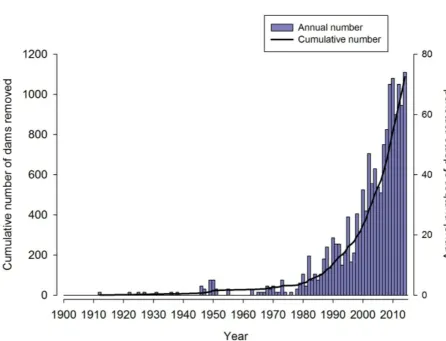
57 parts of the world, particularly China and India, in contrast in North America and Europe
58 there has been a marked overall slowdown in large dam construction (Chao et al., 2008;
59 Winemiller et al., 2016) and concurrent increases in dam removal (O’Conner et al., 2015).
60 Dam removal now outpaces construction in the USA and is increasing at an exponential rate
61 (American Rivers 2014)(Fig. 1). This surge in dam removals has been driven principally by
62 economic factors with many built in the middle years of the 20th Century reaching the end of
63 their working life, and the costs to repair aging infrastructure greatly outweigh removal costs
64 (Stanley and Doyle, 2003). More recently, the impetus for the removal of many dams has
65 been to mitigate their ecological impacts; usually to reinstate fish migration pathways and
66 restore natural flow regimes (Service, 2011; O’Conner et al.,2015).
67 How may climate change affect the value of dams into the future? Climate change and
68 water withdrawal is projected to alter river discharge in every major river basin in the world
69 (Palmer et al., 2008). On the one hand, increasing global population growth and per capita
71 surface water (Palmer et al., 2009). On the other hand, the cost efficiency of maintaining
72 storage dams is likely to be reduced in regions where rainfall and surface flows decline, and
73 in regions where increased extreme weather events, such as flooding, will require dams to be
74 reinforced and/or modified to mitigate associated risks such as overflows and structural
75 failure (Pittock and Hartmann,2011). Therefore, the combined effect of the finite lifespan of
76 dams and their diminishing utility as a reliable water source in regions that are transitioning
77 to a drier climate is likely to increase the rate of dam obsolescence and removal. Certainly,
78 there has been increasing interest in the ecological and social benefits of dam removal even in
79 arid and semi-arid regions such as Australia (e.g. Neave et al, 2009) and South Africa (e.g.
80 Mantel et al. 2010). However, we are unaware of inventories of dam removals in the
81 Southern Hemisphere and development of a database would be of great benefit; similar to
82 that maintained in the USA (American Rivers, 2014). While the negative ecological impacts
83 of dams are well recognised, here we argue the influences of climate change on the future
84 impacts and value of dams requires greater consideration in decision making processes to
85 remove them in drying temperate regions.
86
87 2. Environmental impacts of dam removal
88 Although environmental concerns have often not been the principal driver of dam
89 removals, the process of restoring artificial lentic habitats back to their original lotic state
90 usually has profound associated environmental benefits. The restoration of more natural
91 temperature and sediment transport regimes can contribute to increased species richness,
92 abundance, and biomass of fishes at formerly impacted sites. Reinstating longitudinal river
93 connectivity can permit fishes to access habitat beyond former barriers, with evidence of
96 connectivity between rivers and associated habitats (e.g. floodplains), benefiting aquatic and
97 dependent terrestrial fauna (Shuman, 1995).
98 Although the removal of a dam usually has overwhelmingly positive outcomes for the
99 river ecosystem, it should be considered an ecological disturbance in its own right (Stanley
100 and Doyle, 2003), and some ecological changes might be environmentally costly rather than
101 beneficial. A major concern with dam removal is the mobilisation of accumulated sediments,
102 as this can impact habitats downstream through sediment deposition (which may contain
103 toxins, heavy metals or nutrients) and erosion (Bednarek, 2001; Stanley and Doyle, 2003).
104 We also need to be aware that once a dam has been constructed, the original aquatic
105 ecosystem has been changed, and although it may be physically altered from its original state,
106 the new lentic ecosystems can support considerable aquatic biodiversity. These potentially
107 positive values need to be considered in proposals for dam removal, because we cannot
108 always assume that an ecosystem will return to its original state following the removal of a
109 barrier. More research is required to assess and quantify the impacts of dam removal over
110 longer spatial and temporal scales (Graf, 2003).
111
112 3. Impacts of dams may alter due to climate change
113 Dams can act as refuges
114 One potential cost of dam removals that has not been adequately addressed is the
115 potential loss of novel refuges for aquatic organisms under ongoing climate change. To date,
116 most studies that have considered the implications of climate change on fish distributions
117 have had a strong northern-hemisphere bias, and concentrated on rising water temperature as
118 a driver of change in cold-water fish communities (e.g., Comte et al., 2013). Hydrological
119 shifts have rarely been considered, yet, over the last 50 years, streamflow has decreased by
121 Africa, south-east Asia and Australia, and by 10-30% in western North America and much of
122 South America (Milliman et al.,2008), with most of this decrease due to climate forcing (Dai
123 et al. 2009). Projections from climate change models suggest decreases in streamflow will
124 continue across these regions in the future (Jiménez Cisneros et al., 2014; Schewe et al.,
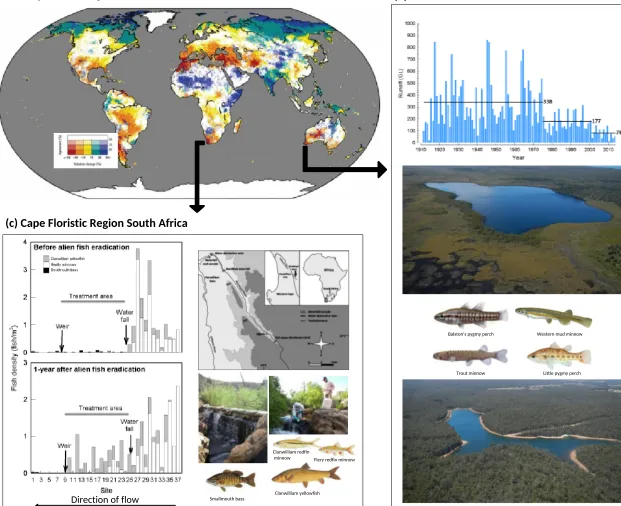
125 2014) (Fig. 2a).
126 These areas of the world all currently have strongly seasonal rainfall and hence
127 streamflow. Freshwater communities in these regions are typically structured by regular
128 patterns of flooding and drying, with isolated pools or waterholes providing ecological
129 refuges between streamflow events (Magoulick and Kobzna, 2003). These refuges are critical
130 to the periodic cycle of retreat and recolonisation that characterises non-perennial river
131 systems. Decreased streamflow (e.g. Fig. 2a) and increasing temperatures as a result of
132 climate change will affect the size, number and connectivity of these refuges, with likely
133 major impacts on freshwater biota, particularly freshwater fishes (Davis et al.,2013; Beatty et
134 al., 2014; Jaeger et al.,2014) (Fig. 2b).
135 There is an increasing recognition that artificially created waterbodies may have an
136 important role to play in creating refuge habitat for aquatic organisms (e.g. Halliday et al.,
137 2015; Beatty and Morgan, 2016). Such artificial refuges include water storage reservoirs,
138 drainage ditches, irrigation pipes, borrow pits, water transport canals and golf course lakes.
139 Importantly, they have also been identified as refuge habitat for a range of endangered
140 aquatic organisms, including freshwater fishes (Tonkin et al., 2010, 2014; Ebner et al., 2011),
141 molluscs (Clements et al., 2006) and waterbirds (Li et al., 2013).
142 We contend that the potential loss of natural refuges under reduced rainfall and flow
143 conditions in drying climatic regions may be offset to some extent by maintaining existing
146 impede the access of fish to natural refuges by physically blocking migratory pathways and
147 increasing the number of no-flow days (Perkins et al., 2015). Dams may also reduce the
148 ability of rivers to maintain natural refuges such as oxbows and scour pools, as they can
149 negatively impact fluvial geomorphic processes and disrupt the dynamics of the habitat
150 mosaic (Hauer and Lorang, 2004). These impacts must therefore be properly evaluated;
151 however in seasonally flowing river systems in arid and semi-arid regions of the world, they
152 may be outweighed by the loss of natural refuge pools in both regulated and unregulated
153 rivers in drying climates. In many of those systems, the ecological and conservation value of
154 at least a proportion of existing reservoirs is likely to increase in the future and this has not
155 been sufficiently appreciated in the dam removal discourse. In addition, it may be possible to
156 at least partially overcome the negative effects of dams on natural refuges, for example by
157 constructing fishways to enhance fish movement (Harris et al., 2016) and by using
158 environmental flows to maintain downstream ecosystems (Arthington, 2012).
159
160 Dams as barriers to invasive species
161 Invasive species and the exotic diseases they introduce represent a considerable threat to
162 aquatic ecosystems throughout the world. There is an increased likelihood of novel invasions
163 by aquatic species that possess physiological thresholds mismatched to current environmental
164 conditions, but matched to conditions likely to prevail under future climatic scenarios (Rahel
165 and Olden, 2008). Warmer water temperatures may also increase the transmission and
166 virulence of exotic parasites and pathogens to native fish species (Marcogliese, 2001). We
167 may therefore expect more invasive aquatic species, and greater impacts from these species,
168 in many regions due to climate change.
169 While the reservoirs created by dams are often hotspots of alien fish species, particularly
171 unintentionally) limiting the spread of invasive species (McLaughlin et al., 2007; Rahel,
172 2013; and see case study below). Moreover, while often difficult, eradicating alien species
173 from reservoirs is possible (Meronek et al. 1996) and can directly facilitate their use as
174 refuges by native fishes (Beatty and Morgan 2016).
175 The relative value of restoring connectivity for native species versus limiting the spread
176 of invasive species requires careful consideration in decisions to remove dams or install
177 fishways. There may be trade-offs between the benefits to lotic ecosystems of removing a
178 dam (such as re-instating migratory pathways for diadromous or potamodromous fishes)
179 against potentially facilitating the spread of invasive species by removing barriers. The
180 dispersal of invasive species following barrier removal is not always predictable (Stanley et
181 al., 2007), highlighting the desirability of a sound biological and ecological understanding of
182 the fauna (both native and alien) that will be impacted. In some cases, retaining or even
183 creating new barriers may help offset the increasing threats that invasive alien species pose to
184 native biodiversity in changing climates (Rahel, 2013).
185
186 4. Case studies of the influence of climate change on the value of dams
187 South-western Australia
188 South-western Australia is a global biodiversity hotspot due to exceptionally high rates
189 of endemism. The rivers naturally have a highly seasonal flow regime and generally cease to
190 flow during the annual dry season, forming disconnected refuge pools. This region has a
191 depauperate freshwater fish fauna consisting of just 11 native species, however nine of these
192 are regionally endemic, the highest rate (~82%) of endemism of freshwater fishes of any
193 icthyological province in Australia (Morgan et al., 2014). All of the endemic species have
195 secondary (anthropogenic) salinisation of waterways, impacts of introduced species, habitat
196 destruction and climate change (Table S1).
197 Severe range contractions have occurred for most species as a result of secondary
198 salinisation, with remnant populations restricted to fresh tributaries and downstream reaches
199 of less salinised catchments (Beatty et al., 2011; Morgan et al., 2014). At least half of the
200 species migrate, however, most undertake short spawning migrations into tributaries during
201 the annual peak flow period before contracting to refuge pools during the dry period (Fig. 2b,
202 Beatty et al., 2014). While instream barriers are known to somewhat restrict the migration of
203 the more common species, their relative impact is minor compared to the other stressors
204 (Table S1).
205 South-western Australia has undergone a 50% reduction in median streamflow since the
206 1970’s (Fig. 2b). Global Climatic Models all project rainfall declines to continue (Hope et al.,
207 2015), with a further 25% reduction in median surface flows projected to occur by 2030
208 (Suppiah et al., 2007). This dramatic change will continue to have direct and indirect impacts
209 on freshwater fishes (Morrongiello et al., 2011; Beatty et al., 2014). Reductions in surface
210 flows and increasing temperatures are likely to reduce the abundance, size and quality of
211 natural refuge pools for aquatic fauna (Fig. 2b). Simultaneously, the drying trend will render
212 most water supply dams unviable as reliable water sources by the end of the century,
213 increasing the economic pressure to remove them.
214 Although reservoirs and other artificial lentic systems in south-western Australia would
215 benefit from habitat rehabilitation to improve their value as aquatic refuges (Fig. 2b), many
216 are free from alien species, have no significant impact to migratory fishes and some already
217 act as important refuges for endemic threatened species. Beatty and Morgan (2016)
218 highlighted that those reservoirs that were free from alien piscivores invariably housed viable
220 alien Eurasian Perch Perca fluviatilis preceded a rapid proliferation of an endemic galaxiid
221 that was previously undetectable in the impoundment. Ogston et al. (2016) also demonstrated
222 that the region’s two species of aestivating fishes had suffered major range declines due to
223 the drying climate, however, they also revealed that artificial lentic habitats would likely hold
224 the key to preventing their extinction in the wild. As natural refuge pools are lost as the
225 climate continues to dry, the potentially ecological value of artificial reservoirs in this region
226 will increase; particularly if actively managed such as eradicating alien fishes, and
re-227 stocking with endemic fishes. Removing them for economic reasons without proper
228 evaluation of their potential ecological value may therefore cause a major loss of vital refuge
229 habitat and result in a net negative impact on native freshwater fishes.
230
231 Cape Floristic Region of South Africa
232 The Cape Floristic Region is a southern African hotspot of fish endemism and diversity.
233 Geographic isolation has resulted in exceptional levels of regional diversity with 18 formally
234 described endemic fish species (and 42 additional recognised taxa with discrete genetic
235 lineages), most of which are narrow range endemics that are either restricted to single river
236 systems or even single tributaries within river systems (Table S1).
237 Seasonal or episodic flows coupled with high demands for water have resulted in the
238 construction of many dams for water storage and high levels of water abstraction for
239 agriculture. These modifications of the natural flow regime of rivers, coupled with large-scale
240 land transformation, invasion by alien plant species in the catchment, changes to water
241 chemistry, siltation, and introduction of alien fishes, have considerable impacts on native
242 fishes. As a result, main stem populations of many native fishes have been extirpated and
244 un-impacted upper reaches of tributaries, usually above barriers that prevent invasion by alien
245 fishes (Weyl et al., 2014; Van der Walt et al., 2016).
246 Climate change will place further pressure on already stressed natural refuges above
247 physical barriers in streams. It has been predicted by the end of the 21st century the annual
248 rainfall for the Cape Floristic Region (including Cape Town) will decrease by between
10-249 20%, causing major declines in surface run-off (de Wit and Stankiewicz, 2006). These
250 reductions in surface run-off will intensify competition for water resources between the
251 human population and the ecological reserves legally required for the maintenance of river
252 functioning by the National Water Act of South Africa. Predicted higher temperatures and
253 lower flows associated with decreased rainfall are likely to increase pressure on the already
254 stressed native fishes in the region. This, coupled with increasing water abstraction for
255 agriculture, is likely to result in a loss of critical habitats during the dry summer months.
256 Impoundments in this region support a variety of freshwater fishes, most of which are
257 alien and extensively utilised for recreational angling. Although small endemic minnows
258 (e.g., Pseudobarbus phlegethon and ‘Pseudobarbus’ calidus) are usually absent from
259 impoundments where predatory alien fishes occur, adults of larger native fishes (such as the
260 Clanwilliam yellowfish Labeobarbus seeberi) are able to co-occur with alien fishes in
261 invaded reaches of rivers and in impoundments. As Clanwilliam yellowfish are known to
262 undertake upstream spawning migrations in spring and early summer from deep pools to
263 shallow temporally variable habitats, this large migratory species may benefit from large
264 instream dams for their long term survival by using lentic habitats as refuges during droughts
265 to repopulate rivers when flows resume.
266 There are also several examples of southern African riverine cyprinids that have been
267 able to establish in impoundments. For example, the Endangered Berg-Breede River
269 crucial to its survival. In the Brandvlei Dam, a 2000 ha off-channel water storage reservoir,
270 whitefish are fully established and are the dominant component of the fish community despite
271 the presence of alien predatory fishes in the impoundment. A recent survey of a 10 ha
272 reservoir into which 48 Critically Endangered Twee River redfin ‘Pseudobarbus’ erubescens
273 were stocked in 1996 demonstrated that these fish had not only established, but also that they
274 were highly abundant (Jordaan et al., in press). Therefore, dam populations might provide
275 important sources for the future re-establishment of native fish if pressures on main stem
276 populations from alien fish can be reduced. Under a drying climate, the value of dams as
277 natural refuges for native fishes will increase as periodic desiccation of riverine habitats
278 becomes more likely.
279 Dams can also be used as barriers to invasions and as mechanisms for rehabilitating
280 native fish populations in this region. In the Cape Floristic Ecoregion, invasions by black bass
281 Micropterus spp. have resulted in the extirpation of native fishes from invaded river reaches
282 (Van der Walt et al., 2016). In some cases, such as the in the Rondegat River (Fig. 2c), the
283 construction of weirs facilitated alien smallmouth bass Micropterus dolomieu removals by
284 preventing re-invasion from downstream source populations after their eradication using the
285 piscicide rotenone. Native fishes begun to colonise the rehabilitated section of river almost
286 immediately (Weyl et al., 2014) and two years after the removal of smallmouth bass, their
287 abundance and diversity was similar to that in the non-invaded reaches of the river. Similar
288 use of instream barriers in alien species eradication and native fish recovery has been
289 employed in Australia (Lintermans 2000; Lintermans and Raadik 2003). Therefore, with
290 active management, many dams and strategic instream barriers could be used to offset the
291 impact of climate change and other stressors, particularly invasive fish species.
294 River basins impacted by dams require a greater level of proactive management than those
295 that are free-flowing, in order to mitigate the ecological and human impacts of climate
296 change (Palmer et al., 2009). Figure 3 outlines the criteria that should be considered when
297 assessing the impacts of dams and prioritising their removal, and we specifically identify
298 those criteria upon which climate change may have a direct or indirect influence. In order to
299 determine whether the removal of a particular dam will result in a net ecological benefit,
300 there is clearly a need to understand the hydrology and ecology of both the artificial water
301 body and the watershed in which it is situated, as well as the probable impacts of projected
302 climatic change and water withdrawals on fluvial systems in the region.
303 Prioritisation processes have been increasingly developed to rank dams and other
304 instream barriers for mitigation and removal. Historically, the majority of barrier
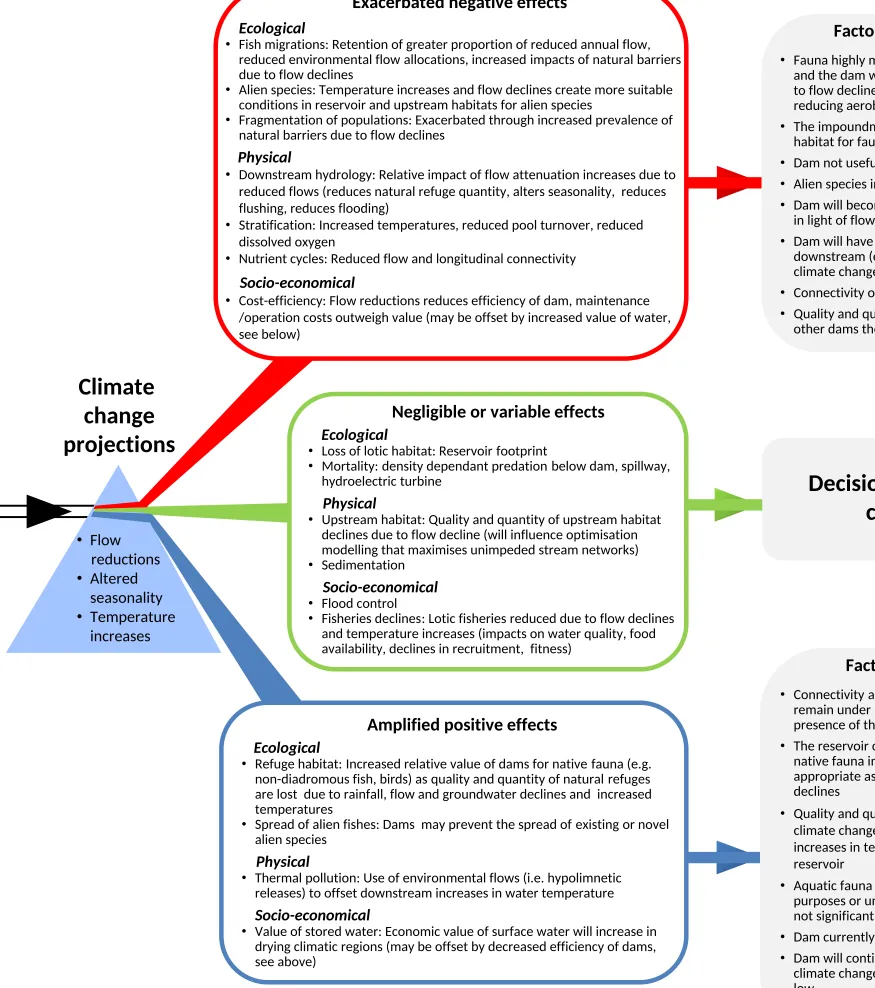
305 prioritisation methods used score and rank techniques, where barriers within a given spatial
306 range are scored based on ecological, physical and financial impacts and ranked for
307 mitigation under given budgetary constraints (Kemp and O’Hanley, 2010). The speed and
308 simplicity of score and rank prioritisation systems come at the cost of efficiency and
309 effectiveness primarily due to insufficient consideration of multiple barriers within
310 catchments, which can result in minimal habitat gains for migratory species, and this can be a
311 major shortcoming of these methods (O’Hanley and Tomberlin 2005). To enhance
cost-312 effectiveness, Kemp and O’Hanley (2010) argued strongly for the use of more robust
313 optimisation-based models that consider the cumulative effects of multiple barrier networks
314 on habitat connectivity and fish passage within catchments, rather than considering each
315 barrier independently.
316 Both score and rank systems and optimisation approaches are intrinsically designed to
317 incorporate additional variables and we propose that including projections of altered
319 processes should greatly enhance the robustness of decisions to remove dams on a longer
320 temporal scale. Null et al. (2014) included future climatic conditions when modelling
321 economic losses (reduced water supply and hydropower) and environmental gains (gains in
322 anadromous fish habitat quantified as river length gained between dams) for optimising dam
323 removals. While they did not consider any potential negative environmental impacts of dam
324 removal, they found considerable variability existed between dams in terms of future
325 economic benefit and environmental impacts. Peterson et al. (2013) incorporated climate
326 change projections into a Bayesian network approach to predict that barrier removal
327 decisions, previously made assuming a stationary climate, were robust in a climate change
328 scenario.
329 Such approaches are the way forward and we propose that these should routinely
330 incorporate robust assessments of both positive and negative ecological impacts of dam
331 removal under projected climate scenarios. Crucially, these assessments need to be
332 underpinned by regionally specific data. For example, Perkin et al. (2015) provide an
333 example of a comprehensive modelling exercise leading to predictions of which dams if
334 removed are likely to yield optimal environmental gains, in particular the expansion or
335 recovery of populations of small, pelagic-spawning fishes in large and historically perennial
336 streams in the central USA. By contrast, in the current study, we draw on examples from
337 South Africa and south-western Australia, which are dry temperate regions, characterised by
338 smaller, non-perennial streams. In the South African- Australian scenarios, habitat alteration,
339 water extraction and alien fishes (particularly large-predatory alien species) are decimating
340 small-bodied native fishes. Under these circumstances, natural upland headwaters, aquifer
341 springs and designed habitats (cf. designed ecosystems, Higgs 2016), namely water
344 these systems and in the case of designed habitats there are opportunities afforded by
345 infrastructure (e.g. draw down) that facilitate alien fish control (Beatty and Morgan, 2016).
346 Therefore, although the optimisation approach provided by Perkin et al. (2015) represents a
347 very useful template for progress, the focus in temperate dryland streams may shift from
348 main channel specialists that have evolved in perennial streams (e.g. pelagic spawners) to
349 threatened species/guilds that have adapted to regular cycles of drying and flooding.
350 Utilising reservoirs as ecological refuges also has a distinct set of management
351 challenges, given they have invariably been designed for other purposes. Their physical
352 characteristics and location in the landscape can lead to water quality issues such as depleted
353 oxygen owing to stratification, and contamination of water and sediments from industrial and
354 agricultural pollutants, particularly during periods of drought (Mosley, 2015). However, these
355 challenges, while they may be more severe in reservoirs, are not qualitatively different to
356 those existing in natural riverine refuges. There are few river systems in the world that are
357 truly undisturbed (Vörösmarty et al., 2010) and as reservoirs are often located in (and
358 contribute to the creation of) novel ecosystems, harnessing them as tools for ecological
359 restoration rather than their original purpose is a management challenge that climate change
360 may force us to meet.
361
362 6. Conclusion
363 Both the construction and removal of dams are often highly controversial and have divided
364 communities throughout the world (Sarakinos and Johnson 2003; Lejon et al., 2009). Finding
365 a balance between competing socioeconomic interests and environmental impacts has proved
366 challenging for policy makers (e.g. Williams et al. 1999). Therefore, the need to include
368 potentially contentious aspect; particularly in situations where climate change increases both
369 the environmental value, as well as the economic value of stored surface water.
370 Given the overwhelming negative biological and ecological impacts that dams have
371 had globally, their removal, in the great majority of cases, would have a significant net
372 positive impact on riverine ecosystems and aquatic biodiversity (Williams et al. 1999, Perkin
373 et al. 2015). Nevertheless, more research is required to quantify the existing ecological
374 values of artificial impoundments and to predict how these values may change in the future.
375 Most notably, in drying temperature streams where natural surface water refuges will be lost,
376 the implication of climate projections on the value of dams and the impacts of their removal
377 need much greater consideration by researchers and policy makers.
378
379 Acknowledgments
380 This work was carried out with financial support from the Australian Government (through
381 the Department of Climate Change and Energy Efficiency and the National Water
382 Commission) and the National Climate Change Adaptation Research Facility (NCCARF).
383 We greatly appreciated the support by Belinda Robson (Murdoch University) and her
384 leadership on the NCCARF project ‘Novel methods for managing freshwater refuges against
385 climate change in southern Australia’. Tom Ryan (Murdoch University), Tim Storer and
386 Gillian White (Department of Water, Western Australia) are acknowledged for earlier input
387 to the project. The authors also appreciated the discussions on the topic with Laura Wildman
388 (Princeton Hydro), Herman Wanningen (World Fish Migration Foundation) and Margaret
389 Zou (International Rivers) and are grateful to American Rivers (Jessie Thomas-Blate) for
391 Africa (Grant No. 77444) and the Water Research Commission (projects K5-2261, K5-2538)
392 for their support.
393 References
394 American Rivers, 2014. U.S. Dam Removals 1936-2014. Available at:
395 <www.americanrivers.org/initiatives/dams/dam-removals-map>
396 Arthington, A.H., 2012. Environmental flows: saving rivers in the third millennium.
397 University of California Press, Berkeley, California, USA, p. 424.
398 Beatty, S.J., Morgan, D.L., 2016. Rapid proliferation of an endemic galaxiid following
399 eradication of an alien piscivore (Perca fluviatilis) from a reservoir. J. Fish Biol. (online
400 early).
401 Beatty, S.J., Morgan, D.L., Lymbery, A.J., 2014. Implications of climate change for
402 potamodromous fishes. Glob. Change Biol.20, 1794-1807.
403 Beatty, S.J., Morgan, D.L., Rashnavadi, M., Lymbery A.J., 2011. Salinity tolerances of
404 endemic freshwater fishes of south-western Australia: implications for conservation in a
405 biodiversity hotspot. Mar. Freshw. Res. 62, 91-100.
406 Bednarek, A.T., 2001. Undamming rivers: a review of the ecological impacts of dam
407 removal. Environ. Manage.27, 803–814.
408 Billman, E.J., 2008. Reproduction by June Sucker in a refuge population: successful
409 spawning in a lake habitat. West. N. Am. Naturalist 68, 475-482.
410 Chao, B.F., Wu, Y.H., Li, Y.S., 2008. Impact of artificial reservoir water impoundment on
411 global sea level. Science 320, 212-214.
412 Chester, E.T., Robson, B.J., 2013. Anthropogenic refuges for freshwater biodiversity: Their
414 Clements, R., Koh, L.P., Lee, T.M., Meier, R., Li, D., 2006. Importance of reservoirs for the
415 conservation of freshwater molluscs in a tropical urban landscape. Biol. Conserv. 128,
416 136-146.
417 Comte, L., Buisson, L., Daufresne, M., Grenouillet, G., 2013. Climate-induced changes in the
418 distribution of freshwater fish: observed and predicted trends. Freshwater Biol. 58,
625-419 639.
420 Dai, A., Qian, T., Trenberth, K.E., Milliman, J.D., .2009. Changes in continental freshwater
421 discharge from 1948 to 2004. J. Climate 22, 2773-2792.
422 de Wit, M., Stankiewicz, J., 2006. Changes in surface water supply across Africa with
423 predicted climate change. Science 311, 1917-1921.
424 Ebner, B.C., Lintermans, M., Dunford, M., 2011. A reservoir serves as refuge for adults of
425 the endangered Macquarie perch. Lakes Reserv. Res. Manag. 16, 23–33.
426 Graf, W.L., 2003. Summary and perspectives in dam removal research - status and
427 Prospects. In: (Ed.) Graf W.L., Dam removal research: Status and prospects, The H. John
428 Heinz III Center for Science, Economics and the Environment, Washington, DC. pp. 1-22.
429 Grumbine, R.E., Pandit, M.K., 2013. Threats from India’s Himalaya Dams. Science 339, 36.
430 Halliday, B.T., Matthews, T.G., Iervasi, D., Dodemaide, D.T., Pickett, P.J., Linn, M.M.,
431 Burns, A., Bail, I., Lester, R.E., 2015. Potential for water-resource infrastructure to act as
432 refuge habitat. Ecol. Eng. 84, 136-148.
433 Harris, J.H., Kingsford, R.T., Peirson, W. Baumgartner, L.J., 2016.Mitigating the effects of
434 barriers to freshwater fish migrations: the Australian experience. Mar. Freshw. Res.
435 (online early).
436 Hauer, F.R., Lorang, M.S., 2004. River regulation, decline of ecological resources, and
388-439 Hope, P., Abbs, D., Bhend, J., Chiew, F., Church, J., Ekström, M., Kirono, D., Lenton, A.,
440 Lucas, C., McInnes, K., Moise, A., Monselesan, D., Mpelasoka, F., Timbal, B., Webb, L.,
441 Whetton, P., 2015. Southern and south-western flatlands cluster report. In: Ekström, M.,
442 Whetton, P., Gerbing, C., Grose, M., Webb, L., Risbey, J. (Eds.), Australia Projections for
443 Australia’s Natural Resource Management Regions: Cluster Reports. CSIRO and Bureau
444 of Meteorology, Australia. 58 pp.
445 Higgs, E., 2016. Novel and designed ecosystems. Restor. Ecol. 25, 8-13.
446 Jackson, R.B., Carpenter, S.R., Dahm, C.N., McKnight, D.M., Naiman, R.J., Postel, S.L.,
447 Running, S.W., 2001. Water in a changing world. Ecol. Appl. 11, 1027–1045.
448 Jaeger, K.L., Olden, J.D., Pelland, N.A., 2014. Climate change poised to threaten hydrologic
449 connectivity and endemic fishes in dryland streams. P. Natl. Acad. Sci. USA. 111,
13894-450 13899.
451 Jiménez Cisneros, B.E., Oki, T., Arnell, N.W., Benito, G., Cogley, J.G., Döll, P., Jiang, T.,
452 Mwakalila, S.S., 2014. Freshwater Resources. In: Field, C.B., Barros, V.R., Dokken, D.J.,
453 Mach, K.J., Mastrandrea, M.D., Bilir, T.E., Chatterjee, M., Ebi, K.L. Estrada, Y.O.,
454 Genova, R.C., Girma, B., Kissel, E.S., Levy, A.N., MacCracken, S., Mastrandrea, P.R.,
455 White, L.L. (Eds), Climate Change 2014: Impacts, Adaptation, and Vulnerability. Part A:
456 Global and Sectoral Aspects. Contribution of Working Group II to the Fifth Assessment
457 Report of the Intergovernmental Panel on Climate Change. Cambridge University Press,
458 Cambridge, UK., pp. 229-269.
459 Jordaan, M.S., van der Walt, J.A., Brink, Z., et al., (in press) Conservation implications of
460 establishment success of the critically endangered Twee River redfin ‘Pseudobarbus’
462 Kemp, P.S., O’Hanley, J.R., 2010. Evaluation of barriers to fish migration and prioritisation
463 of removal and mitigation projects. Fisheries Manag. Ecol. 17, 297-322.
464 Lehner, B., Liermann, C.R., Revenga, C., Vörösmarty, C., Fekete, B., Crouzet, P., Döll, P.,
465 Endejan, M., Frenken, K., Magome, J., Nilsson, C., Robertson, J.C., Rödel, R., Sindorf,
466 N., Wisser, D., 2011. High-resolution mapping of the world's reservoirs and dams for
467 sustainable river-flow management. Front. Ecol. Environ. 9, 494-502.
468 Lejon, A.G.C., Malm Renöfält, B., Nilsson, C.., 2009. Conflicts associated with dam
469 removal in Sweden. Ecol. Soc. 14, 4.
470 Li, D., Chen, S., Lloyd, H., Zhu, S., 2013. The importance of artificial habitats to migratory
471 waterbirds within a natural/artificial wetland mosaic, Yellow River Delta, China. Bird
472 Conserv. Int. 23, 184-198.
473 Lintermans, M., 2000. Recolonization by the mountain galaxias Galaxias olidus of a montane
474 stream after the eradication of rainbow trout Oncorhynchus mykiss. Mar. Freshw. Res. 51,
475 799-804.
476 Lintermans, M., Raadik, T., 2003. Local eradication of trout from streams using rotenone:
477 the Australian experience. In: Managing invasive freshwater fish in New Zealand.
478 Proceedings of a workshop hosted by Department of Conservation, Hamilton, New
479 Zealand, pp. 95-111.
480 Magoulick, D.D., Kobza, R.M., 2003. The role of refugia for fishes during drought: a review
481 and synthesis. Freshwater Biol., 48, 1186-1198.
482 Mantel S.K., Hughes D.A., Muller N.W.J., 2010. Ecological impacts of small dams on South
483 African rivers Part 1: drivers of change - water quantity and quality. Water SA, 36,
351-484 360.
487 McLaughlin, R.L., Hallet, A., Pratt, T.C., O’Connor, L.M., McDonald, D.G., 2007. Research
488 to guide use of barriers, traps and fishways to control sea lamprey. J. Great Lakes Res.33,
489 7-19.
490 Meronek. T.G., Bouchard, P.M., Buckner, E.R. Burri, T.M., Demmerly, K.K., Hatleli, D.C.,
491 Klumb, R.A., Schmidt, S.H., Coble, D.W., 1996. A review of fish control projects. North
492 Am. J. Fish. Manage. 16, 63–74.
493 Milliman, J.D., Farnsworth, K.L., Jones, P.D., Xu, K.H., Smith, L.C., 2008. Climatic and
494 anthropogenic factors affecting river discharge to the global ocean, 1951–2000. Global
495 Planet. Change 62, 187-194.
496 Morgan, D.L., Unmack, P.J., Beatty, S.J., Ebner, B.C., Allen, M.G., Keleher, J.J., Donaldson,
497 J.A., Murphy, J., 2014. An overview of the ‘freshwater fishes’ of Western Australia. J.
498 Royal Soc. West. Austral. 97, 263-278.
499 Morrongiello JR, Beatty SJ, Bennett JC, Crook, D.A., Ikedife, D.N.E.N., Kennard, M.J.,
500 Kerezsy, A., Lintermans, M.L., McNeil, D.G., Pusey, B.J., Rayner, T., 2011. Climate
501 change and its implications for Australia’s freshwater fish. Mar. Freshw. Res. 62,
1082-502 1098.
503 Mosley, L.M., 2015. Drought impacts on the water quality of freshwater systems; review and
504 integration. Earth-Sci. Rev. 140, 203-214.
505 Neave, M., Rayburg, S., Swan, A., 2009. River channel change following dam removal in an
506 ephemeral stream. Australian Geogr. 40, 235-246.
507 Nilsson, C., Reidy, C.A., Dynesius, M., Revenga, C., 2005. Fragmentation and flow
508 regulation of the world's large river systems. Science 308, 405-408.
509 Null, S.E., Medellín-Azuara, J., Escriva-Bou, A., Lent, M., Lund, J.R., 2014. Optimizing the
510 dammed: Water supply losses and fish habitat gains from dam removal in California. J.
512 O’Connor, J.E., Duda, J.J., Grant, G.E. 2015. 1000 dams down and counting. Science, 348,
513 496-497.
514 Ogston, G., Beatty, S.J., Morgan, D.L. Pusey, B.J., Lymbery, A.J., 2016. Living on burrowed
515 time: aestivating fishes in south-western Australia face extinction due to climate change.
516 Biol. Conserv. 195, 235-244.
517 O’Hanley, J.R., Tomberlin, D., 2005. Optimizing the removal of small fish passage barriers,
518 Environ. Modell. Assess. 10, 85-98.
519 Palmer, M.A., Lettenmaier, D.P., Poff, N.L., Postel, S.L., Richter, B., Warner, R., 2009.
520 Climate change and river ecosystems: protection and adaptation options. Environ.
521 Manage. 44, 1053-1068.
522 Palmer, M.A., Liermann, C.A.R., Nilsson, C., Florke, M., Alcamo, J., Lake, P.S., Bond, N.,
523 2008. Climate change and the world's river basins: anticipating management options.
524 Front. Ecol. Environ. 6, 81-89.
525 Perkin, J.S., Gido, K.B., Cooper, A.R., Turner, T.F., Osborne, M.J., Johnson, E.R., Mayes,
526 K.B., 2015. Fragmentation and dewatering transform Great Plains stream fish
527 communities. Ecol. Monogr. 85, 73-92.
528 Peterson, D.P., Wenger, S.J., Rieman, B.E., Isaak, D.J., 2013. Linking climate change and
529 fish conservation efforts using spatially explicit decision support tools. Fisheries 38,
112-530 127.
531 Pittock, J., Hartmann, J., 2011. Taking a second look: climate change, periodic re-licensing
532 and better management of old dams. Mar. Freshw. Res. 62, 312-320.
533 Poff, N.L., Allan, J.D., Bain, M.B., Karr, J.R., Prestegaard, K.L., Richter, B.D., Sparks, R.E.,
534 Stromberg, J.C. (1997) The natural flow regime. BioScience 47, 769-784.
537 Rahel, F.J., Olden, J.D. 2008. Assessing the effects of climate change on aquatic invasive
538 species. Conserv. Biol. 22, 521-533.
539 Sarakinos, H., Johnson, S.E., 2003. Social perspectives on dam removal. In: Graf, W.L.(Ed.)
540 Dam removal research: Status and prospects, pp. 40-55. The H. John Heinz III Center for
541 Science, Economics and the Environment, Washington, DC.
542 Schewe, J., Heinke, J., Gerten, D., Haddeland, I., Arnell, N.W., Clark, D.B., Dankers, R.,
543 Eisner, S., Fekete, B.M., Colón-González, F.J., Gosling, S.N., 2014. Multimodel
544 assessment of water scarcity under climate change. P. Natl. Acad. Sci. USA. 111(9),
3245-545 3250.
546 Service, R.F., 2011. Will busting dams boost salmon? Science, 334, 888-892.
547 Shuman, J.R., 1995. Environmental considerations for assessing dam removal alternatives for
548 river restoration. Regul. River. 11, 249–261.
549 Stanley, E.H., Doyle, M.W., 2003. Trading off: the ecological effects of dam removal. Front.
550 Ecol. Environ. 1, 15-22.
551 Suppiah, R., Hennessy, K.J., Whetton, P.H., McInnes, K.L., Macadam, I., Bathols, J.M.,
552 Ricketts, J.H., Page, C.M., 2007. Australian climate change projections derived from
553 simulations performed for the IPCC 4th assessment report. Aust. Meteorol. Mag., 131,
554 131-152.
555 Tonkin Z, Lyon J, Pickworth A (2010) Spawning behaviour of the endangered Macquarie
556 perch Macquaria australasica in an upland Australian river. Ecol. Manage. Restor. 11,
557 223-226.
558 Tonkin, Z., Lyon, J., Ramsey, D.S.L., Bond, N.R., Hackett, G., Krusic-Golub, K., Ingram,
559 B.A., Balcombe, S.R., 2014. Reservoir refilling enhances growth and recruitment of an
561 Van der Walt, J.A., Weyl, O.L.F., Woodford, D.J. et al., (2016) Spatial extent and
562 consequences of black bass (Micropterus spp.) invasion in a Cape Floristic Region river
563 basin. Aquat. Conserv. 26, 736-748.
564 Vörösmarty, C.J., McIntyre, P.B., Gessner, M.O., Dudgeon, D., Prusevich, A., Green. P.,
565 Glidden, S., Bunn, S.E., Sullivan, C.A., Liermann, C.R., Davies, P.M., 2010. Global
566 threats to human water security and river biodiversity. Nature 467, 555-561.
567 Wada, Y., Wisser, D., Bierkens, M.F.P., 2014. Global modeling of withdrawal, allocation and
568 consumptive use of surface water and groundwater resources. Earth Syst. Dynam. 5,
15-569 40.
570 Weyl, O.L.F., Finlayson, B., Impson, N.D., Woodford, D.J., Steinkjer, J., 2014. Threatened
571 endemic fishes in South Africa's Cape Floristic Region: A new beginning for the Rondegat
572 River. Fisheries 39, 270-279.
573 Williams, R.N., Bisson, P.A., Bottom, D.L., Calvin, L.D., Coutant, C.C., Erho, M.W.,
574 Frissell, C.A., Lichatowich, J.A., Liss, W.J., McConnaha, W.E., Mundy, P.R., Stanford,
575 J.A., Whitney, R.R., 1999. Return to the River: Scientific Issues in the Restoration of
576 Salmonid Fishes in the Columbia River. Fisheries 24, 10-19.
577 Winemiller, K.O., McIntyre, P.B., Castello, L., Fluet-Chouinard, E., Giarrizzo, T., Nam, S.,
578 Baird, I.G., Darwall, W., Lujan, N.K., Harrison, I., Stiassny, M.L.J., Silvano, R.A.M.,
579 Fitzgerald, D.B., Pelicice, F.M., Agostinho, A.A., Gomes, L.C., Albert, J.S., Baran, E.,
580 Petrere, M., Zarfl, C., Mulligan, M., Sullivan, J.P., Arantes, C.C., Sousa, L.M., Koning,
581 A.A., Hoeinghaus, D.J., Sabaj, M., Lundberg, J.G., Armbruster, J., Thieme, M.L., Petry,
582 P., Zuanon, J., Vilara, G.T., Snoeks, J., Ou, C., Rainboth, W., Pavanelli, C.S., Akama, A.,
583 Soesbergen, A.v., Sáenz, L., 2016. Balancing hydropower and biodiversity in the Amazon,
586 Figure Captions
587 Fig. 1 Annual and cumulative number of dams removed in the U.S. between 1912-2014 (Data source
588 American Rivers 2014).
589 Fig. 2 (a) Percentage change of mean annual streamflow for a global mean temperature rise of 2°C
590 above 1980–2010 (2.7°C above pre-industrial). Color hues show the multi-model mean change
591 across five General Circulation Models (GCMs) and 11 Global Hydrological Models (GHMs),
592 and saturation shows the agreement on the sign of change across all 55 GHM–GCM
593 combinations (percentage of model runs agreeing on the sign of change). Reproduced with
594 permission from Jiménez Cisneros et al. (2014).
595 (b) (top to bottom) Annual surface flow into dams that supply Perth (the capital of Western
596 Australia) has declined markedly since 1975 with further decline since 2001 (data source Water
597 Corporation, Western Australia); Natural lentic refuge in south-western Australia (e.g., Lake
598 Quitjup, middle right) are crucial refuges for threatened endemic freshwater fishes; water supply
599 reservoirs (e.g., bottom right) will be increasingly valuable as natural refuges are lost due to
600 climate change.
601 (c) In South Africa’s Rondegat River alien smallmouth bass penetrated 5 km upstream from
602 Clanwilliam Dam to a natural waterfall below which they extirpated native minnows and
co-603 occurred only with large Clanwilliam yellowfish. The subsequent construction of a small 2-m
604 high weir 4 km downstream of the waterfall, effectively isolated a portion of the smallmouth
605 bass population in this stretch of river. In 2012, this isolated section of river was treated using
606 the piscicide rotenone to remove smallmouth bass. Within a year following smallmouth bass
607 removal, threatened redfin minnows had begun to utilise the rehabilitated section of river and
610 Fig. 3 (Left to right) Summary of the criteria commonly considered during decision processes for dam
611 removal, how climate change may influence and interact with those criteria, and (right-hand
612 panels) details on how the specific criteria may be impacted by climate change.
613
Trout minnow
Western mud minnow
Little pygmy perch Balston’s pygmy perch
(c) Cape Floristic Region South Africa
(b) South-western Australia (a) Projected change in streamflow
Climate
change
projections
•
Flow
reductions
•
Altered
seasonality
•
Temperature
increases
Negative impacts
Ecological
•
Impedes migration of native fishes (e.g. reduces spawning
habitats, recruitment success)
•
Loss of lotic habitat due to reservoir footprint
•
Reservoir habitat favours alien species (e.g.
homogenisation of habitats, simplification of foodwebs
that favour generalists)
•
Increases mortality (e.g. density dependant predation
below dams, trauma over spillway and through
hydroelectric turbines)
•
Fragmentation of aquatic populations
Physical
•
Disruption of downstream hydrological processes (e.g.
reduced flows, altered seasonality, reduced flooding,
disruption of the habitat mosaic)
•
Sedimentation
•
Thermal pollution
•
Stratification (reduced dissolved oxygen)
•
Disruption of nutrient cycles
Socio-economical
•
Displacement of human populations
•
Impact on cultural values (particularly for traditional
owners)
•
Loss of arable land
•
Decline in lotic fisheries stocks (subsistence, commercial
and recreational)
•
Maintenance costs (especially for aging dams)
Positive impacts
Ecological
•
Provide novel habitats for some native fauna (e.g. fish,
birds)
•
Can prevent upstream expansion of alien species
Socio-economical
•
Economic value of stored water (potable, irrigation,
hydropower generation)
•
Provide recreational opportunities (e.g. fishing, boating,
swimming, camping)
•
Tourism value (local, regional economies)
•
Flood control
Criteria to assess the impacts of
dams for their removal
Potential effects of climate change on
the impacts of dams
Exacerbated negative effects
Ecological
•
Fish migrations: Retention of greater proportion of reduced annual flow,
reduced environmental flow allocations, increased impacts of natural barriers
due to flow declines
•
Alien species: Temperature increases and flow declines create more suitable
conditions in reservoir and upstream habitats for alien species
•
Fragmentation of populations: Exacerbated through increased prevalence of
natural barriers due to flow declines
Physical
•
Downstream hydrology: Relative impact of flow attenuation increases due to
reduced flows (reduces natural refuge quantity, alters seasonality, reduces
flushing, reduces flooding)
•
Stratification: Increased temperatures, reduced pool turnover, reduced
dissolved oxygen
•
Nutrient cycles: Reduced flow and longitudinal connectivity
Socio-economical
•
Cost-efficiency: Flow reductions reduces efficiency of dam, maintenance
/operation costs outweigh value (may be offset by increased value of water,
see below)
Amplified positive effects
Ecological
•
Refuge habitat: Increased relative value of dams for native fauna (e.g.
non-diadromous fish, birds) as quality and quantity of natural refuges
are lost due to rainfall, flow and groundwater declines and increased
temperatures
•
Spread of alien fishes: Dams may prevent the spread of existing or novel
alien species
Physical
•
Thermal pollution: Use of environmental flows (i.e. hypolimnetic
releases) to offset downstream increases in water temperature
Socio-economical
•
Value of stored water: Economic value of surface water will increase in
drying climatic regions (may be offset by decreased efficiency of dams,
see above)
Key considerations in assessing climate
change affected criteria
Factors contributing to a decision to remove a dam
•
Fauna highly migratory (especially threatened or culturally important species)
and the dam will significantly exacerbate the climatic impacts to migrations due
to flow declines or reduced fitness of native species (e.g. temperature increases
reducing aerobic scope)
•
The impoundment created by the dam does not provide significant refuge
habitat for fauna in the catchment
•
Dam not useful as a barrier to the spread of existing alien species
•
Alien species in dam will increasingly be favoured under climate change
•
Dam will become increasingly economically unviable and / or costly to maintain
in light of flow reductions (e.g. based on age, size, reduced economic return)
•
Dam will have increased impact on sensitive ecological communities located
downstream (e.g. exacerbating the reduction in flows, loss of floodplains due to
climate change)
•
Connectivity of natural refuge habitats significantly impacted by dam
•
Quality and quantity of upstream habitat not impacted by climate change or
other dams thereby not increasing the relative value of the dam in the future
Factors contributing to a decision to retain a dam
•
Connectivity and quality of remnant natural refuge habitats (i.e., those that will
remain under projected drying scenarios) will not be significantly impacted by the
presence of the dam
•
The reservoir created by the dam provides significant amount of refuge habitat for
native fauna in the catchment (especially for threatened species) and/or is
appropriate as a restocking site for threatened species to offset population
declines
•
Quality and quantity of refuge habitat in the catchment projected to decline due to
climate change (declines in rainfall, surface flow, groundwater, water quality,
increases in temperature) that will increase the relative ecological value of the
reservoir
•
Aquatic fauna in the river are not strongly migratory (e.g. not for spawning
purposes or undertake lateral migrations) and therefore life-history movements
not significantly impacted by the dam
•
Dam currently preventing the spread of damaging alien species
•
Dam will continue to be economically viable (modelling of future efficiency under
climate change scenarios) or ongoing maintenance costs forecast to be relatively
low
Negligible or variable effects
Ecological
•
Loss of lotic habitat: Reservoir footprint
•
Mortality: density dependant predation below dam, spillway,
hydroelectric turbine
Physical
•
Upstream habitat: Quality and quantity of upstream habitat
declines due to flow decline (will influence optimisation
modelling that maximises unimpeded stream networks)
•
Sedimentation
Socio-economical
•
Flood control
•
Fisheries declines: Lotic fisheries reduced due to flow declines
and temperature increases (impacts on water quality, food
availability, declines in recruitment, fitness)
Decision on dam removal reached that has
considered climatic projections
Highlights
Dams often have severe ecological impacts and are increasingly being removed in some regions.
Influence of climate change on the impacts of dam removal has not been addressed.
The net ecological value of artificial refuges such as dams may increase in drying regions.
Climate change may profoundly influence the value and impacts of dams in the future.
SUPPORTING INFORMATION
Table 1 Formally described endemic freshwater fishes of south-western Australia and the Cape Floristic Region of South Africa including a summary of threats (Table adapted from Morgan et al. 2014;Weyl et al. 2014). Key: CR = Critically Endangered, EN = Endangered, VU = Vulnerable, NT = Near Threatened, LC = Least Concern, DD = Data Deficient, NE = Not Evaluated. Main threats in south-western Australia (after Morgan et al. 2014; Beatty et al. 2014) and in the CFR, South Africa [adapted from www.iucnredlist.org and CapeNature unpublished data]. *valid species names for former Barbus species as listed in the California Academy of Sciences- Catalog of Fishes http://researcharchive.calacademy.org/research/ichthyology/catalog/fishcatmain.asp).
Region and species IUCN Redlist
(National Listing)
Main threats
Alien fish Habitat
destruction Pollution Human utilisation Genetic integrity Instream barriers Climate change Water abstraction
South-western Australia
Freshwater cobbler (Tandanus bostocki) NE
Salamanderfish (Lepidogalaxias salamandroides) NT (EN)
Western minnow (Galaxias occidentalis) NE
Western Mud minnow (Galaxiella munda) NT
Black-stripe minnow (Galaxiella nigrostriata) NT (EN)
Nightfish (Bostockia porosa) NE
Western pygmy perch (Nannoperca vittata) NE
Little pygmy perch (Nannoperca pygmaea NE (EN)
Balston’s pygmy perch (Nannatherina balstoni) DD (VU)
Cape Floristic Region, South Africa
Barnard’s rock catfish (Austroglanis barnardi) EN Clanwilliam rock catfish (Austroglanis gilli) VU Berg-Breede River whitefish (‘Pseudobarbus’
capensis)*
EN
Clanwilliam redfin (‘Pseudobarbus’ calidus)* VU Twee River redfin (‘Pseudobarbus’ erubescens)* CR
Sawfin (‘Pseudobarbus’ serra)* EN
Eastern Cape redfin (Pseudobarbus afer) EN
Smallscale redfin (Pseudobarbus asper) EN
Burchell’s redfin (Pseudobarbus burchelli) CE
Berg River redfin (Pseudobarbus burgi) CR
Fiery redfin (Pseudobarbus phlegethon) EN
Giant redfin (Pseudobarbus skeltoni) NE
Slender redfin (Pseudobarbus tenuis) NT
Verlorenvlei redfin (Pseudobarbus verloreni) NE
Clanwilliam sandfish (Labeo seeberi) CR