Pre‑impact fall detection
Xinyao Hu and Xingda Qu
*Background
Falls are a major safety concern, especially in older people. Approximately 28–35 % of
people aged of 65 and above fall at least once every year [4, 10, 36]. In the US, 70 % of all
emergency department visits by people over the age of 75 years were related to falls [39].
The consequences of falls are often devastating. Physical injuries caused by falls, such as hip fracture and head injuries, are often associated with high mortality and
morbid-ity among older people [37]. Besides, older people are likely to develop “fear of repeated
falls” after a fall-related incident. This often leads to the loss of mobility and
independ-ence [45]. For these and many more reasons, developing an effective fall prevention
strategy is imperative to mitigate the harm of falls, especially in older people.
Fall detection, whose main idea is to detect the occurrence of a fall event automatically
[16, 33, 46], has been proposed to be an effective fall prevention strategy. Fall detection
can be generally classified as post-fall mobility detection and pre-impact detection. Post-fall mobility detection is expected to initiate timely medical assistance for Post-fall victims,
and thus avoid unnecessary losses caused by ‘long-lie’ [29, 46]. However, this type of fall
detection has an inherent limitation. Falls can be only detected after impacts, so injuries directly caused by fall impacts cannot be prevented.
Unlike post-fall mobility detection, pre-impact fall detection is able to overcome the limitations mentioned above. Pre-impact fall detection refers to the technique that allows falls to be detected before the body hits against the ground (i.e., the body-ground impact). Thus, it can not only help initiate timely medical assistance for fall victims, but
Abstract
Pre-impact fall detection has been proposed to be an effective fall prevention strat-egy. In particular, it can help activate on-demand fall injury prevention systems (e.g. inflatable hip protectors) prior to fall impacts, and thus directly prevent the fall-related physical injuries. This paper gave a systematical review on pre-impact fall detection, and focused on the following aspects of the existing pre-impact fall detection research: fall detection apparatus, fall detection indicators, fall detection algorithms, and types of falls for fall detection evaluation. In addition, the performance of the existing pre-impact fall detection solutions were also reviewed and reported in terms of their sensitivity, specificity, and detection/lead time. This review also summarized the limita-tions in the existing pre-impact fall detection research, and proposed future research directions in this field.
Keywords: Fall accidents, Fall prevention, Pre-impact fall detection
Open Access
© 2016 The Author(s). This article is distributed under the terms of the Creative Commons Attribution 4.0 International License (http://creativecommons.org/licenses/by/4.0/), which permits unrestricted use, distribution, and reproduction in any medium, provided you give appropriate credit to the original author(s) and the source, provide a link to the Creative Commons license, and indicate if changes were made. The Creative Commons Public Domain Dedication waiver ( http://creativecommons.org/publicdo-main/zero/1.0/) applies to the data made available in this article, unless otherwise stated.
REVIEW
also have the potential to help activate on-demand fall protection systems to prevent the physical injuries caused by the body-ground impact. Though on-demand fall protec-tion systems are still in the exploratory phase and not commercially available, the idea of integrating pre-impact fall detection and on-demand fall protection systems have been
well accepted as a promising solution to preventing falls in older people [28]. In fact,
some researchers have attempted to integrate pre-impact fall detection algorithms with
on-demand fall protection systems. For example, Tamura et al. [43] designed a system
that integrated the fall detection algorithm with a wearable airbag system which can be
inflated to protect fallers from the body-ground impact. Similarly, Shi et al. [41]
pro-posed an inflatable hip proctor that can be triggered by an inertial-sensor-based fall detection system.
Given the above-mentioned reasons for that pre-impact fall detection is superior to post-fall mobility detection, current research has become more focused on develop-ing automatic pre-impact fall detection systems. This paper aimed to give a systemati-cal review on pre-impact fall detection. In this review, we would focus on the following aspects of the existing pre-impact fall detection research: fall detection apparatus, fall detection indicators, fall detection algorithms, and types of falls for fall detection evalu-ation. In addition, the performance of the existing pre-impact fall detection solutions were also reviewed and reported in terms of their sensitivity, specificity, and detection/ lead time.
Review procedure
The search of articles was based on the following database: Google Scholar, IEEE Xplore, PubMed, Web of Science and Science Direct. To avoid unnecessary omission, the searching criteria was deliberately broadened. We included the keywords of “fall detec-tion”, “fall detector”, “fall event detecdetec-tion”, “fall recognidetec-tion”, “fall protecdetec-tion”, “fall preven-tion”, “detect falls”, and “detecting falls”. This initial search yielded an initial collection of 683 papers. After that, screening was carried out to manually identify the studies on pre-impact fall detection only. Further actions were carried out to examine the citations of resulted papers to identify the relevant studies. We excluded papers that gave insuffi-cient information, such as the conference abstract. In addition, one study on pre-impact
detection and protection of motorcyclist falls [6] was also excluded as it is irrelevant to
falls in older people.
A total of 23 studies on pre-impact fall detection were identified, including 19 journal articles and 4 full papers from conference proceedings. These studies were reviewed in
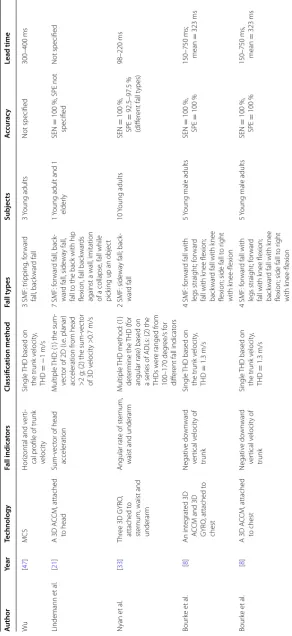
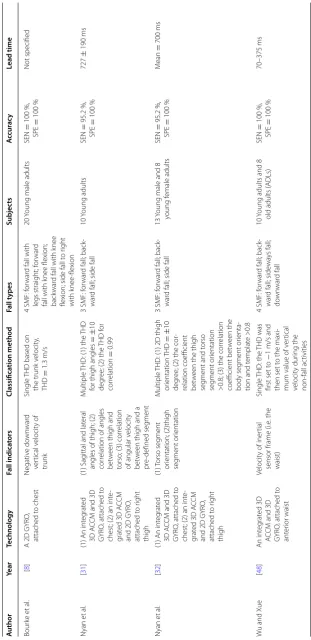
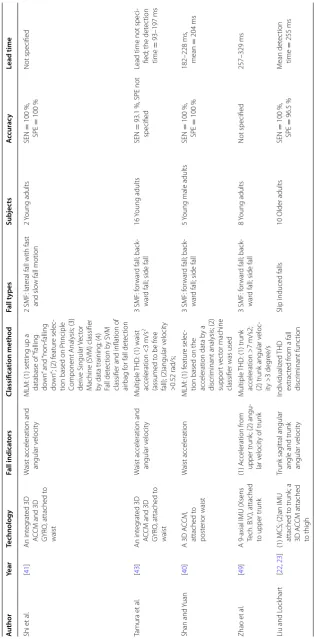
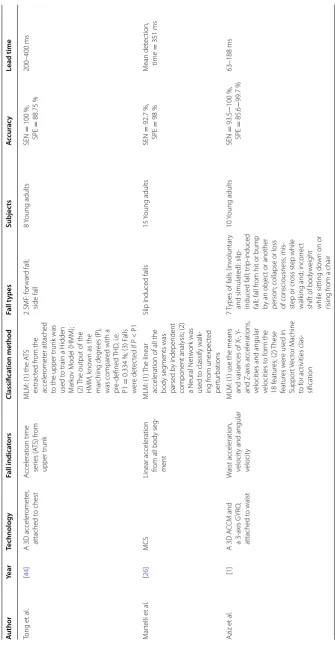
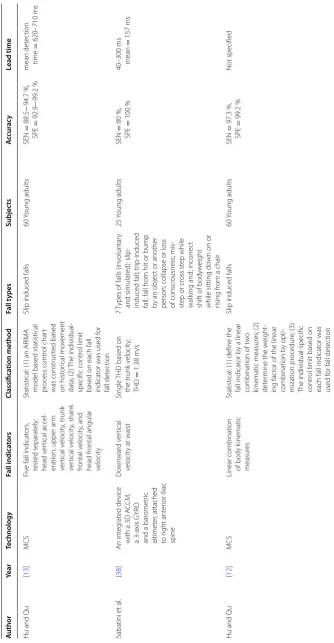
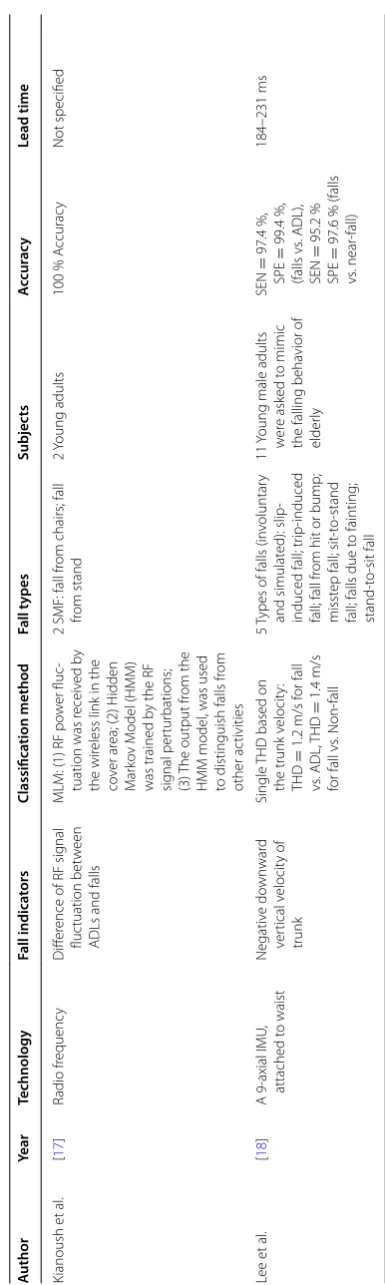
details chronically. The review results were summarized in Table 1.
Fall detection apparatus
The apparatus used in the existing pre-impact fall detection can be generally classified
into the context aware systems and wearable sensors [15]. Five studies were based on the
context aware technology. Among them, four studies used the motion capture system
[12, 13, 26, 47], and one was based on the radio frequency signal analysis [17].
Table
1
Summar
y on pr
e-impac
t fall det
ec tion studies A uthor Year Technology Fall indica tors Classifica tion method Fall t ypes Subjec ts A ccur ac y Lead time Wu [ 47 ] MCS Hor iz
ontal and v
er
ti-cal pr
ofile of trunk
velocit
y
Single
THD based on
the trunk v
elocit y, THD = − 1 m/s 3 SMF : tr ipping , f or war d fall , back war d fall 3 Y oung adults Not specified 300–400 ms Lindemann et al . [ 21 ]
A 3D A
CCM, attached
to head
Sum-vec
tor of head
acceleration
M
ultiple
THD: (1) the
sum-vec
tor of 2D (i.e
. planar)
acceleration fr
om head
>2
g; (2) the
sum-vec
tor
of 3D v
elocit y >0.7 m/s 7 SMF : f or war d fall , back -war d fall , side wa y fall , fall t
o the back with hip
flexion, fall back
war
ds
against a wall
, imitation
of a collapse
, fall while
pick
ing up an objec
t
1
Young adult and 1 elder
ly
SEN
=
100
%, SPE not
specified Not specified N yan et al . [ 33 ] Thr
ee 3D GYR
O , attached t o st er
num, waist and
underar
m
Angular rat
e of st
er
num,
waist and underar
m
M
ultiple
THD method: (1)
det er mine the THD (f or angular rat
e) based on
a ser
ies of ADLs: (2) the
THDs w
er
e ranged fr
om 100–170 deg ree/s f or diff er
ent fall indicat
ors
2 SMF
: side
wa
y fall; back
-war d fall 10 Y oung adults SEN = 100 %, SPE = 92.5–97.5 % (diff er
ent fall t
ypes) 98–220 ms Bour ke et al . [ 8 ] An int eg rat ed 3D A
CCM and 3D GYRO
, attached t
o chest Negativ e do wn war d ver tical v elocit y of trunk Single
THD based on
the trunk v
elocit y, THD = 1.3 m/s 4 SMF : f or war
d fall with
legs straight; f
or
war
d
fall with k
nee flexion;
back
war
d fall with k
nee
flexion; side fall t
o r ight with k nee -flexion 5
Young male adults
SEN = 100 %, SPE = 100 % 150–750 ms; mean = 323 ms Bour ke et al . [ 8 ]
A 3D A
CCM, attached to chest Negativ e do wn war d ver tical v elocit y of trunk Single
THD based on
the trunk v
elocit y, THD = 1.3 m/s 4 SMF : f or war
d fall with
legs straight; f
or
war
d
fall with k
nee flexion;
back
war
d fall with k
nee
flexion; side fall t
o r ight with k nee -flexion 5
Young male adults
Table 1 c on tinued A uthor Year Technology Fall indica tors Classifica tion method Fall t ypes Subjec ts A ccur ac y Lead time Bour ke et al . [ 8 ]
A 2D GYR
O , attached t o chest Negativ e do wn war d ver tical v elocit y of trunk Single
THD based on
the trunk v
elocit y, THD = 1.3 m/s 4 SMF : f or war
d fall with
legs straight; f
or
war
d
fall with k
nee flexion;
back
war
d fall with k
nee
flexion; side fall t
o r ight with k nee -flexion 20
Young male adults
SEN = 100 %, SPE = 100 % Not specified N yan et al . [ 31 ]
(1) An int
eg
rat
ed
3D A
CCM and 3D
GYR
O
, attached t
o
chest; (2) an int
e-grat
ed 3D A
CCM
and 2D GYR
O , attached t o r ight thigh (1) Sag
ittal and lat
eral
angles of thigh; (2) cor
relation of angles
bet
w
een thigh and
torso; (3) cor
relation
of angular v
elocit
y
bet
w
een thigh and a
pr e-defined seg ment M ultiple THD: (1) the THD
for thigh angles
=
±
10
deg
ree; (2) the
THD f or cor relation = 0.99 3 SMF : f or war
d fall; back
-war
d fall; side fall
10 Y oung adults SEN = 95.2 %, SPE = 100 % 727 ± 190 ms N yan et al . [ 32 ]
(1) An int
eg
rat
ed
3D A
CCM and 3D
GYR
O
, attached t
o
chest; (2) an int
e-grat
ed 3D A
CCM
and 2D GYR
O , attached t o r ight thigh (1) T orso seg ment or ientation; (2)thigh seg ment or ientation M ultiple
THD: (1) 2D thigh
or ientation THD = ± 10 deg
ree; (2) the cor
-relation coefficient bet
w
een the thigh
seg
ment and t
orso
seg
ment or
ientation
>0.8; (3) the cor
relation coefficient bet w een the body seg ment or ienta
-tion and t
emplat e >0.8 3 SMF : f or war
d fall; back
-war
d fall; side fall
13
Young male and 8 young f
emale adults SEN = 95.2 %, SPE = 100 % M ean = 700 ms W
u and X
ue [ 48 ] An int eg rat ed 3D A
CCM and 3D GYRO
, attached t
o
ant
er
ior waist
Velocit
y of iner
tial
sensor frame (i.e
. the
waist)
Single THD:
the THD
was
first set t
o
−
1
m/s and
then set t
o the maxi
-mum value of v
er tical velocit y dur ing the non-fall ac tivities 4 SMF : f or war
d fall; back
-war
d fall; side
wa ys fall; do wn war d fall 10
Young adults and 8 old adults (
Table 1 c on tinued A uthor Year Technology Fall indica tors Classifica tion method Fall t ypes Subjec ts A ccur ac y Lead time Shi et al . [ 41 ] An int eg rat ed 3D A
CCM and 3D GYRO
, attached t
o
waist
W
aist acceleration and angular v
elocit
y
MLM: (1) setting up a database
of “
falling
do
wn
” and “
non-falling
do
wn
”; (2) f
eatur
e selec
-tion based on P
rinciple
Component Analysis; (3) der
iv e Singular V ec tor M
achine (SVM) classifier
by data training; (4) Fall det
ec
tion b
y SVM
classifier and inflation of airbag f
or fall det
ec
tion
2 SMF
: lat
eral fall with fast
and slo
w fall motion
2 Y oung adults SEN = 100 %, SPE = 100 % Not specified Tamura et al . [ 43 ] An int eg rat ed 3D A
CCM and 3D GYRO
, attached t
o
waist
W
aist acceleration and angular v
elocit
y
M
ultiple
THD: (1) waist
acceleration <3
m/s
2
(assumed t
o be fr
ee
fall); (2)angular v
elocit y >0.52 rad/s; 3 SMF : f or war
d fall; back
-war
d fall; side fall
16 Y oung adults SEN = 93.1
%, SPE not
specified
Lead time not speci
-fied; the det
ec tion time = 93–197 ms Shan and Y uan [ 40 ]
A 3D A
CCM, attached t o post er ior waist W aist acceleration
MLM: (1) f
eatur
e selec
-tion based on the acceleration data b
y a
discr
iminant analysis; (2)
suppor
t v
ec
tor machine
classifier was used
3 SMF
: f
or
war
d fall; back
-war
d fall; side fall
5
Young male adults
SEN = 100 %, SPE = 100 % 182–228 ms , mean = 204 ms Zhao et al . [ 49 ]
A 9-axial IMU (
Xsens
Tech. B
.V
.), attached
to upper trunk
(1) A
cceleration fr
om
upper trunk
; (2) angu
-lar v
elocit
y of trunk
M
ultiple
THD: (1) trunk
acceleration >7
m/s2;
(2) trunk angular v
eloc -ity >3 deg ree/s 3 SMF : f or war
d fall; back
-war
d fall; side fall
8 Y oung adults Not specified 257–329 ms
Liu and L
ock har t [ 22 , 23 ]
(1) MCS; (2)an IMU attached t
o trunk ; a 3D A CCM attached to thigh Trunk sag ittal angular
angle and trunk angular v
elocit y Individualiz ed THD ex trac ted fr
om a fall
discr
iminant func
tion
Slip induced falls
10 Older adults
Table 1 c on tinued A uthor Year Technology Fall indica tors Classifica tion method Fall t ypes Subjec ts A ccur ac y Lead time Tong et al . [ 44 ]
A 3D acceler
omet er , attached t o chest A
cceleration time ser
ies (
AT
S) fr
om
upper trunk
MLM: (1) the A
TS ex trac ted fr om the acceler omet er attached
to the upper trunk was used t
o train a H
idden M ar ko v M odel (HMM); (2)
The output of the
HMM, k
no
wn as the
mar
ching deg
rees (P),
was compar
ed with a
pr e-defined THD , i.e . P1 = 0.334
%; (3) F
alls
w
er
e det
ec
ted if P
< P1 2 SMF : f or war d fall; side fall 8 Y oung adults SEN = 100 %, SPE = 88.75 % 200–400 ms M ar telli et al . [ 26 ] MCS
Linear acceleration from all body seg
-ment
MLM: (1)
The linear
acceleration of all the body seg
ments was
parsed b
y independent
component analysis; (2) a Neural Net
w
or
k was
used t
o classify walk
-ing fr om unexpec ted per tur bations
Slip induced falls
15 Y oung adults SEN = 92.7 %, SPE = 98 % M ean det ec tion, time = 351 ms A ziz et al . [ 1 ]
A 3D A
CCM and
a 3-axis GYR
O
,
attached t
o waist
W
aist acceleration, velocit
y and angular
velocit
y
MLM: (1) use the means and var
iances of X
-,
Y-
and Z
-axis accelerations
,
velocities and angular velocities t
o f or m the 18 f eatur es; (2) These featur es w er
e used in
Suppor t V ec tor M achine to f or ac tivities clas -sification 7
Types of falls (in
voluntar
y
and simulat
ed): slip
-induced fall; tr
ip
-induced
fall; fall fr
om hit or bump
by an objec
t or another
person; collapse or loss of consciousness; mis
-st
ep or cr
oss st
ep while
walk
ing and; incor
rec
t
shif
t of body
w
eight
while sitting do
wn on or
rising fr
om a chair
Table 1 c on tinued A uthor Year Technology Fall indica tors Classifica tion method Fall t ypes Subjec ts A ccur ac y Lead time
Hu and Qu
[
13
]
MCS
Fiv
e fall indicat
ors , test ed separat ely : head v er tical accel
-eration, upper ar
m ver tical v elocit y, trunk ver tical v elocit y, shank frontal v elocit y, and head fr ontal angular velocit y
Statistical: (1) an ARIM
A
model based statistical process contr
ol char t was construc ted based on hist or ical mo vement data; (2) The individual-specific contr ol limit
based on each fall indicat
or was used f
or
fall det
ec
tion
Slip induced falls
60 Y oung adults SEN = 88.5 − 94.7 %, SPE = 92.9 − 99.2 % mean det ec tion time = 620–710 ms Sabatini et al . [ 38 ] An int eg rat ed de vice
with a 3D A
CCM,
a 3-axis GYR
O
and a bar
ometr ic altimet er , attached to r ight ant er ior iliac spine D own war d v er tical velocit
y at waist
Single
THD based on
the trunk v
elocit y, THD = 1.38 m/s 7
Types of falls (in
voluntar
y
and simulat
ed): slip
-induced fall; tr
ip
-induced
fall; fall fr
om hit or bump
by an objec
t or another
person; collapse or loss of consciousness; mis
-st
ep or cr
oss st
ep while
walk
ing and; incor
rec
t
shif
t of body
w
eight
while sitting do
wn on or
rising fr
om a chair
25 Y oung adults SEN = 80 %, SPE = 100 % 40–300 ms mean = 157 ms
Hu and Qu
[
12
]
MCS
Linear combination of body k
inematic
measur
es
Statistical: (1) define the fall indicat
or b
y a linear
combination of t
w o kinematic measur es; (2) det er
mine the w
eight
-ing fac
tor of the linear
combination b y opti -mization pr ocedur e; (3)
The individual-specific contr
ol limit based on
each fall indicat
or was
used f
or fall det
ec
tion
Slip induced falls
Table 1 c on tinued A uthor Year Technology Fall indica tors Classifica tion method Fall t ypes Subjec ts A ccur ac y Lead time Kianoush et al . [ 17 ] Radio fr equenc y Diff er
ence of RF sig
nal
fluc
tuation bet
w
een
ADLs and falls
MLM: (1) RF po
w
er fluc
-tuation was r
eceiv
ed b
y
the wir
eless link in the
co
ver ar
ea; (2) H
idden M ar ko v M odel (HMM)
was trained b
y the RF
sig
nal per
tur
bations;
(3)
The output fr
om the
HMM model
, was used
to distinguish falls fr
om
other ac
tivities
2 SMF
: fall fr
om chairs; fall
from stand 2 Y oung adults 100 % A ccurac y Not specified Lee et al . [ 18 ]
A 9-axial IMU
, attached t o waist Negativ e do wn war d ver tical v elocit y of trunk Single
THD based on
the trunk v
elocit y: THD = 1.2 m/s f or fall vs
. ADL, THD
=
1.4
m/s
for fall vs
. Non-fall
5
Types of falls (in
voluntar
y
and simulat
ed): slip
-induced fall; tr
ip
-induced
fall; fall fr
om hit or bump;
misst
ep fall; sit
-t
o-stand
fall; falls due t
o fainting;
stand-t
o-sit fall
11
Young male adults were ask
ed t
o mimic
the falling beha
vior of elder ly SEN = 97.4 %, SPE = 99.4 %, (falls vs . ADL), SEN = 95.2 % SPE = 97.6 % (falls vs . near -fall) 184–231 ms MC S motion captur e sy st em, THD thr eshold , ACC M ac celer omet er , GYR O gyr osc ope , SMF simula ted falls , SEN sensitivit y, SPE specificit y, ADLs ac
cameras mounted in fixed locations. The biomechanical convention to calculate the body kinematic measures based on the motion capture system has been well established. Therefore, the major advantage of using the motion capture system for fall detection is that fall detection indicators can be accurately determined. However, it is practically impossible to implement the motion capture system in real life applications. Therefore, the motion capture system can be only used for fall detection model development and evaluation.
Kianoush et al. [17] introduced a novel context-aware technology to detect falls in
pre-impact phase. Their technology was based on tracking the fluctuation of wireless radio-frequency (RF) signals. They found that fall events would cause abnormal perturbations on the RF signal which can be discerned by a hidden Markov model. The wireless RF sig-nal was ubiquitous, and no attachable markers or wearable sensors were required. These features made this fall detection technology nonintrusive.
A limitation of the context-aware based fall detection is that it is restricted by space in the application. The motion capture system always has limited capture volume. Kianoush’s RF based technology also required wireless network deployment within the fall detection area. In addition, both the motion capture system and the RF based technology are expensive. Thus, related research and applications were still restricted to experimental settings. Lower cost context-aware technologies for fall detection have
been introduced recently, such as the vision-based technology [19], camera image
pro-cessing technology [27], acoustic based technology [20], and Microsoft Kinect [42].
However, to our knowledge, no one has used these technologies in pre-impact fall detec-tion. This can definitely be a direction for future research.
The majority of existing pre-impact fall detection systems (17 out of 21) are wearable-sensor-based. Due to the advancement in microelectronics and wireless communication technology, wearable micro-electro-mechanical systems (MEMS), such as
accelerom-eters and gyroscopes, become small, light-weight and low-cost [35]. They are capable
of capturing body movement unobtrusively and allow kinematic measurements to be monitored over extended space and time. This makes them suitable for pre-impact fall detection.
A few studies implemented fall detection by using a single type of wearable sensors.
For example, fall detection solutions from Bourke et al. [8]; Lindemann et al. [21]; Shan
and Yuan [40] and Tong et al. [44] relied on accelerometers only, while in Nyan et al. [32]
and Bourke and Lyons [9], gyroscopes were the only measuring device for fall detection.
The use of a single type of sensors can significantly reduce complexity and computa-tional demand of the fall detection system. However, it also has adverse effects on fall detection. For instance, it has been argued that acceleration signals alone might not be able to detect falls accurately due to that such signals cannot effectively and efficiently differentiate falls from fall-like activities (e.g., successful balance recovery from external
perturbations, and jumping) [14, 34].
consumption. This makes the implementation of wearable IMUs much easier than before. Second, the IMUs can provide more data than a single type of sensors and allow using multiple fall detection indicators, which could improve the fall detection accuracy. Third, integrated IMUs allow the sensor fusion algorithm, such as the Kalman Filter
[49] or extended Kalman Filter [38], to be used to correct errors in both accelerometer
and gyroscope data, and thus could result in more accurate estimation of fall detection indicators.
There is an emerging trend of using wearable sensors in fall detection research [15].
The wearable sensors have some advantages over the context-aware systems. First, the wearable sensors can be used to detect falls in extended space. Second, wearable sensors have much lower cost than context-aware systems. Third, wearable sensors are easier to implement than the context aware systems. In particular, wearable sensors often have wireless communication features which allow them to communicate easily with smart phones or other internet-enabled devices, and do not require additional infrastructure installation.
However, there are still some limitations in wearable-sensor-based fall detection. First, people under the fall detection surveillance are required to wear the sensors all the time. This might result in low user compliance because people sometimes might forget to wear them. Second, the data stability are lower than the context-ware system. This can be affected by many factors like insufficient battery power, and the alarm transmis-sion might be affected by data lost in wireless communication. Third, some fall detection indicators cannot be measured directly by the wearable sensors, and have to be obtained on an estimation basis. For instance, body segment velocity variables have to be esti-mated by the integration of acceleration signals from accelerometers. There are inevita-bly some errors resulted from such estimation procedure.
In a recent study, Liu and Lockhart [23] proposed an integrative ambulatory
measure-ment framework that combined the motion capture data and IMU data to detect falls in the pre-impact phase. This was the first attempt to incorporate both the context-aware based system and wearable sensors simultaneously in pre-impact fall detection. In this framework, the data from the motion capture system was used as a reference to facilitate the development of an individual-calibrated fall discriminant function. Data from wear-able IMUs was used as the input of this function to search the optimal thresholds that can distinguish falls from activities of daily living (ADLs). The evaluation results showed
that the fall detection performance was enhanced with such an integrative system [22].
Fall detection indictors
Fall detection indicators refer to the variables selected to discriminate falls from non-fall activities in fall detection algorithms. Among the reviewed articles, all except Kianoush
et al. [17] defined fall detection indicators by using human body kinematics. The
kin-ematic measures used to define fall detection indicators are typically classified into two categories: segment translational measures and segment rotational measures. Among
the translational measures, trunk velocity [7, 9, 12, 13]; Lee et al. [18, 47, 48] and trunk
accelerations [1, 26, 40, 41, 43, 44, 49] were the most widely used fall detection
indica-tors. Head acceleration [13, 21] and upper arm velocity [13] were also used to define fall
angular rate of the sternum [33], angular rate of the waist [32, 41, 43] and trunk [22, 23],
and segment orientation of the trunk [22, 23] and thigh [31, 32]. Most existing studies
used a single kinematic measure to define the fall detection indicator. Only a few
moni-tored more than one kinematic measures in their fall detection applications [12, 32, 47].
In particular, Wu [47] and Nyan et al. [32] both implemented ‘AND’ logic to link the
selected kinematic measures, where falls were considered to be detected only when all
the selected kinematic measures were beyond predefined thresholds. Hu and Qu [12]
used a linear combination of trunk vertical velocity and shank frontal velocity as the fall detection indicator. The linear combination was considered as the simplest format of combination that made the fall detection implementation easy. Their results showed that such combination improved fall detection performance as compared to that using a sin-gle kinematic measure.
The selection of fall detection indicators was closely related to where to place fall detection sensors. The most commonly chosen body site was the waist area. Seven dif-ferent research groups attached the wearable sensors on either the anterior or poste-rior side of the waist area to monitor the lower trunk kinematics. The chest (or upper trunk) area was another popular choice. Four research groups attached the sensor to the chest. The upper and lower trunk became preferred body sites for fall detection sensors, most probably because these two body areas are close to the whole-body center of mass.
Researchers also considered the head [21], underarm [33] and thigh [32] for fall detector
placement.
Some fall detection indicators cannot be measured directly by the wearable sensors. Instead, they were estimated from the sensor output. For example, the accelerometers can only measure the acceleration with the effect of gravity, which needs to be calibrated with the sensor orientation information to obtain the free acceleration. Besides, body segment velocity and orientation can only be calculated by integration of acceleration data (from accelerometer) and angular rate data (from gyroscope), respectively. For such integration procedure, there is always the drift problem due to the error accumulation in the integral results. Many approaches have been proposed to solve the drift problem,
such as Kalman filters [25], the advanced integration methodology [3], and the
optimi-zation approach [11]. However, these methods have only been tested for normal
activi-ties. To our knowledge, no studies have attempted to use the aforementioned methods to estimate body kinematics during acute activities like falls. Future studies need to be carried out in this direction.
Fall detection algorithms
defined the threshold by using the maximum readings of fall detection indicators during
non-fall activities [7]. However, the selected non-fall activities in the experimental
set-tings cannot be inclusive of all possible non-fall activities, and thus the threshold deter-mined in this way may not sufficiently address the problem.
Machine learning algorithms, including support vector machine [1], hidden Markov
model [41]; hidden Markov model [17, 44] and artificial neural networks [38], were
also used in pre-impact fall detection research. A training period was required in the machine learning algorithms. In the training period, the data collected during non-fall activities were usually used to facilitate the feature extraction and activities classifica-tion. Machine learning algorithms are more computationally intensive compared to the threshold-based algorithms, and thus might lead to longer detection time.
Recently, Hu and Qu [12, 13] have presented a novel fall detection algorithm that
was based on the statistical process control chart. In this model, statistical process con-trol chart that was specified by upper and lower concon-trol limits was used to monitor fall detection indicator time series. The control limits were individual-specific as they were based on the data collected from each individual. Similar as the threshold-based approach, a fall was considered to be detected if the monitored fall detection indicator went beyond the range defined by the upper and lower control limits. Otherwise, the activity was considered to be normal. The limitation of this study, however, was that only slip-induced falls were tested.
Types of falls for fall detection evaluation
Most studies used simulated falls, where the participants were asked to fall voluntarily. Forward, backward and sideway falls were the most common simulated falls. Falls
dur-ing sit-to-stand transition [31, 32], and falls during stair negotiation [40] were also
simu-lated in the laboratory for fall detection research. Most of fall accidents in real life are unexpected and involuntary in nature. Movement patterns during simulated falls must be different from the realistic unexpected falls. Thus, using simulated falls may result in
over-rated fall detection evaluation results. Bagalà et al. [2] reported that the fall
detec-tion sensitivity with real-life fall data were much lower than that using simulated fall data. This was partially due to that the threshold calibrated on simulated fall signals might not be suitable for real-life fall scenarios.
Instead of simulated falls, some researchers used involuntary falls for fall detection
evaluation [1, 12, 13, 22, 23, 26]. For example, realistic slip-induced falls were used in
Hu and Qu [12, 13]. However, this study was limited by only one type of fall. It is worth
noting that Aziz [1]; Sabatini et al. [38]; Lee et al. [18] used both voluntary falls (e.g.
sit-to-stand fall and fall from fainting) and involuntary falls (e.g. falls from slips, trips and hit/bump). Their results can be better generalized into real-life situations than the other studies. The direction of future work in terms of selecting proper types of falls for fall detection evaluation is to establish a database about the involuntary falls in real life for fall detection development and evaluation.
It is also important to note that fall data were typically collected from younger adults instead of older adults in fall detection research due to safety and ethics concern. How-ever, older adults have different postural control characteristics when being exposed to
adults during falls [47]. Therefore, the model evaluation results based on younger adults was in general overestimated.
Fall detection performance
The performance of pre-impact fall detection is mainly assessed from two perspectives: accuracy and efficiency. The fall detection accuracy was typically measured by sensitiv-ity and specificsensitiv-ity. Sensitivsensitiv-ity is determined by the ratio of the number of successfully detected falls over the total number of falls. Specificity is determined by the ratio of the number of successfully detected non-fall activities over the total number of non-fall activities.
The sensitivities reported in the reviewed studies ranged from 80 to100 %. The
sen-sitivity (=80 %) in Sabatini et al. [38] was the lowest. The rest studies can achieve
sen-sitivity above 90 %. A few studies reported 100 % sensitivities, including Lindemann
et al. [21], Nyan et al. [33], Bourke et al. [8], Wu and Xue [48], Shi et al. [41], Shan and
Yuan [40], Tong et al. [44] and Liu and Lockhart [22, 23]. The specificities reported in
the reviewed articles were from 85.6–100 %. The lowest specificity was reported in Aziz
et al. [1]. A few studies reported 100 % specificities, including Bourke et al. [7, 8]; Nyan
et al. [31, 32]; Shi et al. [41]; Shan and Yuan [40] and Sabatini et al. [38].
Note that it is not reasonable to conclude the best fall detection models just based on the reported sensitivity and specificity, as the fall data for evaluation are quite dif-ferent across studies. In particular, the number of participants and the number of falls and other activities in model evaluation varied in different studies. These factors did
affect the reported accuracy. Some studies, like Lindemann et al. [21] and Kianoush [17]
involved only one or two participants, and reported relatively high fall detection accu-racy. Besides, as mentioned earlier, the types of fall selected in the model evaluation also affect the reported fall detection accuracy. For the sake of comparison among different fall detection models, it is important to unify the standard such as the number of falls and other activities involved and the selection of fall types in the model evaluation.
Lead time and/or detection time are typically used to assess the efficiency of fall detec-tion. Lead time was defined by the time interval between when the fall was detected and fall impact, and accounts for the time for protective measures to be activated to protect the fall victims from fall impacts. Thus, the longer the lead time is, the better the fall
detection performance is. The reported lead time were from 40 to 750 ms. Shi et al. [41]
proposed airbag technology for preventing fall impacts. The inflation time of the air-bag was reported to be approximately 130 ms. In order to be effective in avoiding a fall impact, the lead time of fall detection should be longer than 130 ms.
Detection time was the time difference between the fall initiation and fall detection. This parameter is also used to indicate how rapid the fall detection system responds to a fall. A better fall detection performance is associated with a smaller detection time. Liu
and Lockhart [22, 23] and Martelli et al. [26] reported a mean detection time of 255 ms
and 351 ms, respectively. Hu and Qu [13] reported a mean detection time range between
620 and 710 ms. As the time interval between heel-strike and fall impact can be
esti-mated to be around 900 ms [5, 30], these fall detection models can provide sufficient
Conclusion and future work
Research on pre-impact fall detection has been developed rapidly in recent years. This paper aims to have a systematic review on this topic. We reviewed some key aspects in the existing pre-impact fall detection research, including the fall detection apparatus, fall detection indicators, fall detection algorithms and types of falls for fall detection evalua-tion. We also reported the performance of the existing fall detection models.
There are some limitations in the current pre-impact fall detection research. First, the pre-impact fall detection is still limited by current technology. The context-aware sys-tems often have high computational demand. In addition, such syssys-tems are expensive, difficult to implement, and restricted by space. The wearable sensors are limited by their sensor noise, especially when the fall detection indicators need to be estimated from the raw sensor output. Some wearable sensors are still bulky and intrusive that might lead to low user compliance. Second, the selection of appropriate fall detection indicators is essential for achieving desirable fall detection performance; however, there is no much empirical and theoretical evidence for the most appropriate fall detection indicators. Third, the current pre-impact fall detection research is limited by their external validity. The falls used for evaluating the fall detection model are often simulated. It is difficult to generalize the experimental results obtained from a simulated fall to the fall accidents that actually happen in real life. Realistic involuntary falls should be used in fall detec-tion model development and evaluadetec-tion.
Future work should be carried out to address these limitations. First, a low-cost con-text-aware system with an extended capture volume and robust classification algorithm, or a small-sized wireless IMU system with advanced sensor fusion algorithm (which lead to less error in the sensor output) and low-energy consumption should be developed in the near future. Second, the optimal body site for sensor placement needs to be further investigated. Future work should be carried out to assess fall detection performance with different fall detection sensor placement schemes. Lastly, to ensure the external validity, it is imperative to setup a database for realistic falls and ADLs.
Authors’ contributions
XH conducted article screening. Both XH and XQ participated in the review of articles and drafted the manuscript. Both authors read and approved the final manuscript.
Acknowledgements
This work is supported in part by the National Natural Science Foundation of China (Grant #31570944).
Competing interests
The authors declare that they have no competing interests. Received: 25 February 2016 Accepted: 20 May 2016
References
1. Aziz O, Russell CM, Park EJ, Member S, Robinovitch SN. The effect of window size and lead time on pre-impact fall detection accuracy using support vector machine analysis of waist mounted inertial sensor data. In: Proceedings of the 36th annual international conference of IEEE engineering in medicine and biology society. Chicago: IEEE; 2014. p. 30–3.
2. Bagalà F, Becker C, Cappello A, Chiari L, Aminian K, Hausdorff JM, Zijlstra W, Klenk J. Evaluation of accelerometer-based fall detection algorithms on real-world falls. PLoS One. 2012;7:e37062.
4. Berg WP, Alessio HM, Mills EM, Tong C. Circumstances and consequences of falls in independent community-dwell-ing older adults. Age Agecommunity-dwell-ing. 1997;26:261–8.
5. Beschorner KE, Redfern MS. Earliest gait deviations during slips: implications for recovery. IIE Trans Occup. 2012;1:29–35.
6. Boubezoul A, Espie S, Larnaudie B, Bouaziz S. A simple fall detection algorithm for powered two wheelers. Control Engineering Practice. 2013;21:286–97.
7. Bourke AK, Donovan KJO, Nelson J, Ólaighin GM, Member S. Fall-detection through vertical velocity thresholding using a tri-axial accelerometer characterized using an optical motion-capture system. In: Proceedings of the 30th Annual international conference of IEEE engineering in medicine and biology society. Vancouver: IEEE; 2008. p. 2832–35.
8. Bourke AK, Donovan KJO, Olaighin G. The identification of vertical velocity profiles using an inertial sensor to investi-gate pre-impact detection of falls. Med Eng Phy. 2008;30:937–46.
9. Bourke AK, Lyons GM. A threshold-based fall-detection algorithm using a bi-axial gyroscope sensor. Med Eng Phy. 2008;30:84–90.
10. Campbell AJ, Reinken J, Allan BC, Martinez GS. Falls in old age: a study of frequency and related clinical factors. Age Ageing. 1981;10:264–70.
11. Djurić-Jovičić MD, Jovičić NS, Popović DB, Serbia T. Kinematics of gait: new method for angle estimation based on
accelerometers. Sensors (Basel). 2011;11:10571–85.
12. Hu X, Qu X. Detecting falls using a fall indicator defined by a linear combination of kinematic measures. Saf Sci. 2015;72:315–8.
13. Hu X, Qu X. An individual-specific fall detection model based on the statistical process control chart. Saf Sci. 2014;64:13–21.
14. Hu X, Qu X. Differentiating slip-induced falls from normal walking and successful recovery after slips using kinematic measures. Ergonomics. 2013;56:856–67.
15. Igual R, Medrano C, Plaza I. Challenges, issues and trends in fall detection systems. Biomed Eng Online. 2013;12:66. 16. Karantonis DM, Narayanan MR, Mathie M, Lovell NH, Celler BG. Implementation of a real-time human movement
classifier using a triaxial accelerometer for ambulatory monitoring. IEEE Trans Inf Technol Biomed. 2006;10:156–67. 17. Kianoush S, Savazzi S, Vicentini F, Rampa V, Giussani M. Leveraging RF signals for human sensing: fall detection and
localization in human-machine shared workspaces, In: Proceedings of the 13th international conference on IEEE industrial informatics. Cambridge: IEEE; 2015. p. 1456–62.
18. Lee JK, Robinovitch SN, Park EJ, Member S. Inertial sensing-based pre-impact detection of falls involving near-fall scenarios. IEEE Trans Neural Syst Rehabil Eng. 2015;23:258–66.
19. Lee T, Mihailidis A. An intelligent emergency response system: preliminary development and testing of automated fall detection. J Telemed Telecare. 2005;11:194–8.
20. Li Y, Ho KC, Popescu M. A microphone array system for automatic fall detection. IEEE Trans Med Eng. 2012;59:1291–301.
21. Lindemann U, Hock A, Stuber M, Keck W, Becker C. Evaluation of a fall detector based on accelerometers : a pilot study. Med Biol Eng Comput. 2005;43:2–5.
22. Liu J, Lockhart TE. Development and evaluation of a prior-to-impact fall event detection algorithm. IEEE Trans Biomed Eng. 2014;61:2135–40.
23. Liu J, Lockhart TE. Automatic individual calibration in fall detection: an integrative ambulatory measurement frame-work. Comput Methods Biomech Biomed Eng. 2013;16:1860–72.
24. Liu J, Lockhart TE. Age-related joint moment characteristics during normal gait and successful reactive-recovery from unexpected slip perturbations. Gait Posture. 2009;30:276–81.
25. Luinge HJ, Veltink PH. Measuring orientation of human body segments using miniature gyroscopes and accelerom-eters. Med Biol Eng Comput. 2005;43:273–82.
26. Martelli D, Artoni F, Sabatini AM, Micera S. Pre-impact fall detection: optimal sensor positioning based on a machine learning paradigm. PLoS ONE. 2014;9(1–8):e92037.
27. Miaou SG, Sung PH, Huang CY. A customized human fall detection system using omni-camera images and personal information. In: Proceedings of the 1st transdisciplinary conference on distributed diagnosis and home healthcare, Arlington; 2006. p. 39–42.
28. Mubashir M, Shao L, Seed L. A survey on fall detection: principles and approaches. Neurocomputing. 2013;100:144–52.
29. Noury N, Herve T, Rialle V, Virone G, Mercier E, Morey G, Moro A, Porcheron T. Monitoring behavior in home using a smart fall sensor and position sensors. In: Proceedings of the 1st annual international ieee-embs special topic conference on microtechnologies in medicine and biology. Lyon; 2000. p. 607–10.
30. Noury N, Rumeau P, Bourke AK, Ólaighin G, Lundy JE. A proposal for the classification and evaluation of fall detectors Une proposition pour la classification et l’ évaluation des détecteurs de chutes. IRBM. 2008;29:340–9.
31. Nyan MN, Tay FEH, Mah MZE. Application of motion analysis system in pre-impact fall detection. J Biomech. 2008;41:2297–304.
32. Nyan MN, Tay FEH, Murugasu E. A wearable system for pre-impact fall detection. J Biomech. 2008;41:3475–81. 33. Nyan MN, Tay FEH, Tan AWY, Seah KHW. Distinguishing fall activities from normal activities by angular rate
character-istics and high-speed camera characterization. Med Eng Phy. 2006;28:842–9.
34. Pannurat N, Thiemjarus S, Nantajeewarawat E. Automatic fall monitoring: a review. sensors. 2014;14(7):12900–36. 35. Patel S, Park H, Bonato P, Chan L, Rodgers M. A review of wearable sensors and systems with application in
rehabili-tation. J Neuroeng Rehabil. 2012;9:21.
36. Prudham D, Evans JG. Factors associated with falls in the elderly: a community study. Age Ageing. 1981;10:141–6. 37. Rubenstein LZ. Falls in older people: epidemiology, risk factors and strategies for prevention. Age Ageing.
2006;35(2):37–41.
• We accept pre-submission inquiries
• Our selector tool helps you to find the most relevant journal
• We provide round the clock customer support
• Convenient online submission
• Thorough peer review
• Inclusion in PubMed and all major indexing services
• Maximum visibility for your research
Submit your manuscript at www.biomedcentral.com/submit
Submit your next manuscript to BioMed Central
and we will help you at every step:
40. Shan S, Yuan T. A wearable pre-impact fall detector using feature selection and support vector machine. In: Proceed-ings of the 10th IEEE international conference on signal processing, Beijing: IEEE; 2010. p. 1686–9.
41. Shi G, Chan CS, Li WJ, Leung KS, Zou Y, Jin Y. Mobile human airbag system for fall protection using MEMS sensors and embedded SVM classifier. IEEE Sens J. 2009;9:495–503.
42. Stone E, Skubic M. Fall detection in homes of older adults using the microsoft kinect. IEEE J Biomed Heal Inform. 2014;19:290–301.
43. Tamura T, Yoshimura T, Sekine M, Uchida M, Tanaka O. A wearable airbag to prevent fall injuries. IEEE Trans Inf Tech-nol Biomed. 2009;13:910–4.
44. Tong L, Song Q, Ge Y, Liu M, Ieee M. HMM-based human fall detection and prediction method using tri-axial acceler-ometer. IEEE Sens J. 2013;13:1849–56.
45. Vellas B, Cayla F, Bocquet H, de Pemille F, Albarede JL. Prospective study of restriction of activity in old people after falls. Age Ageing. 1987;16:189–93.
46. Williams G, Doughty K, Cameron K, Bradley DA. A smart fall and activity monitor for telecare applications. In: Proceedings of the 20th annual international conference of the IEEE engineering in medicine and biology society. Hong Kong; 1998. p. 1151–4.
47. Wu G. Distinguishing fall activities from normal activities by velocity characteristics. J Biomech. 2000;33:1497–500. 48. Wu G, Xue S. Portable preimpact fall detector with inertial sensors. IEEE Trans Neural Syst Rehabil Eng.
2008;16:178–83.