https://doi.org/10.5194/gmd-11-3659-2018 © Author(s) 2018. This work is distributed under the Creative Commons Attribution 4.0 License.
Requirements for a global data infrastructure in support of CMIP6
Venkatramani Balaji1,2, Karl E. Taylor3, Martin Juckes4, Bryan N. Lawrence5,4, Paul J. Durack3, Michael Lautenschlager6, Chris Blanton7,2, Luca Cinquini8, Sébastien Denvil9, Mark Elkington10,
Francesca Guglielmo9, Eric Guilyardi9,4, David Hassell4, Slava Kharin11, Stefan Kindermann6, Sergey Nikonov1,2, Aparna Radhakrishnan7,2, Martina Stockhause6, Tobias Weigel6, and Dean Williams3
1Princeton University, Cooperative Institute of Climate Science, Princeton, NJ 08540, USA 2NOAA/Geophysical Fluid Dynamics Laboratory, Princeton, NJ 08540, USA
3PCMDI, Lawrence Livermore National Laboratory, Livermore, CA 94550, USA 4Science and Technology Facilities Council, Abingdon, UK
5National Centre for Atmospheric Science, University of Reading, Reading, UK 6Deutsches KlimaRechenZentrum GmbH, Hamburg, Germany
7Engility Corporation, NJ 08540, USA
8Jet Propulsion Laboratory (JPL), 4800 Oak Grove Drive, Pasadena, CA 91109, USA 9Institut Pierre Simon Laplace, CNRS/UPMC, Paris, France
10Met Office, FitzRoy Road, Exeter, EX1 3PB, UK
11Canadian Centre for Climate Modelling and Analysis, Atmospheric Environment Service,
University of Victoria, Victoria, BC, Canada
Correspondence:Venkatramani Balaji ([email protected]) Received: 21 February 2018 – Discussion started: 22 March 2018
Revised: 26 July 2018 – Accepted: 9 August 2018 – Published: 11 September 2018
Abstract. The World Climate Research Programme (WCRP)’s Working Group on Climate Modelling (WGCM) Infrastructure Panel (WIP) was formed in 2014 in response to the explosive growth in size and complexity of Coupled Model Intercomparison Projects (CMIPs) between CMIP3 (2005–2006) and CMIP5 (2011–2012). This article presents the WIP recommendations for the global data infrastruc-ture needed to support CMIP design, fuinfrastruc-ture growth, and evolution. Developed in close coordination with those who build and run the existing infrastructure (the Earth System Grid Federation; ESGF), the recommendations are based on several principles beginning with the need to separate requirements, implementation, and operations. Other im-portant principles include the consideration of the diversity of community needs around data – a data ecosystem – the importance of provenance, the need for automation, and the obligation to measure costs and benefits.
This paper concentrates on requirements, recognizing the diversity of communities involved (modelers, analysts, soft-ware developers, and downstream users). Such requirements include the need for scientific reproducibility and
account-ability alongside the need to record and track data usage. One key element is to generate a dataset-centric rather than system-centric focus, with an aim to making the infrastruc-ture less prone to systemic failure.
With these overarching principles and requirements, the WIP has produced a set of position papers, which are summa-rized in the latter pages of this document. They provide spec-ifications for managing and delivering model output, includ-ing strategies for replication and versioninclud-ing, licensinclud-ing, data quality assurance, citation, long-term archiving, and dataset tracking. They also describe a new and more formal approach for specifying what data, and associated metadata, should be saved, which enables future data volumes to be estimated, particularly for well-defined projects such as CMIP6.
1 Introduction
CMIP6 (Eyring et al., 2016a), the latest Coupled Model In-tercomparison Project (CMIP), can trace its genealogy back to the “Charney report” (Charney et al., 1979). This semi-nal report on the links between CO2and climate was an
au-thoritative summary of the state of the science at the time and produced findings that have stood the test of time (Bony et al., 2013). It is often noted (e.g Andrews et al., 2012) that the range and uncertainty bounds on equilibrium climate sensitivity generated in this report have not fundamentally changed, despite the enormous increase in resources devoted to analysing the problem in decades since (e.g Knutti et al., 2017)
Beyond its enduring findings on climate sensitivity, the Charney report also gave rise to a methodology for the treat-ment of uncertainties and gaps in understanding, which has been equally influential, and is in fact the basis of CMIP itself. The report can be seen as one of the first uses of the “multi-model ensemble”. At the time, there were two models available representing the equilibrium response of the climate system to a change in CO2 forcing, one from
Syukuro Manabe’s group at NOAA’s Geophysical Fluid Dy-namics Laboratory (NOAA-GFDL) and the other from James Hansen’s group at NASA’s Goddard Institute for Space Stud-ies (NASA-GISS). Then as now, these groups marshalled vast state-of-the-art computing and data resources to run very challenging simulations of the Earth system. The report’s re-sults were based on an ensemble of three runs from the Man-abe group (e.g. ManMan-abe and Wetherald, 1975) and two from the Hansen group (e.g. Hansen et al., 1981).
The Atmospheric Model Intercomparison Project (AMIP: Gates, 1992) was one of the first systematic cross-model comparisons open to anyone who wished to participate. By the time of the Intergovernmental Panel on Climate Change (IPCC)’s First Assessment Report (FAR) in 1990 (Houghton et al., 1992), the process had been formalized. At this stage, there were five models participating in the exercise, and some of what is now called the “Diagnosis, Evaluation, and Char-acterization of Klima” (DECK, see Eyring et al., 2016a) experiments1 had been standardized (AMIP, a preindustrial control, 1 % year−1CO2increase to doubling, etc.). The
fu-ture “scenarios” had emerged as well, for a total of five differ-ent experimdiffer-ental protocols. Fast-forwarding to today, CMIP6 expects more than 100 models2from more than 40 modelling centres3(in 27 countries, a stark contrast to the US monopoly in Charney et al., 1979) to participate in the DECK and his-torical experiments (Table 2 of Eyring et al., 2016a), and some subset of these to participate in one or more of the 23
1“Klima” is German for “climate”.
2https://rawgit.com/WCRP-CMIP/CMIP6_CVs/master/src/ CMIP6_source_id.html (last access: 17 August 2018)
3https://rawgit.com/WCRP-CMIP/CMIP6_CVs/master/src/ CMIP6_institution_id.html (last access: 17 August 2018)
MIPs endorsed by the CMIP Panel (Table 3 of Eyring et al., 2016a, originally 21 with two new MIPs more recently en-dorsed). The MIPs call for 287 experiments4, a considerable expansion over CMIP5.
Alongside the experiments themselves is the “data re-quest”5which defines, for each CMIP experiment, what out-put each model should provide for analysis. The complexity of this data request has also grown tremendously over the CMIP era. A typical dataset from the FAR archive (from the GFDL R15 model6) lists climatologies and time series of a few basic climate variables such as surface air temper-ature, and the dataset size is about 200 MB. The CMIP6 data request (Juckes et al., 2015) lists literally thousands of variables, from eight modelling “realms” (e.g. atmosphere, ocean, land, atmospheric chemistry, land ice, ocean biogeo-chemistry, and sea ice) from the hundreds of experiments mentioned above. This growth in complexity is testament to the modern understanding of many physical, chemical, and biological processes which were simply absent from models of the Charney report era.
The simulation output is now a primary scientific resource for researchers the world over, rivaling the volume of ob-served weather and climate data from the global array of sen-sors and satellites (Overpeck et al., 2011). Climate science and observed and simulated climate data have now become primary elements in the “vast machine” (Edwards, 2010) serving the global climate and weather research enterprise.
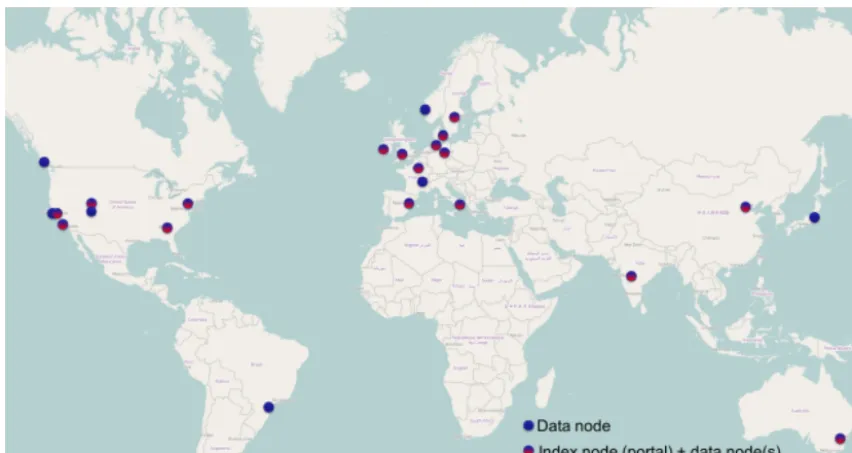
Managing and sharing this huge amount of data is an en-terprise in its own right – and the solution established for CMIP5 was the global Earth System Grid Federation (ESGF, Williams et al., 2011, 2015). ESGF was identified by the WCRP Joint Scientific Committee in 2013 as the recom-mended infrastructure for data archiving and dissemination for the programme. A map of sites participating in the ESGF is shown in Fig. 1 drawn from the IS-ENES data portal7. The sites are diverse and responsive to many national and institu-tional missions. With multiple agencies and institutions, and many uncoordinated and possibly conflicting requirements, the ESGF itself is a complex and delicate artifact to manage. The sheer size and complexity of this infrastructure emerged as a matter of great concern at the end of CMIP5, when the growth in data volume relative to CMIP3 (from 40 TB to 2 PB, a 50-fold increase in 6 years) suggested the community was on an unsustainable path. These concerns led to the 2014 recommendation of the WGCM to form an
in-4https://rawgit.com/WCRP-CMIP/CMIP6_CVs/master/src/ CMIP6_experiment_id.html (last access: 17 August 2018)
5http://clipc-services.ceda.ac.uk/dreq/index.html (last access: 17 August 2018)
6https://cera-www.dkrz.de/WDCC/ui/cerasearch/ entry?acronym=IPCC_DDC_FAR_GFDL_R15TRCT_D (last access: 17 August 2018)
Figure 1.Sites participating in the Earth System Grid Federation in May 2017. Figure courtesy of the IS-ENES data portal.
frastructure panel (based upon a proposal8at the 2013 annual meeting). The WGCM Infrastructure Panel (WIP) was tasked with examining the global computational and data infrastruc-ture underpinning CMIP, and improving communication be-tween the teams overseeing the scientific and experimental design of these globally coordinated experiments, and the teams providing resources and designing that infrastructure. The communication was intended to be two-way: providing input both to the provisioning of infrastructure appropriate to the experimental design, and informing the scientific design of the technical (and financial) limits of that infrastructure.
This paper provides a summary of the findings by the WIP in the first 3 years of activity since its formation in 2014, and the consequent recommendations – in the context of exist-ing organizational and fundexist-ing constraints. In the text below, we refer to “findings”, “requirements”, and “recommenda-tions”. Findings refer to observations about the state of af-fairs: technologies, resource constraints, and the like, based upon our analysis. Requirements are design goals that have been shared with those building the infrastructure, such as the ESGF software and security stack. Recommendations are our guidance to the community: experiment designers, modelling centres, and the users of climate data.
The intended audience for the paper is primarily the CMIP6 scientific community. In particular, we aim to show how the scientific design of CMIP6 as outlined in Eyring et al. (2016a) translates into infrastructural requirements. We hope this will be instructive to the MIP chairs and creators of multi-model experiments highlighting resource implications
8https://drive.google.com/file/d/
0B7Pi4aN9R3k3OHpIWC16Z0JBX3c/view?usp=sharing (last access: 17 August 2018)
of their experimental design, and for data providers (mod-elling centres), to explain the sometimes opaque require-ments imposed upon them as a requisite for participation. By describing how the design of this infrastructure is severely constrained by resources, we hope to provide a useful per-spective to those who find data acquisition and analysis a technical challenge. Finally, we hope this will be of inter-est to general readers of the journal from other geoscience fields, illuminating the particular character of global data in-frastructure for climate data, where the community of users far outstrip in numbers and diversity, the Earth system mod-elling community itself.
2 Principles and constraints
This section lays out some of the principles and constraints which have resulted from the evolution of infrastructure re-quirements since the first CMIP experiment – beginning with a historical context.
2.1 Historical context
In the pioneering days of CMIP, the community of partici-pants was small and well-knit, and all the issues involved in generating datasets for common analysis from different mod-elling groups were settled by mutual agreement (Ron Stouf-fer, personal communication, 2016). Analysis was performed by the same community that performed the simulations. The Program for Climate Model Diagnosis and Intercomparison (PCMDI), established at Lawrence Livermore National Lab-oratory (USA) in 1989, had championed the idea of a more systematic analysis of models, and in close cooperation with the climate modelling centres, PCMDI assumed responsibil-ity for much of the day-to-day coordination of CMIP. Un-til CMIP3, the hosting of datasets from different modelling groups could be managed at a single archiving site; PCMDI alone hosted the entire 40 TB archive.
From its earliest phases, CMIP grew in importance, and its results have provided a major pillar that supports the pe-riodic Intergovernmental Panel on Climate Change (IPCC) assessment activities. However, the explosive growth in the scope of CMIP, especially between CMIP3 and CMIP5, rep-resented a tipping point in the supporting infrastructure. Not only was it clear that no one site could manage all the data, the necessary infrastructure software and operational princi-ples could no longer be delivered and managed by PCMDI alone.
For CMIP5, PCMDI sought help from a number of part-ners under the auspices of the Global Organisation of Earth System Science Portals (GO-ESSP). Many of the GO-ESSP partners who became the foundation members and develop-ers of the Earth System Grid Federation re-targeted existing research funding to help develop ESGF. The primary her-itage derived from the original US Earth System Grid project funded by the US Department of Energy, but increasingly major contributions came from new international partners. This meant that many aspects of the ESGF system began from work which was designed in the context of different re-quirements, collaborations, and objectives. At the beginning, none of the partners had funds for operational support for the fledgling international federation, and even after the end of CMIP5 proper (circa 2014), the ongoing ESGF has been sus-tained primarily by small amounts of funding at a handful of the primary ESGF sites. Most ESGF sites have had little or no formal operational support. Many of the known limita-tions of the CMIP5 ESGF – both in terms of functionality and performance – were a direct consequence of this heritage.
With the advent of CMIP6 (in addition to some sister projects such as obs4MIPs, input4MIPs, and CREATE-IP), it was clear that a fundamental reassessment would be needed to address the evolving scientific and operational require-ments. That clarity led to the establishment of the WIP, but it has yet to lead to any formal joint funding arrangement – the ESGF and the data nodes within it remain funded (if at all, many data nodes are marginal activities supported on best efforts) by national agencies with disparate timescales and objectives. Several critical software elements also are being developed on volunteer efforts and shoestring budgets. This finding has been noted in the US National Academies Report on “A National Strategy for Advancing Climate Modeling” (NASEM, 2012), which warned of the consequences of in-adequate infrastructure funding.
2.2 Infrastructural principles
1. With greater complexity and a globally distributed data resource, it has become clear that in the design of glob-ally coordinated scientific experiments, the global com-putational and data infrastructure needs to be formally examined as an integrated element.
The membership of the WIP, drawn as it is from ex-perts in various aspects of the infrastructure, is a di-rect consequence of this requirement for integration. Representatives of modelling centres, infrastructure de-velopers, and stakeholders in the scientific design of CMIP and its output comprise the panel membership. One of the WIP’s first acts was to consider three phases in the process of infrastructure development: require-ments, implementation, and operations, all informed by the builders of workflows at the modelling centres.
– The WIP, in consort with the WCRP’s CMIP Panel, takes responsibility for articulating the require-ments for the infrastructure.
– The implementation is in the hands of the infras-tructure developers, principally ESGF for the fed-erated archive (Williams et al., 2015), but also re-lated projects like Earth System Documentation (ES-DOC9, Guilyardi et al., 2013).
– In 2016 at the WIP’s request, the “CMIP6 Data Node Operations Team” (CDNOT) was formed. It is charged with ensuring that all the infrastructure elements needed by CMIP6 are properly deployed and actually working as intended at the sites host-ing CMIP6 data. It is also responsible for the op-erational aspects of the federation itself, including specifying what versions of the toolchain are run at every site at any given time, and organizing
ordinated version and security upgrades across the federation.
Although there is now a clear separation of con-cerns into requirements, implementation, and opera-tions, close links are maintained by cross-membership between the key bodies, including the WIP itself, the CMIP Panel, the ESGF Executive Committee, and the CDNOT.
2. With the basic fact of anthropogenic climate change now well established (see, e.g. Stocker et al., 2013) the scientific communities with an interest in CMIP are ex-panding. For example, a substantial body of work has begun to emerge to examine climate impacts. In addi-tion to the specialists in Earth system science – who also design and run the experiments and produce the model output – those relying on CMIP output now in-clude those developing and providing climate services, as well as “consumers” from allied fields studying the impacts of climate change on health, agriculture, natural resources, human migration, and similar issues (Moss et al., 2010). This confronts us with a “scientific scal-ability” issue (the data during its lifetime will be con-sumed by a community much larger, both in sheer num-bers, and also in breadth of interest and perspective than the Earth system modelling community itself), which needs to be addressed.
Accordingly, we note the requirement that infrastructure should ensure maximum transparency and usability for user (consumer) communities at some distance from the modelling (producer) communities.
3. While CMIP and the IPCC are formally independent, the CMIP archive is increasingly a reference in formu-lating climate policy. Hence the scientific reproducibil-ity (Collins and Tabak, 2014) and the underlying dura-bility and provenance of data have now become matters of central importance: the ability, long after the creation of the dataset, to trace back from model output to the configuration of models and the procedures and choices made along the way. This led the IPCC to require data distribution centres (DDCs) that attempt to guarantee the archiving and dissemination of these data in perpetu-ity, and subsequently to a requirement in the CMIP con-text of achieving reproducibility. Given the use of multi-model ensembles for both consensus estimates and un-certainty bounds on climate projections, it is important to document – as precisely as possible, given the inde-pendent genealogy and structure of many models – the details and differences among model configurations and analysis methods, to deliver both the requisite prove-nance and the routes to reproduction.
4. With the expectation that CMIP DECK experiment re-sults should be routinely contributed to CMIP,
opportu-nities now exist for engaging in a more systematic and routine evaluation of Earth system models (ESMs). This has led to community efforts to develop standard met-rics of model “quality” (Eyring et al., 2016b; Gleckler et al., 2016). Typical multi-model analysis has hitherto taken the multi-model average, assigning equal weight to each model, as the most likely estimate of climate response. This “model democracy” (Knutti, 2010) has been called into question and there is now a consider-able literature exploring the potential of weighting mod-els by quality (Knutti et al., 2017). The development of standard metrics would aid this kind of research. To that end, there is now a requirement to enable (through the ESGF) a framework for accommodating quasi-operational evaluation tools that could routinely execute a series of standardized evaluation tasks. This would provide data consumers with an increasingly (over time) systematic characterization of models. It may be some time before a fully operational system of this kind can be implemented, but planning must start now.
In addition, there is an increased interest in climate an-alytics as a service (Balaji et al., 2011; Schnase et al., 2017). This follows the principle of placing analysis close to the data. Some centres plan to add resources that combine archiving and analysis capabilities, for ex-ample, NCAR’s CMIP Analysis Platform10, or the UK’s JASMIN (Lawrence et al., 2013). There are also new efforts to bring climate data storage and analysis to the cloud era (e.g Duffy et al., 2015)11. Platforms such as Pangeo12 show promise in this realm, and widespread experimentation and adoption is encouraged.
5. As the experimental design of CMIP has grown in com-plexity, costs both in time and money have become a matter of great concern, particularly for those design-ing, carrying out, and storing simulations. In order to justify commitment of resources to CMIP, mechanisms to identify costs and benefits in developing new mod-els, performing CMIP simulations, and disseminating the model output need to be developed.
To quantify the scientific impact of CMIP, measures are needed to track the use of model output and its value to consumers. In addition to usage quantification, credit and tracing data usage in literature via citation of data is important. Current practice is at best citing large data collections provided by a CMIP participant, or all of CMIP. Accordingly, we note the need for a mechanism to identify and cite data provided by each
10https://www2.cisl.ucar.edu/resources/cmip-analysis-platform (last access: 17 August 2018)
11https://github.com/ESGF/esgf-compute-api (last access: 17 August 2018)
modelling centre. Alongside the intellectual contribu-tion to model development, which can be recognized by citation, there is a material cost to centres in comput-ing and data processcomput-ing, which is both burdensome and poorly understood by those requesting, designing, and using the results from CMIP experiments, who might not be in the business of model development. The crite-ria for endorsement introduced in CMIP6 (see Table 1 in Eyring et al., 2016a) begin to grapple with this issue, but the costs still need to be measured and recorded. To begin documenting these costs for CMIP6, the “Com-putational Performance” MIP project (CPMIP) (Balaji et al., 2017) has been established, which will measure, among other things, throughput (simulated years per day) and cost (core-hours and joules per simulated year) as a function of model resolution and complexity. New tools for estimating data volumes have also been devel-oped, see Sect. 3.1 below.
6. Experimental specifications have become ever more complex, making it difficult to verify that experiment configurations conform to those specifications. Several modelling centres have encountered this problem in preparing for CMIP6, noting, for example, the chal-lenging intricacies in dealing with input forcing data (see Durack et al., 2018), output variable lists (Juckes et al., 2015), and crossover requirements between the endorsed MIPs and the DECK (Eyring et al., 2016a). Moreover, these protocols inevitably evolve over time, as errors are discovered or enhancements proposed, and centres needed to be adaptable in their workflows ac-cordingly.
Therefore, we note a requirement to encode the pro-tocols to be directly ingested by workflows, in other words, “machine-readable experiment design”. The in-tent is to avoid, as far as possible, errors in confor-mance to design requirements introduced by the need for humans to transcribe and implement the protocols, for instance, deciding what variables to save from what experiments. This is accomplished by encoding most of the specifications in standard, structured, and ma-chine readable text formats (XML and JSON) which can be directly read by the scripts running the model and post-processing, as explained further below in Sect. 3. The requirement spans all of the “controlled vocabu-laries” CMIP6_CVs13: for instance the names assigned to models, experiments, and output variables used in the CMIP protocols as well as the CMIP6 data request (Juckes et al., 2015), which must be stored in version-controlled, machine-readable formats. Precisely docu-menting the “conformance” of experiments to the
pro-13https://github.com/WCRP-CMIP/CMIP6_CVs (last access: 17 August 2018)
tocols (Lawrence et al., 2012) is an additional require-ment.
7. The transition from a unitary archive at PCMDI in CMIP3 to a globally federated archive in CMIP5 led to many changes in the way users interact with the archive, which impacts management of information about users and complicates communications with them. In particu-lar, a growing number of data users no longer registered or interacted directly with the ESGF. Rather they relied on secondary repositories, often copies of some portion of the ESGF archive created by others at a particular time (see, for instance, the IPCC CMIP5 Data Fact-sheet14for a discussion of the snapshots and their cover-age). This meant that reliance on the ESGF’s inventory of registered users for any aspect of the infrastructure – such as tracking usage, compliance with licensing re-quirements, or informing users about errata or retrac-tions – could at best ensure partial coverage of the user base.This key finding implies a more distributed design for several features outlined below, which devolve many of these features to the datasets themselves rather than the archives. One may think of this as a “dataset-centric rather than system-centric” design (in software terms, a “pull” rather than “push” design): information is made available upon request at the user/dataset level, relieving the ESGF implementation of an impossible burden. Based upon the above considerations, the WIP produced a set of position papers (see Appendix A) encapsulating specifications and recommendations for CMIP6 and beyond. These papers, summarized below, are available from the WIP website15. As the WIP continues to develop additional rec-ommendations, they too will be made available. As require-ments evolve, a modified document will be released with a new version number.
3 A structured approach to data production
The CMIP6 data framework has evolved considerably from CMIP5, and follows the principles of scientific reproducibil-ity (Item 3 in Sect. 2.2) and the recognition that the complex-ity of the experimental design (Item 6) required far greater degrees of automation within the production workflow gen-erating simulation results. As a starting point, all elements in the experiment specifications must be recorded in structured text formats (XML and JSON, for example), and any changes must be tracked through careful version control. “Machine-readable” specification of all aspects of the model output configuration is a design goal, as noted earlier.
14http://www.ipcc-data.org/docs/factsheets/TGICA_Fact_ Sheet_CMIP5_data_provided_at_the_IPCC_DDC_Ver_1_2016. pdf (last access: 17 August 2018)
The data request spans several elements discussed in sub-sections below.
3.1 CMIP6 data request
The CMIP6 data request16 specifies which variables should be archived for each experiment. It is one of the most plex elements of the CMIP6 infrastructure due to the com-plexity of the new design outlined in Eyring et al. (2016a). The experimental design now involves three tiers of exper-iments, where an individual modelling group may choose which ones to perform. The variables are also grouped by sci-entific goals and priorities, where again centres may choose which sets to publish, based on interests and resource con-straints. There are also cross-experiment data requests, where for instance the design may require a variable in one ex-periment to be compared against the same variable from a different experiment. The modelling groups will then need to take this into account before beginning their simulations. The CMIP6 data request is a codification of the entire experi-mental design into a structured set of machine-readable doc-uments, which can in principle be directly ingested in data workflows.
The CMIP6 data request16(Juckes et al., 2015) combines definitions of variables and their output format with speci-fications of the objectives they support and the experiments that they are required for. The entire request is encoded in an XML database with rigorous type constraints. Important elements of the request, such as units, cell methods (express-ing the subgrid process(express-ing implicit in the variable defini-tion), sampling frequencies, and time “slices” (subsets of the entire simulation period as defined in the experimental de-sign) for required output, are defined using controlled vocab-ularies that ensure consistency of interpretation. The request is designed to enable flexibility, allowing modelling centres to make informed decisions about the variables they should submit to the CMIP6 archive from each experiment.
In order to facilitate the cross linking between the 2100 variables from the 287 experiments, the request database allows MIPs to aggregate variables and experiments into groups. This allows MIPs to designate variable groups by pri-ority and provides for queries that return the list of variables needed from any given experiment at a specified time slice and frequency.
This formulation takes into account the complexities that arise when a particular MIP requests that variables needed for their own experiments should also be saved from a DECK experiment or from an experiment proposed by a different MIP.
The data request supports a broad range of users who are provided with a range of different access points. These include the entire codification in the form of a structured
16http://clipc-services.ceda.ac.uk/dreq/index.html (last access: 17 August 2018)
(XML) document, web pages, or spreadsheets, as well as a Python API and command-line tools, to satisfy a wide variety of usage patterns for accessing the data request information. The data request’s machine-readable database has been an extraordinary resource for the modelling centres. They can, for example, directly integrate the request specifications with their workflows to ensure that the correct set of variables are saved for each experiment they plan to run. In addition, it has given them a new-found ability to estimate the data vol-ume associated with meeting a MIP’s requirements, a feature exploited below in Sect. 3.4.
3.2 Model inputs
Datasets used by the model for the configuration of model inputs (Input Datasets for Model Intercomparison Projects) input4MIPs, see Durack et al., 2018) as well as observations for the comparison with models (Observations for Model In-tercomparison Projects) obs4MIPs, see Teixeira et al., 2014; Ferraro et al., 2015) are both now organized in the same way, and share many of the naming and metadata conventions as the CMIP model output itself. The coherence of standards across model inputs, outputs, and observational datasets is a development that will enable the community to build a rich toolset across all of these datasets. The datasets follow the versioning methodologies described in Sect. 7.
3.3 Data reference syntax
The organization of the model output follows the data ref-erence syntax (DRS)17 first used in CMIP5, and now in a somewhat modified form in CMIP6. The DRS depends on predefined controlled vocabularies CMIP6_CVs18 for vari-ous terms including the names of institutions, models, ex-periments, time frequencies, etc. The CVs are now recorded as a version-controlled set of structured text documents, and satisfies the requirement that there is a single authoritative source for any CV18, on which all elements in the toolchain will rely. The DRS elements that rely on these controlled vo-cabularies appear as netCDF attributes and are used in con-structing file names, directory names, and unique identifiers of datasets that are essential throughout the CMIP6 infras-tructure. These aspects are covered in detail in the CMIP6 Global Attributes, DRS, Filenames, Directory Structure, and CVs19 position paper. A new element in the DRS indicates whether data have been stored on a native grid or have been regridded (see discussion below in Sect. 3.4 on the
poten-17https://docs.google.com/document/d/1h0r8RZr_
f3-8egBMMh7aqLwy3snpD6_MrDz1q8n5XUk/edit?usp=sharing (last access: 17 August 2018)
18https://github.com/WCRP-CMIP/CMIP6_CVs (last access: 17 August 2018)
tially critical role of regridded output). This element of the DRS will allow us to track the usage of the regridded subset of data and assess the relative popularity of native-grid vs. standard-grid output.
3.4 CMIP6 data volumes
As noted, extrapolations based on CMIP3 and CMIP5 lead to some alarming trends in data volume (e.g. Overpeck et al., 2011). As seen in Fig. 2 in Overpeck et al. (2011), model out-put such as those from the various CMIP phases (1 through 6) are beginning to rival the observational data volume. As noted in the introduction, a particular problem for our com-munity is the diverse and very large user base for the data, many of whom are not climate specialists, but downstream users of climate data studying the impacts of climate change. This stands in contrast to other fields with comparably large data holdings: data from the Large Hadron Collider (e.g. Aad et al., 2008), for example, are primarily consumed by high-energy physicists and not of direct interest to anyone else.
A rigorous approach is needed to estimate future data vol-umes, rather than relying on simple extrapolation. Contribu-tions to the increase in data volume include the systematic increase in model resolution and complexity of the experi-mental protocol and data request. We consider these sepa-rately:
3.4.1 Resolution
The median horizontal resolution of a CMIP model tends to grow with time, and is typically expected to be 100 km in CMIP6, compared with 200 km in CMIP5. Generally the temporal resolution of the model (although not the data) is doubled as well, for reasons of numerical stability. Thus, for anN-fold increase in horizontal resolution, we require anN3
increase in computational capacity. The vertical resolution grows in a more controlled fashion, at least as far as the data are concerned, as often the requested output is reported on a standard set of atmospheric levels that has not changed much over the years. Similarly the temporal resolution of the data request does not increase at the same rate as the model time step: monthly averages remain monthly averages. Thus, the
N3 increase in computational capacity will result in anN2
increase in data volume, ceteris paribus. Thus, data volume (V) and computational capacity (C) are related asV ∼C2/3, purely from the point of view of resolution. Consequently, if centres then experience an 8-fold increase in C between CMIPs, we can expect a doubling of model resolution and an approximate quadrupling of the data volume (see discussion in the CMIP6 Output Grid Guidance document20).
20https://docs.google.com/document/d/
1kZw3KXvhRAJdBrXHhXo4f6PDl_NzrFre1UfWGHISPz4/ edit?ts=5995cbff (last access: 17 August 2018)
A similar approximate doubling of model resolution oc-curred between CMIP3 and CMIP5, but data volume in-creased 50-fold. What caused that extraordinary increase? 3.4.2 Complexity
The answer lies in the complexity of CMIP: the complexity of the data request and of the experimental protocol. The first component, the data request complexity, is related to that of the science: the number of processes being studied, and the physical variables required for the study, along with the large number of satellite MIPs (23) that now comprise the CMIP6 project. In CPMIP (Balaji et al., 2017), we have attempted a rigorous definition of this complexity, measured by the number of physical variables simulated by the model. This, we argue, grows not smoothly like resolution, but in very distinct generational step transitions, such as the one from atmosphere–ocean models to Earth system models, which, as shown in Balaji et al. (2017), involved a substantial jump in complexity with regard to the number of physical, chemi-cal, and biological species being modelled. Many models of the CMIP5 era added atmospheric chemistry and aerosol– cloud feedbacks, sometimes with O(100) species. CMIP5 also marked the first time in CMIP that ESMs were used to simulate changes in the carbon cycle.
The second component of complexity is the experimental protocol, and the number of experiments themselves when comparing successive phases of CMIP. The number of ex-periments (and years simulated) grew from 12 in CMIP3 to about 50 in CMIP5, greatly inflating the data produced. With the new structure of CMIP6, with a DECK and 23 en-dorsed MIPs, the number of experiments has grown tremen-dously (from about 50 to 287). We propose as a measure of experimental complexity, “the total number of simulated years (SYs)” called for by the experimental protocol. Note that modelling centres must make trade-offs between exper-imental complexity and resolution in deciding their level of participation in CMIP6, as discussed in Balaji et al. (2017).
Two further steps have been proposed toward ensuring sustainable growth in data volumes. The first of these is the consideration of standard horizontal resolutions for saving data, as is already done for vertical and temporal resolution in the data request. Cross-model analyses already cast all data to a common grid in order to evaluate it as an ensemble, typ-ically at fairly low resolution. The studies of Knutti and col-leagues (e.g. Knutti et al., 2017), for example, are typically performed on relatively coarse grids. Accordingly for most purposes atmospheric data on the ERA-40 grid (2◦×2.5◦)
it requires considerable expertise to choose appropriate al-gorithms for particular variables, for instance, we may need algorithms that guarantee the exact conservation for scalars, or the preservation of streamlines for vector fields may be a requirement; and it can be expensive in terms of computa-tion and storage. Secondly, regridding is irreversible (which amounts to “lossy” data reduction) and non-commutative with certain basic arithmetic operations such as multiplica-tion (i.e. the product of regridded variables does not in gen-eral equal the regridded output of the product computed on the native grid). This can be problematic for budget studies. However, the same issues would apply for time-averaging and other operations long used in the field: much analysis of CMIP output is performed on monthly averaged data, which is “lossy” compression along the time axis relative to the model’s time resolution.
These issues have contributed to a lack of consensus in moving forward, and the recommendations on regridding re-main in flux. The CMIP6 Output Grid Guidance document
21 outlines a number of possible recommendations,
includ-ing the provision of “weights” to a target grid. Many of the considerations around regridding, particularly for ocean data in CMIP6, are discussed at length in Griffies et al. (2016).
There is a similar lack of consensus around whether or not to adopt a common calendar for particular experiments. In cases such as a long-running control simulation where all years are equivalent and of no historical significance, it is customary in this community to use simplified calendars – such as a Julian, a “no-leap” (365-day), or an “equal-month” (360-day) calendar – rather than the Gregorian. However, comparison across datasets using different calendars can be a frustrating burden on the end-user. However, there is no consensus at this point to impose a particular calendar.
As outlined below in Sect. 6, both ESGF data nodes and the creators of secondary repositories are given consider-able leeway in choosing data subsets for replication, based on their own interests. The tracking mechanisms outlined in Sect. 5.2 below will allow us to ascertain, after the fact, how widely used the native grid data may be vis-à-vis the regrid-ded subset, and allow us to recalibrate the replicas, as usage data becomes available. We also note that the providers of at least one of the standard metrics packages (ESMValTool, Eyring et al., 2016a) have expressed a preference of stan-dard grid data for their analysis, as regridding from disparate grids increases the complexity of their already overburdened infrastructure.
A second method of data reduction for the purposes of storage and transmission is the issue of data compression. The netCDF4 software, which is used in writing CMIP6 data, includes an option for lossless compression or deflation (Ziv and Lempel, 1977) that relies on the same technique used in
21https://docs.google.com/document/d/
1kZw3KXvhRAJdBrXHhXo4f6PDl_NzrFre1UfWGHISPz4/ edit?ts=5995cbff (last access: 17 August 2018)
standard tools such as gzip. In practice, the reduction in data volume will depend upon the “entropy” or randomness in the data, with smoother data or fields with many missing data points (e.g. land or ocean) being compressed more.
Dealing with compressed data entails computational costs, not only during its creation, but also every time the data are reinflated. There is also a subtle interplay with precision: for instance temperatures usually seen in climate models appear to deflate better when expressed in Kelvin, rather than Cel-sius, but that is due to the fact that the leading order bits are always the same; thus, the data is actually less precise. Defla-tion is also enhanced by reorganizing (“shuffling”) the data internally into chunks that have spatial and temporal coher-ence.
Some argue for the use of more aggressive lossy compres-sion methods (Baker et al., 2016), but for CMIP6 it can be ar-gued that the resulting loss of precision and the consequences for scientific results require considerably more evaluation by the community before such methods can be accepted. How-ever, as noted above, some lossy methods of data reduction (e.g. time-averaging) have long been common practice.
To help inform the discussion about compression, we dertook a systematic study of typical model output files un-der lossless compression, the results of which are publicly available22. The study indicates that standard zlib compres-sion in the netCDF4 library with the settings ofdeflate=2
(relatively modest, and computationally inexpensive), and
shuffle(which ensures better spatiotemporal
homogene-ity) ensures the best compromise between increased compu-tational cost and reduced data volume. For an ESM, we ex-pect a total savings of about 50 %, with ocean, ice, and land realms benefiting most (owing to large areas of the globe that are masked) and atmospheric data benefiting least. This 50 % estimate has been verified with sample output from one model whose compression rates should be quite typical.
The DREQ23alluded to above in Sect. 3 allows us to mate expected data volumes. The software generates an esti-mate given the model’s resolution along with the experiments that will be performed and the data one intends to save (using DREQ’s priority attribute).
For instance, analyses available at the DREQ site24 indi-cate that if a centre were to undertake every single experi-ment (all tiers) and save every single variable requested (all priorities) at a “typical” resolution, it would generate about 800 TB of data, using the guidelines above. Given 100 par-ticipating models, this translates to an upper bound of 80 PB for the entire CMIP6 archive, although in practice most cen-tres are planning to perform a modest subset of experiments
22https://public.tableau.com/profile/balticbirch#!/vizhome/NC4/ NetCDF4Deflation (last access: 17 August 2018)
23https://earthsystemcog.org/projects/wip/CMIP6DataRequest (last access: 17 August 2018)
and save only a subset of variables, based on their scientific priorities and available computational and storage resources. The WIP carried out a survey of modelling centres in 2016, asking them for their expected model resolutions, and inten-tions of participating in various experiments. Based on that survey, we have initially forecast a compressed data volume of 18 PB for CMIP6. This number, 18 PB, is about 7 times the CMIP5 archive size. The causes for this dramatic increase in data volume between CMIP3 and CMIP5 were noted above. There is no comparable jump between CMIP5 and CMIP6. CMIP6’s innovative DECK/endorsed-MIP structure could be considered successful in that it has limited the rate of growth in data volume.
Prior to CMIP5, similar analyses were undertaken at PCMDI to estimate data volume and the predicted volume proved reasonably accurate. However, the methods used for CMIP5 could not be applied to CMIP6 because they de-pended on having a much less complex data request. In par-ticular, the cross-MIP data requests (variables requested by one MIP from another MIP, or the DECK) require a more sophisticated algorithm. The experience in many modelling centres as present is that data volume estimates become avail-able only after the production runs have begun. Reliavail-able es-timates ahead of time based on nothing more than the ex-perimental protocols and model resolutions are valuable for preparation and planning hardware acquisitions.
It should be noted that reporting output on a lower resolu-tion standard grid (rather than the native model grid) could shrink the estimated data volume 10-fold, to 1.8 PB. This is an important number, as will be seen below in Sect. 6: the managers of Tier 1 nodes (the largest nodes in the federa-tion) have indicated that 2 PB is about the practical limit for replicated storage of data from all CMIP6 models. This tar-get could be achieved by requiring compression and the use of reduced-resolution standard grids, but modelling centres are free to choose whether or not to compress and regrid.
4 Licensing
The licensing policy established for CMIP6 is based on an examination of data usage patterns in CMIP5. First, while in CMIP5 the licensing policy called for registration and ac-ceptance of the terms of use, a large fraction, perhaps a ma-jority of users, actually obtained their data not directly from ESGF, but from third-party copies, such as the “snapshots” alluded to in Item 7, Sect. 2. Those users accessing the data indirectly, as shown in Fig. 2, relied on user groups or their home institutions to make secondary repositories that could be more conveniently accessed. The WIP CMIP6 Licensing and Access Control25position paper refers to the secondary repositories as “dark” and those obtaining CMIP data from
25https://www.earthsystemcog.org/site_media/ projects/wip/CMIP6_Licensing_and_Access_Control.pdf (last access: 17 August 2018)
those repositories as “dark users” who are invisible to the ESGF system. While this appears to subvert the licensing and registration policy put in place for CMIP5, this should not be seen as a “bootleg” process: it is in fact the most efficient use of limited network bandwidth and storage at the user sites. In CMIP6 we expect similar data archive snapshots to host data and offload some of the network provisioning requirements from the ESGF nodes.
At the same time we wish to retain the ability for users of these “dark” repositories to benefit from the augmented provenance services provided by infrastructure advances, where a user can inform themselves or be notified of data retractions or replacements when contributed datasets are found to be erroneous and replaced (see Sect. 5 and 5.4).
The proposed licensing policy removes the impossible task of license enforcement from the distribution system, and em-braces the “dark” repositories and users. To quote the WIP position paper:
The proposal is that (1) a data license be embedded in the data files, making it impossible for users to avoid having a copy of the license, and (2) the onus on defending the provisions of the license be on the original modeling center . . .
Licenses will be embedded in all CMIP6 files, and all repositories, whether sanctioned or “dark”, can be data sources, as seen below in the discussion of replication (Sect. 6). In the embedded license approach, modelling cen-tres are offered two choices of Creative Commons licenses: data covered by the Creative Commons Attribution “Share-Alike” 4.0 International License26 will be freely available; for centres with more restrictive policies, the Creative Com-mons Attribution “NonCommercial-ShareAlike” 4.0 Interna-tional License27will limit use to non-commercial purposes. Further sharing of the data is allowed, as the license travels with the data. The PCMDI website provides a link to the cur-rent CMIP6 Terms of Use webpage28.
5 Citation, provenance, quality assurance, and documentation
As noted in Sect. 2, citation requirements flow from two un-derlying considerations: one, to provide proper credit and formal acknowledgment of the authors of datasets; and the other, to enable rigorous tracking of data provenance and data usage. The tracking facilitates scientific reproducibility and traceability, as well as enabling statistical analyses of dataset utility.
26http://creativecommons.org/licenses/by-sa/4.0/ (last access: 17 August 2018)
27http://creativecommons.org/licenses/by-nc-sa/4.0/ (last access: 17 August 2018)
Figure 2.Typical data access pattern in CMIP5 involved users making local copies, and user groups making institutional-scale caches from ESGF. Figure courtesy of Stephan Kindermann, DKRZ, adapted from WIP Licensing White Paper.
In addition to clearly identifying what data have been used in research studies and who deserves credit for providing that data, it is essential that the data be examined for qual-ity and that documentation be made available describing the model and experiment conditions under which it was gener-ated. These subjects are addressed in the four position papers summarized in this section.
The principles outlined above are well-aligned with the Joint Declaration of Data Citation Principles29formulated by the Force11 (The Future of Research Communications and e-Scholarship) consortium, which has acknowledged the rapid evolution of digital scholarship and archiving, as well as the need to update the rules of scholarly publication for the dig-ital age. We are convinced that not only peer-reviewed pub-lications but also the data itself should now be considered a first-class product of the research enterprise. This means that data requires curation and should be treated with the same care as journal articles. Moreover, most journals and academies now insist that data used in the literature be made publicly available for independent inquiry and reproduction of results. New services like Scholix30 are evolving to sup-port the exchange and access of such data–data and data– literature interlinking.
Given the complexity of the CMIP6 data request, we ex-pect a total dataset count of O(106). Because dozens of datasets are typically used in a single scientific study, it is impractical to cite each dataset individually in the same way as individual research publications are acknowledged. Based on this consideration, there needs to be a mechanism to cite data and give credit to data providers that relies on a rather coarse granularity, while at the same time offering another option at a much finer granularity for recording the specific files and datasets used in a study.
In the following, two distinct types of persistent identifiers (PIDs) are discussed: DOIs, which can only be assigned to data that comply with certain standards for citation metadata
29https://www.force11.org/group/
joint-declaration-data-citation-principles-final (last access: 17 August 2018)
30http://www.scholix.org (last access: 17 August 2018)
and curation, and the more generic “Handles”31 that have fewer constraints and may be more easily adapted for a par-ticular use. The “Handle System”, as explained in Sect. 5.2 allows unique PIDs to be assigned to datasets at the point of publication. Technically both types of PIDs rely on the un-derlying Global Handle Registry to provide services (e.g. to resolve the PIDs and provide associated metadata, such as the location of the data itself).
5.1 Persistent identifiers for acknowledgment and citation
Based on earlier phases of CMIP, some datasets contributed to the CMIP6 archive will be flawed (due, for example, to errors in processing); therefore, they will not accurately rep-resent a model’s behaviour. When errors are uncovered in the datasets, they may be replaced with corrected versions. Sim-ilarly, additional datasets may be added to an initially incom-plete collection of datasets. Thus, initially at least, the DOIs assigned for the purposes of citation and acknowledgement will represent an evolving underlying collection of datasets.
The recommendations, detailed in the CMIP6 Data Cita-tion and Long Term Archival32position paper, recognize two phases to the process of assigning DOI’s to collections of datasets: an initial phase, when the data have been released and preliminary community analysis is underway and a sec-ond stage when most errors in the data have been identi-fied and corrected. Upon reaching stage two, the data will be transferred to the long-term archive (LTA) of the IPCC Data Distribution Centre (IPCC DDC) and deemed appropriate for interdisciplinary use (e.g. in policy studies).
For evolving dataset aggregations, the data citation in-frastructure relies on information collected from the data providers and uses the DataCite33 data infrastructure to
as-sign DOIs and record associated metadata. DataCite is a leading global non-profit organization that provides
persis-31https://www.dona.net/handle-system (last access: 17 August 2018)
32https://www.earthsystemcog.org/site_media/projects/wip/ CMIP6_Data_Citation_LTA.pdf (last access: 17 August 2018)
tent identifiers (DOIs) for research data. The DOIs will be assigned to the following:
1. aggregations that include all the datasets contributed by one model from one institution from all of a single MIP’s experiments, and
2. smaller-size aggregations that include all datasets con-tributed by one model from one institution generated in performing one experiment (which might include one or more simulations).
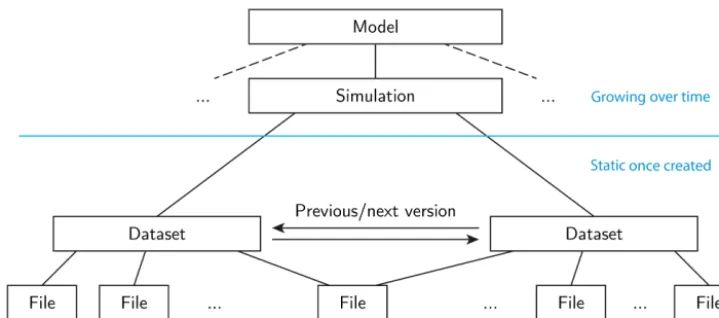
These aggregations are dynamic as far as the PID infras-tructure is concerned: new elements can be added to the ag-gregation without modifying the PID. As an example, for the coarser of the two aggregations defined above, the same PID will apply to an evolving number of simulations as new ex-periments are performed with the model. This PID architec-ture is shown in Fig. 3. Since these collections are dynamic, citation requires authors to provide a version reference.
As an initial dataset matures and becomes stable, it is as-signed a new DOI. Before this is done, to meet formal re-quirements, the data citation infrastructure requires some ad-ditional steps. First, we ensure that there has been sufficient community examination of the data (through citations in pub-lished literature, for instance) to qualify it as having been peer-reviewed. Second, further steps are undertaken to assure important information exists in ancillary metadata reposito-ries, including, for example, documentation (ES-DOC, errata and citation) and to provide quality assurance of data and metadata consistency and completeness (see Sect. 5.3). Once these criteria have been satisfied, a DOI will be issued by the IPCC DDC hosted by DKRZ. These dataset collections will meet the stringent metadata and documentation require-ments of the IPCC DDC. Since these collections are static, no version reference is required in a citation. Should errors be subsequently found, they will be corrected in the data and published under a new DOI. The original DOI and its related data are still available but are labelled as superseded with a link recorded pointing to the corrected data.
For CMIP6, the initially assigned DOIs (associated with evolving collections of data) must be used in research papers to properly give credit to each of the modelling groups pro-viding the data. Once a stable collection of datasets has met the higher standards for long-term curation and quality, the DOI assigned by the IPCC DDC should be used instead. The data citation approach is described in greater detail in Stock-hause and Lautenschlager (2017).
5.2 Persistent identifiers for tracking, provenance, and curation
Although the DOIs assigned to relatively large aggregations of datasets are well suited for citation and acknowledgment purposes, they are not issued at fine enough granularity to meet the scientific imperative that published results should
be traceable and verifiable. Furthermore, management of the CMIP6 archive requires that PIDs be assigned at a much finer granularity than the DOIs. For these purposes, PIDs recognized by the Global Handle Registry will be assigned at two different levels of granularity: one per file and one per dataset.
A unique Handle will be generated each time a new CMIP6 data file is created, and the Handle will be recorded in the file’s metadata (in the form of a netCDF global attribute namedtracking_id). At the time the data is published,
thetracking_idwill be processed by the CMIP6
Han-dle service infrastructure and recorded in the ESGF meta-data catalog. Another Handle will subsequently be assigned at a somewhat coarser granularity to each aggregation of files containing the data from a single variable sampled at a single frequency from a single model running a single experiment. In ESGF terminology, this collection of files is referred to as an “atomic dataset”.
As described in the CMIP6 Persistent Identifiers Imple-mentation Plan34position paper, a Handle assigned at either of these two levels of the PID hierarchy identifies a static entity; if any file associated with a Handle is altered in any way a new Handle must be created. The PID infrastructure is also central to the replication and versioning strategies, as described in Sects. 6 and 7 below. Furthermore, as a means of recording provenance and enabling tracking of dataset us-age, authors are urged to include a PID list (a flat list of all PIDs referenced) attached to each CMIP6-based publication as supplementary material.
The implementation plan describes methods for generat-ing and registergenerat-ing Handles usgenerat-ing an asynchronous messag-ing system known as RabbitMQ. This system, designed in collaboration with ESGF developers and shown in Fig. 4, guarantees, for example, that PIDs are correctly generated in accordance with the versioning guidelines. The CMIP6 Han-dle system builds on the idea of tracking-ids used in CMIP5, but with a more rigorous quality control to ensure that new PIDs are generated when data are modified. The dataset and file Handles are also associated with basic metadata, called PID kernel information (Zhou et al., 2018), which facilitate the recording of basic provenance information. Datasets and files point to each other to bind the granularities together. In addition, dataset kernel information refers to previous and later versions, errata information, and replicas, as explained in more detail in the position paper.
5.3 Quality assurance
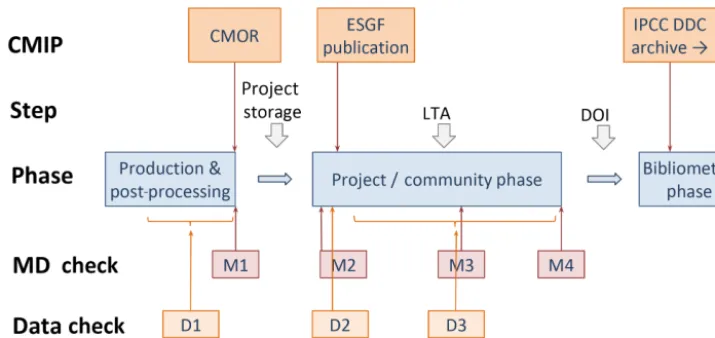
Quality assurance (QA) encompasses the entire data life cy-cle, as depicted in Fig. 5. At all stages, a goal is to cap-ture provenance information that will enable scientific repro-ducibility. Further, as noted in Item 2 in Sect. 2.2, the QA
Figure 3.Schematic PID architecture, showing layers in the PID hierarchy. In the lower layers of the hierarchy, PIDs are static once generated, and new datasets generate new versions with new PIDs. Each file carries a PID and each collection (dataset, simulation, and so on) is related to a PID. Resolving the PID in the Handle server guides the user to the file or the landing page describing the collection. Each box in the figure will be uniquely addressed by its PID.
Figure 4.PID workflow, showing the generation and registry of PIDs, with checkpoints where compliance is assured.
procedures should uncover issues that might undermine trust in the data by those outside the Earth system modelling com-munity if errors were left unreported.
QA must ensure that the data and metadata correctly re-flect a model’s simulation, so that it can be reliably used for scientific purposes. As depicted in Fig. 5, the first stage of QA is the responsibility of the data producer: in fact the cy-cle of model development and diagnosis is the most criti-cal element of QA. The second aspect is ensuring that dis-seminated data include common metadata based on com-mon CVs, which will enable consistent treatment of data from different groups and institutions. These requirements are directly embedded in the ESGF publishing process and in tools such as CMOR35(and its validation component, Pre-PARE36). These checks (the D1 and M1 phases of QA in
35https://cmor.llnl.gov/ (last access: 17 August 2018) 36https://cmor.llnl.gov/mydoc_cmip6_validator/ (last access: 17 August 2018)
Fig. 5) ensure that the data conform to the CMIP6 data re-quest specifications, conform to all naming conventions and CVs, and follow the mandated structure for organization into a common directory structure. As noted in Sect. 3, many modelling centres have chosen to embed these steps directly in their workflows to ensure conformance with the CMIP6 requirements as the models are being run and their output processed.
At this point, as noted in Fig. 5, control is ceded to the ESGF system, where designated QA nodes (ESGF data nodes where additional services are turned on) perform fur-ther QA checks to certify data is suitable for citation and long-term archiving. A critical step is the assignment of PIDs (Sect. 5.2, the D2 stage of Fig. 4), which is more controlled than in CMIP5 and guarantees that across the data life cycle, the PIDs will be reliably useful as unique labels of datasets.
Figure 5.Schematic of the phases of quality assurance, displaying earlier stages in the hands of modelling centres (left), and more formal long-term data curation stages (right). Quality assurance is applied both to the data (D, above) as well as the metadata (M) describing the data. Figure drawn from the WIP’s Quality Assurance position paper.
CMIP6 Quality Assurance37 position paper. As previously described, once data have been published, the data will be scrutinized by researchers in what can be considered an on-going period of community-wide scientific QA of the data. During this period, modelling centres may correct errors and provide new versions of datasets. In the final stage, the data pass into the long term archive (LTA) status, described as the “bibliometric” phase in Fig. 5. Just prior to LTA, the system will verify the minimum standards of provenance documen-tation. This is described in the next section.
5.4 Documentation of provenance
As noted earlier in Sect. 3, for data to become a first-class scientific resource, the methods of their production must be documented to the fullest extent possible. For CMIP6, this includes documenting both the models and the experiments. While traditionally this is done through peer-reviewed liter-ature, which remains essential, we note that to facilitate var-ious aspects of search, discovery, and tracking of datasets, there is an additional need for structured documentation in machine readable form.
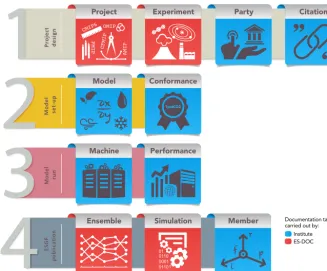
In CMIP6, the documentation of experiments, models, and simulations is done through the Earth System Documentation (ES-DOC38, Guilyardi et al., 2013) project. The various as-pects of model documentation are shown in Fig. 6, and in greater detail in the WIP position paper on ES-DOC39. The CMIP6 experimental design has been translated into
struc-37https://www.earthsystemcog.org/site_media/projects/wip/ CMIP6_Quality_Assurance.pdf (last access: 17 August 2018)
38https://www.earthsystemcog.org/projects/es-doc-models/ (last access: 17 August 2018)
39https://www.earthsystemcog.org/site_media/projects/wip/ CMIP6_ESDOC_documentation.pdf (last access: 17 August 2018)
tured text documents, already available from DOC. ES-DOC has constructed CVs for the description of the CMIP6 standard model realms (CMIP terminology for climate sub-systems, such as “ocean” or “atmosphere”), including a set of short tables (specializations, in ES-DOC terminology) for each realm. The specializations are a succinct and structured description of the model physics. Ideally, modelling groups would integrate their provision of documentation to ES-DOC with their model development process. This would better ensure the accuracy and consistency of the documentation. ES-DOC provides a variety of user interfaces to read and write structured documentation that conforms with the Com-mon Information Model (CIM) of Lawrence et al. (2012). As models evolve or differentiate (for example, an Earth system model derived from a particular physics-only general circula-tion model), branches and new versions of the documentacircula-tion can be produced, and it will be possible to display, annotate, and add new entries in the genealogy of a model in a manner familiar to anyone who works with version control software like git.
fu-4
ESGFpublication
3
Model run2
Model set-up1
Project designConformance
1pctCO2
Model
ñ\ ñ]
Experiment Party Citation
Project OMIP CMIP6
PMIP
CFMIP
AMIP
Machine Performance
Member
V
M T J
Ensemble Simulation
IPSL/CNRS - 28/01/2018 by G. Levavasseur
Documentation task carried out by:
Institute ES-DOC
Figure 6.Elements of ES-DOC documentation. Rows indicate phases of the modelling process being documented, and box colours indicate the parties responsible for producing the documentation (see legend). Figure courtesy of Guillaume Levavasseur, IPSL.
ture CMIP phases (shown schematically in Fig. 1 of Eyring et al., 2016a). The conformances will be essential in enabling studies across model generations.
The method of capturing the conformance documenta-tion is a two-stage process that has been designed to min-imize the amount of work required by a modelling centre. The first stage is to capture the many conformances com-mon to all simulations. ES-DOC will then automatically copy these common conformances to multiple simulations, thereby eliminating duplicated effort. This is followed by a second stage in which those conformances that are specific to individual experiments or simulations are collected.
While this method of documentation is unfamiliar to many, such methods are likely to become common and required practice in the maturing digital age as part of best scien-tific practices. Documentation of software validation (see e.g. Peng, 2011) and structured documentation of complete sci-entific workflows that can be independently read and pro-cessed are both becoming more common (see the special is-sue on the “Geoscience Paper of the Future”, David et al., 2016). We previously noted (see Item 3 in Sect. 2.2) the spe-cial importance of documenting how results have been ob-tained and enabling results to be reproduced by others in modern-day climate research. Rigorous documentation re-mains a hardy bulwark against challenges to the scientific process.
In keeping with the “dataset-centric rather than system-centric” approach (Item 7 in Sect. 2.2), a user will be directly linked to documentation from each dataset. This is done in CMIP6 by adding a required global attribute
further_info_urlin file headers pointing to the
associ-ated CIM document, which will serve as the landing page for documentation from which further exploration (by humans or software) will take place. The form of this URL is stan-dard and can be software-generated: CMOR, for instance, will automatically add it. The existence and functioning of the landing page is assured in Stage M3 of Fig. 5.
6 Replication
The replication strategy is covered in the CMIP6 Replica-tion and Versioning40position paper. The recommendations therein are based on the following primary goal:
– ensuring at least one copy of a dataset is present at a stable ESGF node with a mission of long-term mainte-nance and curation of data. The total data storage re-sources planned across the Tier 1 nodes in the CMIP6 era is adequate to support this requirement, although
some data will likely be held on accessible tape storage rather than spinning disk.
In addition, we have articulated a number of secondary goals:
– enhancing data accessibility across the ESGF (e.g. Aus-tralian data easily accessible to the European continent despite the long distance);
– enabling each Tier 1 data node to enact specific policies to support their local objectives;
– ensuring that the most widely requested data is acces-sible from multiple ESGF data nodes (of course, any dataset will be available at least on its original publica-tion data node);
– enabling large-scale data analysis across the federation (see Item 4 in Sect. 2);
– ensuring continuity of data access in the event of indi-vidual node failures;
– enabling network load-balancing and enhanced perfor-mance;
– reducing the manual workload related to replication; – and building a reliable replication mechanism that can
be used not only within the federation, but by the sec-ondary repositories created by user groups (see discus-sion in Sect. 4 around Fig. 2).
In conjunction with the ESGF and the International Cli-mate Networking Working Group (ICNWG), these recom-mendations have been translated to two options for replica-tion.
The basic toolchain for replication is built on updated ver-sions of the software layers used in CMIP5 including the following: synda41 (formerly synchrodata) and Globus On-line (Chard et al., 2015), which are based on underlying data transport mechanisms such as gridftp42 and the older and now deprecated protocols like wget and ftp.
As one option, these layers can be used for ad hoc repli-cation by sites or user groups. For ad hoc replirepli-cation, there is no obvious mechanism for triggering updates or replica-tion when new or corrected data are published (or retracted, see Sect. 7 below). As a second option, certain designated nodes (replica nodes) will maintain a protocol for automatic replication, shown in Fig. 7.
Given the nature of some of the secondary goals listed above, it would not be appropriate to prescribe which data should be replicated by each centre. Rather, the plan should
41https://github.com/Prodiguer/synda (last access: 17 August 2018)
42http://toolkit.globus.org/toolkit/docs/latest-stable/gridftp/ (last access: 17 August 2018)
be flexible to accommodate changing data use profiles and resource availability. A replication team under the guidance of the CDNOT will coordinate the replication activities of the CMIP6 data nodes such that the primary goal is achieved and an effective compromise for the secondary goals is es-tablished.
The International Climate Network Working Group (IC-NWG), formed under the Earth System Grid Federation (ESGF), helps set up and optimize network infrastructures for ESGF climate data sites located around the world. For ex-ample, prioritizing the most widely requested data for repli-cation can best be done based on operational experience and will of course change over time. To ensure that the replition strategy is responding to user need and data node ca-pabilities, the replication team will maintain and run a set of monitoring and notification tools assuring that replicas are up to date. The CDNOT is tasked with ensuring the deployment and smooth functioning of replica nodes.
A key issue that emerged from discussions with node man-agers is that the replication target has to be of sustainable size. A key finding is that a replication target about 2 PB in size is the practical (technical and financial) limit for CMIP6 online (disk) storage at any single location. Replication be-yond this may involve offline storage (tape) for disaster re-covery.
Based on experience in CMIP5, it is expected that a num-ber of “special interest” secondary repositories will hold se-lected subsets of CMIP6 data outside of the ESGF federa-tion. This will have the effect of widening data accessibility geographically, and by user communities, with obvious ben-efit to the CMIP6 project. These secondary repositories will be encouraged and supported where it does not undermine CMIP6 data management and integrity objectives.
In the new dataset-centric approach, licenses and PIDs re-main embedded and will continue to play their roles in the data toolchain even for these secondary repositories.
In CMIP5 a significant issue for users of some third-party archives was that their replicated data was taken as a one-time snapshot (see discussion above in Item 7 in Sect. 2), and not updated as new versions of the data were submitted to the source ESGF node. Tools have been developed by a number of organizations to maintain locally synchronized archives of CMIP5 data and third-party providers should be encouraged to make use of these types of tools to keep the local archives up to date.
In summary, the requirements for replication are limited to ensuring
– that within a reasonably short time period following submission, there is at least one instance of each sub-mitted dataset stored at a Tier 1 node (in addition to its primary residence);