279 | P a g e
PROMOTING DISTRIBUTED POLICY
ENFORCEMENT AND ACCOUNTABILITY FOR DATA
SHARING IN THE CLOUD
Ms. Priyanka S. Shinkar, Prof. Dipa D. Dharmadhikari
Department of Computer Science and Engineering
Marathwada Institute of Technology
Aurangabad, India
[email protected],[email protected]
Abstract: Cloud Computing is a distributed computing mechanism that focuses on providing a large number of users with visualized hardware and software infrastructure over the internet. In the most legal and commercial transactions, the organization holds the individual accountable transaction is very important to access the data. For this role, we require Accountability concept in the cloud environment. This will check for every action of a user is executed in his account and it will also store the information of that user. Accountability concept is important for safety and security purpose. The main feature is that users' data usually processed on the unknown machine accessing remotely do not own or operate on the unknown machine using cloud services. Cloud computing is highly scalable services to easily processed over the internet on an as useful basis.To address this problem, this is a highly decentralized information accountability framework to maintain track of the actual use of the user data.An object centeredapproach that enables enclosing of our logging mechanism with users' data and policies. Now, we control the JAR programmable capabilities to create a dynamic or travelling object and to make sure that any access to user data will trigger automated and authentication logging local to the JARs. To maximize users control, we provide distributed auditing mechanism for protection.
Keywords: Cloud Computing, Logging mechanism, CIA framework, Cloud Service Provider (CSP), Java Archives (JAR).
1. INTRODUCTION
Cloud Computing is an emerging paradigm in the computer industry that puts entire
computing infrastructure hardware and software applications online. It uses the internet and
remote, central servers to maintain users' information, data and applications. Cloud
computing technology is flexible, highly scalable and provide us technology enables services Journal homepage: www.mjret.in
280 | P a g e that can be easily used over the many Internet applications on as needed basis. Cloud
computing presents a new direction to the current use of goods and services and delivery
model for the cloud IT services based on the Internet through providing for dynamically
scalable and repeatedly virtualized resources as a service over the Internet/Intranet.
Now a day, there are a number of important individual and commercial cloud computing
services like Amazon, Google, Microsoft, Yahoo, and Salesforce [7]. Any user may not know
the machines where it is actually processed and host their data. While using the technology,
user also starts to bother about losing control of his own data [1] [8]. The data running on
clouds are often utilized by a number of issues associated with accountability, including the
checking of personally identifiable information. Accountability [3] is the obligation to act as a
responsible steward of the user personal information to take responsibility for the protection
and appropriate use of that information beyond legal requirements, and to be accountable for
any exploitation of that personal information.
The cloud provides three service models are Platform as a service (Paas), Infrastructure as a
service (Iaas) and Software as a service (Saas). The four sections of the Database as a
service is as follows:
1.1 Encryption and Decryption - The best solution for security is the encryption
technique which will store data safely in the cloud.
1.2 Key Management - If encryption technique is important for data storing in the
cloud, the encryption keys can’t be stored, so user requires key management.
1.3 Authentication - For accessing stored data in the cloud by authorized users.
1.4 Authorization – Rights given to the user as well as cloud providers.
To solve the security issues in cloud; the user can’t read or write the respective users' data
without having his access rights. Data owner does not worry about his data, and should not
get hesitate about the harm to his data by hacker; there is a need of security mechanism
which will trace where the data is used in the cloud. Accountability is important for monitoring
data usage, in this case all actions of users such as sending or receiving of files are
cryptographically connected to the server, it will perform them and server uses secured
record of all the actions of previous and server can use the earlier records to know the
correctness of the action.
It also provides reliable information about the use of data and it checks all the records, so it
will help to make relationship and reputation. So accountability is used for verification of
authentication and authorization in this paper [9]. It is very important tool to check the
authorization policies in the cloud.
2.
LITERATURE
SURVEY
281 | P a g e Accountability specifies authorization requirement for data usage policies in the cloud to show
the services. Accountability mechanisms which display after the fact verification is very
attractive to enforce authorization rules/policies [10].
There are seven phases of accountability in the cloud as follows:
a. Policy setting with data
b. Use of data by users
c. Logging
d. Merge logs
e. Error correcting in the log
f. Auditing
g. Rectify and improvement. These phases may change according to the
framework.
First step is the data owner will set the rules/policies with data and send it to CSP (Cloud
Service Provider), data will be accessed by users only and logs of each record will be
created at that time, after that log will be clubbed together and error correction in the log file
has been done and in auditing logs are checked and in last phase improvement has been
done [11]. All steps are important to perform the next step, accountability is nothing but
validation of user actions means user having rights for accessing that data or not. Suppose
the user is doing misuse of any data or resources, then network or data owner will take
action on it. So, users should not worry about his data for sharing in the cloud.
2.2 Security and Privacy issues in cloud
Cloud computing is a technique which is used for data sharing in the cloud. Basically, this
concept is based on security and privacy issues. So, users’ data and applications are stored
in the cloud. The user purchases that data for a certain amount of time, which is owned and
maintained by a third party. Accountability mechanisms are based on privacy concerns with
end users and then develop a privacy manager. Privacy manager provides only limited
features to the user with limited rights and does not guarantee about protection to once data
are being disclosed.
There are seven cloud computing security threats as follows:
a. Abuse and Nefarious Use of Cloud computing
b. Insecure Application Programming Interfaces
c. Malicious Insiders
d. Shared Technology Vulnerabilities
e. Data Loss/Leakage
282 | P a g e g. Unknown Risk Profile
2.3 Identity based Encryption (IBE)
A fully functional identity based encryption scheme (IBE) has selected for cipher text security
in the random mysql model. This system is based on bilinear maps between a group. The
Weil pairing on elliptic curves is an example of a map. This will bind the content with the
rules and provide encrypted content and log the files, using a security against chosen
cipertext and plaintext attacks. This will simply provide security to our data in the cloud
environment [6].
2.4 Self Depending Objects (SDO)
Self-defending objects [12] are newer version of the object-oriented programming standard.
In which, Software objects offers useful functions or hold useful data are responsible for
caring those data. Similarly, we also expand the concepts of object-oriented programming in
SDO. The main purpose of our implementations is that the user still uses centralized
database to maintain the access records, while the items being protected or held as
separate files. In previous papers, the author provided a Java-based approach to prevent
privacy [4] leakage from indexing, which could be integrated with the Cloud Information
Accountability (CIA) framework.
2.5 Proof Carrying Authentication (PCA)
The terms of authentication techniques, Appel and Felten [2] proposed the Proof-Carrying
authentication (PCA) structure. The PCA contains a high order logic language that allows
quantification over predicates, and it will focus on access control for web services. The
PCA’s goal is highly focused on validating code, not monitoring content.
3. PROBLEM STATEMENT
Now a day, Security is very important for user data. In a cloud environment, a user can
secure his data by using setting some policy to the user. Accountability is generally referred
by Log. In the existing system, there was problem that more time was required when it
generates the Log. Generally, this Log file created with every data suppose if the Cloud
subscriber retrieves any data from a cloud service provider then Log file attached to that
data. Generally user only required data there will be no need of Log information. If the size of
data is large according to the need of user then abruptly the large log file is also attached so
for copying that log file more time is required. For merging the log files if the log file size is
small then merging time is small but if the size of log file increases then tremendously it
affect on merging time.
Generally performance is the ratio of expected output and total load of the system. If load or
283 | P a g e Database the JAR file or Log File attached to that data so it will be more hectic processed
when log file is large this problem is overcome by our System due to which application is
used as filter So there will be no problem because most of the restrictions are provided by
the application.
4.
PROPOSED
WORK
To propose a different method, namely Cloud Information Accountability (CIA) framework. It
will be based on the concept of information accountability. The basic idea is that simply Data
Owner can upload the data into the cloud server after that data will be encrypted. So, User
can subscribe the data into the cloud server with certain access rules and policies such as
read, write and copy of the original information. With the help of Loggers and Log
Harmonizer will have to track the access logs and reports of the data owner. This Process
guarantees the security.
4.1 Cloud Information Accountability (CIA) Framework
Cloud Information Accountability (CIA) framework is nothing but the maintaining lightweight
and powerful accountability concept that combines aspect if access control, usage control
and authentication. This means that, data owners can track not only whether or not the
service-level agreements are being privileged, but also enforce access and usage control
rules as needed.
4.1.1 Major Components of CIA
There are two main components of the CIA, the first is the logger, and the second is
the log harmonizer. The logger is nothing but the component which is strongly
coupled with the user’s data. So, It is downloaded when the data are retrieved, and
the data are copied in the any system. It checks for a particular instance or copy of
the user’s data or is responsible for logging access to that instance or copy. The log
harmonizer creates the central component which permits the user access to the
generated log files.
4.1.2 Data Flow
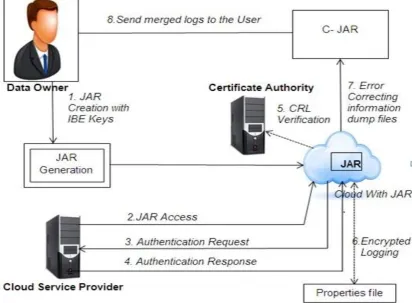
The overall CIA framework is combining data, users, logger and harmonizer in Fig. 1.
At the starting, each user creates a pair of private and public keys based on
Identity-Based Encryption (step 1 in Fig. 1). Using the produced key, user will create a logger
component which is a Java Archives (JAR) file, to store its data items. The JAR file
contains a combination of simple access control rules/policies specifying whether and
284 | P a g e authorized to access the content itself and then, he sends the JAR file to the cloud
service provider that he will subscribe it.
To check the authentication of the Cloud Service Provider to the JAR (steps 3-5 in
Fig. 1), we use OpenSSL- based certificates. Verifying the user’s identity based on
his username. Once the authentication succeeds, the user (Service Provider) will be
permitted to access the data enclosed in the JAR. To check the configuration setting
defined at the time of creation, depending on the JAR file, it will generate usage
control related with logging mechanism, or it will display only logging functionality. As
per the logging, each user having access to their data at any time. The JAR file will
automatically create a log record and encrypt using public key distributed by the data
owner.
Any one user can not change the encrypted file without having authority or
permission. The data owner could not reuse the same pair of key for all JAR files
and create different key pairs for separate JARs files. The separate keys can
increase the security without introducing any overhead except in the starting phase.
A few error correction information will be sent to the log harmonizer to handle
285 | P a g e 4.2 Distributed Auditing Mechanism
Distributed auditing mechanism, including the algorithms for data owners to query the logs
regarding their data.
4.2.1 Push mode
In this mode, the logs are periodically pushed to the audit (or data owner) by the
harmonizer. The push action can be triggered by using two events:
a. Time elapse for a certain period, according to the time inserted as a part of the
JAR file.
b. JAR file exceeds the specified size by the data owner at the time of creation.
4.2.2 Pull mode
In this mode, the auditors allow to retrieve the logs anytime when he wants to check
the updated access to their own data. The request will be sent to the harmonizer.
Then, the user will be informed of the data locations and obtain an integrated copy of
the sealed and authentic and log file.
4.2.3 Push and Pull mode Algorithm
Require:
Size: log file maximum size is specified by the data owner,
time: maximum time allowed to pass before the log file is dumped,
tbeg: timestamp at which the last dump occurred, log: the current log file,
pull: indicates whether a command from the data owner is received.
Algorithm:
1. Let TS (NTP) // the network time protocol timestamp
2. pull : = 0
3. rec : = <UID,OID,AccessType,Result,Time,loc>
4. curtime : =TS(NTP)
5. lsize : = sizeof(log)
6. if((cutime-tbeg)<time)&&(lsize<size)&&(pull==0) then
7. log:=log+ENCRYPT(rec)
8. PING to CJAR
9. if PING - CJAR then
10. PUSH RS(rec)
11. else
12. EXIT(1)
286 | P a g e 14 end if
15 if ((cutime – tbeg) > time) || (lsize>= size)||(pull≠0) then
16 if PING - CJAR then
17 PUSH log
20. RS(log) := NULL
21. tbeg := TS(NTP)
22. pull := 0
23. else
24. EXIT (1) end if
25. end if
Fig. 2 Push and pull PureLog mode
The log retrieval algorithm is shown in Fig.2 for the Push and Pull modes. This algorithm
presents synchronization and logging steps with the log harmonizer in case of PureLog
mode. Firstly, the algorithm checks whether the size of the JAR file is exceeding a
predefined size or the normal time between two alternate dumps has elapsed. The size and
time threshold for a dump are specified by the data owner at the time of creation of the JAR.
This algorithm also checks whether the data owner has requested for a dump log file. If no
one of these events have occurred, it proceeds to encrypt the record and write the
error-correction information to the harmonizer.
5. SECURITY ATTACKS
Now, we analyze possible attacks to our framework. Analysis is based on assuming that a
user does not lose his master keys to unauthorized parties, while the attacker may try to
learn extra information from the log files. Suppose that the attackers may have enough Java
programming skills to disassemble a JAR file and prior knowledge of CIA architecture.
Firstly, we have to check the JVM file is not corrupted.
5.1 Copying Attack
The most powerful attack is that the attacker/ hacker copies hole/entire JAR files. The
attacker may sure that, how accessing that data in the JAR file without access rights given
by the data owner. This type attack will be very harmful to secure file. However, this attack
will be checked by the auditing mechanism. Every JAR file is required to send log record to
the log harmonizer.
5.2 Disassembling Attack
The second possible attack is to disassemble the JAR file of the logger and then attempt to
287 | P a g e
6. CONCLUSION
In this paper, We proposed original approaches for automatically logging access to the data
in the cloud composed with an auditing mechanism. Our approach allows the data owner do
not only edit his content, but also apply strong back-end protection if recommended. The
main feature is that it enables the data owner to edit his content with those copies of that
data were made without his knowledge.
ACKNOWLEGEMENT
The authors express gratitude to Principal, Head of Department (CSE) Dr. Radhakrishna
Naik. Marathwada Institute of Technology, College of Engineering, Aurangabad, and
Maharashtra India. They also express their sincere thanks all the faculty members of the
CSE Department, MIT College of Engineering, Aurangabad, and Maharashtra, India for their
constant support and enthusiasm.
REFERENCES
[1] SmithaSundareswaran, Anna C. Squicciarini and Dan Lin, "Ensuring Distributed Accountability for Data sharing in the Cloud,",IEEE Transaction on dependable a secure computing, VOL. 9, NO. 4, pp 556- 568,August 2012.s
[2] X. Feng, Z. Ni, Z. Shao, and Y. Guo, “An Open Framework for Foundational Proof-Carrying Code,” Proc. ACM SIGPLAN Int’l Workshop Types in Languages Design and Implementation,pp. 67-78, 2007
[3] S. Pearson, “Towards Accountability in the Cloud ,” Proc. IEEE Internet Computing, pp. 64-69, 2011
[4] S..Pearson,Y. Shen, and M. Mowbray," A privacy Manager for Cloud Computing," Proc. Int'l Conf. Cloud Computing (cloudcom), pp.90-106, 2009.
[5] R. Corin, S. Etalle, J.I. den Hartog, G. Lenzini, and I. Staicu, “A Logic for Auditing Accountability in Decentralized Systems,” Proc. IFIP TC1 WG1.7 Workshop Formal Aspects in Security and Trust, pp. 187-201, 2005.
[6] D. Boneh and M.K. Franklin, “Identity-Based Encryption from the Weil Pairing,” Proc. Int‟l Cryptology Conf. [7] P.T. Jaeger, J. Lin, and J.M. Grimes, “Cloud Computing and Information Policy: Computing in a Policy
Cloud?,”J. Information Technology and Politics,vol. 5, no. 3, pp. 269-383, 2009.
[8] S. Sundareswaran, A. Squicciarini, D. Lin, and S. Huang, ―Promoting Distributed Accountability in the Cloud,‖ Proc. IEEE Int’l Conf. Cloud Computing, 2011.
[9] D.J. Weitzner, H. Abelson, T. Berners - Lee, J. Feigen-baum, J. Hendler, and G.J. Sussman, “Information Accountability,” Comm. ACM, vol. 51, no. 6, pp. 82-87, 2008.
[10] B. Crispo and G. Ruffo, “Reasoning about Accountability within Delegation,” Proc. Third Int’l Conf. Information and Comm. Security (ICICS), pp.251-260, 2001
[11] Ryan K L Ko, Peter Jagadpramana, Miranda Mowbray, Siani Pearson, Markus Kirchberg, Qianhui, TrustCloud: A Framework for Accountability and Trust in Cloud Computing‖ HP Laboratories, pp 1 – 7, HPL-2011-38