Intern. J. Fuzzy Mathematical Archive
Vol. 10, No. 2, 2016, 117-123
ISSN: 2320 –3242 (P), 2320 –3250 (online) Published on 29 April 2016
www.researchmathsci.org
117
International Journal of
Fuzzy Optimal Solution for Fully Fuzzy Linear
Programming Problems Using Hexagonal Fuzzy
Numbers
K.Dhurai1 and A Karpagam2
1
Department of Mathematics, Valliammai Engineering College, Kattangulathur
Chennai- 600 048 1e-mail: [email protected]
2
e-mail: [email protected]
Received 13 April 2016; accepted 26 April 2016
Abstract. The fuzzy set theory has been applied in many fields such as management, engineering and almost in every business enterprise as well as day to day activities. In this paper fully fuzzy linear programming problems with hexagonal fuzzy numbers were discussed. A new approach for solving fully fuzzy linear programming problems (FFLPP) is proposed, based upon the new Ranking function, which is divided as two Trapezoidal and average values of the same were taken. This paper compares the three different ranking functions by solving some FFLLP problems which are tabulated.
Keywords: Fuzzy number, Trapezoidal fuzzy number, Hexagonal fuzzy number, Ranking
function, Fuzzy variable linear programming, Fuzzy optimal solution.
AMS Mathematics Subject Classification (2010):90C05
1. Introduction
Fuzzy Logic was initiated in 1965 by Lotfi A. Zadeh, Professor at the University of California in Berkeley. Basically, Fuzzy Logic (FL) is a multivalued logic that allows intermediate values to be defined between conventional evaluations like true/false,
yes/no, high/low, etc. Ranking fuzzy number is used mainly in decision-making, data
118
three methods for solving three models of fuzzy integer linear programming based on the representation theorem and on fuzzy number ranking method. Nasseri et.al [14] proposed a new method for solving fuzzy linear programming problems in which he has used the fuzzy ranking method for converting the fuzzy objective function into crisp objective function. Lee and Li [12] discussed the comparison of fuzzy numbers. Amit Kumar et al. [3, 4] presented a new method for solving fuzzy linear programs with Trapezoidal fuzzy numbers. Cheng [8] used a centroid based distance method to rank fuzzy numbers in 1998.Kauffmann and Gupta [9] introduced to Fuzzy Arithmetic. Kolman and Hill [10] was introduced a FFLP problem. Chen [7] proposed the ranking trapezoidal fuzzy number using maximizing and minimizing set decomposition principle and sign distance. In this paper, some preliminaries are presented in section 2. Section 3 describes the proposed method with one numerical example and obtained results were discussed. Section 4 concludes the paper.
2. Preliminaries
Definition 2.1.The characteristic function µA of a crisp set A ∁ X assigns a value either 0
or 1 to each member in X. This function can be generalized to a function μ such that the
value assigned to the element of the universal set X fall within a specified range i.e.μ :
X → [0,1]. The assigned value indicate the membership function and the set = {(x,
μ(x)); x X} defined by μ(x) for x X is called fuzzy set.
Definition 2.2. An effective approach for ordering the elements of F(R) is also to define a
ranking function ℜ :F(R) → R which maps each fuzzy number into the real line, where a
natural order exists. We define orders on F(R) by:≥if and only if R ( ) ≥ R ( ),
≤ if and only if R ( ) ≤ R ( ),
= if and only if R ( ) = R ( )
Definition 2.3. A fuzzy number is a hexagonal fuzzy number denoted by
= (, , , , , )where (, , , , , ) are real numbers and its
membership function μ(x) is given below.
0 x< a1
(
) ≤x≤
+
(
) ≤x≤
μ(x) = 1 ≤x≤
1- (
) ≤x≤
(
!
! ) ≤x≤
Hexagonal Fuzzy Numbers
119
Figure 1: Graphical representation of a hexagonal fuzzy number for x ∈ [0, 1]
3. Proposed method
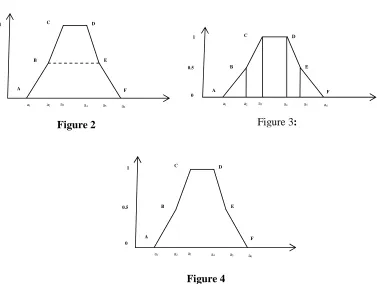
In this paper, the hexagonal has been divided into two plane figures. These two plane figures are trapezoidal ABEF and BCDE (Fig.2).Then the ranking function were taken for ABEF and BCDE and the four lines were joined from x-axis to hexagonal
(Fig.3). Average has been taken by using all six points (Fig.4). Let = (, ,, ,
, ) be a hexagonal fuzzy number. The ranking functions are obtained as below:
ℜ() =#### #!
(3.1)
1
0.5
0
C D
E B
F
a1 a2 a3 a4 a5 a6
1
0.5
0
C D
E B
F A
Figure 2
a1 a2 a3 a4 a5 a6
1
0.5
0
C D
E B
F A
a1 a2 a3 a4 a5 a6
Figure 3:
1
0.5
0
C D
E B
F A
a1 a2 a3 a4 a5 a6
120
ℜ() =#### #!
(3.2)
ℜ() =#### #!
(3.3)
Algorithm
Step 1: Formulate the chosen problem into the following fully fuzzy linear programming
Problem: Max (or) min$̃ = &̃'('
Subject to )*'('≤ +* ,
('≥ 0
Step 2: Using the Ranking functions (3.1, 3.2, 3.3), the FFLPP transformed into FVLPP. Step 3: Solve the FVLPP by using simplex method / Big-M method. Let the solution be
(j. Hence the solution of FFLPP is (,∗.
Step 4: Express the problem in standard form by introducing slack / surplus variables, to convert the inequality constraints into equations.
Step 5: Compute the value of . == CBYj-Cj j ≠ B, j=1...n.
(i) If all .≥ 0∀0 for maximization problem
(ii) If all .< 0 ∀0 for minimization problem. Then the current solution is optimal,
otherwise go to step 6.
Step 6: Determine the basic variable (k, which will be replaced by the non-basic variable,
Where k = arg min {ℜ(+ )1 } i=1, 2….m, in maximization problem and
k = arg max {ℜ(+ )1 } i=1, 2….m, in minimization problem.
Step 7: Perform the pivot operation and return to step 5. Then repeat the procedure until a fuzzy optimal solution is obtained.
Example 3.1. Maximize (11, 13, 15, 17, 19, 21) (1 + (31, 33, 35, 37, 39, 41) (2
Subject to
(41, 43, 45, 47, 49, 51) (1 + (61, 63, 65, 67, 69, 71) (2 ≤ (151, 153, 155, 157, 159, 161)
(81, 83, 85, 87, 89, 91) (1 + (101, 103, 105, 107, 109, 111) (2 ≤ (271, 273, 275, 277,
279, 281) Solution:
Maximize (11, 13, 15, 17, 19, 21) (1 + (31, 33, 35, 37, 39, 41) (2
Subject to
(41, 43, 45, 47, 49, 51) (1 + (61, 63, 65, 67, 69, 71) (2 + (1, 1, 1, 1, 1, 1) (3 = (151, 153, 155, 157, 159, 161)
(81, 83, 85, 87, 89, 91)(1 + (101, 103, 105, 107, 109, 111)(2 +(1, 1, 1, 1, 1, 1) (34 = (271, 273, 275, 277, 279, 281)
(1, (2, (3, (4, ≥ 0
Ranking function (i)
Maximize .= 32(1 + 72(2 + 0(3 + 0(4
Subject to
92(1+ 132(2 +(3 = (151, 153, 155, 157, 159, 161)
172(1+ 212(2 +(4 = (271, 273, 275, 277, 279, 281)
Hexagonal Fuzzy Numbers
121
Initial table
Basis (1 (2 (3 (4 RHS ℜ(+ ) 1
(3 92 132 1 0 (151, 153, 155, 157, 159, 161) 312
(4 172 212 0 1 (271, 273, 275, 277, 279, 281) 552
. -32 -72 0 0 (0,0,0,0,0,0)
First iteration
Basis (1 (2 (3 (4 RHS
(2
92
132 1
1
132 0 (
,
,
,
: ,
; ,
) (4
3200
132 0 −
212
132 1 (
:> ,
>> ,
> ,
> ,
> ,
;> )
. 2400
132 0
72
132 0 (
>A: ,
> ,
> ,
>
,
A
,
; )
Since . ≥ 0, the fuzzy optimal solution of the FVLPP and FFLPP is
( ∗
= (0,0,0,0,0,0), (
∗
= (
, ,
,
: ,
; ,
) and $̃ =
(>A:
,
>
,
>
,
>
,
A
,
;
) ≅ 510.54
Ranking function (ii)
Maximize .= 24(1 + 54(2 + 0(3 + 0(4
Subject to
69(1+ 99(2 +(3 = (151, 153, 155, 157, 159, 161)
129(1+ 159(2 +(4 = (271, 273, 275, 277, 279, 281)
(1, (2, (3, (4, ≥ 0.
The fuzzy optimal solution of the FVLPP and FFLPP is (∗= (0,0,0,0,0,0),
(∗
= (
;;,
;;,
;;, :
;; , ;
;; ,
;; ) and $̃ = (
A ;; ,
A ;; ,
A:> ;; ,
A:A ;; ,
AA ;; ,
A;
;; ) ≅ 510.54
Ranking function (iii)
Maximize .= 16(1 + 36(2 + 0(3 + 0(4
Subject to
46(1+66(2+(3 = (151,153,155,157,159, 161)
86(1+106(2+(4= (271,273,275,277,279,281)
(1, (2, (3, (4, ≥ 0
The fuzzy optimal solution of the FVLPP and FFLPP is (∗= (0, 0,0,0,0,0),
(∗= (
,
,
,
: ,
; ,
) and $̃ = (
, >A
, A>
,
, :
, :;
) ≅ 510.54
S l. N o
No. of const raints
No. of varia bles
Ranking function I Ranking function II Ranking function III
Fuzzy optim
al value (,∗
122
1 2 2
(∗
= ( 0,0,0,0,0,0) , (∗ = ( , , , : , ; , ) (∗
= ( 0,0,0,0,0,0) (∗ = ( ;;, ;;, ;;, : ;;, ; ;;, ;; )
(∗ = ( 0,0,0,0,0,0)
(∗= ( , , , : , ; , ) 510.5
2 2 2
( ∗
= ( >
, > , > , >A , > , )
(∗ = (0 ,0,0,0,0,0)
( ∗
= ( > >., > >., > >., >A >., > >., >.) ( ∗
= (0 ,0,0,0,0,0)
( ∗
= ( >
:, > :, > :, >A :, > :, :)
(∗= (0 ,0,0,0,0,0)
966
3 2 2
(∗
= ( 0,0,0,0,0,0) (∗= ( : A, : A, : A, :: A, :; A, A A) ( ∗
= ( 0,0,0,0,0,0) ( ∗ = ( : ;, : ;, : ;, :: ;, :; ;, A ;)
(∗ = ( 0,0,0,0,0,0)
( ∗ = ( : , : , : , :: , :; , A ) 511.5
4 2 2 (
∗
= ( 0,0,0,0,0,0) (∗
= ( > , , , , A , :> ) ( ∗
= ( 0,0,0,0,0,0) (∗
= ( >
., ., ., ., A ., :> .) ( ∗
= ( 0,0,0,0,0,0) (∗ = ( > :., :., :., :., A :., :> :.) 364
5 3 3
(∗
= ( 0,0,0,0,0,0) (∗
= ( 0,0,0,0,0,0) (
∗
= ( > A, A, A, A, A A, :> A) (∗
= ( 0,0,0,0,0,0) (∗
= ( 0,0,0,0,0,0) (
∗
= ( > A., A., A., A., A A., :> A.)
(∗ = ( 0,0,0,0,0,0)
(∗ = 0,0,0,0,0,0)
(( ∗
= ( >
;, ;, ;, ;, A ;, :> ;) 225.7
6 3 3
(∗
= ( 0,0,0,0,0,0) (∗
= ( 0,0,0,0,0,0) (∗
= ( > ;A, ;A, ;A, ;A, A ;A, > ;A) ( ∗
= ( 0,0,0,0,0,0) (
∗
= ( 0,0,0,0,0,0) (∗
= ( > :., :., :., :., A :., > :.)
(∗ = ( 0,0,0,0,0,0)
(∗ = ( 0,0,0,0,0,0)
( ∗
= ( > ;, ;, ;, ;, A ;, > ;) 290.8
7 4 4
(∗
= ( 0,0,0,0,0,0) (∗
= ( 0,0,0,0,0,0) (∗
= ( 0,0,0,0,0,0) (
∗
= ( >
:, > :, > :, >A :, > :, :) (∗
= ( 0,0,0,0,0,0) (∗
= ( 0,0,0,0,0,0) (∗
= ( 0,0,0,0,0,0) ( ∗ =(> >., > >., > >., >A >., > >., >. )
(∗ = ( 0,0,0,0,0,0)
( ∗
= ( 0,0,0,0,0,0) (∗ = ( 0,0,0,0,0,0)
(∗= ( > A:, > A:, > A:, >A A:, > A:, A:) 783.3
8 4 4
( ∗
= ( 0,0,0,0,0,0) (∗
= ( 0,0,0,0,0,0) (∗
= ( 0,0,0,0,0,0) (
∗
= ( >
>, > >, >: >, >; >, >, >) ( ∗
= ( 0,0,0,0,0,0) (∗
= ( 0,0,0,0,0,0) (∗
= ( 0,0,0,0,0,0) (
∗
= ( > >, > >, >: >, >; >, >, >) ( ∗
= ( 0,0,0,0,0,0) (∗ = ( 0,0,0,0,0,0)
(∗ = ( 0,0,0,0,0,0)
( ∗
= ( >
A>, > A>, >: A>, >; A>, A>, A>) 639.9
9 5 5
(∗
= ( 0,0,0,0,0,0) (∗
= ( 0,0,0,0,0,0) (∗
= ( 0,0,0,0,0,0) (∗
= ( 0,0,0,0,0,0) (∗
= ( >> :>, > :>, > :>, > :>, >A :>, > :>) (∗
= ( 0,0,0,0,0,0) (∗
= ( 0,0,0,0,0,0) (∗
= ( 0,0,0,0,0,0) (∗
= ( 0,0,0,0,0,0) (∗
= ( >> :., > :., > :., > :., >A :., > :.)
(∗ = ( 0,0,0,0,0,0)
(∗ = ( 0,0,0,0,0,0)
(∗ = ( 0,0,0,0,0,0)
(∗ = ( 0,0,0,0,0,0)
( ∗
= ( >>
A, > A, > A, > A, >A A, > A) 332.8 2 1
0 6 6
(∗
= ( 0,0,0,0,0,0) (∗
= ( 0,0,0,0,0,0) (
∗
= ( 0,0,0,0,0,0) (∗
= ( 0,0,0,0,0,0) (
∗
= ( 0,0,0,0,0,0) (∗
= ( >> ;, > ;, > ;, > ;, >A ;, > ;) (∗
= ( 0,0,0,0,0,0) (∗
= ( 0,0,0,0,0,0) (∗
= ( 0,0,0,0,0,0) (∗
= ( 0,0,0,0,0,0) (∗
= ( 0,0,0,0,0,0) (∗
= ( >> :, > :, > :, > :, >A :, > :)
(∗ = ( 0,0,0,0,0,0)
(∗ = ( 0,0,0,0,0,0)
( ∗
= ( 0,0,0,0,0,0) (∗ = ( 0,0,0,0,0,0)
(∗ = ( 0,0,0,0,0,0)
(∗= ( >> ;A, > ;A, > ;A, > ;A, >A ;A, > ;A) 476.9 3
Numbers
123
4. Conclusion
In this paper a new method is proposed for solving the fuzzy optimal solution of FFLP problem transform into FVLP problems. The FFLP problem is converted into FVLP problem using new Ranking function. We have obtained the same results by using the above three ranking functions (3.1), (3.2), (3.3). Ranking function is reasonable and effective for calculating the hexagonal weights of criteria. Therefore it is easier to solve fully fuzzy linear programming problem.
REFERENCES
1. S. Abbasbandy and T. Hajjari, Ranking of fuzzy numbers by sign distance, Information Sciences,
176(2006), 2405-2416.
2. T.Allahviranloo, F.H.Lotfi, M.K.Kiasary, N.A.Kiani and L. Alizadeh, Solving fully fuzzy linear
Programming problems by the ranking function, Applied Mathematical Sciences,2 (2008), 19-32.
3. A.Kumar and J.Kaur, A New Method for Solving Fuzzy Linear Programs with Trapezoidal Fuzzy
Numbers, International Journal of fuzzy set valued Analysis, 2011(2011).
4. Amitkumar, Jagdeepkaur and Singh, Solving fully fuzzy linear programming problems with
inequality constraints, International Journal of Physical and Mathematical Sciences,1(2010), 6-18.
5. R.E.Bellman and L.A.Zadeh, Decision making in a fuzzy environment, Management
Science,17(1970) 141-164.
6. D.Chanas, Fuzzy programming in multiobjective linear programming a parametric approach, Fuzzy
Sets and Systems, 29 (1989) 303-313.
7. S.H. Chen, Rank in Fuzzy numbers with maximizing set and minimizing set, Fuzzy Sets and Systems,
17 (1985) 113-129.
8. C.H.Cheng, A New approach for ranking fuzzy numbers by distance method, Fuzzy Sets and Systems,
95 (1998) 307-317.
9. A.Kauffmann and M. Gupta, Introduction to Fuzzy Arithmetic, Theory and Applications, Van
Nostrand Reinhold, New York, 1980.
10. Kolman and Hill, Applied Mathematics, 18, 1984.
11. A.Kumar, J.Kaur and Singh, Fuzzy optimal solution of fully fuzzy linear programming problems with
Inequality constraints, International Journal of Applied Mathematics and Computer sciences, 6 (2010) 37-41.
12. E.S.Lee and R.J. Li, Comparison of fuzzy numbers based on the probability number of fuzzy events,
Computers and Mathematics with Applications, 15(1988) 887-896.
13. T.S.Liou and M.J. Wang, Ranking fuzzy numbers with integral value, Fuzzy Sets and Systems, 50
(1992) 247-255.
14. S.H.Nasseri, A new method for solving fuzzy linear programming by solving linear programming,
Applied Mathematical Sciences, 2 (2008) 37-46.
15. P.Rajarajeswari, A.Sahayasudha and R.Karthika, A new operation on hexagonal fuzzy number,
International Journal of Fuzzy Logic Systems,3 (2013), 15-26.
16. H.Tanaka and K.Asai, Fuzzy linear programming problems with fuzzy numbers, Fuzzy Sets and
Systems, 13 (1984) 1-10.
17. H.Tanaka, T.Okuda and K.Asai, Fuzzy mathematical programming, Journal of Cybernetics and
Systems, 3 (1973) 37-46.
18. J.L.Verdegay, A dual approach to solve the fuzzy linear programming problem, Fuzzy Sets and
Systems, 14(1984), 131-141.
19. H.J. Zimmermann, Fuzzy programming and linear programming with several objective functions,