IJPAR |Vol.5 | Issue 4 | Oct - Dec -2016 Journal Home page: www.ijpar.com
Research article Open Access
Development and validation of septrophotometricmethods for the
estimation of rasagiline in tablet doage form
*1
M. Swapna,
1R. Pavani,
2M.Sunil Kumar
*1
Teegala Ram Reddy College of Pharmacy, Meerpet, Hyderabad-79.
2
Hetero Labs Limited, Jeedimetla, Hyderabad-055
*Corresponding Author:M. Swapna Email: [email protected]
ABSTRACT
Two simple and sensitive spectrophotometric methods (A and B) for the determination of Rasagiline mesylate in tablet dosage form are described. In method A – UV Spectroscopic method, Distilled Water was used as solvent and shows absorption maximum at 265 nm. In the method B – UV Spectroscopic method, 0.2 N Methanolic Hydrochloric acids was used as solvent and shows absorption maximum at 211 nm. The Beer’s Law range for method A is 20 – 160 µg/ml and 4 – 20 µg/ml for method B. The linear regression for method A and B are found to be 0.9999 and 0.9998 respectively. When tablet dosage forms where analysed, the results obtained by the proposed methods are in good agreement with the labelled amount and the results were validated statistically.
Keywords:
Rasagiline, UV spectroscopy, Tablet dosage form, Statistical validationINTRODUCTION
Rasagiline is chemically known as (1R)-N-prop-2-ynyl-2, 3-dihydro-1H-inden-1-amine and shown in fig.1 It is used for the treatment of the signs and symptoms of idiopathic Parkinson’s disease as initial monotherapy and as adjunct therapy to levodopa. It is a monoamine oxidase β-inhibitor [1-2], used in preventing MPTP-induced Parkinsonism. A literature survey revealed no spectrophotometric methods for the estimation of Rasagiline in pure and tablet dosage form. HPLC and LC-MS methods [3-5] were reported for the estimation of Rasagiline in biological fluids. In the
present report, the paper describes two simple and sensitive spectroscopic methods for the determination of Rasagiline mesylate in pure and tablet dosage form.
MATERIALS AND METHODS
Pharmaceutical grade of Rasagiline was kindly gifted from Lupin Pharmaceuticals, Pune. The brand of Rasagiline tablets used was Azilect and procured from a local Pharmacy. All the solvents and chemicals used were of analytical reagent grade and procured from Qualigens fine Chemicals (Mumbai).
Instruments
Shimadzu AX - 220 digital balances, Shimadzu
- 1700 Double beam UV - Visible
spectrophotometer with 1 cm matched quartz cells, Sonicator Sonica Ultrasonic cleaner model 2200 mH.
METHOD
A
–
SIMPLE
UV-
SPECTROSCOPY
The solubility of Rasagiline was determined in a variety of solvent ranging from non polar to polar using essentially a method of Schefter and Higuchi [6]. The drug was found to be very soluble in chloroform, glacial acetic acid, ethanol sparingly soluble in Distilled Water and freely soluble in 0.2 N methanolic hydrochloric acid. Considering the economic factor and the drug were stable in Distilled Water for 3 h, Distilled Water was selected as the solvent for method A.
Preparation of standard stock solution
10 mg Rasagiline was accurately weighed and transferred into a 100 ml standard flask and dissolved with minimum quantity of Distilled Water and made up to 100 ml with more Distilled Water (100 μg /ml).
Selection of λ
maxand stability studies
The standard stock solution was further diluted with Distilled Water to get 10 μg/ml concentration (1 ml to 10 ml). The solution was scanned between 200 and 400 nm using Distilled Water as blank. From the spectrum obtained, 265 nm was selected as λmax for the analysis of Rasagiline. Stability
studies were performed and Rasagiline was found to be stable for 3 h.
Calibration graph and linearity
In this method, the aliquots (1–8 ml) of standard stock solution of Rasagiline were transferred into 25 ml standard flasks and made up to the mark with Distilled Water. The absorbance was measured at 265 nm against Distilled Water as blank. The sample solutions were found to be linear from 20-160 μg/ml. The calibration curve was plotted between concentration and absorbance.
Quantification of formulations
accurately weighed to find out the average weight and powdered. Transferred the powdered tablets equivalent to 25 mg of Rasagiline mesylate into a 50 ml conical flask, extracted with Distilled Water for three times (3 x 10 ml), sonicated for 15 min and produced to 50 ml with Distilled Water using a standard flask. Half of the solution was filtered using Whatmann filter paper No. 41. From this clear solution, 5 ml was transferred to a 25 ml standard flask and produced to obtain 100 μg/ml solution with Distilled Water. The absorbance was measured at 265 nm using Distilled Water as blank. The amount of Rasagiline mesylate present in each formulation was calculated from the slope and intercept of respective calibration curve [7].
Recovery studies
From each of the preanalyzed formulation, known quantities were taken (20 μg/ml) and the raw material solution was added in ascending amounts (1, 2, 3, 4, 5 and 6 ml) to 25 ml standard flasks. The contents were mixed well, finally made up to the mark and filtered. The absorbance was measured at 265 nm using Distilled Water as blank and the amount of drug recovered from the each formulation was calculated by the mathematical relation followed by Sane et al [8] .
METHOD B
Preparation of standard stock solution
50 mg Rasagiline raw material was accurately weighed and transferred into a 50 ml standard flask and dissolved with minimum quantity of 0.2 N methanolic hydrochloric acid and made up to 50 ml with more 0.2 N methanolic hydrochloric acid. The solution was observed to contain 1000 μg /ml.
Selection of λ
maxand stability studies
The standard stock solution was further diluted with 0.2 N methanolic hydrochloric acid to get 50 μg/ml concentration (2.5 ml to 50 ml) and further dilution was made with 0.2 N methanolic hydrochloric acid to get 10 μg/ml solution (2 ml to 10 ml). The solution was scanned between 200 and 400 nm using 0.2 N methanolic hydrochloric acid as blank. From the spectrum obtained, 211 nm was selected as λmax for the analysis of Rasagiline.
Preparation of working standard
2 ml of standard stock solution was pipetted (contains 1000 μg/ml) into a 50 ml standard flask and the volume was made up to the mark with 0.2 N methanolic hydrochloric acid and obtained a concentration of 40 μg/ml.
Calibration graph and linearity
In this method, the aliquots (1–5 ml) of working standard solution of Rasagiline were transferred into 10 ml standard flasks and made up to the mark with 0.2 N methanolic hydrochloric acid. The absorbance was measured at 211 nm against 0.2 N methanolic hydrochloric acid as blank. The sample solutions were found to be linear from 4-20 μg/ml. The calibration curve was plotted between concentration and absorbance.
Quantification of formulations
Thirty tablets of formulation (Azilect) containing 1 mg of Rasagiline mesylate were accurately weighed to find out the average weight and powdered. Transferred the powdered tablets equivalent to 25 mg of Rasagiline mesylate into a 25 ml conical flask, extracted with 0.2 N methanolic hydrochloric acid for three times (3 x 5 ml), sonicated for 15 min and produced to 25 ml with 0.2 N methanolic hydrochloric acid. Half of the solution was filtered using Whatmann filter paper No. 41. From this clear solution, 2 ml was
transferred to a 50 ml standard flask and produced to obtain 40 μg /ml solution with 0.2 N methanolic hydrochloric acid, further by taking 3 ml of the above solution to 10 ml standard flasks and the volumes were made up to the mark with 0.2 N methanolic hydrochloric acid to get the concentration of 12 μg/ml. The absorbance was measured at 211 nm using 0.2 N methanolic hydrochloric acid as blank. The amount of Rasagiline mesylate present in each formulation was calculated from the slope and intercept of respective calibration curve [7].
Recovery studies
From each of the preanalyzed formulation, known quantities were taken (40 μg/ml) and the raw material solution was added in ascending amounts (1 to 3.5 ml) to 10 ml standard flasks. The contents were mixed well, finally made up to the mark and filtered. The absorbance was measured at 211 nm using 0.2 N methanolic hydrochloric acid as blank and the amount of drug recovered from the each formulation was calculated by the mathematical relation followed by Sane et al [8].
Statistical Validation [9]
The obtained results were treated for statistical validation parameters like Standard Deviation (SD) and Percentage Relative Standard Deviation (% RSD).
Table1: Optical characteristics of Rasagiline
Parameters Method A Method B
λmax (nm) 265 211
Beers law limit (μg/ml) 20 – 160 4-20
Sandell’s sensitivity (μg/cm2/0.001A.U.) 0.159776521 0.02605352
Correlation coefficient (r) 0.99992 0.99987
Regression equation (y = mx + c) Y = 0.006261 x +0.00022084 Y =0 .038383929x +0.001616663
Slope (m) 0.006261309 0 .038383929
Intercept (c) 0.00022084 0.001616663
LOD (μg/ml) 0.412232939 0.138990171
LOQ (μg/ml) 1.249190725 0.421182338
Standard error of mean 0.000445499 0.000544837
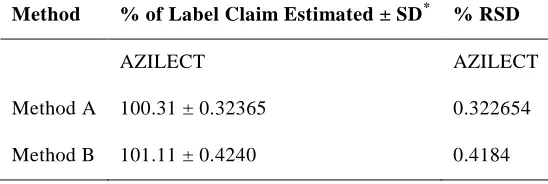
Table 2: Results of analysis of commercial formulations
Method % of Label Claim Estimated ± SD* % RSD
AZILECT AZILECT
Method A 100.31 ± 0.32365 0.322654
Method B 101.11 ± 0.4240 0.4184
SD is standard deviation, % RSD percentage relative standard deviation *Average of six determinations
Table 3: Results of recovery studies
Method Percentage Recovered*
AZILECT
Method A 102.11
Method B 102.55
*Average of six determinations
RESULTS AND DISCUSSION
The solubility profile of Rasagiline was determined as per procedure followed by Schefter and Higuchi [6]. Using various polar to non polar solvents and from the solubility studies the category of solvents for Rasagiline was hereby confirmed as insoluble in 0.1 M NaoH, sparingly soluble in Distilled water, freely soluble in Methanol, very soluble in 0.1 M Hydrochloric acid, Acetonitrile, Acetic acid, Chloroform, Ethanol, and 0.1 M methanolic Hydrochloric acid.
Method A
Distilled water was selected as solvent for simple UV-method A because of its easy availability, cost factor and high stability. The proposed method for estimation of Rasagiline in pure and in tablet dosage form were found to be simple and sensitive. The drug in Distilled water shows λmax at265 nm, with linearity range of 20 –
160 μg/ml.
of detection (0.412232939), and limit of quantification (1.249190725) were calculated for Rasagiline in Distilled water and produced in Table 1. Quantification of Rasagiline from tablets dosage form was performed under method A and the amount present was determined by average of six replicate analysis and the amount in percentage purity is found to be 100.31 and shown in table 2.
To evaluate the accuracy of the method and for knowing the interference from excipients recovery study was performed. The Recovery of Rasagiline mesylate by UV- Spectroscopic method A was found to be 102.11 and the results are shown in Table 3. The values of co-efficient of variance were satisfactorily low and recovery was close to 100 % indicating reproducibility of the methods. The excipients in the formulation did not interfere in the accurate estimation of Rasagiline mesylate in tablet dosage form.
Method B
0.2 N methanolic hydrochloric acid was selected as solvent for simple UV-method B because of its easy availability, sensitivity and high stability. The proposed method for estimation of Rasagiline in pure and in tablet dosage form were found to be simple and sensitive. Rasagiline in 0.2 N methanolic hydrochloric acid shows λmax at211
nm, with linearity range of 4 – 20 μg/ml.
The optical parameters like Beer’s law limits (4-20 μg/ml), Sandell’s sensitivity (0.02605352), correlation coefficient (0.999876), slope (0.038383929), intercept (0.001616663), limit of detection (0.138990171), and limit of quantification (0.421182338) were calculated for
Rasagiline in 0.2 N methanolic hydrochloric acid and produced in Table 1. Quantification of Rasagiline from tablets dosage form was performed under method B and the amount present was determined by average of six replicate analysis and the amount in percentage purity are found to be 101.11 and shown in Table 2.
To evaluate the accuracy of the method and for knowing the interference from excipients recovery study was performed. The Recovery of Rasagiline mesylate by UV- Spectroscopic method B was found to be 102.55 and the results are shown in Table 3. The values of co-efficient of variance were satisfactorily low and recovery was close to 100 % indicating reproducibility of the methods. The excipients in the formulation did not interfere in the accurate estimation of Rasagiline mesylate in tablet dosage form.
From the results, the UV-Spectroscopy methods were found to be more precise. Since none of the spectroscopic method is reported for the estimation of Rasagiline mesylate in tablet dosage form, these developed methods can be applied in industries for routine analysis of the Rasagiline in tablet dosage form.
Acknowlegments
The authors would like to acknowledge Lupin Pharmaceuticals, Pune, India, for providing pure drug sample of Rasagiline. Acknowledgement is further extended to Arulthiru Bangaru Adigalar, President, Thirumathi Lakshmi Bangaru Adigalar, Vice-President and Dr. T. Ramesh, Managing Director, MAPIMS, Melmaruvathur for providing necessary facilities to carry out this work
REFERENCES
[1]. Budavari S, editors. The Merck Index. Merck and Co., Inc., Whitehouse Station, NJ: 14, 2006, 8116. [2]. Bertram G. Katzung. Basic and Clinical Pharmacology, 2004, 453.
[3]. Beckett HA, Stenlake BJ. Practical Pharmaceutical Chemistry. CBS Publications; New Dehli: 4, 2001, 275. [4]. Marcos Fernández, Emilia Barcia and Sofía Negro.Jpba. 2009, 1188-1191.
[5]. Patel SA, Patel MH. Indian J PharmSci. 68, 2006, 101-03. [6]. Schefter E, Higuchi T. J Pharm Sci. 52, 1963, 781
[7]. Gupt SC. Fundamentals of Statics. Himalaya Publications House; New Delhi: 4, 1999, 3-58. [8]. Sane RJ, Smita GJ, Mary F, Aamer RK, Premangsus H. Indian Drugs. 36, 1999, 317.