SECURING PUBLIC CLOUD USING
MULTI-ATTRIBUTE, MULTI-AUTHORITY LAYER SCHEME
WITH DATASET FRAGMENTS
Mr. Vipin, Dr. Pankaj Agarkar
Department of Computer Engineering
Dr. D. Y. Patil School of Engineering,
Pune, India
Abstract: Ciphertext-policy Attribute-Based Encryption (CP-ABE) has been embraced as a promising method to give adaptable, fine-grained and protect information from unauthorized
access for distributed storage with genuine yet inquisitive cloud servers. In any case, in the
current CP-ABE designs, the single quality master must execute the monotonous customer
realness check and secret key course, and hereafter it results in a lone point execution
bottleneck when a CP-ABE plot is grasped in a far-reaching scale appropriated capacity
system. Clients may think to use complex key and its access mechanism for that they can
use extensive stretch to acquire their secrete keys, accordingly bringing about
low-effectiveness of the framework. Even though multi specialist involved in the proposed
security mechanism, these plans still can't defeat the disadvantages of single-point
bottleneck and low productivity, because of the way that every one of the experts still
autonomously deals with a unique property set. In this paper, we propose a novel
heterogeneous framework to oust the issue of single-point execution bottleneck and give a
more viable access control plot with an analyzing segment. clients might imagine using
complicated key and it get right of entry to mechanism for that they can use big stretch to
accumulate their secrete keys, as a result, bringing approximately low-effectiveness of the
framework. even though multi expert worried within the proposed safety mechanism, these
plans still cannot defeat the dangers of unmarried-point bottleneck and occasional
productiveness, because of the manner that every one of the experts still autonomously
deals with a completely unique assets set. on this paper, we propose a novel heterogeneous
framework to oust the issue of single-point execution bottleneck and give an extra possible
access manipulate plot with a studying section. Our framework uses various credit score Journal homepage: www.mjret.in
government to share the pile of patron legitimacy check. in the interim, in our arrangement, a
CA (important Authority) is acquainted with create mystery keys for realness affirmed
customers. To remodel security, we moreover recommend an assessing phase to perceive
which first-rate master has incorrectly or maliciously performed out the validness take a look
at framework.
Keywords: Cloud Computing, Central Authority, Attribute-Based Encryption, Master Key
1. INTRODUCTION
Cloud stockpiling is a promising and vital administration worldview in cloud figuring.
Advantages of utilizing cloud stockpiling incorporate more prominent availability, higher
dependability, quick sending and more grounded security, to give some examples [1]. Since
cloud stockpiling is worked by cloud specialist co-ops, who are often outside the confided in
area of information proprietors, the conventional access control strategies in the Client/Server
display are not appropriate in cloud stockpiling condition. The data get the chance to control
in cloud amassing condition has thus transformed into a testing issue. To address the issue
of data, get the chance to control in cloud amassing, there have been numerous plans
proposed, among which Cipher content Policy Attribute Based Encryption (CPABE) is seen
as a champion among the most promising systems. A straight forward arrangement to clear
the single point bottleneck is to empower distinctive specialists to commonly manage the
general characteristic set, with the goal that each one of them can scatter puzzle keys to
customers independently [2]. By grasping various pros to share the stack, the effect of the
single point bottleneck can be decreased to a degree. Regardless, this game plan will convey
risks on security issues. Since there are different essentially unclear masters playing out a
comparative technique, it is slippery the careful master if messes up have been made or
dangerous practices have been completed amid the time spent puzzle scratch the age and
dispersion[5] A straight forward arrangement to empty the single point bottleneck is to
empower diverse authorities to together manage the broad property set, so every one of them
can flow secret keys to customers self-sufficiently.
By receiving several professionals to percentage, the heap, the effect of the single point
bottleneck can be diminished to a selected diploma. Be that as it is able to, this arrangement
will supply dangers on safety troubles [three]. when you consider that there are various
practically indistinguishable specialists gambling out a similar methodology, it's far elusive the
capable expert if botches had been made or vindictive practices were actualized at some
As an example, an expert can also erroneously convey thriller keys past patron's proper
assets set. Such frail factor on security makes this straight forward thought difficult to satisfy
the security necessity of get right of entry to manage for public cloud stockpiling. Our ongoing
work, TMACS, is a side multi professional CPAB get to govern plot for public cloud stockpiling
wherein numerous specialists collectively deal with a uniform trait set [1,2]. As a remember of
truth, it tends to the single point bottleneck of execution and safety, but, presents a few
greater overheads. in this manner, in this paper, we present a practical arrangement which
advances effectiveness and strength, in addition to ensures that the brand-new association is
as relaxed because the first single professional plans.
The primary contributions of this work may be summarized as follows.
• To deal with the unmarried-point execution bottleneck of key appropriation existed in
the contemporary plans, we propose a robust and effective heterogeneous structure
with single CA(imperative Authority) and numerous AAs (attribute specialists) for
public cloud stockpiling. the overpowering heap of client authenticity affirmation is
shared via severa AAs, every one in every of which offers with the all-inclusive
belongings set and can freely overall the purchaser authenticity test, even as CA is in
charge of computational undertakings. To the pleasant of our insight, that is the
primary work that proposes the heterogeneous get right of entry to manage machine
to address the low productiveness and single-factor execution bottleneck for cloud
stockpiling.
• We reproduce the CP-ABE plan to deal with our proposed gadget and recommend a
robust and high-proficient get admission to control conspire, in the period in-between
the plan nevertheless jelly the excellent granularity, adaptability and safety highlights
of CP-ABE.
• Our plan incorporates an examining gadget that makes a distinction the framework
follows an AA's trouble making on client's authenticity confirmation.
2. LITERATURE REVIEWS
There are some varying systems which utilized as a bit of various examining structures. This
range present some the systems like CPABE, RAAC and so forth which are utilized for
different purposes like information endorsement, information decency in surveying courses of
action on cloud.
Ciphertext-Policy Attribute-Based Encryption (CPABE): Even however the definitions and
developments of various CPABE plans are not constantly precise, the employments of the
entrance structure in Encrypt and Decrypt calculations are almost the equivalent. Here we
calculations: Setup, Encrypt, Key Generation (KeyGen), and Decrypt. Setup(λ,U) → (PK,MSK). The setup calculation takes the security parameter λ and the characteristic
universe depiction Uas the information. It yields the general population parameters PK and an
ace mystery key MSK.
Encrypt(PK,M,A) → CT. The encryption calculation takes the general population
parameters PK, a message M, and an entrance structure An as info. The calculation
will encode M and deliver a ciphertext CT with the end goal that just a client whose
traits fulfills the entrance structure will be capable todecrypt the message. We will
expect that the ciphertext certainly contains A. KeyGen(MSK, S) → SK. The key age
calculation takes the ace mystery key MSK and an arrangement of qualities S as
information. It yields a mystery key SK.
Decrypt(PK,CT, SK)→M. The decoding calculation takes general society parameters
PK, a ciphertext CT which contains an entrance strategy An, and a mystery key SK as
info, where SK isa mystery key for a set S of qualities. In the event that the set S of
traits fulfills the entrance structure A, the calculation will unscramble the ciphertext
and restore a message M.
Robust and Auditable Access Control (RAAC) (RAAC): In this paper, roused by the
heterogeneous design with single CA and different RAs, we propose a powerful and auditable
access control plot (named RAAC) for open distributed storage to advance the execution
while keeping the adaptability and fine granularity highlights of the current CP-ABE plans. In
our plan, we separate the strategy of client authenticity check from the mystery key age and
allocate these two sub methods to two various types of experts. There are numerous experts
(named characteristic specialists, As), every one of which is responsible for the entire quality
set and can direct client authenticity confirmation autonomously. In the meantime, there is just
a single worldwide confided in authority (alluded as Central Authority, CA) accountable for
mystery key age and circulation. Before playing out a mystery key age and dispersion
process, one of the AAs is chosen to check the authenticity of the client's qualities and
afterward it creates a middle of the road key to send to CA. CA creates the mystery key for
the client based on the got middle of the road key, with no need of any more confirmation.
Along these lines, numerous AAs can work in parallel to share the heap of the tedious
authenticity check and reserve for one another in order to evacuate the single-point
bottleneck on execution. In the interim, the chose AA doesn't assume the liability of producing
last mystery keys to clients. Rather, it creates middle of the road keys that connect with
Attribute Based Access Control with Efficient Revocation: Cipher content approach
property based encryption is a promising cryptographic answer for these issues for
authorizing access control strategies characterized by an information proprietor on
redistributed information a few difficulties as to the characteristic and client renouncement.
Access control instrument utilizing figure content approach credit-based encryption to
implement get to control strategies with proficient quality and client repudiation ability. The
fine-grained get to control can be accomplished by double encryption component which
exploits the property-based encryption and particular gathering key appropriation in each
characteristic gathering
PRSE (Personalized multi-keyword Ranked Search over Encrypted data) Framework: In
Cloud figuring accessible encryption is a testing undertaking. Nonetheless, most of the
current works pursue the model of "one size fits all" and disregard customized look over outs
sourced scrambled information. So PRSE structure takes care of the issue of customized
multikey word positioned seek over encoded information by protecting security of the
framework in distributed computing. This system assembles client intrigue display for each
client with the assistance of semantic cosmology Word Net by investigation client's hunt
history and by embracing a scoring component to express client premium adroitly.
Mehdi Sookhaka et al (2017): This paper gives an exhaustive study on trait-based access
control plans and looks at each plan's usefulness and trademark. We likewise present a
topical scientific classification of trait constructed approaches based with respect to critical
parameters, for example, get to control mode, design, repudiation mode, renouncement
strategy, denial issue, and disavowal controller. The paper audits the best in class ABE
techniques and arranges them into three principle classes, for example, centralized,
decentralized, and hierarchal, in light of their designs.
3. GENERAL DISCUSSION OF THE REVIEW WORK
Recently, we considered the single-point execution bottleneck of CP-ABE based plans and
formulated a limit multi-authority CP-ABE get to control plot in another work [1]. Unique in
relation to other multi-authority plans, in [1], numerous experts together deal with a uniform
property set. Exploiting (t, n) edge mystery sharing, the ace mystery key can be shared
among various specialists, and a legitimate client can create his/her mystery key by
connecting with any t experts. This plan tended to the single-point bottleneck on both security
and execution in CP-ABE based access control out in the open distributed storage. However,
it is not efficient, because a user must interact with at least t authorities, and thus introduces
The system model of our design is shown in Fig. 1, which involves five entities: a central
authority (CA), multiple attribute authorities (AAs), many data owners (Owners), many data
consumers (Users), and a cloud service provider with multiple cloud servers (here, we
mention it as cloud server.).
The central authority (CA) is the head of the whole framework. It is in charge of the
framework development by setting up the framework parameters and producing public
key for each attribute of the widespread attribute set. In the framework instatement
stage, it allocates every client a one of a kind Uid and each attribute authority an
extraordinary Aid. For a key demand from a client, CA oversees producing mystery
keys for the client in light of the got middle of the road key related with the client's real
attributes checked by an AA. As a director of the whole framework, CA can follow
which AA has mistakenly or malignantly checked a client and has allowed
ill-conceived attribute sets.
Fig. 1. System model [1].
The attribute authorities (AAs) oversee performing client authenticity check and
producing middle of the road keys for authenticity confirmed clients. Not at all like a
large portion of the current multi-authority plans where every AA deal with a disjoint
attribute set individually, our proposed plot includes different authorities to share the
obligation of client authenticity check and every AA can play out this procedure for any
client autonomously. At the point when an AA is chosen, it will check the clients'
genuine attributes by physical work or validation conventions and produce a middle of
the road key related with the attributes that it has authenticity confirmed. Middle of the
road key is another idea to help CA to create keys.
The data (Owner) characterizes the entrance arrangement about who can gain
admittance to each record and encodes the document under the characterized
approach. Above all else, every owner scrambles his/her data with a symmetric
attribute set and scrambles the symmetric key under the strategy as indicated by
public keys got from CA. From that point forward, the owner sends the entire
scrambled data and the encoded symmetric key (meant as ciphertext CT) to the cloud
server to be put away in the cloud.
The data consumer (User) is allocated a worldwide client character Uid by CA. The
client has an arrangement of attributes and is furnished with a mystery key related
with his/her attribute set. The client can uninhibitedly get any intrigued scrambled data
from the cloud server. Be that as it may, the client can decode the encoded data if and
just if his/her attribute set fulfills the entrance arrangement inserted in the scrambled
data.
The cloud server provides a public platform for owners to store and share their encrypted data. The cloud server doesn’t conduct data access control for owners. The
encrypted data stored in the cloud server can be downloaded freely by any user.
4. PROBLEM DEFINITION
Data integrity is one of the essential troubles, as there's lack of identity privacy due to
relinquish tendencies in cloud, in which the users are unacquainted with the auditor of the
statistics, over geographically scattered data centers. this feature of cloud computing evolved
various worries related to consumer’s identity, statistics integrity and consumer’s availability.
ultimately this affect to advocate an stronger version on the way to audit the records integrity
and preserving the identification of privacy with green person revocation even as sharing.
5. PROPOSED SYSTEM
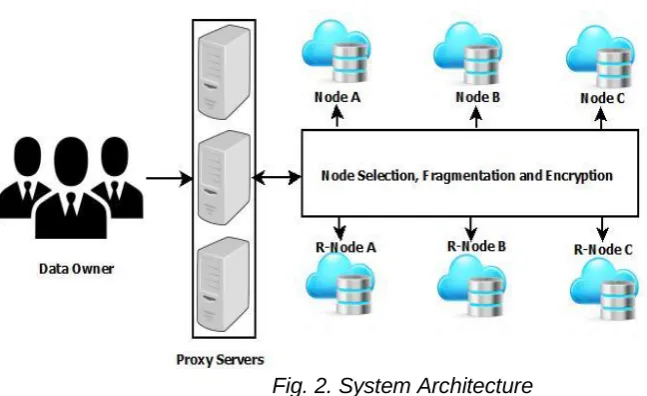
Fig. 2. System Architecture
In the proposed system, instead of transmitting the fragments of the file as it is, encryption
done. The file which user wants to replicate is fragmented into multiple parts. Key
generation is done which we are going to apply on the fragments. By using key, these
fragments are encrypted, and fragments are replicated to multiple nodes. For getting the
original data, all the fragments are decrypted and merged.
6. MATHEMATICAL MODEL
A.
Problem Design Using Set Theory
1. Let S= { } be as a secure Cloud System.
2. Obtain a set of shared keys’ of Data Owner who upload file is ShK
ShK1={ uid,dob,rP} ShK={ShK1,ShK2,ShK3}
Where uid, dob are the Data Owner attributes &rP randomly choose odd big
integer
S={ShK }
3. Give input files upload to Cloud F F= {f1, f2,...,fn}
FR1,FR2, FR3
4. Decrypt(FR1, C)
5. Repeat step 3 for all fragments Merge all fragments Homomorphic
Operations:
Where f1is a plain text file
S={ShK, F }
6. Create fragments of input file fX FR= {fR1, fR2, fR3}
Where fXis a plain text file, FRis set of fragments S={ShK, F ,FR}
7. Perform encryption process on set of plain text fragments of afilefXis a En
En= { FR, ShK}
Where En process take input as set fragments of file and data owners shared key
S={ShK, En ,FR}
8. Obtain a node_idto load file fragment of file uploaded by Data Consumer
Nid= {FR, EXL}
Where Nidnode id where fragment is loaded&EXLcurrent load of Nid
S={ShK, En ,FR, Nid }
9. Obtain a replica_id to load file fragment of file uploaded by Data Consumer
Rid = { FR, EXL }
Where Ridnode id where fragment is replicated&EXLcurrent load of Rid
S={ShK, En ,FR, Nid, Rid}
10. File accessor decryption process on set of cipher text fragments of a
11. Dn= { ShK,FR, Nid}
Where Dn process take input as set of fragments of file,data owners shared
key and data node_idS={ShK, En ,FR, Nid, Rid,Dn }
12. Merge fragments Mrg Mrg = { fR1, fR2, fR3 }
Where Mrg process take input as set of fragments of file and create single file
S={ShK, En ,FR, Nid, Rid,Dn,Mrg }
13. Final Set
S={ShK, En ,FR, Nid, Rid,Dn,Mrg }
B. Mathematical Model
KeyGen(p):
The key is a random P-bit odd integer p.Encrypt (p, m):
To encrypt a bit m{0,1} , output the plain text c = m + p + r * p * q,where r is a random Rbitnumber and q is a contain Q-bit big integer.
Decrypt (p, c):
Output (c mod p).To decrypt bit m {0, 1}, output thecipher text c = m - p - r * p * q, where r is a random
Rbitnumber and q is a contain Q-bit big integer.
Retrieval(c):
Take input file_id Fid,
Find locations of fragments of Fid which are FR1
Suppose there are two plaintext m1 and m2 under encryption. After encryption, the
cipher text turns out to be c1 and c2 respectively.
c1 = m1 + p + r1 * p * q,
c2 = m2 + p + r2 * p * q……… (3)
Firstly, checking the additively homomorphic property of the proposed SDC scheme.
Then
c3=c1 + c2= (m1 + m2) + (r1 + r2) * p * q + 2p.
………….(4)
And
m3 = c3 mod p = m1 + 2………(5)
7. DATASET AND EXPECTED OUTCOMES
As over public cloud person uploads its non-public information inside the form of files and
these documents having extraordinary formats like txt, document, pdf or it could incorporate
pix, audio or video. earlier than data load to cloud garage it encrypted using real time
encryption method. information tactics by means of gadget is a user input report and person
fragmentation is compared with byte array fragmentation with respect to file size where byte
array fragmentation time is less than that of other.
File size Byte array Content reading
Fragmentation and encryption time(milliseconds)
Replication time(milliseconds)
Fragmentation and encryption time(milliseconds
)
Replication time(milliseconds)
250 kb 1645.7471 126.5909 2391.9457 903.8963 500kb 1713.6838 280.0631 2516.9615 885.7568 750kb 1746.1070 287.0199 2536.3845 956.5988 1mb 2033.7212 590.3808 2626.6444 1083.2420 2mb 2347.6645 799.8776 2832.9673 1343.9213 3mb 3190.6101 1439.1851 3398.3227 1774.8506
Table .1 Result analysis
Graph 1 Comparison of fragmentation and encryption time of byte array and file content
Above graph.1. shows the Comparison between fragmentation and encryption time of byte
array and file content. Here fragmentation and encryption time of byte array is less than file
content reading.
Above graph 2 shows the Comparison between replication time of byte array and file content.
Here replication time of byte array is less than file content reading. Hence converting file
content into byte array is beneficial.
8. CONCLUSION & FUTURE SCOPE
The statistics which consumer desires to add on the cloud. This information is first
fragmented into distinct components. This record is available in byte array layout. On those
fragments’ encryption strategies are implemented to encrypt the data. After encryption the
statistics get stored at the nodes and the replicated copy of that facts get replicated at the
respective replication node. The records from that node may be brought in case of node
failure. on every occasion original information is needed, the decryption of these fragments
takes region and after merging all the decrypted fragments the authentic information may be
derived.
Consequently, via encryption greater quantity of protection is supplied. as opposed to storing
the fragments on sequential nodes, the records are saved on the random nodes in addition to
encryption techniques are implemented so the higher security is supplied. right here
fragmentation and encryption time for byte array is less than that of the content material
array. additionally, replication time for byte array is much less than that of content material
reading.
REFERENCES
[1] Boyang Wang, IEEE, Baochun Li and Hui Li, ”Panda: Public Auditing for Shared Data with Efficient User Revocation in the Cloud”, IEEE transactions on services computing, vol. 8, no. 1, january/february 2015 [2] C. Wang, Q. Wang, K. Ren, and W. Lou, ”Towards Secure and Dependable Storage Services in Cloud
Computing,” IEEE Transactions on Services Computing, vol. 5, no. 2, pp. 220-232, 2011.
[3] Y. Zhu, G.-J. Ahn, H. Hu, S. S. Yau, H. G. An, and S. Chen, ”Dynamic Audit Services for Outsourced Storage in Clouds,” IEEE Transactions on Services Computing.
[4] S. Marium, Q. Nazir, A. Ahmed, S. Ahthasham and Aamir M. Mirza, ”Implementation of EAP with RSA for Enhancing The Security of Cloud Computig”, International Journal of Basic and Applied Science, vol 1, no. 3, pp. 177-183, 2012
[5] Balkrishnan. S, Saranya. G, Shobana. S and Karthikeyan.S, ”Introducing Effective Third Party Auditing (TPA) for Data Storage Security in Cloud”, International Journal of computer science and Technology, vol. 2, no. 2, ISSN 2229-4333 (Print) — ISSN: 0976- 8491(Online), June 2012.
[6] K. Kiran Kumar, K. Padmaja, P. Radha Krishna, ”Automatic Protocol Blocker for Privacy-Preserving Public Auditing in Cloud Computing”, International Journal of Com- puter science and Technology, vol. 3 pp, ISSN. 0976-8491(Online), pp. 936-940, ISSN: 2229-4333 (Print), March 2012.
[7] Jachak K. B., Korde S. K., Ghorpade P. P. and Gagare G. J.,”Homomorphic Authentication with Random Masking Technique Ensuring Privacy & Security in Cloud Computing”,
[8] Bioinfo Security Informatics, vol. 2, no. 2, pp. 49-52, ISSN. 2249-9423, 12 April 2012.
[9] C. Wang, Q. Wang, K. Ren, and W. Lou, Towards Secure and Dependable Storage Services in Cloud Computing, IEEE Transactions on Services Computing, vol. 5, no. 2, pp. 220232, 2011.
[11] S. Marium, Q. Nazir, A. Ahmed, S. Ahthasham and Aamir M. Mirza, Implementation of EAP with RSA for Enhancing The Security of Cloud Computig, International Journal of Basic and Applied Science, vol 1, no. 3, pp. 177-183, 2012
[12] K. Kiran Kumar, K. Padmaja, P. Radha Krishna, Automatic Protocol Blocker for Privacy- Preserving Public Auditing in Cloud Computing, International Journal of Computer science and Technology, vol. 3 pp, ISSN. 0976-8491(Online), pp. 936-940, ISSN: 2229- 4333 (Print), March 2012
![Fig. 1. System model [1].](https://thumb-us.123doks.com/thumbv2/123dok_us/8860196.1806980/6.595.134.454.337.469/fig-system-model.webp)