Open Access
Research
A brain-computer interface with vibrotactile biofeedback for haptic
information
Aniruddha Chatterjee*
1, Vikram Aggarwal
1, Ander Ramos
2,
Soumyadipta Acharya
1and Nitish V Thakor
1Address: 1Department of Biomedical Engineering, The Johns Hopkins University, Baltimore, MD, USA and 2Department of Biomedical Engineering, Fatronik Technological Foundation, Spain
Email: Aniruddha Chatterjee* - [email protected]; Vikram Aggarwal - [email protected]; Ander Ramos - [email protected]; Soumyadipta Acharya - [email protected]; Nitish V Thakor - [email protected]
* Corresponding author
Abstract
Background: It has been suggested that Brain-Computer Interfaces (BCI) may one day be suitable for controlling a neuroprosthesis. For closed-loop operation of BCI, a tactile feedback channel that is compatible with neuroprosthetic applications is desired. Operation of an EEG-based BCI using only vibrotactile feedback, a commonly used method to convey haptic senses of contact and pressure, is demonstrated with a high level of accuracy.
Methods: A Mu-rhythm based BCI using a motor imagery paradigm was used to control the position of a virtual cursor. The cursor position was shown visually as well as transmitted haptically by modulating the intensity of a vibrotactile stimulus to the upper limb. A total of six subjects operated the BCI in a two-stage targeting task, receiving only vibrotactile biofeedback of performance. The location of the vibration was also systematically varied between the left and right arms to investigate location-dependent effects on performance.
Results and Conclusion: Subjects are able to control the BCI using only vibrotactile feedback with an average accuracy of 56% and as high as 72%. These accuracies are significantly higher than the 15% predicted by random chance if the subject had no voluntary control of their Mu-rhythm. The results of this study demonstrate that vibrotactile feedback is an effective biofeedback modality to operate a BCI using motor imagery. In addition, the study shows that placement of the vibrotactile stimulation on the biceps ipsilateral or contralateral to the motor imagery introduces a significant bias in the BCI accuracy. This bias is consistent with a drop in performance generated by stimulation of the contralateral limb. Users demonstrated the capability to overcome this bias with training.
Background
A Brain-Computer Interface (BCI) uses electrophysiologi-cal measures of brain activity to enable communication with external devices, such as computers and prostheses.
Recent breakthroughs in the development of BCI have enabled practical applications that may help users with severe neuromuscular disabilities. By modulating changes in their electroencephalographic (EEG) activity, BCI users Published: 17 October 2007
Journal of NeuroEngineering and Rehabilitation 2007, 4:40 doi:10.1186/1743-0003-4-40
Received: 31 March 2007 Accepted: 17 October 2007
This article is available from: http://www.jneuroengrehab.com/content/4/1/40 © 2007 Chatterjee et al; licensee BioMed Central Ltd.
have demonstrated two-dimensional cursor control and the ability to type out messages on virtual keyboards [1-5].
A survey of individuals with upper-limb loss suggests that improving prosthetic control capabilities is a top priority in the community [6]. Most of these individuals are cur-rently limited to cumbersome prostheses with myoelectric control or cable-operated systems and many in fact choose to avoid the hassle of a prosthesis [7,8]. It has been suggested that advances in BCI may eventually allow for control of neuroprostheses [9,10], with research groups already having demonstrated invasive cortical control of mechanical actuators in humans and nonhuman primates [11-13].
Of the numerous hardware and signal processing issues that must be resolved to make this goal a reality, one important factor which merits attention is the nature of the BCI biofeedback to the user. Conventional BCIs designed for the paralyzed have utilized a visual interface, such as a computer cursor or virtual keyboard, to close the control loop between the subject and the interface. While this modality is suitable for situations where the BCI user is interested in only the position and configuration of the controlled device, visual feedback is inadequate for grasp-ing objects where haptic (relatgrasp-ing to touch) senses such as grasping force are desired. To overcome this deficiency, a haptic information channel such as vibrotactile feedback can provide the user with the appropriate sensory infor-mation from a neuroprosthesis.
Vibrotactile feedback is a simple and compact mechanism commonly used in noninvasive haptic feedback systems because it is safe, straightforward to implement, and frees the user from having to maintain visual attention of the actuator [14]. Many vibrotactile feedback systems have been developed to convey information through a tactile interface when visual attention was deemed inefficient or unnecessary [15]. Prior prosthetics research also investi-gates how such feedback systems are used to convey the intensity of grasping force [16,17]. Since any advanced neuroprosthetic control will inevitably require communi-cating different haptic inputs to the user, the integration of haptic biofeedback to BCI applications deserves to be investigated.
This study uses a vibrotactile stimulus to provide one-dimensional feedback of a specific parameter, such as the output of a force sensor. The vibrotactile feedback is placed on the arm in order to mimic sensory stimulation provided on the residual limb of an amputee. Feedback at this location has been used in previous studies testing haptic feedback with upper-limb prostheses [18-20]. The BCI platform used to control this parameter is based on the modulation of Mu (8–12 Hz) rhythm activity via
motor imagery tasks, which is a well-documented BCI control strategy [21-23]. Actual or imagined motor move-ments result in an event-related desynchronization (ERD) in spectral power at these frequencies over the sensorimo-tor cortex. Subjects can learn to modulate their Mu-band power to produce a 1-D control signal. The platform is designed to distinguish between three states: relaxation and two separable desynchronization patterns that are operant-conditioned from a starting baseline of right hand versus left hand motor imagery. This control para-digm can enable the Open, Close, and Rest commands needed to actuate an upper-limb prosthetic device in real time.
The goal of the study is to demonstrate that vibrotactile biofeedback is an effective method to enable closed-loop BCI control. This is a necessary step for the integration of a haptic information channel with a BCI-controlled pros-thesis. Accuracy and latency statistics of BCI control using only vibrotactile biofeedback are presented to demon-strate the feasibility of the novel feedback approach. In addition, performance with vibrotactile feedback ipsilat-eral to hand motor imagery is compared to performance with feedback contralateral to hand motor imagery in order to determine whether the subjects' ability to modu-late Mu rhythms is remodu-lated to the location of the vibrotac-tile stimulus.
Methods
Experimental Setup
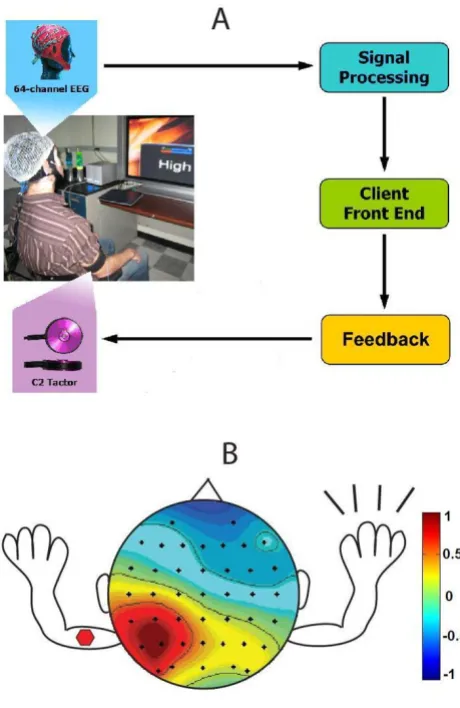
Subjects used a three-state EEG-based BCI to control a parameter in one dimension (see Fig. 1a). Upon hearing an auditory cue of either High or Low, the subject would use the corresponding motor imagery task to move the parameter value to opposite levels. Two methods of feed-back were supported for the BCI; 1) a visual interface that showed the parameter position on a horizontal bar on a monitor 3 ft from the subject and 2) a vibrotactile feed-back system that conveyed the parameter state by modu-lating the pulse rate of a vibrating voice coil motor placed on the subject's arm. Subjects were trained with both the visual and vibrotactile interfaces simultaneously, and then moved to the vibrotactile interface only for data col-lection. The location of the vibration was also systemati-cally varied between arms to investigate location-dependent effects on performance (see Fig. 1b).
shown in Fig. 2 mirrored the vibrotactile stimulus, incre-menting or decreincre-menting in 7 discrete levels, and with
Low and High target endpoints at the extreme left and right respectively.
A total of six healthy male adults (aged 21–25) partici-pated in the study. Subjects A, B, D and F had no previous BCI training, while Subjects C and E had 25 and 12 hours of previous BCI training respectively. Informed consent was obtained from all subjects, and all data were collected under certification from the Johns Hopkins University Institutional Review Board.
EEG Data Acquisition
EEG was acquired using a Neuroscan SynAmps2
64-chan-nel amplifier from Compumedics (El Paso, TX). A Quick-Cap 64-channel EEG cap (modified 10–20 system) from Neuroscan was used for data acquisition; referenced between Cz and CPz, and grounded anteriorly to Fz.
The SynAmps2 amplifier and signal processing modules
were connected through client-server architecture, with the amplifier acting as the server and the signal processing module running on a stand-alone client PC. Data were sampled at 250 Hz and transmitted over a TCP/IP proto-col to the client PC for storage and real-time signal processing using a custom BCI platform.
Mu-Band Extraction with Hierarchical Classifiers
The control signal output by the BCI was based on extract-ing peak Mu-band power, which is well known to be mod-ulated by motor imagery [21-23]. In general, the EEG activity for right hand and left hand motor imagery were focused at electrodes C3 and C4, respectively, which over-lay the M1 hand area [24]. A large Laplacian spatial filter was applied by re-referencing each electrode to the mean of its next-nearest neighboring electrodes [25].
The spatially filtered EEG activity from each electrode was modeled as an autoregressive (AR) process over a sliding temporal window of duration TW s shifting every TS s,
y n a y n kk n k
K
[ ]= [ − +] [ ]
=
∑
0ε (1)
Visual Interface
Figure 2
Visual Interface. Visual interface displaying horizontal bar that is proportional to level of vibrotactile feedback. A) shows bar when Low cue is reached (Level 1) successfully, B) shows bar at beginning of each trial (Level 4), and C) shows bar when High cue is reached (Level 7).
Experimental Setup
Figure 1
where ak were the autoregressive coefficients, K was the model order, and ε[n] was an independent identically dis-tributed stochastic sequence with zero mean and variance
σ2 [26]. T
W and TS were typically chosen to be 2 s and 250
ms, respectively, with a model order K of 12–15. Model orders above this range have been shown to yield minimal improvements in regression accuracy of the sensorimotor rhythm [27]. Burg's method [28] was used to estimate the time-varying AR coefficients.
The power spectral density (in dB) of the AR process for each electrode was then computed as,
P(ω) = 10 log(h(ω)) (2)
and the peak mu-band power was extracted at discrete times tk,
PC3(tk) = max(PC3(ωµ)) (3)
PC4(tk) = max(PC4(ωµ)) (4)
where ωµis the frequency range of the mu-band (8–12 Hz).
A novel two-stage hierarchical linear classification scheme was used to generate the final output control signal. A gat-ing classifier G was designed to distinguish between motor imagery ERD and relaxation,
where w1G, w2G, BG, and TG were the weights, bias, and threshold, respectively, determined online for each sub-ject. A second movement classifier M was designed to dis-tinguish between right hand and left hand motor imagery tasks,
where w1M, w2M, BM, and TM are the weights, bias, and threshold, respectively, determined online for each sub-ject. The final output F(tk) was the product of the two clas-sifiers,
F(tk) = G(tk) × M(tk) (7)
where +1 corresponds to right-hand movement, -1 to left-hand movement, and 0 to relaxation. A classifier decision was made every 250 ms.
This 3-type classification is highly appropriate for pros-thetic applications, where a user controlling a prospros-thetic device will require an easily-maintained "rest" state. This is achieved with a gating classifier. Only when the subject is actively trying to produce a movement (e.g. open or close a prosthetic hand) does the movement classifier dis-tinguish the movement type.
Vibrotactile Feedback System
Vibratory feedback was provided by a C2 voice coil tactor from Engineering Acoustics, Inc. (Winter Park, FL), which was placed on the biceps with an elastic cuff. Feedback at this location has been used in previous studies testing haptic feedback with prosthetic technology [18-20]. Fur-thermore, psychophysical responses to stimulation in this location have been well-characterized [29].
The vibratory stimulus waveform was a series of discrete pulses with a fixed duty cycle of 50%. The waveform was modulated by varying the width of the pulses to change the pulse rate. Shorter, more rapid pulses were perceived as an increase in stimulus intensity, and longer, less rapid pulses were perceived as a decrease in stimulus intensity. The vibration carrier frequency for each pulse was 200 Hz in order to maximally stimulate high-frequency Pacinian mechanoreceptors [30].
The range of vibration waveforms comprised of 7 discrete pulse rates. A BCI classifier output of +1 generated by right hand motor imagery increased the pulse rate, while a clas-sifier output of -1 generated by left hand motor imagery decreased the pulse rate. A classifier output of 0, implying relaxation, kept the pulse rate constant. All cues and suc-cess/failure indicators were presented to the subject audi-bly through headphones. In addition, to ensure that the subject was responding to purely the tactile sensation, the headphones played white noise throughout the trial that masked any audible vibrations from the tactor.
Subject Training
Each subject underwent a training period at the beginning of the study in order to determine the thresholds for the gating classifier and movement classifier. During this time the subject practiced right and left hand motor imagery tasks to modulate his Mu rhythm while the classifier parameters were optimized. For each classifier, the thresh-olds were set halfway between the average mu rhythm powers for the two separable states. These values were set manually for each subject using a utility that allowed the
where h
a e i a eK iK ( ) ... ω σ ω ω = + − + + − 2 1 2 1
G t if w P t w P t B T
else
k G C k G C k G G
( )= ( )+ ( )+ <
1 1 2
0
3 4
(5)
M t if w P t w P t B T
else
k M C k M C k M M
( )= + ( )+ ( )+ <
−
1 1 2
1
3 4
operator to visualize and adjust the parameters online. Once the optimal weights and biases were selected during this training period, they remained constant for the dura-tion of the study for that subject. Total training time var-ied due to subject to subject learning variations (ranging from 10 min. for experienced Subject D to 30 min. for novice Subject A). After the final optimization, the subject was allowed to rest for 5 min prior to the start of the study.
Study Design: BCI Control of Vibrotactile Stimulus
The task was designed to test the subject's ability to oper-ate a BCI to control the strength of a vibrotactile stimulus. As shown in the timing diagram in Fig. 3, each experimen-tal trial began with a variable 3–8 s rest period, at the end of which the subject was presented with an auditory Ready
cue. Following the Ready period of 1 s, either a Low or High
cue was given to the subject audibly. The cues were pro-vided through the headphones and overlaid the white noise. The trial ended successfully if the subject reached the intended vibration level and maintained this position for 1 s. The trial ended with failure in two ways: 1) failure at timeout if the subject could not complete the task in 15 s and 2) immediate failure if the subject reached and maintained the incorrect vibration level for 1 s.
A single recording session consisted of a training period and a testing period. During the training period, the sub-ject performed a variable number of training sets; each consisting of 10 trials with five High and five Low cues pre-sented in a pseudorandom order. These training sets were performed with both visual feedback and a constant level of vibrotactile stimulation on the right biceps. In this phase of the experiment, the vibrotactile stimulation did not convey any information, but was present to
acclima-tize the subject to the conditions of the testing period. Subjects completed multiple training sets until they achieved a success rate of 60% – at which point they moved on to the testing period.
During the testing period, the subject completed six trial sets; each consisting of 20 trials with 10 High and 10 Low
cues presented in a pseudorandom order. The first two testing sets were performed with both visual feedback and vibrotactile feedback so the subject could map changes in the vibrotactile stimulation to the visual display. The posi-tion of the tactor was varied between trial sets so that the feedback alternated between left and right arm. The remaining four testing sets were performed with only vibrotactile feedback (and alternating tactor placement). The entire recording session ran for approximately 2 hours, including 2 minute breaks between trial sets and additional break time as needed.
Results
Performance Measures for BCI
Accuracy was defined as the percentage of trials where the subject completed the BCI control task successfully. Latency was defined as the time required to complete the task successfully. Accuracy and latency results for vibrotac-tile feedback trials are reported in Table 1 for each subject, separated by trials where the tactor was placed ipsilateral or contralateral to the motor imagery.
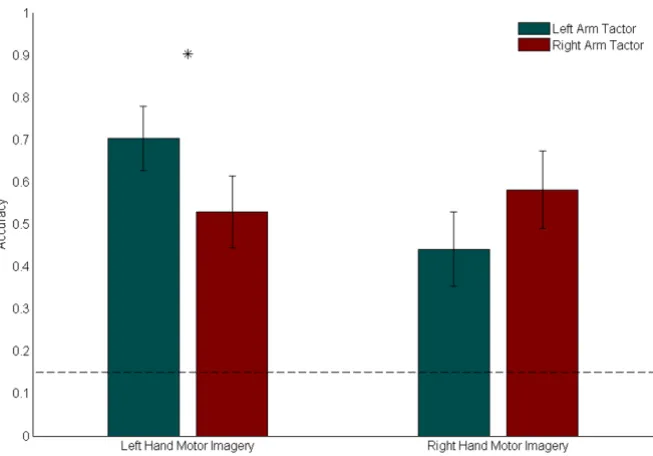
Accuracy statistics were calculated for trials where the sub-ject received only vibrotactile feedback. The average accu-racy results across all subjects, separated by both motor imagery and tactor placement, are presented in Fig. 4. The data show that on average, subject accuracy was 56%,
Trial Timing Diagram
Figure 3
which was significantly larger than the probability of ran-domly achieving success, as outlined below.
Due to the use of a three-state classifier, and the fact that the subject must maintain the Low or High vibration level for 1 s, the probability of randomly succeeding was 15%. Since a classifier decision was made every 250 ms and the timeout period for each trial was 15 s, there was a maxi-mum of 60 classification outputs per trial. The user began each trial from a mid-vibration level, and seven consecu-tive outputs of +1(-1) were needed to reach the maxi-mum(minimum) vibration level. To successfully
complete the trial, the user then had to maintain the cor-rect vibration level for an additional 1 s, or four classifica-tion outputs. Therefore, the fastest a user could complete a trial was 2.75 s. Assuming a 1:1 classification distribu-tion between 0/+1 for the gating classifier, and a 1:1 clas-sification distribution between +1/-1 for the movement classifier, a random walk over 10,000 simulated trials yielded an average success rate of 15%.
Fig. 4 also suggests that the accuracy for particular cues varied with tactor placement. Tests for significant differ-ence in medians between left arm and right arm accuracies
Accuracy Comparison
Figure 4
Accuracy Comparison. Means and standard errors of accuracies across all subjects, separated by motor imagery and tactor location. The dotted line indicates the success rate expected through random chance (15%). For Low cues (which required left hand motor imagery), mean accuracy was statistically significantly higher with vibratory stimulus on the left arm (p = 0.031). For High cues (which required right hand motor imagery), mean accuracy was higher with the stimulus on the right arm.
Table 1: BCI Performance Results. Accuracy and latency results are reported for each subject, separated by trials where tactor was placed ipsilateral or contralateral to the motor imagery. Accuracies for trials with ipsilateral placement are generally higher than accuracies for trials with contralateral placement.
ACCURACIES LATENCIES
SUBJECT ID Ipsilateral Contralateral Ipsilateral (s) Contralateral (s)
A 65% 70% 8.58 7.62
B 48% 30% 8.93 9.86
C 53% 27% 8.15 8.14
D 64% 57% 7.68 7.40
E 86% 58% 8.46 7.57
were performed using the Wilcoxon Sign Rank test. Dur-ing trials with a Low cue (which required left hand motor imagery), average performance was significantly better with the tactor on the left biceps (p = 0.031). During trials with a High cue (which required right hand motor imagery), the average performance was better with the tac-tor on the right biceps, although the increase was not sta-tistically significant (p = 0.150). The general trend appears to be that the vibrotactile stimulus biases results in favor of the outcome requiring motor imagery of the hand ipsi-lateral to the tactor location.
Latency statistics were also computed for the trials where the subject received only vibrotactile feedback. The aver-age latency results across all subjects, separated by both motor imagery and tactor placement, are presented in Fig. 5. A comparison of medians using the Mann-Whitney U test shows that during trials with a Low cue (which required left hand motor imagery), average latencies were significantly longer by 1.04 s with the tactor on the left biceps (p = 0.046). Similarly, during trials with a High cue (which required right hand motor imagery), average
latencies were significantly longer by 0.92 s with again the tactor on the left biceps (p = 0.033).
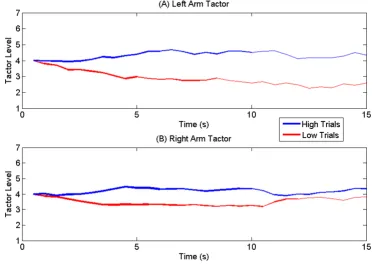
Trajectory plots were generated to visualize the subjects' control throughout the duration of the trial. A mean tra-jectory plot for all trials with the tactor placed on the left arm is shown in Fig. 6a, and with the tactor placed on the right arm in Fig. 6b. Since the trajectory duration for each trial varied with subject performance, the thickness of the mean trajectory is drawn proportional to the number of trials that reached that length of time (this value drops with time due to early successes and failures). The mean trajectory is shown in blue for trials with a High cue (which required right hand motor imagery) and in red for trials with a Low cue (which required left hand motor imagery). Trials with the tactor on the left arm (Fig. 6a) showed faster divergence and a clearer separation between
Low and High mean trajectories.
EEG Data Analysis
In addition to performance statistics, the peak Mu-band powers from electrodes C3 (PC3) and C4 (PC4) were
Latency Comparison
Figure 5
recorded for all subjects and analyzed using EEGLAB v. 5.02 (Schwartz Center for Comp. Neurosci., UCSD, CA) [31]. Since the movement classifier accepts the weighted difference of these values (see Eq. 6), a plot of (PC3 -PC4) characterizes the subjects' Mu-band activity and allows for the separation of left and right hand motor imagery pat-terns. These plots were averaged across all trials and sub-jects. The cumulative plot with standard error bars is shown in Fig. 7. The results for right hand motor imagery trials (High cues) are shown in Fig. 7a and the results for left hand motor imagery trials (Low cues) are shown in Fig. 7b.
Fig. 7 shows that tactor placement tended to disturb the control signal early on in the trial, but that this influence was reduced as the trial progressed. Contralateral place-ment showed greater deviation from ipsilateral placeplace-ment in left arm tactor trials, indicating a greater separation in performance in left arm trials, which is consistent with the trajectory analysis. In general, the contralateral and ipsi-lateral traces merged as the trial progressed, indicating that the tactor bias effects weakened as the trial progressed and the user compensated for the vibrotactile stimulation.
Discussion
BCI Feedback Represents Haptic Information
To successfully complete our task, the subject was required to drive a parameter from an initial medium state to either a low or a high state and maintain it for 1 s. The low and high states represented discrete regions of a 2-D space with a third neutral state between them. The ration-ale for selecting this type of task is based on the applica-tion of a BCI to the context of upper-limb prosthetics. The primary motivation for pursuing vibrotactile biofeedback is to develop a method whereby haptic information can be provided to the user in an appropriate manner. One can imagine a BCI user controlling an advanced neuro-prosthesis to grasp an object. Just as robotic mechanisms in teleoperation systems transmit forces from the end-effector to the operator, this advanced prosthesis is instru-mented with force sensors so that force information can be transmitted to the user. A compact and safe vibrotactile feedback system is used to convey this force information and as a result, the BCI operator's ability to interpret and modulate his grasping force is improved.
Trajectory Comparison
Figure 6
With this application in mind, the appropriate BCI task is not the selection of a particular state as in a hierarchical selection tree, but rather the direct control of a certain parameter whose state is conveyed through biofeedback. If the vibrotactile intensity is thought to represent grip force strength, then the task of driving the intensity high (through right hand motor imagery) may be thought of as squeezing a grasped object while driving the intensity low (through left hand motor imagery) would represent releasing the object. Furthermore, maintaining a constant intensity level (through relaxation) would be equivalent to maintaining a steady hold on the object. The develop-ment of a three-state, self-paced BCI based on simple motor movement was motivated by this intended neuro-prosthesis control paradigm and proved sufficient to test the efficacy of a vibrotactile feedback system. It should be noted that more complex BCIs that operate using different control paradigms may interact with haptic stimuli differ-ently.
Establishing BCI Performance Capability
Accuracy and latency statistics are the preferred methods in literature for quantifying the performance of a BCI
[32-34]. However, due to the nature of our defined task, per-formance figures from this study should not be compared to results from BCIs designed for different purposes. Unlike a typical two-state selection paradigm, the random chance of success is not 50%, but actually much lower due to the difficulty of the task as described in the previous section. The effectiveness of this control scheme is estab-lished by demonstrating that accuracies across all cues and tactor locations were significantly higher than the 15% random chance of success.
The accuracies from the vibrotactile feedback trials dem-onstrate that vibrotactile stimulation is an effective means to provide feedback information in 1-D. Considering the fact that four of the six subjects had no prior BCI experi-ence, additional training sessions would likely improve performance further, as expected with any BCI paradigm. The learning process for this feedback modality was facil-itated by the study protocol, which was designed to intro-duce the vibrotactile biofeedback by associating it with a commonly used visual feedback system. The sequential process of training the subject with visual feedback, map-ping the visual feedback to the vibrotactile feedback, and Mu Band Power
Figure 7
then finally testing with vibrotactile feedback, allowed the subject to mentally associate the different stimulus modalities. This type of paired stimulus presentation has been used successfully in prior studies of haptic feedback training [35,36] and studies of associative learning [37].
Tactor Placement Bias
The accuracy data also indicated that a significant bias was introduced with regards to the tactor placement location. Left arm tactor placement led to better performance for
Low cues and right arm tactor placement led to better per-formance for High cues. Since Low and High were mapped to left and right hand imagery respectively, it appears that the tactor bias is consistent with either an enhancement of Mu rhythm desynchronization from ipsilateral hand imagery or an inhibition of Mu rhythm desynchroniza-tion from contralateral hand imagery. These results are summarized in Fig. 8.
The offline analysis of EEG data suggests that the latter case is true. The plots of the difference in peak Mu-band power from between C3 and C4 show that, on average, contralateral vibrotactile stimulation produces deviations in the signal in the first second of the trial. The contralat-eral and ipsilatcontralat-eral average traces eventually converge, indicating that subjects were able to overcome the vibra-tory influence to an extent. If so, the tactor bias is under some level of voluntary control and may be mitigated with greater concentration and training time. This hypoth-esis is supported by impressions from subjects who noted that vibrotactile feedback tended to draw attention to the stimulated hand. Although this inadvertent attention
might lead to changes similar to those associated with motor imagery, most subjects reported that they were able to consciously re-focus on the required motor imagery task while maintaining their awareness of the information from the vibrotactile feedback.
The mean trajectory plots suggest that average subject per-formance is different for tactor placement on the left arm versus the right arm, as evidenced by a higher rate of diver-gence and earlier point of separation between Low and
High trials for mean left arm trajectories. This could be due to a combination of a) faster successes during Low tri-als leading to the early divergence, and b) faster failures during High trials which keep the average trajectories sep-arate at later stages of the trial. These results are supported by the accuracy data, which show that on average, ipsilat-eral left arm Low trials were the most accurate (70%) while contralateral left arm High trials were the least accurate (44%).
While a significant disparity exists between ipsilateral and contralateral motor imagery accuracies with the tactor on the left arm, the disparity is muted with the tactor on the right arm (58% for ipsilateral vs. 53% for contralateral). Furthermore, the average latency of trials with the tactor on the left arm was 0.98 s longer than trials with the tactor on the right arm with a high statistical significance. It is possible that the training protocol of acclimating our sub-jects with right arm tactor stimulation may have led them to better adapt to motor imagery tasks with the feedback at this location. It should also be noted that the tactor bias results are averaged from only two experienced subjects and four novice subjects. It remains to be seen whether sufficient training with the vibrotactile stimulus at alter-nate locations can reduce the difference in performance between ipsilateral and contralateral motor imagery tasks.
The bias effect may be mitigated through training as well as modifications to the BCI signal processing. Adjusting the thresholds and weights for the linear classifier appro-priately, possibly by introducing an adaptive algorithm, could compensate for the stimulation and reduce this bias. Adaptive algorithms have been utilized in some of the latest BCIs to improve robustness against changes in brain dynamics brought about by fatigue and other factors [3,38]. These methods adjust the weights and biases of the classifiers on a trial-by-trial basis by using optimization algorithms such as Least-Mean-Squares method [23]. Fur-ther work will be needed to determine if similar methods can adapt to the vibrotactile stimulation during real-time BCI classification.
Conclusion
A tactile information channel will be a critical component of any BCI designed to control an advanced neuropros-Summary Accuracy Comparison
Figure 8
Summary Accuracy Comparison. This representative
thetic device. To test the efficacy of this approach, a motor imagery BCI was enhanced with a vibrotactile feedback channel to convey 1-D information. A hierarchical classi-fication scheme was used to generate output appropriate for prosthesis grasping tasks. Subjects were initially trained to perform BCI control tasks with a visual feed-back system and were then migrated to the vibrotactile feedback system. The performance results show that all subjects were able to operate a three-state motor imagery BCI using only vibrotactile biofeedback, but that varia-tions in tactor placement led to a notable bias in accuracy. The EEG data indicate that the choice of vibrotactile stim-ulus location biased the user's modulation of Mu-rhythm activity towards desynchronization generated by imagery of the ipsilateral hand. Analysis of latency and trajectory data indicate that preferences for stimulation location may be affected by the training protocol. Further work will be needed to determine exactly how the neural correlates of vibrotactile feedback affect the modulation of Mu-rhythm activity and to determine optimal signal process-ing techniques to account for the feedback. In conclusion, the successful incorporation of training procedures and mechanisms to compensate for vibrotactile feedback bias in BCI platforms will aid the development of haptic bio-feedback systems for neuroprosthetic and other applica-tions.
Authors' contributions
AC participated in study design, running the experiments, data analysis, and drafted the manuscript. VA participated in running the experiments, data analysis, and drafted the manuscript. AR participated in running the experiments and data analysis. SA participated in study design and run-ning the experiments. NVT participated in study design and supervised the research. All authors read and approved of the final manuscript.
Acknowledgements
The authors thank Dongwon Lee, Yoonju Cho, Brandon O'Rourke, and Rob Rasmussen for their contributions towards development of the BCI platform used for this experiment. This study was supported by the Defense Advanced Research Projects Agency, under the Revolutionizing Prosthetics 2009 Program.
References
1. Trejo LJ, Rosipal R, Matthews B: Brain-computer interfaces for 1-D and 2-1-D cursor control: designs using volitional control of the EEG spectrum or steady-state visual evoked potentials.
IEEE Trans Neural Syst Rehabil Eng 2006, 14:225-229.
2. Vaughan TM, McFarland DJ, Schalk G, Sarnacki WA, Krusienski DJ, Sellers EW, Wolpaw JR: The Wadsworth BCI Research and Development Program: at home with BCI. IEEE Trans Neural Syst Rehabil Eng 2006, 14:229-233.
3. Vaughan TM, Wolpaw JR: The Third International Meeting on Brain-Computer Interface Technology: making a difference.
IEEE Trans Neural Syst Rehabil Eng 2006, 14:126-127.
4. Birbaumer N, Kubler A, Ghanayim N, Hinterberger T, Perelmouter J, Kaiser J, Iversen I, Kotchoubey B, Neumann N, Flor H: The thought translation device (TTD) for completely paralyzed patients.
IEEE Trans Rehabil Eng 2000, 8:190-193.
5. Blankertz B, Dornhege G, Krauledat M, Muller KR, Kunzmann V, Losch F, Curio G: The Berlin Brain-Computer Interface: EEG-based communication without subject training. IEEE Trans Neural Syst Rehabil Eng 2006, 14:147-152.
6. Atkins DJ, Heard DCY, Donovan WH: Epidemiologic Overview of Individuals with Upper-Limb Loss and Their Reported Research Priorities. J Prosth Orth 1996, 8:2-11.
7. Nelson VS, Flood KM, Bryant PR, Huang ME, Pasquina PF, Roberts TL:
Limb deficiency and prosthetic management. 1. Decision making in prosthetic prescription and management. Arch Phys Med Rehabil 2006, 87:S3-9.
8. Roeschlein RA, Domholdt E: Factors related to successful upper extremity prosthetic use. Prosthet Orthot Int 1989, 13:14-18. 9. Abbott A: Neuroprosthetics: in search of the sixth sense.
Nature 2006, 442:125-127.
10. Schwartz AB, Cui XT, Weber DJ, Moran DW: Brain-controlled interfaces: movement restoration with neural prosthetics.
Neuron 2006, 52:205-220.
11. Taylor DM, Tillery SI, Schwartz AB: Direct cortical control of 3D neuroprosthetic devices. Science 2002, 296:1829-1832. 12. Hochberg LR, Serruya MD, Friehs GM, Mukand JA, Saleh M, Caplan
AH, Branner A, Chen D, Penn RD, Donoghue JP: Neuronal ensem-ble control of prosthetic devices by a human with tetraple-gia. Nature 2006, 442:164-171.
13. Carmena JM, Lebedev MA, Crist RE, O'Doherty JE, Santucci DM, Dimitrov DF, Patil PG, Henriquez CS, Nicolelis MA: Learning to control a brain-machine interface for reaching and grasping by primates. PLoS Biol 2003, 1:E42.
14. Kaczmarek KA, Webster JG, Bach-y-Rita P, Tompkins WJ: Electro-tactile and vibroElectro-tactile displays for sensory substitution sys-tems. IEEE Trans Biomed Eng 1991, 38:1-16.
15. Benali KM, Hafez M, Alexandre JM, Kheddar A: Tactile Interfaces: A State of the Art Survey: 24-26 March 2004; Paris, France.
; 2004.
16. Shannon GF: Sensory feedback for artificial limbs. Med Prog Technol 1979, 6:73-79.
17. Shannon GF: A comparison of alternative means of providing sensory feedback on upper limb prostheses. Med Biol Eng 1976,
14:289-294.
18. Meek SG, Jacobsen SC, Goulding PP: Extended physiologic tac-tion: design and evaluation of a proportional force feedback system. J Rehabil Res Dev 1989, 26:53-62.
19. Patterson PE, Katz JA: Design and evaluation of a sensory feed-back system that provides grasping pressure in a myoelec-tric hand. J Rehabil Res Dev 1992, 29:1-8.
20. Pylatiuk C, Kargov A, Schulz S: Design and evaluation of a low-cost force feedback system for myoelectric prosthetic hands.
Journal of Prosthetics and Orthotics 2006, 18:57-61.
21. Wolpaw JR, McFarland DJ: Multichannel EEG-based brain-com-puter communication. Electroencephalogr Clin Neurophysiol 1994,
90:444-449.
22. Pineda JA, Silverman DS, Vankov A, Hestenes J: Learning to control brain rhythms: making a brain-computer interface possible.
IEEE Trans Neural Syst Rehabil Eng 2003, 11:181-184.
23. Wolpaw JR, McFarland DJ: Control of a two-dimensional move-ment signal by a noninvasive brain-computer interface in humans. Proc Natl Acad Sci U S A 2004, 101:17849-17854. 24. Guger C, Ramoser H, Pfurtscheller G: Real-time EEG analysis
with subject-specific spatial patterns for a brain-computer interface (BCI). IEEE Trans Rehabil Eng 2000, 8:447-456. 25. Ramoser H, Muller-Gerking J, Pfurtscheller G: Optimal spatial
fil-tering of single trial EEG during imagined hand movement.
IEEE Trans Rehabil Eng 2000, 8:441-446.
26. Bos R, deWaele S, Broersen PMT: Autoregressive spectral esti-mation by application of the Burg algorithm to irregularly sampled data. IEEE Trans Instrum Meas 2002, 51:1289.
27. Krusienski DJ, McFarland DJ, Wolpaw JR: An evaluation of autore-gressive spectral estimation model order for brain-compu-ter inbrain-compu-terface applications: Aug 30 - Sept 3; New York City, USA. ; 2006:1323-1326.
28. Burg JP: Proc. 37th Meeting Soc. Exploration Geophys. 1967. 29. Cholewiak RW, Collins AA: Vibrotactile localization on the arm: effects of place, space, and age. Percept Psychophys 2003,
65:1058-1077.
Publish with BioMed Central and every scientist can read your work free of charge "BioMed Central will be the most significant development for disseminating the results of biomedical researc h in our lifetime."
Sir Paul Nurse, Cancer Research UK
Your research papers will be:
available free of charge to the entire biomedical community
peer reviewed and published immediately upon acceptance
cited in PubMed and archived on PubMed Central
yours — you keep the copyright
Submit your manuscript here:
http://www.biomedcentral.com/info/publishing_adv.asp
BioMedcentral
events in mechanoreceptive afferent nerve fibers innervat-ing the monkey hand. J Neurophysiol 1972, 35:122-136. 31. Delorme A, Makeig S: EEGLAB: an open source toolbox for
analysis of single-trial EEG dynamics. Journal of Neuroscience Methods 2004, 134:9-21.
32. McFarland DJ, Sarnacki WA, Wolpaw JR: Brain-computer inter-face (BCI) operation: optimizing information transfer rates.
Biol Psychol 2003, 63:237-251.
33. Sellers EW, Krusienski DJ, McFarland DJ, Vaughan TM, Wolpaw JR: A P300 event-related potential brain-computer interface (BCI): the effects of matrix size and inter stimulus interval on performance. Biol Psychol 2006, 73:242-252.
34. Kronegg J, Voloshynovskiy S, Pun T: Analysis of bit-rate defini-tions for Brain-Computer Interfaces: June 20-23; Las Vegas, Nevada. ; 2005.
35. Feygin D, Keehner M, Tendick R: Haptic guidance: experimental evaluation of a haptic training method for a perceptual motor skill: 3/24/2002 - 3/25/2002; Orlando, FL, USA. ; 2002:40-47.
36. Ernst M, Banks M: Does vision always dominate haptics: ; Uni-versity of Southern California. ; 2001.
37. Molchan SE, Sunderland T, McIntosh AR, Herscovitch P, Schreurs BG:
A functional anatomical study of associative learning in humans. Proc Natl Acad Sci U S A 1994, 91:8122-8126.