Insulin-like growth factor-I peptides act centrally
to decrease depression-like behavior of mice
treated intraperitoneally with lipopolysaccharide
Park
et al
.
R E S E A R C H
Open Access
Insulin-like growth factor-I peptides act centrally
to decrease depression-like behavior of mice
treated intraperitoneally with lipopolysaccharide
Sook-Eun Park
1,2,4, Marcus Lawson
1,2,3, Robert Dantzer
1,2,3,4, Keith W Kelley
1,2,3,4and Robert H McCusker
1,2,3,4*Abstract
Centrally administered insulin-like growth factor (IGF)-I has anti-depressant activity in several rodent models, including lipopolysaccharide (LPS)-induced depression. In this study we tested the ability of IGF-I and GPE (the N-terminal tri-peptide derived from IGF-I) to alter depression-like behavior induced by intraperitoneal (i.p.)
administration of LPS in a preventive and curative manner. In the first case, IGF-I (1μg) or GPE (5μg) was administered i.c.v. to CD-1 mice followed 30 min later by 330μg/kg body weight i.p. LPS. In the second case, 830
μg/kg body weight LPS was given 24 h prior to either IGF-I or GPE. When administered i.p., LPS induced full-blown sickness assessed as a loss of body weight, decrease in food intake and sickness behavior. None of these indices were affected by IGF-I or GPE. LPS also induced depression-like behavior; assessed as an increased duration of immobility in the tail suspension and forced swim tests. When administered before or after LPS, IGF-I and GPE abrogated the LPS response; attenuating induction of depression-like behaviors and blocking preexistent depression-like behaviors. Similar to previous work with IGF-I, GPE decreased brain expression of cytokines in response to LPS although unlike IGF-I, GPE did not induce the expression of brain-derived neurotrophic factor (BDNF). LPS induced expression of tryptophan dioxygenases, IDO1, IDO2 and TDO2, but expression of these enzymes was not altered by GPE. Thus, both IGF-I and GPE elicit specific improvement in depression-like behavior independent of sickness, an action that could be due to their anti-inflammatory properties.
Keywords:IGF-I, depression-like behavior, sickness, lipopolysaccharide
Background
There is accumulating evidence that depression may develop in response to activation of the innate immune system [1-3]. Exposure of volunteers to a low dose of endotoxin induces depressed mood that correlated with cytokine expression, independent of sickness behaviors [4]. Recently, a low dose of endotoxin given to volun-teers was for the first time shown to induce anhedonia, one of the primary features (diagnostic = DSM IV) for depression [5]. An increase in negative affect follows typhoid vaccine injections and similar to endotoxin exposure, these mood changes correlate with the induc-tion of cytokine secreinduc-tion [6]. Studies such as these pro-vide a correlation between mood changes and
inflammation, but a direct cause-effect link between activation of the innate immune system and mood changes came with human cytokine immunotherapy. Cancer immunotherapy and cytokine treatment for hepatitis C viral infection induces symptoms of depres-sion in a significant percentage of patients [7,8]. These symptoms develop on a background of neurovegetative symptoms that are very similar to inflammation-induced sickness behavior [3]. Together with the Reichenberg study [4] showing a dissociation between depression and overt sickness, there is now strong evidence that depres-sion does not fully overlap with sickness and that depression may be caused by cytokines in the brain.
In a rodent preclinical model, activation of the immune system reliably induces depression-like behavior assessed by several criteria including decreased prefer-ence for a sweetened (saccharin) solution over water, as an index of anhedonia, decreased sexual behavior [9],
* Correspondence: [email protected] 1
Integrated Immunology and Behavior Program, University of Illinois at Urbana-Champaign, Urbana, Illinois 61801-3873, USA
Full list of author information is available at the end of the article
decreased preference for a sweetened (sucrose) solution over water, increased time of immobility during the forced swim test (FST) [10] and increased time of immobility during the tail suspension test (TST) [11]. LPS induces transient sickness with the changes in pre-ference for a sweetened solution or immobility in the FST and TST still being evident after the disappearance of sickness; i.e. after locomotor activity, social explora-tion of a novel juvenile, body weight or food intake have normalized. These depression-like behaviors are reversed by anti-depressants and importantly by minocy-cline which attenuates LPS-induced expression of brain cytokines [9,11-14]. In all of these studies, depression-like behaviors continued after the acute immune response that was induced by LPS and the minocycline study clearly indicated that the cytokine response was requisite for the development of depression-like beha-viors. These types of studies support the human data that inflammation is causative in the development or maintenance of depressive disorders.
Until recently, IGF-I has not been evaluated for anti-depression actions on a background of inflammation. We showed that i.c.v. IGF-I did not affect the acute sickness response that was induced by i.c.v. LPS. In contrast, IGF-I tempered cytokine expression and depression-like behavior [11]. In that study, IGF-I also increased the central expression of BDNF, a neurotro-phin with well-characterized anti-depressant activity. For that work, gene expression was quantified in cDNA prepared from the entire perfused brain of mice [11,13]. Whether, the LPS or IGF-I responses were glo-bal or localized with a specific brain region was not examined. However, following a single LPS injection, pro-inflammatory cytokines, IL-1b, TNFa and IL-6 are all similarly elevated in the hippocampus and frontal cortex of mice [15]. Following repeated LPS injections, IL-1b is elevated in the frontal cortex, hippocampus and striatum [16]. These studies suggest that LPS induces a global inflammatory response within the brain and justified our previous use of total brain mRNA as the source for cDNA to quantify an immune response following LPS. However, it is clear from stu-dies with humans that the frontal cortex plays a unique role in depression [17-20]. Similarly with rodents, electrical stimulation of the frontal cortex eli-cits hedonic vocalizations [21], whereas lesions reduce play behavior [22]. The antidepressant effect of fluoxe-tine on immobility in the TST was shown to correlate with BDNF expression in the frontal cortex, but not in the hippocampus [23] implicating a unique role for the frontal cortex in depression-like behavior of mice. Thus in the current study, expression of genes asso-ciated with inflammation were quantified in the frontal cortex of mice.
IGF-I is well recognized as a neuroprotective hormone and paracrine growth factor displaying activities in a variety of neuropathologies [24,25]. IGF-I is cleaved within the brain to release an N-terminal tripeptide [26]. GPE, like IGF-I, is neuroprotective bothin vivoand in vitro[27]. Lower amounts of GPE provide protection when given i.c.v. compared to i.p. suggesting a central site of action; indeed GPE does not appear to act out-side the nervous system. Thus GPE may represent a centrally active IGF-derivative, separating it from the global role of IGF-I. Importantly, purification of IGF-I from brain yields IGF-I lacking the first 3 amino acids [26,28,29] suggesting that GPE is naturally produced in the brain. Indeed, GPE is found in the normal brain [30] and a protease that releases GPE is found in brain [31,32]. Protease inhibitors, that prevent the release of GPE from IGF-I, block IGF-I inhibition of GNRH secre-tion [33,34]. This later finding strongly suggests that GPE mediates at least part of the central action of IGF-I. These finding suggest that GPE is a natural product of central IGF-I and has naturalistic neuroprotective actions. A central function for GPE, outside of cell sur-vival such as behavior modification, has not been reported. The current study shows that like IGF-I its’ natural cleaved product, GPE, has behavior modifying activity. In the present series of experiments, we show that both IGF-I and GPE administered centrally are able to prevent and cure depression-like behavior induced by peripheral administration of LPS.
Methods
Animals
Male CD-1 mice, 7 to 8 weeks old, were purchased from Charles River Laboratory International, Inc. (Wilming-ton, MA). Mice were group housed in ventilated cages under a 12:12 h reversed light:dark cycle (lights off at 10:00 h) for 2 weeks until surgery. Juvenile, 3 to 4 wk of age, C57BL/6J mice were used as novel targets for tests of social exploration. Food and water was provided ad libitum. Animal care and procedures were conducted with the approval of the University of Illinois’ Institu-tional Animal Care and Use Committee.
Surgery
cure” Teets denture mixture (Co-oral-lte Dental MFG Co, Diamond springs, CA). Mice were individually housed post-surgery in conventional cages with a 2-week recovery period before treatment.
Treatments
Mice were handled for at least 5 days prior to transfer to a room in the behavioral suite 2-3 days before treat-ment. A white noise Marpac soundscreen was used to minimize interference from external sounds while in the behavior suite. Experimental mice were 11 to 12 weeks of age at treatment. All treatments were administered at the end of light phase. IGF-I (recombinant human, Gro-Pep, Adelaide, Australia) was prepared at 1μg/μl, GPE was prepared at 5 μg/μl and LPS (serotype 0127:B8, Sigma, St. Louis, MO) at 33 or 83μg/ml. IGF-I, GPE or 1 μl PBS were administered, injection time approxi-mately 1 min, through the guide cannula and into the lateral cerebral ventricle using a 33-gauge stainless-steel cannula. Therefore, the final dose of IGF-I was 1 μg, which we have previously shown to be active i.c.v. [11], and the final dose of GPE was 5μg, which is within the range tested i.c.v. for neuroprotection [35,36]. LPS was administered i.p. at 10 ml/kg body weight for final doses of 330 or 830 μg/kg body weight. We have previously shown that the higher dose of LPS causes depression-like behavior for at least 24 h assessed using either the forced swim, tail suspension or sucrose preference tests, while locomotor activity is expected to return to normal [10]. The low dose of LPS was determined empirically as a dose that elicits depressive-like behavior after a short acute-phase sickness response. At 330 μg/kg LPS body weight, mice do not present with either sickness or depression-like behaviors at 24 h (data not shown). IGF-I, GPE or PBS were administered either 30 min prior to 330μg/kg LPS or PBS or they were adminis-tered 24 h after 830μg/kg LPS. Treatment combinations are: PBS/PBS (Control), IGF-I or GPE/PBS (IGF-I or GPE), PBS/LPS (LPS) and IGF-I or GPE/LPS (IGF-I + LPS or GPE + LPS). LPS, at 830 μg/kg body weight, induces depression-like behavior that lasts at least 30 h. This time interval presents ample opportunity for IGF-I/ GPE administration to be given post- LPS (at 24 h) while still permitting assessment of depression-like behavior. LPS, at 330μg/kg body weight induces a less intense and more transient sickness response permitting the evaluation of an IGF-I/GPE effect on the develop-ment of depression-like behavior.
Sickness response
Body weight and food weight were recorded before treatment and at various intervals post treatment. Sick-ness associated with LPS administration parallels a loss of body weight and decreased food intake. Social
exploration of novel C57BL/6J juvenile mice and general locomotor activity were used to assess sickness behavior. Social investigation was performed with protected juve-niles; juveniles confined to a 8 × 8 × 11.5 cm wire cage and placed in the corner of the experimental mouse’s home cage [11]. Time spent by the experimental mouse exploring the caged juvenile during the 5 min test inter-val was recorded by a trained person blind to treatment. Social exploration was performed 24 h prior to treat-ment (baseline), then 2 and 6 h after treattreat-ment, using a different juvenile at each time point. Social exploration was used to assess recovery rate during the acute phase of sickness; 2-6 h after LPS administration because it can be administered repeatedly without habituation by the test subject. Locomotor activity (LMA) was recorded by a trained person blind to treatment from 5 min recording of mice placed in a clean cage and was only performed once for each experimental mouse 27 h after treatment with LPS. We use this test to determine the degree of residual sickness behavior when testing for depression-like behavior at a single time point usually 24 to 30 h following LPS. This test was usedin lieu of social exploration because of its simplicity. LMA cannot be used to assess rate of recovery during the acute phase of sickness as it can only be performed once per mouse, due to habituation. LMA was assessed as the number of cage quadrants entered during the test per-iod. All behavioral assessments were performed under red light illumination during the dark phase of the light cycle.
Depression-like behavior
day as LPS treatment (4 h post-treatment) and the fol-lowing day (4 h post-treatment with GPE).
Tissue preparation for real time PCR
Immediately after assessment of behavior, mice were euthanized with CO2 then they were transcardially per-fused with cold PBS. Brains were excised, dissected and frozen on dry ice. The frontal cortex, containing the frontal association, dorsolateral orbital, ventral orbital and prelimbic cortices (first 1 mm of the frontal cortex as defined inThe Mouse Brain[37]), was collected and stored at -80°C until solubilized with TRIzol (Invitrogen Life Technologies, Carlsbad, CA) and RNA prepared as described [11]. RNA was quantified using a Nanodrop ND-1000 spectrophotometer (Nanodrop Technologies, Inc. Wilmington, DE). RNA was reverse transcribed using High Capacity cDNA Reverse Transcription Kits (catalog no. 4368813, Applied Biosystems, Foster city, CA) to prepare cDNA. Real-time rtPCR was performed to quantify steady-state mRNA as described previously [11]. Assays were purchased from Applied Biosystems (Foster City, CA) and amplification performed with a Prism 7900 (Applied Biosystems) and the TaqMan uni-versal PCR master mix (Applied Biosystems, catalog no. 4305719). A 50 ng aliquot of cDNA was used per reac-tion. GAPDH was used to normalize target gene expres-sion. Expression of GAPDH was not affected by any of the treatment combinations (data not shown). Changes in gene expression are expressed as 2-ΔΔCts, where Ct is the cycle threshold. A brief description of the target genes and primers has been presented [11].
Statistical analysis
All data were expressed as mean ± SEM; Data were ana-lyzed by a two-way (IGF-I × LPS) ANOVA using Stat-View (SAS Institute Inc., San Francisco, CA) or SigmaPlot (Systat Software, Inc., San Jose, CA). Where appropriate (social investigation, changes in body weight and food intake), data were analyzed using repeated measures ANOVA. SigmaPlot was used for the prepara-tion of figures. Tukey’s HSD (Honestly Significant Dif-ference) was used for post hoc analysis when a significant interaction was present.
Results
IGF-I does not prevent LPS-induced sickness, but attenuates depression-like behavior
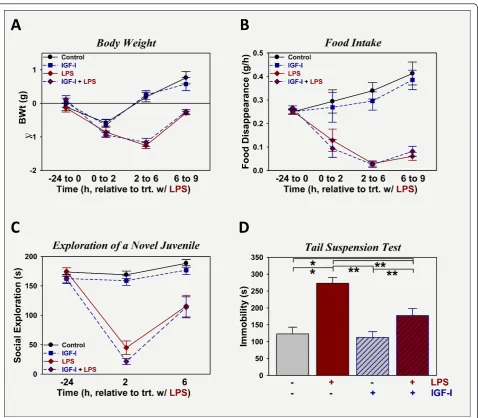
To assess its ability to prevent LPS-induced depression-like behavior, IGF-I was administered i.c.v. 30 min prior to LPS and several assessments were made to quantify sickness and depression-like responses. To investigate the effect of i.c.v. IGF-I on sickness, changes in body weight, food intake and social exploration towards a novel juvenile were assessed (Figure 1). As expected,
LPS administration at 330μg/kg body weight i.p. caused sickness, p < 0.05 evident by all measures. Mice treated with LPS lost body weight (Figure 1A), ate less food (Figure 1B) and spent less time exploring a novel juve-nile mouse (Figure 1C). Mice were recovering between 6 and 9 h post-LPS for all three indices, although less-so for food intake. These are typical responses for this low dose of LPS. Administration of IGF-I i.c.v. did not alter the ability of LPS to induce sickness, being without effect on body weight, food intake and social explora-tions, p > 0.05. Depression-like behavior was assessed by duration of immobility during the tail suspension test (Figure 1D). Duration of immobility was increased by LPS (p < 0.05) and decreased by IGF-I (p < 0.05). The interaction between the two treatments was significant [F (1,80) = 4.9, p < 0.05].Post-hoc analysis revealed that duration of immobility did not differ between controls and mice treated with IGF-I, although time spent immo-bile by mice treated with IGF-I + LPS was still above that of controls or IGF-I, p < 0.05; thus IGF-I did not completely block LPS-induced depression-like behavior. Duration of immobility was highest in mice treated with LPS and was significantly different from that of all other groups, p < 0.05. Thus, similar to our previous work administering both IGF-I and LPS i.c.v. [11], i.c.v. IGF-I has anti-depression like activity, but not anti-sickness activity against i.p. administered LPS.
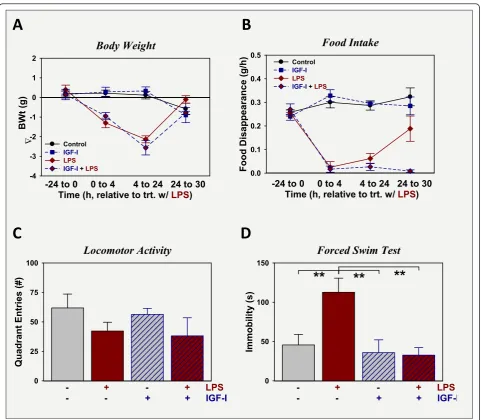
IGF-I does not affect preexisting LPS-induced sickness, but alleviates LPS-induced depression-like behavior
revealed that immobility did not differ between controls, mice treated with I, or mice treated with both IGF-I + LPS, p > 0.05. IGF-In contrast, immobility was highest in mice treated with LPS and was significantly different from all other groups, p < 0.05. Again, IGF-I had anti-depression, but not anti-sickness activity.
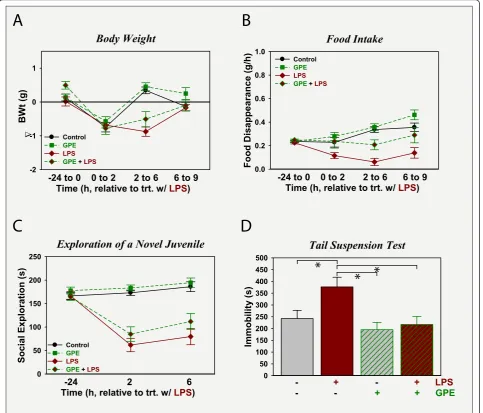
GPE does not prevent LPS-induced sickness, but attenuates depression-like behavior
To assess its ability to prevent LPS-induced depression-like behavior, GPE was administered i.c.v. 30 min prior to LPS to quantify sickness and depression-like responses. LPS administration i.p. caused sickness again
anti-depression like activity, but not anti-sickness activity.
GPE does not affect preexisting LPS-induced sickness, but alleviates LPS-induced depression-like behavior
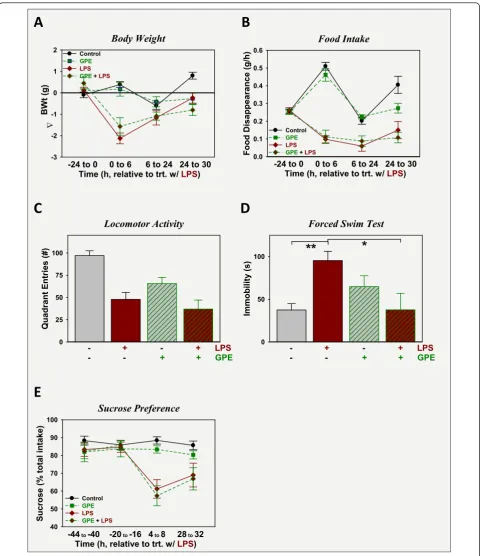
To assess its ability to cure LPS-induced depression-like behavior, GPE was administered i.c.v. 24 h after i.p. LPS. As described above, LPS administration at 830 μg/kg body weight i.p. caused sickness, p < 0.05 evident by all measures: mice treated with LPS lost body weight (Fig-ure 4A), ate less food (Fig(Fig-ure 4B) and had lower sponta-neous movement in a novel clean cage: locomotor activity (Figure 4C). Administration of GPE i.c.v. did not
duration of immobility was highest in mice treated with LPS and significantly different from controls or mice treated with GPE plus LPS, p < 0.05. Again, GPE had anti-depression activity. In contrast to these findings, GPE was unable to reverse the decrease in sucrose pre-ference observed following LPS administration. As shown in Figure 4E, sucrose preference was stable for the two days prior to treatment for all treatment groups. LPS caused a decrease in sucrose preference during the 4 to 8 h interval after treatment. Sucrose preference was still depressed for LPS-treated mice when assessed 28 to 32 h after treatment. GPE, given 24 h after LPS, did not alter sucrose preference 4 to 8 h later (28 to 32 h post-LPS).
GPE administered i.c.v. decreases i.p. LPS-induced expression of brain cytokines
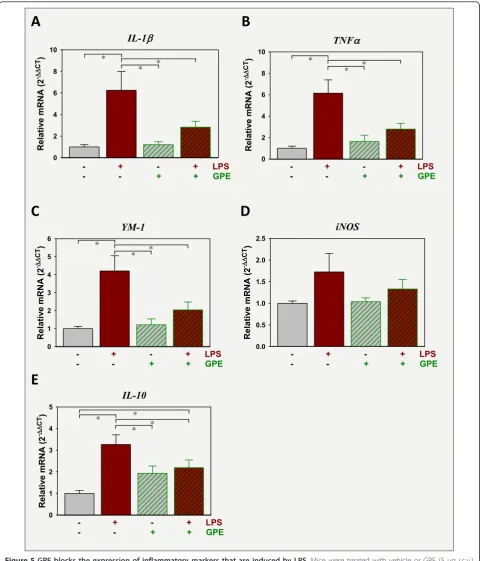
(interaction between LPS and GPE, [F (2,42) = 7.2, p < 0.05]) and approached significance for IL-1b (interac-tion between LPS and GPE [F (2,42) = 3.7, p = 0.06]). Expression of YM-1, a marker of microglia activation [38], was also elevated by LPS (Figure 5C). Similar to TNFa, there was an interaction between LPS and GPE for YM-1 expression [F (2,42) = 5.5, p < 0.05].Post-hoc analysis indicated that GPE attenuated LPS induction of YM-1. LPS increased iNOS expression (p < 0.05). Although GPE appeared to reduce expression of iNOS, the effect of GPE and its interaction with LPS was not significant (Figure 5D). IL-10 expression was induced by LPS and attenuated by GPE with a significant interac-tion between LPS and GPE [F (2,42) = 8.6, p < 0.05]. Post-hocanalysis indicated that GPE did not return the level of IL-10 expression to that of controls, but there was no significant difference between expression in mice treated with GPE or LPS + GPE (Figure 5E) Overall, these data indicate that glial activation is suppressed by central GPE, offsetting the inflammatory response initiated by i.p. LPS.
GPE administration does not regulate expression of tryptophan dioxygenases
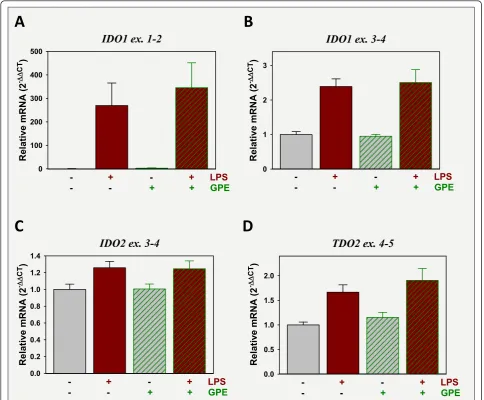
To assess the possible involvement of changes in trypto-phan metabolism in LPS-induced depression-like beha-vior and GPE’s antagonistic actions, expression of IDO1, IDO2 and TDO2 were quantified in the frontal cortex. Assays designed to probe for expression of IDO1’s full-size transcript (probe spanning exons 1 and 2) and one that quantified all transcripts (probe spanning exons 3 and 4) used to quantify IDO1 expression. Expression of IDO1 ex. 1-2 was increased almost 300-fold by LPS, p < 0.05, but unaffected by GPE (Figure 6A). Expression IDO1 ex. 3-4 amplification was increased by LPS to ~2.5-fold of controls, p < 0.05, but expression again was unaffected by GPE (Figure 6B). IDO2 and TDO2 expres-sion were quantified with probes that span exons 3 and 4 and 4 to 5, respectively. These assays quantify all tran-scripts. Expression of IDO2 (Figure 6C) and TDO2 (Fig-ure 6D) were both increased by LPS, p < 0.05, but unaffected by GPE. These data indicate that GPE is not altering depression-like behavior by reducing the LPS-induction of tryptophan dioxygenase mRNA expression.
GPE administration does not regulate expression of either IGF-I or BDNF
To assess the possible involvement of changes in neuro-trophin expression in the GPE behavior response, expression of IGF-I, VEGF and BDNF were quantified. IGF-IEb was decreased by LPS, p < 0.05, but unaffected by GPE (Figure 7A). VEGF was also decreased by LPS, p < 0.05, but again GPE had not effect (Figure 7B). BDNF is synthesized from multiple transcripts within the brain.
LPS decreased the expression of both of the transcripts that were measured, BDNF exon I-IX (Figure 7C) and BDNF exon VI-IX (Figure 7D). Neither mRNA tran-script for BDNF was affected by GPE. Thus, although LPS clearly decreases neurotrophin expression, GPE does not reverse this action.
Discussion
Three new findings are evident from the current studies, 1) although they both share an inflammatory compo-nent, sickness and depression-like behavior are indepen-dently modulated by the IGF system, 2) when added exogenously, two naturally occurring products found in the naïve brain, mature IGF-I and GPE, act centrally to temper LPS-induced changes in depression-like beha-vior, and 3) GPE can temper the central innate immune response to LPS providing a possible mechanism by which to regulate depression-like behavior. A direct behavior modifying role of GPE has never been reported. Previous studies with the GPE peptide had shown biological activity associated with neuroprotec-tion using preclinical models for Alzheimer’s, Parkin-son’s disease, stroke, multiple sclerosis and Huntington’s [27], but a central behavioral effect that is independent of neuroprotection had yet to be reported. Neither IGF-I or GPE affected behavior of naïve (non-LPS) mice, but had anti-depressant activity when tested against the inflammation-inducer LPS in the TST and FST. It’s not known whether the effect of GPE can be extended to other models of depression as GPE was not able to reverse LPS-induced decrease in sucrose preference, used as an index of anhedonia.
TST. The action of IGF-I and NBI-31772 was blocked by JB1, an IGF-1R antagonist [44] supporting a mechan-ism that requires activation of IGF-1R. A single i.c.v. injection of IGF-I to rats decreased immobility during the FST [42] while JB1 blocked the anti-depressant activity of IGF-I [43]. Data such as these, especially with naïve animals, show that the behavior modifying role of endogenous and exogenous IGF-I is independent of IGF-I’s well documented neuroprotective actions and that the anti-depressant activity of IGF-I can be quanti-fied with several tests that have proven to be reliable indices of depression-like behaviors. Blocking the anti-depressant activity of exogenous IGF-I with JB1, which prevents IGF-1R receptor activation, shows that IGF-1R activation is requisite for IGF-I action, but does not
show whether all the effects are mediated by the IGF-1R. With this in mind we determined whether the nat-uralistic product of IGF-I cleavage within the brain that acts independent of the IGF-1R [45] can exert additional anti-depressant activity.
response, subsequent delivery of cytokines to the brain via the humoral and neural communication pathways is unlikely to be altered by i.c.v. administration of either IGF-I or GPE. Thus in this model, the sickness response appears to be largely under the control of the peripheral inflammatory input to the brain. These primary signals subsequently initiate an activation of the innate immune system of the brain which is tempered by GPE (Figure 5). Decreased neuroinflammation in response to IGF-I [11] and GPE (current study) correlate with changes in depression-like behavior when assessed using the TST and FST. The anti-depressant activities of IGF-I and GPE in the current experiments assessed with the TST and FST does not appear to be a result of an overall attenuation of psychomotor retardation as locomotor
mg/day for 14 d, vs. a 1 mg bolus in the current work) did not increase sucrose consumption in naïve mice (an effect we have found with bolus IGF-I injection i.c.v.), but this constant chronic infusion of IGF-I reversed the lowered sucrose consumption by mice subjected to chronic unpredictable stress [40]. Our new finding how-ever provides a novel model to help define central path-ways controlling specific behavioral symptoms.
We previously found that IGF-I induced the expres-sion of several BDNF transcripts [11]; another possible mediator of its anti-depressant activity. One of the more interesting aspects of BDNF biology is the differential expression and regulation of specific transcripts. All transcripts produce mature BDNF, but in different cells types. Transcripts initiating from exons I, II and III are expressed predominantly in neurons and transcripts initiating from exons IV, V and VI are expressed by both neurons and astrocytes [47]. Normal expression of all transcripts may be necessary for wellness, as a knock-out of even a single transcripts causes depression-like behavior of mice [48]. Duloxetine, an SNRI class anti-depressant, increases the expression of only 4 of the 9 transcripts [49] indicating specificity of treatment. Thus we again examined multiple BDNF transcripts. However, GPE did not induce BDNF expression and thus BDNF may not play a significant role in the anti-depressant role of GPE. Only a single dose of GPE was tested in the present study; a dose with proven neuroprotective action [35,36]. The present results call for a more exten-sive investigation of the dose-response effect of GPE on inflammation-induced depression and moreover on the ability of endogenously generated GPE to mediate part of the anti-depressant activity of IGF-I.
Clearly from studies mentioned above, the anti-depressant activity of mature I is dependent of IGF-1R signaling, which also mediates IGF-I’s neuroprotec-tive action. The receptor that mediates GPE action on behavior has not been characterized. GPE was shown to displace glutamate from its receptor, but GPE’s neuro-protective activity is not clearly related to glutamate/ NMDA receptor (NMDA-R) binding as it competes with glutamate binding with a very low affinity (30μM) even though neuroprotective activity is evident at 0.1 nM [33,34,45,50,51]. This discrepancy suggests that GPE activity is dependent on an as yet uncharacterized mechanism [52]. Peptidase inhibitors that block proces-sing of many proteins including the release of GPE from intact mature IGF-I with the generation of des-(1-3)-IGF-I, block IGF-I inhibition of GNRH secretion [33,34] suggesting that GPE mediates at least part of the central action of IGF-I. Mature intact IGF-I has antidepressant activity, but it is still not known if des-(1-3)-IGF-I, act-ing via the IGF-1R, or the generation of GPE from exo-genous IGF-I play a significant role in the
antidepressant activity of the intact mature peptide. However, since blockage of IGF-1R activity abrogates anti-depressant activity of the mature peptide [44] and GPE does not activate the IGF-1R [45], clearly IGF-I itself has anti-depressant activity through the IGF-1R independent of GPE. Thus it appears that IGF-I has the potential to generate two distinct signaling events that result in anti-depressant activity; an IGF-1R mediated action and an IGF-1R independent GPE-mediated action.
control animals it may be a minor source for protein translation. However, expression of IDO1 ex. 1-2 may play an important role in neurophysiology because of its strong induction with neuroinflammation; in this case following administration of LPS. In our current model, IDO1, IDO2 AND TDO2 mRNA expression, which are rate-limiting enzymes for the conversion of intracellular tryptophan to kynurenine, were all increased by LPS. Expressions were unaffected by GPE; similarly IGF-I did not attenuate LPS-induced dioxygenase expression (unpublished data). These data seem to suggest that IGF-I and GPE do not act by altering the consequences associated with elevated dioxygenase expression. How-ever, it remains to be determined if IGF-I or GPE alter the effects of elevated tryptophan dioxygenase expres-sion downstream of the enzyme; i.e. by directly attenuat-ing the activity of quinolinic acid or other downstream products such as 3’-hydroxykynurenine or kynurenic acid.
Cytokine and neurotrophin mRNA expression was quantified in the prefrontal cortex as this region has been strongly implicated in the regulation of positive affect. In rodents, electrical stimulation of the frontal cortex elicits hedonic vocalizations by rodents, [21], whereas lesions reduce rough-and-tumble play behavior [22] both associated with a positive emotional state. Although many studies show a strong correlation between changes in the frontal cortex and hippocampus, the antidepressant effect of fluoxetine was shown to cor-relate with BDNF expression in the frontal cortex, but not in the hippocampus [23]. With humans, several positive affective stimuli increase neuronal activity in the frontal cortex [17-20]. Here we show that LPS induces expression of central cytokine and GPE reduces their expression in a brain region intimately associated with depression-like behaviors. The opposing effects of LPS and GPE on cytokine expression parallel changes in depression-like behavior.
The neurotrophic hypothesis for depression asserts that neuronal plasticity is dysfunctional because of insuf-ficient neurotrophic support and that classic anti-depressants ultimately reactivate plasticity in the brain [60-62]. IGF-I is a classic neurotrophin; inducing the proliferation, survival, differentiation and maturation of cells of the central nervous system [63] and directly sup-porting neuronal plasticity [64]. GPE is also a neurotro-phin; although characterized primarily by its ability to support neuronal survival and stimulation of glia prolif-eration [65]. IGF-I is expressed by neurons within the brain [66-68] and expression was reduced by the admin-istration of LPS (Figure 7). This reduction would trans-late into low central levels of both IGF-I and GPE within the frontal cortex. This reduced protein expres-sion would result in lower neurotrophic support along
with the lower expression of BDNF and VEGF (Figure 7). By administration of IGF-I or GPE neurotrophic sup-port is exogenously provided and depression-like beha-vior is attenuated.
In conclusion, data in this manuscript show that exo-genous central administration of either IGF-I or GPE results in anti-depressant-like activity, assessed using the TST and FST. The behavioral changes did not occur with naïve mice but these neurotrophins attenuated the behavioral changes induced by i.p. LPS. These data extend the anti-depressant activity of the IGF system by showing that a proteolytic product derived from IGF-I, GPE, has anti-depressant activity paralleling that of the mature peptide. Both IGF-I and GPE offset the inflam-matory response elicited by LPS which may in part be responsible for anti-depressant activity.
Acknowledgements
This work was supported by RO1 MH083767 to RHM from the National Institutes of Health.
Author details
1Integrated Immunology and Behavior Program, University of Illinois at Urbana-Champaign, Urbana, Illinois 61801-3873, USA.2Neuroscience Program, University of Illinois at Urbana-Champaign, Urbana, Illinois 61801-3873, USA.3Department of Animal Sciences, University of Illinois at Urbana-Champaign, Urbana, Illinois 61801-3873, USA.4Department of Pathology, University of Illinois at Urbana-Champaign, Urbana, Illinois 61801-3873, USA.
Authors’contributions
RHM designed the experiments, performed surgery, treated animals, performed behavior tests, analyzed data and wrote much of the manuscript. SP performed surgery, treated animals, performed behavior tests, analyzed data and did all the PCR analyses. ML, KWK and RD helped in the design and interpretation of the experiments and editing the manuscript. All authors have read and approved the final version of this manuscript.
Competing interests
RD has received honoraria from Bristol-Myers Squibb and Lundbeck Laboratories and works as a consultant for Lundbeck Laboratories. RD and KWK have received honoraria from Astra-Zeneca.
Received: 25 August 2011 Accepted: 21 December 2011 Published: 21 December 2011
References
1. Raison CL, Capuron L, Miller AH:Cytokines sing the blues: inflammation and the pathogenesis of depression.Trends Immunol2006,27:24-31. 2. Miller AH, Maletic V, Raison CL:Inflammation and its discontents: the role
of cytokines in the pathophysiology of major depression.Biol Psychiatry
2009,65:732-741.
3. Dantzer R, O’Connor JC, Freund GG, Johnson RW, Kelley KW:From inflammation to sickness and depression: when the immune system subjugates the brain.Nat Rev Neurosci2008,9:46-56.
4. Reichenberg A, Yirmiya R, Schuld A, Kraus T, Haack M, Morag A, Pollmacher T:Cytokine-associated emotional and cognitive disturbances in humans.Arch Gen Psychiatry2001,58:445-452.
5. Eisenberger NI, Berkman ET, Inagaki TK, Rameson LT, Mashal NM, Irwin MR:
Inflammation-induced anhedonia: endotoxin reduces ventral striatum responses to reward.Biol Psychiatry2010,68:748-754.
6. Harrison NA, Brydon L, Walker C, Gray MA, Steptoe A, Critchley HD:
Inflammation causes mood changes through alterations in subgenual cingulate activity and mesolimbic connectivity.Biol Psychiatry2009,
7. Capuron L, Dantzer R:Cytokines and depression: the need for a new paradigm.Brain Behav Immun2003,17(Suppl 1):S119-124.
8. Capuron L, Gumnick JF, Musselman DL, Lawson DH, Reemsnyder A, Nemeroff CB, Miller AH:Neurobehavioral effects of interferon-alpha in cancer patients: phenomenology and paroxetine responsiveness of symptom dimensions.Neuropsychopharmacology2002,26:643-652. 9. Yirmiya R:Endotoxin produces a depressive-like episode in rats.Brain Res
1996,711:163-174.
10. Frenois F, Moreau M, O’Connor J, Lawson M, Micon C, Lestage J, Kelley KW, Dantzer R, Castanon N:Lipopolysaccharide induces delayed FosB/ DeltaFosB immunostaining within the mouse extended amygdala, hippocampus and hypothalamus, that parallel the expression of depressive-like behavior.Psychoneuroendocrinology2007,32:516-531. 11. Park SE, Dantzer R, Kelley KW, McCusker RH:Central administration of
insulin-like growth factor-I decreases depressive-like behavior and brain cytokine expression in mice.J Neuroinflammation2011,8:12.
12. Yirmiya R, Pollak Y, Barak O, Avitsur R, Ovadia H, Bette M, Weihe E, Weidenfeld J:Effects of antidepressant drugs on the behavioral and physiological responses to lipopolysaccharide (LPS) in rodents. Neuropsychopharmacology2001,24:531-544.
13. O’Connor JC, Lawson MA, Andre C, Moreau M, Lestage J, Castanon N, Kelley KW, Dantzer R:Lipopolysaccharide-induced depressive-like behavior is mediated by indoleamine 2,3-dioxygenase activation in mice.Mol Psychiatry2009,14:511-522.
14. Henry CJ, Huang Y, Wynne A, Hanke M, Himler J, Bailey MT, Sheridan JF, Godbout JP:Minocycline attenuates lipopolysaccharide (LPS)-induced neuroinflammation, sickness behavior, and anhedonia.J
Neuroinflammation2008,5:15.
15. Gibb J, Hayley S, Poulter MO, Anisman H:Effects of stressors and immune activating agents on peripheral and central cytokines in mouse strains that differ in stressor responsivity.Brain Behav Immun2011,25:468-482. 16. Bay-Richter C, Janelidze S, Hallberg L, Brundin L:Changes in behaviour
and cytokine expression upon a peripheral immune challenge.Behav Brain Res2011,222:193-199.
17. Damasio AR, Grabowski TJ, Bechara A, Damasio H, Ponto LL, Parvizi J, Hichwa RD:Subcortical and cortical brain activity during the feeling of self-generated emotions.Nat Neurosci2000,3:1049-1056.
18. Blood AJ, Zatorre RJ:Intensely pleasurable responses to music correlate with activity in brain regions implicated in reward and emotion.Proc Natl Acad Sci USA2001,98:11818-11823.
19. Kringelbach ML, O’Doherty J, Rolls ET, Andrews C:Activation of the human orbitofrontal cortex to a liquid food stimulus is correlated with its subjective pleasantness.Cereb Cortex2003,13:1064-1071.
20. Nitschke JB, Heller W, Etienne MA, Miller GA:Prefrontal cortex activity differentiates processes affecting memory in depression.Biol Psychol
2004,67:125-143.
21. Burgdorf J, Wood PL, Kroes RA, Moskal JR, Panksepp J:Neurobiology of 50-kHz ultrasonic vocalizations in rats: electrode mapping, lesion, and pharmacology studies.Behav Brain Res2007,182:274-283. 22. Panksepp J, Normansell L, Cox JF, Siviy SM:Effects of neonatal
decortication on the social play of juvenile rats.Physiol Behav1994,
56:429-443.
23. Hodes GE, Hill-Smith TE, Lucki I:Fluoxetine treatment induces dose dependent alterations in depression associated behavior and neural plasticity in female mice.Neurosci Lett2010,484:12-16.
24. Aberg ND, Brywe KG, Isgaard J:Aspects of growth hormone and insulin-like growth factor-I related to neuroprotection, regeneration, and functional plasticity in the adult brain.ScientificWorldJournal2006,6:53-80. 25. Carro E, Trejo JL, Nunez A, Torres-Aleman I:Brain repair and
neuroprotection by serum insulin-like growth factor I.Mol Neurobiol
2003,27:153-162.
26. Sara VR, Carlsson-Skwirut C, Andersson C, Hall E, Sjogren B, Holmgren A, Jornvall H:Characterization of somatomedins from human fetal brain: identification of a variant form of insulin-like growth factor I.Proc Natl Acad Sci USA1986,83:4904-4907.
27. Guan J, Gluckman PD:IGF-1 derived small neuropeptides and analogues: a novel strategy for the development of pharmaceuticals for
neurological conditions.Br J Pharmacol2009,157:881-891. 28. Ballard FJ, Wallace JC, Francis GL, Read LC, Tomas FM:Des(1-3)IGF-I: a
truncated form of insulin-like growth factor-I.Int J Biochem Cell Biol1996,
28:1085-1087.
29. Carlsson-Skwirut C, Jornvall H, Holmgren A, Andersson C, Bergman T, Lundquist G, Sjogren B, Sara VR:Isolation and characterization of variant IGF-1 as well as IGF-2 from adult human brain.FEBS Lett1986,201:46-50. 30. Guan J, Thomas GB, Lin H, Mathai S, Bachelor DC, George S, Gluckman PD:
Neuroprotective effects of the N-terminal tripeptide of insulin-like growth factor-1, glycine-proline-glutamate (GPE) following intravenous infusion in hypoxic-ischemic adult rats.Neuropharmacology2004,
47:892-903.
31. Yamamoto H, Murphy LJ:Generation of des-(1-3) insulin-like growth factor-I in serum by an acid protease.Endocrinology1994,135:2432-2439. 32. Yamamoto H, Murphy LJ:Enzymatic conversion of IGF-I to des(1-3)IGF-I
in rat serum and tissues: a further potential site of growth hormone regulation of IGF-I action.J Endocrinol1995,146:141-148.
33. Bourguignon JP, Alvarez Gonzalez ML, Gerard A, Franchimont P:
Gonadotropin releasing hormone inhibitory autofeedback by subproducts antagonist at N-methyl-D-aspartate receptors: a model of autocrine regulation of peptide secretion.Endocrinology1994,
134:1589-1592.
34. Bourguignon JP, Gerard A, Alvarez Gonzalez ML, Franchimont P:Acute suppression of gonadotropin-releasing hormone secretion by insulin-like growth factor I and subproducts: an age-dependent endocrine effect. Neuroendocrinology1993,58:525-530.
35. Guan J, Krishnamurthi R, Waldvogel HJ, Faull RL, Clark R, Gluckman P: N-terminal tripeptide of IGF-1 (GPE) prevents the loss of TH positive neurons after 6-OHDA induced nigral lesion in rats.Brain Res2000,
859:286-292.
36. Sizonenko SV, Sirimanne ES, Williams CE, Gluckman PD:Neuroprotective effects of the N-terminal tripeptide of IGF-1, glycine-proline-glutamate, in the immature rat brain after hypoxic-ischemic injury.Brain Res2001,
922:42-50.
37. Paxinos G, Franklin KBJ:The Mouse Brain in Stereotaxic Coordinates, Deluxe Edition of the Atlas.Second edition. London: Academic Press; 2001. 38. Rojo AI, Innamorato NG, Martin-Moreno AM, De Ceballos ML, Yamamoto M,
Cuadrado A:Nrf2 regulates microglial dynamics and neuroinflammation in experimental Parkinson’s disease.Glia2010,58:588-598.
39. Trejo JL, Llorens-Martin MV, Torres-Aleman I:The effects of exercise on spatial learning and anxiety-like behavior are mediated by an IGF-I-dependent mechanism related to hippocampal neurogenesis.Mol Cell Neurosci2008,37:402-411.
40. Duman CH, Schlesinger L, Terwilliger R, Russell DS, Newton SS, Duman RS:
Peripheral insulin-like growth factor-I produces antidepressant-like behavior and contributes to the effect of exercise.Behav Brain Res2009,
198:366-371.
41. Burgdorf J, Kroes RA, Beinfeld MC, Panksepp J, Moskal JR:Uncovering the molecular basis of positive affect using rough-and-tumble play in rats: a role for insulin-like growth factor I.Neuroscience2010,168:769-777. 42. Hoshaw BA, Malberg JE, Lucki I:Central administration of IGF-I and BDNF
leads to long-lasting antidepressant-like effects.Brain Res2005,
1037:204-208.
43. Hoshaw BA, Hill TI, Crowley JJ, Malberg JE, Khawaja X, Rosenzweig-Lipson S, Schechter LE, Lucki I:Antidepressant-like behavioral effects of IGF-I produced by enhanced serotonin transmission.Eur J Pharmacol2008,
594:109-116.
44. Malberg JE, Platt B, Rizzo SJ, Ring RH, Lucki I, Schechter LE, Rosenzweig-Lipson S:Increasing the levels of insulin-like growth factor-I by an IGF binding protein inhibitor produces anxiolytic and antidepressant-like effects.Neuropsychopharmacology2007,32:2360-2368.
45. Sara VR, Carlsson-Skwirut C, Bergman T, Jornvall H, Roberts PJ, Crawford M, Hakansson LN, Civalero I, Nordberg A:Identification of Gly-Pro-Glu (GPE), the aminoterminal tripeptide of insulin-like growth factor 1 which is truncated in brain, as a novel neuroactive peptide.Biochem Biophys Res Commun1989,165:766-771.
46. Dantzer R:Cytokine-induced sickness behavior: mechanisms and implications.Ann N Y Acad Sci2001,933:222-234.
47. Aliaga EE, Mendoza I, Tapia-Arancibia L:Distinct subcellular localization of BDNF transcripts in cultured hypothalamic neurons and modification by neuronal activation.J Neural Transm2009,116:23-32.
48. Sakata K, Jin L, Jha S:Lack of promoter IV-driven BDNF transcription results in depression-like behavior.Genes Brain Behav2010. 49. Calabrese F, Molteni R, Maj PF, Cattaneo A, Gennarelli M, Racagni G,
expression of BDNF transcripts and in the subcellular localization of the neurotrophin protein.Neuropsychopharmacology2007,32:2351-2359. 50. Bourguignon J, Gerard A:Role of insulin-like growth factor binding
proteins in limitation of IGF-I degradation into the N-methyl-D-aspartate receptor antagonist GPE: evidence from gonadotrophin-releasing hormone secretion in vitro at two developmental stages.Brain Res1999,
847:247-252.
51. Nilsson-Hakansson L, Civalero I, Zhang X, Carlsson-Skwirut C, Sara VR, Nordberg A:Effects of IGF-1, truncated IGF-1 and the tripeptide Gly-Pro-Glu on acetylcholine release from parietal cortex of rat brain.Neuroreport
1993,4:1111-1114.
52. Alonso De Diego SA, Gutierrez-Rodriguez M, Perez de Vega MJ, Gonzalez-Muniz R, Herranz R, Martin-Martinez M, Cenarruzabeitia E, Frechilla D, Del Rio J, Jimeno ML, Garcia-Lopez MT:The neuroprotective activity of GPE tripeptide analogues does not correlate with glutamate receptor binding affinity.Bioorg Med Chem Lett2006,16:3396-3400.
53. Escartin C, Boyer F, Bemelmans AP, Hantraye P, Brouillet E:Insulin growth factor-1 protects against excitotoxicity in the rat striatum.Neuroreport
2004,15:2251-2254.
54. Alexi T, Hughes PE, van Roon-Mom WM, Faull RL, Williams CE, Clark RG, Gluckman PD:The IGF-I amino-terminal tripeptide glycine-proline-glutamate (GPE) is neuroprotective to striatum in the quinolinic acid lesion animal model of Huntington’s disease.Exp Neurol1999,159:84-97. 55. Dantzer R, O’Connor JC, Lawson MA, Kelley KW:Inflammation-associated
depression: from serotonin to kynurenine.Psychoneuroendocrinology2011,
36:426-436.
56. Lestage J, Verrier D, Palin K, Dantzer R:The enzyme indoleamine 2,3-dioxygenase is induced in the mouse brain in response to peripheral administration of lipopolysaccharide and superantigen.Brain Behav Immun2002,16:596-601.
57. Maes M, Leonard BE, Myint AM, Kubera M, Verkerk R:The new‘5-HT’ hypothesis of depression: cell-mediated immune activation induces indoleamine 2,3-dioxygenase, which leads to lower plasma tryptophan and an increased synthesis of detrimental tryptophan catabolites (TRYCATs), both of which contribute to the onset of depression.Prog Neuropsychopharmacol Biol Psychiatry2011,35:702-721.
58. Ball HJ, Yuasa HJ, Austin CJ, Weiser S, Hunt NH:Indoleamine 2,3-dioxygenase-2; a new enzyme in the kynurenine pathway.Int J Biochem Cell Biol2009,41:467-471.
59. Nishizawa H, Kato T, Ota S, Nishiyama S, Pryor-Koishi K, Suzuki M, Tsutsumi M, Inagaki H, Kurahashi H, Udagawa Y:Genetic variation in the indoleamine 2,3-dioxygenase gene in pre-eclampsia.Am J Reprod Immunol2010,64:68-76.
60. Akbarian S, Rios M, Liu RJ, Gold SJ, Fong HF, Zeiler S, Coppola V, Tessarollo L, Jones KR, Nestler EJ,et al:Brain-derived neurotrophic factor is essential for opiate-induced plasticity of noradrenergic neurons.J Neurosci2002,22:4153-4162.
61. Castren E, Voikar V, Rantamaki T:Role of neurotrophic factors in depression.Curr Opin Pharmacol2007,7:18-21.
62. Castren E, Rantamaki T:The role of BDNF and its receptors in depression and antidepressant drug action: Reactivation of developmental plasticity.Dev Neurobiol2010,70:289-297.
63. Bibollet-Bahena O, Cui QL, Almazan G:The insulin-like growth factor-1 axis and its potential as a therapeutic target in central nervous system (CNS) disorders.Cent Nerv Syst Agents Med Chem2009,9:95-109. 64. Torres-Aleman I:Toward a comprehensive neurobiology of IGF-I.Dev
Neurobiol2010,70:384-396.
65. Guan J:Insulin-Like Growth Factor -1 (IGF-1) Derived Neuropeptides, a Novel Strategy for the Development of Pharmaceuticals for Managing Ischemic Brain Injury.CNS Neurosci Ther2011,17:250-255.
66. Reijnders CM, Koster JG, van Buul-Offers SC:Overexpression of human IGF-II mRNA in the brain of transgenic mice modulates IGFBP-2 gene expression in the medulla oblongata.J Endocrinol2004,182:445-455. 67. Niblock MM, Brunso-Bechtold JK, Lynch CD, Ingram RL, McShane T,
Sonntag WE:Distribution and levels of insulin-like growth factor I mRNA across the life span in the Brown Norway x Fischer 344 rat brain.Brain Res1998,804:79-86.
68. Zhou X, Herman JP, Paden CM:Evidence that IGF-I acts as an autocrine/ paracrine growth factor in the magnocellular neurosecretory system: neuronal synthesis and induction of axonal sprouting.Exp Neurol1999,
159:419-432.
doi:10.1186/1742-2094-8-179
Cite this article as:Parket al.:Insulin-like growth factor-I peptides act
centrally to decrease depression-like behavior of mice treated intraperitoneally with lipopolysaccharide.Journal of Neuroinflammation
20118:179.
Submit your next manuscript to BioMed Central and take full advantage of:
• Convenient online submission
• Thorough peer review
• No space constraints or color figure charges
• Immediate publication on acceptance
• Inclusion in PubMed, CAS, Scopus and Google Scholar
• Research which is freely available for redistribution