Does information literacy correlate and affect the job commitment?
Mohammad Javad Hashemzadeh *1, Masoomeh Mohammadi 2, Ali Asgari 31 Associate Professor, Department of knowledge and information science, Faculty of Education and Psychology,
University of Birjand, Birjand, Iran
2 Postgraduate of knowledge and information science, Faculty of Education and Psychology, University of
Birjand, Birjand, Iran
3 Assistant Professor, Department of Education, Faculty of Education and Psychology, University of Birjand, Birjand,
Iran
Abstract
Objective: The study aims to assess the impact and correlation of information literacy on the job commitment of public library workers of two Iranian western and eastern provinces.
Method: The research is designed on a descriptive method, applying a survey data gathering methodology. The population are all librarians of public libraries of Kermanshah and South Khorasan provinces during 2014-2015. The sample population of study, consisting of 147 individuals, was chosen through random stratified sampling method. To gather the data, information literacy questionnaire and job commitment standard questionnaire were used. Validity of questionnaires was confirmed by content validity evaluation. To ensure reliability of the questionnaires, Cronbach’s alpha correlation was calculated. Coefficient value of Cronbach’s alpha gained was 0.93 and 0.91 for information literacy and job commitment, respectively.
Results: A high over all positive relation between information literacy skills and job commitment among the employees of research population was observed. A significant relation between each dimension of information literacy of employees and their job commitment according to their information literacy skills was revealed. Moreover, there was a significant relation between information literacy and each facet of job commitment of employees. Information literacy facets predicted 43 percent of job commitment variance. There was a difference between the two regarding both groups, but there was no significant difference between their job commitments. There was a significant difference between employees regarding their information literacy based on their field and level of education. There was no difference between the employees regarding their job commitment based on their filed and level of education.
Conclusion: Many studies have been conducted on literature of information literacy as well as job commitment and management dimensions, but no research was found working on the relation between information literacy and job commitment as a managerial dimension among employees of an organization. This paper revealed a positive development of information literacy skills affecting job commitment among employees.
Keywords: Information literacy, Job commitment, Public libraries librarians, Kermanshah province, South Khorasan province, Iran
Introduction
The history of literacy has adopted diversified conceptual levels during the linear edge of human history. Dump illiteracy complies the status of disability of reading and writing; though in the new millennium, the concept goes more beyond the ordinary definition. The latent and complexity of human life has necessitated the beat of new phenomena coordinating the bare literacy concept to facilitate the enhanced information society. The key feature of such progressive and complicated role of human generations in this fast-forwarding era demands the overgeneralization of the literacy meaning; so the literacy concept has coordinated with many new ones such as computer, net, etc. through which information literacy has picked up a new disciplinary environment and has attained the attention of many scientific investigations and findings through which the outcomes facilitate human life, occupation, organization, freedom and many other highlighted styles and standards, specifically in the domain of knowledge and information.
According to many new management practices such as knowledge management or even the older ones such as TQM1, information literacy plays a dominant role for the workers in any job implementation. This skill facilitates the comprehension of change and complexities of occupation environment, relatively in the job environment. Moreover, one of the other main managerial factors that deeply promotes the achievement of organizational goals is commitment and loyalty of the workers to their job.
Job commitment is one of the basic aspects of human resources management that organizations can rely on, and evaluates employees’ performance on the basis of this criterion. Nowadays, commitment comprises different models including job commitment (Talebpour & Imami, 2006). Blau (1985) considered 4 dimensions for job commitment, namely job affiliation (job satisfaction and job interest), organizational affiliation (spiritual and rational loyalty to organizational goals), commitment to work values (the individual’s zealousness towards his or her job and the expectations of others related to his or her job) and job participation (the degree of individuals’ involvement in performing their tasks).
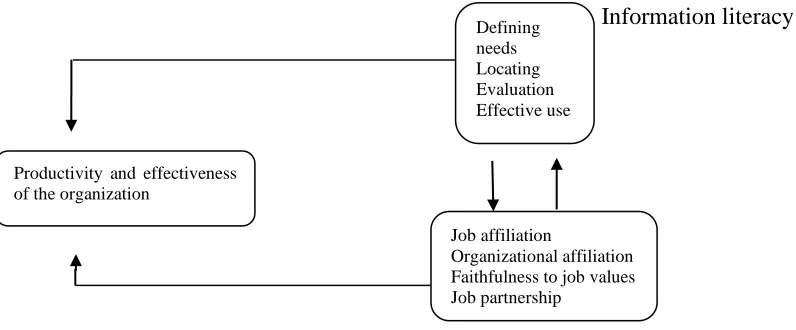
Job commitment means having a kind of cognitional and psychological identity with a job. Job commitment is the belief about one’s job and depends on the degree that a job can satisfy one’s current needs. Individuals, who are intensely involved in their jobs, consider it as an important part of their identities. Furthermore, individuals who are highly job-affiliated, devote most of their enthusiasm on their jobs (Hackett, Lapierre & Hausdorf, 2001). Noting that job commitment of employees of an organization is related to the way they perform job services, information literacy is one of the key components affecting the employees’ job skills. So doing it is obvious that these individuals have better job commitment as a result of their literacy and information skills. This could be demonstrated in productivity and effectiveness of the organizations. Generally speaking, investigations about the relation between information literacy and managerial dimensions could be subdivided into several main categories:
In a study Nikpoor, Manzari Tavakoli and Rajaee Nezhad (2012) observed that there was a significant relation between the employees’ information literacy and its indices, namely distinguishing informational needs, locating information, evaluating information, effective use of information along with organizational effectiveness. Therefore, development of information literacy of the employees, could improve their organizational effectiveness and consequently organizational productivity. In current study, the relation between four dimensions of information literacy and employees’ job commitment, being a component of managerial dimensions, is investigated. Having such a relation will enhance organizational effectiveness and productivity.
Noveen Isfahani (2011) studied the relation between Information literacy and job motivation as one of managerial dimensions. He found a significant relation between informational need of teachers and their job motivation. The more were their capabilities in collecting, evaluating and analyzing the information and applying correct and effective formats, the more were their job motivations. Also they increased information literacy skills, boosted the job achievement and so teachers’ job motivation would have increased significantly. In this study, information literacy and job commitment correspondingly would be assessed, because probably information literacy will improve job commitment and job commitment is rooted in job motivation. Hull (1993) in an article assessed the role of literacy in workplaces. His study showed that weak skill in literacy resulted in job weakness and benchmarked low organizational productivity. The result also showed that the employees’ literacy skills directly affected their job performance and organizational productivity.
Safari and Mahboob (2010) in an investigation concluded that information literacy skills of librarians of public libraries of Tehran in recognizing information needs were not more than an intermediate level, but in recognizing, utilizing and evaluating the resources skills levels were higher than intermediate. Li & Hung (2010), studied the condition of mediation role of personal-job fit in relation between information literacy and job outcomes. The results showed a positive relation between dimensions of classical and personal job fit of computer literacy. Also, it was observed that individuals’ information literacy could predict their job performance.
Aghdasi, Alipour, Mafi and Talebi (2013) studied on relation between librarians’ information literacy and their job productivity in Tabriz public libraries. The result showed that there was a direct relation between the location skills of resources of library information literacy skills and employees’ performance. Mollapoor, Mohammadi Sadr and Siadat (2013), in their study showed that there was a significant relation between job environment component, job adjustment and some fragmented abilities of information literacy such as using information technology, finding and controlling information components, and the skills in apprising information needs by teachers. So, in a multidimensional work environment, when teachers employ the more information literacy, the more do their jobs with satisfaction. Jokar and Afifan (2013) showed that there was a significant difference between the employees’ job commitment and their education level. Consequently, the more job commitment increases, the more job satisfaction and emotional attachment of employees increases and consequently effectiveness and productivity of the organization would accelerate. In the present study, job commitment of employees is studied as a factor improving organizational effectiveness.
Information literacy in higher education levels has been studied in many spectrums. In a study, Corral (2008) showed that, information literacy in international level is recognized as an essential skill in higher education, employment and society. Likewise, studies showed that access to resources and information, evaluation of information and effective use of information increase the effectiveness, productivity and professional performance of managers of organizations. Mirza Safi, Rajayee Poor, and Jamshidian (2010) in a study showed that there was a significant relation between information literacy and students’ entrepreneurial abilities. Regression results also showed that entrepreneurial capabilities have a highly significant relation with critical capabilities of information evaluation. Ali Nezhad, Horri, Sarmadi and Shobeiri (2011) in a study showed that there is a positive relation between information literacy (defining informational needs, effective and efficient access, critical evaluation, effective use of information and legal issues) and educational performance satisfaction.
of management dimensions can correlate with information literacy as a main feature of job dimensions in public libraries staff according to the nature of their work.
Public libraries give services to all groups of society. Training and satisfaction of the clients’ needs by librarians is a comprehensive service that enables users to access what they need in the minimum possible time. Therefore, the role of librarians is very fundamental in empowering and in creating a society with high information literacy skills and capabilities. Then, as the society advances, according to their duty for performing of information literacy chain, librarians should enhance the ways and methods they give services to people. This happens only when the librarians themselves enjoy high information literacy skills. On other hand, it seems that obtaining information literacy skills by public librarians results in inevitable commitment for advancement of their job goals. Therefore, from among libraries, those having high literate and committed human resources are considered to be more successful since information literacy is a milestone whose techniques for improvement of effectiveness will improve commitment of human resources.
Due to the close relation and importance between information literacy and job commitment of librarians and the fact that the duty of staff in any organization mandates the improvement of effectiveness and efficiency of skilled workers, we decided to investigate three issues.
Information literacy
Job commitment
Figure 1. Theoretical framework of the Research
This research aims to investigate the correlation between information literacy dimensions and job commitment among librarians of Kermanshah and South Khorasan provinces to determine whether there is any significant relation between information literacy and job commitment of public librarians. Is there any relation between the components of these two constructs (information literacy and job commitment)? To what extent would information literacy skills predict and enhance the job commitment of library workers?
Method
Through a descriptive survey method, the study was designed to review the population of Kermanshah and South Khorasan library workers for collecting the required data. Total population included 235 librarians (Kermanshah Province 150 and South Khorasan 85 individuals). Proportional stratified sampling method was utilized. The sample included 147 individuals, accordingly, 93 individuals from
Defining needs Locating Evaluation Effective use
Job affiliation
Organizational affiliation Faithfulness to job values Job partnership
Kermanshah province and 54 individuals from South Khorasan, constituted the sample of the study. After final follow ups 137 respondents returned the questionnaires.
Two questionnaires were utilized to gather the data for the constructs of the study in 2015. The first one was a predesigned information literacy questionnaire (Nikpoor, Manzari tavakoli, Rajayee nezhad, 2012) including 35 questions to determine four facets of information literacy, namely defining information needs, locating information, evaluating information and effective use of information. Blau’s Standard questionnaire (1985) using 40 questions to assess job commitment of employees were used for job commitment variables including professional affiliation, organizational affiliation, faithfulness and job involvement. The Likert’s 5 scale scoring method was applied for all questions.
To scale the logical validity of the questionnaire of information literacy, the content validity method was used; likewise, to elaborate the validity of Blau’s standard questionnaire of job commitment, the same method was applied to measure and ensure the adjustment of the instruments. However, to ensure the reliability of the information literacy and job commitment questionnaires, again Cronbach’s alpha coefficient was calculated. The Cronbach’s alpha obtained for information literacy and job commitment was 0.93 and 0.91 respectively.
The assumptions underlying the Pearson product moment correlation and linear regression (level of measurement, related pairs, absence of outliers, normality of variables, and linearity) were met. The assumptions underlying the independent-sample t-test (The data were independent of each other; assumption of normality; and the assumption of homogeneity of variance) were met in this study. The assumptions of the analysis of variance (independence of cases, normality, and homogeneity of variances, called homoscedasticity) were met. According to the Table 1, the normality assumptions of data was met.
Table 1. Tests of Normality
Kolmogorov-Smirnov Shapiro-Wilk
Variables statistic df sig statistic df sig
Information literacy 0.090 137 0.008 0.983 137 0.091
Job Commitment 0.063 137 0.200 0.988 137 0.282
Findings
Hypothesis 1: There is a significant relationship between information literacy and job commitment of
librarians of public libraries of Kermanshah and South Khorasan provinces.
According to the test result (shown in Table 2), there is a significant relationship between information literacy and job commitment of librarians of public libraries of Kermanshah and South Khorasan (p<0.01, r= 0.37).
Table 2. Pierson’s correlation coefficient between information literacy and job commitment
Job commitment Information
literacy
Numbers Correlation
Coefficient
p- value
137 0.371 0.001
Hypothesis 2: There is a significant relationship between the dimensions of information literacy
(defining informational needs, locating information, evaluating information, and effective use of information) and job commitment of librarians of public libraries of Kermanshah and South Khorasan
Based on the test results (shown in Table 3), there is a significant and positive relationship between job commitment and all components of information literacy except “locating information” (p>0.05, r= 0.13).
Table 3. Pierson’s correlation coefficient between the dimensions of information literacy and job commitment
Job commitment
The dimensions of Information literacy
Number Correlation Coefficient
P- value
Defining informational need 137 0.331 0.001
Locating information 137 0.131 0.121
Evaluating information 137 0.342 0.001
Effective use of information 137 0.373 0.001
Hypothesis 3: There is a significant relationship between information literacy and the dimensions of job commitment (professional affiliation, organizational affiliation, faithfulness to job values, and job involvement) of librarians of public libraries of Kermanshah and South Khorasan provinces.
As shown in Table 4, there is a significant positive relationship between information literacy of employees and all components of job commitment.
Table 4. Pierson’s correlation coefficient between the dimensions of job commitment and information literacy
Information literacy
The Dimensions Job Commitment
Number Correlation coefficient
P- value
Professional Affiliation 137 0.295 0.001
Organizational Affiliation 137 0.433 0.001
Faithfulness to Job Values 137 0.288 0.001
Job Involvement 137 0.133 0.03
Hypothesis 4: Information literacy of librarians of public libraries of Kermanshah and South Khorasan predicts their job commitment.
To test the hypothesis, linear regression was used. According to the test result shown in Table 5, Beta coefficient is positive and at a level of 0.05 is significant. So, librarians with higher information literacy have more job commitment. It can be said that for each one unit of increase in information literacy of librarians, their job commitment increases 0.43 of a unit.
Table 5. Coefficients
Unstandardized Coefficients
Standardized Coefficients
t P- value
Model B Std. error Beta
(Constant)
Information literacy
1.799 0.43
0.403
0.107 0.371
0.703 0.646
0.001 0.001 Dependent variable: Job Commitment
Hypothesis 5: There is a significant difference between information literacy of librarians of Kermanshah and South Khorasan provinces.
Hypothesis 6: There is a significant difference between job commitment of librarians of Kermanshah and South Khorasan province.
According to Table 6, the assumption of equality of variances is accepted and there is not a significant difference between job commitment of librarians of Kermanshah and South Khorasan province (p> 0.05).
Table 6. The result of independent sample t-test based on the provinces
Levene’s Test for equality variances
F Sig. t df Sig. Mean
Difference
95% Confidence Interval of the
Difference
Lower Upper
Information literacy 0.44 0.50 2.05 135 0.04 0.153 0.005 0.301
Job commitment 0.01 0.89 0.76 135 0.44 0.068 -0.010 0.244
Equality variances assumed
Hypothesis 7: There is a significant difference between information literacy of librarians of Kermanshah and South Khorasan provinces based on their field of study.
According to Table 6 the condition of equality of variances is accepted and there is a significant difference between information literacy of librarians of public libraries of South Khorasan and Kermanshah provinces at alpha level of 0.05 (p< 0.05).
Hypothesis 8: There is significant relation between job commitment of public libraries of Kermanshah and South Khorasan provinces based on their field of study.
According to Table 7, there is no significant difference between job commitment of librarians of public libraries of Kermanshah and South Khorasan provinces (p> 0.05).
Table 7. Independent sample t-test result based on the field of study
Levene’s Test for equality variances
F Sig. t df Sig. Mean
Difference
95% Confidence Interval of the
Difference
Lower Upper
Information literacy 0.23 0.62 2.32 135 0.02 0.20 0.03 0.38
Job commitment 0.00 0.93 1.06 135 0.28 0.29 -0.09 0.32
Equality variances assumed
Hypothesis 9: There is a significant relation between information literacy of librarians of public libraries of Kermanshah and South Khorasan provinces based on their level of education.
showed that there is a significant difference between the scores of information literacy of librarians with education levels of bachelor and master degree (p < 0.05).
Table 8. The results of analysis of variance of information literacy of librarians based on different educational level
Model Sum of
Squares
df Mean
Square
F Sig.
Regression Residual Total 1.172 23.946 25.114 2 134 136 0.586 0.179
3.279 0.041
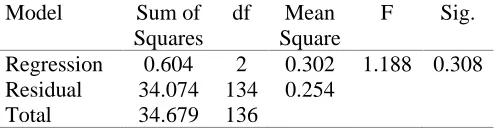
Hypothesis 10: There is a significant difference between job commitment of librarians of public libraries of Kermanshah and South Khorasan provinces based on their level of education.
According to Table 9, there is no significant difference between job commitment of librarians of public libraries of South Khorasan and Kermanshah provinces (p> 0.05, F= 1.88).
Table 9: The results of analysis of variance of job commitment of librarians based on different educational levels
Model Sum of
Squares
df Mean
Square
F Sig.
Regression Residual Total 0.604 34.074 34.679 2 134 136 0.302 0.254
1.188 0.308
Discussion and Conclusion
Information literacy as an accelerator for organizational productivity could be an essential factor in organizations, especially those with scientific and research goals. Doubtlessly, such skills are super visional factors in success gain of librarians of public libraries as information-oriented organizations. On the other hand, well-informed, faithful and committed librarians are human resources side factors for success of such organizations. Human resources are the only potential competitive advantage that organization should make them de facto forces and lead them in the direction of organizational goals. Therefore, recruiting and maintaining committed and expert employees should be the most important organizational strategic resource. Committed and expert employees move towards of organizational goals and their attitude goes further than their duties. The horizon of being specialized to information skills lead to job satisfaction and consequently the desire to remain and feel helpful for the organization in the library environment increases. Finally, this status leads to users’ satisfaction and changing the overall vision and positive attitude towards the job duties.
organizational performance along with job commitment as one of the managerial dimensions. However, this study contradicts Safavi and Mahboob’s study indicating that there is no relation between information literacy of librarians with their performance’s indices.
The relationship between information literacy dimensions and job commitment of employees showed that, ability of employees in defining informational needs, evaluation, analysis of retrieved information in shortest time, differentiating related and unrelated information and, most importantly, having education and work experience in defining, evaluation and applying information are important factors in success of themselves and achieving of organizational goals and positively correlates their job commitment. One result showed that there is no relation between locating information and employees’ job commitment. This may be due to librarians’ lack of familiarity with production phases and organizing new informational resource with less known structures, lack of access to such resources and lack of familiarity with continual changing search methods.
According to the result of the third assumption, librarians of the community are interested in their job affairs and this implies their right decision in choosing their profession. Being affiliated to the organization and remaining in the organization has been necessitated through their willingness. So, they get more involved in organization problems and know that personal values depend on performing their duties properly. All these factors induce employees to learn information literacy skills with more motivation and steps towards the users’ satisfaction and advancement of organizational goals. Perhaps, factors such as interest in job and job satisfaction, feeling attached to the organization, faithfulness to job values and enthusiasm of librarians of these two province’s public libraries lead to improvement of information literacy skills to advance their organizational goals.
As the results show, information literacy predicts staff job commitment. Therefore, it is necessary that managers and planners pay attention to the preconditions of training information literacy. In sum, information literacy skills lead to improvement of job commitment of employees of organizations and increase their productivity. The result of this study, together with findings of Li and Hung showed that information literacy skills predict employees’ job commitment as one of managerial dimensions of the research community. According to the results, information literacy of librarian of Kermanshah Province is higher than that of South Khorasan. It seems that, facilities, access to high-speed internet, in-service training, education level, etc. are factors causing this kind of difference. Concordant with this study, findings of Alinezhad et al. (2011) shows that there is difference between information literacy skills of AmirKabir University of Science and Technology and Shiraz University.
There is no difference between job commitment of employees of Kermanshah and South Khorasan. Probably, librarians of these two provinces feel their job and profession concordant with their interest and perform their career with satisfaction. This motivation induces them to remain in their organization and consequently they respond to their job demands with more enthusiasm. So, job commitments of librarians of these two provinces show no difference. As shown, there is significant difference between information literacy of employees based on their field of study. Probably, the more their education level and experiences, the more their information literacy skills increase. Therefore, the higher is their education level, the more they have benefited from training. Therefore, job related field of study positively affect the improvement of professional abilities including information literacy.
have more capabilities in defining informational needs, retrieving and evaluating information literacy and applying information in doing their job. The results of the present study showed that higher educational levels and experiences of employees will raise their information literacy skills. Concordant with this study, findings of Nikpoor et al. (2012); and Mohammadi et al. (2012) showed when the level of employees’ level of education increases their information literacy level rise up as well.
The result also showed that, there is no significant difference between job commitment performances of these two provinces. It seems that the librarians feel themselves belonging to their organization equally and concern about their work values and take part in their duties. So, their feedbacks had been the same. Consequently, education level makes no difference in their job commitments. The results of this study do not contradict findings of Jokar and Afifian (2013). According to their findings, there is no significant difference between job commitments of employees and their educational level. Generally speaking, librarians’ commitment and expertise are important principles in each public library and enhancing these two aspects leads to improvement of librarians’ durability. As a final result, one can conclude that information literacy strongly correlates with job commitment, most probably in any informational organization.
References
Agdasi, A. N., Alipour Baghbannezhad, Y., Mafi, M., & Talebi, B. (2013). Information Literacy Relationship with the Librarians’s Performance in Tabriz. Journal of Basic and Applied Scientific Research, 3(3), 270-275.
Alinezhad Mehrangizm Horri, A., Sarmadi, M., & Shobeiri, M. (2011). Relationship between information literacy of students of electronic training with their educational performance and their course satisfaction. Researches of Notification and Public Libraries, 35-75.
Bani Taba, M. (2009). Assessment of inter organizational trust and job commitmentin Isfahan’s high schools. Educational Sciences, 68-98.
Blau, G. J. (1985). The measurement and prediction of career commitment. Journal of Job Psychology, 58(4), 277-288. Bruce, C. S. (1999). Workplace experiences of information literacy. International Journal of Information
Management, 19(1), 33-47.
Corral, Sh. (2008). Information Literacy Strategy development in higher education: an exploratory Study. International Journal of Information Management, 28(1), 26-37.
DavarPanah, M., Ghasemi, A., & Siamak, M. (2009). Evaluation of information literacy of Student. Tehran, Dbiz Publications.
Hackett, R. D., Lapierre, L. M., & Hausdorf, P. A. (2001). Understanding the links between work commitment constructs.
Journal of Vocational Behavior, 58(3), 392-413.
Hull, G. (1993).Critical Literacy and Beyond: Lessons Learned from Students and Workers in a Vocational Program and on the Job. Anthropology & Education Quarterly, 24 (4).
Jokar, A., & Afifian, F. (2013). Relationship between job satisfactions of employees occupied in libraries, case study Shiraz University. Specialized seasonal journal of social sciences, Islamic Azad university,7(21),1-14.
Li, C. K., & Hung, C. H. (2010). An examination of the mediating role of person-job fit in relations between information literacy and work outcomes. Journal of Workplace Learning, 22(5), 306-318.
Mirza Safi, A., Rajayee Poor, S., Jamshidian, A. (2010). Relationship between information literacy and entrepreneurship capabilities of students of complimentary educations of Isfahan University. Journal of Librarianship and Notification, 272-244
Mohammadi, F., Shakeri, S., & Akbari, D. (2012). Assessment of information literacy of clients of National Libraries of Islamic Republic of Iran, ACRL standards. Journal of Systems and Notification Services, 85-96.
Mollapour, H., Siadat, S. A., & Mohammadi Sadr, M. (2013). Determination of Relationship between Information literacy and Job adjustment of High School Teachers in City of Izeh. International Journal of Scientific and Research Publications, 7(3), 1-3.
Noveen Isfahani, N. (2013). Assessment of the relation between information literacy and job motivation of female teachers of vocational and technical schools of Ghazvin province, M.A treatise of educational psychology, Alameh Tabatabyee University.
Safavi, Z., & Siamak, M. (2010). Evaluation of the effect of information literacy of librarians of public libraries on indices of library performance. Case study: public libraries of Tehran. Librarianship and notification, 16(2), 225-241.