A Designed Enclosure Unit for Loop-Mediated Isothermal Amplification
Arayan Wongniyom
1, Jyh
-
Jian Chen
2,*1
Department of Tropical Agriculture and International Cooperation, National Pingtung University of Science and Technology, Pingtung, Taiwan, ROC.
2 Department of Biomechatronics Engineering, National Pingtung University of Science and Technology, Pingtung, Taiwan, ROC.
Received 17 July 2017; received in revised form 05 August 2017; accepted 25 August 2017
Abstract
The gene amplification technique is used in medical science and biotechnology popularly. The loop-mediated
isothermal amplification (LAMP) is a nucleic acid amplification method that can be utilized in low-resource settings
and does not require expensive or complex instruments. The annealing process of LAMP is performed at a constant
temperature (around 65 °C) for an hour. From previous works, phase change materials (PCMs) have been applied for
the latent heat energy storages due to their isothermal operation during phase transitions. The utilization of the
melting temperature of the paraffin wax to maintain the suitable temperature for LAMP process is introduced in our
study. To enhance the heat transfer inside the energy storage unit, several pin fins are constructed on the inner
surface of the unit which is 50 mm × 50 mm × 50 mm in inner size. The influence of various numbers of pin fins on
the temperature distribution is examined by the numerical simulation. The heat transfer inside the paraffin enclosure
with fins is better than that without fin. It can be found that the temperature uniformity in the PCM inside the
enclosure with fins shows much better. Though the numbers of the fin are increased, some transfer energy from the
heat source remains at the enclosure wall and cannot penetrate into the PCM. The duration for all PCM melted from
solid phase to liquid phase is over 10 minutes. In the future, the geometric parameters on the duration for phase
transition of PCM inside the LAMP chamber will be investigated.
Keywords: phase change materials, LAMP, paraffin wax
1.
Introduction
The detection of nuclei-acid sequences is popularly used in medical research, biotechnology and food science. The
Loop-mediated isothermal amplification (LAMP) is a biotechnique that can amplify deoxyribonucleic acid (DNA) within 60
minutes under isothermal conditions (50-65 °C). This technique, a highly sensitive technique that can be used in low-resource
settings and does not require expensive or complex instruments [1], is suitable for small-scale hospitals, primary care facilities
and clinical laboratories in developing countries [2-3]. In previous studies, the LAMP technique was able to yield the
amplification of 109-bp of DNA [4], and applied to detect the virus as follows: Mycobacterium [1], Tuberculosis [5], M. avium
and M. intracellulare in sputum [3], Porcine kobuvirus [6], etc.
*The LAMP process is to anneal DNA and primers with an appropriate constant temperature. To build a reaction device
for LAMP process, one of the most important issues is to design a reaction chamber that can be kept at a constant temperature
for a period of time. When heat energy is supplied to or extracted from a phase change material (PCM), there is only a little
change of temperature inside the PCM. Therefore, PCM can be used to stabilize the temperature in an application for LAMP
process. In general, PCM refers to solid-liquid phase changes only [7]. Paraffin wax is the most commonly used commercial
organic PCM because of its high heat of fusion, varied phase change temperatures, negligible supercooling, lower vapor
pressure in a melt and chemically inert and stable behavior [8].
However, due to low thermal conductivity of paraffin wax, it requires large surface area for heat exchange [9].
Kandasamy et al. [10] studied about using the paraffin wax as the PCM-based heat sink. The results from simulations and
experiments have shown that PCM-based heat sink can be used in intermittent-use devices. Nayak et al. [11] improved the
cooling of the electronics devices by using PCM with fins made of thermal conductivity enhancer material. Pakrouh et al. [12]
presented a numerical investigation to optimize the geometry of PCM-based fin heat sinks. The result showed the fin height
affects the base temperature. Hosseinizadeh et al. [13] carried out a comparison between heat sink with and without PCM.
Their results revealed that fins thickness larger than 4 mm did not improve the performance of the heat sink. Kamkari et al. [14]
demonstrated the experimental results of PCM melting in an enclosure with and without horizontal partial fins. Results
indicated that when the surface-averaged Nusselt number was reduced, increasing the number of fins decreased the melting
time and increased the total heat transfer rate.
LAMP has been utilized for the detection of DNA and/or RNA from a wide range of bacterial and viral pathogens [15-17].
Curtis et al. [15] presented a non-instrumented nucleic acid amplification (NINA) heating device. The heat from the
exothermic chemical reaction was enough to anneal DNA sample for 60 minutes. However, the changing of the ambient
temperature had an effect on the temperature stability during the amplification process and it was difficult to control the heat
from the chemical reaction. In our LAMP device, a cartridge heater is utilized to generate heat energy for melting PCM and
then the melting PCM is used for stabilizing the sample temperature during the DNA amplification. This process does not need
any thermal controller and the integration of the LAMP device was easy.
2.
Numerical Methodology
A schematic diagram of three-dimensional the enclosure physical model consist of lid, fin array and cavity, the DNA
sample put on the top surface of the lid is shown in Fig. 1(a). Considering the symmetry of the geometry, only one quarter of
the physical model is included for computation. The pin fin array and the cavity are made of aluminum which contains the
PCM. A uniform heat power is applied at the bottom surface of the cavity. Initially, the solid PCM and enclosure are in thermal
equilibrium with the ambient temperature, 20 °C. The solid and liquid phases of PCM are homogeneous and isotropic. Thermal
resistance across the wall of the container is neglected and lateral sides of the rectangular enclosure are well insulated. The
melting point of PCM is 65 °C. The effect of natural convection within the melt PCM is neglect because the space into
enclosure is moderately narrow and fin array barrier velocity flow when phase transition to liquid. The PCM undergoes the
transition from the solid state to the liquid state. There are governing equations as follows.
Heat conduction in liquid region:
𝜕𝑇𝑙 𝜕𝑡 = 𝛼𝑙
𝜕2𝑇𝑙 𝜕𝑥2 + 𝛼𝑙
𝜕2𝑇𝑙 𝜕𝑦2 + 𝛼𝑙
𝜕2𝑇𝑙
𝜕𝑧2 , 𝑡 > 0 (1)
Heat conduction in solid region:
𝜕𝑇𝑠 𝜕𝑡 = 𝛼𝑠
𝜕2𝑇𝑠 𝜕𝑥2 + 𝛼𝑠
𝜕2𝑇𝑠 𝜕𝑦2+ 𝛼𝑠
𝜕2𝑇𝑠
𝜕𝑧2 , 𝑡 > 0 (2)
Interface temperature:
Stefan condition:
𝑘𝑠𝜕𝑇𝜕𝑥𝑠− 𝑘𝑙𝜕𝑇𝜕𝑥𝑙= 𝐻𝑓𝜌𝑑𝑋𝑑𝑡 , 𝑡 > 0 (4)
where 𝛼 is thermal diffusivity. k is the thermal conductivity. 𝛾 is the melt fraction during the phase change process and is
defined by the following relations: 𝛾 = 0 , if 𝑇 < 𝑇𝑠; 𝛾 = 0 , if 𝑇 > 𝑇𝑙 ; 𝛾 =𝑇𝑇−𝑇𝑠
𝑙−𝑇𝑠 , if 𝑇𝑠< 𝑇 < 𝑇𝑙 . Tm is melting
temperature, the subscript l and s is liquid and solid phase respectively. A grid system is composed of 32768 to 61952
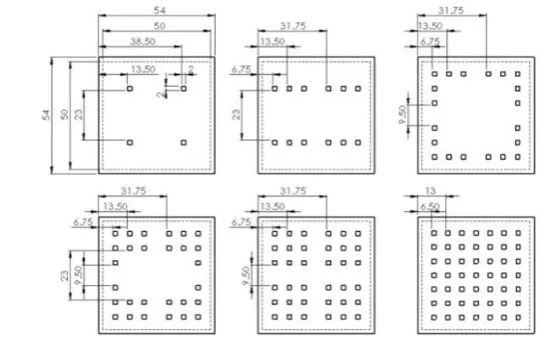
hexahedral cells, which depends on the numbers of fin. The numbers of fin are varied from 4 to 49 pin fins, H is fin height,
which is varied from 20 mm to 47 mm and the fin maintains 2 mm thickness of whole models shown in Fig. 1(b). A constant
heat power of 14 W is applied at the bottom surface of the enclosure.
A finite volume approach is adopted by using computational fluid dynamics (CFD) software ESI-CFD (V2006, CFD
Research Corporation, Huntsville, AL, USA) to model the PCM melting process. A structured grid system with good
orthogonality is recommended for accurate prediction and reliability. In this study the geometric model for the three
dimensional rectangular structure is considered. In the computation of the enthalpy of the simulation model, the spatial
discretizations are performed using a second-order upwind scheme. The conditions of convergence can be divided into two
kinds. The first one is the maximum number of the solver iterations. The second one determines the convergence criteria to be
used. In this study, we perform 100 sweep times and use 5×10⁻⁵ as the convergence criterion. Grid sensitivity is evaluated by
using different element sizes to ensure that the simulated results are independent of element size. The element size is repeated
until the similarity in results is within the acceptable solution tolerance (0.1%). This study use the PCM, which has the melt
point near the amplification process of LAMP technique is the Rubitherm® RT64HC paraffin wax has a solid density of 880
kg/m3, a liquid density of 780 kg/m3, a specific heat of 2000 J/kg-K, a latent heat of 2.3×10⁵ J/kg and a thermal conductivity of 0.2 W/m-K. Aluminum has a density of 2700 kg/m3, a specific heat of 880 J/kg-K and a thermal conductivity of 190 W/m-K.
(a) The quarter part of the enclosure and PCM (b) Bottom view of the heat sinks with 4, 9, 20, 28, 36, and 49 pin fins
Fig. 1 The numerical models of 2 mm thickness fin
3.
Results and Discussion
In this section, we present the thermal characteristics obtained from the three dimensional simulations and the results of
the parametric studies are shown. The discussion concerns the calculated temperatures and melt fractions of the PCM as
functions of time.In our study, heat conduction is the main heat transfer mechanism inside the enclosure. The heater generates
heat energy from pin fin array and cavity through to the solid PCM, melting of the PCM and then heating of the molten PCM to
temperature above its melting point. The material of the fins is identical to the enclosure. Therefore the temperature of the
enclosure and the fins increase more than that of PCM. The temperature of the lid might exceed the temperature suitable for
amplification process in LAMP technique. The purpose of the fins is enhancing thermal conductivity of PCM that contain
inside an enclosure, the heat flux flow with heat conduction from the heat source at the bottom cavity aluminum to PCM. The
large disparity thermal conductivity between aluminum and PCM that make effect to the intensive heat flux flow in material.
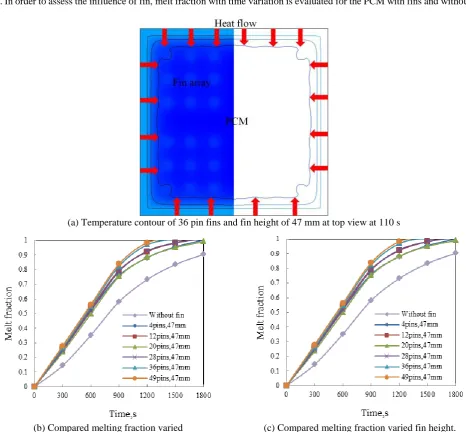
The fins array is proficiently constrained the temperature for annealing the sample on the top surface enclosure shown in Fig.
2(a). In order to assess the influence of fin, melt fraction with time variation is evaluated for the PCM with fins and without fin
(a) Temperature contour of 36 pin fins and fin height of 47 mm at top view at 110 s
(b) Compared melting fraction varied (c) Compared melting fraction varied fin height.
Fig. 2 The melt contour inside enclosure of PCM and Melt fraction effected of number of pin fin and fin height
After 1800s, there are three cases of PCM no complete melting to liquid as follows: without fin, 20pins fin and 47mm fin
height, and 49 pins fin and 20mm fin height Fig. 2(b) and 2(c) show the temporal variations of melt fractions during melting
processes for finned enclosure and enclosure without fun. A rapid increase in temperature of PCM is observed with fins than
that of PCM without fins. This is because the longitudinal finned material is able to transfer heat from the heat source quickly.
The higher heat transfer rate was induced by the presence of fins near the heat source causes faster melting of PCM. Thus, the
total melting time is reduced compared to the system without fins. The fins accelerate the heat transfer rate from the surface of
heat source to and through the PCM. The melt fraction of PCM with 49 pin fins and fin height of 47 mm is higher than that of
other cases. Regarding to the enclosure with 36 pin fins, the melt fraction is lower than that with 49 pin fins, but is almost the
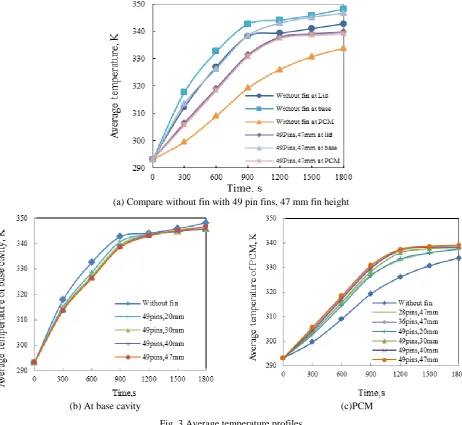
(a) Compare without fin with 49 pin fins, 47 mm fin height
(b) At base cavity (c)PCM
Fig. 3 Average temperature profiles
The gradients of the temperature contours are large at the bottom of the enclosure during the observed times because the
applied heat source is at the bottom of the enclosure. The PCM has a low thermal conductivity. Therefore, the large heat flow
along aluminum wall causes high temperature, the PCM temperature is improving almost lid temperature when applied fin
array the 49 pins fin and 40mm fin height shown in Fig. 3(a). Although concentrated temperature at the base cavity in 49 pins
and 40 mm fin height is most (neglect without fin case) Fig. 3(b), the temperature profiles of PCM almost 49 pins and 47 mm
fin height case after 900s. The solid PCM was heated by the adjacent liquid PCM. Hence fin array enhanced and increased the
melting rate. The extended surfaces of the fin array are inserted into PCM and lead to more heat transfer than the enclosure
without fin, as shown in Fig. 3(c).
The fin array and cavity structures cause the heat energy penetrated into the PCM. The largely different thermal
conductivity between aluminum and PCM has the effect to intensive gradient temperature occur on surface heat transfer of
aluminum, demonstrated in Fig. 4(a,b), and the space without fin remain solid state indicate that the heat transfer between
liquid to solid not well. The melting rate is enhanced by pin fin array. The number of pin fin and fin height directly influence
the surface heat transfer. When the surface heat transfer is increased, the heat energy for phase transition is reduced in Fig. 4(c).
It is because the large heat flux through surface fin to PCM change to complete the melting, the liquid PCM cannot absorb
energy. The influence of various fin heights and numbers of pin fin on melt fraction when each fin surface heat transfer is
with 28 pin fins and 47 mm fin height and 22520 mm2 with 20 pin fins and 47 mm fin height, respectively. The 49 pin fins and 40 mm fin height has surface heat transfer 30680 mm2 less surface heat transfer than 49 pin fins and 47 mm fin height (33424 mm2) and use latent heat energy for phase transition. The difference of the melt fractions among these cases are within 10% after the beginning of the duration of 300 s. Therefore, the latent heat energy storage depends on the surface of the heat transfer.
The saved energy for each model can be found by integrating the area under the relative latent heat energy and time. The slope
of each graph indicates the energy to be used within 1800s. The group of 49 pin fins saves more energy than others with large
space between adjacent fins.
(a)Top view cross-section at half of fin length
(b) Front view cross-section at middle of first row of fin (c) Latent heat energy and surface heat transfer
Fig. 4 Temperature contours of 36pin 47mm fin height model at 300
(a) The area under each the graph (b) The slope value each graph of latent heat energy
4. Conclusion
In this paper, the numerical study of the designed PCM enclosure for LAMP was presented. The transient simulation of
heat conduct problem of an enclosure with PCM is shown with several pin fins inside the enclosure. The main parameters
about enhancing the heat transfer were the number of pin fin and the fin height. The simulation results show an enhancement of
melting rate and a decreasing temperature gradient near the heating wall of enclosure with fin array extended from lid. The
thorough pin fin position distribution and the number of pin fin can be used to save the energy to melt PCM. The simulation
study shows the pin fin array technique can improve the potential of PCM for applying in the LAMP machine.
Acknowledgment
The authors would like to thank the Ministry of Science and Technology of the Republic of China for financially
supporting this research under Contract No. MOST 105-2313-B-020-007-.
R
eferences
[1] E. Aryan, M. Makvandi, A. Farajzadeh, K. Huygen, P. Bifani, and S. L. Mousavi et al, “A novel and more sensitive loop-mediated isothermal amplification assay targeting IS6110 for detection of Mycobacterium tuberculosis complex,” Microbiological Research, vol. 165, no. 3, pp. 211-220, 2010.
[2] Y. Mori and T. Notomi, “Loop-mediated isothermal amplification (LAMP): a rapid, accurate, and cost-effective diagnostic method for infectious diseases,” Journal of Infection and Chemotherapy, vol. 15, no. 2, pp. 62-69, 2009 [3] T. Iwamoto, T. Sonobe, and K. Hayashi, “Loop-mediated isothermal amplification for direct detection of mycobacterium
tuberculosis complex, M. avium, and M. intracellulare in sputum samples,” Journal of Clinical Microbiology, vol. 41, no. 6, pp. 2616-2622, 2003.
[4] T. Notomi, H. Okayama, H. Masubuchi, T. Yonekawa, K. Watanabe, and N. Amino et al, “Loop-mediated isothermal amplification of DNA,” Nucleic Acids Research, vol. 28, no. 12, pp. e63-e63, 2000.
[5] C. C. Boehme, P. Nabeta, G. Henostroza, R. Raqib, Z. Rahim, and M. Gerhardt et al., “Operational feasibility of using loop-mediated isothermal amplification for diagnosis of pulmonary tuberculosis in microscopy centers of developing countries,” Journal of Clinical Microbiology, vol. 45 no. 6, pp. 1936-1940, 2007.
[6] C. Li, J. Chen, H. Shi, X. Zhang, D. Shi, and X. Han et al., “Rapid detection of porcine kobuvirus in feces by reverse transcription loop-mediated isothermal amplification,” Virology Journal, vol. 11, no. 1, pp. 73, 2014.
[7] H. Mehling and L. F. Cabeza, Heat and cold storage with PCM, Berlin, Springer, 2008.
[8] M. K. Rathod and J. Banerjee, “Thermal stability of phase change materials used in latent heat energy storage systems: a review,” Renewable and Sustainable Energy Reviews, vol. 18, pp. 246-258, 2013.
[9] M. Akgün, O. Aydın, and K. Kaygusuz, “Experimental study on melting/solidification characteristics of a paraffin as PCM,” Energy Conversion and Management, vol. 48, no. 2, pp. 669-678, 2007.
[10] R. Kandasamy, X. Q. Wang and A. S. Mujumdar, “Transient cooling of electronics using phase change material (PCM)-based heat sinks,” Applied Thermal Engineering, vol. 28, no. 8, pp. 1047-1057, 2008.
[11] K. C. Nayak, S. K. Saha, K. Srinivasan, and P. Dutta, “A numerical model for heat sinks with phase change materials and thermal conductivity enhancers,” International Journal of Heat and Mass Transfer, vol. 49, no. 11, pp. 1833-1844, 2006. [12] R. Pakrouh, M. J. Hosseini, A. A. Ranjbar, and R. Bahrampoury, “A numerical method for PCM-based pin fin heat sinks
optimization,” Energy Conversion and Management, vol. 103, pp. 542-552, 2015.
[13] S. F. Hosseinizadeh, F. L. Tan, and S. M. Moosania, “Experimental and numerical studies on performance of PCM-based heat sink with different configurations of internal fins,” Applied Thermal Engineering, vol. 31, no. 17, pp. 3827-3838, 2011.
[14] B. Kamkari and H. Shokouhmand, “Experimental investigation of phase change material melting in rectangular enclosures with horizontal partial fins,” International Journal of Heat and Mass Transfer, vol. 78, pp. 839-851, 2014. [15] K. A. Curtis, D. L. Rudolph, I. Nejad, J. Singleton, A. Beddoe, and B. Weigl et al., “Isothermal amplification using a
chemical heating device for point-of-care detection of HIV-1,” PloS One, vol. 7, no. 2, p. e31432, 2012.
[16] J. Singleton, J. L. Osborn, L. Lillis, K. Hawkins, D. Guelig, and W. Price et al., “Electricity-free amplification and detection for molecular point-of-care diagnosis of HIV-1,” PLoS One, vol. 9, no. 11, p. e113693, 2014.