R E S E A R C H A R T I C L E
Open Access
Gene-specific selective sweeps in bacteria and
archaea caused by negative frequency-dependent
selection
Nobuto Takeuchi
1*, Otto X Cordero
2, Eugene V Koonin
3and Kunihiko Kaneko
1Abstract
Background:Fixation of beneficial genes in bacteria and archaea (collectively, prokaryotes) is often believed to erase pre-existing genomic diversity through the hitchhiking effect, a phenomenon known as genome-wide selective sweep. Recent studies, however, indicate that beneficial genes spread through a prokaryotic population via recombination without causing genome-wide selective sweeps. These gene-specific selective sweeps seem to be at odds with the existing estimates of recombination rates in prokaryotes, which appear far too low to explain such phenomena. Results:We use mathematical modeling to investigate potential solutions to this apparent paradox. Most microbes in nature evolve in heterogeneous, dynamic communities, in which ecological interactions can substantially impact evolution. Here, we focus on the effect of negative frequency-dependent selection (NFDS) such as caused by viral predation (kill-the-winner dynamics). The NFDS maintains multiple genotypes within a population, so that a gene beneficial to every individual would have to spread via recombination, hence a gene-specific selective sweep. However, gene loci affected by NFDS often are located in variable regions of microbial genomes that contain genes involved in the mobility of selfish genetic elements, such as integrases or transposases. Thus, the NFDS-affected loci are likely to experience elevated rates of recombination compared with the other loci. Consequently, these loci might be effectively unlinked from the rest of the genome, so that NFDS would be unable to prevent genome-wide selective sweeps. To address this problem, we analyzed population genetic models of selective sweeps in prokaryotes under NFDS. The results indicate that NFDS can cause gene-specific selective sweeps despite the effect of locally elevated recombination rates, provided NFDS affects more than one locus and the basal rate of recombination is sufficiently low. Although these conditions might seem to contradict the intuition that gene-specific selective sweeps require high recombination rates, they actually decrease the effective rate of recombination at loci affected by NFDS relative to the per-locus basal level, so that NFDS can cause gene-specific selective sweeps.
Conclusion:Because many free-living prokaryotes are likely to evolve under NFDS caused by ubiquitous viruses, gene-specific selective sweeps driven by NFDS are expected to be a major, general phenomenon in prokaryotic populations.
Background
Accumulating evidence from ecological and genomic surveys of microbial diversity indicates that archaea and bacteria (collectively, prokaryotes) in nature are orga-nized into genotypic clusters that largely coincide with distinct ecological characteristics [1]. How such patterns of microbial diversity are formed and maintained is an open question in microbial ecology. It is generally agreed
that restriction of recombination and balancing selection between genotypic clusters are necessary for stable, sym-patric coexistence of multiple distinct clusters [1-4]. More controversial are the roles played by selection and recombination in the formation of such clusters [5,6].
A prominent concept, known as the ecotype model, posits a central role for positive selection and restricted recombination for cluster formation [2]. According to this model, when positive selection causes fixation of a beneficial gene (allele) at one locus in the genome within a population, it also entails fixation at all other loci be-cause recombination is not frequent enough to unlink
* Correspondence:[email protected]
1
Department of Basic Science, Graduate School of Arts and Sciences, University of Tokyo, Tokyo, Japan
Full list of author information is available at the end of the article
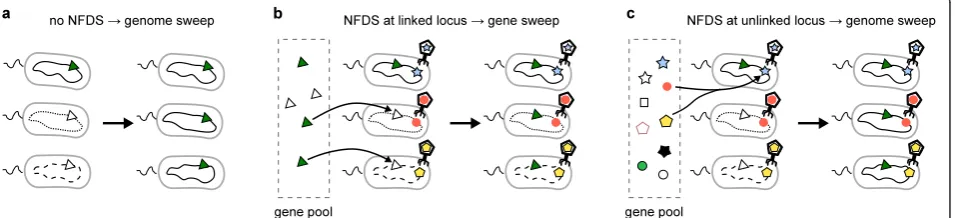
the beneficial gene from the rest of the genome (Figure 1a). This phenomenon is known as genome-wide selective sweep [7] or genetic hitchhiking [8]. Genome-wide selective sweeps can repeatedly occur in a population adapting to a new environment, each time purging within-population genetic diversity, a phenomenon known as periodic selec-tion [9]. Periodic selecselec-tion makes a populaselec-tion genetically cohesive and distinct from other populations, leading to cluster formation [5].
Recently, this common view of prokaryote evolution has been challenged by the study of Shapiro et al. [10], which explored the spread of adaptive genes through natural populations of ocean microbes, Vibrio
cyclitro-phicus. This study has shown that adaptive genes spread
through microbial populations via horizontal gene trans-fer (i.e., recombination) without purging genome-wide diversity that was present before the selective sweep. Accordingly, this mode of evolution is denoted gene-specific selective sweep. Under this evolutionary regime, ecologically differentiated individuals are not genetically differentiated at the vast majority of polymorphic loci. Thus, cluster formation rests on establishment of re-combination barriers between ecologically differentiated populations [10,11], a situation similar to that of sexually reproducing eukaryotes (e.g., [12-14]). Gene-specific se-lective sweeps have additional implications for the ecol-ogy and evolution of prokaryotes. In particular, under this scenario, genetic diversity within a population is protected from genome-wide selective sweeps that could potentially exert major effects on ecological characteris-tics of populations such as primary productivity [15]. Moreover, under the gene-specific sweep model, the evo-lutionary history of a population cannot be described by a single line of succession of common ancestors, in con-trast to the implications of the ecotype model [16].
The gene-specific selective sweeps in prokaryotes not only challenge the common view of prokaryote evolution, but also are puzzling with respect to the underlying mech-anism. At face value, a gene-specific selective sweep implies that recombination is so frequent as to unlink ecologically beneficial alleles from the rest of the genome before they rise to high frequencies [17,18]. This apparently would re-quire recombination rates far higher than those currently inferred from the available data from many prokaryotes [17,19-22] (see also ‘Discussion’). Although one cannot completely exclude the possibility that current methods underestimate recombination rates by several orders of magnitude, it seems worthwhile to seek an alternative ex-planation as suggested by the following consideration. The concept of periodic selection, on which the ecotype model is based, was originally derived from experimental evolu-tion of pure bacterial cultures in an isolated environment [9]. Most microbes in the wild do not evolve under such controlled conditions. Rather, they struggle for existence amidst a highly heterogeneous, dynamic ecological com-munity including other evolving microbes, hosts, preda-tors, viruses and plasmids. Ecological interactions with these diverse biological entities substantially impact the course of microbial evolution as indicated by recent work on experimental coevolution [23].
A general mechanism by which such an impact can be made is negative frequency-dependent selection (NFDS), which is a type of selection that favors rare phenotypes in a population [24]. NFDS can be caused by various eco-logical interactions such as evasion of parasites (also known as the kill-the-winner dynamics) and attack on competitors (e.g., antibiotics production) as well as social interactions such as provision of public goods (e.g., sidero-phores and virulence factors) [24-28]. NFDS can generate and maintain genetic diversity within a population [29],
with the implication that genes adaptive for every individ-ual would spread through a population via recombination, hence gene-specific selective sweeps (Figure 1b) (NFDS has been suggested as a potential cause of gene sweeps by Shapiro et al. [10]; related ideas have been explored by Maynard Smith [30], and Majewski and Cohan [31]; see Discussion). According to this scenario, gene-specific se-lective sweeps would be a general phenomenon because many, if not most, free-living prokaryotes are likely to evolve under NFDS caused, in particular, by the ubiqui-tous viruses [32].
A potential problem with the NFDS scenario, however, is that the loci involved in these interactions often are located in genomic islands that appear to experience significantly elevated recombination rates [24,27,33-35]. For example, the O-antigen, the outermost part of lipo-polysaccharide protruding from the surface of Gram-negative bacteria, is a typical virus receptor [27]. Genes encoding the O-antigen are likely to evolve under NFDS as attested by their high variability among closely related bacteria [27]. These genes typically are clustered in genomic islands that undergo frequent horizontal gene transfer [36]. In the Vibrio splendidus genome, O-antigen-encoding regions contain conserved signal se-quences known as JUMP sites, which are exclusively found in these regions and are thought to be involved in natural transformation [37]. Other examples include genomic islands ofProchlorococcuscyanobacteria, which encompass genes for various metabolite transporters (potential targets of virus recognition) as well as many tRNA genes, repeat elements and integrases, which can enhance the rate of recombination in these islands [38]. Furthermore, genes encoding various antiviral defense mechanisms, such as restriction-modification systems, also form clusters known as defense islands, which are significantly co-localized with genes encoding transpo-sons and prophage components [35]. Finally, genes en-coding synthetases of secondary metabolites that can act as public goods have been shown to appear in mobile re-gions of prokaryotic genomes. For example, in marine
vibrios, toxin-coding genes have been found in genomic islands [39]. Also, secreted virulence factor genes are typically located in the hyper-recombinant regions of many prokaryotic genomes [40]. As a consequence of el-evated recombination rates, the loci affected by NFDS can be unlinked from the rest of the genome, and ac-cordingly, NFDS would be unable to prevent genome-wide selective sweeps driven by other adaptive alleles (Figure 1c) [24]. Thus, evaluation of the potential effect of NFDS on fixation of beneficial alleles requires consid-eration of such biased recombination rates.
Here, we investigate whether and under what condi-tions NFDS can cause gene-specific selective sweeps in the presence of elevated recombination rates at the loci affected by NFDS. Using mathematical modeling, we show that NFDS indeed can cause gene-specific selective sweeps in large prokaryotic populations, but only when the basal recombination rate is sufficiently low, appar-ently contradicting the intuition that high recombination rates are required for gene-specific selective sweeps.
Results
General framework of the model
We first introduce the general framework of the model by formulating the question we seek to address (see
‘Materials and methods’ for the details of the model). Suppose that a population of prokaryotes is evolving to-ward adaptation to a new ecological niche. The genomes of these prokaryotes are assumed to consist of three types of loci (Figure 2a): (i) loci involved in the adapta-tion to the new niche (E or ecological loci, for short), (ii) n loci subject to NFDS (S or susceptibility loci, for short), and (iii) all the other loci, which are assumed to be neutral (N or neutral loci, for short; only one such locus is shown in Figure 2a). The S loci assume lalleles per locus, allowing for a total of ln allelic patterns or ln susceptibility types (see Table 1 for notation). Each sus-ceptibility type is selectively maintained in the popula-tion by the kill-the-winner dynamics. The N loci assume multiple alleles that are selectively neutral. Suppose
further that a beneficial allele appears at one of the E loci in one individual of the population. Driven by direc-tional selection, this allele would tend to spread through the population. The question is whether this spread purges genetic diversity at the N loci. If the NFDS is suf-ficiently strong (see ‘Discussion’ for the justification of this assumption), the frequency of the beneficial allele at the E locus cannot increase beyond the limit imposed by the NFDS, unless the E locus is completely unlinked from all the S loci. Two extreme cases are conceivable that result in such unlinking. In the first extreme case, only the E locus undergoes recombination, whereas the S and N loci are completely linked (Figure 1b). In this case, the beneficial allele at the E locus spreads via re-combination without purging neutral diversity at the N loci. Therefore, a gene-specific selective sweep ensues. In the other extreme case, only the S loci undergo recom-bination, whereas the E and N loci are completely linked (Figure 1c). In this case, the beneficial allele at the E locus can still spread via recombination at the S loci, but the di-versity at the N loci is purged because the E and N loci are
linked and, thus, sweep together. Therefore, a genome-wide selective sweep ensues (except at the S loci). The above argument illustrates the crux of the problem: whether a gene-specific or genome-wide selective sweep occurs depends on the relative degree of linkage between the E and N loci, and the S and N loci. Thus, we pose the question: If the S loci undergo recombination much more frequently than the E locus (as is likely to be the case), can gene-specific selective sweeps nevertheless occur?
To address the above question, a deterministic popula-tion genetics model of evolving prokaryotes under NFDS was developed. The model was formulated as a system of difference equations, ignoring stochastic effects for simpli-city (a model incorporating stochastic effects is described in Additional file 1 under the section‘Effect of finite popu-lations’). The model incorporated NFDS by assuming the kill-the-winner dynamics, following the matching-allele model of infection genetics [41] (an alternative model that incorporates NFDS without explicitly assuming host– parasite interactions is described in Additional file 1 under
‘Alternative model’). For more details, see ‘Materials and methods’.
Negative frequency-dependent selection can cause gene sweeps when recombination is rare
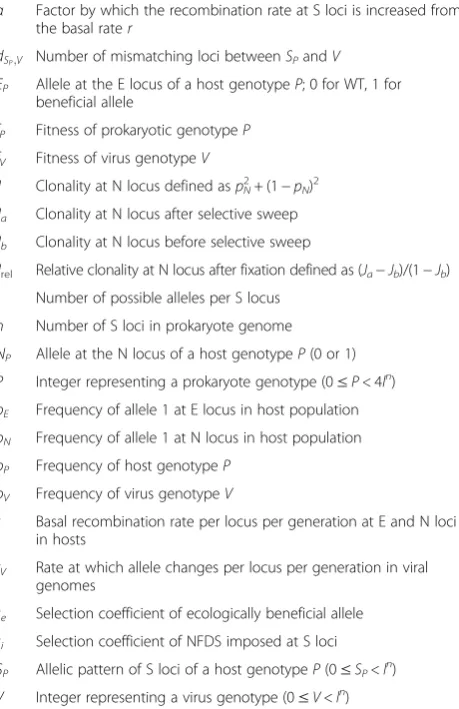
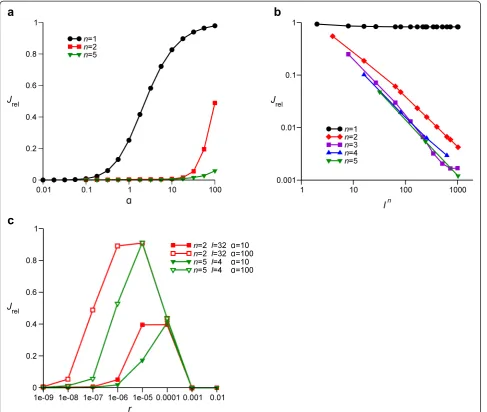
Using the model outlined above, we examined whether gene-specific selective sweeps can occur when recombin-ation at the S loci is substantially more frequent than it is at the E locus. To this end, we measured the relative clonalityJrelof the population caused by the fixation of a beneficial allele at the E locus for the various parameter values (Jrelis defined by Eq. (1) in‘Materials and methods’; see Table 1 for notation). Figure 3a showsJrelas a function ofα, the factor by which the recombination rate at an S locus is increased or decreased over the rate of recombin-ation at the E and N loci (see ‘Modeling recombination’ for the biological rationale ofα). If the host genome con-tains only one S locus (n= 1),Jrelbecomes almost unity as
α exceeds one (Figure 3a), indicating that NFDS cannot cause a gene-specific selective sweep when recombination at the S locus is more frequent than it is at the E and N loci. If, however, the host genome contains more than one S locus (n> 1), the point of inflection ofJrelshifts toward much higher values ofα(Figure 3a). These results indicate that NFDS can cause a gene-specific selective sweep even if the recombination at the S locus is substantially more frequent than it is at the E and N loci, provided the host genome contains at least two S loci.
Figure 3b shows the relative clonalityJrelas a function of the number of susceptibility types that are selectively main-tained at the S loci (i.e.,ln) for various values ofnwithα= 10. Forn= 1,Jrelremains nearly unity as a function ofln, in-dicating that NFDS cannot cause a gene-specific selective sweep even if it maintains a higher diversity at the S loci as
Table 1 Notation
α Factor by which the recombination rate at S loci is increased from the basal rater
dSP;V Number of mismatching loci betweenSPandV EP Allele at the E locus of a host genotypeP; 0 for WT, 1 for
beneficial allele
fP Fitness of prokaryotic genotypeP fV Fitness of virus genotypeV
J Clonality at N locus defined aspN2+ (1−pN)2 Ja Clonality at N locus after selective sweep Jb Clonality at N locus before selective sweep
Jrel Relative clonality at N locus after fixation defined as (Ja−Jb)/(1−Jb) l Number of possible alleles per S locus
n Number of S loci in prokaryote genome NP Allele at the N locus of a host genotypeP(0 or 1) P Integer representing a prokaryote genotype (0≤P< 4ln) pE Frequency of allele 1 at E locus in host population pN Frequency of allele 1 at N locus in host population pP Frequency of host genotypeP
pV Frequency of virus genotypeV
r Basal recombination rate per locus per generation at E and N loci in hosts
rV Rate at which allele changes per locus per generation in viral genomes
se Selection coefficient of ecologically beneficial allele si Selection coefficient of NFDS imposed at S loci SP Allelic pattern of S loci of a host genotypeP(0≤SP<ln) V Integer representing a virus genotype (0≤V<ln)
is consistent with the result shown in Figure 3a. Forn >1, however,Jrel is inversely proportional toln, indicating that the greater the diversity at the S loci is, the more effective NFDS is in causing gene-specific selective sweeps.
Figure 3c shows the relative clonalityJrelas a function of the basal recombination rater(i.e., the recombination rate at the E and N loci).Jrelis non-monotonic with respect to r and decreases as r deviates from intermediate values. This result indicates that a gene-specific selective sweep occurs when recombination is sufficiently rare, apparently contradicting the intuition that high recombination rates are required for specific selective sweeps. A gene-specific selective sweep occurs also whenris so high as to
be comparable to the selection coefficient of the ecologic-ally beneficial allelese(which was set to 0.01). However, in this parameter range, recombination is so frequent that gene-specific selective sweeps occur independently of NFDS [17]. Thus, this parameter range is irrelevant for the key question addressed in this work.
Interpretation and mathematical analysis of simulation results
To interpret the above results, let us imagine that the prokaryote population is divided into ln subpopulations. Each subpopulation has an identical allelic pattern at the S loci (i.e., one particular susceptibility type). The
Figure 3Relative clonalityJrelas a function of various parameters. (a)Jrelas a function ofα, the factor by which the recombination rate at S loci is increased (or decreased whenα< 1) over the basal recombination rate at the E and N loci. The value oflnwas fixed at 1,024, while the value ofnwas varied as indicated in the graph. The other parameters were as follows (see Table 1 for notation):r= 10−7,se= 0.01,si= 0.1 andrv= 10−
4
.(b)Jrelas a function ofln, the number of susceptibility types maintained by NFDS, for various values ofnas indicated in the graph. The other parameters were as follows:r= 10−8,α= 10,se= 0.01,si= 0.1 andrv= 10−
4
.(c)Jrelas a function ofr, the recombination rate at the E and N loci. The value oflnwas fixed at 1,024, while the values ofn,landαwere varied as indicated in the graph. The other parameters were as follows:se= 0.01,si= 0.1 andrv= 10−
frequency of each subpopulation is on average main-tained atl−nby NFDS because all susceptibility types are assumed to be basically the same. Suppose a recombin-ation event brings a beneficial allele into one genome in a subpopulation. This allele spreads through the given subpopulation via clonal expansion of the recipient gen-ome. This expansion, however, is restricted within the subpopulation (the idea is similar to the models de-scribed in Maynard Smith [30], Peck [42], Majewski and Cohan [31], and Hodgson and Otto [41]). The smaller the frequency of one subpopulation, the stronger the re-striction of clonal expansion. This argument explains whyJreldecreases in proportion tol−n, which is the aver-age frequency of one subpopulation. Why this result holds only forn> 1, is addressed next.
For a beneficial allele to spread beyond any given sub-population, recombination is required. The relevant re-combination events can occur either at the E locus or at the S loci whereby:
Recombination occurs at the E locus and transfers the beneficial allele into a genome that has a different susceptibility type.
or
Recombination occurs at the S loci and changes the susceptibility type of a genome that already carries the beneficial allele.
These scenarios differ in their effect on the diversity at the N locus. The scenario involving recombination at the S loci decreases this diversity because it allows clonal ex-pansion of the genome that carries a beneficial allele. By contrast, the scenario involving recombination at the E locus does not decrease the diversity to a similar extent. If n= 1, the scenario that involves recombination at the S locus (and thus decreases the diversity) is dramatically more prevalent than the scenario with recombination at the E locus because recombination is assumed to be much more frequent at the S locus than at the E locus (i.e.,α> > 1 is assumed). In this case, the fixation of the beneficial allele purges diversity at the N locus, resulting in a genome-wide selective sweep (Figure 1c). However, if n= 2, the scenario involving recombination at the S loci requires at least two recombination events for the beneficial allele at the E locus to spread throughout the population. To consider this case, let us suppose that a novel genotype with the beneficial allele at the E locus is produced by two successive recombination events at the S loci. The produc-tion of this genotype is proporproduc-tional to (αrτ)2where τis the time since the sweep started. The same genotype also can be produced by one recombination event at the E locus. In this case, the production of the genotype is
proportional to rτ. The timescale of the spread of the beneficial allele is τ~se-1, where seis the selection coeffi-cient of the ecologically beneficial allele. Therefore, if
αrs−1e
2
<<rs−1e , that is, ð Þαr
2
s−1e <<r, the scenario
in-volving recombination at the E locus becomes dominant over the scenario involving recombination at the S loci, leading to gene-specific selective sweeps. This argument explains why r has to be sufficiently small for NFDS to cause gene-specific selective sweeps.
The above heuristic argument can be made more pre-cise using a simple mathematical model as described in Additional file 1 (under ‘Maximum recombination rate below which NFDS can cause gene-specific selective sweeps’). Therein, the condition for gene-specific select-ive sweeps is derselect-ived for n= 2 as (ar)2τ2< < r, where τ2 is the time required for a beneficial allele to spread through the population. Becauseτ2depends logarithmic-ally onr(see Additional file 1), it can be regarded as a constant for an order-of-magnitude comparison be-tween (αr)2τ2 and r. Numerical calculations indicate thatτ2>10s−1e (data not shown).
To test the validity of the condition (αr)2τ2< < r, we produced a phase diagram displaying the parameter regions in which gene-specific selective sweeps occur (Figure 4a). The results show that the boundary be-tween the parameter regions where gene-specific select-ive sweeps are caused by NFDS and where genome-wide selective sweeps occur has the same slope as that of the line of (αr)2∝rwhere the constant of proportionality is arbi-trary. This result indicates that the condition (αr)2τ2< <r gives a correct power-law relationship betweenrandαfor the boundary between the two evolutionary regimes, lend-ing validity to the arguments described in the precedlend-ing paragraphs. Forn> 2, the boundary between the two evo-lutionary regimes is translationary shifted toward a lower value ofr(Figure 4b), suggesting that the same power-law relationship apparently holds forn> 2.
In summary, the condition n> 1 ensures that at least two recombination events are required to transform one susceptibility type into the majority of the other suscepti-bility types. The condition (αr)2τ2< < r ensures that the basal recombination rate (r) is small enough for processes involving multiple recombination events to be negligible compared with processes involving a single recombination event. Both conditions reduce the effective recombination rate at S loci relative to the basal recombination rate, thus enabling NFDS to cause gene-specific selective sweeps despite the effect of elevated recombination rates at S loci.
Alternative model without the explicit assumption of host–parasite interactions
that cause NFDS. To this end, we considered an alternative model that does not explicitly assume the kill-the-winner dynamics (i.e., host–parasite interactions). In this model, each S locus was subject to NFDS independently. The re-sults obtained with this model were basically the same as described above (see Additional file 1 under ‘Alternative model’), suggesting that gene-specific selective sweeps are independent of specific mechanisms that cause NFDS.
Discussion
Whether or not NFDS would cause gene-specific select-ive sweeps is not obvious because of the possibility that elevated recombination rates at loci affected by NFDS could lead to genome-wide selective sweeps. However, investigation of the models presented here indicates that NFDS can cause gene-specific selective sweeps despite this effect, provided two conditions are satisfied. Specif-ically, there should be at least two loci subject to NFDS, and the basal recombination rate should be sufficiently low. The latter condition is notable as it apparently con-tradicts the intuition that gene-specific selective sweeps are made possible by high recombination rates.
In addition, there are three conditions that are re-quired for NFDS to cause gene-specific selective sweeps regardless of whether the loci subject to NFDS experi-ence elevated recombination rates. One of these condi-tions is that high diversity is maintained at S loci within the population (i.e., ln > > 1). Another condition is that NFDS is sufficiently stronger than directional selection
on ecologically beneficial alleles (i.e., si > >se) so that NFDS can oppose clonal expansion driven by directional selection (see‘General framework of the model’; see also [42]). The third condition, which is implicitly assumed in the model, is that prokaryotic populations are suffi-ciently large (see Additional file 1 under ‘Effect of finite populations’), which apparently is a realistic assumption based on the available data [43].
Can the conditions required for gene-specific selective sweep be satisfied in nature?
The available data indicate that the first and third condi-tions required for gene-specific selective sweeps, namely that there should be at least two loci subject to NFDS and that high diversity is maintained at these loci within the population, are likely to be satisfied in nature for virus-induced NFDS. In particular, metagenomic ana-lyses indicate that genetic differences between strains of prokaryotes in the same habitat often are due, in part, to the presence or absence of genomic regions called meta-genomic islands (MGIs). A typical prokaryote genome contains multiple (≤10) MGIs [27,44]. The MGIs usually consist of genes involved in the synthesis of extracellular components such as O-antigens and flagella, which can serve as targets for virus recognition [27]. Moreover, screening for virus-resistant mutants in a single bacterial culture has revealed many loci that carry resistance mu-tations to viruses [34]. Such resistance is effective against only a subset of tested viruses and commensurately
a
b
Figure 4Phase diagram of the parameter regions in which NFDS causes gene-specific selective sweeps.Circles indicate a gene-specific selective sweep (Jrel< 0.05), whereas squares indicate genome-wide selective sweeps (Jrel≥0.05) for the respective values ofαandr. The parameters were as follows:ln= 1,024,s
increases the susceptibility of hosts to other viruses. In addition, these loci show considerable allelic diversity in the same habitat [34,45,46]. Taken together, these find-ings suggest that the number of loci involved in virus susceptibility in a typical prokaryote is substantially greater than one, and the number of possible susceptibil-ity types is large.
The second condition for gene-specific selective sweeps is that recombination rates are sufficiently low. Whether or not this condition is satisfied in nature remains uncertain for two reasons. First, rates of spontaneous recombination in prokaryotes under natural conditions are unknown. Sec-ond, how low recombination rates must be is unclear be-cause this depends onα, the factor by which recombination rates increase in the loci subject to NFDS, a value that is currently unknown and is likely to vary among prokaryotes. The first problem can be partly addressed by inferring the rate of spontaneous recombination from the available data. For example, Overballe-Petersen et al. [47] con-ducted natural transformation assays to measure the spon-taneous rate of recombination inAcinetobacter baylyias a function of the concentration and size of extracellular DNA (eDNA). The eDNA concentrations in seawater par-ticulates are on the order of 1μg/ml [48] (note, however,
thatA. baylyi lives in soil). Assuming the most favorable
conditions for recombination (namely, all eDNA is avail-able for recombination at any given locus and is in the chromosomal length range), the recombination rate would be about 10−3per cell per nucleotide per 90 min [47]. This value is likely to be an upper bound of recombination rates in this organism, and the realistic values should be at least a few orders of magnitude lower, i.e. about 10−6to 10−5. At these rates, recombination alone would be too infrequent to cause gene-specific selective sweeps, given that a typical range of selection coefficients ob-served during experimental evolution is se≥10− 3 [49]. However, whether or not NFDS can cause gene-specific selective sweeps under these conditions remains uncer-tain due to the unceruncer-tainty regardingα.
Finally, the condition that NFDS is sufficiently strong (i.e.,si> >se) is likely to be fulfilled in nature. Viral pre-dation, likely the most prominent factor causing NFDS, is considered to be the major cause of prokaryote mor-tality in various natural environments. Virus-induced mortality (defined as cells killed by viruses per cell produced) is estimated to be >90% in seawater [50] and >80% in deep-ocean sediments [51]. A simple interpret-ation of these data is that viral predinterpret-ation can cause a se-lection coefficient of up to 0.9. Another factor that can cause NFDS is social interactions such as the production of public goods. In laboratory-generated cross-feeding bacterial consortia, NFDS is estimated to cause a selection coefficient of up to 0.14 [52] (calculated from the reported relative Malthusian fitness, following the method of [53]).
These findings indicate that NFDS can cause selection co-efficients (si) of 0.1 or more. By contrast, the strength of directional selection due to ecologically beneficial alleles (se) could be approximated by selection coefficients of beneficial mutations that arise during experimental evolu-tion. In the majority of these experiments, the selection coefficient is estimated to be <0.1 [49]. Therefore, NFDS appears to be strong enough to oppose directional selec-tion caused by ecologically beneficial alleles.
Overall, it does not seem unlikely that all the condi-tions required for NFDS to cause gene-specific sweeps are satisfied in nature although much ambiguity re-mains about the rates of spontaneous recombination. More experimental data are required to draw a stronger conclusion.
A possible experimental test for gene sweeps caused by NFDS might be sought in the fact that NFDS does not prevent genome-wide selective sweeps within each sub-population. These restricted genome-wide sweeps would temporarily decrease the diversity of genotypes in the population without substantially decreasing per-locus neu-tral diversity. Although this signal would be eventually obliterated by recombination, it could be detectable soon after the sweep. If, alternatively, a gene-specific selective sweep were caused simply by exceedingly frequent recom-bination, a decrease in genotype diversity is not expected. Based on this difference, a test could be developed to dis-tinguish between these two currently available hypotheses about the mechanism of gene-specific selective sweeps in prokaryotes.
Comparison with previous studies
The model of gene-specific selective sweeps caused by NFDS is similar to the ‘adapt globally, act locally’model of Majewski and Cohan [31], but differs from it in terms of the applicable scales of populations (see also [30] for related discussion). The previous model is concerned with selective sweeps across multiple, ecologically dis-tinct populations of prokaryotes, a situation similar to trans-specific selective sweeps in sexual eukaryotes [54]. By contrast, here we considered selective sweeps in a population where the subpopulation structure is induced by NFDS, but the members of different subpopulations are frequently interchanged through recombination (at S loci), so that no permanent correlation exists between neutral polymorphisms and traits associated with sub-populations. The main point of the present study is that even in such an ecologically and genetically cohesive population, gene-specific selective sweeps can occur be-cause of NFDS.
arising from interplay between NFDS and directional selection. Accordingly, they do not consider how these interactions affect neutral diversity, the question consid-ered in the present study. This difference notwithstand-ing, the similarity between the models is striking and suggests wide applicability of the models incorporating interactions between NFDS and directional selection, which are likely to be common in complex ecosystems (see ‘Background’), for different aspects of evolution in prokaryotes and eukaryotes.
Conclusions
The results of this modeling study indicate that NFDS is a realistic causative factor behind gene-specific selective sweeps in prokaryotes, provided recombination is suffi-ciently infrequent.
Materials and methods Modeling host genotypes
To address the question posed in‘Results’(under ‘ Gen-eral framework of the model’), a population genetics model of evolving prokaryotes under NFDS was devel-oped (our model is very similar to that described in Hodgson and Otto [41], except that it incorporates neu-tral loci, but does not assume modifier loci). Although NFDS can be caused by various types of ecological inter-actions, the model considered in this study assumes the kill-the-winner dynamics to incorporate NFDS for the sake of concreteness (an alternative model that incorpo-rates NFDS without explicitly assuming host–parasite interactions is described in Additional file 1). Thus, the model considers populations of prokaryotic hosts and vi-ruses. Prokaryotic genomes are assumed to encompass three types of loci (Figure 2b): (i) one E locus that as-sumes either the wild-type or beneficial allele (denoted by 0 and 1, respectively), (ii)nS loci that assumelalleles per locus (which determine susceptibility to viral infec-tion as described later), and (iii) one N locus that as-sumes two neutral alleles (denoted by 0 or 1). For simplicity, the model explicitly incorporates only one N locus to consider the average relative decrease of per-locus neutral diversity caused by a selective sweep (per-locus diversity is more relevant than genotype diversity under the situation in which recombination is a more dominant source of genetic variation than mutations; also, per-locus diversity has been considered in previous work [17]). At S loci, there are a total of ln allelic pat-terns (i.e., ln susceptibility types). Thus, there are 4ln host genotypes in total (each of which is represented by an integer denoted byP).
Modeling fitness and virus genotypes
For simplicity, the interactions between the hosts and vi-ruses are assumed to follow the matching-allele model
[55,56]. Specifically, genomes of viruses consist of nloci each of which assumes l alleles (as in the S loci). If a viral genotype perfectly matches the allelic pattern of the host S loci, infection occurs. If there are mismatching loci, the probability of infection decreases exponentially with the number of such loci (denoted by dSP;V). Under these assumptions, the fitness of a host genotypeP was defined as
fP¼ð1þseEPÞ
Xln−1
V¼0
1−siexp −dSP;V
pV:
The expression in the first bracket reflects the effect of the E locus, which increases fitness by se if the genome carries the beneficial allele (see Table 1 for notation). The expression in the second bracket under the sum re-flects the effect of the S loci, which decreases fitness by at mostsidepending on the frequency of virusespVand the probability of infection. In a similar fashion, the fit-ness of a virus genotypeVis defined as
fV ¼
X
4ln−1
P¼0
exp −dSP;V
pP:
The value ofsewas set to 0.01 because selection coeffi-cients of beneficial mutations that arise during experi-mental evolution are estimated to be between 10−3and 10−1, which might approximate selection pressure due to ecologically beneficial alleles. The value of si was set to 0.1 given the high virus-induced mortality of prokaryotes in marine environments [50,51], which suggests thatsiis much higher thanse.
Modeling recombination
The rate of recombination is likely to depend on various factors including those that affect an entire genome such as mismatch-repair activity and those that affect specific loci such as the presence of site-specific recombinases. In the model, these effects are assumed to be absorbed into two parameters, r and α. r is the genome-wide, basal rate of recombination per locus per generation. α is a factor by which the basal rate is modified by locus-specific factors. At the E and N loci, recombination was assumed to occur at the rate r. At the S loci, this rate was increased by a factor α to take account of the as-sumed high mobility at these loci (α > > 1 unless other-wise stated).
Accordingly, the frequencies of incoming alleles were set identical to the frequencies of the alleles in the given population. At the S loci, incoming DNA was assumed to originate from a large, exogenous source. Accordingly, the frequencies of incoming alleles were set to l−1. This assumption increases the chance of introducing rare al-leles at the S loci and thus amounts to high mobility at these loci.
Finally, mutations were ignored because we analyze the situation in which recombination is the dominant source of genetic variation (the model incorporating mu-tations is described in Additional file 1 under ‘Effect of finite populations’). In viruses, alleles are replaced by one of the lalleles with an equal frequency at a rate rV per locus per generation (whether this is due to recom-bination or mutation is irrelevant to this study and thus unspecified).
Modeling population dynamics
The population size was assumed to be infinitely large (the model assuming finite populations is described in Additional file 1 under‘Effect of finite populations’). The recombination-selection dynamics was defined by the difference equations given in Additional file 1.
Simulations
Under the model defined above, the following simula-tions were performed to evaluate the effect of NFDS on the mode of fixation of beneficial alleles. First, the model was initialized by randomizing the frequencies of the host and virus genotypes. During this initialization, the frequency of the E alleles was set at zero, and the fre-quencies of the two N alleles were set equal to each other. The first condition implies that a selective sweep has not yet started to occur in the host population. The second implies that the clonality at the N locus (denoted by J) was a minimum before the selective sweep. The clonality was defined as
J¼p2Nþð1−pNÞ 2;
wherepNis the frequency of allele 1 at the N locus [57]. Then, the simulation was run for a number of steps (4 × 10⁴ generations) to eliminate transient effects. Subse-quently, the beneficial allele was introduced as follows. One host genotype was arbitrarily chosen, and a small fraction of it (viz., 10−9) was converted into an adaptive genotype by replacing the wild-type allele at the E locus with the beneficial allele. Then, the simulation was continued until the frequency of the beneficial allele was increased to a high value (0.99), at which point the allele was considered fixed. After the fixation, the clonality J was measured (denoted by Ja; averaged over 2,000 generations to remove the effect of oscillations). If a
genome-wide selective sweep occurred, Jawould increase to unity; conversely, if a gene-specific selective sweep oc-curred,Jawould remain at the original value before the se-lective sweep (denoted by Jb). Thus, the relative increase of clonality caused by fixation of the beneficial allele was defined as
Jrel¼Ja−Jb 1−Jb
: ð1Þ
Jrel assumes values between 0 and 1, ranging from the case of a gene-specific selective sweep to the case of a genome-wide selective sweep, respectively.
Additional file
Additional file 1:Supplementary materials and methods, and results.
Abbreviations
eDNA:extracellular DNA; E locus: ecological locus; MGI: metagenomic island; NFDS: negative frequency-dependent selection; N locus: neutral locus; S locus: susceptibility locus.
Competing interests
The authors declare that they have no competing interests.
Authors’contributions
NT performed the research. NT and OXC designed the study. NT, OXC, EVK and KK analyzed the data and wrote the manuscript; all authors read and approved the final manuscript.
Acknowledgments
NT is a research fellow of the Japan Society for the Promotion of Science. OXC is funded by the European Research Council, under Starting Grant 336938. EVK is supported by the intramural funds of the US Department of Health and Human Services (to the National Library of Medicine). KK is supported in part by the Dynamic Approaches to the Living Systems from MEXT, Japan.
Author details
1
Department of Basic Science, Graduate School of Arts and Sciences, University of Tokyo, Tokyo, Japan.2Department of Environmental Systems Science, ETH Zurich, Zurich, Switzerland.3National Institutes of Health, National Library of Medicine, National Center for Biotechnology Information, Bethesda, USA.
Received: 25 October 2014 Accepted: 13 March 2015
References
1. Polz MF, Hanage WP. Quantitative and theoretical microbial population biology. In: Rosenberg E, DeLong EF, Lory S, Stackebrandt E, Thompson F, editors. The prokaryotes: prokaryotic communities and ecophysiology. 4th ed. Berlin: Springer; 2013. p. 31–42.
2. Cohan FM. Bacterial species and speciation. Syst Biol. 2001;50:513–24. 3. Fraser C, Hanage WP, Spratt BG. Recombination and the nature of bacterial
speciation. Science. 2007;315:476–80.
4. Polz MF, Alm EJ, Hanage WP. Horizontal gene transfer and the evolution of bacterial and archaeal population structure. Trends Genet. 2013;29:170–5. 5. Cohan FM, Perry EB. A systematics for discovering the fundamental units of
bacterial diversity. Curr Biol. 2007;17:R373–86.
6. Fraser C, Alm EJ, Polz MF, Spratt BG, Hanage WP. The bacterial species challenge: making sense of genetic and ecological diversity. Science. 2009;323:741–6.
8. Maynard Smith J, Haigh J. The hitch-hiking effect of a favourable gene. Genet Res. 1974;23:23–35.
9. Atwood KC, Schneider LK, Ryan FJ. Periodic selection inEscherichia coli. Proc Natl Acad Sci U S A. 1951;37:146–55.
10. Shapiro BJ, Friedman J, Cordero OX, Preheim SP, Timberlake SC, Szabó G, et al. Population genomics of early events in the ecological differentiation of bacteria. Science. 2012;336:48–51.
11. Cadillo-Quiroz H, Didelot X, Held NL, Herrera A, Darling A, Reno ML, et al. Patterns of gene flow define species of thermophilic archaea. PLoS Biol. 2012;10, e1001265.
12. Machado CA, Haselkorn TS, Noor MAF. Evaluation of the genomic extent of effects of fixed inversion differences on intraspecific variation and interspecific gene flow in Drosophila pseudoobscura and D. persimilis. Genetics. 2007;175:1289–306.
13. Neafsey DE, Lawniczak MKN, Park DJ, Redmond SN, Coulibaly MB, Traoré SF, et al. SNP genotyping defines complex gene-flow boundaries among
African malaria vector mosquitoes. Science. 2010;330:514–7.
14. Sambatti JBM, Strasburg JL, Ortiz-Barrientos D, Baack EJ, Rieseberg LH. Reconciling extremely strong barriers with high levels of gene exchange in annual sunflowers. Evolution. 2012;66:1459–73.
15. Hughes AR, Inouye BD, Johnson MTJ, Underwood N, Vellend M. Ecological consequences of genetic diversity. Ecol Lett. 2008;11:609–23.
16. Papke RT, Gogarten JP. How bacterial lineages emerge. Science. 2012;336:45–6.
17. Shapiro BJ, David LA, Friedman J, Alm EJ. Looking for Darwin’s footprints in the microbial world. Trends Microbiol. 2009;17:196–204.
18. Levin BR. Periodic selection, infectious gene exchange and the genetic structure ofE. colipopulations. Genetics. 1981;99:1–23.
19. Feil EJ, Maynard Smith J, Enright MC, Spratt BG. Estimating recombinational parameters inStreptococcus pneumoniaefrom multilocus sequence typing data. Genetics. 2000;154:1439–50.
20. Feil EJ, Holmes EC, Bessen DE, Chan MS, Day NPJ, Enright MC, et al. Recombination within natural populations of pathogenic bacteria: short-term empirical estimates and long-term phylogenetic consequences. Proc Natl Acad Sci U S A. 2001;98:182–7.
21. Cohan FM. Periodic selection and ecological diversity in bacteria. In: Nurminsky DI, editor. Selective sweep. Georgetown (TX): Landes Bioscience; 2005. p. 78–93.
22. Vos M, Didelot X. A comparison of homologous recombination rates in bacteria and archaea. ISME J. 2009;3:199–208.
23. Brockhurst MA, Koskella B. Experimental coevolution of species interactions. Trends Ecol Evol. 2013;28:367–75.
24. Cordero OX, Polz MF. Explaining microbial genomic diversity in light of evolutionary ecology. Nat Rev Microbiol. 2014;12:263–73.
25. Levin BR. Frequency-dependent selection in bacterial populations (and Discussion). Philos Trans R Soc Lond B Biol Sci. 1988;319:459–72. 26. Thingstad TF, Lignell R. Theoretical models for the control of bacterial
growth rate, abundance, diversity and carbon demand. Aquat Microb Ecol. 1997;13:19–27.
27. Rodriguez-Valera F, Martin-Cuadrado A-B, Rodriguez-Brito B, PašićL, Thingstad TF, Rohwer F, et al. Explaining microbial population genomics through phage predation. Nat Rev Microbiol. 2009;7:828–36.
28. Cordero OX, Ventouras L-A, DeLong EF, Polz MF. Public good dynamics drive evolution of iron acquisition strategies in natural bacterioplankton populations. Proc Natl Acad Sci U S A. 2012;109:20059–64.
29. Weeks AR, Hoffmann AA. Frequency-dependent selection maintains clonal diversity in an asexual organism. Proc Natl Acad Sci U S A. 2008;105:17872–7. 30. Maynard SJ. The population genetics of bacteria. Proc R Soc Lond B Biol Sci.
1991;245:37–41.
31. Majewski J, Cohan FM. Adapt globally, act locally: the effect of selective sweeps on bacterial sequence diversity. Genetics. 1999;152:1459–74. 32. Suttle CA. Marine viruses—major players in the global ecosystem. Nat Rev
Microbiol. 2007;5:801–12.
33. Dobrindt U, Hochhut B, Hentschel U, Hacker J. Genomic islands in pathogenic and environmental microorganisms. Nat Rev Microbiol. 2004;2:414–24.
34. Avrani S, Wurtzel O, Sharon I, Sorek R, Lindell D. Genomic island variability facilitates Prochlorococcus-virus coexistence. Nature. 2011;474:604–8. 35. Makarova KS, Wolf YI, Snir S, Koonin EV. Defense islands in bacterial and
archaeal genomes and prediction of novel defense systems. J Bacteriol. 2011;193:6039–56.
36. López-Pérez M, Gonzaga A, Rodriguez-Valera F. Genomic diversity of‘deep ecotype’Alteromonas macleodiiisolates: evidence for pan-Mediterranean clonal frames. Genome Biol Evol. 2013;5:1220–32.
37. Wildschutte H, Preheim SP, Hernandez Y, Polz MF. O-antigen diversity and lateral transfer of thewberegion amongVibrio splendidusisolates. Environ Microbiol. 2010;12:2977–87.
38. Coleman ML, Sullivan MB, Martiny AC, Steglich C, Barry K, DeLong EF, et al. Genomic islands and the ecology and evolution of Prochlorococcus. Science. 2006;311:1768–70.
39. Cordero OX, Wildschutte H, Kirkup B, Proehl S, Ngo L, Hussain F, et al. Ecological populations of bacteria act as socially cohesive units of antibiotic production and resistance. Science. 2012;337:1228–31.
40. Ho Sui SJ, Fedynak A, Hsiao WWL, Langille MGI, Brinkman FSL. The association of virulence factors with genomic islands. PLoS One. 2009;4, e8094. 41. Hodgson EE, Otto SP. The red queen coupled with directional selection
favours the evolution of sex. J Evol Biol. 2012;25:797–802.
42. Peck JR. Frequency-dependent selection, beneficial mutations, and the evolution of sex. Proc R Soc Lond B Biol Sci. 1993;254:87–92.
43. Whitman WB, Coleman DC, Wiebe WJ. Prokaryotes: the unseen majority. Proc Natl Acad Sci U S A. 1998;95:6578–83.
44. Cuadros-Orellana S, Martin-Cuadrado A-B, Legault B, D’Auria G, Zhaxybayeva O, Papke RT, et al. Genomic plasticity in prokaryotes: the case of the square haloarchaeon. ISME J. 2007;1:235–45.
45. Lindell D, Jaffe JD, Coleman ML, Futschik ME, Axmann IM, Rector T, et al. Genome-wide expression dynamics of a marine virus and host reveal features of co-evolution. Nature. 2007;449:83–6.
46. Kashtan N, Roggensack SE, Rodrigue S, Thompson JW, Biller SJ, Coe A, et al. Single-cell genomics reveals hundreds of coexisting subpopulations in wild Prochlorococcus. Science. 2014;344:416–20.
47. Overballe-Petersen S, Harms K, Orlando LAA, Mayar JVM, Rasmussen S, Dahl TW, et al. Bacterial natural transformation by highly fragmented and damaged DNA. Proc Natl Acad Sci U S A. 2013;110:19860–5.
48. Pietramellara G, Ascher J, Borgogni F, Ceccherini MT, Guerri G, Nannipieri P, et al. Extracellular DNA in soil and sediment: fate and ecological relevance. Biol Fertil Soils. 2008;45:219–35.
49. Gordo I, Perfeito L, Sousa A. Fitness effects of mutations in bacteria. J Mol Microbiol Biotechnol. 2011;21:20–35.
50. Corinaldesi C, Dell’anno A, Danovaro R. Viral infection plays a key role in extracellular DNA dynamics in marine anoxic systems. Limnol Oceanogr. 2007;52:508–16.
51. Danovaro R, Dell’Anno A, Corinaldesi C, Magagnini M, Noble R, Tamburini C, et al. Major viral impact on the functioning of benthic deep-sea ecosystems. Nature. 2008;454:1084–7.
52. Pande S, Merker H, Bohl K, Reichelt M, Schuster S, de Figueiredo LF, et al. Fitness and stability of obligate cross-feeding interactions that emerge upon gene loss in bacteria. ISME J. 2014;8:953–62.
53. Chevin L-M. On measuring selection in experimental evolution. Biol Lett. 2011;7:210–3.
54. Brand CL, Kingan SB, Wu L, Garrigan D. A selective sweep across species boundaries inDrosophila. Mol Biol Evol. 2013;30:2177–86.
55. Kaneko K, Ikegami T. Homeochaos: dynamic stability of a symbiotic network with population dynamics and evolving mutation rates. Phys D.
1992;56:406–29.
56. Agrawal A, Lively CM. Infection genetics: gene-for-gene versus matching-alleles models and all points in between. Evol Ecol Res. 2002;4:79–90. 57. Nei M. Molecular evolutionary genetics. New York: Columbia University