University of New Orleans Theses and
Dissertations Dissertations and Theses
5-21-2004
Investigation on Material Dispersion as a Function of Pressure
Investigation on Material Dispersion as a Function of Pressure
and Temperature for Sensor Design
and Temperature for Sensor Design
Rajiv Mididoddi
University of New Orleans
Follow this and additional works at: https://scholarworks.uno.edu/td
Recommended Citation Recommended Citation
Mididoddi, Rajiv, "Investigation on Material Dispersion as a Function of Pressure and Temperature for Sensor Design" (2004). University of New Orleans Theses and Dissertations. 92.
https://scholarworks.uno.edu/td/92
This Thesis is protected by copyright and/or related rights. It has been brought to you by ScholarWorks@UNO with permission from the rights-holder(s). You are free to use this Thesis in any way that is permitted by the copyright and related rights legislation that applies to your use. For other uses you need to obtain permission from the rights-holder(s) directly, unless additional rights are indicated by a Creative Commons license in the record and/or on the work itself.
A Thesis
Submitted to the Graduate Faculty of the University of New Orleans in partial fulfillment of the requirements for the degree of
Masters of Science in
The Department of Electrical Engineering
by
Rajiv Mididoddi
I wish to acknowledge and thank those people who contributed to this thesis both directly
and indirectly:
First of all, I want to thank my advisor Prof. Kim Jovanovich, who has provided me with
continuous support and encouragement not only during my thesis work but also
throughout my master’s program.
I would also like to express my sincere thanks to my committee members, Dr. Dimitrios
Charalampidis and Dr. Vesselin Jilkov, for sitting on my committee and their suggestions
on my thesis.
I would also like to thank my parents, family members and friends for their moral and
iii
TABLE OF CONTENTS
List of Figures ...v
List of Tables ... vii
Abstract...viii
Introduction...1
1. Overview of Optical Networks ...3
1.1 Introduction...3
1.2 Optical Networks ...4
1.2(a) Asynchronous ...4
1.2(b) Synchronous ...5
1.2(c) Optical ...5
1.3 Driving Factors behind Optical Networks ...6
1.3(a) Fiber Capacity ...6
1.3(b) Restoration Capability...6
1.3(c) Reduced Costs ...7
1.3(d) Wavelength Services ...7
1.4 Types of Transmission Networks ...7
1.4(a) Long Haul Environment ...8
1.4(b) Metro Inter Office Environment ...11
1.4(c) Business Access Networks ...12
1.5 Optical Fiber Performance Characteristics ...12
1.5 Attenuation...12
1.5(a) Intrinsic Attenuation...13
1.5(b) Extrinsic Attenuation...15
1.6 Different Types of Single Mode Fibers ...16
1.6(a) Standard Single Mode Fiber...16
1.6(b) Dispersion Shifted Fiber...17
1.6(c) Cutoff Shifted Single Mode Fiber ...17
1.6(d) Non-Zero Dispersion Shifted Fiber...18
1.7 Conclusion ...19
2. Dispersion ...20
2.1 Introduction...20
2.2 Refractive Index...22
2.3 Chromatic Dispersion ...22
2.3(a) Material Dispersion ...25
2.3(b) Waveguide Dispersion ...25
iv
2.5 Conclusion ...26
3. Sellmeier Coefficients...27
3.1 Introduction...28
3.2 Wavelength Dependent Sellmeier Equation ...28
3.3 Temperature Dependence ...28
3.4 Pressure Dependence ...29
3.5 About Sellmeier Equation...30
3.6 Different Dispersive Relations for Refractive Index ...30
3.7 Material Dispersion Equation ...33
3.8 Conclusion ...39
4. Simulation Results ...40
4.1 Introduction...40
4.2 Simulation...40
4.3 Results...42
4.4 Discussions ...54
4.5 Conclusion ...55
5. Conclusion and Future Work ...57
5.1 Summary...57
5.2 Future Work ...58
6. References...59
v
LIST OF FIGURES
Figure 1.1: Optical Network Market (in Millions of Dollars) ...8
Figure 1.2: Attenuation vs. Wavelength ...13
Figure 2.1: Dispersion in Optical Fiber ...20
Figure 2.2: Typical Dispersion vs. Wavelength curve...21
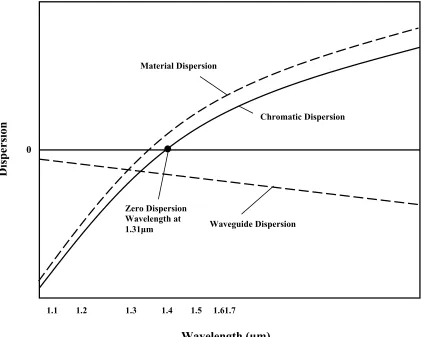
Figure 2.3: Dispersion versus Wavelength Characteristics ...23
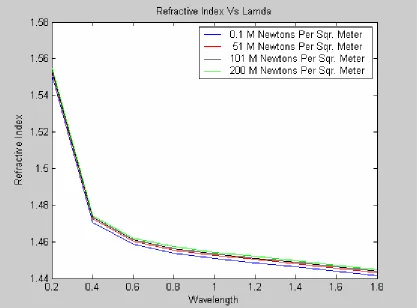
Figure 4.1: Refractive Index Versus Material Dispersion for Various...42
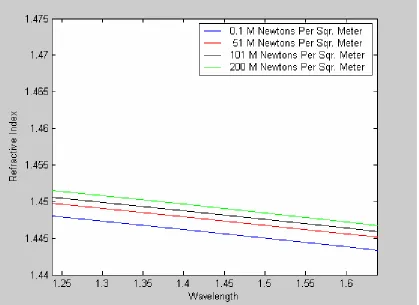
Pressures Figure 4.2: Enlarged Section of Previous graph from 1.3µm to 1.55µm ...43
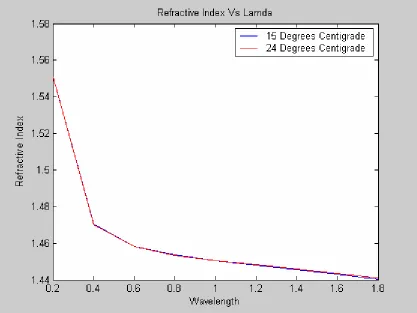
Figure 4.3: Refractive Index Versus Wavelength for Different Values of ...44
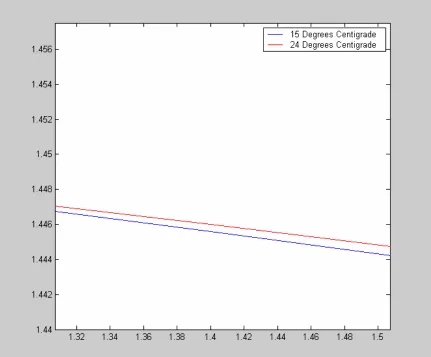
Temperature Figure 4.4: Enlarged Section of Previous graph from 1.3µm to 1.5µm ...45
Figure 4.5: Wavelength Versus Material Dispersion for Various Values of ...46
Pressure Figure 4.6: Enlarged View of a Section for Figure 3...47
Figure 4.7: Wavelength Versus Material Dispersion for Values of Temperature ...48
Figure 4.8: Enlarged View of a Section for Figure 5...49
Figure 4.9: Wavelength Versus Material Dispersion for Different Extrapolated ...50
Values of Pressure Figure 4.10: Enlarged View of a Section for Figure 7...51
vi
Figure 4.12: Enlarged View of a Section of Figure 9...53
vii
LIST OF TABLES
viii
ABSTRACT
The concept of material dispersion is an important factor in analyzing the performance of
an optical fiber system. The thesis presents an analysis of the material dispersion as a
function of any pressure (in Mega Newton’s per square meter) and temperature (in
degrees Celsius). The pressure dependent and temperature dependent Sellmeier
coefficients are considered for the analysis. The results obtained can be used in building a
Introduction
Material dispersion is the phenomena whereby materials cause light to spread out as it
propagates. Material dispersion occurs because the index of refraction varies as a
function of the optical wavelength. Since the group velocity of a mode is a function of
the index of refraction, the various spectral components of a given mode will travel at
different speeds, depending on wavelength. As the distance increases, the pulse becomes
broader as a result.
Material dispersion is present in graded index fibers and also single mode fibers,
but this is of particular importance in the single mode waveguides and any system, which
has a broader output spectrum such as LED. This phenomenon is not helpful in optical
communications. On the contrary, material dispersion limits how much data can be sent,
as the pulses will overlap and information will be lost. Ongoing research is attempting to
reduce the effects of material dispersion.
In optics, the Sellmeier equation is an empirical relationship between refractive
index n and wavelength λ for a particular transparent medium. The refractive index of
any optical material is determined mainly by the two types of resonance absorption: one
is due to the electronic transitions of oscillators, i.e., the average resonance of electronic
absorption in the UV region and the other is due to the lattice vibrations of the material in
Sellmeier equation with the consideration of the effective electronic transition and lattice
vibration as
E D C B A n
− + − +
= 2 2 2 2
2
λ λ λ
λ
, where A, B, C, D, E are the optical constants. C
and E represent the effective resonance absorption wavelengths in the UV and IR region
respectively. λ is the wavelength in microns.
In this thesis, an examination of the Sellmeier equation is done for calculating
material dispersion of optical fibers at different pressures and temperatures. The second
derivative of the refractive index with respect to wavelength gives the material
dispersion. The refractive index, n, in the Sellmeier equation is considered for double
differentiating with respect to wavelength λ, which in turn is multiplied with wavelength
over velocity of light. Substituting the values of Sellmeier constants A, B, C, D, E,
wavelength, velocity of light being constant, at desired pressure/temperature yields us the
material dispersion at the desired value.
The material dispersion for silica at different pressures and temperatures are
calculated. The pressure dependent Sellmeier constants for silica at any operating
pressure have also been calculated. These optical constants help in determining the
optical design parameters at different pressures and also to predict the operating features
Chapter 1: Overview of Optical Networks
1.1 Introduction
Telecommunications networks based on optical fiber technology have become a
major information-transmission system, with high capacity optical fiber links encircling
the globe in both terrestrial and undersea applications (1). Optical fiber communications
technology has been extensively employed and deployed in global communications
networks and throughout terrestrial systems, from fiber-to-the-home schemes in several
countries to internetworking between countries and major cities. Optical networking uses
optical fiber to carry data, voice, or video signals from one place to another. Those
signals travel as pulses of infrared light, which are created by a light-emitting diode
(LED) or a laser at one end of the fiber.
Optical networks are high-capacity telecommunications networks based on optical
technologies and components that provide routing, grooming, and restoration at the
wavelength level as well as wavelength based services. Most optical networks are used to
carry enterprise data over substantial distances, such as between two buildings or
between two cities, rather than to individual computers. Optical fiber has tremendous
bandwidth and this helps them carry much more data over greater distances than copper
wire of equivalent size (2). Because of this, optical networks can carry many forms of
information simultaneously. For example, Internet Protocol (IP) data, ESCON (computer
storage) traffic, and telephone calls can coexist on an optical network. The optical fiber
advantage over copper, a quality that is especially desired in some medical, security, and
national-defense applications.
Several innovative configurations for optical transmission systems and distribution
networks have been made possible due to the enormous bandwidth of optical fibers and
the advancements in optical communications technology. Current deployments of optical
signals over single mode optical fibers are only based on single channels either at 1310
nm or 1550 nm windows, except in some field trail systems and networks. It is essential
that these enormous bandwidth regions should be used extensively. Intense investigation
and experiments of ultra-long and ultra-high speed optical communication systems have
been carried out together with interests in the multiplexing of optical carriers in the same
fiber channel.
1.2Optical Networks
Telecommunication networks have evolved during a century-long history of
technological advances and social changes. The networks that once provided basic
telephone service are now capable of transmitting the equivalent of thousands of
encyclopedias per second. Throughout, the digital network has evolved in three
fundamental stages: asynchronous, synchronous, and optical (3).
1.2(a) Asynchronous
The first digital networks were asynchronous networks. In asynchronous
networks, each network element's internal clock source timed its transmitted signal.
Because each clock had a certain amount of variation, signals arriving and transmitting
More importantly, as optical-fiber deployment increased, no standards existed to mandate
how network elements should format the optical signal. A myriad of proprietary methods
appeared, making it difficult for network providers to interconnect equipment from
different vendors.
1.2(b) Synchronous
The need for optical standards led to the creation of the synchronous optical network
(SONET). SONET standardized line rates, coding schemes, bit-rate hierarchies, and
operations and maintenance functionality. SONET also defined the types of network
elements required, network architectures and the functionality that each node must
perform. Network providers were now able to use different vendor's optical equipment
with the confidence of at least basic interoperability.
1.2(c) Optical
The one aspect of SONET that has allowed it to survive during a time of tremendous
changes in network capacity needs is its scalability. Based on its open-ended growth plan
for higher bit rates, theoretically no upper limit exists for SONET bit rates. However, as
the bit rates increased, the physical limitations of laser sources and optical fiber made the
increasing bit rate on each signal an impractical solution. Additionally, connection to the
networks through access rings has also had increased requirements. To provide full
end-to-end connectivity, a new paradigm was needed to meet all the high-capacity and varied
needs. Optical networks provided the required bandwidth and flexibility to enable
end-to-end wavelength services.
Optical networks began with wavelength division multiplexing (WDM), which provided
architectures provided the basis of the optical network. However, unlike SONET, rather
than using a defined bit-rate and frame structure as its basic building block, the optical
network was based on wavelengths. The components of the optical network were defined
according to transmission, grooming implementation of wavelengths in the network.
1.3Driving Factors behind Optical Networks:
Here the factors that are the driving factors behind the optical networks are
described.
1.3(a) Fiber Capacity:
The first implementation of what has emerged as the optical network began on routes that
were fiber-limited. When providers needed more capacity between two sites, higher bit
rates or fibers were not available. The only option in these situations was either to install
more fiber, which is an expensive and labor-intensive chore, or place more time division
multiplexed (TDM) signals on the same fiber. WDM provided many "virtual" fibers on a
single physical fiber. By transmitting each signal at a different frequency, network
providers could send many signals on one fiber just as though they were each traveling
on their own fiber.
1.3(b) Restoration Capability:
As network planners use more network elements to increase fiber capacity, a fiber cut can
have massive implications. In current electrical architectures, each network element
performs its own restoration. For a WDM system with many channels on a single fiber, a
fiber cut would initiate multiple failures, causing many independent systems to fail. By
performing restoration in the optical layer rather than the electrical layer, optical
the optical layer can provide restoration in networks that currently do not have a
protection scheme. By implementing optical networks, providers can add restoration
capabilities to embedded asynchronous systems without first upgrading to an electrical
protection scheme.
1.3(c) Reduced Costs:
In systems using only WDM, each location that demultiplexes signals needs an electrical
network element for each channel, even if no traffic is dropping at that site. By
implementing an optical network, only those wavelengths that add or drop traffic at a site
need corresponding electrical nodes. Other channels can simply pass through optically,
which provides tremendous cost savings in equipment and network management. In
addition, performing space and wavelength routing of traffic avoids the high cost of
electronic cross-connects, and network management is simplified.
1.3(d) Wavelength Services:
One of the great revenue-producing aspects of optical networks is the ability to resell
bandwidth rather than fiber. By maximizing capacity available on a fiber, service
providers can improve revenue by selling wavelengths, regardless of the data rate
required. To customers, this service provides the same bandwidth as a dedicated fiber.
1.4Types of Transmission Networks
The evolution to the optical layer in telecommunications networks will occur in stages in
different markets because the traffic types and capacity demands for each are different.
two different types of transmission networks: one for long-haul environment and the
other for metro-inter office environment.
Figure 1.1: Optical Network Market (in Millions of Dollars)
1.4(a) Long-Haul Environment
Spanning in many cases for thousands of miles, long-haul networks are different from all
other markets in several important regards: long spans between nodes and extremely
high-bandwidth requirements.
Long-haul optics refers to the transmission of visible light signals over optical fiber cable
for great distances, especially without or with minimal use of repeaters. Normally,
repeaters are necessary at intervals in a length of fiber optic cable to keep the signal
quality from deteriorating to the point of non-usability. In long-haul optical systems, the
$3,000
$2,500
$2,000
$1,500
$1,000
$500
$
1997 1998 1999 2000 2001
goal is to minimize the number of repeaters per unit distance, and ideally, to render
repeaters unnecessary.
The backbone network is the traditional long-haul network that has been around for many
years. Typical backbone networks have the following characteristics:
• There are an extensive number of points where traffic is going onto or leaving the
network.
• Distances of a circuit (a service) transported on this network are less than 600 km.
Long-haul networks were the first to have large-scale deployment of optical
amplifiers and wideband WDM systems mainly because of cost reductions. Optical
amplifiers are a cheaper alternative to a large number of electrical regenerators in a span.
In addition, using WDM, inter exchange carriers increased the fiber capacity by using
WDM, which avoids the large expenditures of installing new fiber.
Optical networking technologies have brought about radical changes and
revolutionary possibilities for long-haul optical transport. Service providers are driven to
continually lower the cost per bit per kilometer while maximizing fiber usage and
increasing service velocity to meet customer demand. Service providers continually
evaluate solutions that lengthen spans, increase capacity, and enhance performance.
While technological advancements overcome the constraints that previously
hindered cost-effective long-haul optical transport, market drivers in today's complex
optical core are converging to form distinct segments around which service providers are
• Conventional Long-Haul (LH), which serves spans of fiber between signal
regeneration devices of up to 600 km.
• Extended Long-Haul (ELH), supporting spans of 600 to 2,000 km while reducing
network costs.
• Ultra Long-Haul (ULH), which supports spans of over 2,000 km and is best,
suited for the all-photonic network of the future in which photonic switching
plays a key role in the backbone.
While traditional views have broken the core transport market into two segments, the LH
and ULH, the third -- the Extended Long-Haul -- is emerging as the sweet spot for
long-haul transport where service providers can maximize channel count, speed, and distance.
As end-to-end transport becomes the mantra of ever more carriers, long-haul
optical technology is revolutionizing approaches to overall network design with promises
of improvements in capacity, flexibility and cost- efficiency at the regional and metro
levels as well as dramatic gains in signal reach over great distances. The expanding
impact of techniques typically associated with ultra-long-haul (ULH) performance ties
directly into the fact that as optical wavelength switching gains traction among carriers
that operate end-to-end networks. Network designers will have to plan for how each
aspect of the optical architecture affects every other aspect across traditional topological
boundaries. According to some vendors, the driving force behind the roll out of optical
platforms employing innovations such as solitons, Raman amplifiers and so-called
"super" forward error correction (FEC) has at least as much to do with this perspective on
in a straight shot over a single fiber for a distance of 3,000 kilometers, which is the
performance level now being reached by some ULH systems.
Forward Error Correction (FEC) -- serves to synchronize the reading of the bit stream
in accord with how the stream has been distorted as it travels over the network, resulting
in a net code gain of several decibels once the coding penalty associated with
synchronization is subtracted from the amount of recovered code.
Raman pump lasers -- deliver a stream of photons into the fiber core or into a
Raman-optimized erbium-doped fiber amplifiers where, as they travel through the fiber and lose
energy from collisions with atoms in the glass, they drop to lower frequencies and
assume the wavelength and signal pattern of the primary light wave in the 1550 nm
waveband, resulting in a great boost in the signal power without the addition of spurious
signals or noise.
Solitons -- Concentrations of multiple light pulses that capitalize on the fact that when
such pulses are in precise phase with each other they combine into a single, high-energy
pulse that is more resistant to degradation as it travels through fiber than any of the
original pulses would be.
1.4(b) Metro-Inter Office (IOF) Environment:
Networks in the metro interoffice (IOF) have different needs for optical technologies.
IOF networks are typically more interconnected and geographically localized. Because of
the traffic patterns and distances between offices, optical rings and optical cross-connects
will be required much earlier. IOF networks not only need to distribute traffic throughout
evolves, Wavelength add/drop and interconnections add flexibility and value that IOF
networks require.
1.4(c) Business Access Networks:
The "last mile" of the network to business customers has gone by many names:
Wide-Area Networks (WANs), Metropolitan-Wide-Area Networks (MANs), and Business-Access
Networks. Regardless of the name, these networks provide businesses with connections
to the telecommunications infrastructure. It is these networks where the application of
optical networks is not so clear. Many more complexities arise in these networks,
including variable bit-rate interfaces, different cost structures, and different capacity
needs. Similar in architecture to IOF networks, business-access network sites are much
closer together, so fiber amplification is not as important.
An important component for optical networks in business-access networks is the
asynchronous transponder, which allows a variety of bit-rate signals to enter the optical
network. Optical networks designed for the business access environment will need to
incorporate lower-cost systems to be cost-effective and enable true wavelength services.
The challenge will be proving when and where DWDM is effective in access networks.
1.5 Optical Fiber Performance Characteristics:
The key optical performance parameters for fibers are attenuation and dispersion.
Dispersion is discussed in detail in the next chapter.
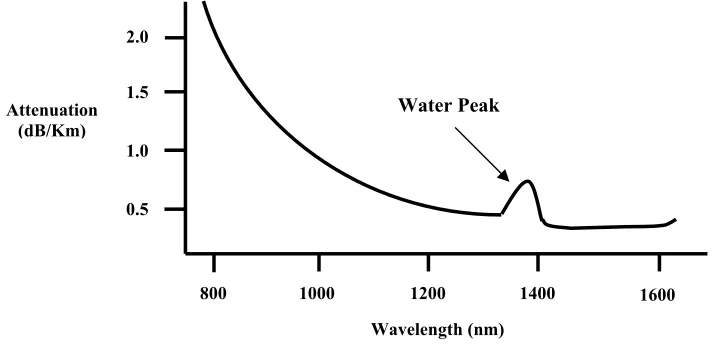
1.5(a): Attenuation:
The reduction in signal strength is measured as attenuation. Attenuation measurements
output power to input power. Each optical fiber has a characteristic attenuation that is
normally measured in decibels per kilometer (dB/km) (4).
Figure 1.2: Typical Attenuation vs. Wavelength
Optical fibers are distinctive in that they allow high-speed transmission with low
attenuation. Attenuation can be caused by several factors, but is generally placed in one
of two categories: intrinsic or extrinsic.
1.5(a-1): Intrinsic Attenuation:
Intrinsic attenuation occurs due to something inside or inherent to the fiber. It is
caused by impurities in the glass during the manufacturing process. As precise as
manufacturing is, there is no way to eliminate all impurities, though technological
advances have caused attenuation to decrease dramatically since the first optical fiber in
1970.
When a light signal hits an impurity in the fiber, one of two things will occur: it will be
either scattered or absorbed.
Scattering
Water Peak
800 1000 1200 1400 1600 Wavelength (nm)
2.0
1.5
1.0
0.5 Attenuation
Rayleigh scattering accounts for the majority (about 96%) of attenuation in
optical fiber. Light travels in the core and interacts with the atoms in the glass. The light
waves elastically collide with the atoms, and light is scattered as a result.
Rayleigh scattering is the result of these elastic collisions between the light wave and the
atoms in the fiber. If the scattered light maintains an angle that supports forward travel
within the core, no attenuation occurs. If the light is scattered at an angle that does not
support continued forward travel, the light is diverted out of the core and attenuation
occurs.
Some scattered light is reflected back toward the light source (input end). This is a
property that is used in an Optical Time Domain Reflectometer (OTDR) to test fibers.
This same principle applies to analyzing loss associated with localized events in the fiber,
such as splices.
Absorption
The second type of intrinsic attenuation in fiber is absorption. Absorption
accounts for 3-5% of fiber attenuation. This phenomenon causes a light signal to be
absorbed by natural impurities in the glass, and converted to vibrational energy or some
other form of energy.
Unlike scattering, absorption can be limited by controlling the amount of impurities
1.5(a-2): Extrinsic Absorption:
The second category of attenuation is extrinsic attenuation. Extrinsic attenuation can be
caused by two external mechanisms: macrobending and microbending. Both cause a
reduction of optical power (5).
Macrobending:
If a bend is imposed on an optical fiber, strain is placed on the fiber along the
region that is bent. The bending strain will affect the refractive index and the critical
angle of the light ray in that specific area. As a result, light traveling in the core can
refract out, and loss occurs. A macrobend is a large-scale bend that is visible; for
example, a fiber wrapped around a person's finger. This loss is generally reversible once
bends are corrected.
To prevent macrobends, all optical fiber (and optical fiber cable) has a minimum bend
radius specification that should not be exceeded. This is a restriction on how much bend a
fiber can withstand before experiencing problems in optical performance or mechanical
reliability. The rule of thumb for minimum bend radius is 1 1/2" for bare, single-mode
fiber; 10 times the cable's outside diameter (O.D.) for non-armored cable; and 15 times
the cable's O.D. for armored cable.
Microbending:
The second extrinsic cause of attenuation is a microbend. This is a small-scale
distortion, generally indicative of pressure on the fiber. Microbending may be related to
temperature, tensile stress, or crushing force. Like macrobending, microbending will
Microbending is much localized, and the bend may not be clearly visible upon inspection.
With bare fiber, microbending may be reversible; in the cabling process, it may not.
1.6Different Types of Single Mode Fibers:
Although we have got several different types of fibers, we shall only deal with
single mode fibers in this section, as we shall be concentrating on them in the future
sections. We shall only deal with the dispersion in the single mode fibers. There are four
different types of single-mode fiber in use today. These are standardized by the IEC
(International Electrotechnical Commission) and ITU (International Telecommunications
Union). The ITU-T Series G.652 recommendation, commonly referred to as standard
single-mode fiber, represents the majority of the installed base of single-mode fiber. The
G.652 recommendation describes both standard single-mode fiber (IEC type B1.1) and
low water-peak standard single-mode fiber (IEC type B1.3).
1.6(a-1): Standard Single-Mode Fiber (IEC 60793-2 B1.1 & B1.3 / ITU G.652):
Standard single-mode fiber is essentially a thin core (5-8 microns) of
Silicon/Germanium-doped glass surrounded by a thicker layer of pure glass and is the
workhorse of the optical communications infrastructure. Nearly any application can be
addressed with standard single-mode fiber, but it is optimized to support transmission at
1310 nm. Performance issues with standard single-mode fiber can become more
significant as higher data rates (such as 10 Gbps) and longer distances (>40 km) are
encountered. Low water-peak standard single-mode fiber (IEC type B1.3) has the same
dispersion characteristics as standard single-mode fiber (IEC type B1.1), but has reduced
attenuation in the region of the water peak (nominally 1383 nm). As no specification is
of 1383 nm can be significantly higher than that at 1310 nm. By reducing the water
impurities introduced in this region during the time of manufacture, low water-peak
standard single-mode fiber provides identical support to standard single mode fiber, plus
can support additional wavelengths between 1360 and 1460 nm.
1.6(a-2): Dispersion Shifted Fiber (DSF) (IEC 60793-2 B2 / ITU G.653):
Dispersion shifted fiber (DSF) was introduced in the mid 80’s and represents a very small
percentage of the installed base of single-mode fiber. The need for DSF was driven by the
development of 1550 nm lasers which have much less fiber attenuation than 1310 nm
lasers. DSF allowed optical signals to travel significantly farther without the need for
regeneration or compensation due to reduced chromatic dispersion characteristics,
effectively allowing an optical pulse to maintain its integrity over longer distances. DSF
was well suited to meet these needs for single-channel optical transmission systems.
However, with the advent of broadband optical amplifiers and wavelength division
multiplexing (WDM) the chromatic dispersion characteristics of DSF presented
detrimental effects to multiple wavelength signal integrity. As a result, a new type of
fiber was introduced, namely non-zero dispersion shifted fiber (NZDSF).
1.6(a-3): Cutoff Shifted Single-Mode Fiber (IEC 60793-2 B1.2 / ITU G.654):
Cutoff shifted single-mode fiber is designed to allow for extended transmission distances
through lower attenuation and the ability to support higher power signals. This fiber is
typically used only for transmission in the 1550 nm region due to a high cutoff
wavelength around 1500 nm. Due to significant manufacturing complexity, cutoff shifted
is commonly found only in submarine applications due to the stringent requirements in
such an environment.
1.6(a-4):Non-Zero Dispersion Shifted Fiber (NZDSF) (IEC 60793-2 B4 / ITU G.655):
Non-zero dispersion shifted fiber (NZDSF) was introduced in the mid 90’s to address
issues encountered with multiple wavelength transmission over DSF by maintaining a
finite amount of chromatic dispersion across the optical window (typically 1530-1625
nm) commonly exploited by wavelength division multiplexing (WDM). The primary
concern addressed by NZDSF is a nonlinear effect known as four wave mixing (FWM).
In simple terms, three wavelengths carrying different information can generate signals at
another wavelength. In the regularly spaced channel plan of most WDM systems (usually
1.6 nm or less between adjacent wavelengths); the newly generated noise signals can
overlap with a wavelength carrying live traffic. NZDSF mitigates this effect by ensuring
that all wavelengths in the region of interest (1530-1625 nm) encounter some finite
dispersion and thus signals on adjacent wavelengths will not overlap in time for extended
periods. Four wave mixing is reduced as the time during which adjacent wavelength
signals overlap is shortened. The reduced chromatic dispersion of NZDSF can also
reduce the detrimental contributions of other nonlinear effects such as self-phase
modulation (SPM) and cross-phase modulation (XPM). NZDSF is optimized for
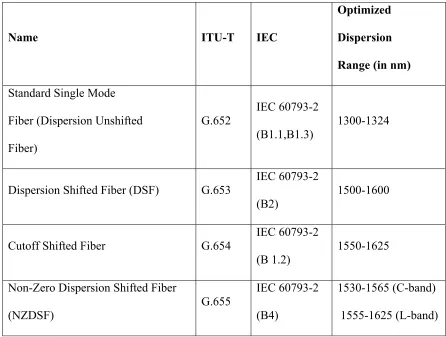
transmission in the 1530-1625 nm window, but can support some 1310 nm configurations
Name ITU-T IEC Optimized
Dispersion
Range (in nm)
Standard Single Mode
Fiber (Dispersion Unshifted
Fiber)
G.652
IEC 60793-2
(B1.1,B1.3) 1300-1324
Dispersion Shifted Fiber (DSF) G.653
IEC 60793-2
(B2) 1500-1600
Cutoff Shifted Fiber G.654 IEC 60793-2
(B 1.2)
1550-1625
Non-Zero Dispersion Shifted Fiber
(NZDSF)
G.655
IEC 60793-2
(B4)
1530-1565 (C-band)
1555-1625 (L-band)
Table 1.1: Different Types of Fibers
1.7Conclusion:
The above discussions presented a brief idea on the present optical networks scenario
and also put forth the basic concepts of optical fibers. In this chapter, we have reviewed
the performance characteristics of the optical fibers along with the various parameters
affecting them. The proceeding chapters mainly deal with one of the main characteristics
Chapter 2: Concepts of Dispersion
2.1 Introduction
This chapter deals with the dispersion. A study of dispersion is made here as this is a key
characteristic in analyzing the performance of a fiber.
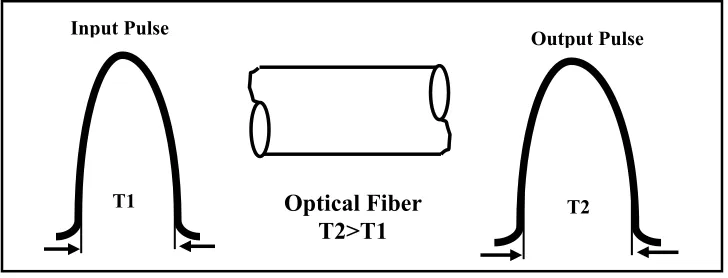
Dispersion is the "spreading" of a light pulse as it travels down a fiber. As the
pulses spread, or broaden, they tend to overlap, and are no longer distinguishable by the
receiver as 0s and 1s. Light pulses launched close together (high data rates) that spread
too much (high dispersion) result in errors and loss of information.
Figure 2.1: Dispersion in Optical Fiber
There are two different types of dispersion in optical fibers.
They are:
1. Intramodal Dispersion
2. Intermodal Dispersion
Optical Fiber T2>T1
T1 Input Pulse
Intramodal, or chromatic, dispersion occurs in all types of fibers. Intermodal or modal
dispersion occurs only in multimode fibers. Each type of dispersion mechanism leads to
pulse spreading. As a pulse spreads, energy is overlapped. The spreading of the optical
pulse as it travels along the fiber limits the information capacity of the fiber.
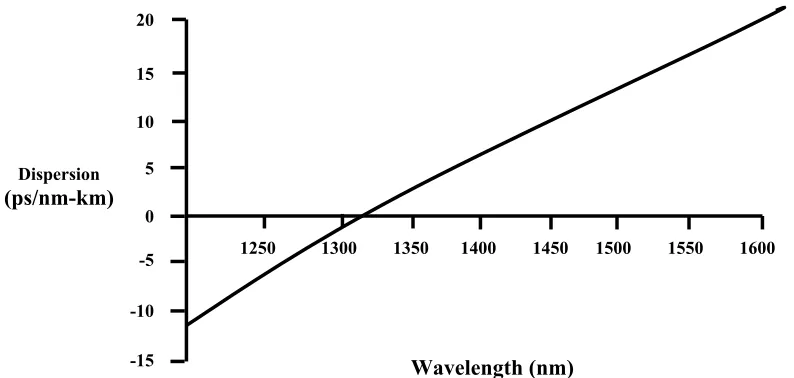
Figure 2.2: Typical Dispersion vs. Wavelength curve
Intramodal Dispersion:
Intramodal, or chromatic, dispersion depends primarily on fiber materials. There
are two types of intramodal dispersion. The first type is material dispersion. The second
type is waveguide dispersion. Intramodal dispersion occurs because different colors of
light travel through different materials and different waveguide structures at different
speeds.
Wavelength (nm)
1250 1300 1350 1400 1450 1500 1550 1600 20
15
10
5
0
-5
-10
-15 Dispersion
2.2 Refractive Index:
Light travels slower within a medium than in a vacuum. The speed at which light
travels in the medium is determined by its refractive index. In an ideal situation, the
refractive index would not depend on the wavelength of the light. However, this is not the
case which results in different wavelengths traveling at different speeds within an optical
fiber.
Environmental conditions, such as variations in temperature can change the
refractive index of the optical fiber. As temperature increases, so will the refractive index,
however, the increase is not uniform over all wavelengths resulting in differing
wavelength speeds. In addition, stress, such as the pressure experienced by a submarine
cable, can affect the refractive index of an optical fiber.
2.3 Chromatic Dispersion:
Chromatic dispersion is a broadening of the input signal as it travels down the
length of the fiber. Chromatic dispersion consists of both material dispersion and
Figure 2.3: Dispersion versus Wavelength Characteristics
When a series of pulses travel down an optical fiber, the pulses broaden or disperse
making them indistinguishable, creating an effect called intersymbol interference. The
source of intersymbol interference arises from the waveguide and material properties of
the optical fiber. One of the dispersive effects caused by the properties of the waveguide
and the material is called chromatic dispersion and is measured in units of ps/nm-km.
A pulse is not monochromatic, but is comprised of several wavelengths. The
amount of broadeninga pulse experiences is a function of the refractive index difference
between the wavelengths contained within the pulse. The difference in the refractive
index results in the wavelengths comprising the pulse to travel at different speeds,
1.1 1.2 1.3 1.4 1.5 1.61.7 Zero Dispersion
Wavelength at
1.31µm Waveguide Dispersion
Chromatic Dispersion
0
Material Dispersion
Dispersion
causing some wavelengths to travel faster than others. This phenomenon is known as
material dispersion. The detrimental effects of material dispersion result in the slower
wavelengths of one pulse intermixing with the faster wavelengths of an adjacent pulse,
causing intersymbol interference.
Optical fiber is composed of a core and cladding layer where the refractive index
of the core is greater than the refractive index of the cladding. The difference in the
refractive index causes most of the light to be confined within the core of the fiber.
However, some of the light propagates within the cladding. The difference in the
refractive index causes the light in the core traveling slower than the light in the cladding,
resulting in a spreading of the pulse. This phenomenon is known as waveguide
dispersion. Waveguide dispersion is a function of the wavelength of light, the refractive
index difference between the core and cladding layers and the diameter of the core.
Changes in the core diameter, the wavelength or the refractive index of the core and
cladding will result in a change in the waveguide dispersion. The time between pulses, or
bit rate, determines the amount of pulse broadening an optical system can handle. The
chromatic dispersion limit, the amount of acceptable dispersion, is inversely proportional
to the bit rate squared. This implies higher bit rates can tolerate smaller amounts of
dispersion. For instance, a 2.5 Gbps system can experience 16 times more dispersion than
a 10 Gbps system and 250 times more dispersion than a 40 Gbps system.
Changes in the refractive index due to temperature variations will result in
modifying the amount of chromatic dispersion the pulse experiences. Varying the
temperature results in a change of the zero-dispersion wavelength, the wavelength of the
of the dispersion curve by∆λ0, either increasing or decreasing the amount of dispersion
experienced by the pulse. Not only does the temperature affect the zero dispersion
wavelength, pressure and strain also shifts the zero dispersion wavelength. This results
from changes in the waveguide properties of the fiber due to pressure or strain. The
resultant pressure related change in zero-dispersion wavelength for unshifted fiber is
-0.007 nm/MPa, respectively.
2.3 (a) Material Dispersion:
Material dispersion occurs because the spreading of a light pulse is dependent on
the wavelengths' interaction with the refractive index of the fiber core. Different
wavelengths travel at different speeds in the fiber material. Different wavelengths of a
light pulse that enter a fiber at one time exit the fiber at different times. Material
dispersion is a function of the source spectral width. The spectral width specifies the
range of wavelengths that can propagate in the fiber. Material dispersion is less at longer
wavelengths.
2.3 (b) Waveguide Dispersion:
Waveguide dispersion occurs because the mode propagation constant is a function
of the size of the fiber's core relative to the wavelength of operation. Waveguide
dispersion also occurs because light propagates differently in the core than in the
cladding. In multimode fibers, waveguide dispersion and material dispersion are basically
separate properties. Multimode waveguide dispersion is generally small compared to
material dispersion. Waveguide dispersion is usually neglected. However, in single mode
single mode fibers may be minimized by trading material and waveguide properties
depending on the wavelength of operation.
2.4 Intermodal Dispersion:
Intermodal or modal dispersion causes the input light pulse to spread. The input
light pulse is made up of a group of modes. As the modes propagate along the fiber, light
energy distributed among the modes is delayed by different amounts. The pulse spreads
because each mode propagates along the fiber at different speeds. Since modes travel in
different directions, some modes travel longer distances.
Modal dispersion occurs because each mode travels a different distance over the
same time span. The modes of a light pulse that enter the fiber at one time exit the fiber at
different times. This condition causes the light pulse to spread. As the length of the fiber
increases, modal dispersion increases. Modal dispersion is the dominant source of
dispersion in multimode fibers. Modal dispersion does not exist in single mode fibers.
Single mode fibers propagate only the fundamental mode. Therefore, single mode fibers
exhibit the lowest amount of total dispersion. Single mode fibers also exhibit the highest
possible bandwidth.
2.5 Conclusion:
In this chapter, an overview of the concepts of dispersion has been presented. The chapter
mainly focused on the various types of dispersion, its occurrence and effects. The next
chapter deals with the Sellmeier coefficients and its dependence on pressure and
temperature along with a brief review of the technical papers used. The chapter also gives
Chapter 3: Sellmeier Coefficients
3.1 Introduction:
As dispersion is an important characteristic in the transmission of optical fibers, much
work is being carried out to minimize it during the transmission. For analyzing the
refractive indices of optical materials, the two-pole Sellmeier dispersion formula, is the
most accurate of the dispersion formulas, and can fit index data to accuracy consistent
with the measurements and the accuracy needed for most optoelectronic applications. The
analyses of papers that have been used for this thesis work have also been analyzed.
Fiber lasers and amplifiers are considered the initial step in the replacement of the
older electronic regenerators leading to an all-optic complete photonics future. The basic
component in the fiber lasers, amplifiers and various kinds of optical fibers is Silica glass.
Characteristics of silica glass such as refractive index (RI), dispersion, chromatic
dispersion and its variation as a function of temperature and pressure play an important
role in the evaluation of optical fiber transmission system. Characterization of refractive
indexes with sufficient accuracy is important in the ultrafast optical fiber communication
systems (OCFS) and in other optical devices.
Owing to its sound physical basis, Sellmeier method is considered to be one of the
most common techniques for the measurement for the above mentioned desirable
characteristics of silica, and its suitable interpolation/extrapolation technique is the state
of art. Chromatic dispersions play a vital role in the optical fiber communication system
signals from one continent to other Evaluation of chromatic dispersion, at different
temperatures and different pressures requires knowledge of refractive index as a function
of temperature and pressure respectively. The two-pole Sellmeier formula has been
considered a physically meaningful model that is capable of representing the refractive
indices (RIs) with wavelengths for all optical materials satisfactorily. One pole is due to
electronic resonance absorption, and the other is due to lattice/ionic absorption. The
refractive index of any optical material is determined by two types of resonance
absorption – one due to electronic transitions of oscillators and the other due to the lattice
vibrations of the material in the IR region.
3.2 Wavelength Dependent Sellmeier Equation:
The wavelength dependent Sellmeier Equation is of the form
E D C B A n
− + − +
= 2 2 2 2
2
λ λ λ
λ
Where, λ is the wavelength inµm. The last term accounts for the decrease in the
refractive indexes due to lattice absorption, where as the first and second terms represent
the contribution to refractive indexes due to higher energy and lower energy gaps of
electronic absorption. The method of fitting a refractive index data for low refractive
index materials to a Sellmeier in order to evaluate constants was first described by
Maltison. More about the Sellmeier equation is described in the section to follow.
3.3 Temperature Dependence:
Of the two factors determining temperature dependence, electronic effect is more
dominant than lattice/ionic effect in diamond-like semiconductor crystals. An observation
manifestations of chromatic dispersion in the silica optic window possess a temperature
modulation dominated by temperature derivative of the Sellmeier valence to conduction
band energy gap. Here the temperature derivative of the average energy gap is considered
and since in such glasses the variation of energy gap with temperature is much larger than
that of thermal expansion a positive dn/dT is observed. Then they allowed variations in
the electronic energy gap, keeping lattice absorption frequency constant while evaluating
temperature dependency of Sellmeier coefficients. A negligible shift of lattice absorption
gap was observed when temperature was changed. The authors succeeded in formulating
the temperature dependent Sellmeier coefficients of optical fiber glasses to calculate the
RIs at any wavelength and at any operating temperature. These were not only useful in
the determination of optical design parameters but also were capable of predicting the
operating features of fiber optics as a function of temperature.
3.4 Pressure Dependence:
Here, a physically meaningful two-pole Sellmeier equation that is capable of representing
the RIs for all optical materials satisfactorily to account for the change of RIs against
pressure in silica glass. The dispersion is analyzed in a physically meaningful
Sellmeier-type equation by considering a constant dn/dP at the measured pressure
increments/intervals for the silica glass. The optical constants can be used to calculate the
Sellmeier coefficients at any operating pressure. The authors successfully formulated the
pressure-dependent Sellmeier coefficients to calculate RIs at any wavelength and at any
operating pressure. These were not only useful in the determination of optical design
parameters but also were capable of predicting the operating features of fiber optics as a
3.5 Refractive Index and Sellmeier Equation:
The refractive indices are the fundamental parameters of the optical materials. There are
many dispersive relations accounting for the refractive indices. Normally the measured
refractive indices are fitted with the desired dispersive relation. However, the fitting
accuracy should be the dominant consideration in choosing a dispersion formula having
fewer optical parameters. For analyzing the refractive indices of optical materials, the
two-pole Sellmeier dispersion formula, is the most accurate of the dispersion formulas,
and can fit index data to accuracy consistent with the measurements and the accuracy
needed for most optoelectronic applications.
The room temperature values of refractive indices are used to evaluate the
Sellmeier coefficients A, B, C, D and E for mostly all optical materials. Sometimes, other
forms of Sellmeier equations are used to evaluate the Sellmeier coefficients. The five
evaluated Sellmeier coefficients are used to calculate the refractive index for any
wavelength lying within the normal transmission region of the optical materials.
3.6 Different Dispersive relations for Refractive Index:
The dielectric constant and refractive index are function of wavelength and hence
frequency. The variation of wavelength or frequency of refractive index is dispersion.
Dispersion is an important optical design parameter in correcting chromatic aberration
and this of much importance for ultra fast optical fiber communication systems.
Refractive indices are measured at discrete wavelengths within the transmission
region of the optical materials with sufficient accuracy. It is desirable to have a functional
Many formulae are used to represent the refractive index. One of them is the Sellmeier
equation.
The Sellmeier equation was first proposed by Sellmeier in 1871 and hence it is so called.
The equation is:
( )
(
2 22)
1 2 1 i i m i a n λ λ λ λ − + =
∑
=……… (Equation 1)
where λ is the wavelength of the incident radiation and aiis a constant that depends on
the number of oscillations per unit volume and is called the oscillator strength of the
oscillators resonant at the wavelengthλi and mis a collection of number of harmonic
oscillators resonant to a radiation of various wavelengthsλi
It was believed that the dispersion formula of the Sellmeier type best fits the refractive
indices of the alkali halide crystals in their transmission region. As a result, most of the
early experimental researchers adopted the above equation 1 withλi’s andai’s as
adjustable empirical constants chosen only to fit data without any theoretical or
experimental basis or explanation. Nevertheless, if the equation used correctly, gives a
good deal of explanation concerning the position of absorption band, oscillator strength
and the dielectric constant for static field.
The above equation 1 can be rewritten for the transparent region as:
∑
∑
= =−
+
−
+
=
=
1 2 2 2
1 2 2 2 2
)
(
)
(
1
)
(
j j j i i ic
b
n
λ
λ
λ
λ
λ
λ
λ
ε
…… (Equation 2)The first summations are contributions from ultraviolet absorption bands and the second
summations are due to infrared absorption bands. But atλ1 =0, equating the wavelength
term represents contributions to the refractive index from electronic transitions at
energies far above the band gap. Sellmeier terms with small λi(representing electronic
transitions), can be expanded a power series:
... ... ) ( 4 4 2 2 0 2 2 2 2 2 + + + = = −
∑
∞ = λ λ λ λ λ λ λ λλ i i i i
i j j i i i
i a a a a
a
… (Equation 3)
and the terms with large λi(representing vibrational transitions) are expanded as:
... ... ) ( 4 4 2 2 1 2 2 2 2 2 + − − = − = −
∑
∞ = λ λ λ λ λ λ λ λ λ i i i i j j i i ii a a a
a
…… (Equation 4)
The power-series approximations of the Sellmeier equation are expressed in many forms.
The equations 3 and 4 were used to represent the index of refraction for Schott and Ohara
optical glasses as the power series approximation to the Sellmeier equation. One common
form was used by Schott and Ohara is given by:
8 5 6 4 4 3 2 2 2 1 0
2 = A +Aλ +A λ− +Aλ− + Aλ− +Aλ−
n ………. (Equation 5)
A comparison of the Schott power-series formula with a three-term Sellmeier formula
showed equivalent accuracy of the range of the Schott fit, but the Sellmeier model was
accurate over a much wider wavelength range. A generalized form of the
short-wavelength approximation to the Sellmeier equation is the Cauchy formula developed in
1836. This was the first successful attempt to represent dispersion by an empirical
∑
= + = 1 2 0 i i i A A nλ ………. (Equation 6)
The Hartmann formula is also commonly used for the index of refraction. This is related
to the Sellmeier equation for a limited spectral region as:
) (λ−λ0 +
= A B
n ……… (Equation 7)
Among all these dispersion equations, Equation 2 is the most significant and can be
transformed to
∑
−+ =
)
( 2 2
2 j j uv c λ λ λ ε ε ,
where εuv=1+
∑
bi=εs −∑
cjis the high-frequency dielectric constant. In thetransparent wavelength region, the damping effects are negligibly small. It is
scientifically useful and physically acceptable to use an average absorption band gap and
also an average lattice absorption band gap.
E D C B A n − + − +
= 2 2 2 2
2
λ λ λ
λ
3.7 Material Dispersion Equation:
The propagation loss of single mode fibers has been reduced to the most intrinsic
limit of the material by proper fiber design and by OH radical reduction in both core and
material dispersion and waveguide dispersion, which are much smaller than the
multimode dispersion, remains resulting in broad bandwidth characteristics.
Wavelength dispersion arises from variation of group delay per unit length τ with
wavelengthλ. That is
λ τ d d
s= ……… (1)
λ β π λ τ d d c 2 2
= ……. (2)
Where c is the speed of light in vacuum and β is the propagating constant. Wavelength
dispersion is separated into material dispersion smand waveguide dispersionsw. That is
w
m s
s
s= + . The analysis of material dispersion is as follows:
The scalar wave equation in the weakly guiding fiber, with the arbitrary refractive index
profile n(r), is written as:
0 ) ( ) ( )
( 2 2
2 2 2 = − +
∇ n r r c
r ω β ψ
ψ ..(3)
Where ψ(r) represents transverse components of the electric or magnetic field, β, cand
ω are propagation constants of the guided wave, light speed in vacuum and angular
frequency respectively. Normalized frequency is defined as:
(
)
(
2 2)
max/
2 a n nclad
v= Π λ − … (4)
Here, nmaxis the maximum value of the refractive index in the core, ncladis the cladding
refractive index, λ is the wavelength in vacuum and a is the effective core radius. The
0 ) ( ] ) ( [ )
( ' 2 ' 2 '
2
' + − =
∇ ψ r v f r v bψ r … (5)
Where
(
) (
)
(
)
) 6 ..( ... ... / / ) ) ( ( ) ( / / ' ' 2 2 max 2 ' 2 ' 2 2 max 2 2 2 ∇ = ∇ = − − = − − = a a r r n n n r n r f n n n k b clad clad clad clad βHere, band )f(r' are the normalized propagation constant and the normalized refractive
index profile respectively. Equation (5) indicates that bdepends only on vwhere
) (r'
f is assumed to be independent of the wavelength.
The propagation constant β is expressed from equation (6) as:
(
n n)
b nk clad 2 clad2 max 2
2
2 = [ + −
β ………… (7)
Putting equation (7) into (2), τ is obtained as:
(
)
(
(
2 2)
)
1/2max 2 max max . 2 1 b n n n N n N n dv db v b N n
c clad clad clad clad clad + − clad
− + + − =
τ … (8)
Where Nmaxand Ncladare the group indexes. Then s is obtained by differentiating
c d c w c
m s s
s
s= + +
Where
(
)
1/22 2
2 max 2
max ( ) 1 ( ) 2 [1 2 b]
d n d c v H v H d n d cn n s clad clad c
m =− λ + − λ + ∇
λ
(
)
(
)
d(
F v b)
d d dn n b c n v G d dn n b c n s clad clad clad clad clad clad c
w −
∆ ∆ − − ∆ + ∆ − − ∆ + ∆ − = . ( ) 2 1 2 1 ) ( 1 2 1 2 2 / 3 2 2 2 / 1 λ λ λ λ λ λ λ λ
(
)
(
)
(
)
(
)
) 1 )( ( ) 2 1 ( ) 2 1 ( 2 1 ) ) ( ( ) ( * 4 1 2 1 / 2 / 1 3 2 / 1 2 / 1 b v H b c d n b b b v F v G d d d dn n b c d d n s clad clad clad clad c d − ∆ + ∆ + ∆ + ∆ − − + ∆ ∆ − − ∆ + ∆ − = λ λ λ λ λ λ λ λ λ( )
) 9 ( ... ... 2 2 / ) ) ( ( ) ( ) ( ) ( ) ( 2 2 2 max 2 2 clad clad n n n b v F v H dv vb d v v G dv vb d v F − = ∆ + = = =Since ∆ and λd∆/dλ are smaller than unity in the weakly guiding optical fiber, higher
order terms with respect to these parameters may be neglected. Furthermore, the absolute
values of
(
λ/nclad)(
dnclad /dλ)
and(
λ/∆)(
d∆/dλ)
in the Ge doped silica optical fiber in0.02 and 0.05 respectively, which may also be neglected when compared to unity. Then
equation (9) becomes:
d w
m s s
s
s= + +
(
)
− + −= 2 max2 ( ) 1 ( ) 2 2 λ λ λ λ d n d c v H v H d n d c s clad m ) (v G c n s clad w ∆ − =
(
G v F v b)
d d c n
s clad
d + −
∆ −
= ( ) ( )
λ
λ ………. (10)
In equation 10,
(
/)
( / 2)max
2 λ
λ c d n d
− and
(
λ/c)
(d2n /dλ2)clad
− indicate the material
dispersion the material dispersions corresponding to the maximum refractive index and
the cladding index, respectively. Material dispersion sm is the linear combination of
(
/)
( / 2)max
2 λ
λ c d n d
− and
(
λ/c)
(d2n /dλ2)clad
− with a weighting factorH(v).
The meaning of H(v) is discussed. The relation between the group velocity vg or
τ and the phase velocity vp for the wave propagation in the inhomogeneous and the
nondispersive media may be generalized to the dispersive case as
(
v
gv
p)
=
[
∫
n
( ) ( )
x
,
y
N
x
,
y
2ds
c
2∫
2ds
]
1
ψ
ψ
…… (11)by introducing the dispersive refractive index into the variation expression for the angular
frequency . Here n
( ) ( )
x,y ,N x,y and ψ are the refractive index, the group index and thepropagating wave. Since the velocities vp and vg are expressed as ω/ andβ 1/
(
dβ/dω)
,respectively. 1
( )
vgvp may be rewritten using equations (7) and (9) as( )
(
max max)
21 . 2 . 1 c dv db v b N n N n N n v
vg p clad clad clad clad
+ − +
= ….. (12)
then equation (11) can be rewritten as
(
)
( ) ( )
+ = −+ n N n N H v
∫
n x y N x y ds n N∫
ds∫
dsN n core clad clad clad clad clad clad clad 2 2 2 max
max ( ) , , ψ ψ ψ
…………. (13)
by separating the integration of the numerator
∫
ds, and the cladding part∫
cladds, and by
the relation H(v)=b+
( )
v/2[
db/dv]
. Thus,c
P k v
H( )= ' , where
c
P expresses the fractional field power in the core. In the
homogeneous core fiber, the fractional field power is unity. Therefore H(v) in the
homogeneous core fiber is the fractional power in the core.
Waveguide dispersion sw is determined only by waveguide parameters. The main part of
waveguide dispersion is governed by G(v), which depends only on the v value. So,
dispersion values depend on the refractive index profile. This fact may be utilized during
the manufacture of the optical fibers.
The third term in equation (10) indicates the dispersion effect caused by λd∆/dλ. The
3.8 Conclusion:
The thesis mainly focuses on the pressure dependent Sellmeier coefficients and
temperature dependent Sellmeier Coefficients, as an important factor to optimize optical
design parameters of the optical fiber transmission system. A study of Sellmeier
equations and the coefficients have been done. The next chapter deals with the
Chapter 4: Simulation Results
4.1 Introduction:
The dispersion characteristics are important in analyzing the optical fiber characteristics.
This chapter helps in understanding the material dispersion characteristics and zero
dispersion wavelength characteristics of silica fibers at various pressures and
temperatures.
4.2 Simulation Program:
The Matlab program can be explained as a process of three steps. Initially the values for
refractive index and wavelength are plotted against each other. In the next step the values
of material dispersion and wavelength are plotted against each other. This is considered
to be the important part of the program. Finally, the zero dispersion values are calculated
for different wavelengths for different pressures and temperatures.
For the initial step, the Sellmeier equation which relates refractive index and different
Sellmeier coefficients is considered. The equation is:
E D C B A n
− + − +
= 2 2 2 2
2
λ λ λ
λ
This equation is the building block on which the whole program is based on. Then the
values of different Sellmeier coefficients are taken. The values of Sellmeier coefficients
are different for pressure and temperature. From the above equation, refractive index, n,
is calculated by taking the square root on the equation. Changing the Sellmeier