Management of persistent
postconcussion symptoms in youth:
a randomised control trial protocol
Nick Reed,1,2Dayna Greenspoon,3Grant L Iverson,4,5,6,7Carol DeMatteo,8,9 Philippe Fait,10,11,12,13Jérôme Gauvin-Lepage,14Anne Hunt,1
Isabelle J Gagnon15,16
To cite:Reed N,
Greenspoon D, Iverson GL,
et al. Management of
persistent postconcussion symptoms in youth: a randomised control trial protocol.BMJ Open2015;5: e008468. doi:10.1136/ bmjopen-2015-008468 ▸ Prepublication history and additional material is available. To view please visit the journal (http://dx.doi.org/ 10.1136/bmjopen-2015-008468).
Received 13 April 2015 Revised 26 June 2015 Accepted 30 June 2015
For numbered affiliations see end of article.
Correspondence to Dr Nick Reed;
ABSTRACT
Introduction:Current management of concussion
consists of early education, rest until symptom free, with gradual return to school and physical activity protocols. Although this management strategy is effective for most youth who sustain a concussion, it is not an appropriate strategy for youth with persistent postconcussion symptoms. Prolonged rest and periods of restricted activity may place youth at risk for secondary issues and contribute to the chronicity of postconcussion symptoms. The purpose of this study is to evaluate the efficacy of an active rehabilitation protocol for youth who are slow to recover from concussion. It is hypothesised that an active rehabilitation intervention can reduce persistent postconcussion symptoms, improve function and facilitate return to activity. This article describes the research protocol.
Methods and analysis:This is a randomised clinical
trial with blinded outcome measurement. Participants will be recruited and randomly assigned to 1 of 2 treatment groups, an active rehabilitation intervention or a standard care education group. Both groups will receive standard care education. However, the active rehabilitation group will participate in an additional low-intensity exercise programme consisting of aerobic, coordination and visualisation exercises. Both the active rehabilitation and the standard care education interventions will be 6 weeks in duration. The primary outcome measure is postconcussion symptoms. Secondary outcome measures include functional recovery (cognitive, motor, psychosocial and emotional functioning) and return to activity. Outcome measures will be administered preintervention and postintervention. The primary outcome measure will also be repeated 2 weeks into the intervention period.
Ethics and dissemination:This study has been
approved by the Holland Bloorview Kids Rehabilitation Hospital research ethics board (REB # 13-459). The findings from this study will be shared with the general public, sport associations, relevant brain injury organisations and healthcare professionals.
Trial registration number:NCT02257749.
INTRODUCTION
According to International Consensus, con-cussion is defined as “A complex patho-physiological process affecting the brain, induced by biomechanical forces” (ref. 1, p.89). The acute management of concussion in children and youth includes early identifi -cation, education and reassurance, along with physical and cognitive rest.2 Return to school, often with accommodations, often occurs while the youth is symptomatic—and some clinician-researchers have provided recommendations for this.3–5 After postcon-cussion symptoms resolve, graduated return-to-play protocols are followed.2 International Consensus suggests that for most, recovery from a concussion is a short-lived process (80–90% experience symptom resolution within 7–10 days).1However, there remains a percentage of individuals who will experi-ence persisting symptoms and will need add-itional care and rehabilitation. Further, it has been suggested that children and youth are more susceptible to prolonged recovery.1An epidemiological study exploring postconcus-sion symptoms among children found that 58.5% of children remained symptomatic in the first month following concussion, 11% at 3 months, and 2.3% beyond 1 year.6 As a result, a significant number of youth who experience a concussion will suffer from per-sistent symptoms. To date, little is known about interventions to manage these youth
and the research to date exploring
approaches to rehabilitation specific to youth with persistent symptoms has been limited to case reports and descriptions.7 8 This study aims to address this gap by investigating two treatment approaches for youth who
con-tinue to experience symptoms lasting
1-month or longer following their concussion and applies a randomised control trial
on September 22, 2020 by guest. Protected by copyright.
http://bmjopen.bmj.com/
design to improve the methodological quality of the evi-dence, which might then justify improved approaches to rehabilitation within this population.
Prolonged rest and extended periods of activity restric-tion may place youth at risk for secondary issues (eg, physical deconditioning, irritability, anxiety, stress and depression) and may contribute to symptom mainten-ance over time.9–11 A further consideration is that for many youth, absolute rest is unrealistic, and youth will naturally transition back to an active lifestyle, especially those who are only mildly symptomatic.9 Complicating these issues is that little is known about the optimal time period for rest and activity restriction following concus-sion.10 11It is possible that extended periods of rest and activity restrictions contribute to the development of sec-ondary problems including emotional consequences.11 Unfortunately, the authors of a systematic review examin-ing treatment for sports-related concussions9 found that the literature regarding treatment approaches is severely lacking.
Regular exercise has been shown to have positive effects on well-being including mental health,12 13 improved self-esteem,14 sleep15–17 and memory.18 19 It is also known to promote neuroplasticity and neurogenesis in healthy and injured brains.20Leddyet al21 used super-vised exercise protocols with adults who experienced a concussion and were suffering from persistent postcon-cussion symptoms. Using a carefully controlled progres-sive programme where participants exercised on a treadmill 5–6 days per week at 80% of a predetermined symptom exacerbation threshold during exercise, partici-pants showed significant decreases in postconcussive symptoms and recovery time.21
Recognising the promising nature of exercise as an approach to rehabilitation, Gagnon et al8 published a case series examining the outcome of an active rehabili-tation programme on 16 children and adolescents with persistent postconcussion symptoms. The active rehabili-tation programme consists of a combination of submaxi-mal aerobic training, light sport-specific coordination exercises, visualisation and imagery techniques, and a home exercise programme. All youth had a decrease in their postconcussion symptoms, and successfully returned to their activities of daily living including sports participation following the intervention. Youth reported high satisfaction with the intervention andfindings from a qualitative analysis suggest an improved sense of empowerment for youth and their parents.8In a second case series of 10 adolescents with persistent symptoms, postconcussive symptoms and functioning improved after participation in the active rehabilitation interven-tion, suggesting that the introduction of graded light-intensity exercise in the postacute period following concussion is feasible and appears to have positive bene-fits in uncontrolled studies.7
Overall, the current literature examining exercise as a treatment modality postconcussion, and in particular, persistent postconcussion symptoms, appears positive.
However, this body of literature is very limited in quan-tity and quality, lacking randomisation and comparison groups.9 As such, the most recent consensus statement on concussion in sport from the 4th International
Conference on Concussion in Sport Consensus
Conference (2013) advocates more research on the effectiveness of these approaches in order to best meet the needs of the individuals following a concussion. This study aims to address these gaps and meet this call from the concussion clinical and research community.
The purpose of this randomised clinical trial is to examine the efficacy of an active rehabilitation protocol as compared with a standard care comprehensive educa-tion protocol for treatment of youth with persistent postconcussion symptoms (greater than 1 month postin-jury). This study expands on the work of Gagnonet al7 8
by implementing a more rigorous study methodology using a two-group, prospective, randomised control design. This study examines whether a 6-week active rehabilitation programme in combination with standard care comprehensive education is more effective in redu-cing postconcussive symptoms and improving functional recovery than standard care comprehensive education alone. The study objective is to determine the efficacy of the active rehabilitation programme, compared with standard care alone, with respect to (1) reduction in post-concussion symptoms and (2) functional recovery as indi-cated by cognitive, motor and psychological measures. This paper presents the protocol used for this study.
METHODS Design
This study will examine the effects of an adapted form of the active rehabilitation protocol reported by Gagnon and colleagues7 8 22 with youth who continue to experience symptoms for more than 1 month following concussion. A two-group prospective randomised design that includes blinded outcome assessment will be used. Following a tele-phone screening interview, participants will attend a
base-line testing session and be randomised to the
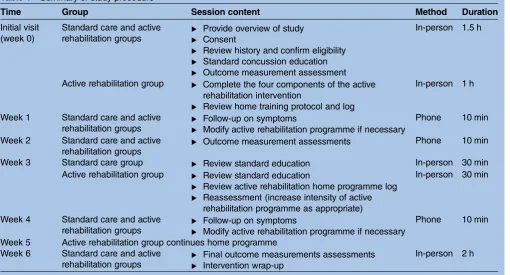
experimental (active rehabilitation plus standard care comprehensive education) or control group (standard care comprehensive education). Participants will be told that they are receiving one of two interventions for concus-sion management. Table 1 presents a summary of the study procedure. All study procedures will be conducted at a paediatric rehabilitation hospital in Toronto, Canada.
Participants and recruitment
One hundred youth with persistent symptoms for at least 1 month following concussion will be recruited. Participants will be recruited via (1) referrals from our facility’s concussion clinic; and (2) flyers sent to local community practitioners (eg, family physicians, paedia-tricians, etc). All recruitment materials will direct inter-ested potential participants (and their families) to contact the study coordinator to learn more. Potential
on September 22, 2020 by guest. Protected by copyright.
participants will be screened by a telephone interview to determine eligibility. Inclusion criteria are youth between the ages of 10 and 18 years with a confirmed diagnosis of mild traumatic brain injury (mTBI) or con-cussion; concussive injury that occurred between 1 and 3 months prior to enrolment in the study; presence of at least one postconcussion symptom as measured by the Post-Concussion Symptom Inventory (PCSI)23(eg, head-aches, anxiety, fatigue) for greater than 4 weeks; fluent in written and spoken English and; able to demonstrate capacity to consent to participate in the study. To be enrolled, the child or adolescent must have at least one symptom that is believed to be related to the injury and has resulted in the youth not being medically cleared to fully return to sports or other recreational activities. Exclusion criteria include youth with more than one concussion in the past 6 months; presence of neck pain; presence of significant musculoskeletal pain or balance dysfunction; pre-existing comorbidities (eg, chronic pain, cardiac, mental health or autoimmune conditions) that prevent participation in active rehabilitation, assess-ment of gait or balance, or participation in cognitive testing; concurrent participation in other physical rehabilitation interventions for persisting postconcussion symptoms (eg, physiotherapy, massage therapy, chiro-practic) at the time of enrolment and throughout the duration of the study.
Informed consent
This trial is registered with clinicaltrials.gov, registration #: NCT02257749. An in-person meeting will be arranged
with potential participants and the research coordinator to confirm study eligibility, to discuss the study procedure in greater detail, and to obtain informed written consent. At this meeting, potential participants will be provided with an information letter that outlines the study purpose, procedures and time commitment, followed by an in-person discussion with the study’s research coordinator. The research coordinator will explain: (1) the purpose of the study; (2) how the randomisation process works and (3) a general overview of the two treatments and outcome measures. The discussion will also include a thorough explanation of the potential risks and benefits associated with participation in the study. The research coordinator will ensure an understanding that they can withdraw from the study at any time without question or consequence and without any effect on the care that they or their fam-ilies receive. Youth and their famfam-ilies will be given unlim-ited time to consider implications, ask questions and respond to the invitation to participate in the study.
Sample size
Fifty participants will be allocated to each treatment group for a total of 100 participants. This sample size was calculated using information from other concussion studies involving high school athletes, and children who experience persistent postconcussion symptoms.8The α was set at 0.01 and power was set at 0.8. The difference between individuals receiving the active rehabilitation intervention versus the control group on the primary outcome measure, the PCSI, is expected to be six points with a pooled SD of 6.8.8 Calculations suggest a sample
Table 1 Summary of study procedure
Time Group Session content Method Duration
Initial visit (week 0)
Standard care and active
rehabilitation groups ▸
Provide overview of study ▸ Consent
▸ Review history and confirm eligibility ▸ Standard concussion education ▸ Outcome measurement assessment
In-person 1.5 h
Active rehabilitation group ▸ Complete the four components of the active rehabilitation intervention
▸ Review home training protocol and log
In-person 1 h
Week 1 Standard care and active
rehabilitation groups ▸
Follow-up on symptoms
▸ Modify active rehabilitation programme if necessary
Phone 10 min
Week 2 Standard care and active
rehabilitation groups ▸
Outcome measurement assessments Phone 10 min
Week 3 Standard care group ▸ Review standard education In-person 30 min
Active rehabilitation group ▸ Review standard education
▸ Review active rehabilitation home programme log ▸ Reassessment (increase intensity of active
rehabilitation programme as appropriate)
In-person 30 min
Week 4 Standard care and active
rehabilitation groups ▸
Follow-up on symptoms
▸ Modify active rehabilitation programme if necessary
Phone 10 min
Week 5 Active rehabilitation group continues home programme Week 6 Standard care and active
rehabilitation groups ▸
Final outcome measurements assessments ▸ Intervention wrap-up
In-person 2 h
on September 22, 2020 by guest. Protected by copyright.
http://bmjopen.bmj.com/
size of 30 children per group. On the basis of previous clinical and research experience, an attrition rate of 25% is expected. As a result, this study will oversample with the aim of enrolling 50 participants per treatment group (100 participants in total).
Randomisation
Participants who meet all study inclusion criteria and consent to participate within the study will be randomly allocated to a treatment group using a stratified process. Owing to previous research indicating an increase in postconcussion symptoms reported by females,24 strati-fied randomisation will be used to ensure equal repre-sentation of gender across the intervention groups. A research coordinator who is not directly involved in this study will perform randomisation to ensure that the research study staff remain blinded to group allocation.
Outcome measures
All participants will be assessed at three time points throughout the duration of the study: week 0 (in-person session on enrolment in the study), week 2 (over the phone), and week 6 (in-person session on completion of the intervention). All outcome measures will be com-pleted by a blinded assessor to minimise the risk for bias during data collection.
Primary outcome
The primary outcome of interest is postconcussion symp-toms. This outcome was chosen because postconcussion symptoms are considered to be an essential clinical marker of recovery following concussion.1Symptoms will be measured using a modified version of the PCSI.23 There are three available versions of the PCSI that will be used: (1) 21-item adolescent version, ages 13–18 years; (2) 18-item child version, ages 8–12 years and (3) 21-item parent-report scale. The PCSI captures the perceived presence and severity of symptoms following concussion. The modification is to add additional symptoms relating to sleep disturbance from the Post-Concussion Scale,25 the scale on which the PCSI was derived. Symptoms are rated on a Likert scale and are reported for before injury and after injury (current symptoms), to track changes in symptoms over brief intervals of time. PCSI has been vali-dated for use with parents and youth following concus-sion.23 It has moderate to strong test–retest reliability (intraclass coefficients=0.65–0.89), moderate parent and youth concordance (r=0.44–0.65) and good convergent validity with a similar symptom checklist measure (r=0.8).23 It also has strong internal consistency.23 PCSI will be administered at baseline, week 2 and on comple-tion of the intervencomple-tion (week 6) for the experimental and control groups.
Secondary outcomes
Secondary measures include assessments of cognition, motor function, behaviour and emotions to evaluate functional recovery across a range of performance
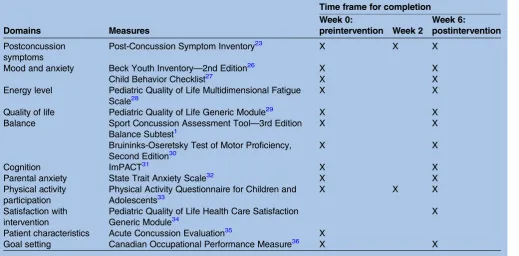
domains. Table 2 outlines the secondary measures used according to domain, along with the time frame within which each of the secondary measures will be adminis-tered within the study protocol.
Interventions
Control intervention: standard care (comprehensive education)
A standardised approach to delivering this concussion education and recommendations has been developed for the purposes of this study, and is reflective of the current standard care practices of the research team members representing three paediatric acute care and rehabilita-tion hospitals in Canada and the Ontario Neurotrauma Foundation’s Guidelines for diagnosing and managing pediatric concussions.2The components of the standard care intervention include comprehensive education about the diagnosis of concussion, self-management strat-egies and return to activity and school guidelines. Specific curriculum topics are outlined inbox 1.
Standard care will be provided to all participants regardless of group allocation. This education will be provided on an individual basis over the 6-week interven-tion period and consists of three 30 min in-person visits with an occupational therapist of the research team (see table 1).
Experimental intervention: active rehabilitation intervention+ standard care
In addition to the standard care (comprehensive educa-tion) described above, the experimental intervention involves an active rehabilitation programme that includes four components: (1) aerobic exercise; (2) coordination exercise; (3) visualisation exercise and (4) a home programme. This programme is based on a protocol developed and reported by Gagnon et al8and has been adapted to be delivered over a period of 6 weeks. The 6-week intervention duration was deter-mined on the basis of findings from Gagnon et al8 that symptom resolution occurred after an average of 4.4 weeks (SD=2.6 weeks) following the initiation of the active rehabilitation programme.
Once allocated to the experimental intervention (active rehabilitation), youth will complete a 1 h in-person session (week 0) that will consist of an intro-duction to the active rehabilitation protocol. Youth will begin by participating in an aerobic exerciseof their choos-ing, either a fast-paced walk or light jog on a treadmill or stationary bicycle. Youth will wear a portable heart rate monitor and will be asked to exercise up to a prede-termined submaximal heart rate that corresponds to 50–60% of their maximum heart rate (maximum heart rate=220 bpm—participant age) and/or a level 4 on the Pictorial Children’s Effort Rating Table (PCERT).37 Participants will continue the aerobic exercise until
post-concussion symptoms are exacerbated or for a
maximum of 15 min.8 37 The time to postconcussion symptom exacerbation (or 15 min) becomes the time
on September 22, 2020 by guest. Protected by copyright.
interval for the aerobic exercise component of the parti-cipant’s rehabilitation programme (take home pro-gramme and in-person visits). This time interval can be adjusted (eg, made longer up to a maximum of 15 min) if the participant is able to demonstrate the ability to complete the time interval without an exacerbation of symptoms.
On completion of the aerobic training, youth will par-ticipate in light coordination exercises for up to 10 min. These activities will be tailored to the child’s favourite sport or physical activity. For example, a North American soccer player may be asked to complete a series of ball and footwork activities that are standard in typical practices. Heart rate will continue to be moni-tored to ensure that it does not exceed 50–60% of their maximal capacity.8 Since research has shown that youth experience decreased self-efficacy in relation to their physical activity performance after mTBI,38 these exer-cises combine light aerobic exercise with familiar sport activities in a monitored and supervised environment to
target self-efficacy and physical function.8 Participants will be closely monitored for symptom exacerbation during the coordination exercises. If postconcussion symptoms are exacerbated, the exercises are stopped immediately8and procedures for symptom exacerbation will be followed (see Safety reporting and monitoring section).
Following the completion of coordination exercise, youth will engage in a sport-specific visualisation exer-cise. The purpose of this exercise is to reassociate posi-tive experiences in relation to physical activity participation and to target self-confidence in return to sports and physical activities. Participants will be asked to choose a specific physical activity associated with their favourite sport for the visualisation exercise. Specifically, they will be asked to choose an activity that they typically perform successfully and that is finite in duration (eg, footwork or dribbling drills in North American soccer).8
Home programme: Thefinal part of the active rehabilita-tion intervenrehabilita-tion includes a daily home programme. The home programme consists of daily practice of the aerobic training, coordination drills and visualisation exercises at the level predetermined in the initial session in the clinic and without exacerbation of symptoms. Participants will monitor their participation by recording their completion of each programme component using a daily log designed for this purpose.8 Parents will be asked to facilitate completion of the daily log. Participants will be contacted by phone at weeks 1, 2 and 4, and they will have an in-person re-evaluation at week 3. The home programme may be modified by the therapist at any of these time points depending on the participant’s symptoms and progress. A third and final
Table 2 Secondary measures and time frame for their completion
Domains Measures
Time frame for completion Week 0:
preintervention Week 2
Week 6:
postintervention
Postconcussion symptoms
Post-Concussion Symptom Inventory23 X X X
Mood and anxiety Beck Youth Inventory—2nd Edition26 X X
Child Behavior Checklist27 X X
Energy level Pediatric Quality of Life Multidimensional Fatigue Scale28
X X
Quality of life Pediatric Quality of Life Generic Module29 X X
Balance Sport Concussion Assessment Tool—3rd Edition Balance Subtest1
X X
Bruininks-Oseretsky Test of Motor Proficiency, Second Edition30
X X
Cognition ImPACT31 X X
Parental anxiety State Trait Anxiety Scale32 X X
Physical activity participation
Physical Activity Questionnaire for Children and Adolescents33
X X X
Satisfaction with intervention
Pediatric Quality of Life Health Care Satisfaction Generic Module34
X
Patient characteristics Acute Concussion Evaluation35 X
Goal setting Canadian Occupational Performance Measure36 X X
Box 1 Standard care
Standard Care Education Topics ▸ What is a concussion? ▸ Energy conservation ▸ Sleep hygiene ▸ Relaxation strategies ▸ Nutrition and hydration
▸ Return-to-school recommendations ▸ Return-to-activity recommendations ▸ Self-management tools
on September 22, 2020 by guest. Protected by copyright.
http://bmjopen.bmj.com/
in-person session will be held at week 6. During this session, youth will be verbally instructed in the standard return-to-activity protocol provided they report remain-ing symptom free at rest for at least 1 week. Youth who continue to experience persistent symptoms beyond the 6-week intervention may be referred to the Concussion Clinic at Holland Bloorview Kids Rehabilitation Hospital for evaluation by a physician and/or rehabilitation team.
Compliance
Participants will be aware that they can withdraw from the study at any time without penalty. Those who choose to withdraw from the study, regardless of their treatment group assignment (standard care only vs active rehabili-tation), will be given the opportunity to participate in the protocol’s final data collection point (week 6). This is to ensure that important data (such as ceased partici-pation due to negative outcomes) are not excluded from the analysis. An analysis of participants who com-plete at least 80% of the intervention will also be included for exploratory purposes.
Participants will be asked to make up any missed evaluation sessions as soon as possible ( preferably within 9 days of the date the evaluation was initially scheduled). Any missed active rehabilitation and standard education sessions are required to be made up as soon as possible. The 6-week intervention can extend to a maximum of 9 weeks secondary to missed sessions. The participant is considered to have dropped out of the study if these cri-teria are not met.
Co-intervention and contamination
On the basis of our experience, it is expected that some children will be pursuing concurrent physical rehabilita-tion intervenrehabilita-tions (eg, physiotherapy, massage therapy, chiropractic) for their postconcussion symptoms. Owing to the nature of the randomised control trial design and risk for co-intervention bias, youth will be asked not to participate in any concurrent physical rehabilitation for postconcussion symptoms throughout the duration of the study. Participation in a concurrent physical rehabili-tation intervention would impede the study’s ability to determine the effectiveness of the active rehabilitation intervention as a treatment for postconcussion symp-toms, and therefore is considered to be the exclusion criterion. A research coordinator will inquire about co-occurring treatment at weeks 0, 3 and 6 to ensure that this exclusion criterion continues to be met throughout the duration of the study.
To monitor for contamination ( participation in activ-ity outside of the intervention protocol), youth’s activity levels will be tracked using data collected from the Physical Activity Questionnaire for Children and Adolescents33(seetable 2for administration schedule).
Safety reporting and monitoring
The risk for increased fatigue and exacerbation of post-concussion symptoms will be disclosed to participants.
Although it is possible that participants may experience an exacerbation of symptoms with increased activity, there are also risks associated with prolonged inactivity, including an increase in postconcussion symptoms.9 Participants will be provided with the opportunity to take rest breaks as needed during study intervention and/or data collection sessions.
Participants will be asked to report any new symptoms, or increases in frequency or intensity of postconcussion symptoms, to the principal investigator throughout the duration of the study. The principal investigator will keep a log of all adverse events for both treatment groups to enable comparisons on completion of the study. Youth will be advised to stop the active rehabilita-tion intervenrehabilita-tion and rest at the onset or exacerbarehabilita-tion of symptoms. Rest should reverse symptom exacerbation. Youth will be permitted to continue the protocol once symptoms have resolved and/or returned to baseline for at least 24 h. If symptoms persist and/or worsen, the principal investigator will assess whether: (1) the child can continue with the intervention; (2) the intervention needs to be discontinued or (3) the intervention needs to be suspended for a specific period of time. These youth will be referred back to their community physi-cians as needed and may require medical clearance before resuming participation in the study.
Planned analyses
Baseline characteristics will be compared using descrip-tive statistics (mean, SD, 95% CIs). Differences in patient characteristics (eg, age, gender, mechanism of
injury and presenting postconcussion symptoms)
between the experimental and control groups will be examined using Student t tests (Wilcoxon rank-sum tests are used if the assumptions of normality and homogen-eity of variance are not met) andχ2tests. Any significant difference between groups will be included as covariates in further analyses. Analyses will be based on intention to treat. To address aim 1, comparing changes in post-concussion symptoms (PCSI) postintervention, a two-way analysis of variance (ANOVA) (group×time (baseline, 2 weeks, 6 weeks) with repeated measures on the time factor will be performed (Friedman two-way ANOVA by ranks will be used if the assumptions of normality and homogeneity of variance are not met). The 6-week inter-val will be of primary interest. Similar analyses with the secondary outcome measures will be performed for the baseline to 6-week data to address aim 2.
Dissemination
Knowledge generated from this study will be shared with healthcare professionals, the general public, sport asso-ciations, and brain injury and relevant organisations, through publication of manuscripts, conference presen-tations and seminars/rounds. Further, this study will engage knowledge translation specialists to create an implementation strategy to reach as many stakeholders and members of the youth sport community as possible.
on September 22, 2020 by guest. Protected by copyright.
CONCLUSION: IMPACT ON CLINICAL PRACTICE
This article describes a protocol for a randomised control trial that tests the efficacy of two interventions for the rehabilitation of youth with persistent postcon-cussion symptoms: active rehabilitation plus standard care (comprehensive education) and standard care only. Results from primary and secondary measures will improve our understanding of the efficacy of the two interventions in relation to physical, cognitive, socioemo-tional and funcsocioemo-tional recovery. Knowledge from this study will help clinicians make informed evidence-based decisions regarding return to activity following concussion.
CURRENT STUDY STATUS
This trial is set to begin recruitment in July/August 2015.
Author affiliations
1Concussion Research Centre, Bloorview Research Institute, Holland Bloorview Kids Rehabilitation Hospital, Toronto, Ontario, Canada
2Department of Occupational Science and Occupational Therapy, University of Toronto, Toronto, Ontario, Canada
3Concussion Research Centre, Centre for Leadership in ABI, Bloorview Research Institute, Holland Bloorview Kids Rehabilitation Hospital, Toronto, Ontario, Canada
4Department of Physical Medicine and Rehabilitation, Harvard Medical School, Boston, Massachusetts, USA
5Spaulding Rehabilitation Hospital, Boston, Massachusetts, USA 6MassGeneral Hospital for Children Sports Concussion Program, Boston, Massachusetts, USA
7Red Sox Foundation and Massachusetts General Hospital Home Base Program, Boston, Massachusetts, USA
8School of Rehabilitation Science, McMaster University, Hamilton, Ontario, Canada
9CanChild Centre for Childhood Disability Research, Hamilton, Ontario, Canada
10Department of Human Kinetics Sciences, Université du Québec à Trois-Rivières (UQTR), Trois-Trois-Rivières, Quebec, Canada
11Research Group on Neuromusculoskeletal Dysfunctions, UQTR, Trois-Rivières, Quebec, Canada
12Centre de Recherche en Neuropsychologie, Montreal, Quebec, Canada 13Clinique Cortex Medicine et Readaptation, Quebec City, Quebec, Canada 14School of Physical and Occupational Therapy, McGill University, Montreal, Quebec, Canada
15Faculty of Medicine, School of Physical and Occupational Therapy, McGill University, Montreal, Quebec, Canada
16Trauma, Montreal Children’s Hospital of the McGill University Health Center, Montreal, Quebec, Canada
Twitter Follow Nick Reed at @DrNickReed and Philippe Fait at @DrPhilFait AcknowledgementsThe authors acknowledge sport concussion research funding from the Mooney-Reed Charitable Foundation.
Contributors IJG designed the experimental intervention. NR, IJG, GLI, CD and PF refined the study protocol and study implementation. DG coordinated the protocol manuscript development. All the authors contributed to the writing and editing of the manuscript.
Funding Funding for the pilot study informing this protocol was provided by Fonds de recherche du Québec-Santé.
Competing interests GLI has been reimbursed by the government, professional scientific bodies and commercial organisations for discussing or presenting research relating to mild TBI and sport-related concussion at meetings, scientific conferences and symposia. He has a clinical and
consulting practice in forensic neuropsychology involving individuals who have sustained mild TBIs. He has received research funding from several test publishing companies, including ImPACT Applications, Inc, CNS Vital Signs and Psychological Assessment Resources (PAR, Inc). He is a co-investigator, collaborator or consultant on grants relating to mild TBI funded by several organisations, including, but not limited to, the Canadian Institute of Health Research, Alcohol Beverage Medical Research Council, Rehabilitation Research and Development (RR&D) Service of the US Department of Veterans Affairs, Vancouver Coastal Health Research Institute and Roche Diagnostics Canada. PF is the founder and co-owner of Cortex Medicine and rehabilitation clinic. Ethics approval Ethics approval has been received from Bloorview Research Institute and Holland Bloorview Kids Rehabilitation Hospital’s Research Ethics Board.
Provenance and peer review Not commissioned; externally peer reviewed. Open Access This is an Open Access article distributed in accordance with the Creative Commons Attribution Non Commercial (CC BY-NC 4.0) license, which permits others to distribute, remix, adapt, build upon this work non-commercially, and license their derivative works on different terms, provided the original work is properly cited and the use is non-commercial. See: http:// creativecommons.org/licenses/by-nc/4.0/
REFERENCES
1. McCrory P, Meeuwisse W, Aubry M,et al. Consensus statement on
concussion in sport—the 4th International Conference on Concussion in
Sport held in Zurich, November 2012.Clin J Sport Med2013;23:89–117.
2. Zemek R, Duval S, Dematteo C,et al.Guidelines for diagnosing and
managing pediatric concussions. Toronto, Ontario: Ontario Neurotrauma Foundation, 2014.
3. DeMatteo C, Stazyk K, Giglia L,et al. A balanced protocol for return
to school for children and youth following concussive injury. Clin Pediatr (Phila)2015;54:783–92.
4. Halstead ME, McAvoy K, Devore CD,et al. Returning to learning
following a concussion.Pediatrics2013;132:948–57.
5. McGrath N. Supporting the student-athlete’s return to the classroom
after a sport-related concussion.J Athl Train2010;45:492–8.
6. Barlow KM, Crawford S, Stevenson A,et al. Epidemiology of
postconcussion syndrome in pediatric mild traumatic brain injury. Pediatrics2010;126:e374–81.
7. Gagnon I, Grilli L, Friedman D,et al. A pilot study of active
rehabilitation for adolescents who are slow to recover from
sport-related concussion.Scand J Med Sci Sports2015 Published
Online First: 3 March 2015.
8. Gagnon I, Galli C, Friedman D,et al. Active rehabilitation for children
who are slow to recover following sport-related concussion.Brain Inj
2009;23:956–64.
9. Schneider KJ, Iverson GL, Emery CA,et al. The effects of rest and
treatment following sport-related concussion: a systematic review of
the literature.Br J Sports Med2013;47:304–7.
10. Silverberg ND, Iverson GL. Is rest after concussion“the best
medicine?”: recommendations for activity resumption following
concussion in athletes, civilians, and military service members. J Head Trauma Rehabil2013;28:250–9.
11. Thomas DG, Apps JN, Hoffmann RG,et al. Benefits of strict rest
after acute concussion: a randomized controlled trial.Pediatrics
2015;135:213–23.
12. Cooney GM, Dwan K, Greig CA,et al. Exercise for depression.
In:Cochrane database of systematic reviews. John Wiley & Sons, Ltd, 1996. http://onlinelibrary.wiley.com/doi/10.1002/14651858. CD004366.pub6/abstract (accessed 15 May 2014).
13. Mead GE, Morley W, Campbell P,et al. Exercise for depression.
In:Cochrane database of systematic reviews. John Wiley & Sons, Ltd, 1996. http://onlinelibrary.wiley.com/doi/10.1002/14651858. CD004366.pub4/abstract (accessed 15 May 2014).
14. Ekeland E, Heian F, Hagen KB,et al. Exercise to improve
self-esteem in children and young people.Cochrane Database Syst
Rev2004;(1):CD003683.
15. Brand S, Gerber M, Beck J,et al. High exercise levels are related to
favorable sleep patterns and psychological functioning in
adolescents: a comparison of athletes and controls.J Adolesc
Health2010;46:133–41.
16. Brand S, Beck J, Gerber M,et al.“Football is good for your sleep”:
favorable sleep patterns and psychological functioning of adolescent
male intense football players compared to controls.J Health Psychol
2009;14:1144–55.
on September 22, 2020 by guest. Protected by copyright.
http://bmjopen.bmj.com/
17. Youngstedt SD. Effects of exercise on sleep.Clin Sports Med 2005;24:355–65, xi.
18. Chaddock L, Erickson KI, Prakash RS,et al. A neuroimaging
investigation of the association between aerobic fitness, hippocampal volume, and memory performance in preadolescent
children.Brain Res2010;1358:172–83.
19. Chaddock L, Erickson KI, Prakash RS,et al. Basal ganglia volume
is associated with aerobic fitness in preadolescent children. Dev Neurosci2010;32:249–56.
20. Griesbach GS, Hovda DA, Molteni R,et al. Voluntary exercise
following traumatic brain injury: brain-derived neurotrophic factor
upregulation and recovery of function.Neuroscience2004;125:129–39.
21. Leddy JJ, Kozlowski K, Donnelly JP,et al. A preliminary study of
subsymptom threshold exercise training for refractory
post-concussion syndrome.Clin J Sport Med2010;20:21–7.
22. Iverson GL, Gagnon I, Griesbach GS. Active rehabilitation for
slow-to-recover children following mild traumatic brain injury. In:
Yeates KO, Kirkwood M, eds.Mild traumatic brain Injury in children
and adolescents: from basic science to clinical management.
New York: Guilford Press, 2012:281–302.
23. Sady MD, Vaughan CG, Gioia GA. Psychometric characteristics of
the postconcussion symptom inventory in children and adolescents. Arch Clin Neuropsychol2014. Published Online First: 15 April 2014.
24. Covassin T, Elbin RJ, Harris W,et al. The role of age and sex in
symptoms, neurocognitive performance, and postural stability in
athletes after concussion.Am J Sports Med2012;40:1303–12.
25. Lovell MR, Iverson GL, Collins MW,et al. Measurement of
symptoms following sports-related concussion: reliability and
normative data for the postconcussion scale.Appl Neuropsychol
2006;13:166–74.
26. Beck J, Beck A, Jolly J,et al.Beck youth inventories—second
edition for children and adolescents BYIII. San Antonio, TX: Harcourt Assessment Inc., 2005.
27. Achenback TM.Manual for Child Behavior Checklist/ 4-18 and 1991
profile. Burlington, VT: University of Vermont, Dept. of Psychiatry, 1991.
28. Varni JW, Burwinkle TM, Katz ER,et al. The PedsQL in pediatric
cancer: reliability and validity of the Pediatric Quality of Life Inventory Generic Core Scales, Multidimensional Fatigue Scale, and Cancer
Module.Cancer2002;94:2090–106.
29. Varni JW, Seid M, Kurtin PS. PedsQL 4.0: reliability and validity of
the Pediatric Quality of Life Inventory version 4.0 generic core scales
in healthy and patient populations.Med Care2001;39:800–12.
30. Bruininks RH, Bruininks BD.Bruininks-Oseretsky test of motor
proficiency. 2nd edn. Circle Pines, MN: Pearson, 2005.
31. Maroon JC, Lovell MR, Norwig J,et al. Cerebral concussion in
athletes: evaluation and neuropsychological testing.Neurosurgery
2000;47:659–69; discussion 669–72.
32. Spielberger C.Test of anxiety inventory: preliminary professional
manual. Palo Alto, CA: Consulting Psychologists Press, 1980.
33. Crocker PR, Bailey DA, Faulkner RA,et al. Measuring general levels
of physical activity: preliminary evidence for the Physical Activity
Questionnaire for Older Children.Med Sci Sports Exerc
1997;29:1344–9.
34. Varni JW, Burwinkle TM, Dickinson P,et al. Evaluation of the built
environment at a children’s convalescent hospital: development of
the Pediatric Quality of Life Inventory parent and staff satisfaction
measures for pediatric health care facilities.J Dev Behav Pediatr
2004;25:10–20.
35. Gioia GA, Collins M, Isquith PK. Improving identification and
diagnosis of mild traumatic brain injury with evidence: psychometric
support for the acute concussion evaluation.J Head Trauma Rehabil
2008;23:230–42.
36. Carswell A, McColl MA, Baptiste S,et al. The Canadian
occupational performance measure: a research and clinical literature
review.Can J Occup Ther2004;71:210–22.
37. Roemmich JN, Barkley JE, Epstein LH,et al. Validity of PCERT and
OMNI walk/run ratings of perceived exertion.Med Sci Sports Exerc
2006;38:1014–19.
38. Gagnon I, Swaine B, Friedman D,et al. Exploring children’s
self-efficacy related to physical activity performance after a mild
traumatic brain injury.J Head Trauma Rehabil2005;20:436–49.
on September 22, 2020 by guest. Protected by copyright.