PUBLISHED 15 AUGUST 2019
http://www.demographic-research.org/Volumes/Vol41/18/ DOI: 10.4054/DemRes.2019.41.18
Research Article
Migration influenced by environmental change
in Africa: A systematic review of empirical
evidence
Marion Borderon
Patrick Sakdapolrak
Raya Muttarak
Endale Kebede
Raffaella Pagogna
Eva Sporer
This publication is part of the Special Collection on “Drivers and the potential impact of future migration in the European Union,” organized by Guest Editors Alain Bélanger, Wolfgang Lutz, and Nicholas Gailey.
© 2019 Marion Borderon et al.
This open-access work is published under the terms of the Creative Commons Attribution 3.0 Germany (CC BY 3.0 DE), which permits use, reproduction, and distribution in any medium, provided the original author(s) and source are given credit.
2 Migration and environmental change: A brief sketch of the debate 494
3 Methods: A systematic review 496
4 Results: Assessing the environmental change and migration nexus 511
4.1 Trends and geographical scope 511
4.2 Methodological overview: Type of methods used 513
4.3 The multiple dimensions of environment and migration 515
4.3.1 Characterisation of the environmental component 515
4.3.2 Characterisation of the migration component 517
4.4 The nature of the nexus: Linking environment and migration 518
5 The key evidence: From sound to contradictory statements 520
5.1 No evidence that environmental change is a sole cause of migration 520
5.2 Sensitivity of livelihoods matters when applying migration as a
coping and adaptation strategy, but different types of migration react differently in the context of environmental stress
521
5.3 There are demographic differentials in migration response 522
5.4 The nature and duration of the environmental pressure results in
different migration behaviours
522
5.5 Social networks and kinship ties act as facilitators for migration 523
5.6 Environmental surplus also influences migration patterns 524
5.7 The nature of migration–environment relationships is contextually
contingent
524
5.8 The choice of scale for the observation and analysis of the
environment change–migration nexus influences the evidence
526
5.9 It is not possible to draw a universal conclusion based on
implications from the data and methods used
526
6 Conclusion: An attempt to systematise empirical evidence on
migration influenced by climate change in African countries
528
Migration influenced by environmental change in Africa:
A systematic review of empirical evidence
Marion Borderon1
Patrick Sakdapolrak2
Raya Muttarak3 Endale Kebede4 Raffaella Pagogna1
Eva Sporer1
Abstract
BACKGROUND
Despite an increase in scholarly and policy interest regarding the impacts of environmental change on migration, empirical knowledge in the field remains varied, patchy, and limited. Generalised discourse on environmental migration frequently oversimplifies the complex channels through which environmental change influences the migration process.
OBJECTIVE
This paper aims to systematise the existing empirical evidence on migration influenced by environmental change with a focus on Africa, the continent most vulnerable to climate change.
METHODS
1 Department of Geography and Regional Research, University of Vienna, Austria.
Email:[email protected].
2 Department of Geography and Regional Research, University of Vienna, Austria, and Wittgenstein Centre
for Demography and Global Human Capital (IIASA, VID/ÖAW and WU), International Institute for Applied Systems Analysis, Vienna, Austria.
3 School of International Development, University of East Anglia, Norwich, UK, and Wittgenstein Centre for
Demography and Global Human Capital (IIASA, VID/ÖAW and WU), International Institute for Applied Systems Analysis, Vienna, Austria.
4 Wittgenstein Centre for Demography and Global Human Capital (IIASA, VID/ÖAW and WU),
change on migration from the comprehensive Climig database and systematically analyse the literature considering the multidimensional drivers of migration.
RESULTS
Environmental change influences migration in Africa in an indirect way by affecting other drivers of migration, including sociodemographic, economic, and political factors. How and in what direction environmental change influences migration depends on socioeconomic and geographical contexts, demographic characteristics, and the type and duration of migration.
CONCLUSIONS
The contextually contingent nature of migration–environment relationships prevents us from drawing a universal conclusion, whether environmental change will increase or suppress migration in Africa. However, this study unravels the complex interactions between the nature and duration of the environmental pressure, the livelihood of the populations, the role of kinship ties and the role of demographic differentials on migration response.
CONTRIBUTION
The review provides an initial systematic and comprehensive summary of empirical evidence on the environmental drivers of migration in Africa. It also discusses the implications of the scale, materials, and methods used in the 53 studies.
1. Introduction
influence of environmental change on migration, which can range from playing a limited and rather indirect role (de Haas 2011) to having significant impacts (Marchiori and Schumacher 2011).
The recent World Bank report which warns that climate change will be a major driver of future internal migration flows in sub-Saharan Africa, South Asia, and Latin America provides an example of the difficulty of estimating and predicting the number of environmental migrants (Rigaud et al. 2018). There is indeed a high degree of uncertainty as reflected in a wide range of the numbers of climate migrants estimated in different scenarios: between 91 and 143 million in the pessimistic scenarios and between 31 and 71 million in the climate-friendly scenarios (Rigaud et al. 2018). What is consistent across all scenarios is the fact that the numbers of potential migrants are predicted to be the highest in Africa.
Africa is considered to be one of the region’s most vulnerable to climate change and climate variability due to its geographical characteristic of vast semiarid areas, high reliance on rain-fed agriculture (only 5% of cultivated area is under irrigation, compared to the world average of 21%) (FAO 2016), and low adaptive capacity. Accordingly, some authors such as Werz and Hoffman (2016) take an “excessively alarmist” approach (Gemenne 2011) in the estimates and predictions of numbers of environmental migrants, arguing that a high level of vulnerability coupled with demographic pressure will lead to the influx of climate migrants from vulnerable regions in sub-Saharan Africa to Europe. Other scholars, on the other hand, have raised concerns about the overemphasis on the importance of environmental stress as a major driver of migration from Africa (Omobowale et al. 2019; Zickgraf 2019).
To shed light on the issues and to provide guidance for researchers to navigate through the increasingly complex body of evidence, this paper seeks to systematise the existing empirical literature on migration influenced by environmental change with a focus on Africa. We combine elements of a systematic evidence assessment with a more reflexive form of evidence-focused literature review. The literature is selected from the comprehensive Climig Database: Migration, Climate Change and the Environment (Piguet, Kaenzig, and Guélat 2018). We employ Black et al.’s (2011a) heuristic framework on drivers of migration to organise and systematise the evidence.
empirical research, our study provides a sound basis for a more evidence-based discussion of this highly politicised issue. In comparison to other reviews on migration in the context of environmental change, our review is broader in scope geographically (compared to Brüning and Piguet 2018; van der Land, Romankiewicz, and van der Geest 2018) and methodologically more systematic (compared to Jónsson 2010; Morrissey 2014).
The remainder of the paper is organised as follows: The next section provides an overview of the scientific debate on migration and the environment and provides the broader context for the review. Section 3 describes the methods and procedures of our systematic literature review and presents the database. Section 4 describes the results, and section 5 discusses the key findings. The paper concludes with section 6.
2. Migration and environmental change: A brief sketch of the debate
Research on the relationship between environmental change and migration has a long history and has gained currency in the past decades (Piguet, De Guchteneire, and Pécoud 2011).5 Piguet (2013) points out that the environment played a central role in migration research in the early works of geographers such as Friedrich Ratzel (1903) or Ellen Churchill Semple (1911) but disappeared as an explanatory factor at the beginning of the second half of the last century. Interest in environmental drivers of migration reappeared again in the 1980s and 1990s due to growing concern over environmental issues and the potential impacts of climate change on livelihoods and well-being. Different disciplines – demography, geography, sociology, and social anthropology, to name a few – have contributed to the conceptualisation of the environment–migration nexus. Furthermore, the field is characterised by a close interaction between science and policy (Gemenne 2011).
There is a consensus that the relationship between migration and environment is complex and multifaceted (Hugo 2011). The difficulty involved in capturing the phenomenon is expressed by the myriads of terms and definitions that seek to address the link (Aufenvenne and Felgentreff 2013; Müller et al. 2012; Renaud et al. 2007; Warner et al. 2010). The literature, as the Foresight Report (Government Office for Science 2011: 34) points out, is characterised by the “unwieldy and imprecise collection of terms and phrases.” In a collection by Müller et al. (2012), which does not claim completeness, 16 different terms and over 20 definitions were identified. The
5 See Piguet (2013) for elaborated and detailed remarks on the history and development of the research on
(1985), which has been heavily criticised by many scholars (Black 2011; Castles 2002) but is still popularly used in the media and by policymakers – to “migration influenced by environmental change” – a phrase used by the Foresight Report (Government Office for Science 2011) that seeks to avoid simplification and capture the complex nature of the relationship. What most of the terms have in common is that they focus on the impact of the environment on human mobility and take into consideration temporal (e.g., permanent and seasonal migration or slow- and rapid-onset events) and spatial (e.g., internal and international movements) dynamics. But the terms differ with respect to which aspect of the environment is included: Some definitions include human-induced stresses such as industrial accidents and the introduction of dams (e.g., El-Hinnawi 1985), while some refer only to specific aspects of the environment such as the climate (e.g., Bronen 2010).
Furthermore, the terms can be differentiated in two important additional ways. The first distinction refers to the degree of autonomy of the population on the move. While those terms that refer to ‘refugee’ and ‘displacement’ focus solely on situations where people have limited agency and are forced to move (for climate refugees, see Brown 2008; for environmental displacement, see Dun, Gemenne, and Stojanov 2007), the term ‘migration’ (for environmental migrant, see Laczko and Aghazarm 2009) seeks to capture forced as well as voluntary movements that can occur in the context of environmental change. This has significant implications regarding the scope of the phenomena that the term refers to. The second difference refers to the way causality is expressed. On the one hand, most terms imply the possibility of clearly attributing the impacts of specific environmental factors to aspects of human mobility and by doing so express a monocausal relationship between some aspects of the environment and human mobility (e.g., environmental refugee or environmental migrants). On the other hand, the above mentioned phrase “migration influenced by environmental change” seeks to highlight that environmental change most often does not influence migration decisions directly but is mediated by other existing drivers of migration as well as other variables on different scales.
options an individual can draw upon. On the other hand, the majority of scholars draw on existing approaches in migration studies and insights from a broad range of disciplines in order to capture the complexity of the relationship (see Black et al. 2011a; Hunter, Luna, and Norton 2015). Bilsborrow (1992), for instance, considers outmigration as one of the demographic responses to resource scarcity in the context of population pressure but also highlights the importance of social, political, and economic contexts that influence the nature of the relationship. Based on the insights from hazard research, Perch-Nielsen, Bättig, and Imboden (2008) point out the range of adaptive options – including migration – that people have to deal with environmental stresses.
Subsequently, more recent research on the migration–environment nexus has broadened and diversified its focus conceptually and methodologically. Scholars have moved beyond the question of how the environment migration influences the migration decision and ask how migration might contribute to climate-change adaptation (McLeman and Smit 2006; Gemenne and Blocher 2017) and resilience building (Sakdapolrak et al. 2016; Rockenbauch and Sakdapolrak 2017; Tebboth, Conway, and Adger 2019). Furthermore, the one-sided focus on mobile populations has been supplemented by research on different forms of immobility, including trapped populations (Zickgraf 2018; Ayeb-Karlsson, Smith, and Kniveton 2018). On a conceptual level, the adoption of concepts such as mobility (Boas et al. 2018) and trans-locality (Porst and Sakdapolrak 2018), the acknowledgement of the temporal (Barnett and McMichael 2018) and emotional (Parsons 2018) dimensions, and the role of non-linearity and thresholds (Adams and Kay 2019; McLeman 2018) has enhanced our understanding of the migration–environment nexus. Indeed, in the past couple of decades, the field of environmental change and migration has achieved scientific progress both theoretically and empirically.
3. Methods: A systematic review
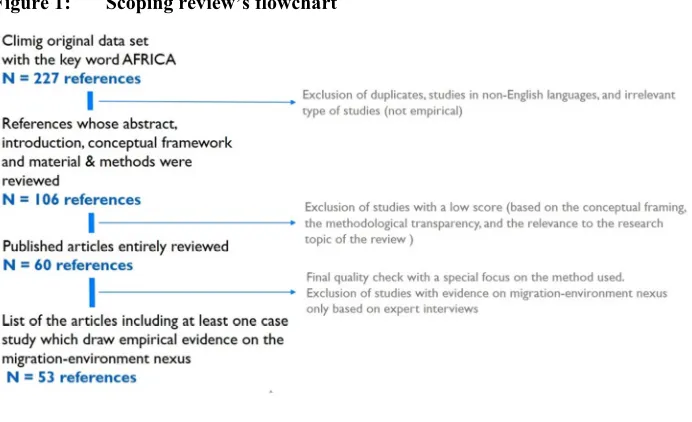
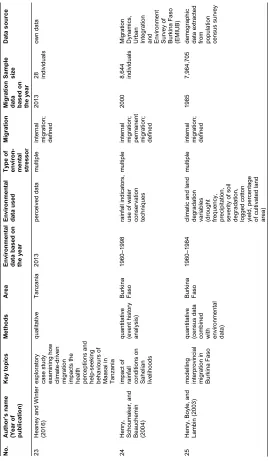
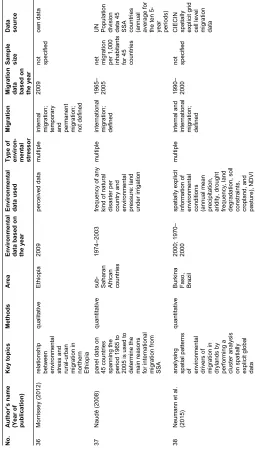
bibliographic database comprised about 1,200 scientific papers and books on climate/environmental change and migration, including more than 450 empirical case studies. A Rapid Evidence Assessment was then conducted following the procedure described in Cummings et al. (2015). This study examines the state and strength of knowledge on a specific topic. It looks at what we know about that topic in the literature, drawing mainly on primary and secondary research studies. The research and analysis process started with the overarching leading question, “How does environmental change influence migration patterns?” Then, the literature search from the database is conducted with a clear structured protocol and rationale for how the search is performed (Figure 1). The first screening stage was mainly the exclusion of studies without an empirical nature and those written in non-English languages. Then, the appraisal of the quality of evidence was considered in the second stage by taking into consideration the type, design, and quality of the studies. After applying a systematic scoring system, 60 studies were selected and analysed. A final quality check was performed to exclude the papers based on limited method-producing evidence (e.g., expert-based interviews).
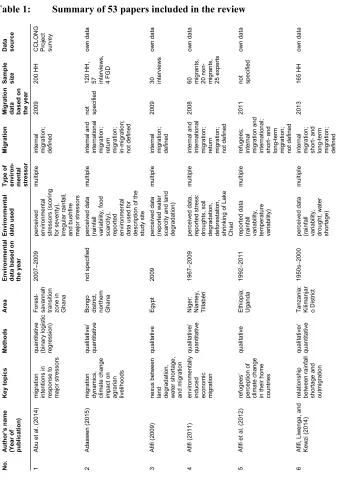
No.
Auth
or
’s name
(Year of publica
tion) Key topic s Methods Area E nvironmental dat
a based on
the year Envir on men tal dat a use d T ype of env iron -men tal stresso r Migration M igratio n dat a bas ed on the year Sample size Data source 1
Abu et al.
(2014) m igrat ion intent ions in respo nse to m a jor st resso rs quan titative (bina ry logistic regr ess io n) For est -savann ah tran si tion zone in Ghana 2007 – 2009 percei ved enviro nm ental stresso rs (scoring for se verity), irregular rainfa ll, and b ushfire m a jor st resso rs m ul tip le interna l m igra tion; define d 2009 200 HH CCLONG Proj ect surve y 2 Adaaw en ( 2015 ) m igrat ion dynam ics, cli m ate ch ange im pact o n agra rian live lihoods quali tat ive/ quan titative
Bongo dist
ri ct, n orth ern Ghana n ot spe ci fied percei ved data (rai nfall variability, food scarcity) , repo rted enviro nm ental data used for descrip
tion of the
study site m ul tip le interna land internationa l m igra tion; retu rn m igra tion; in -m igration; not d efined not speci fie d
120 HH, 57 interv
iew s, 4 FG D o w n da ta 3 Afifi ( 2009) nexus betw een land degr adation, w ater shor tage , and m igratio n quali tat ive Egypt 2009 percei ved data (re ported water scarcity a nd land degr adation) m ul tip le interna l m igra tion; define d 2009 30 interv iew s o w n da ta 4 Af ifi (2011) enviro nm entall y induced econo m ic m igrat ion quali tat ive/ quan titative Ni ger: Ni am ey, Till ab éri 1967 – 2009 percei ved data, repo rted stress: drou ghts, so il degr adation, defor estat ion, shrinking of Lake Chad m ul tip le interna land internationa l m igra tion; retu rn m igra tion; not d efined 2008
60 migran
ts, 20 no n -m igran ts, 25 experts o w n da ta 5 Afifi e
t al. (2012)
refu gees ’ perce ption of cli m ate ch ange in the ir ho m e countri es quali tat ive Ethi opia; Uganda 1992 – 2011 repo rted data (rai nfall
variability, tem
No.
Auth
or
’s name
(Year of public
atio n) Key topi cs Methods Area E nvir on men tal dat
a based on
the year Envir on men tal dat a use d T ype of env iron -men tal stresso r Migration M igratio n dat a bas ed on the y ear Sample size Data source 7 Afri yi e , Gan le, and Santos (20 18) adap tion strat egies of house ho lds to perio di c flooding quali tative
(AVA Fram
e w ork) Ghana : Centr al
Gonja District
1974 – 2010 rep orted data (floo d statistics, rainf all variabilitie s), per ce ived data si ngle
internal migrat
ion; shor t-term ; not d efined 2011
60 HH, 14 F
GDs o w n dat a 8 Barr io s, Bertinelli, and Str obl (200 6) role of clim ate chang e in u rbani sation patte rns quan titative (eco nom etri c anal ys is ) sub -Sahara n Afri can countri es 1960 – 1990 rainf all data set from IPCC as pro xy for cli m ati c chang e si ngle
internal migrat
ion (ur banisat ion as pr ox y
indicator); not d
efined 1950 – 2000 36 sub -Sahara n Afri can countri es census data 9 Bleib aum (20 08) dri vers o f m igrat ion and the linka ge with cli m ate ch ange quali tative
Senegal: Peanut Basi
n and Ri ver Valle y 2008 per ce ived and rep orted enviro nm enta l stresso rs (dr ought, lack of w ater , l ow soil fertility) m ul tip le
internal migrat
ion; shor t- and long -ter m m igrat ion; not d efined 2008
27 migran
ts o w n da ta 10 Carr (2005) interv iew ing of econo m ic, soci al , and enviro nm ental dri vers o f m igrat ion quali tativ e (i ntervie w s, sm al l-scale surve y) Ghana : Do m inase, Pankrum , Yensunkw a not sp ec ifi ed per ce ived and rep orted enviro nm ental stresso rs (de cli ni ng ra infall, soil degradat ion) m ul tip le
internal migrat
ion; shor t- and long -ter m m igrat ion; not d efined 1997 – 2000 90 interv iew s,
50 in survey
o w n da ta 11 Cattane o and Massetti (2015) interact ion enviro nm ental chang e and m igrat ion quan titative Ghana , Ni geria 1961 – 1990/ GCM cli m ate 2 perio ds: 2031 – 2060 /2071 – 2100 g ridde d cl im ate data; m onthl y m ean tem per atur es and pre ci pi tation/ cli m ate ch ange scenari os m ul tip le
internal and internationa
l m igrat ion; define d 2010 /2011 ; 2005 /2006 variou s Ni geria Gener al Househol d
Survey, Ghana Livi
ng Standar d Survey 12 Cattane
o and Per
No.
Auth
or
’s name
(Year of publica
tion) Key to pic s Methods Area E nvironmental dat
a based on
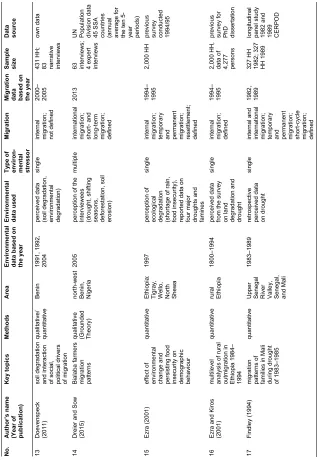
the year Envir on men tal dat a use d T ype of env iron -men tal stresso r Migration M igratio n dat a bas ed on the year Sample size Data source 13 Doevensp eck (201 1) soil degradat ion and in teract ion
of social, poli
tica l driver s of m igra tion quali tative/ quan titative Beni n 1991 , 1992, 2004 per ce ived data (soil degradatio n, enviro nm ental degr adation) si ngle interna l m igrat ion; not d efined 200 0 – 200 5
431 HH; 83 narr
ative interv iew s o w n da ta 14 Dreier and Sow (201 5) Biala ba farm ers m igra tion patte rns quali tative (Gr ounded The ory) nor th -w est Beni n, Ni geria 2005 per
ception of the
Inter vi ew ees (dr ought, shifting season s, defor estat ion, soil ero si on) m ul tip le internationa l m igrat ion; short - and long -ter m m igrat ion; define d 2013 63 interv iew s; 4 ex pert interv iew s UN Popul ation di vi si on data
45 SSA countri
es (ann ual avera ge for the te n 5 -year perio ds) 15 Ezra (2 001) effect of enviro nm ental chang e and per si st ing food insecur ity on dem ogr aphi c beha vi our quan titative Ethi opia: Tigr ay, W ello , North Shew a 1997 per ception of ecol og ica l degr adation (sho
rtage of ra
in,
food in
security)
,
rep
orted data on
four m a jor dro ughts and fam ines si ngle
internal migrat
ion; te m por ary and perm anen t m igrat ion; reset tlem ent; define d 1994 – 1995 2 ,000 HH p reviou s surve y condu cted 1994 /95 16 Ezra and K iros (200 1) m ul tilevel anal ys is of r ural outm igra tion in Ethi opia 1984 – 1994 quan titative rural Ethi opia 1800 – 1994 per ce ived data from the su rvey on lan d degr adation and dro ught si ngle
internal migrat
ion; define d 1994 – 1995 2
,000 HH, data
of 4 ,277 perso ns previo us surve y for
PhD disse
rtatio n 17 Findle y (1994) m igra tion patte rns of fam ilies in Mali durin g drought of 19 83 –1985 quan titative
Upper Senegal River Valle
y, Senegal , and Mali 1983 – 1989 retr ospect ive per ce ived data on dr ought si ngle internal and internationa l m igrat ion; tem por ary and perm anen t m igrat ion; short -cycle m igrat ion; define d 1982 , 1989
327 HH 1982
No.
Auth
or
’s name
(Year of publica
tion) Key to pic s Methods Area E nvironmental dat
a based on
the year Envir on men tal dat a use d T
ype of environ
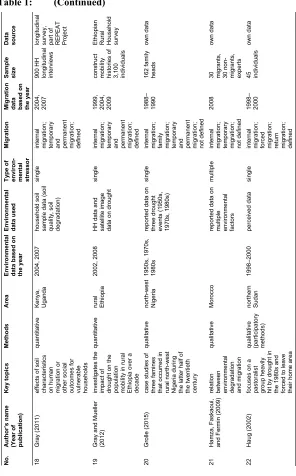
-men tal stresso r Migration M igratio n dat a bas ed on the year Sample size Data source 18 Gray ( 2011) effects of soil chara cteristics on hu m an m igra tion or other social outcom es for vul nerab le house holds quan titative Kenya, Uganda 2004 , 2007 house hold soil sam pl e dat a (soil quali ty , soil degr adation ) si ngle
internal migrat
ion; tem pora ry and perm anen t m igrat ion; define d 2004 , 2007
900 HH longitud
inal interv iew s longitud inal surve y, part of REP EAT Proj ect 19 Gray a nd Mue ller (201 2)
investigates the impact o
f
drou
ght on the
popula tion m obi lity in rural Ethi
opia over a
decad e quan tit ative rural Ethi opia 2002 , 2008
HH data a
nd satelli te im age data on drought si ngle
internal migrat
ion; tem por ary and perm anen t m igrat ion; define d 1999 , 2004 , 2009 constr uct m obi lity hi stor ies of 3 ,100 individua ls Ethi opian Rural Househol d surve y 20 Grol le (2015) case stu di es of thre e fam ines that o ccurred in rur al north -w est Ni geria during the lat ter ha lf of the twenti eth centur y quali tative nor th -w est Ni geria 1950 s, 1970s, 1980 s rep
orted data on
thre e drought events (1 950s, 19 70s, 1 980s) si ngle
internal migrat
ion; fam ily m igrat ion; tem por ary and perm anen t m igrat ion; not d efined 1988 – 1990 162 f am ily head s o w n da ta 21 Ha m za , Fa skaoui, and F erm in (20 09) relatio n between enviro nm ental degr adation and m igra tion quali tative Morocco rep
orted data on
m ul tip le enviro nm ental factor s m ul tip le
internal migrat
ion; tem por ary m igrat ion; not d efined 2008
30 migra
nts, 30 no n -m igra nts, ex per ts o w n da ta 22 Haug ( 2002) focuses on a pastor ali st grou p heav ily hi
t by dro
ught in
the 1
980s and
force
d to leave
their hom e ar ea quali tative (pa rticipatory m ethod s) n orth ern Sudan 1998 – 2000 per ce ived data si ngle
internal migrat
No.
Auth
or
’s name
(Year of public
ation) Key to pic s Methods Area E n vironmental dat
a based on
the year Envir on men tal dat a use d T ype of env iron -men tal stresso r Migration M igrati on dat a bas ed on the year Sample size Data s ource 23 Heaney and W int er (201 6) ex pl ora tory case stu dy ex a m in ing how cli m ate -dr iv en m igra tion im pac ts the health perce ptions and hel p-seekin g beha vi our s of Maasai in Tan zania quali tative Tan zania 2013 per ce ived data m ul tip le
internal migrat
ion; define d 2013 28 individua ls o w n da ta 24 Henry, Schoum aker , and Beauchem in (200 4) im pact o f rainfall conditio ns on Saheli an live lihoods quan titative (even t history anal ys is ) Burki na Faso 1960 – 1998 rainf all indicators, use of w ater conser vation techniq ues m ul tip le
internal migrat
ion; perm anen t m igrat ion; define d 2000 8 ,644 individua ls Migr ation Dynam ics, Urban Integ ration and Envir onm ent
Survey of Burki
na Faso (EMIUB ) 25 Henry , Boy le, and Lam bi n (20 03) m odel ling interprovincia l m igra tion in Burki na Faso quan titative (censu s data com bi ned w ith enviro nm ental data) Burki na Faso 1960 – 1984 cli m ati
c and la
nd degr adat ion variabl es (dr ought freq uency, pre ci pi tation, severit
y of soil
degr
adation,
logged cotton yiel
No.
Au
thor
’s name
(Year of public
ation) Key topi cs Methods Area E nvir on men tal dat
a based on
the year Envir on men tal dat a use d T ype of env iron -men tal stresso r Migration M igratio n dat a bas ed on the y ear Sample size Data s ource 26 Henry
et al. (2004)
influence o f enviro nm ental chang e on m igrat ion in Burki na Faso quan titative Burki na Faso 1960 – 1999 rainf all (globa l m onthl y pre ci pi tation),
land degradation via estim
ati
on of
the RUE (r
ai n use ef fic iency) m ul tip le interna land internationa l m igrat ion; define d 1960 – 1999 3
,570 HH, collection of 9,612 biographies
Migr ation Dynam ics, Urban Integ ration and Envir onm ent
Survey of Burki
na Faso (EMIUB ) 27 Hu mm el (20 16) interact ions
between clim
No.
Auth
or
’s name
(Year of publica
tion) Key to pic s Methods Area E nvironmental dat a bas ed o n the y ear Env ironmental dat a use d T ype of env iron -men tal stresso r Migration M igrati o n dat a bas ed on the year Sample size Data source 30 Konsei ga (20 07 ) m oti vati on behind the im port ant m igrat ion from Burki
na Faso to
C ôte d ’Ivo ire quan titative Burki na Faso , C ôte d ’Ivoire 2000 , 2002 com par ison o f area s accord ing to an am ount of
rainfall (low
/m edi um rainfall w ith thre shold of 400mm /year ly rainfall le ve l of
400 mm =
low / m edi u m = 450mm per year ) m ul tip le internationa l m igrat ion; season al and perm anen t m igrat ion; define d 2000 , 2002 401 HH CAP Ri survey 31 Koubi et a l. (2016) m igr ati on deci si on-m aki ng an d indi vi dua l perce pt ions of di fferent types of enviro nm ental chang e (sudd en vs. grad ual enviro nm ental events) quan titative Uganda , Viet nam , Ca m bodi a, Ni caragua, Peru 2013 – 2014 percei ved data, choi ce of stu died regio n re lated to enviro nm ental co nditions m ul tip le interna l m igrat ion; perm anen t m igrat ion; define d 2013 – 2014 3 ,6 89 individua ls m igran ts and n on -m igran ts o w n dat a 32 Kubi
k and M
aur el (201 6) anal ys is of m igrat
ion as a
respo nse of rur al house holds to w eathe r sho cks quan titative Tan zania 2 008, 2009 SP EI i ndex, crop prod uct ion esti m ated by usi ng agr icu ltural
and weather data,
index is
used a
s a prox
y for d rought m ul tip le interna l m igrat ion; perm anen t m igrat ion; define d 2008 /2009 – 2010 /2011 1 ,583 HH Tan zania Nati ona l
No.
Auth
or
’s name
(Year of public
ation) Key topi cs Methods Area E nvir on men tal dat
a based on
the year Envir on men tal dat a use d T ype of env iron -men tal stresso r Migration M igratio n dat a bas ed on the year Sample size Data s ource 33 Leyk et al. (2012) devel oping m igrat ion m odel s consi dering spatial n on -stati onarit y and tem por al variatio n thro ugh ex a m inati on of the m igra tion – enviro nm ent associ ation at nested geog raph ic scal es quan titative South Afri ca 2000 – 2002, 2007 pro xi m ate n atur al reso urce avail abili ty b ased on NDVI m ul tip le
internal migrat
ion; tem por ary m igrat ion; define d 2002 , 2007 9 ,374 HH Agin court Heal th and De m ogra phic Surveill ance Syste m (AHDSS ) 34 Meze -Hausken (200 0) adap tation capacity o f subsi st ence farm ers i n n orth ern Ethi opia quali tative (ra pi d rural appr ai sa l) Ethi opia 1999 rep orted drought, per ce ived data – anal ys is of m igran t’s beha vi our and liv ing cond iti ons befor
e and after
the o nset of pre vi ous dro ughts m ul tip le
internal migrat
ion; in - and retu rn -m igrat ion; define d 1999 104 o w n da ta 3 5 Morri ssey (201 3) ex pl ore s dom inant m obi lity nar rative s am ong popula tions w hose live lihoods are ex posed to a ran ge of enviro nm ental stresse s quali tative Ethi opia 2009 per ce ived data m ul tip le
internal migrat
ion;
not d
efined
2009
361 migra
No.
Auth
or
’s name
(Year of publica
tion) Key to pic s Methods Area E nvironmental dat a bas ed o n the y ear Env ironmental dat a use d T ype of env iron -men tal stresso r Migration M igratio n dat a bas ed on the y ear Sample size Data source 36 Morri ssey (2 012) relatio nship between enviro nm ental stress a nd rur al -urban m igrat ion in n orth ern Ethi opia quali tative Ethi opia 2009 percei ved data m ul tip le interna l m igra tion; tem por ary and perm anen t m igra tion; not d efined 2009 not speci fie d o w n da ta 37 Naud é (2 008) panel data on 45 cou nt ries spannin g the perio
d 1965 to
2005
is used to
deter m ine th e m ai n re asons for in ternat ional m igrat ion from SS A quan titative sub -Sahara n Afri can countri es 1974 – 2003 freq
uency of any
ki
nd of natura
l di saster per countr y and enviro n m ental pressu re: land unde r irr igation m ul tip le internationa l m igra tion; define d 1965 – 2005
net migrat
No.
Auth
or
’s name
(Year of publica
tion) Key to pic s Methods Area E nvironmental dat a bas ed o n the y ear Env ironmental dat a use d T ype of env iron -men tal stresso r Migration M igrati on dat a bas ed on the year Sample size Data source 39 Ocell
o et a
l. (201 4) ex a m ines th e roles pl ayed by drou ghts or
floods, crop diseases, and severe
w ater short ages in inter -distr ict m igra tion in Tan zania quan titative Tan zania 2008 – 2009 percei ved data m ul tip le interna l m igrat ion; define d 2008 – 2009 3 ,265 HH Tan zania Nati ona l P anel
Survey (TZNPS)
40 Radem acher -Schul z, Schraven, and Maham a (201 4) interrelationsh ip
s between rainfall variability, live
lihood/food security , and m igra tion in rur al Savannah comm uni ties i n n orth ern Gh ana quali tative/ quan titative (HH sur vey, PRA , exper t interv iew s) Ghana 2011 percei ved data m ul tip le interna l m igrat ion; season al m igrat ion; not d efined 2011 158 HH o w n dat a 41 Ro m anki ew icz and Doevensp eck (201 5) local persp ect ive on m igra tion with consi dera tio n of cul tura l norm s and interpretat ion of w ea ther even ts quali tative (m ul tis ite ethno graphy) Mali , Senegal 1961 – 2000; 2011 /2012
local indicators on r
ai nfall and vegeta tion (num ber of tr ees
in the f
No.
Auth
or
’s name
(Year of public
ation) Key to pic s Methods Area E nvironmental dat
a based on
the year Envir on men tal dat a use d T ype of en vi ron-men tal stresso r Migration M igratio n dat a bas ed on the y ear Sample size Data source 43 Sow et a l. (2 014) ex pl ore s archive s and narr atives of Afri can m igra nts i n nort h -w ester n Beni n and nort h -eastern Ghana quali tative Beni n, Ghana 2012 , 2013 rep orte d data from arch ives m ul tip le internal and internationa l m igrat ion; in -m igration; not d efined 2012 , 2013
35 HH, 4 FGD, 2
5 interv iew s o w n dat a 44 Suckall et al. (201 7) ex a m ine s how cli m ate ch ange m ay affe ct the m igra tion deci si ons of rur al farm ers i n SS A quali tative/ quan titative (HH sur vey, FGD, interv iew s) sub -Sahara n Afri can countri es 2009 , 2010 p erceive d data on cli m ati c stresse s and shocks m ul tip le
internal migrat
ion; not d efined 2009 , 2010
255 HH, 75 interv
iew s, 93 F GD o w n da ta 45 Van der Geest (2011 a) nexus betw een enviro nm ental degr adation and m igratio n in nort hern Ghana quali tative/ quan titative n orth ern Ghana 1982 – 2002 vegeta tion data
(NDVI and GIMM
S data) , rainf all data m ul tip le internal and internationa l m igrat ion; define d 2000 regio nal n
= 10 distri
ct n = 110 life histor ies, focus gr oup d iscuss io ns, Ghana ’s 2000 popula tion and h ousing census d ata 46 Van der Geest (201 1b) deter m ine th e im por tance of the enviro nm ent a s a drive r of n orth –south m igra tion in Ghana quali tative/ quan titative Ghan a 1970 s, 1980s NDVI d ata o n rainf all vegetat ion and cr
op yields at
di st ri ct level an d surve y per
ception at the
individua l l evel m ul tip le
internal migrat
ion; vol untary and force d m igrat ion; define d 2011
total populatio
n of Gha na, 203 HH Ghana ’s popula tion a nd ho us in g
census different year
s, ow
n
No.
Auth
or
’s name
(Year of publica
tion) Key to pic s Methods Area E nvironmental dat a bas ed o n the y ear Env ironmental dat a use d T ype of env iron -men tal stresso r Migration M igrati on dat a bas ed on the year Sampl e size Data source 47 Van der Geest , Vri eli
ng, and D
ietz (201 0) tren ds in corr el at io ns
between migra
tion and vegeta tion cover quan titative (censu s data com bi ned w ith NDVI) Ghana 1981 – 2006 vegeta tion cover NDVI Data m ul tip le interna l m igrat ion; in - and outm igra tion; define d 2000 regio nal n
= 10 distri
ct n = 110 Ghana ’s 2000 popula tion
and housing census
48 Van der Land and Hu mm el (201 3) ex a m ini ng the role o f form al educa tion in enviro nm entall y
induced migra
tion as one chara cte ri sti c of soci al vul nerab ili ty to enviro nm ental chang e quali tative/ quan titative Mali , Senegal m enti oni ng that study a reas face cli m ati c chang e
like reduction of rainfall,
drought m ul tip le interna land internationa l m igrat ion; not d efined 2012
905 HH, 60 interv
iew s o w n da ta 49 V eron is and McLem an ( 2014 ) enviro nm ent a s a drive r of m igra tion to overse as, Canada quali tative (focus g roup interv iew s) Horn o f Afri ca, fran copho ne sub-Sahara Afri ca not sp ec ifi ed repo
rted data on
drou ght, defor estat ion, land degradation m ul tip le internati ona l m igrat ion; define d not speci fie d 47 individua ls o w n da ta 50 Morti m ore (198 9) link betw een enviro nm ental chang e and m igra tion in course of tim e quali tative/ quan titative Ni geria 1973 – 19 74 percei ved data m ul tip le interna land internationa l m igrat ion; resid ent and nonr es ident m igrat ion; not d efined 1973 – 19 74 not speci fie d surve y 51 Adoho an d W odon (201 4) m igra
tion as a
respo nse strate gy of house holds in
the MENA regio
n to enviro nm ental stress quan titative Alge ria, Morocco, Syri a, Ye m en, Egypt 2011 pe rceived data from surve y on drou
ght and flood
No.
Auth
or
’s name
(Year of publica
tion) Key to pic s Methods Area E nvironmental dat a bas ed o n the y ear Env ironmental dat a use d T ype of env iron -men tal stresso r Migration M igrati on dat a bas ed on the y ear Sample size Data source 52 Gran
t, Burger, and
W odon (2014) interact ion of w eathe r patte rns, perce pt ion of cli m ate ch ange , and m igratio n in the M ENA regio n quali tative (focus g roup interv iew s) Alge ria, Morocco, Syri a, Ye m en, Egypt 2010 ; 2012 percei ved enviro nm ental chang e from focus g roup interv iew s m ul tip le interna l m igrat ion; not d efined 2010 ; 2012 each g roup: 6 –8 particip ants 7 focus g roup s in M orocco , Syri a, Egypt 53 Nguyen and W odon (2014) im pact o f ex tre m e w eathe r eve nts on m igra tion in Morocco quan titative Morocco 2009 – 20 10 p erceive d enviro nm ental chang e, weather events from survey data m ul tip le interna land internationa l m igrat ion; tem por ar y and perm anen t m igrat ion; define d 2009 – 20 10 2
,000 HH (rural and urba
migration influenced by environmental change. To do so, the framework on drivers of migration from Black et al. (2011a) served as a heuristic device to structure and systematise the evidence gathered from the literature. Following the framework, we extract – if it exists – evidence about the economic, political, social, demographic, and environmental drivers; factors on the micro level (personal and household) and meso level (intervening obstacles and facilitators); and the interaction between the different factors. Using this approach, all the necessary information on the effects of environmental factors on migration in Africa were collected. The key micro-, meso-, and macro-scale interactions that result in migration–environment associations were reported and analysed for each paper. Ultimately, considering that the key concepts ‘migration’ and ‘environment’ may refer to various realities, the definitions, materials, and methods used were particularly scrutinised. The 53 articles selected represent not only a wide variety of empirical case studies related to how environmental change shapes migration decision-making but also a diversity of definitions of the terms, units of analysis, materials used, geographical scales, methods, and contexts or livelihoods of interest.
4. Results: Assessing the environmental change and migration nexus
In this section, we present a summary of the nature of research on environmental change and migration in Africa, including the key findings from the review. First, we provide an overview of the number of studies conducted over the past 28 years and their geographical scope. Second, we assess the methods applied in the literature. Third, we carve out how the literature conceptualises migration and the environment in different strands of research. Lastly, we highlight how the research articles included in our sample address the interaction between migration and the environment.
4.1 Trends and geographical scope
environmental change and migration at a national scale. The most frequent study design is the local case studies (subnational studies); 26 case studies6 have been carried out, covering mainly West Africa on one side and Ethiopia and Tanzania in East Africa (see Figure 2).
Figure 2: Map of distribution of case studies by country
6Some of the case studies in the articles that adopted a comparative approach are also counted at local cases,
in this review arranged by time period. The evolution of the number of case studies over time reflects the general pattern of publication activities in the field of migration and climate change, which has intensified significantly, particularly since 2010 (Piguet, Kaenzig, and Guélat 2018). This is likely to be attributable to improvements in climate and migration data as well as statistical tools and techniques (Fussell, Hunter, and Gray 2014).
Figure 3: Number of selected publications over time
4.2 Methodological overview: Type of methods used
In terms of the type of methods used, we apply a six-group typology presented by Piguet (2010) in his review of research methods used in empirical research focusing on the environment–migration nexus. The first four typologies characterise different research designs, data, and levels/units of analysis in quantitative research.
· Type 1: ecological inference analysis based on area characteristics where migration and environmental factors are measured at the aggregate level.
between environmental factors and migration over time.
· Type 4: multilevel analysis that differs from Type 2 only for environmental data, which is collected at the ecological level, while migration information is measured at the individual or household levels.
· Type 5: agent-based modelling, which is a simulation of the behavioural responses of individuals and households to environmental pressure based on the assumptions of a researcher. This modelling is thus not necessarily based on empirical evidence like other approaches.
· Type 6: qualitative/ethnographic methods, including face-to-face interviews, focus group interviews, and expert interviews. In particular, this methodological distinction focuses on research that analyses the role and importance of the environmental driver of migration.
migration
4.3 The multiple dimensions of environment and migration
Most of the empirical case studies included in the review were carried out after 2010, which was after the methodological overview by Piguet (2010) on the environment– migration nexus. At this time, Piguet concluded that “Meta-studies that could assess the migratory impact of different factors on the basis of a collection of studies are as yet impossible. This is largely due to the lack of data available to measure migration behaviour and environmental evolutions at temporally and spatially comparable scales” (Piguet 2010: 6). Meanwhile, a later literature review of research on the environmental dimensions of migration by Hunter, Luna, and Norton (2015) points out the need for clarification and critical examination of the definition of ‘migration’ and the ‘environment,’ and questions what is included and what is excluded. With this in mind, a comprehensive analysis of the definitions and data used for the environment and migration components lays the foundation for this evidence review.
4.3.1 Characterisation of the environmental component
people’s migratory behaviour. The concept of environment encompasses climate stressors, natural disasters, and any environmental degradation – often resulting in a combination of a climate-related event and a human-made process. The focus could be on a single stressor (11 papers out of 53) – that is, the impact of a drought event – or on multiple stressors (42 papers). In the latter case, droughts, floods, or various climatic events are considered in the study as a separate stressor or together in a common pot named environmental stressors.
One distinction of the characteristic of the environmental component is related to the rapidity of the process: slow-onset event vs. rapid or extreme weather-related event. A strong assumption refers to the speed of the phenomena that might result in various human consequences and migration decisions. For instance, combining a large national survey of individual biographies with environmental data including rainfall (global monthly precipitation) and land degradation via an estimation of the rain-use efficiency, Henry et al. (2004) concludes that people affected by land degradation are more likely to move compared to those from the areas affected by poor climatic conditions. It is assumed that migrations are more likely to be influenced by a slow-acting process such as land degradation than by episodic events such as droughts. The study implies that when considering a migration response to environmental stressors, it is important to distinguish between rapid- and slow-onset events.
Another distinction emerges as to the degree of exposure to the environmental stressors, as well as their severity, which would lead to a differential influence on the migration decision-making process. The impacts of environmental stressors are not distributed evenly across individuals, households, and communities (Muttarak, Lutz, and Jiang 2016). Consequently, there is no universal perception of the degree of severity of the impacts, which are perceived in the same way everywhere and by everyone (Dessai et al. 2004; Marx et al. 2007; Piguet 2010).
The notion of perception is therefore fundamental in defining the environmental stressors. Indeed, most of the environmental data is captured either by asking direct questions in the survey or by collecting information at the local level. Going back to the typology of Piguet (2010), most of the qualitative/ethnographic methods (Type 6) as well as some papers based on individual sample surveys (Type 2) do not used the observed or measured environmental data but the perceived and self-reported data.
major stressors (Abu, Codjoe, and Sward 2014).
In understanding the role of the environment as a migration driver (or the absence of it) by directly questioning the respondents, the question of the environmental factor can be explicitly mentioned. A study by Romankiewicz and Doevenspeck (2015) presents an example of the role of the environmental driver of migration which can be captured only when being prompted by the interviewers. When explicit questions about the possible linkages between environment and migration are avoided, the results show that environmental stress was not mentioned by the participants as a key driver of migration.
Within the empirical study using objectively measured environmental data, the most frequently used sources are earth-observation-based data, including all information extracted from satellite imageries, local or national meteorological data, or models from weather stations. From the geolocated environmental data, the most common indicators include annual mean precipitation, aridity, drought frequency, land degradation, soil constraints, cropland and pasture, and the Normalized Difference Vegetation Index (NDVI). Out of the 53 studies including in our review, 7 based their analyses on an estimation of the natural resource availability via the NDVI.
4.3.2 Characterisation of the migration component
Similarly to the environmental component, the reviewed literature presents a broad range of different types of migration being studied. In the most basic sense, any definitions of population movement involve both spatial and temporal dimensions (King 2012). Furthermore, categorisation according to causes and purpose of migration is also possible. With regard to the spatial dimension of movements, 32 of the case studies focused on internal migration, 4 on international migration, and 16 considered both types of migration. A strong focus on internal migration reflects the established scientific evidence, including from beyond Africa, that migration in the context of environmental change is mostly short distance and occurring within a country (Rigaud et al. 2018). Regarding the operationalisation of migration in the reviewed articles, we identify three patterns which are strongly linked to the methodological approach employed.
(2014), for example, in their study of African migration to Canada, provide detailed information about their interviewees, including country of origin, length of stay, immigration status, and skills, and clearly delineate the criteria for the selection of the respondents for focus group interviews. Other studies are more unspecific, referring, for example, to places where people migrated to in the past (e.g., Dreier and Sow 2015) or to the places of origin (e.g., Afifi 2009).
Second, another group of studies capture migration through individual sample surveys – mostly by using household rosters to identify members with past migration experience or currently absent household members who are considered migrants. The spatial and temporal criteria applied to identify absent members as migrants varies: Afifi, Liwenga, and Kwezi (2014) use a six-month threshold to differentiate between seasonal and permanent migrants; similarly Findley (1994) considers members who are not in the village for periods of between one and six months as “short-term cycle migrants” and those who left without returning in the reference period as “permanent migrants.” Other authors such as Hummel (2016) use a three-month absence from the place of origin as a threshold. With regard to the spatial criteria, the threshold ranges from having left home (e.g., Ezra 2001), the village (e.g., Findley 1994), the district (e.g., Gray and Mueller 2012), or one’s place of birth (which is not equivalent to the place of residence) (Koubi et al. 2016). Some studies introduce additional criteria for the identification of migrants, such as whether absent members are still considered to belong to the household (e.g., Adoho and Wodon 2014), retain livelihood connections (Hunter et al. 2017), or send remittances (Cattaneo and Massetti 2015).
A third group of studies utilises existing data sources such as censuses to derive migrant stocks and counts migration as net-migration, that is, bilateral net-migration rates between countries (e.g., Cattaneo and Peri 2016; Naudé 2008) or provinces and regions (van der Geest 2011a; e.g., Henry, Boyle, and Lambin 2003). Migration may also be captured indirectly, such as in a study by Barrios, Bertinelli, and Strobl (2006) which compares 36 sub-Saharan African countries using urbanisation as a proxy indicator for internal migration.
4.4 The nature of the nexus: Linking environment and migration
environmental stressors and migration, whatever the type and nature considered, should not be directly established without considering how the environmental dimension interacts with other factors at macro, meso, and micro scales.
Going back to the application of Black’s framework on drivers of migration (Black et al. 2011a), the study of the nexus between both components requires taking into account all the other factors and contextual effects which could play a role in the migration–environment association. The absence of consideration of these interactions can apparently make the relationship between environmental change and migration spurious. In a study in Ghana (Abu, Codjoe, and Sward 2014), the link between environmental stress and household heads’ intention to migrate is examined. Once socio-demographic factors are controlled for, there is no significant association between any of the climate-related stressors and intention of migration. In another study by Ocello et al. (2015), the relationship remained after accounting for relevant variables. It is found that being exposed to droughts or floods and to crop diseases or crop pests had negative and statistically significant effects on migration even after controlling for socio-demographic factors.
In general, most papers address the interactions of the drivers either at the macro or micro level so as to avoid ecological fallacy. Frequently, the study of the association between the environmental component and the economic one is highlighted. Konseiga (2007) illustrates that the environmental driver plays a role by increasing the probability that people will move out and follow the opportunity to have a better income when living in a drier area (i.e., migration as successful adaptation and a way to diversify income). The same direction is pointed out in Neumann et al. (2015), showing how environmental degradation acts as a push factor via the reduction of economic means.
For quantitative studies carried out at the household level, perceptions of environmental stressors expressed by members of the household, as well as their socio-demographic characteristics, do not require the use of a multilevel model for statistical analysis. Yet, the integration of a contextual effect (e.g., at the community level) rather than only individual-level factors would demand the use of multilevel modelling design (Laczko and Aghazarm 2009; Rabe-Hesketh and Skrondal 2006). Therefore, the interactions between individual- or household-level migration with the meso- or macro-level environmental data can only be studied with consideration of the multimacro-level modelling design. Amongst the 53 studies reviewed, only 7 papers employ multilevel framework7 (Cattaneo and Massetti 2015; Gray and Mueller 2012; Henry et al. 2004; Henry, Schoumaker, and Beauchemin 2004; Hunter et al. 2017; Kubik and Maurel 2016; Neumann et al. 2015). However, we could expect an increase in the use of
7 Strictly speaking, multilevel modelling would normally have a random intercept model. Most of these
interactions (Fussell, Hunter, and Gray 2014).
On another note, the qualitative methods allow the identification of interactions and give the possibility of understanding both measurable and unmeasurable factors underlying the migration decision of an individual. Qualitative approaches can also help to unravel the different factors that influence the migration decision process by following a multilevel reasoning. Different social levels (e.g., the individual, the household, and the community) can be investigated.
Each approach has its own limitations, and the benefits of using a combination of methods (mixed methods) thus deserve to be underlined. Mixed-methods studies allow the possibility of deeper insights and greater representativeness. Nine case studies from our selection (Table 1) combined qualitative and quantitative methods (however, only one explicitly referred to mixed methods).
5. The key evidence: From sound to contradictory statements
The empirical studies reviewed show that environmental factors interact with a complex array of contextual factors as well as individual- and household-level characteristics in shaping migration decision-making. The systematic review allows us to gain insights into interactions between key macro-, meso-, and micro-scale factors that influence migration in the context of environmental change. The major patterns found from the review are described below.
5.1 No evidence that environmental change is a sole cause of migration
framework – provide detailed insights on how micro-level factors influences migration patterns under environmental change measured at the meso or macro levels.
5.2 Sensitivity of livelihoods matters when applying migration as a coping and adaptation strategy, but different types of migration react differently in the context of environmental stress
Most of the reviewed empirical studies focus their analysis on rural livelihoods sensitive to environmental stresses, such as small-scale farmers, livestock herders, and subsistence farming households. A few studies that also included non-resource-based livelihoods in their analysis indicate that environmental drivers of migration are mostly relevant for households that rely on natural resources for their livelihoods. Van der Land and Hummel (2013), for example, show that those with higher education and less dependence on environment-sensitive economic activities are less vulnerable to environmental stress. This evidence is also present in quantitative studies which show that the effects of temperature change on migration is larger in countries (Cattaneo and Peri 2016) and households (Kubik and Maurel 2016) where the main source of income comes from agriculture. However, note that the relationship is negative: Higher temperatures suppress migration in countries where agriculture is a major economic activity. Some studies also embed migration in the context of livelihood vulnerability and in so doing show that migration is only one of many strategies households adopt in order to deal with environmental stress. Ezra (2001), for example, analyses a wide range of life-course transition responses to environmental stress in northern Ethiopia. Besides migration (both rural–rural and rural–urban), changes in marriage behaviour and fertility patterns can also be observed. Here the evidence is also not conclusive, as in some cases; environmental stress increases the propensity to migrate while in other cases migration decreases (Cattaneo and Massetti 2015; Ezra and Kiros 2006).
Migration response to environmental pressure is not uniform across population subgroups. Demographic characteristics including age, gender, wealth/economic status, and education are key factors underlying migration patterns, with the effect of age on environmental migration appearing to have the most consistent direction. Generally, young and middle-aged persons have higher intention and higher propensity to migrate (Abu, Codjoe, and Sward 2014; Adaawen 2015; Afriyie, Ganle, and Santos 2018; Bleibaum 2008; Carr 2005; Ezra 2001; Ezra and Kiros 2006; Gray 2011; Henry et al. 2004; Henry, Schoumaker, and Beauchemin 2004; Morrissey 2012, 2013; Ocello et al. 2015).
Gender plays a role both in terms of migration rate and types of migration. In general, men are more likely to migrate than women in response to environmental pressure (Afriyie, Ganle, and Santos 2018; Hamza, Faskaoui, and Fermin 2009; Heaney and Winter 2016), possibly due to the gender-differentiated character of (re)productive work allocation within the household (Findley 1994). This is reflected in different types of migration engaged in by men and women: Labour migration increases for men in times of drought, whilst marriage migration declines for women (Gray and Mueller 2012). Sow, Adaawen, and Scheffran (2014) also show that marriage relations and migrations are affected by environmental stress. The findings underline that bride price payment could be seen as an avenue to accumulate wealth.
The effects of wealth and education on migration response to environmental shocks are expressed in both directions. On the one hand, wealthier and more educated households have more available resources to draw upon when facing environmental shocks. In this case, these groups are less likely to migrate due to environmental pressure (Afifi, Liwenga, and Kwezi 2014; Cattaneo and Massetti 2015; Ezra and Kiros 2006; Gray 2011; Ocello et al. 2015). On the other hand, wealth and education also facilitate the migration process. These households thus have a higher capacity to choose migration as an adaptation strategy if needed (Gray and Mueller 2012; Kubik and Maurel 2016). Education also determines types of migration: Long-term moves are more common among the highly educated, while the opposite is true for their less-educated counterparts (Henry, Schoumaker, and Beauchemin 2004).
5.4 The nature and duration of the environmental pressure results in different migration behaviours
sudden-onset events. The effects of the nature of the environmental stressor on the migration decision go in both directions, however. Koubi et al. (2016) find that sudden-onset events such as storms or floods tend to increase the likelihood of migration, whereas long-term, gradual environmental events such as increasing salinity or drought are unlikely to lead to migration but in fact decrease its likelihood. The reported empirical evidence shows that individuals prefer to stay and try to adapt to an environmental problem instead of opting for the more uncertain and costly option of migration when facing long-term environmental shocks. For Henry et al. (2004), the findings support an opposite observation: Migration seems to be more influenced by a slow-acting process such as land degradation than by episodic events such as droughts in Burkina Faso. Van der Geest (2011b) highlights the same findings for Ghana. Scarcity of fertile land was mentioned much more often as a reason to migrate than climate change or erratic rainfall. None of the respondents linked their migration decision with sudden-onset environmental events. The time dimension of the migration is added in the findings of Nguyen and Wodon (2014). They point out that a reduction in yields due to shortage of water would also increase permanent migration but at the same time reduce the probability of migrating overall.
Moreover, the temporal dynamics and duration of exposure to the environmental stressor would play a significant role. The findings from Meze-Hausken (2000) underline how time matters in her case study in northern Ethiopia. At the beginning of a drought, the households with more assets suffer less and migrate less, while the others might use migration as an adaptation. If the drought lasts, outmigration then becomes a strategy for everybody. Therefore, when options for coping strategies (other than migration) are reduced, this leads to a challenging situation for everyone. Rademacher-Schulz, Schraven, and Mahama (2014) also report the importance of timing. When a bad harvest is expected, season migration is shifted from a dry season to a rainy season. Rainy-season migration appears therefore as an adaptation to crisis or survival strategy, running contrary to the local agricultural cycle in which migration is normally most pronounced outside the growing season.
5.5 Social networks and kinship ties act as facilitators for migration
ethnic-abroad. Carr (2005) also states that migration from the rural case-study area in Ghana to peri-urban areas was strongly influenced by kinship. She additionally highlights that these personal connections are important means through which migrants could claim access to land in the destination area. Doevenspeck (2011) describes kinship networks as an “indispensable condition” for migrants to be accepted and integrated in the new settlement for his case study in Benin.
5.6 Environmental surplus also influences migration patterns
While most studies focus on the influence of unfavourable environmental conditions such as droughts, floods, or land degradation on migration patterns, a few also highlight that favourable conditions (van der Geest 2011a; Henry, Boyle, and Lambin 2003) – or what Hunter et al. (2017) refers to as “environmental surplus” – can have an impact. This aspect is commonly a neglected issue in the research on the environment– migration nexus. The studies reviewed highlight that the conditions at the place of origin as well as the place of destination can be relevant. Focusing on the place of destination, Henry, Boyle, and Lambin (2003), in their study on interprovincial migration in Burkina Faso, show that migration patterns are influenced by favourable conditions at the place of destination concerning rainfall variability, land degradation, and land availability. Environmental conditions in the place of destination can act as a pull factor for migration flows. Hunter et al. (2017) in their study from rural South Africa show that there is a positive relationship between availability and proximity to environmental resources or natural capital in the place of origin and outmigration. Resource availability enables households to pursue migration as a strategy for livelihood diversification. Mortimore (1989) and van der Geest, Vrieling, and Dietz (2010) further highlight that the crucial factor influencing the migration decision is access to environmental resources. Therefore, it is not sufficient to consider the availability (either abundance or scarcity) of natural resources alone.
5.7 The nature of migration–environment relationships is contextually contingent