Volume 5
Issue 2
Patient & Family Experience in Children’s
Hospitals and Pediatric Care
Article 13
2018
Family Experience Tracers: Patient Family Advisor
led interviews generating detailed qualitative
feedback to influence performance improvement
Kathryn Taff
Children's Mercy Kansas City, [email protected]
Sheryl Chadwick
Children's Mercy Kansas City, [email protected]
DeeJo Miller
Children's Mercy Kansas City, [email protected]
Follow this and additional works at:
https://pxjournal.org/journal
Part of the
Health and Medical Administration Commons,
Health Policy Commons,
Health
Services Administration Commons, and the
Health Services Research Commons
This Case Study is brought to you for free and open access by Patient Experience Journal. It has been accepted for inclusion in Patient Experience Journal by an authorized editor of Patient Experience Journal.
Recommended Citation
Patient Experience Journal, Volume 5, Issue 2 – 2018
Case Study
Family Experience Tracers: Patient Family Advisor led interviews
generating detailed qualitative feedback to influence performance
improvement
Kathryn Taff,
Children’s
Mercy Kansas City, [email protected]
Sheryl Chadwick,
Children’s Mercy Kansas City,
[email protected]
DeeJo Miller,
Children’s Mercy Kansas City,
[email protected]
Abstract
Patient Family Advisors (PFAs) are integral partners in quality improvement processes at Children’s Mercy Kansas City. Mimicking Joint Commission patient tracers, the Family Experience Tracer program was created to gather perspectives from end users of care and provide valuable insights regarding the patient experience. The Patient and Family
Engagement team collaborates with departmental and organizational leadership to define the scope of the tracer project and determine meaningful topics to elicit feedback from patients and families. Tracers are conducted across the continuum of care and are led by a Patient Family Advisor to establish an immediate peer relationship. Patients and families provide detailed information in Family Experience Tracers, and CM acknowledges the importance of combining this information with other feedback sources to strengthen patient- and family-centered improvements.
Keywords
Patient experience, patient engagement, patient- and family-centered care, qualitative methods, tracer, Patient Family Advisor (PFA), peer interview, communication
Introduction
Designing health care in partnership with patients and families results in better care and outcomes. Commonly used feedback sources such as family experience surveys and formally reported grievances can be limiting in their ability to provide the context that supports the desires of patients and families. Children's Mercy Kansas City (CM) strategically developed an innovative way to gather perspectives of many patients and families amid their health care experiences to ascertain valuable insights to influence organizational improvement, as well as validation of elements that are working well. Leveraging multiple feedback sources ensures the health care system advances a culture grounded in patient- and family-centered care.
Background
Setting
CM is a free-standing pediatric health system providing comprehensive care for patients from birth to age 21. With hospitals in two states, CM has an inpatient capacity of 367 beds and has the region’s only Level I Pediatric Trauma Center and Level IV Neonatal Intensive Care Unit. The organization is nationally recognized for outstanding clinical care and ranks in ten of ten specialties by US News and World Report and has earned the
prestigious Magnet designation for excellence in patient
care from the American Nurses Credentialing Center four consecutive times. The not-for-profit health system is the fifth largest employer in Kansas City and is home to more than 750 pediatric specialists, 2,200 pediatric nurses, and over 8,000 employees.
Structure
individuals provide input to influence quality, safety, and experience improvement. Additionally, some PFAs assist in conducting Family Experience Tracers.
Ideation of tracer concept
The Joint Commission is an independent, non-profit organization that accredits health care organizations and programs in the United States based on the organization’s commitment to meeting exceptional quality and
performance standards1. In 2005, The Joint Commission
introduced an initiative known as “New Beginnings” where unannounced surveys and patient tracers were conducted on-site in health care settings to evaluate the delivery of service and education to patients by reviewing clinical documentation in the medical record. The Joint Commission defines the patient tracer methodology as, “taking the patient’s experience and tracing it through the organization and determining in a variety of different areas – it could be information management, assessment, treatment, patient education – for that individual patient how the organization is performing, how it’s executing on its plans related to standards compliance, and best quality safest care,”2. Tracers are a way to analyze the
organization’s system of providing care, treatment, or services using actual patients as the framework for assessing standards compliance. This new methodology of evaluating the delivery of health care provides qualitative information through assessment of documentation in greater detail that supplements quantitative measures indicating clinical processes met the standards of care.
In 2008, the CM Quality Improvement team began conducting tracers following the “New Beginnings” model to uncover inconsistencies in documentation and the delivery of care. This team confirmed documentation was present and complete for identified standards including interventions to treat pain, medication reconciliation, and discharge teaching. The parents on staff questioned if auditing documentation was an accurate depiction of the care CM intends to deliver. For example, when pain interventions were documented, how did CM know if the family felt that their child’s pain was well controlled? This gap in the evaluation of clinical documentation and limitations in the family experience survey results led to a new tracer program that assesses the efficacy of care through the eyes of the patient and family. The parents on staff led a multi-disciplinary team to create a conversation guide for the Family Experience Tracers which gathers the real-time, detailed family perspectives of the effectiveness of care delivery and the experience at CM. This group established process guidelines including parent to parent interviewing, an electronic form to capture the
information, and recommendations for dissemination of the patient and family feedback to appropriate leadership.
Method
At CM, the Patient and Family Engagement Department partners with organizational leaders who are committed to redesigning processes with patients and families to improve experiences. In setting up a Family Experience Tracer project, the first tasks are to establish tracer goals and define the end to end experience to be evaluated. Family Experience Tracer methodologies are classified in the following categories:
• Parent or family interview • Patient interview
• Project specific interview • Time study
• Passive observation
While each methodology can stand alone, they are often used in combination to capture the complete picture of the patient experience. Tracers can be implemented across the health care continuum, are always completed while patients are in the midst of a hospital or clinic experience, and ideally these conversations are led by a PFA to establish an immediate peer relationship. This peer relationship aids in reducing an inherent positive bias as conversations are not conducted with clinical caregivers present. The PFA begins the guided conversation by reassuring the family that they have not reviewed the child’s medical record and their responses will not impact the care received. In order to maintain an engaging conversation and provide undivided attention, a member of the Patient Experience team typically accompanies the PFA to document the family feedback, observations, and recommendations.
Parent/Family Interview
During a parent/family interview, individuals are chosen at random and are first asked if they would be willing to share their perspective of their health care experience. A PFA begins capturing feedback by asking the parent or family member to share their understanding of why their child is at CM. The conversation continues around topics including arrival, communication with the medical team, medications, pain, and preparations for caring for the child at home. A conversation guide for an inpatient
parent/family interview is available in Appendix A.
Patient Interview
them in their care and how well the clinical team is respectfully adjusting to and acknowledging their unique needs.
Project Specific Interview
Project specific interviews are valuable tools to evaluate a particular part of the care experience or to enhance an improvement project by adding parent insight. Alignment with the project leader is critical to the success of these tracers in order to identify distinct objectives relevant to the project yielding a unique conversation guide addressing the most pertinent information. Because improvement initiatives are often targeted at a defined patient
population, interviews are not conducted at random and families who participate in this type of tracer are identified by predetermined criteria. Appendix B includes a
conversation guide to evaluate the parent perception of a recent process change for Emergency Department to Inpatient Unit nurse to nurse patient handoff.
Regardless of methodology, every conversation ends with the following two questions:
• “What could Children’s Mercy do to improve your family’s experience?”
• “Is there any other information you would like to share with us?”
These open-ended questions provide the family an opportunity to discuss any topics relevant and important to their experience and current situation. The broad responses to these questions range from difficulties with wayfinding to the necessity for assistance with care coordination to the emotional trauma of past experiences.
Time Study
Time studies are only used in the ambulatory setting at CM, including outpatient surgery, outpatient radiology, specialty clinics, primary clinics, emergency and urgent care services. A PFA shadows the family from check-in through departure and documents the process flow from the eyes of the patient and family. The time study template in Appendix C outlines the process flow map with a place to document times for every staff interaction, as well as patient and family reactions to each encounter throughout the experience. The time study methodology is often combined with a parent or family interview to maximize the opportunity to gather in-depth information.
Passive Observation
Passive observation is an element of all tracers conducted at CM where the PFA notes what they witness during a patient encounter. The use of a PFA strengthens observations because of their past experiences at CM and their ability to identify perceived gaps in care,
communication, and the physical environment. A majority of constructive feedback gathered via observation is derived from family reactions and commentary after
interacting with staff. Passive observation provides the opportunity to validate staff behaviors such as
introductions, washing or sanitizing hands in front of the family, and checking two patient identifiers before administering medications or drawing labs. The PFA is also looking at the environment through the family’s lens noting pitfalls, including but not limited to misleading signage, perceived gaps in cleanliness or tidiness, or missed opportunities to provide exceptional service.
Documentation/Utilization
Children’s Mercy utilizes the Patient Feedback module from software vendor RL Solutions to document, track, and trend tracers. This program provides a file
management module for the health care grievance process, making it a natural fit to document additional forms of patient and family feedback in this program. A custom form was created and accommodates the following documentation:
• Identification of who (patient and parent) is
reporting concerns, commendations, and suggestions • Tracking and trending of distinct departments and
staff involved
• Capacity to document multiple suggestions and compliments from one conversation
• Capability to manage and track requests and responses for items requiring staff follow up • Ability to retrieve the information at a later time and
include content in custom reports
Appendix D highlights the technical aspects of the form layout used by CM to document tracers.
Disseminating Information
Once documented, it is imperative that the tracer results are compiled with other sources of feedback and shared with influential leaders. The tracer program mirrors the existing CM process for the dissemination of information and the accountability structure for acting on opportunities and commendations identified by patients and families. When feedback pertains to a certain department or project, the established process defines leaders who receive timely communication generated by the Patient and Family Engagement Department.
It is important to consider the variability and scale of the recommendations identified in tracer conversations and observations. Some can be as simple as updating or adding appropriate signage, while others are complicated in nature and require the establishment of a
visitors. This project originated from parent feedback regarding the chaos and congestion when entering the building alongside employees reporting to work. This concern was acknowledged and prioritized by CM leadership as a priority. A team was assembled including Administration, Security, Facilities and PFAs and after months of collaboration and construction, the staff entrance was moved.
Results
In an 18-month period, the Patient and Family
Engagement Department led over 120 Family Experience Tracers. Approximately 70% of the completed tracers were conducted in the ambulatory care setting, while the
remaining 30% reflect inpatient encounters. The distribution of inpatient and ambulatory Family Experience Tracers was dependent upon hospital initiatives and projects.
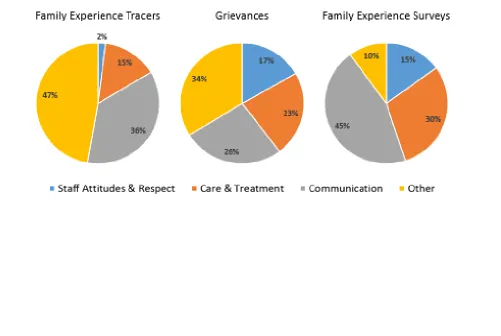
Children’s Mercy utilizes three primary sources of patient experience feedback including real-time family experience surveys administered upon discharge, patient advocate issues and grievances, and Family Experience Tracers. In evaluation of these three datasets, common themes of staff attitudes and respect, care and treatment, and
communication consistently emerge. These three categories regularly represent over half of the concerns raised by patients and families regardless of the method of collection or care setting (Figure 1).
Family experience surveys yield quantitative results that allow the organization to prioritize improvements yet are limited in their ability to provide tactical insights. The Family Experience Tracer data complements survey results with descriptive, in-depth explanations of the care
experience providing CM teams the ability to generate patient- and family-centered solutions. In conducting Family Experience Tracers, the role of the PFA provides a bridge of understanding between the complex system of providing clinical care and the expectations of the patient and family. Many families express appreciation for the opportunity to speak directly with a peer and have their experience and suggestions documented. Feedback from Family Experience Tracers led to the following
improvements at CM:
• Lengthy third available appointment times and quantitative survey results revealed timely access to care and treatment was a barrier identified by many patients and families. Family Experience Tracers affirmed several families not only struggled to schedule and attend appointments during traditional timeframes due to work and school commitments, but also voiced concerns about the long
appointments they encountered once they came to a visit. Pointed questions in Family Experience Tracers yielded insight that expanded appointment times would be helpful. In order to meet this need, CM added evening and weekend appointment times in outpatient specialty clinics and worked to improve clinic flow implementing Lean methods and
strategies. Review of family experience survey results yielded a statistically significant improvement of 3.0% in the top box response with nearly 33,000 respondents in a six-month period when families were asked to rate the timeliness of being seen in ambulatory clinics.
• During Family Experience Tracers, perceptions of communication are explored between families and practitioners, as well as amongst health care providers. These discussions pinpointed a
knowledge gap in the family’s understanding of who was in charge of their child’s care. To increase communication and properly identify the members of the health care team, a color-coded
communication board was co-designed by staff and PFAs for all emergency and inpatient rooms. The boards list the names and roles of each member of the team and clearly identify the attending physician and nurse for the day. During family centered rounds, the clinical team is responsible for updating the content including the care plan, daily activities, and other essential information. To strengthen two-way communication, color coded squares invite the family to add questions for the team, personal
information about their child, and contact information. Continuous audits are conducted to ensure consistent use and completion of the communication board, and Family Experience Tracer conversations often reference the board to assess patient and family engagement.
• Pain and discomfort are commonly discussed topics in Family Experience Tracers. As a part of the standard conversation guide, the PFA prompts the family to clarify if their child has experienced pain throughout their inpatient visit or in their ambulatory appointment. If a family reports that their child has experienced pain or discomfort, the PFA will ask the family to elaborate. In review of several documented tracers, there was an emerging trend regarding needle sticks and the start of IV lines. Based on recommendations from families, CM deployed the Comfort Promise. Several
interventions, including the use of topical analgesics and j-tips, were established as standard practice to ensure pain, as well as stress and anxiety, were reduced with needle sticks. Family members were involved in the phased roll out of this program and were integral partners in providing feedback regarding the realities of managing fear and concern in their children. Family experience survey results show this program has been effective. Families are asked to rate staff in their ability to ease their child's discomfort. This particular measure shows a statistically significant improvement of 5.7% in the top box response with over 2,400 respondents in the inpatient setting.
Limitations
While the data received from Family Experience Tracers is descriptive and in-depth, the number of tracers completed is limited because of the time commitment to talk with patients and families, observe the environment, document findings, and distribute information. A conversation can range from fifteen minutes to several hours, depending on the response of the patient and family.
Accessibility to the opinions and viewpoints of non-English speaking families is limited due to a language barrier. In the past, Family Experience Tracers were conducted by a PFA who utilized an interpreter, and families appeared to be reluctant to share detailed
feedback. CM recently recruited PFAs who speak Spanish as their primary language to conduct tracers. The recognition of language and culture allows the
establishment of a peer relationship between the PFA and family. This relationship creates an immense
It is critical to acknowledge the data collected is qualitative in nature and represents the single viewpoint of the individual patient and family. Qualitative information provided by tracers must be combined with feedback from other sources and balanced with the organization’s business objectives to determine the most effective course of action.
The formalized documentation process utilized at CM is limited by the Patient Feedback module provided by RL Solutions. Software programs like RL Solutions require a financial investment. Additional systems may be developed and utilized by other organizations to track, trend, and share tracer information.
Discussion and Conclusion
Children’s Mercy utilizes PFAs as the primary resource to conduct Family Experience Tracers. The use of a seasoned parent who is perceived as a peer by the family creates an environment of mutual understanding. The PFA can provide empathy regarding the topics discussed, offer informal support when needed, and reassure the family that information shared will not negatively affect their child’s care. The PFA is able to notice opportunities to improve patient and family experiences while also validating current policies and practices.
During tracers, families not only highlight areas of opportunity, but also validate positive and intended behaviors and processes. The small sample of in-depth insights provides detailed information that cannot come from a standardized family experience survey. CM acknowledges the two datasets are most meaningful when used in tandem, are sent to the appropriate leadership, and used to influence patient- and family-centered
performance improvement.
It is also important to recognize that families will discuss what is most important to them. The Patient and Family Engagement Department learned to adjust from an interview-style discussion to a loosely guided conversation, empowering the family to share stories and experiences most relevant to them. Families will share information regarding the current care experience but may also describe previous encounters. The PFA should remain open minded to learn about past experiences and the influence this has on current perceptions and must be comfortable with natural deviations from the prescribed question set.
The Patient and Family Engagement Department recognizes some suggestions provided by patients and families require extensive redesign in order to follow through. It is important to assess constructive criticisms to determine the validity and subsequent course of action.
Oftentimes, a unique account of a certain experience can be documented, reviewed, and combined with other experiences at a future date to build a larger justification to implement change.
Future considerations for the Family Experience Tracer program include expansion to incorporate the staff voice, recruiting additional PFAs and FTEs to support the program, and establish further accountability in acting on feedback. CM is beginning to explore the potential to share tracer data across the health system but remains cautious as the dataset is not statistically significant and may not be representative of the entire patient population. Organizations aspiring to implement a tracer program should engage executive leadership to promote buy-in and accountability for the actionable feedback. Leadership support ensures the appropriate systems and accountability structures are in place as well as alignment with the organization’s strategic plan. Consider starting with a small group or project to design the process of conducting guided interviews with patients and families, establishing a plan for documenting and disseminating information, and recording the results. A small group or project provides an organization the opportunity to test the program and make modifications to ensure it meets the needs and goals of all stakeholders.
While the quantity of Family Experience Tracers may be small, the rich information is often incredibly powerful. This practice allows institutions to design experiences as defined and desired by the patient and family and also prevents rework due to missed expectations.
References
1. The Joint Commission (2016). Topic library item: Facts about tracer methodology. Retrieved from: https://www.jointcommission.org/facts_about_the_t racer_methodology/
Appendix A
Appendix B
Inpatient Family Experience Tracer
• Coming to CM
o Can you tell me a little bit about why your child is here?
o What was it like getting to your room?
• Communication
o Tell me how you were included in shift change at the bedside. Do you feel confident and comfortable
that nurses are sharing all of the important information about your child? o In what ways did you participate in rounds this morning?
o Can you tell me how our teams communicate about your child and include you in making decisions about
your child’s plan of care or treatment? • Medications
o How do the nurses and other staff involve you when they give medicine to your child?
o Has someone talked to you about the importance of your child’s ID band?
o Where is your child’s ID band?
o Before giving your child medications, did the nurse check your child’s ID band?
• Pain
o How well has the hospital staff done everything they can to help when your child is in pain? What do you
feel is the most important thing we can do when your child is in pain? • Going Home
o How are you being prepared to care for your child at home?
ED to Inpatient Family Experience Tracer
• Coming to CM
o Can you tell me a little bit about why you brought your child to the Emergency Department?
o Tell me about your experience in the Emergency Department.
o Tell me about your experience being moved from the Emergency Department to this room.
o Our doctors and nurses in the Emergency Department are on a different team than the doctors and
nurses on this inpatient unit. How did the transition between our care teams feel? How was the plan of care explained to you?
• Communication
o Tell me how you were included in shift change at the bedside. Do you feel confident and
comfortable that nurses are sharing all of the important information about your child? o In what ways did you participate in rounds this morning?
o Can you tell me how our teams communicate about your child and include you in making decisions
about your child’s plan of care or treatment? • Medications
o How do the nurses and other staff involve you when they give medicine to your child?
o Has someone talked to you about the importance of your child’s ID band?
o Where is your child’s ID band?
o Before giving your child medications, did the nurse check your child’s ID band?
• Pain
o How well has the hospital staff done everything they can to help when your child is in pain? What do
you feel is the most important thing we can do when your child is in pain? • Going Home
o How are you being prepared to care for your child at home?
Appendix C
Perioperative Services Time Study
Child's Name: _______________________________ Parent/Guardian:
Date: __________________
TIME ACTION NOTES
Arrival at CM
Security check-in
Arrival at Same Day Surgery
Patient registration completed
Patient roomed
RN
Surgeon
Anesthesiologist
Child taken to surgery
Parents check-in waiting room
Phone calls/Updates from OR
Reunited with child (where?)
Discharged from Same Day Surgery
Appendix D
Field Name Conditions Content Notes
SECTION: Person Affected (patient)
Last Name Required, HL7-linked Patient’s last name
First Name Required, HL7-linked Patient’s first name
Middle Name HL7-linked Patient’s middle name
MRN HL7-look up Patient’s medical record number
Sex HL7-linked Patient’s gender
Race HL7-linked Patient’s race
DOB HL7-linked Patient’s date of birth
Age Auto-calculates Patient’s age at current time
Street1 HL7-linked Patient’s street address 1
Street2 HL7-linked Patient’s street address 2
City HL7-linked Patient’s city
State HL7-linked Patient’s state
ZIP HL7-linked Patient’s zip code
Country Auto-populates = United States, dropdown available to modify Patient’s country
Email HL7-linked Patient’s email
Inpatient Rm + Phone Open text box Patient’s hospital room and phone
Phone HL7-linked Patient’s phone
Alternate Phone Open text box Patient’s alternate phone
Account Number HL7-linked Patient’s account number for encounter
Patient Payer Source HL7-linked Patient’s primary payer source
SECTION: Communicated by (parent/guardian/family member)
Last Name Required Parent/Family last name
First Name Required Parent/Family first name
Street 1 Open text box Parent/Family street 1
Street 2 Open text box Parent/Family street 2
City Open text box Parent/Family city
State Open text box Parent/Family state
ZIP Open text box Parent/Family zip
Country Auto-populates = United States, dropdown available to modify Parent/Family country
Email Open text box Parent/Family email
Phone Open text box Parent/Family phone
Alternate Phone Open text box Parent/Family alternate phone
Interpreter Required Yes/No Parent/Family requiring interpreter
Interpreter Language If previous is yes, dropdown for language Parent/Family language required Feedback Details
Entered Date Required, Auto-populates to today Date tracer entered in system Entered Time Required, Auto-populates to current time Time tracer entered in system Entered By Auto-populates to current user Staff entering tracer in system
Method Required, single-select pick list Delivery of family feedback (e-mail, social media, phone call, letter, tracer inpatient, tracer outpatient, etc.)
File Owner Required, single-select employee lookup Staff person managing tracer follow up (FCC or PX staff)
Referral Source Single-select pick list Type of staff person who referred FCC/PX for tracer (MD, Nurse, QI Team, etc.) if applicable
Appendix D (cont’d.)
SECTION: Patient Experience Tracer (This form is used in tandem with grievance file management. Tracer Fields do not appear until file is “Submitted” once previous fields complete AND Method = Tracer – Inpatient or Tracer – Outpatient)
Open text box Parent feedback regarding why patient is in the hospital/clinic and arriving to hospital/clinic
Tracer – Communication Open text box Parent feedback around communication with and amongst staff
Tracer – Medications Open text box Parent feedback around medication administration
Tracer – Importance of ID Band
Conditional, only appears if Method = Tracer – Inpatient, single-item pick list (Yes/No)
NPSG #1 real-time check, has parent been taught importance of ID band?
Tracer – Location of ID
Band Conditional, only appears if Method = Tracer – Inpatient, open text box NPSG #1 real-time check, observation, note where ID band is on patient
Tracer – Check ID Band Conditional, only appears if Method = Tracer – Inpatient, single-item pick list (Always, Usually, Sometimes, No)
NPSG #1 real-time check, ask parent how often they feel staff are checking ID band before giving meds, etc.
Tracer – Pain Open text box Parent feedback regarding pain, interventions, and effectiveness
Tracer – Going Home Open text box Parent feedback regarding discharge preparations
Tracer – Anything to
Improve Open text box Parent feedback regarding final tracer question anything to improve – Tracer – Additional
Information Open text box Parent feedback regarding final tracer question anything to improve – Issues List – A function pre-built in RL Solutions, multiple “issues” can be added to list in one file
Classification Required, single-select pick list Denotes issue, commendation, grievance, etc. Tracers = issue or commendation
Incident Date Date box Date issue/commendation occurred
Incident Time Time box Time issue/commendation occurred
Description Open text box Description of issue/commendation
Issue About Single-select pick list (Location, Person) Defines if issue/commendation is about an individual person or a unit/department
Group Involved Conditional, only appears if Issue About = Person, Single-select pick list Further defines the type of person involved
Site Required, single-select pick list Defines the state where issue/commendation occurred (for CM, = MO or KS)
Building Required, single-select pick list Defines the location where issue/commendation occurred (for CM, defines the specific building)
Department Required, single-select pick list Defines the department where issue/commendation occurred (for CM, defines the specific clinical unit)
Pediatric Team Single-select pick list Defines the medical team where issue/commendation occurred (for CM, defines the specific building)
Appendix D (cont’d.)
Attachments – ability to add any attached documentation useful to the tracer
Follow-up List – A function pre-built in RL Solutions to manage resolution, multiple “follow-ups” can be added to a file
Date Date box Date follow up task occurred
Type Single-select pick list Defines the goal of the communication (At CM = Request for Review, Review from Staff, Referred to Staff, etc.)
Follow-Up Done By Auto-populates to current user Person entering follow up information
Follow Up Method Single-select pick list Defines the method of communication (At CM = telephone call, email, etc.)
Follow Up Time Time box Time the communication occurred
Follow Up From Open text box Defines who communication is from
Follow Up To Open text box Defines who communication is to
Follow Up Description Open text box Summary of communication (emails often copy/pasted) Resolution and Outcomes
Resolution Date Required Date file is closed
Issue Status Single-select pick list (Resolved/Not Resolved)
Resolved = if all parent concerns are resolved or are sent to appropriate parties for resolution, Not Resolved = unable to make progress or resolution on parent concern
Satisfaction Level Required, single-select pick list (Satisfied, Neutral, Dissatisfied,
Very Dissatisfied, Unknown) Parent/family satisfaction with resolutions made