6720 RP-HPLC METHOD DEVELOPMENT AND VALIDATION FOR THE
QUANTIFICATION OF SELECTED ANTI RETROVIRAL DRUG
Muchu Balaji * , K.Thejomoorthy, Sreenivasa prasanna
Malineni Lakshmaiah College of Pharmacy, Kanumalla , Singarayakonda, Prakasam -523101, Andhra Pradesh, India
ARTICLE INFO ABSTRACT
Key Words
RP-HPLC Tenofovir disproxil
Validation
The Present work is aimed to develop, simple, fast, rapid, accurate, efficient and re producible by RP-HPLC method for the analysis of Tenofovir Disoproxil Fumarate. The RP-HPLC Isocratic method was developed by utilizing Phenomenex luna C18 column (250×4.6mm, 5µ) and using mobile
phase was Methanol: Water (0.1%OPA) in the ratio of 55:45%v/v. The retention time of Tenofovir disproxil fumarate was found to be 4.7 minutes. The linearity concentration was obtained from 10-60µg/ml and correlation coefficient was found to be 0.9995. Considering all the results of validation parameters simplicity of the method and the cost effectiveness of the overall procedure, it is possible to conclude that the developed method can be suitable for the regular quality control determination of Tenofovir disproxil fumarate in bulk as well as pharmaceutical dosage form.
Key words: Tenofovir disproxil fumarate, Isocratic, RP-HPLC, Mobile phase, Validation
INTRODUCTION
Tenofovir belongs to a class of antiretroviral drugs known as nucleotide analog reverse transcriptase inhibitors (NtRTIs), which block reverse transcriptase, an enzyme necessary for viral production in HIV-infected individuals. This enables the management of HIV viral load through decreased viral replication. It is indicated in combination with other antiretroviral agents for the management of HIV-1 infection in adults and pediatric patients 2 years of age and older [1,2]. It is also used for the clinical
management of chronic hepatitis B in adults and pediatric patients 12 years of age and older. From the literature survey reveals that few analytical methods have been reported for the analysis of the Tenofovir Disoproxil Fumarate by Spectroscopy and RP-HPLC
[59]. The reported methods shown
quantification of Tenofovir Disoproxil Fumarate was expensive. Hence we felt that need of new analytical method development
for the estimation of Tenofovir Disoproxil Fumarate in less time of analysis for the determination of this drug in API and pharmaceutical dosage form. The developed method will be validated according to ICH guidelines [10].
MATERIALS AND METHODS Materials:
API of Tenofovir disproxil fumarate gift sample was procured from Reddy’s labs, Hyderabad. HPLC grade methanol and water were purchased from Merck labs, Mumbai, India. AR grade ortho phosphoric acid was obtained from SD fine chemicals ltd, Mumbai.
Instruments and specifications:
Ultra-fast liquid chromatographic system was made up of shimadzu, Japan, it proving software was LC solutions -20AD along with PDA detector. Vibra shinko denshi co.ltd manufactured analytical balance and ultra sonicator was
Journal of Global Trends in Pharmaceutical Sciences
6721
manufactured by Spincotech Pvt.,Ltd also used for the determination of Tenofovir Disoproxil Fumarate.
Preparation of mobile phase:
Preparation of mobile phase by using Methanol and water in the ratio of 55:45 v/v. Mobile phase PH was adjusted with 0.1% OPA (PH 4). The mobile phase was filtered through 0.45 µ Nyoln 66 (N66) 47 mm membrane filter paper. After filtration it was ultra sonicated for 20 minute on ultra sonicator.
Preparation of stock solution of Tenofovir Disoproxil Fumarate:
API of Tenofovir Disoproxil Fumarate (10mg) accurately weighed and transferred to 10 ml volumetric flask, dissolved in sufficient quantity of methanol and then diluted to the mark with mobile phase. The solution contains 1000ug/ml of Tenofovir Disoproxil Fumarate.The solution was filtered through 0.45 um Nylon 66 (N66) 47 mm membrane filter paper and firs few drops of filtrate were discarded.
Preparation of sample solution:
Take 25 mg equivalent tablet powder of Tenofovir and dilute with 25 ml of mobile phase up to the mark. Pipette out 0.4 ml of this solution in the 10 ml volumetric flask and make the volume with mobile phase, Sonicate it for 10 minutes. Filter the solution through Whatmann filter paper no. 41. This solution was used as sample solution.20 µL of the blank, standard and sample was injected in to the chromatographic system and areas for the Tenofovir Disoproxil Fumarate the peaks were used for calculating the % assay by using the formulae.
Method development:
The chromatographic method development for the Tenofovir Disoproxil Fumarate was optimized by several trails for various parameters as different column, flow rate and mobile phase; finally the following chromatographic method was selected for the separation and quantification of Tenofovir Disoproxil Fumarate in API and pharmaceutical dosage form by RP-HPLC method.
Optimized Chromatographic conditions: Column :Phenomenex Luna
C18 column 250x4.6mm; 5µm Mobile phase :Methanol:Water
(0.1%OPA) (55:45%V/V) Detection
wavelength
:295 nm
Flow rate :1.0 ml/min Injection volume :20µl
Column temperature
:Ambient
Run time :12 min Retention time :4.7 min Elution :Isocratic System Suitability: System suitability is a integral part of many analytical procedures and the various parameters like theoretical plates, efficiency and tailing factor were found to be with in the limit. Then selected system was precise. Tailing factor for the peaks due to Tenofovir Disoproxil Fumarate in standard solution should not be more than 1.5. Theoritical plates for the Tenofovir Disoproxil Fumarate peaks in standard solution should not be less than 1.5.
Method Validation
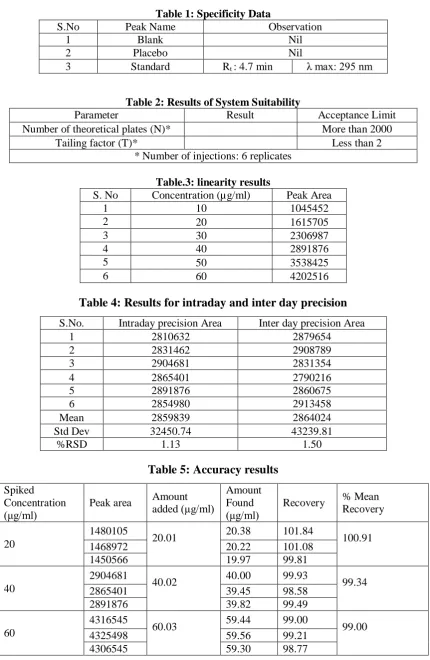
Specificity: In the case of assay, demonstration of assay specificity is required to show that the procedure is unaffected by the impurities or exipients. Specificity of an analytical method indicates that the analytical method is its able to measure accurately and specifically the analyte of interest without any interference from blank.
Linearity: API of Tenofovir Disoproxil Fumarate (10mg) accurately weighed and transferred to 10 ml volumetric flask, dissolved in sufficient quantity of methanol and then diluted to the mark with mobile phase. Further respected dilutions were prepared from stock solution, and then obtained linearity concentration in the range of 10-60µg/ml. Correlation coefficient should be not less than 0.999.
6722
Table 1: Specificity Data
Table 2: Results of System Suitability
Parameter Result Acceptance Limit
Number of theoretical plates (N)* More than 2000
Tailing factor (T)* Less than 2
* Number of injections: 6 replicates
Table.3: linearity results
S. No Concentration (µg/ml) Peak Area
1 10 1045452
2 20 1615705
3 30 2306987
4 40 2891876
5 50 3538425
6 60 4202516
Table 4: Results for intraday and inter day precision
S.No. Intraday precision Area Inter day precision Area
1 2810632 2879654
2 2831462 2908789
3 2904681 2831354
4 2865401 2790216
5 2891876 2860675
6 2854980 2913458
Mean 2859839 2864024
Std Dev 32450.74 43239.81
%RSD 1.13 1.50
Table 5: Accuracy results
Spiked Concentration (μg/ml)
Peak area Amount added (μg/ml)
Amount Found (μg/ml)
Recovery % Mean Recovery
20
1480105
20.01 20.38 101.84 100.91
1468972 20.22 101.08
1450566 19.97 99.81
40
2904681
40.02 40.00 99.93 99.34
2865401 39.45 98.58
2891876 39.82 99.49
60
4316545
60.03 59.44 99.00 99.00
4325498 59.56 99.21
4306545 59.30 98.77
S.No Peak Name Observation
1 Blank Nil
2 Placebo Nil
6723 Table 6(a): Change of Flow rate (± 0.1mL)
S.No Robust condition 0.9ml/min 1ml/min 1.1ml/min
1
Flow Rate
2906452 2860675 2905465
2 2865620 2913458 2860654
3 2840645 2887067 2850498
4 Mean 2870905.66 2887067 2872206
5 Std dev 27124.33 21548.57 23880.59
6 % RSD 0.94 0.74 0.83
Table 6(b): Change in Temperature (± 5oC)
S.No Robust
condition 30
o
C 35 oC 40 oC
1
Temperature
2810632 2904681 2810632
2 2831462 2865401 2831462
3 2904681 2891876 2880654
4 Mean 2848925 2887319 2840916
5 Std dev 40332.12 16356.49 29357.61
6 % RSD 1.41 0.56 1.03
Fig.1: Chemical structure of Tenofovir Disoproxil Fumarate
Fig.2: Optimized chromatogram of Tenofovir Disoproxil Fumarate
6724
Accuracy was performed in three different three concentration levels and injected three times. The standard solutions of accuracy 50%, 100% and 150% were injected in to chromatographic system. Calculate the amount found and amount added for Tenofovir Disoproxil Fumarate and calculate the individual % recovery and mean % recovery values. % Recovery at each spike level shall be not less than 98.0 and not more than 102.0.
Precision: The standard solution was injected for five times and measured the area for all five injections in HPLC. The % RSD for the area of five replicate injections was found to be within the specified limits. Robustness: As Part of the robustness, deliberate change in the flow rate, mobile phase composition was made to evaluate the impact on the method.
RESULTS AND DISCUSSION
Specificity: There is no interference of mobile phase, and placebo with the analyte peak and also the peak purity of analyte peak which indicate that the method is specific for the analysis of analytes in their dosage form. The data was shown in table 1.
System suitability: System suitability test was an integral part of method development and has been used to ensure adequate performance of the chromatographic system. The results are given in table 2.
Linearity: Each solution was injected in to the chromatographic system and peak area was measured. Plot a graph of peak area versus concentration (on x –axis concentration and on y axis peak area) and the correlation was calculated. The results were shown in table 3.
Accuracy: Accuracy of the method was determined by Recovery studies. To the formulation (pre analyzed sample), the reference standards of the drugs were added at the level of 50%, 100%, 150%. The data was shown in table 5.
Robustness: The flow rate was varied at ± 10%. Standard solution 40 µg/ml of Tenofovir Disoproxil Fumarate was prepared and analysed using the varied flow rates along with method flow rate. The Temperature was varied (± 5oC) Standard
solution 40 µg/ml of Tenofovir Disoproxil Fumarate was prepared and analysed using the varied flow rates along with method flow rate. Results were shown in table 6a & 6b. DISCUSSION
A new method was established for estimation of Tenofovir Disoproxil Fumarate by RP-HPLC method. The chromatographic conditions were successfully developed for the separation of Tenofovir Disoproxil Fumarate bu using Phenomenex Luna C18
column 250x4.6mm 5µm, flow rate was 1.0 ml/min, mobile phase ratio was (55:45%v/v) Methanol: Water (0.1%OPA) ,detection wavelength was 295 nm. The retention time was found to be 4.7 mins. The % purity of Tenofovir Disoproxil Fumarate was found to be 100.443% respectively. The system suitability parameters for Tenofovir Disoproxil Fumarate such as theoretical plates and tailing factor were found to be more than 2000, the resolution was found to be less than 2. The analytical method was validated according to ICH guidelines (ICH, Q2 (R1). The linearity study for Tenofovir
Disoproxil Fumarate was found in concentration range of 10µg-60µg/ml and correlation coefficient (r2) was found to be 0.999, % recovery was found to be 99.75%, % RSD for repeatability was 1.134, % RSD for intermediate precision was 1.509 respectively.
CONCLUSION
The present research work concluded that developed RP-HPLC method was found to be simple, sensitive, precise and reproducible. Hence the suggested RP-HPLC method can be used for routine analysis of Tenofovir Disoproxil Fumarate in API and pharmaceutical dosage form.
REFERENCES
1. https://www.drugbank.ca/drugs/DB0 0300
2. Breaux J and Jones K, understanding and implementing efficient analytical methods development and validation. J pharma tech 2003; 5: 110- 114.
6725
Sankar, Swapan Kumar Moita, Sudam Chandra Si, Development and Validation of Spectrophotometric Method for Determination of Emtricitabine and Tenofovir Disoproxil Fumarate in Bulk and Tablet dosage form. Int J PharmTech Res 2011; 3: 1874-1882. 4. Rajesh Sharma, Pooja Gupta, A
Validated RP- HPLC Method for Simultaneous Estimation of Emtricitabine and Tenofovir Disoproxil Fumarate in a Tablet Dosage Form. Eur j Anal Chem 2009; 4(3):276-284.
5. Shirkhedkar Atul A, Bhirud Charushila H, Surana Sanjay J,
Application of
UVSpectrophotometric methods for Estimation of Tenofovir Disoproxil Fumarate in tablets. Pak. J. Pharm. Sci 2009; 22: 27-29.
6. Manish Yadav, Puran Singhal,Sailendra Goswami, Umesh C Pande, Mallika Sanyal, Pranav S, Shrivastav. Selective Determination of Antiretroviral agents Tenofovir, Emtricitabine, and Lamivudine in human plasma by a LC-MS-MS method for a Bioequivalence study in healthy Indian Subjects. Jof chrom sci 2010; 48: 704-13.
7. Narendra Devanaboyina, Satyanarayana T, Ganga Rao B, HPLC Method Development and Validation for Simultaneous Estimation of Tenofovir and Emtricitabine in combined pharmaceutical dosage form. IntJof Res Pharmaand Biomed Sci 2012: 3(1): 361-367.
8. P.Chandra, A.S.Rathore, L.Sathiyanarayanan, K.R.Mahadik, Application of High- Performance Thin-Layer Chromatographic method for the Simultaneous Determination of Lamivudine and Tenofovir Disoproxil Fumarate in pharmaceutical dosage form. J. Chil. Chem. Soc 2011; 56: 702-705. 9. R.Sharma, K.Mehta, Simultaneous
Spectrophotometric Estimation of
Tenofovir Disoproxil Fumarate and Lamivudine in three component tablet formulation containing Efavirenz. IndJof PharmaSci 2010; 72(4): 527-530.
10. ICH Q 2A, Validation of analytical methods, definitions and terminology, ICH Harmonized tripartite guideline, (1999).