Available Online at www.ijpret.com
418
INTERNATIONAL JOURNAL OF PURE AND
APPLIED RESEARCH IN ENGINEERING AND
TECHNOLOGY
A PATH FOR HORIZING YOUR INNOVATIVE WORK
SOFTWARE DEFINED NETWORKING – A NEW ARCHETYPE
PARNAL P. PAWADE1, ANIKET A. KATHALKAR2, SNEHA R. SONTAKKE3
1. Information Technology Department, Faculty of Engineering, P. R. Patil C.O.E.T., Amravati, India. 2. Electronics and Telecommunication Department, Sinhgad College of Engineering, UOP, India. 3. Computer Science & Engineering Department, Faculty of Engineering, P. R. Patil C.O.E.T.,
Amravati, India.
Accepted Date: 27/02/2014 ; Published Date: 01/05/2014
\
Abstract:For the past year, Software Defined Networking (SDN) has been the buzz of the networking world. But in many ways, networking has always been defined by software. SDN is fast emerging as a significant building block for next-generation carrier services and networks. SDN is an architectural concept that encompasses the programmability of multiple network layers including management, network services, control, forwarding and transport planes to optimize the use of network resources, increase network agility, unleash service innovation, accelerate service time-to-market, extract business intelligence and ultimately enable dynamic, service-driven virtual networks. Network devices support a standard programmable interface with a protocol like Open Flow so a heterogeneous network can be programmed in a unified manner. The network devices can be programmed by the SDN controller using the Open Flow protocol. Open Flow thus provides an open standards interface to vendor network devices. The API interfaces on the SDN controller integrate with cloud orchestration tools like Open Stack and enable SDN applications that deliver networks services (e.g., network virtualization, intrusion detection, load balancing). Application programmers can ignore the physical network topology and work on abstract topology.
Keywords: Software Defined Networking, Open Flow, Open Networking Foundation.
Corresponding Author: MR. PARNAL P. PAWADE
Access Online On:
www.ijpret.com
How to Cite This Article:
Parnal Pawade, IJPRET, 2014; Volume 2 (9): 418-423
Available Online at www.ijpret.com
419 INTRODUCTION
The topic of Software Defined Networking (SDN) has attracted a great deal of attention from service providers, enterprises, and industry associations. A true picture of SDN has yet to emerge, however, despite today’s enthusiastic expectations. Software Defined Networking (SDN) is an approach to computer networking which evolved from work done at UC Berkeley and Stanford University around 2008 [1]. SDN allows network administrators to manage network services through abstraction of lower level functionality. This is done by decoupling the system that makes decisions about where traffic is sent (the control plane) from the underlying systems that forward traffic to the selected destination (the data plane). As a result, enterprises and carriers gain unprecedented programmability, automation, and network control, enabling them to build highly scalable, flexible networks that readily adapt to changing business needs.
Software-Defined Networking (SDN) is an emerging architecture that is dynamic, manageable, cost-effective, and adaptable, making it ideal for the high-bandwidth, dynamic nature of today's applications.
Driving Need for New Network Paradigm
The explosion of mobile devices and content, server virtualization, and advent of cloud services are among the trends driving the networking industry to re-examine traditional network architectures. SDN addresses the fact that the static architecture of conventional networks is ill-suited to the dynamic computing and storage needs of today’s data centres, campuses, and carrier environments. The key features of driving need for new network paradigm includes:
Traffic patterns to change
Within the enterprise data centre, traffic patterns have changed significantly. At the same time, users are changing network traffic patterns as they push for access to corporate content and applications from any type of device (including their own), connecting from anywhere, at any time.
The “consumerization of IT”
The Bring Your Own Device (BYOD) trend requires networks that are both flexible and secure. IT is under pressure to accommodate these personal devices in a fine-grained manner while protecting corporate data and intellectual property and meeting compliance mandates.
Available Online at www.ijpret.com
420
Enterprises have enthusiastically embraced both public and private cloud services, resulting in unprecedented growth of these services. To add to the complexity, IT’s planning for cloud services must be done in an environment of increased security, compliance, and auditing requirements, along with business reorganizations, consolidations, and mergers that can change assumptions overnight.
“Mega data” means more bandwidth
Handling today’s “big data” or mega datasets requires massive parallel processing on thousands of servers, all of which need direct connections to each other. The rise of mega datasets is fuelling a constant demand for additional network capacity in the data centre.
MATERIALS & METHODS
Existing network infrastructures can respond to changing requirements for the management of traffic flows, providing differentiated QoS levels and security levels for individual flows, but the process can be very time-consuming if the enterprise network is large and/or involves network devices from multiple vendors. The network manager must configure each vendor's equipment separately, and adjust performance and security parameters on a per-session, per-application basis. In a large enterprise, every time a new virtual machine is brought up, it can take hours or even days for network managers to do the necessary reconfiguration [2].
This state of affairs has been compared to the mainframe era of computing [3]. In the era of the mainframe, applications, the operating system, and the hardware were vertically integrated and provided by a single vendor. All of these ingredients were proprietary and closed, leading to slow innovation. Today, most computer platforms use the x86 instruction set, and a variety of operating systems (Windows, Linux, or Mac OS) run on top of the hardware. The OS provides APIs that enable outside providers to develop applications, leading to rapid innovation and deployment. In a similar fashion, commercial networking devices have proprietary features and specialized control planes and hardware, all vertically integrated on the switch. As will be seen, the SDN architecture and the OpenFlow standard provide an open architecture in which control functions are separated from the network device and placed in accessible control servers. This setup enables the underlying infrastructure to be abstracted for applications and network services, enabling the network to be treated as a logical entity.
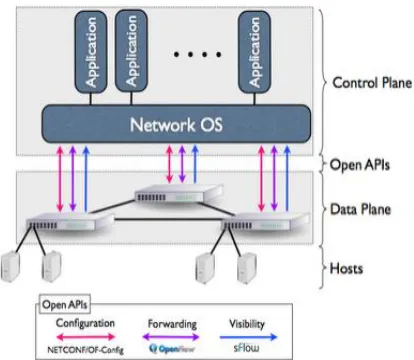
Architecture of Software Defined Networking
Available Online at www.ijpret.com
421 Figure 1: SDN Architecture
switches connected together to form a network. However, instead of relying on proprietary software running on each switch to control its forwarding behaviour, switches in SDN architecture are controlled by a Network OS (NOS) that interacts with the switches to provide an abstract model of the network topology to Applications running on the NOS. Applications can adapt the network behaviour to suite specialized requirements, for example, providing network virtualization services that allow multiple logical networks to share a single physical network - similar to the way in which a hypervisor allows multiple virtual machines to share a single physical machine [4].
Open Flow
Open Flow is a communications protocol that gives access to the forwarding plane of a network switch or router over the network [5]. It is added as a feature to commercial Ethernet switches, routers and wireless access points – and provides a standardized hook to allow researchers to run experiments, without requiring vendors to expose the internal workings of their network devices. It is currently being implemented by major vendors, with Open Flow-enabled switches now commercially available.
Available Online at www.ijpret.com
422
plane that has led to the characterization of today’s networking devices as monolithic, closed, and mainframe-like. A protocol like OpenFlow is needed to move network control out of proprietary network switches and into control software that's open source and locally managed [2].
DISCUSSION
Architecturally, a SDN solution consists of a SDN controller and a separate packet forwarding function which remains in the individual network elements (switches or routers). An orchestration layer is used to pass applications, requirements or policies to the network controller. Much of SDN's business benefit is derived from the orchestration layer's use of automated workflows, provisioning and change management processes. A virtualization layer is used to express network transport requirements in terms of each application's functional requirements, rather than in technical or hardware specific terms. This abstraction of the applications' networking requirements makes it easier to optimally configure the physical network to minimize cost while assuring fulfilment of each application's networking requirements. The use cases flesh out these concepts [8].
Use Cases
The first use case is the hyper scale data centre, including those of giants such as Amazon (Nasdaq: AMZN), Google (Nasdaq: GOOG) and Facebook (Nasdaq: FB). The scale of these data centres creates extremely difficult management and operational challenges. SDN simplifies the problem by allowing VMs (Virtual Machines) to communicate with each other while being unaware of the underlying network. This significantly increases the ease with which VMs can be deployed and moved in the data centre, and lowers cost by improving asset utilization and reducing operations expense.
Campus access networks can be strengthened by applying a SDN controller across wired and wireless LANs. WLAN controllers provide the precedent for this use case. They were introduced to provide security and policy controls to wireless LANs, which were viewed as inherently less secure than wired LANs. However, modern WLAN controllers now provide better security and access control to wireless LANs than is commonly found on wired LANs. A SDN controller can be used to provide uniform security and access controls across all wired and wireless access points.
CONCLUSION
Available Online at www.ijpret.com
423
responsive to dynamic business and institutional needs by coupling applications with network control. Finally, SDN gives IT teams more agility, because they can quickly customize network behaviour for emergent business needs. The increasing velocity of application development will continue to drive IT organizations to deploy technologies that allow them to scale and respond to rapidly changing demands.
REFERENCES
1. Prof. Scott Shenker - Gentle Introduction to Software-Defined Networking Technion lecture" . YouTube. 2012-06-26.
2. Open Networking Foundation, "Software-Defined Networking: The New Norm for Networks," ONF White Paper, April 12, 2012.
3. Dell, Inc., "Software Defined Networking: A Dell Point of View," Dell White Paper, October 2012.
4. http://blog.sflow.com/2012/05/software-defined-networking.html
5. Nick McKeown et al. (April 2008). "Open Flow: Enabling innovation in campus networks". ACM Communications Review.
6. Kate Greene (March/April 2009). "TR10: Software-Defined Networking". MIT Technology Review. Retrieved October 7, 2011.
7. "Open Networking Foundation: SDN Defined". Open Networking Foundation.