Research Article ISSN: 2319-507X Vipula Wajgade, IJPRET, 2013; Volume 1(8): 228-238 IJPRET
Available Online At www.ijpret.com
INTERNATIONAL JOURNAL OF PURE AND
APPLIED RESEARCH IN ENGINEERING AND
TECHNOLOGY
A PATH FOR HORIZING YOUR INNOVATIVE WORK
ENHANCING DATA SECURITY WITH ADVANCED DIGITAL IMAGE
STEGANOGRAPHY
VIPULA M.WAJGADE, NAGESH D. MATHARIA, Dr. SURESH KUMAR
1. M Tech Second Year CSE, Dept of Computer Science and Engineering, SGT Institute Of
Technology Institute Of Technology & Management, Gurgaon, India.
2. ME First Year IT, Dept of Info. Technology, PRMIT & R Badnera, Amravati, India
3. HOD, Dept of Computer Science and Engineering, SGT Institute Of Technology Institute
Of Technology & Management, Gurgaon, India.
Accepted Date:
27/02/2013
Publish Date:
01/04/2013
Keywords
Steganography,
Cryptography,
Least Significant Bit,
Watermarks
Corresponding Author
Mr. Vipula M. Wajgade
Abstract
Available Online At www.ijpret.com
I. INTRODUCTION
Steganography does not deal with
alteration of the structure of the secret
message or data that is to be hidden, but
hides it inside an image called as cover
image so that it cannot be seen. For
instance A message in a cipher text, might
be suspicion on the part of the recipient but
a “hidden or invisible” message created
using steganographic methods will not. So it
can be stated in other words that the
steganography prevents an unintended
recipient from detecting or from suspecting
that the data exists in cover data.
A. First Steganographic Methods:
The Ancient Chinese used to write
messages on fine silk, after crunching into a
tiny ball it was covered with wax. The
message were carried with messenger
which is first swallowed as the ball of wax,
the Italian scientist developed another
method in sixteenth century, Giovanni
Porta described another approach how to
conceal a message with a hard-boiled egg
using an ink made up from a mixture of
one ounce of alum and a vinegar this
mixture then using ink to write on the shell.
As a result the ink penetrated the porous
shell, and the message on the surface of the
hardened egg albumen appears which could
be read only when the shell was removed.
Various methods of Special “inks” were
essential steganographic tools even during
Second World War. During Second World
War a new approach of data hiding was
invented that was developed to shrink
photographically a page of text into a dot
which was shorter diameter less than one
millimeter , and used to hide the microdot
in an apparently innocuous letter.
A new and general model of a cryptographic
system was then emerged, which consists
of following [1] [7]:
1. Cover text (cover-data - cover-object)
which is simply an original unaltered
message.
2. The Embedding process in which the
sender tries for hiding of the message by
embedding it into a cover text which is
randomly chosen text, which is done usually
using a key, which results in a stego-text
(stego-data or stego-object). The
Research Article ISSN: 2319-507X Vipula Wajgade, IJPRET, 2013; Volume 1(8): 228-238 IJPRET
Available Online At www.ijpret.com using the mapping EP:CV ´ KY ´ MG ® CV,
where CV is the set of possible cover- and
stego-texts, KY is the set of keys and MG is
the set of messages.
3.Stegotext (stego-data - stego-object)
which is the output of step 2.
4.Lastly the Recovering process (or also
called as extraction) in which the receiver,
will try to get the data, using the key only,
and but not the cover text.
We can describe this recovery process as
can be seen as mapping DE: CV ´ KY ® CV.
Security is required so that a third person
watching such a communication should not
be able to find out whether the sender is
active, and when will be sender remain
active, in the sense that he actually did
embedding a message in the cover -text.
That is in other words, stegotexts should be
indistinguishable from cover texts.
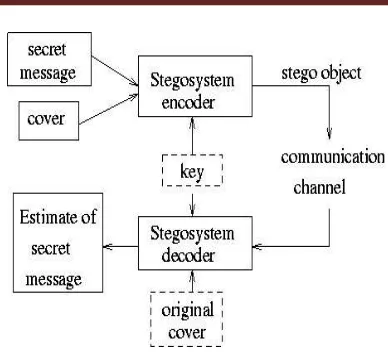
Figure 1 : Steganographic systems model
There are three basic types of
stegosystems[2]
1. Pure Stegosystems (Where no key is used
for data hiding.)
2. Secret-key Stegosystems (Where a secret
key is used for data)
3.Public-key Stegosystems(Where public
key is used for receiving and sending the
data.)
B. Digital Era of Steganography-Need for
More Secure and Robust Steganography.
Various aspects of secure data
Available Online At www.ijpret.com
unauthorized access of data and
eavesdropping. The main motivation behind
developing data hiding technique that is
digital image Steganography methods is
according to its uses in various
environments to communicate between its
members, as well as, it can also be used to
communicate between members of the
military or intelligence operatives or various
agents of the organisation to hide secret
messages or in the espionage field. The vital
goal of using the Steganography is to
disable or avoid drawing attention to the
transmission of hidden information from
sender to receiver [3]. If suspicion is raised,
then security of secret message must be
achieved this goal has been planned to
achieve the security, because if the hackers
is able to notice any change in the message
send by sender then this observer may try
to know the hidden information inside the
secret message being delivered.
The next evolution of image steganography
is the advanced system that consists of the
senders cover message, secret message,
secret key and embedding algorithm [4].
The cover message is the carrier of the
message and can be any format such as
image, video, audio, text, or some other
digital media. Next the secret message is
the data or the information which is needed
to be hidden in the appropriate digital
media. Hiding algorithm uses the secret key
usually to embed the message according to
algorithms. The embedding algorithm is
means by which secret information is
usually embedded in the cover message.
In the steganographic system sender must
select suitable message carrier i.e.
image,audio,text,video etc before the
hiding process, after suitable carrier he
must select the secret messages efficiently,
in some cases we need to set
authentication as well as the robust
password (which suppose to be known by
the receiver). The most suitable effective
and appropriate Steganography algorithm
must be then selected that should be able
to encode the message in more secure
technique [5] [6]. Then the sender may then
send the Stego file by means of the email or
chat-rooms or chatting, or by any other
latest techniques of communication. The
Stego file is the carried message with the
secret information. After receiving the
Research Article Vipula Wajgade, IJPRET, 2013; Volume 1(8
Available Online At www.ijpret.com decode the message using the suitable
extracting algorithm and with the same
password that is used by the sender while
sending the message. The Steganography
system scenario is shown in the Figure 2.
Suppress Message
Embedding Extracting
(Secret Key, (Secret Message)
Secret Message,
Cover Message)
Figure 2: Steganography Scenario
We can view the application of this example
as follows:
STEGO IMAGE?
SENDER RECEIVER
Research Article
Vipula Wajgade, IJPRET, 2013; Volume 1(8): 228-238
Available Online At www.ijpret.com decode the message using the suitable
extracting algorithm and with the same
password that is used by the sender while
sending the message. The Steganography
scenario is shown in the Figure 2.
Embedding Extracting
(Secret Message)
: Steganography Scenario
We can view the application of this example
Figure 3: Steganography Example (image)
As with modern era many carrier messages
formats can be used as an evolution in the
recent technologies, such as Te
video, audio and many others. The image
file carrier is the most commonly used and
popularly used for this purpose because of
the simplicity and it easy to send during the
communication between the sender and
receiver. The images are generally d
into three main types: binary images (Black
White), Gray scale images and Red
Blue (RGB) images. The binary image is
distinguished by one bit value per pixel
represented by 0 for black and 1 for white
pixels. While on the other hand next type
the gray scale images has 8 bits value per RECEIVER
ISSN: 2319-507X IJPRET
: Steganography Example (image)
As with modern era many carrier messages
formats can be used as an evolution in the
recent technologies, such as Text, Image,
video, audio and many others. The image
file carrier is the most commonly used and
popularly used for this purpose because of
the simplicity and it easy to send during the
communication between the sender and
receiver. The images are generally divided
into three main types: binary images (Black-
White), Gray scale images and
Red-Green-Blue (RGB) images. The binary image is
distinguished by one bit value per pixel
represented by 0 for black and 1 for white
pixels. While on the other hand next type
Available Online At www.ijpret.com pixel represent from 00000000 for black
and 11111111 for white pixels. The recent
and most common nowadays the RGB
image has 24 bits values per pixel represent
by (00000000, 00000000 and 00000000) for
black and (11111111, 1111111 and
11111111) for white pixels. The RGB image
is the most popular suitable because it
unable hiding of secret information easily as
it contains a lot of information with a bit
change in the image resolution which does
not affect the image quality and make the
message more robust and secure[8][9]. Due
to this quality of RGB images in this paper
we used the RGB images as a carrier
message to hide the secret messages by the
Least Significant Bit hiding method (LSB) as
well as the proposed method.
II. RELATED WORK
Many researchers have done tremendous
work on hiding data inside image using
Steganography techniques. The Existing
steganography methods is divided into
three main categories as, methods that
exploits image format, methods that
embeds in the spatial domain and methods
which are embedding in the frequency
domain. Most essentially, Image
Steganography is achieved by modifying the
image’s Least Significant Bits (LSBs) in such
a way that the carrier image remains intact
visually.
A. LSB Substitution
This is one of the simplest image
steganography methods based on the use
of LSB, and therefore the most vulnerable.
The LSB method consists of the embedding
process of the sequential substitution of
each Least Significant Bit (LSB-1) of the
image pixel for the bit message. Due to its
simplicity, this method LSB substitution can
camouflage a great volume of information.
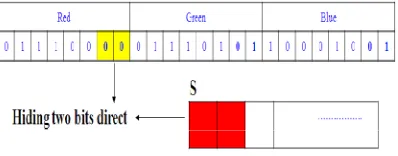
Figure 4: LSB Substitution
The technique used in LSB hiding technique
is to hide the secret message directly in the
least two significant bits in the image pixels,
Research Article ISSN: 2319-507X Vipula Wajgade, IJPRET, 2013; Volume 1(8): 228-238 IJPRET
Available Online At www.ijpret.com problem, which reduce the image quality
and also make the image easy to attack by
unauthorised users. As a result this method
is already has been attacked and broken by
attackers or unauthorised users observing
the network traffic. As a result a new
technique that able to make the secret
message more secure and to overcome the
resolution problem also to enhance the
quality of the image is proposed.
B. Other Methods
1. The sequential process or random
process of embedding in the spatial domain
can be achieved through altering the least
significant bits of the bytes of image pixel
values. The resultant process may be in a
sequential or in a randomised form. The
advantaged of using this algorithms based
on this method have a high payload; the
negative aspects are that the method is
fragile, prone to statistical attacks and
sometimes results in the visual attacks.
2. Apart from the spatial domain method
second type of method, the frequency
domain method has also been proposed,
which is mainly based on the embedding in
the coefficient in the frequency domain also
called as DCT or DWT (i.e., Discrete Cosine
Transformation (DCT), Discrete Wavelet
Transformation (DWT)). The positive aspect
of this type of technique is that it is more
robust with respect to common image
processing operations and lossy
compression [10] [11]. Another alternative
approach is the type of method which is
based on adaptive Steganography. This
adapts the message embedding technique
to the actual content and features of the
image. These methods have advantages
that it can avoid areas of uniform colour
and select pixels with large local standard
deviation. Another method called as Edge
embedding can also be used with the
Adaptive Steganography.
III. THE PROPOSED SYSTEM
The negative aspects of previous system
results in evolution of new technique. The
LSB hiding technique results in image
distortion, image resolution problem and
reduced image quality, hence more efficient
and secure system is proposed to enhance
quality of image and to provide data hiding.
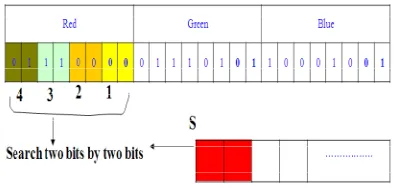
Available Online At www.ijpret.com values between secret message and image
pixels [12] [13].
Figure 4: The Two Bits Substitution.
We can describe its process by means of algorithm as follows:
The Proposed Hiding Algorithm.
1. Start
2. Start by scanning the image from left row by row and encode it in binary.
3. Encode the secret message in binary.
4. Measure the size of the image and the size of the secret message.
5. Start with sub-iteration 1:
5.1 Randomly select the one pixel of the image then divide the image (RGB) into three
parts (Red, Green and Blue parts) then start with hiding two by two bits of the secret message
in every pixel while searching about the identical.
5.2 [Satisfied?] If the identical is satisfied then set new value of the image.
5.3 [Unsuccessful?] hide in the two least significant bits and set the image with the new
values save the location of the hiding bits in binary table.
Research Article ISSN: 2319-507X Vipula Wajgade, IJPRET, 2013; Volume 1(8): 228-238 IJPRET
Available Online At www.ijpret.com 7. Set the image with the new values and save it.
8. Return
IV
. FEATURES OF THE PROPOSED SYSTEM
1. High Embedding capacity is achieved with
this method.
2. The quality of image retains as it is.
3. As the data is hidden in the adjacent pixel
value, so few LSB bits cannot extract the
hidden data [14].
4. The secret key is needed without which
extraction of data becomes impossible.
5. This approach is also needed to provide
password not only the information to reach
that information.
6. The communication is easy because it is
difficult to detect by attackers, only receiver
can detect.
7. It is responsible for enhance security.
8. This technique can be applied differently
in different formats like image, audio and
video file.
V. APPLICATION
•This can be applicable when no
cryptographic methods are available the
secure and secret communication is
possible.
•Strong cryptography absentee can also be
treated.
• Secret communication like military
services can use this method.
• The medical field like imaging the health
care systems may be benefitted from this
approach of information hiding.
• The Communication remains confidential
and data storing is kept secret.
• Data alteration can be protected.
• This technique is mostly used in modern
equipments, printers.
• Confidentiality can be maintained such as
Available Online At www.ijpret.com
VI. CONCLUSION
The proposed method in this paper hides
the secret message on the basis of
searching about the identical bits between
the secret messages and image pixels
values. The proposed method when
compared to the LSB benchmarking method
for hiding the secret message in which the
secret message is hided based directly on
the least two significant bits of the image
pixels [15]. With this paper we can conclude
that the proposed method is more simple,
appropriate, efficient and accurate than LSB
method, the searching about the identical
bits value then start hiding, the advantage
of this method is that the change in the
image resolution is quite low, as well as its
simplicity makes the secret message more
secure and robust. This paper concluded
that the LSB hiding method is the worst
case of the proposed method. The positive
aspects of this proposed method is
efficient, simple and fast, robust to attack
and improve the image quality, as a result it
has obtained a high accuracy.
REFERENCES
1. W, Peter. Disappearing Cryptography:
Information Hiding: Steganography &
Watermarking (second edition). San
Francisco: Morgan Kaufmann.
3(1992)192-213.
2. B. Dunbar. A detailed look at
Steganographic Techniques and their use in
an Open-Systems Environment, Sans
Institute, 1(2002).
3. N Ghoshal, J K Mandal .A steganographic
scheme for colour image authentication
(SSCIA), Recent Trends in Information
Technology ICRTIT 2011 International
Conference on (2011), 826-831.
4. Spam Mimic.”
http://www.spammimic.com.
5. R. Ibrahim and T.S. Kuan, Steganography
imaging system (SIS): hiding secret message
inside an image, Lecture Notes in
Engineering and Computer Science:
Proceedings of The World Congress on
Engineering and Computer Science 2010,
San Francisco, USA, 2010, pp. 144-148.
6. N Ghoshal, J K Mandal .A steganographic
scheme for colour image authentication
Research Article ISSN: 2319-507X Vipula Wajgade, IJPRET, 2013; Volume 1(8): 228-238 IJPRET
Available Online At www.ijpret.com
Technology ICRTIT 2011 International
Conference on (2011), 826-831.
7. W, Peter. Disappearing Cryptography:
Information Hiding: Steganography &
Watermarking (second edition). San
Francisco: Morgan Kaufmann. 3(1992)
192-213.
8. Chen, N. Memon, E.K. Wong, Data hiding
in document images, in: H. Nemati (Ed.).
Premier Reference Source–Information
Security and Ethics:
Concepts,Methodologies, Tools and
Applications, New York:Information Science
Reference, 2008, pp. 438-450.
9. N.N. El-Emam, Hiding a large amount of
data with high security using steganography
algorithm, Journal of Computer Science 3