A Review of Conducting Polymers in Electrical
Contact Applications
J.W.McBride, L. Lam
School of Engineering Sciences, University of Southampton, SO18 1LN, UK.
ABSTRACT
A review of recent developments in fretting studies in electrical contacts is presented, focusing on developments in conducting polymer surfaces. Fretting is known to be a major cause of contact deterioration and failure; commonly exhibited as the contact resistance increases from a few milliohms, in the case of a new metallic contacts, to in excess of several ohms for exposed contacts. Two technologies are discussed; firstly extrinsically conducting polymer (ECP), where highly conductive interconnects are formed using metallized particles embedded within a high temperature polymer compound, and secondly; intrinsically conducting polymers (ICPs) are discussed. These latter surfaces are new developments which are beginning to show potential for the application discussed. This paper presents the work on the ICPs using poly(3,4-ethylenedioxythiophene)/poly(4-styrenesulfonate) (PEDOT /PSS) and its blends from secondary doping of dimethylformamide (DMF) PEDOT/PSS. Two different processing techniques namely drop coating and spin coating have been employed to develop test samples and their functionality were assessed by two independent studies of temperature and fretting motion. The review leads to a number of recommendations for further studies into the application of conducting polymers for contacts with micro-movement.
KEYWORD (Conducting Polymers, Fretting, Connectors)
1. INTRODUCTION
The semi-permanent connector is an essential component for carrying out installation and servicing of electrical systems. The importance of the contact reliability has exponentially increased as the requirements of system performance become more demanding. Hence, this has led to much diversity in connector trends of integrated wiring. Materials with high electrical and thermal conductivity ranging from noble metals (such as gold) to more economical alternatives (for example, tin) are commonly used to create electrical contacts. However, for complex electrical and electronic systems where large numbers of contacts are required, connector designs vary significantly and these require the exploitation of other materials. In the automotive application, severe and harsh environmental conditions such as thermal, mechanical and corrosive stresses are usually the main causes of fretting which leads to contact failure. The results of these influences could prove to be detrimental. It has been shown that more than 60% of the electric problems in cars are related to fretting contact problems [1]. Fretting is defined as the minute relative movement between the mated contacts either by differential thermal expansion of materials or vibration [2]. For the past 3 decades, although many connectors have been designed with the aim to endure fretting, this phenomenon remains as one of the major deterioration mechanisms of non-arcing electrical contacts [3, 4]. The study of fretting is therefore critical to understanding the reliability of connector systems. With the increasing application of electronic signal transmission in all aspects of technology, the role of the connector as the potential weak link in these systems should not be underestimated.
review to focus on the more classical fretting studies, these are well documented, [5-7]. The aim is to investigate recent developments in the investigation of fretting. A key material development in this area is the potential application of conducting polymer contact surfaces.
The use of highly conductive interconnects where metallized particles are embedded within a high temperature polymer compound, better known as extrinsically conducting polymer (ECP) proves to be an avenue of interest for automotive research and development due to their low cost fabrication and compactness [8-10]. However, concerns regarding the abrasion (or fretting) at the surface interfaces of the doped metallic particles within the ECPs would vary the resistance of the material and effectively affect the overall system over long periods of operation, especially when operating in an environment where fretting is likely to take place. In order to satisfy such requirements in the connector design, the employment of intrinsically conducting polymers (ICPs) are explored so as to deal with the abrasiveness experienced within ECPs. Being homogeneous and free from metallic additives, ICPs retain the ability to conduct naturally and the influence of external forces would most likely be minimised with adequate levels of polymeric elasticity. ICP has been attracting a large amount of attention and interest due to its ease of synthesis, stability and environmental factors [13].
This paper presents the work on the ICPs using poly(3,4-ethylenedioxythiophene)/poly(4-styrenesulfonate) (PEDOT /PSS) and its blends from secondary doping of dimethylformamide (DMF) [11,12]. PEDOT/PSS. Two different processing techniques namely drop coating and spin coating have been employed to develop test samples and their functionality were assessed by two independent studies of temperature and fretting motion.
2. THE FRETTING PROCESS
The fretting process is a special case of the surface sliding problem, where the sliding surface is limited and cyclically loaded with low amplitude displacement. In 1980 Antler [2], gave a review of the fretting process from the mechanical perspective with a strong emphasis on the wear processes. The review does not consider the link to the external influences, and does not offer an understanding of the processes with current flowing through the contacts or the limitations on the fretting process. A further detailed analysis of the tribology of electronic connectors was covered by Antler in [3]. In both studies the fretting process is defined as consisting of 4 regimes;
Stick, where the movement between the contact surfaces is accommodated by the elastic deformation in the near surface regions.
Mixed Stick-Slip, where there is a central stick area surrounded by an annular slip region. Gross Slip, where asperities are broken during each cycle, movements between 10-100µm. Reciprocating sliding, where the movements are more than 100-200µm.
The automotive environment combines external vibrations with strong environmental factors, of temperature and humidity. In 2000 Maul et.al. [14] showed the complexity of the problem, in a study on a test vehicle where the external temperatures of connectors were monitored. The study has recently been enhanced with a number of micro-sensors embedded within a connector housing. This for the first time allows real information about the events occurring at the connector interface [15]. In [16] a novel in-situ position sensor for monitoring fretting motion has been designed and developed using thick film techniques. In a field test study, [15,16] the samples were placed in the engine compartment of a vehicle which was driven for a number of tests, each lasting approximately 10 minutes. In general, it was found that the trends of results obtained from the field test agreed with results from laboratory experiments. The field data is shown in Fig.1, where both the internal pressure and temperature are plotted with the displacements. The pressure change arises from the sealed housing. The field experiment has demonstrated the viability of using the novel thick film sensor for in-situ displacement at the contact interface for practical applications, and that fretting displacement can be measured directly in a real operation environment. Typical displacements are greater that 10µm, falling within the gross slip regime.
Fig 1 The influence of environmental parameters on displacement in field tests
3. CONDUCTING POLYMER SURFACES.
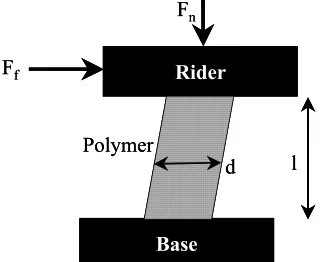
The application of conducting polymers in the connector application can be separated into two technologies. Extrinsic Conduction Polymers (ECP), and Intrinsic Conduction Polymers (ICP). A key advantage of this technology is the potential ability for the polymer interface to reduce the fretting potential. This can be represented by the schematic of an interface in Fig.2, showing that as the top surface moves under the application of the force Ff, the friction between the rider and the polymer causes the polymer to deflect, maintaining the contact with the rider surface. Clearly this solution is dependent upon the nature of the tangential force, but if we assume that the environmental stress are those associated with a fretting cycle, then a potential solution to the problem could be achieved.
Base Rider
Ff
l d Polymer
Fn
Base Rider
Ff
l d Polymer
Fn
Fig. 2 Schematic of a polymer connector interface
Extrinsic Conduction Polymers (ECP)
The ECP is a technology that involves the use of highly conductive interconnects where metal particles (for example Ag) are embedded within a high temperature polymer compound. These contacts are often described as extrinsically conducting polymer (ECP) and have been used for connecting microprocessors and ASICs to PC boards. Employing ECP’s as alternative contact materials could reduce the use of precious metals and improve reliable by minimising the influences of fretting [9,10]. However, concerns have been raised about abrasion (or fretting) at the surface interfaces of the doped metallic particles within the ECPs. Possible deformation of contact surfaces and degradation of metallic particles would vary the resistance of the material and effectively affect the overall system over long periods of operation.
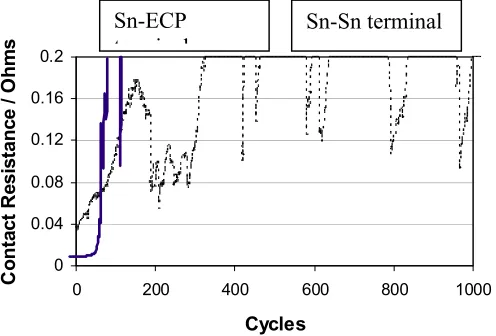
[image:3.612.233.393.387.518.2]Fig.3. The resistance of the samples are initially between 0.02 and 0.04 at the start of the fretting test and increase to >0.2. The Sn-Sn interface is shown to exceed the 0.2 level after 100 cycles, whereas the ECP-Sn interface shows an improved performance. It is clear from these observations that the ECP interface is still susceptible to the fretting cycle. This has thought to be caused by the abrasive interaction of the embedded metallic particles.
0 0.04 0.08 0.12 0.16 0.2
0 200 400 600 800 1000
Cycles
C
o
n
ta
ct
R
es
is
ta
n
ce
/
O
h
m
s
Fig 3. The Highest Contact Resistance per Cycle against Fretting Cycle, for Sn interface and ECP interface.(1N force)
Intrinsic Conduction Polymers (ICP).
Until recently, carbon based polymers were rigidly regarded as insulators. This perspective has rapidly changed as a new class of polymer known as intrinsically conducting polymer (ICP) or electro-active polymers are being discovered. Although this class is in its infancy, the potential applications of ICPs are relatively significant [13]. One such applications is the automotive industry where metal terminals could be replaced by conducting polymer contacts.
PEDOT/PSS and its blends
Thiophenes and polythiophenes are conjugated polymers that enhance conductivity [17]. By introducing ethylenedioxy-substituents at the 3, 4 ring carbons of the thiophene rings [18], the thermal and electrochemical stability of these polymer systems are improved. With the primary doping of poly(styrenesulfonate) (PSS) to poly(3,4-ethylenedioythiophene) (PEDOT) at weight ratio of 1.6:1, a soluble polymerized structure can be easily processed to produce a good hole conductor. Charge transport takes place on and between the PEDOT chains as the dopant molecules are passive [17, 19]. The conductivity of pristine PEDOT/PSS has been approximated at 0.8 S.cm-1 [20]. By secondary doping, the conductivity levels of PEDOT/PSS can be further enhanced by a factor of up to 100 by screening effects [20].
The screening effect is defined as a reduction of nuclear charge on an electron that is caused by the repulsive forces of other electrons between itself and the nucleus. This effectively reduces the Coulomb interaction [21] between positively charged PEDOT and negatively charged PSS dopants, which in turn increases the hopping rate and conductivity in the PEDOT/PSS systems.
The Metal-Polymer Contact Interface
Ideally, it is not possible to have a perfect interface between conducting polymers and metals due to the presence of an interfacial layer [22]. Factors such as the diffusion of atoms and molecules, the chemical interaction and electronic interaction occurring at the interfacial layer determine the kind of junction formed. Furthermore, as the polymer films are produced in ambient conditions, the surface of the films will contain a layer of adsorbed hydrocarbons, water and impurities. The most practical interface for an optimal device performance can be achieved when there is good adhesion between the polymer and the metal, without affecting the inherent electrical properties of the polymer. In this case, the covalent bonds formed do not break the conjugation along the polymer backbone or affect the doping of the conjugated species [23].
Sn-ECP
Contact structure
In recent investigations applied to connector surfaces, [24], the main aim has been to reduce fretting and incorporate the advantages of ECPs by studying the possibilities of employing intrinsically conducting polymers (ICPs) in place of ECPs for applications involving electrical contacts. The hypothesis made for overcoming the abrasive effects of ECPs is mainly attributed to the elastic property of ICPs. With this, ICPs retain the ability to conduct and possess the capability of absorbing the effects of external forces at the contact interface.
In [24] an initial investigations was made on two types of ICPs namely poly(3,4-ethylenedioxythiophene) (PEDOT) and polyaniline (PANI). The ICPs were doped with different ratios of solvents and prepared under certain conditions to achieve improvements in the mechanical structure, processibility and conductivity. Experiments were carried out to measure the contact resistances using 4-wire resistance measurement techniques while subjected to a normal force. To observe and compare the physical changes of the ICPs, the surface distributions of the samples were taken before and after the experiments. For this initial study the ICP material was used on top of a ECP structure as shown in Fig.4. The structure was then subjected to a range of polymer blends and applied force to determine levels of conductivity.
Fig.4.Initail study of ICP coated ECP
It was shown that the PEDOT/PSS:DMF mixture at 3:1 gave the optimum conductivity value of 7.96x10⁻² S.cm-1. When the amount of DMF was increased beyond this ratio, a sudden decrease in conductivity was noted. The actual reason has not been thoroughly investigated but this could be due to saturation of the derivatives where PEDOT/PSS no longer dominates the electrical characteristics of the overall conducting polymer.
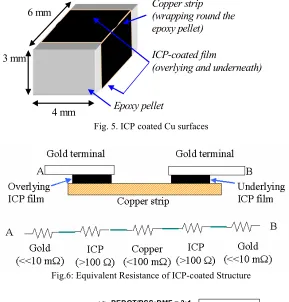
In a further study of the influence of the compressive forces, [25], the ECP used in Fig 4, was replaced with a new assembly shown in Fig 5. In addition to the compressive force the sample used in this study was subjected to thermal cycling to determine the performance. It was shown that the results for thermal influence have shown that the ICP materials studied in this context have exponential negative thermal coefficients of temperature. This phenomenon is supported by previous literature, attributing to the explanation of charge transport mechanism. Furthermore, the samples subjected to several cycles of thermal shocks have produced repeatable measurement. Thus, acceptable levels of thermal fretting experienced by the ICP contacts due to rapid changes in temperature have been observed for this short term evaluation.
ICP-coated film
(overlying and underneath)
Copper strip
(wrapping round the
epoxy pellet)
Epoxy pellet
6 mm
3 mm
[image:6.612.160.449.85.387.2]4 mm
Fig. 5. ICP coated Cu surfaces
Fig.6: Equivalent Resistance of ICP-coated Structure
PEDOT/PSS:DMF = 3:1
0 0.2 0.4 0.6 0.8 1
0 20 40 60 80 100
Temperature (deg C)
N
o
rm
a
lis
e
d
R
es
is
ta
n
c
e
spin drop (d)
Fig.7. ICP resistance change with temperature cycling over a 100min temperature cycle.
The resistance measured across the clamped 3:1 sample is approximately 500 at normal room temperature and it is found to have the lowest output resistance among five different samples. There was consistency with the previous results where the resistance measured for a ‘copper-3:1 ICP blend-copper’ configuration with slightly different dimensions and interface materials has been recorded at 210 . Fig. 7 shows the relationship between the normalised resistance and temperature for each polymer blend using the two coating techniques - spin-coating and drop-coating. The key observation from Fig. 7 is that the trend of the exponential response given by the experimental results corresponds to that of the theoretical model, which describes the charge transport with a phase segregation of polymer colloidal suspensions, in this case PEDOT/PSS.
1) Effects of heating and cooling on resistance
The second observation made from Fig. 7 is the presence of hysteresis which suggests the possibility of ICP blends having non linear thermal variation characteristics. This occurs when a material behaves differently when temperature changes from a low to high level (heating) as compared to the reverse case of having a high to low transition (cooling) within the same temperature range. It is noted that lower resistance values were experienced during the cooling phase.
2) Effects of coating technique on resistance
[image:6.612.204.420.386.493.2]similar rates of the resistance variation for both the heating and cooling phases. The exact opposite trend is noted for the spin-coated samples where the addition of DMF has caused a comparable rate of resistance change for both temperature phases. In the cooling phase, the variation for the normalised resistance is also found to remain relatively similar for all spin-coated samples regardless of the type of polymer blend. The originally measured resistance values are also comparable for both coating processes. These responses are repeatable and have shown that the impact of spin coating and drop coating on the output resistance are distinct.
In [26], the study was further extended to include the influence of fretting, and included the testing of connector samples in a test vehicle. In this new study the process methods used to create the ICP surface were also studied to include a comparison of drop and spin coating surfaces. The paper presents the results obtained from the investigations on poly (3,4-ethylenedioxythiophene) / poly(4-styrenesulfonate) PEDOT /PSS) and its blends from secondary doping. Experiments have been carried out to access their functionality based on two independent studies of temperature and fretting motion.
Laboratory Fretting Tests
To simulate the influence of vibration under laboratory conditions, a fretting apparatus giving an oscillatory motion of 100 m at 0.17 Hz is used. A gold terminal is fixed to the stationary parts of the jig and the bottom terminal is held in place to the movable part. This way, forced fretting at the contact interface can be simulated. Results are shown in Fig 8a and b. In Fig 8a the contact resistance increases after a low number of fretting cycles, leading to early failure. In Fig 8b as the number of fretting cycles increase, resistance reduces at a gradual rate to reach an averaged variation of 35%, 20% and 25% from the original values at the end of 1000 cycles for the 5:1, 4:1 and 3:1 samples respectively. The results show minimal resistance fluctuations, which could be associated with the degree of elasticity of the ICP materials. 0 0.1 0.2 0.3 0.4 0.5 0.6 0.7 0.8 0.9 1
0 200 400 600 800 1000
Number of cycle
N o rm al is ed R es is ta n ce 4:1 5:1 3:1
Figure 8a(left): Variation in Resistance of Spin-coated Samples (Unblended and 2:1) during the First 1000 Cycles of a 100 m Fretting Amplitude (‘A’, ‘B’ indicate the onsets of rapid change in connector
resistance to failure), and b(right) , the resistance of spin-coated samples (5:1, 4:1 and 3:1)during the first 1000 cycles of a 100 m fretting amplitude
Field Test Data
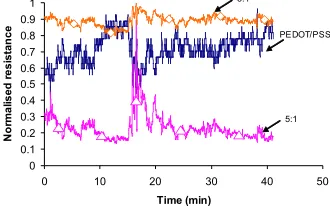
The samples coated with PEDOT/PSS and its blends were subjected to field conditions. They were placed near the brake sensory system in the engine compartment of a test vehicle. The test consists of a 40-minute drive along a mixture of road conditions. Data is recorded continuously using the same procedures for the laboratory tests, results are shown in Fig.9.
0 0.1 0.2 0.3 0.4 0.5 0.6 0.7 0.8 0.9 1
0 10 20 30 40 50
[image:7.612.112.488.342.459.2]Time (min) N o rm a lis ed r e s is ta n c e 5:1 PEDOT/PSS 3:1
[image:7.612.228.393.584.687.2]All experiments in this investigation have revealed that the sample spin-coated with PEDOT/PSS:DMF of 3:1 has produced the most stable and repeatable results. Together with the fact that this weight ratio has also produced the highest conductivity level, it proves to be the most promising candidate to have the potential of overcoming fretting problems. Although at this current stage, ICP’s are not ready to be integrated into connector systems; this study has highlighted the issues concerning the design consideration of the prototypes using ICP’s. Alongside with the characteristic studies made on the ICP materials, all information will benefit future explorations in the design of ICP contact prototypes.
4. SUMMARY AND CONCLUSION
The paper provides an overview of the conducting polymers surfaces in the application for electrical contact surfaces. Two type of conducting polymer are identifies in this study, extrinsically conducting polymer (ECP), where highly conductive interconnects are formed using metallized particles embedded within a high temperature polymer compound, and intrinsically conducting polymers (ICPs). It has been shown that both types have the potential to reduce the fretting phenomena common on automotive connector systems. This is achieved by the ability of the polymers surfaces to absorb the force which causes fretting in metallic surfaces. Initial studies have shown that the ECP type of surfaces although absorbing the tangential forces, can still result in contact resistance changes which are similar to the metallic fretting results. This is thought to result from the internal fretting of the embedded metallic particles.
The application of ICP surfaces is also considered. Investigations are presented on two types of ICPs namely poly(3,4-ethylenedioxythiophene) (PEDOT) and polyaniline (PANI). The ICPs were doped with different ratios of solvents and prepared under certain conditions to achieve improvements in the mechanical structure, processibility and conductivity. It was shown that the PEDOT/PSS:DMF mixture at 3:1 gave the optimum conductivity value of 7.96x10⁻² S.cm-1. When the amount of DMF was increased beyond this ratio, a sudden decrease in conductivity was noted. The actual reason has not been thoroughly investigated but this could be due to saturation of the derivatives where PEDOT/PSS no longer dominates the electrical characteristics of the overall conducting polymer.
To method of preparation for the ICP coatings are considered, spin and drop coatings, which have then been investigated in terms of the contact resistance- force relationship and with fretting under both laboratory and in field conditions. Initial results show the spin coated surfaces with the 3:1 PEDOT/PSS:DMF mixture have the optimum performance.
REFERENCES
[1] S. Hannel, S. Fouvry, Ph. Kapsa, L. Vincent, “The fretting sliding transition as a criterion for electrical contact performance”, Wear, 249, 2001, pp. 761–770.
[2] Lee, A. Mao, M.S. Mamrick, “Fretting corrosion of tin at elevated temperatures”, Proceedings of the Thirty Fourth Meeting of the IEEE Holm Conference on Electrical Contacts, 1988, pp. 87 – 91.
[3] J. Swingler and J. McBride, “Fretting corrosion and the reliability of multicontact connector terminals”, IEEE Trans. Components Pack. Tech., vol. CAPT-25, 2002, pp. 670 – 676.
[4] G.T. Flowers, F. Xie M. Bozack, X. Hai, B.I. Rickett, R.D. Malucci, “A study of the physical characteristics of vibration-induced fretting corrosion”, Proc. of the 50th IEEE Holm Conference on Electrical Contacts and the 22nd International Conference on Electrical Contacts, 2004, pp. 312–319.
[5] ASTM Designation B 896-99, Standard Test Methods for the Evaluating Connectability Characteristics of Electrical Conductor Materials.
[6] Antler.M "Sliding Wear of metallic Contacts" Holm Conf. 1980,pp3-24. [7] Electrical Contacts: Priciples and Applications, Ed P.Slade.Chapter 6.
[8] Tyco Electronics, “Metallized Particle Interconnect Application Guide”, Rev. B.
[9] J. Swingler and J. McBride, “Fretting corrosion studies of an extrinsic conducting polymer and tin interface”, Proceedings of the 47th IEEE Holm conference on electrical contacts, 2001, pp.215-219. [10] J. Swingler, J.W. McBride, “Minimising Fretting Slip in Connector Temrinals Using Conducting Polymer Contacts”, IEICE Trans. Electron., E87-C, 8, 2004, pp. 1295-1301.
[12] L. Lam, J.W. McBride, J. Swingler, “The Influence of Thermal Cycling and Compressive Force on the Resistance of Poly(3,4-ethylenedioxythiophene) / Poly(4-styrenesulfonic acid)-coated Surfaces”, Journal of Applied Polymer Science, Wiley Periodicals, Inc., 101, 2006, pp. 2445–2452.
[13] M. Aldssi, “Intrinsically conducting polymers: an emerging technology”, Kluwer Academic Publishers NATO ASI series E: applied sciences –Volume 246, 1993.
[14] Swingler, J., J.W. McBride, and C. Maul, The Degradation of Road Tested Automotive
Connectors. IEEE Transactions on Components and Packaging Technologies (CPMT), 2000. 23(1): p. pp. 157 - 164.
[15] Lam, L, Maul C, McBride J.W. "Temperature , Humidity and Pressure measurments on Automotive Connectors. IEEE Trans CPT, June 2006.
[16] Lam L, McBride J.W, Maul C, Atkinson J.K, "Displacement Measurements at the Connector Contact Interface Employing a Novel Thick Film Sensor", IEEE Trans CPT, June 2006.
[17] G. Greczynski, M. Fahlman, and W. R. Salaneck, "Hybrid interfaces of poly(9,9-dioctylfluorene) employing thin insulating layers of CsF: A photoelectron spectroscopy study”, J. Chem. Phys., 114, 2001, pp. 8628-8636.
[18] G. Greczynski, M. Fahlman, and W. R. Salaneck, “An experimental study of poly(9,9-dioctyl-fluorene) and its interfaces with Li, Al, and LiF”, J. Chem. Phys., 113, 2000, pp. 2407-2412. [19] L. S. Hung, C. W. Tang, and M. G. Mason, "Enhanced electron injection in organic electroluminescence devices using an Al/LiF electrode”,Appl. Phys. Lett. 70, 1997, pp. 152.
[20] J. Y. Kim, J. H. Jung, D. E. Lee and J. Joo, “Enhancement of electrical conductivity of poly(3,4-ethylenedioxythiophene) / poly(4-styrenesulfonate) by a change of solvents”, Synthetic Metals, 126, Issues 2-3, 2002, pp. 311-316.
[21] H. Kato, D. Yoshioka, “Suppression of persistent currents in one-dimensional disordered rings by the Coulomb interaction”, Physical Review B, 50, 7, 1994, pp. 4943-4946.
[22] V. Zaporojtchenko, T. Strunskus, K. Behnke, C. Von Bechtolsheim, M. Kiene and F. Faupel, “Metal/polymer interfaces with designed morphologies”, 14, 3, 2000, pp. 467-490.
[23] R. Lazzaroni, M. Lögdlund, A. Calderone, J. L. BrédasP. Dannetun, C. Fauquet, C. Fredriksson, S. Stafström and W. R. Salaneck, “Chemical and electronic aspects of metal/conjugated polymer
interfaces. Implications for electronic devices”, Synthetic Metals, 71, 1-3, 1995, pp. 2159-2162. [24] Liza Lam , J. Swingler, J. McBride, "The Contact Resistance Force Relationship of an Intrinsically Conducting Polymer Interface", IEEE T ransaction on Components and Packaging T echnologies , Vol . 29, N o. 2, pp. 294-302, J une 2006.
[25] L. Lam, J.W. McBride, J. Swingler, “The Influence of Thermal Cycling and Compressive Force on the Resistance of Poly(3,4-ethylenedioxythiophene) / Poly(4-styrenesulfonic acid)-coated Surfaces”, J.of Appl. Polymer Science, Vol. 101, (2006), pp2445-2452.