A thesis presented for the degree of Doctor of Philosophy
in Economics
at
the University of Canterbury Christchurch, New Zealand
by
J.N.
Lye ~I
ABSTRACT
In the standard classical regression model the most commonly
used procedures for estimation are based on the Ordinary Least
Squares Method, which is justified on the basis of well known
finite-sample properties. However, this model consists of a number
of assumptions, such as, for example, homoskedastic, serially
independent and normally distributed disturbances and nonstochastic
regressors. By changing these assumptions in one way or another,
different estimating situations are created, in many of which the
OLS estimator may have no statistical justification at all.
Further, alternative estimation methods have often been justified
only on the basis of their asymptotic properties, although in
practice economists frequently have to base their statistical
analysis on a relatively small number of observations. This
suggests that the particular estimator to use in any situation
should be chosen on the basis of finite-sample considerations.
The analysis of finite-sample properties of commonly used
estimators in three well known Econometric models is the focus of
this thesis. In particular the three models considered are: the
limited-information simultaneous equations model, the nonnormal
linear regression model and the nonnormal limited-information
simultaneous equation model. The techniques used include the
derivation of the estimators' exact distribution and when this is
analytically intractable Monte Carlo methods are employed.
The limited-information simultaneous equation model is
evaluating many of the commonly used estimators, including the
two - stage least squares estimator, is presented. Secondly this
method is then used, and combined with Monte Carlo analysis, to
compare the distributions of the limited-information maximum
likelihood and two-stage least squares estimators in misspecified
simultaneous equations models. The result of this comparison
indicates the superior performance of the limited-information
maximum likelihood estimator over the two-stage least squares
estimator in both correctly specified and misspecified simultaneous
equations models.
Recently, models with possibly nonnormal distributed
disturbances have attracted more attention. For such models,
independence and uncorrelatedness of the disturbance terms are not
equivalent. Using the nonnormal regression model the statistical
consequences of distinguishing between independence and
uncorrelatedness are considered when the disturbances are Student-t
distributed. The results obtained demonstrate that the distinction
between the two assumptions is an important one and the
consequences of making the wrong assumption can be serious.
Consequently, specification tests are also presented which test for
uncorrelatedness versus independence in the elliptically symmetric
family.
The nonnormal limited-information simultaneous equation
model provides a relatively new area of analysis as there are few
published results available on the effects of nonnormal
disturbances in the limited- information simultaneous equation
separately in the other two models previously considered. However,
to narrow the range of possible models that can be examined,
attention is focussed only on the exactly-identified simultaneous
equation model. This model has a number of interesting features
when the reduced-form disturbances are normally distributed. These
features are illustrated and then comparisons are made with the
same model when the distribution of the disturbances is widened to
include. the Student-t family. In this case, as for the nonnormal
linear regression model, a distinction needs to be made between
independently distributed and jointly distributed disturbances.
The consequences of these different assumptions are shown to be
important; specification tests relating to this distinction are
ACKNOWLEDGEMENTS
There are a nwnber of people and organizations whose help
and support I would like to acknowledge with gratitude: my
supervisor, David Giles, for his overseeing of this thesis, for
providing comments on all individual chapters and for his
encouragement in the furtherance of my academic career; Dorian
Owen, for reading and commenting on numerous drafts of chapters;
Arnan U11ah, for providing many suggestions and comments that
improved the presentation and content of Chapter 5; Ray Byron, for
his comments on Chapter 5 in his role as discussant at the second
International Postgraduate Conference, Perth, November 1988; Robin
Harrison, for help in producing the graphs; Robert Davies, for
supplying me with a Fortran version of one of his algorithms that
was used in Chapter 6; Ian Coope, for suggesting and providing
nwnerous algorithms used; The University Grants Committee, and The
Reserve Bank of New Zealand, for providing financial support.
Thanks are also due to The Reserve Bank of Ne,,, Zealand for
providing financial assistance so I could attend the second
International Post-graduate Conference, Perth, November 1988, and
The Department of Economics, University of Melbourne, for providing
financial support so I could return to Canterbury University during
Summer 1989 to complete this thesis. I would like to thank Karilyn
Smith for her care in preparing the final typed copy, and for her
patience in deciphering many pages of untidy manuscript. Finally,
I would like to thank my parents for their financial and moral
CONTENTS
ABSTRACT
ACKNOWLEDGEMENTS
1 . INTRODUCTION 1.1
1.2 1.3
A General Overview
The Models And Objectives An Overview of the Chapters
2. PRELIMINARY DEFINITIONS 2.1 Introduction
2.2 Preliminary Mathematical and Statistical Definitions
2.3 Multivariate Normal, Multivariate Student-T,
PAGE
i
iv
1
4
9
12
12
Elliptically-Symmetric and Wishart Distributions 15
2.4 Note on Layout 21
3. KERNEL DENSITY ESTIMATION
3.1 Introduction 22
3.2 The Method 23
3.3 The Asymptotic Properties 26
3.4 Choosing the Kernel, Window Width
and Sample Size 28
CHAPTER
4. MONTE CARLO EXPERIMENTS -A DESCRIPTION OF METHODOLOGY
4.1
Introduction4.2 Number of Replications and the Estimation of DF's, PDF's and Measures of Location and Dispersion
4.3 Generation of Random Numbers
4.4 Estimation of the Unknown Parameters of the Models
5. THE NUMERICAL CALCULATION OF THE DISTRIBUTION FUNCTION OF A BILINEAR FORM TO A QUADRATIC FORM WITH ECONOMETRIC EXAMPLES
6. 5.1 5.2 5.3 THE 6.1 6.2 6.3 6.4 6.5 6.6 Introduction Main Results Special Cases
LIML AND TSLS ESTIMATORS Introduction
The Estimators
Finite-Sample Properties of the TSLS and LIML Estimators: A Review
The Key Parameters in the Misspecified Canonical Distributions
Properties of the Misspecified Distributions Some Final Comments
CHAPTER
7. EXTENSIONS OF THE NORMALITY ASSUMPTION: A REVIEW
7.1 The Normal Assumption
7.2 Nonnorma1 lID Disturbances - The Effect on Gaussian-type Statistics
7.3 Robust Estimation Techniques
7.4 Multivariate Elliptically Symmetric Distributions
7.5 Jointly Distributed versus Independent Disturbances
8. THE LOCATION/SCALE MODEL WITH STUDENT-t OBSERVATIONS
8.1 8.2 8.3
8.4 8.5
Introduction
Lloyd's Best Linear Unbiased Estimators
Maximum Likelihood Estimators for Independent Student-t Observations
Joint versus lID Student-t Observations Some Final Comments
PAGE
98
101 107
111
117
123 125
CHAPTER
9. THE GENERAL LINEAR REGRESSION MODEL WITH STUDENT-t OBSERVATIONS
9.1 Introduction
9.2 Properties of Maximum Likelihood Estimators with Dependent Student-t Errors
9.3 Properties of Maximum Likelihood Estimators with Independent Student-t Errors
9.4
9.5
Joint Versus lID Student-t Errors Some Final Comments
10. THE NONNORMAL LIMITED-INFORMATION SIMULTANEOUS EQUATIONS MODEL
10.1 Introduction
10.2 The Exactly-identified Limited-Information SEM
10.3 Consequences of Misspecification
11. TESTING THE ASSUMPTION OF JOINTLY-DISTRIBUTED VERSUS INDEPENDENTLY-DISTRIBUTED NONNORMAL DISTURBANCES
11.1 Introduction
11.2 Tests of Normality
11.3 Extension to Testing the Normality Assumption in Regression Models
11.4 Testing for Jointness Versus Independence 11.5 Monte Carlo Experiments
11.6 Some Final Comments
PAGE
161
162
163 184 200
202
203 228
246
247
253 255 257
CHAPTER
12. SUMMARY AND CONCLUSIONS
12.1 Overview 12.2 Methods Used
12.3 Results and Conclusions Obtained 12.4 Some Further Issues
REFERENCES
APPENDIX A
APPENDIX B
PAGE
267 268 269 279
282
312
LIST OF TABLES
CHAPTER 6
5.1 Median and 1QR for L1ML and TSLS Estimators 5.2 Median and 1QR for L1ML and TSLS Estimators
CHAPTER 8
A A
3.1 The Variance of ~LB' Empirical Variance of ~ML' the
CRLB and the Degrees of Freedom Parameter, ~, in the
Student-t Approximation for the Distribution of
"
"
" A
3.2 The Bias of aML, the Variance of aLB and the
4.1
4.2 4.3A
Variance of a
ML
Adjusted for BiasA(D) A(I)
The Actual and Assumed Variances of ~ML'M
OLS"(D)
A(I)
The Bias of a
ML
and aOLS
Median-Bias of Adjusted
~~~)
and aOLS Estimators " (1) for the Cauchy DistributionCHAPTER 9
3.1 3.2 3.3
4.1
4.2 4.3 "Empirical and Asymptotic MSE's for
f3
ML
for N AEmpirical and Asymptotic MSE's for
f3
ML
for NA
Empirical MSE's for
f3
TLS and Actual MSE's for b for N = 20Comparison of MSE's for
~~~)
and b forN
= 20 Comparison of Empirical Variances for~(D)
ML with Asymptotic VarianceEmpirical MSE's for b(l) for N = 20
of
~(1)
for K 2, N = 20 ML1'.(1)
CHAPTER 10
1\
2.1 Points of the Distribution Function of a in the
Exactly Identified Limi~ed-Information SEM with
Normally-Distributed Reduced-form Disturbances,
a = 0.5 and 5.33 and various 02
1\
2.2 Points of the Distribution Function of a in the
Exactly-Identified Limited-Information SEM with
Reduced-form Disturbances Distributed as in (2.6),
a = 0.5 and 5.33 and various 02
1\
2.3 Points of the Distribution Function of a in the
Exactly-Identified Limited-Information SEM with
Reduced-form Disturbances Distributed as (2.12),
a = 0.5 and 5.33 and Various 02
3.1 Comparison of Median and IQR for Estimators IML(I)
and DML(I)
3.2 Comparison of Median and IQR for Estimators IML(D)
and DML(D)
2 2
3.3 Asymptotic Variances for l+a (DML-a) and l+a (IML-a)
02 02
when reduced-form disturbances are distributed as
(2.6) and (2.12)
3.4 Effect of using the wrong Limiting Distribution
for standardized
a
when errors areJointly-Distributed but are thought to be
Independently-Distributed
3.5 Effect of using the wrong Limiting Distribution
1\
for standardized a when errors are
Independent1y-Distributed but are thought to be
Jointly-Distributed
PAGE
206
213
222
230
232
236
239
CHAPTER 11
5.1 Results of Monte Carlo Experiments for Linear
Regression Models using 5000 Replications
5.2 Results of Monte Carlo Experiments for
Exact1y-identified Limited-Information SEM using 5000
Replications and Corresponding to data set 1
5.3 Results of Monte Carlo Experiments for
Exactly-identified Limited-Information SEM using 5000
Replications and Corresponding to data set 2
APPENDIX A
Table Al The Eigenvalues of (B1 -qB2) and their mul tiplici ties
Table A2 Components of the Eigenvectors
PAGE
261
264
265
313
LIST OF FIGURES
CHAPTER 3
PAGE
5.1 Comparison of Different Kernels for Cauchy 34
Distribution Using 100,000 Replications
5.2 Comparison of Different Kernels for Cauchy
Distribution Using 100 Replications 35
CHAPTER 6
5.1 Densities for the LIML and TSLS Estimators when
2
0: = 0.0, {; = 16 87
5.2 Densities for the LIML and TSLS Estimators when
2
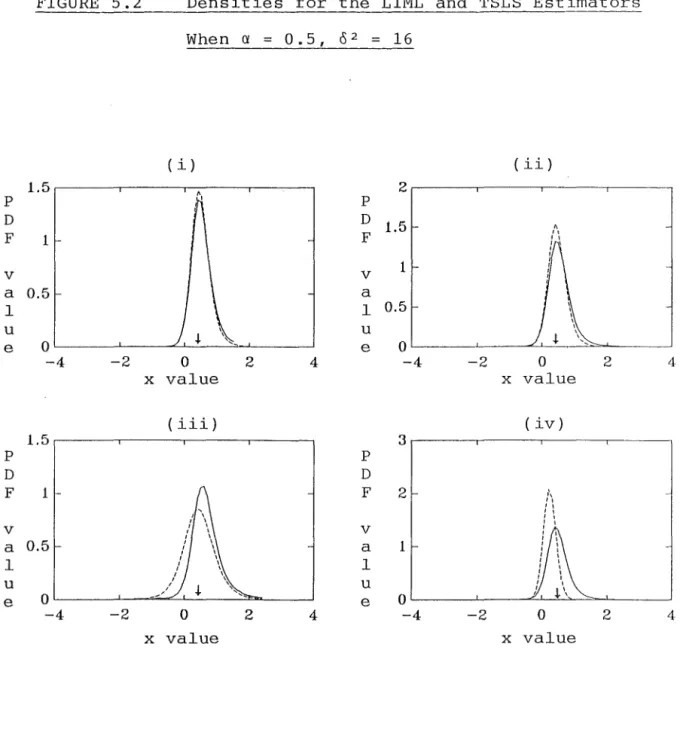
0: = 0.5, {; = 16 88
5.3 Densities for the LIML and TSLS Estimators when
2
0: = 1.0, {; = 16 89
CHAPTER 7
5.1 Bivariate Surface for Spherical Normal
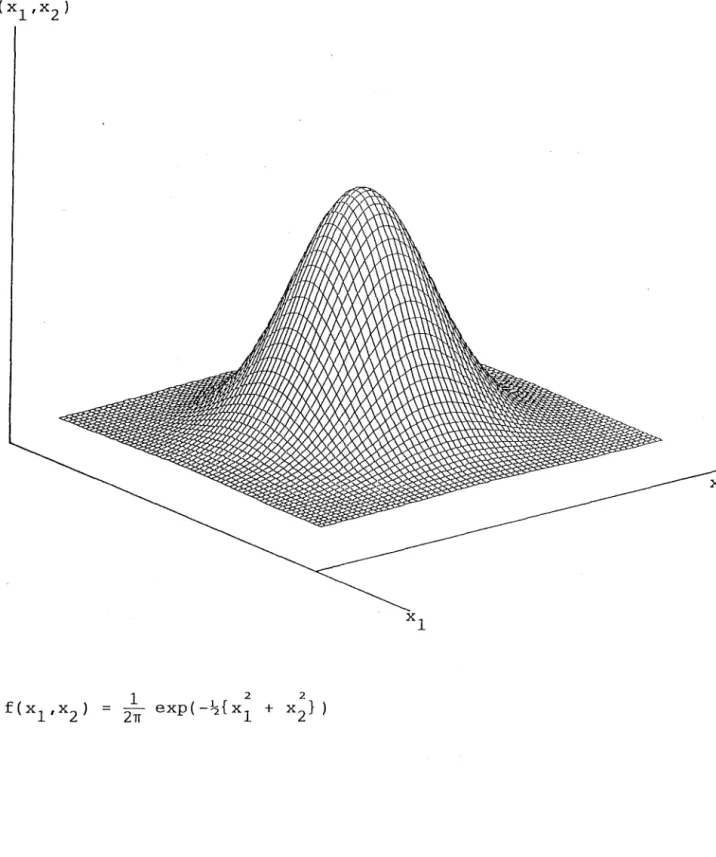
Distribution 118
5.2 Bivariate Surface for Joint Spherical Cauchy
Distribution 119
5.3 Bivariate Surface for Independent Spherical
CHAPTER 8
PAGE
3.1 Comparison of Maximum Likelihood, BLUE and Student-t Approximation for the Standardized Location Parameter Corresponding to v = 3
and Different N l38
3.2 Comparison of Maximum Likelihood, BLUE, and Student-t Approximation for the Standardized Location Parameter Corresponding to Different
v and N = 10 139
3.3 Comparison of Maximum Likelihood and BLU Estimators for the Standardized Scale
Parameter 142
3.4 Comparison of Maximum Likelihood, BLUE and Student-t Approximation for the Standardized Location Parameter Corresponding to v = 1 and
N = 5 and 10 144
3.5 Comparison of Maximum Likelihood and Student-t Approximation for the Standardized Location
Parameter Corresponding to v = 1 and different N 145
3.6 Comparison of Maximum Likelihood and Student-t Approximation for the Standardized Location
Parameter Corresponding to v = 2 and different N 146
4.1 Distributions of
~(D)
ML and~(D)
LB when theDisturbances are Uncorrelated 152
4.2 The Distribution of MOLS for lID Student-t "(I)
CHAPTER 9
3.1 Comparison of the Finite-Sample Distribution A
of ~ML. with its Asymptotic Distribution for
1
v = 3, N = 20
3.2 Comparison of the Finite-Sample Distribution A
of ~ML.with its Asymptotic Distribution for
1
v = 10,
N
= 203.3 Comparison of the Finite-Sample Distribution
4.1
A
of ~ML. with its Asymptotic Distribution for
1
v = 1, N = 20
Comparison of the distribution of
~(D)
ML with its A(I) Incorrectly Assumed Asymptotic Distribution ~MLfor v = 3, N = 20
4.2 Comparison of the Distribution of b(I) with its Incorrectly Assumed Asymptotic Distribution beD) for v = 3, N = 20
4.3 Comparison of the Distribution of
~(D)
ML with its Incorrectly Assumed Asymptotic Distribution A (I)~ML
for v = 1, N = 20
4.4
Comparison of the Distribution of b (I) with itsIncorrectly Assumed Asymptotic Distribution beD) for v = 1, N = 20
PAGE
176
177
178
187
191
196
CHAPTER 10
PAGE
2.1 Distributions of Maximum Likelihood Estimator in Exactly-Identified SEM with Normally Distributed
Reduced-form Disturbances Corresponding to a = 0.5 207
2.2 Distributions of Maximum Likelihood Estimator in Exactly-Identified SEM with Normally Distributed
Reduced-form Disturbances Corresponding to a = 5.33 208
2.3 Distributions of Maximum Likelihood Estimator in Exactly-Identified SEM with Student-t Distributed Reduced-form Disturbances given by (2.6) and Corresponding to a = 0.5
2.4 Distributions of Maximum Likelihood Estimator in Exactly-Identified SEM with Student-t Distributed Reduced-form Disturbances given by (2.6) and Corresponding to a = 5.33
2.5 Distributions of Maximum Likelihood Estimator in Exactly-Identified SEM with Student-t Distributed Reduced-form Disturbances given by (2.12) and Corresponding to a = 0.5
2.6 Distributions of Maximum Likelihood Estimator in
3.1 3.2
Exactly-Identified SEM with Student-t Distributed Reduced-form Disturbances given by (2.12) and Corresponding to a = 5.33
Graphs of DML(I) Graphs of IML(D)
215
216
224
CHAPTER 1
INTRODUCTORY COMMENTS
1.1 A GENERAL OVERVIEW
Consider the standard linear multiple regression model that
appears in all econometric textbooks (e.g. Johnston (1984), Harvey
(1981»:
y = X{3 + E (1.1)
where y' = (Y1" 'YN)' X is an N X K matrix, {3' = ({31" .{3K) is a
vector of unknown parameters and E' = (E
1 ... EN) is a vector of disturbances, and where the following conditions are satisfied:
Condition (i) : X is a nonstochastic matrix of rank K
<
N
and has the property that(X' X)
lim
N
= Q,N:>oo
where Q is a finite nonsingu1ar matrix. It is further assumed that there are no variables wrongly included in and/or excluded from the
X matrix.
Condition (ii) : E has a multivariate normal distribution with mean
O an d covar~ance · matrlx . a . 21
The most commonly used procedures for estimation and
inference in this model are based on the Ordinary Least Squares
(OLS) principle. This principle is justified on the basis of its
well known finite-sample properties which are given in Properties
Properties 1.1
(i) The least-squares estimator b = (X'X)-lx'y, which is also
the maximum likelihood estimator, and the associated
variance estimator s2 (y-Xb)' (y-Xb)/(N-K), are unbiased
minimum variance estimators from within the class of all
unbiased estimators.
(ii) The joint distribution of b is multivariate normal with mean
(iii)
(iv)
f3
and variance covariance matrix a2 (X' X) -1, implying that the marginal distribution for an element of the b-vector,2 -1
and variance a (X' X) ... JJ b., is normal with mean
f3.
J J
say
The statistic (N-K)s 2
/a
2 is distributed as a chi-square random variable with N-K degrees of freedom.Under the null hypothesis
f3
j 0, the test statistic~ 2 -1
b. / s (X' X) ..
J JJ has a Student-t distribution with N K degrees of freedom.
However, this model is not sufficient as a basis for
modelling many economic data generation processes, simply because
in many situations conditions (i) and (ii) do not hold. Consequently, Properties 1.1 are not valid in general and, in
particular, the use of OLS techniques may have no statistical
justification at all. The relaxation of these conditions has
enriched the range of econometric models and has consequently led
to the development of a number of estimation and inference
techniques which are alternatives to those based on OLS. The
introduction of most of these techniques however has only been
justified on the basis of their asymptotic properties, asymptotic
economists frequently have to base their statistical inferences on
a relatively small number of sample observations. This suggests
that the choice of the appropriate techniques to use should be
based on finite-sample considerations such as those given in
Properties 1.1, rather than asymptotic behaviour. However, in
general, relatively little is known about these relevant
finite-sample considerations.
The objective of this thesis is to extend and develop
finite-sample results for various estimators used for estimation
and inference in three econometric models. The particular
econometric models chosen are well-known extensions of the standard
multiple linear regression model when conditions (i) or (ii) or a
combination of both conditions are relaxed. Further, each of the
econometric models chosen provides a basis for much applied
econo-metric analysis and, in particular, all of the estimators
considered are now included in standard and widely-used econometric
packages such as SHAZAM and TSP.
The next section describes the three econometric models
chosen for investigation and so defines the three main components
of this thesis. These models are: the limited-information
simultaneous equations model, the nonnormal linear regression model
1.2 THE MODELS AND OBJECTIVES
(i) The Limited-Information Simultaneous Equations Model
Econometric models typically consist of sets of equations
which incorporate feedback effects from one variable to another.
These are known as Simultaneous Equation Models (SEMS). In
particular, when the econometrician is interested only in making
statistical inferences about the parameters of a single equation of
the model, then this is known as "The Limi ted- Information SEM".
Writing this model in the form of (1.1) implies that some of the
regressors in X are stochastic and are correlated with the
disturbance vector €, in the sense that (l/N)X'€ does not tend to
the zero vector as the sample size, N, tends to infinity.
Therefore condition (i) is invalidated, and furthermore OLS is an
inconsistent estimation technique.
The SEM was first proposed by Haave1mo (1943, 1944, 1947)
and this suggestion provided the basis for a research programme
undertaken by the Cowles Foundation during the late 1940' sand
early 1950's. However, the estimators suggested, such as Two Stage
Least Squares (TSLS) and the Limited Information Maximum Likelihood
estimator (LIML) , are rather complicated functions of the
underlying random variables, so that the exact distributions are
difficult to derive. Nonetheless, the analysis of the exact
distributions and their moments began in the early 1960' s and in
recent years substantial progress has been made for the case when
all of the predetermined variables are assumed to be exogenous and
the equation is identified by means of zero res tric tions (e. g.
1973b, 1977); Hillier, Kinal and Srivastava (1984); Hillier (1985);
Phillips (1980a, 1980b, 1984a, 1984b, 1985); Anderson (1982».
the finite-sample properties of certain Although
test-statistics and variance estimators have received some
attention in the literature, most results are concerned with the
estimation of the parameters of the structural equation of interest
and, in particular, the coefficients of the endogenous regressors.
It is this topic that is pursued here.
Traditionally a distinction is made between models in which
the structural equation of interest contains only one endogenous
regressor, and more than one endogenous regressor. This is because
it is only recently that techniques have been developed which allow
for the derivation of the exact densities in the case of more than
one endogenous regressor, and even then these results are complex
and currently not suitable for numerical evaluation.
Consequently, most numerical evaluations have concentrated simply
on the one endogenous regressor case. One of the themes in this
case has been the numerical comparison of the distributions of the
LIML and TSLS estimators. In particular the numerical computations
of Anderson et al. (1979, 1982) have pointed to the superior
performance of the LIML procedure over the TSLS estimator. In this
thesis this analysis is extended to the comparison of the
distributions of the TSLS and LIML estimators when there are
predetermined variables wrongly included in and/or excluded from
the model.
The numerical procedures used in this thesis differ from
those of Anderson et al. (1979, 1982). In particular, as most of
as a ratio of quadratic forms in normal variables it is shown how
the techniques such as those developed by Imhof (1961) and Davies
(1973) can be used to compute the distribution functions. This is
an extension of the analysis in Cribbett et al. (1989) which
concentrates only on the TSLS estimator. In the case of the LIML
estimator, however, the nonparametric density estimator is
integrated with a simple Monte-Carlo approach to estimate the
density, due to the complexity of numerically evaluating the exact
expressions.
(ii) The nonnormal linear regression model
When it is assumed that the error distribution is nonnormal,
condition (ii) is invalidated. In the literature a distinction is
commonly made on the basis of whether the distribution has a finite
or infinite variance.
If the error distribution is assumed to have finite first
and second moments then the properties of OLS are well-known. The
OLS estimator of ~ is best linear unbiased (BLUE) and the
conventional tests are asymptotically justified in the sense that
they have the correct size asymptotically. These results have
often been the justification for the use of the least squares
estimator under conditions of nonnormality. However, there are two
problems with this approach. First, it is well-known that although
OLS is BLUE it is, in general, asymptotically inefficient.
Consequently there may be nonlinear estimators which have superior
finite and asymptotic properties. Secondly, there is a large body
of literature (e.g. Mandelbrot (1963a, 1963b, 1966), Fama (1963,
particularly prices in financial and commodity markets, are well
represented by a class of distributions with infinite variance. A
distribution with an infinite variance has "fat tails" which
implies that large values or "outliers" will be relatively
frequent. Because the least squares technique minimizes squared
deviations, it places relatively heavy weight on outliers, leading
to estimates that are extremely sensitive to the presence and
values of such observations.
In recent years, to broaden the assumption of nonnormality
in the linear regression model, it has often been assumed that the
error components follow a joint multivariate elliptically symmetric
distribution. Under this assumption it has been shown that the
resulting estimators and test statistics possess properties which
make them analytically tractable and, furthermore, in many cases,
identical to those obtained under the normality assumption. See,
for example, Zellner (1976), King (1979, 1980), Singh (1987, 1988).
However, the normal distribution is the only member of the
class of multivariate elliptically symmetric distributions where
the disturbances are, in fact, independent. Also, it is usually
forgotten that the marginal distributions of the disturbance terms
under this assumption are identical to those obtained when the
disturbances are assumed to be independently and identically
distributed (iid) elliptically symmetric. It is these features
that lead naturally to the question of the statistical consequences
of distinguishing between multivariate and iid elliptically
symmetric error distributions and it is this issue that is taken up
Kelejian and Prucha (1985) address this problem using
asymptotic criteria for the linear regression model and Student-t
errors for degrees of freedom greater than 2. This distribution is
a particularly important member of the elliptically symmetric class
because it is claimed by authors such as Judge et al. (1985) that
this distribution may be a reasonable way of modelling tails that
are fatter than those of the normal distribution. (see also the
recent article by Lange et al. (1989)). The obj ective here is to
extend this analysis by developing properties of the maximum
likelihood estimators for the entire Student-t family using
finite-sample criteria. Results are obtained assuming the data
matrix, X, is nonstochastic.
(iii) The Nonnormal Limited-Information Simultaneous Equations Model
Models (i) and (ii) can be related by simultaneously
relaxing both of the conditions associated with the standard linear
regression model. This model provides a relatively new area of
analysis as there are few published results available on the
effects of nonnormal disturbances in the limited- information SEM
(e.g. Knight (1985b, 1986), Raj (1980), Donatos (1989)).
The objective here is to combine both of the themes pursued
separately in Models (i) and (ii). In particular, in the
estimation of the coefficient of the one endogenous regressor in
the exactly-identified limited-information SEM, the statistical
consequences of distinguishing between multivariate and iid.
Student-t error distributions on the LIML and TSLS estimators are
examined. Although (because it is exactly-identified) it is a
number of interesting features when the errors are normally
distributed. In particular, in this case the TSLS, LIML and Least
Variance Ratio (LVR) estimators are identical and
1
distribution is bimodal over part of the parameter space.
1.3 AN OVERVIEW OF THE CHAPTERS
their
Chapter 2 reviews certain key concepts in probability and
statistical inference used in this thesis. It also introduces the
notational conventions used.
Chapter 3 reviews an essential tool of analysis that is used
throughout this thesis. This is the integration of the
nonparametric density estimator with the Monte-Carlo technique.
This is a useful technique for approximating many of the density
functions considered in the thesis when either the exact
distribution is too difficult to derive explicitly or when the
exact distribution is known but too complex to be analyzed
conveniently. A number of statistical properties of this estimator
are discussed. These are all asymptotic properties, but are
considered relevant because in the applications considered here,
sample size, which is simply the number o( replications in the
simulation experiment, can be chosen by the investigator.
Chapter 4 discusses the methods used in the simulation
experiments. In particular, this includes a discussion of the
choice of the number of replications in the simulation experiments,
the generation of the random numbers involved, and the algorithms
used to solve the likelihood equations associated with the models
considered.
Chapter 5 shows that the exact distribution of a ratio of a
bilinear form to a quadratic form in normal variables can be
computed using techniques such as those developed by Imhof (1961)
and Davies (1973). As many of the commonly used estimators in the
limited-information SEM, including TSLS, are of this form, this is
a useful technique for the numerical evaluation of their
distributions.
Chapter 6 reviews recent relevant finite-sample properties
in the literature on the limited-information SEM. It also pursues
the theme of comparing the LIML and TSLS distributions, which
involves the use of techniques discussed or developed in Chapter 3
and Chapter 5.
Chapter 7 reviews some alternatives to the assumption that
the disturbances in the econometric models considered are
distributed normally. In particular, the effects of iid
nonnorma1ly distributed regression disturbances on the traditional
inference and estimation procedures used for normally distributed
disturbances are discussed, and a class of alternative estimation
techniques collectively labelled "robust estimators" are reviewed.
Also in this chapter, the consequences of replacing the normality
assumption with the assumption that the regression disturbances
follow a multivariate elliptically symmetric distribution are
examined. Therefore two types of nonnorma11y distributed
disturbances are reviewed in this chapter, these being, iid
nonnormal1y distributed disturbances and multivariate distributed
chapters. That is, "an examination of the statistical
conse-quences of distinguishing between the regression disturbances
following a multivariate elliptically symmetric distribution and an
iid elliptically symmetric distribution".
Chapters 8 and 9 take up this theme in the nonnormal linear
regression model. Chapter 8 considers the "location-scale" model,
which is a special case of the linear regression model. It is
equivalent to only estimating the intercept term in the linear
regression model. Chapter 9 extends the results obtained to the
more general model. A distinction is made between the
location-scale model and the more general model simply because a
number of techniques can be used to examine the problem in the
location-scale model that do not generalize to the more general
model.
Chapter 10 pursues this theme in the exactly-identified
nonnorma1 limited-information SEM. In particular, the
distributions of the TSLS and LIML estimators are compared, since
with nonnorma1 disturbances these two estimation techniques are not
necessarily the same.
Chapters 8, 9 and 10 indicate the importance of making the
distinction between iid nonnormally distributed disturbances and
multivariate nonnormally distributed disturbances. This suggests
that it is important to construct appropriate specification tests
that make this distinction. This is the topic of Chapter 11.
Finally, Chapter 12 offers some conclusions and presents
CHAPTER 2
PRELIMINARY DEFINITIONS
2.1 INTRODUCTION
The purpose of this Chapter is to introduce the notational
conventions used throughout this thesis.
Section 2.2 defines preliminary mathematical and statistical
definitions, such as those given in De Groot (1970), Feller (1966,
1968) and Muirhead (1982). Section 2.3 defines a number of
distributions that are used throughout this thesis. These include
the multivariate normal, multivariate Student-t, multivariate
elliptically-symmetric and Wishart distributions. Finally, Section
2.4 gives a brief note on the layout of the thesis.
2.2 PRELIMINARY MATHEMATICAL AND STATISTICAL DEFINITIONS
(i) Random Variables
A probability space is defined as the combination (0, A, P)
where, 0 is a set of points, A is a a-field of subsets of 0, and P
is a probability distribution defined on the elements of A.
1
Furthermore, any set LEA is known as an event.
A random variable Z is a real valued function from 0 to the
real line R which satisfies the condition that for each Borel set B
E
fi
on R, the set Z-l(B) = (W:Z(W)EB,WEO) is an event in A.A collection of random variables Zl(w),Z2(w)", on a given
pair (O,A) will be denoted by Zl' Z2' ... A random vector is a
K-tuple ZK = (Zl" ,ZK) of random variables defined on a given pair
(O,A) .
No distinction will be made between a random variable or
vector and the value taken by that random variable or vector.
(ii) Distribution, Probability Density and Characteristic Functions
Associated with a random vector ZK on (O,A,P) is a distribution function defined on RK by
FK(tl · .. t K) = Pro ((W:Z1 (W)
~
t 1 .. ,ZK(w) ~ t K} ) (2.1)K
for all t E R . The joint distribution of Zl" ,ZK is absolutely
continuous if there exists a nonnegative joint probability density
K
function pdfK(Zl" ,ZK) such that for every Borel set B cR.
(2.2)
The characteristic function of a random K-vector ZK is defined as
-1. (2.3)
The characteristic function always exists and no two different
distributions yield the same characteristic function so that there
is a one-to-one correspondence between characteristic functions and
(iii) Marginal Distribution Functions
The j oint distribution of a subset of random variables Zl ... Zp of Zl ... ZK (p ~ K) is called a marginal distribution.
marginal j oint distribution F of Zl ... Z is determined from the p p The
joint distribution function by the relation
(2.4)
p+1. .. K
Similarly, the marginal j oint probability density function pdfp of Zl ... Zp is determined from the joint probability density function pdfK Zl ... ZK by the relation
pdfp (Zl·· .Zp) =
J
K~~
J
pdfK(Zl·· .ZK)dZp+1 ·· .dZK· (2.5)R
Let G. denote the marginal univariate distribution function ~
of the random variable Z ..
~ The random variables Zl ... ZK are independent if and only if (iff) their joint distribution function can be factored at every point (Zl ... ZK) E RK as follows:
(2.6)
(iv) The Expectation Operator
The expectation E(Z) of any random variable Z with distribution function F is defined as
E(Z) =
J
Z pdf(Z)dZR1
and it exists iff the integral exists.
(2.7)
mean of Z or the expected value of Z. For a random vector ZK the mean is defined as
(2.8)
The variance of a random variable Z is given by E[(Z-E(Z»)1 and denoted var(Z). The covariance between random variables Zl and Z2 is defined as [(Zl-E(Zl»)(Z2-E(Z2»] and denoted cov(Zi,Zj)' Equivalently, this can be expressed as
For a vector ZK' the covariance matrix is ~ = (aij)KxK' where aij
cov(Z.,Z.).
~ J
2.3 MULTIVARIATE NORMAL, MULTIVARIATE STUDENT-T, ELLIPTICALLY-SYMMETRIC AND WISHART DISTRIBUTIONS
(i) Multivariate .. Normal and Student-t distributions
A K-dimensional random vector ZK has a nonsingular normal distribution with mean J.L
K
and covariance matrix ~ if ZK has an absolutely continuous distribution whose probability density functionpdf(ZKIJ.LK'~)
is specified at any point ZK E RK by the equation(3.1) In (3.1) J.L
components can be arbitrary real numbers and ~ must be a symmetric
and positive definite matrix. This distribution is denoted
-1
~
.
Define the precision matrix T of NK (JL!~:~) to be equal to
Suppose that Y
K is NK(JLK'~) with precision matrix T and
suppose the random variable
i
is distributed independently of Yand is chi-square distributed with v degrees of freedom, so that
2
pdf(X ) =
where r(a) is the gamma function,
r(a)
f
x a-1 exp(-x)dx, a>
0o
If the components of ZK are defined by the equation,
1
2 2
Z. = y.(K)
+
JL. , i = l ... K, 1. 1.V 1.(3.2)
(3.3)
(3.4)
with v then the distribution of ZK is multivariate Student-t,
degrees of freedom, location vector ILK and precision matrix T. It
is denoted by MTK(ILK,T,v), and the probability density function of
Z E RK .
K
1.S,r
r
1
_ (v+K)
For v
>
1, the mean vector E(Z~) = p,~ exists, and for v>
2 thecovariance matrix exists and is equal to v-v2~'
In both cases the marginal distributions are easy to derive.
Suppose that the random vector Z~ is partitioned in the form,
ZK
~ [:~
1
)~
where the dimension of Zi is Ki (i = 1,2) and Kl + K2 K. Also
suppose that p,~, T and ~ are partitioned as
T
[
~ll
~21 ~12
~22
1 '
where the dimension of p,. is K. (i = 1,2) and the dimension of the
1. 1.
sub- matrices T .. and ~ .. is K. X K. (i,j = 1,2).
1.J 1.J 1. J K
normal distribution at any point
Z~
E R 1 the value~l
Then, for the
*
pdfK (Zl) of
1
the marginal probability density function of Zl is specified as
~l
For the multivariate Student-t distribution it is,
-1
where T* = Tll - T12T22T2l' Therefore, in both cases, the marginal distributions are members of the same family as their respective joint distributions.
Further properties of both of these distributions can be found in, for example, De Groot (1970, pp.50-60).
Elliptically Symmetric Distributions
Each of the distributions above belong to the wider family of multivariate elliptically-symmetric distributions. The random vector ZK has a multivariate elliptically-symmetric distribution if the characteristic function ~Z _ (sK) of (Z_K - ~_K) is a function
K
J-lK
-of the quadratic form sKh sK' (where sK is a row vector), that,
such
(3.8)
for some function
1/1.
If it is further assumed that the density function with nonsingular h exists, then it is of the form,1
where g is a one-dimensional real-valued function independent of K
and CK is a scalar proportionality constant. This distribution is
denoted MES(~,T) and it has the first two moments, E(Z~) = ~K and
Cov(Z~) = a~, where a = -2~' (0), provided these moments exist. If
~ = 0 and ~ = I in (3.8) then the multivariate elliptically
~
symmetric distributions are called spherically symmetric
distributions. Two properties of these distributions used in this
thesis are (see, for example, Muirhead (1982, p.34»:
Properties 3.1
(1) All marginal distributions are elliptical and all marginal
density functions of dimension p ~ K have the same
functional form.
(2) If Z~ is N(~~,~) and ~ is diagonal then the components
Zl' .. ZK of Z~ are all independent. Wi thin the class of
multivariate-elliptically symmetric distributions
independence when ~ is diagonal characterizes the normal
distribution.
Further properties of these distributions are discussed by
authors such as Chmielewski (1981), Kelker (1970), King (1979),
Cambanis, Huang and Simons (1981) and Muirhead (1982).
(iii) The Wishart Distribution
The Wishart distribution is used in the derivation of
limited-information simultaneous equations models (as discussed in Chapters 5 and 6). The Wishart distribution is a matrix generalization of the noncentral chi-squared distribution (see, for example, Johnston and Kotz (1972, p.158». Consider the random n x
K matrix
Z
Z'
1Z'
nwhere the Z. terms are independent normal random vectors with mean
1.
M. and covariance matrix E.
1. The K
x
K matrix W = Z'Z, with (i,j)thelement Z(i),z(j), is said to be a Wishart matrix. The elements of W have a non- central Wishart distribution of order K, with n degrees of freedom, covariance matrix E and noncentrality parameter
n
M = E MiMi, This is denoted by i=l
The distribution is said to be central if M = O.
(3.10) The Wishart distribution has properties similar to those of the noncentral chi-squared distribution. In particular, if A and B are symmetric idempotent matrices, then Z'AZ - WK[q,E,E(Z)'AE(Z)], where q is the rank of A, and Z'AZ and Z'BZ have independent Wishart distributions
2.4 NOTE ON LAYOUT AND NOTATION
The purpose of this chapter has been to introduce the basic
notational conventions used in this thesis. Other notation used
that is not introduced in this chapter is defined when it is
required.
The layout of this thesis is as follows. Each chapter is
divided into sections. Theorems, Equation Numbers, Properties and
Figures within each section of a chapter are denoted by their
section number and then in sequence. Therefore, when referenced in
other chapters they are denoted by their chapter number first and
CHAPTER 3
KERNEL DENSITY ESTIMATION
3.1 INTRODUCTION
There are a number of techniques that are used to
approximate density functions, either when the exact distribution
is too difficult to derive explicitly, or when the exact
distribution is known but too complex to be analyzed conveniently.
For example, the exact sampling distributions of estimators of the
unknown coefficients of the endogenous variables in single
structural equations, have been shown to depend upon multiple
infinite series of zonal-type polynomials, and these present
enormous difficulties in numerical work. Phillips (1980a, 1983)
has overcome these difficulties by extracting various j oint and
marginal density approximations using asymptotic expansions.
However, another method which may be used to analyze such
distributions is the Monte Carlo method, in which artificial data
are generated and from them sampling distributions and moments are
estimated. One advantage of this technique is that it can be
implemented easily on an extensive range of models and error
probability distributions. An extension of this technique which is
used in this thesis is the integration of density estimation with
the Monte Carlo technique, as suggested by Ullah and Singh (1985).
That is, the Monte Carlo approach is used to generate the
statistics of interest and then the density of these statistics is
estimated using the generated statistics as observations. The
obj ective of this chapter is to briefly review the history and
is a particular example of a density estimator that is both widely
used and thoroughly studied in the statistical literature. The
actual Monte Carlo methodology that is used in this thesis is the
topic of the next chapter.
The Kernel estimation technique has been reviewed by, for
example, Tapia and Thompson (1976), Singh, Ullah and Carter (1987),
Wertz (1978), Devroye (1987), Silverman (1986), and Ullah (1988)
and the contents of this chapter draw heavily on these reviews.
The finite-sample analysis of statistics is the application of the
Kernel density estimation technique that will be used throughout
this thesis. Recently there has been a great deal of interest in
other applications of the technique, such as applying the method to
the estimation and testing of econometric models. A review of
these applications is beyond the scope of this chapter. However,
these applications have been reviewed by Bierens (1986), Singh
et al. (1987) and Ullah (1988).
In Section 2 the Kernel density estimation technique is
defined and its history is briefly reviewed. Section 3 considers
the asymptotic properties of this estimator and Section 4 considers
the choice of Kernel, window width and sample size.
concludes this chapter with a simple illustration.
3.2 THE METHOD
Section 5
Let Xl ,X2 , ... ,XN
*
be independently and identicallydistributed observations on a random variable X with probability
density function pdf (X) . Rosenblatt (1956) and Parzen (1962)
pdf(X) 1 N* [X-X.] l:: K J j=l h(N~'<')
(2.1)
where h(N*) is the window width, which is assumed to be a positive
function of the sample size, N*, such that lim h(N*) = 0, and K is
N~C()
the Kernel. If K is everywhere a nonnegative function and
satisfies
J
K(x)dx 1, then pdf(X) will be a probability densityfunction which possesses
all
of the continuity anddifferentiability properties of K. Numerous extensions of this
estimator have been considered. For example, Breiman et a1. (1977)
introduced the variable Kernel estimator in which the window width
varies across the data points, allowing the tails of the estimator
to be smooth while not distorting the central part of the density.
Cacou11os (1966 ) extended the Kernel estimator to the
estimation of multivariate density functions. Let
Xi = x(xii) X(i) 2
...
x~i))
i 1.
..
N*be a given sample of N* independent realizations of an
m-dimensiona1 random variable X(X1 X) from a population m
characterized by a continuous m-variate probability density f(X1
... X). The estimator suggested by Cacou11os is, m
pdf(X)
(2.2)
where (as in the univariate case), h(N~'<') is the window width,
assumed to be a positive function of sample size such that
lim h(N*)
N*:;.oo 0, and K is the natural generalization of the
univariate Kernel. This estimator uses only a single h(N*) for all
appropriate (see, for example, Ullah (1988, p.634». On occasions throughout this thesis an estimate of the appropriate marginal density is required, and these can be estimated using the expression in (2.2). Conditional densities can also be estimated; however, the details will not be given here but can be found in Ullah (1988).
Suppose that the vector of realizations is written as,
Xi(Xii)
x~i)
.,.x~i))
= xi(z(i) ,y(i»)where Z(i) is a p X 1 vector and y(i) is a q X 1 vector such that p
+ q = m. The marginal density of Zt at Z is
J
p~f(Z,y)dy
(2.3)One example of a joint Kernel K from which marginal densities can be found easily is studied by Epanechnikov (1969), and is given by the equation
pdf(X) N*-l L: N~~ m II
t=l i=l
If each Ki satisfies
J
Ki(x)dx can be written as,_1_ K 1. 1.
[
X.
-X~
t)]
h (N*) i h (N*) . (2.4)
1 and h. (N*) 1. h(N*), then (2.3)
N~~ q
N*-l L: h(N*)-q II
K
[
z._z~t)]
J Jj h(N*) . (2.5)
t=l j=l
In particular, when (2.4) and (2.5) are used in this thesis it is assumed that each K. has the same form, such as, for example, K. 1. 1. __
1_exp(_~y2),
the normal Kernel.3.3 THE ASYMPTOTIC PROPERTIES
The asymptotic properties of the Kernel estimator are
particularly relevant for the application of the density estimation
technique to the finite-sample analysis of statistics. This is
because the sample size, N*, which is the number of replications of
the simulation experiment, can be chosen and is bounded only by the
limits of the duplication of the random number generator. The
obj ective of this section is to present some of the asymptotic
properties of Kernel estimators. In particular, these properties
are dependent upon the chosen Kernel, window width and the unknown
density. A more extensive review can be found in Ullah (1988,
pp.638-642).
To obtain these asymptotic properties, certain regularity
conditions are specified on the Kernel, window width and density.
The following set of assumptions are taken from Ullah (1988,
p.639). Let K be the class of Borel-measurable bounded real valued
functions K(x), x = (xl" .xm) such that for the:
Kernel
I. (i) J K(x)dx = 1
(ii) JIK(X)ldX
<
00(iii) IIxllmIK(x) I=}O as II xII =} 00 where II
.11
is the Euclidean norm.(iv) supIK(x)1
<
00.Window Width
II.
h(N*) =} 0 as N*=} 00Density
IV.
pdf(x) is continuous at any point xO'Using these assumptions Cacoullos
(1966)
has shown that ifI, II
andIV
hold,lim E
[P~f(X)]
= pdf (x)N*=}ex:>
which implies pointwise asymptotic unbiasedness, and if
I, II,
III
andIV
hold,1\ p
pdf(x) =} pdf (x) as N* =} ex:>
at any point and therefore implies pointwise weak consistency. Other results have also been shown to hold. For example, Deheuvels
(1974)
develops weaker conditions under which these results hold, and Devroye and Wagner(1976)
develop strong consistency results assuming some further conditions.Each of the properties above are pointwise properties. Some authors (e.g. Bai and Chen
(1987»
have obtained results for global properties, using criteria such as those based on the norm Lp, which involve considering conditions under which[J
1\ ] lipIpdf(x) - pdf(x)IPdx =}
°
as N*(3.1)
The last asymptotic property to be discussed is the property of asymptotic normality, which is useful for deriving confidence intervals for pdf(x). The results of Parzen
(1962)
and Cacoullos(1966)
imply,1
(N*hm(N*»)2[P~f(X)
-E(P~f(X»)]
- N(O,Pdf(X)JKZ) (3.2)1
(N*hm(N*»)2Bias[p~f(X)]
tends to zero asymptotically since,1
(N*hm(N*»)
2[P~f(X)
- pdf (x) ] = (N*hm(N*»)[P~f(X)
- E(P~f(X»)]
1
+
(N*hm(N*»)2Bias[p~f(X)]
Ullah (1988, p.642) shows that This implies that asymptotically then (3.2) holds.
Bias
[P~f(X)]
is 4+mif N*h-2-(N*)
(3.3)
proportional to tends to zero
As an example, consider the univariate normal Kernel 1 1 2
--exp( --y ), then the 99% asymptotic confidence interval for
v'2ii
2pdf (x) is given by
1
pdf(x) ± 2.58 (3.4)
3.4 CHOOSING THE KERNEL, WINDOW WIDTH AND SAMPLE SIZE
In the implementation of the Kernel estimator and in the use of the results in the previous section, the selection of h, K and N* is required. Most emphasis in the literature has been given to choosing a suitable window width and Kernel on the basis of minimizing some measure. The usual measures to be taken are approximate bias, mean squared error (MSE) , or integrated mean squared error (IMSE) of pdf(x) where,
(4.1)
is used as a global accuracy measure of f as an estimator of f.
The approximations to these measures are obtained using similar
me thods to Kadane' s (1971) small disturbance expansion of
estimators, and they can be found in Ullah (1988, p. 642) . The
existence of these approximations require a number of assumptions
as given in Ullah (1988, p.64l).
The optimal h that minimizes MSE is,
-1/(m+4)
h* = cN*
,
. where,
(4.2)
[ { }
2 ] -1/m+4
c = mpdf(x) Dpdf(x)
J
x 2K(x)dxJ
K2(x)and for IMSE is,
h* c*N*-1/(m+4); where, (4.3)
d 2pdf(x)
where Dpdf(X) is the operator 8x8x' , so that h* converges to 0
as
N*~ ~
but only at the rate N*-1/m+4.However, these choices are not in general operational as
they depend upon the unknown dens i ty . However, suitable
operational window widths have been suggested which depend upon the
actual estimator pdf(x). Simply, in (4.2) and (4.3) above, pdf(x)
replaces pdf(x), and the iteration process is begun with an initial
arbitrary starting value for h. However, the rate of convergence
of this estimator may be slow (see, for example, Ullah (1988,
p.644».
There are various other ways of choosing h. The
cross-validity approach is one that has often been used. It is
and it involves a completely data- based choice for h. There have
been a number of papers that have examined the asymptotic
equivalence of the cross-validity choice to MISE (e.g., Hall
(1983), Stone (1984».
Tapia and Thompson (1976) suggest an "interactive" method
which is useful mainly in the univariate case. It is recommended
that the estimation technique begins with h values that are too
large, that is, when the pdf is obviously overly smoothed, and then
h is sequentially decreased until overly noisy probability density
estimates are obtained. The point where further attempts to
improve resolution, by decreasing h lead to noisy estimators is
generally fairly sharp and readily observable. Examples of this
approach are given by Tapia and Thompson (1976, pp.61-66).
Alternatively, they also present an empirical algorithm which
iterates according to the algorithm:
[
I
2 ] -1/5[1\
]
-1/5h. = N*-1/5K (x)dx JIDPdf(x)1 2dX
1+1 Ix2K(x)dx
Other approaches have been suggested and the details are
given in U11ah (1988, p.644). A Monte Carlo study of three
data-based nonparametric probability density estimators is given by
Scott and Factor (1981).
Usually the choice of K will be a symmetric unimodal pdf.
Two examples of multivariate kernels are,
-m/2 1
K(x) = 21(" exp(--x'x),
2 (4.4)
K(x) 2 c (m+2) (l-x'x) -1 -1 m
o
if x'x 1
}. (4.5)
otherwise
where c m is the volume of the unit m-dimensional sphere. These
examples illustrate two different types of Kernels, that is, those
with compact or those with non-compact support. Kernels with
compact support have two advantages. These are:
savings in computer time,
if the density to be estimated has compact support,
estimation using a Kernel with noncompact support will
always be disturbed by boundary effects (see, for
example, Gasser and Muller (1979».
To obtain the optimal Kernel (4.3) is substituted into (4.1)
and IMSE is then minimized. This gives the optimal Kernel given in
(4.5) as shown in Epanechnikov (1969).
Davis (1975, 1977) examines the rate at which MSE and IMSE
decrease, as sample size increases, for a number of univariate
Kernels. Generally though, both the theoretical and the Monte
Carlo results have led some researchers to question whether the
properties of the Kernel estimator are sensitive to the choice of
Kernel. See, for example, Epanechnikov (1969, p.156). However, it
is also considered (e.g. Davis (1975» that if the Kernels are not
restricted to be nonnegative, then the degree of approximation may
actually improve, although the resulting density estimate may be
negative at some points.
Although in many situations the sample size is determined by
the availability of data, when the Monte Carlo method is integrated
the sample size, as it is simply the number of replications in the
simulation experiment.
Epanechnikov (1969) gives values of sample size that assure
a prescribed level of "minimum relative global error", when the
true density is assumed to be multivariate normal and the
multivariate normal Kernel is used. 1 This approach is not
operational because it depends upon the unknown density. However,
using the approximate expressions for MSE and IMSE given by Ullah
(1988, p. 642), with the estimate pdf(x) appropriately replacing
pdf(x), then a similar procedure to Epanechnikov (1969) can be
performed. However, the properties of this procedure need to be
examined. Alternatively, an easy technique to employ is similar to
the application of the Kolmogorov-Smirnov statistic in the
estimation of the empirical cumulative distribution function. This
method is used throughout this thesis and is discussed in the next
chapter.
3.5 AN ILLUSTRATION
Epanechnikov (1969) compares various Kernels by calculating
the ratio,
co
f
2K (y)dy
-co
r co
(5.1)
f
2KO(y)dy
-co
where K~ refers to the optimal Kernel given in (4.2) for m l.
1 In determining the optimal window
"minimum relative global error II gives the
minimizing IMSE.
width and Kernel,
This ratio is used because the optimal Kernel is determined on the
basis of minimum IMSE and this is equivalent to minimizing
J
K2(y)dy, subject to a number of conditions. For the normalKernel, given in (4.4), r = 1.051 and for the Laplace Kernel, which
is defined by the equation,
K(y) -1 exp(
V2
lyl),V2
(5.2)r = 1. 320. To illustrate the techniques reviewed in the chapter,
and to compare the three Kernels mentioned, given the difference in
their r values, the standard Cauchy density is estimated. Two
sample sizes are chosen,
(loa,
000 and 100 replications), theserepresenting a "large" and "small" sample respectively. The choice
of window width is determined using the technique of Tapia and
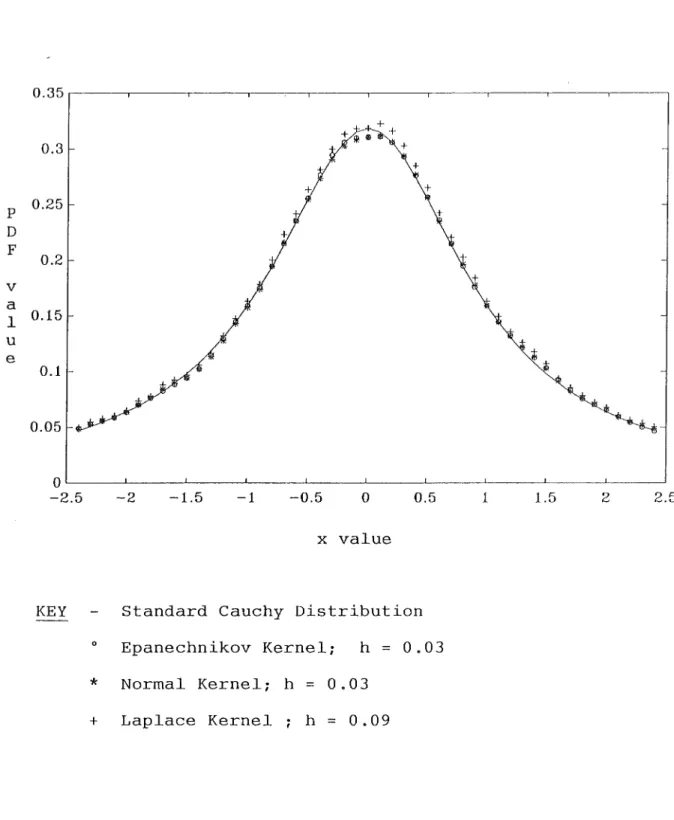
Thompson (1976). Figure 5.1 illustrates the results obtained for
100,000 replications, and given the asymptotic properties presented
in Section 3 it is expected that all of the estimated densities
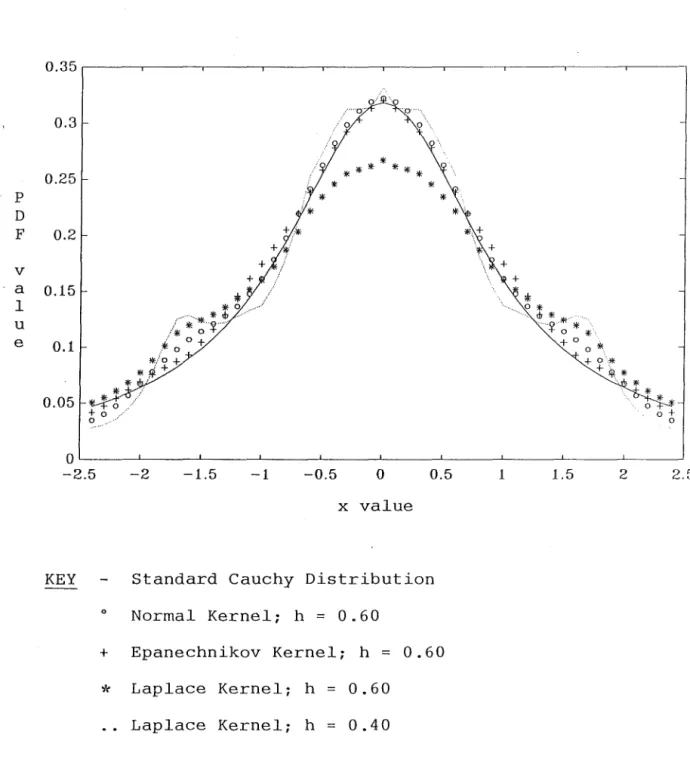
will be very similar. In Figure 5.2 when only 100 replications are
used, some differences, particularly with the Laplace Kernel, are
noticeable, suggesting that in small samples differences do exist
between different Kernels. However, these results are only
illustrative and the differences obtained with this example may not
FIGURE 5.1
Comparison of Different Kernels for Cauchy
Distribution Using 100,000 Replications
0.35
0.3 +
+ +
P 0.25 +
D
+F
0.2+
v
a
1 0.15u
e
it0.1
0.05
0
-2.5 -2 -1.5 -1 -0.5 0 0.5 1 1.5 2 2.5
x
value
KEY
Standard Cauchy Distribution
o
Epanechnikov Kernel; h
=
0.03
*
Normal Kernel; h
0.03
P
D F
v a
1 u
e
FIGURE 5.2
Comparison of Different Kernels for Cauchy
Distribution Using 100 Replications
0.35~----~---.---~----~---.---~----~---.---.---,
0.3
0.25
0.2
0.15
0.1
0.05
*'
0* d7*'
~'
y~** +0 o .
*'
+ 0'* +ip,*
0+ o
o~----~----~~----~----~---~----~---~----~---~----~
-2.5 -2 -1.5 -1 -0.5
o
0.5 1 1.5 2x
value
KEY
Standard Cauchy Distribution
o