On the Relevance of Syntactic and Discourse Features for Author
Profiling and Identification
Juan Soler-Company
UPF
Carrer de Roc Boronat 138 Barcelona, 08018, Spain
Leo Wanner
UPF and ICREA Carrer de Roc Boronat 138
Barcelona, 08018, Spain
Abstract
The majority of approaches to author profiling and author identification focus mainly on lexical features, i.e., on the con-tent of a text. We argue that syntactic dependency and discourse features play a significantly more prominent role than they were given in the past. We show that they achieve state-of-the-art performance in author and gender identification on a lit-erary corpus while keeping the feature set small: the used feature set is composed of only 188 features and still outperforms the winner of the PAN 2014 shared task on au-thor verification in the literary genre.
1 Introduction
Author profiling and author identification are two tasks in the context of the automatic derivation of author-related information from textual material. In the case of author profiling, demographic author information such as gender or age is to be derived; in the case of author identification, the goal is to predict the author of a text, selected from a pool of potential candidates. The basic assumption under-lying author profiling is that, as a result of being exposed to similar influences, authors who share demographic traits also share linguistic patterns in their writings. The assumption underlying author identification is that the writing style of an author is unique enough to be characterized accurately and to be distinguishable from the style of other authors. State-of-the-art approaches commonly use large amounts of lexical features to address both tasks. We show that with a small number of features, most of them syntactic or discourse-based, we outperform the best models in the PAN 2014 author verification shared task (Stamatatos et al., 2014) on a literary genre dataset and achieve
state-of-the-art performance in author and gender identification on a different literary corpus.
In the next section, we briefly review the related work. In Section 3, we describe the experimental setup and the features that are used in the exper-iments. Section 4 presents the experiments and their discussion. Finally, in Section 5, we draw some conclusions and sketch the future line of our research in this area.
2 Related Work
Author identification in the context of the liter-ary genre attracted attention beyond the NLP re-search circles, e.g., due to the work by Alju-mily (2015), who addressed the allegations that Shakespeare did not write some of his best plays using clustering techniques with function word frequency, word n-grams and character
n-grams. Another example of this type of work is (Gamon, 2004), where the author clas-sifies the writings of the Bront¨e sisters using as features the sentence length, number of nom-inal/adjectival/adverbial phrases, function word frequencies, part-of-speech (PoS) trigrams, con-stituency patterns, semantic information and n -gram frequencies. In the field of author pro-filing, several works addressed specifically gen-der identification. Schler et al. (2006), Koppel et al. (2002) extract function words, PoS and the 1000 words that have more information gain. Sarawgi et al. (2011) use long-distance syntactic patterns based on probabilistic context-free gram-mars, token-level language models and character-level language models.
In what follows, we focus on the identifica-tion of the author profiling trait ‘gender’ and on author identification as such. For both, feature engineering is crucial and for both the tendency is to use word/charactern-grams and/or function
and stop word frequencies (Mosteller and Wal-lace, 1963; Aljumily, 2015; Gamon, 2004; Arg-amon et al., 2009), PoS tags (Koppel et al., 2002; Mukherjee and Liu, 2010), or patterns captured by context-free-grammar-derived linguistic patterns; see e.g. (Raghavan et al., 2010; Sarawgi et al., 2011; Gamon, 2004). When syntactic features are mentioned, often function words and punctuation marks are meant; see e.g. (Amuchi et al., 2012; Abbasi and Chen, 2005; Cheng et al., 2009). How-ever, it is well-known from linguistics and philol-ogy that deeper syntactic features, such as sen-tence structure, the frequency of specific phrasal, and syntactic dependency patterns, and discourse structure are relevant characteristics of the writing style of an author (Crystal and Davy, 1969; Di-Marco and Hirst, 1993; Burstein et al., 2003).
3 Experimental Setup
State-of-the-art techniques for author profiling / identification usually draw upon large quantities of features; e.g., Burger et al. (2011) use more than 15 million features and Argamon et al. (2009) and Mukherjee and Liu (2010) more than 1,000. This limits their application in practice. Our goal is to demonstrate that the use of syntactic dependency and discourse features allows us to minimize the total number of features to less than 200 and still achieve competitive performance with a standard classification technique. For this purpose, we use Support Vector Machines (SVMs) with a linear kernel in four different experiments. Let us intro-duce now these features and the data on which the trained models have been tested.
3.1 Feature Set
We extracted 188 surface-oriented, syntactic de-pendency, and discourse structure features for our experiments. The surface-oriented features are few since syntactic and discourse structure fea-tures are assumed to reflect better than surface-oriented features the unconscious stylistic choices of the authors.
For feature extraction, Python and its natural language toolkit, a dependency parser (Bohnet, 2010), and a discourse parser (Surdeanu et al., 2015) are used.
The feature set is composed of six subgroups of features:
Character-based features are composed of the ratios between upper case characters,
peri-ods, commas, parentheses, exclamations, colons, number digits, semicolons, hyphens and quotation marks and the total number of characters in a text. Word-based features are composed of the mean number of characters per word, vocabulary richness, acronyms, stopwords, first person pro-nouns, usage of words composed by two or three characters, standard deviation of word length and the difference between the longest and shortest words.
Sentence-based features are composed of the mean number of words per sentence, standard de-viation of words per sentence and the difference between the maximum and minimum number of words per sentence in a text.
Dictionary-based featuresconsist of the ratios of discourse markers, interjections, abbreviations, curse words, and polar words (positive and nega-tive words in the polarity dictionaries described in (Hu and Liu, 2004)) with respect to the total num-ber of words in a text.
Syntactic featuresThree types of syntactic fea-tures are distinguished:
1. Part-of-Speech featuresare given by the rel-ative frequency of each PoS tag1in a text, the
rel-ative frequency of comparrel-ative/superlrel-ative adjec-tives and adverbs and the relative frequency of the present and past tenses. In addition to the fine-grained Penn Treebank tags, we introduce general grammatical categories (such as ‘verb’, ‘noun’, etc.) and calculate their frequencies.
ber of children per level. In other words, the tree features characterize the complexity of the depen-dency structure of the sentences.
These measures are also applied to subordinate and coordinate clauses.
Discourse features characterize the discourse structure of a text. To obtain the discourse struc-ture, we use Surdeanu et al. (2015)’s discourse parser, which receives as input a raw text, divides it into Elementary Discourse Units (EDUs) and links them via discourse relations that follow the Rhetorical Structure Theory (Mann and Thomp-son, 1988).
We compute the frequency of each discourse relation per EDU (dividing the number of occur-rences of each discourse relation by the number of EDUs per text) and additionally take into account the shape of the discourse trees by extracting their depth, width and ramification factor.
3.2 Datasets
We use two datasets. The first dataset is a corpus of chapters (henceforth, referred to as “Literary-Dataset”) extracted from novels downloaded from the “Project Gutenberg” website2. Novels from
18 different authors were selected. Three novels per author were downloaded and divided by chap-ter, labeled by the gender and name of the author, as well as by the book they correspond to. All of the authors are British and lived in roughly the same time period. Half of the authors are male and half female3. The dataset is composed of 1793
in-stances.
The second dataset is publicly available4 and
was used in 2014’s PAN author verification task (Stamatatos et al., 2014). It contains groups of literary texts that are written by the same author and a text whose author is unknown (henceforth, “PANLiterary”).
3.3 Experiments
As already mentioned above, we carried out four experiments; the first three of them on the
Lit-2https://www.gutenberg.org/
3The 18 selected authors are: Virginia Woolf, Arthur Conan Doyle, Anne Bront¨e, Charlotte Bront¨e, Lewis Car-roll, Agatha Christie, William Makepeace Thackeray, Oscar Wilde, Maria Edgeworth, Elisabeth Gaskell, Bram Stoker, James Joyce, Jane Austen, Charles Dickens, H.G Wells, Robert Louis Stevenson, Mary Anne Evans (known as George Eliot) and Margaret Oliphant.
4http://pan.webis.de/clef14/pan14-web/ author-identification.html
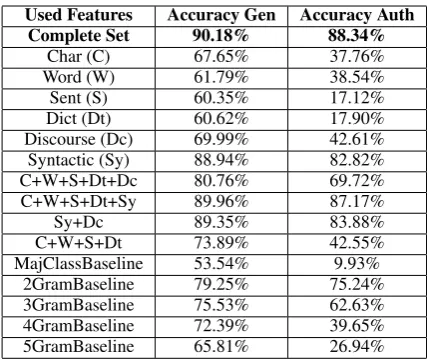
Used Features Accuracy Gen Accuracy Auth
Complete Set 90.18% 88.34%
Char (C) 67.65% 37.76%
Word (W) 61.79% 38.54%
Sent (S) 60.35% 17.12%
Dict (Dt) 60.62% 17.90%
Discourse (Dc) 69.99% 42.61% Syntactic (Sy) 88.94% 82.82%
C+W+S+Dt+Dc 80.76% 69.72%
C+W+S+Dt+Sy 89.96% 87.17%
Sy+Dc 89.35% 83.88%
C+W+S+Dt 73.89% 42.55%
[image:3.595.309.523.60.240.2]MajClassBaseline 53.54% 9.93% 2GramBaseline 79.25% 75.24% 3GramBaseline 75.53% 62.63% 4GramBaseline 72.39% 39.65% 5GramBaseline 65.81% 26.94%
Table 1: Results of the Gender and Author Identi-fication Experiments
eraryDataset, and the last one on the PANLiter-ary dataset. The LiterPANLiter-aryDataset experiments tar-geted gender identification, author identification, and identification to which of the 54 books a given chapter belongs, respectively. The PANLiterary experiment dealt with author verification, anal-ogously to the corresponding PAN 2014 shared task.
4 Experiment Results and Discussion
4.1 Gender Identification
The gender identification experiment is casted as a supervised binary classification problem. Table 1 shows in the column ‘Accuracy Gen’ the perfor-mance of the SVM with each feature group sep-arately as well as with the full set and with some feature combinations. The performance of the ma-jority class classifier (MajClassBaseline) and of four different baselines, where the 300 most fre-quent tokenn-grams (2–5 grams were considered) are used as classification features, are also shown for comparison.
4.2 Author Identification
The second experiment classifies the texts from the LiteraryDataset by their authors. It is a 18-class 18-classification problem, which is consider-ably more challenging. Table 1 (column ‘Accu-racy Auth’) shows the performance of our model with 10-fold cross-validation when using the full set of features and different feature combinations. The results of the 10-fold author identification experiment show that syntactic dependency fea-tures are also the most effective for the charac-terization of the writing style of the authors. The model with the full set of features obtains 88.34% accuracy, which outperforms the n-gram base-lines. The high accuracy of syntactic dependency features compared to other sets of features proves again that dependency syntax is a very powerful profiling tool that has not been used to its full po-tential in the field.
Analyzing the confusion matrix of the experi-ment, some interesting conclusions can be drawn; due to the lack of space, let us focus on only a few of them. For instance, the novels by Elisa-beth Gaskell are confused with the novels by Mary Anne Evans, Jane Austen and Margaret Oliphant. This is likely because not only do all of these au-thors share the gender, but Austen is also consid-ered to be one of the main influencers of Gaskell. Even though, Agatha Christie is predicted cor-rectly most of the times, when she is confused with another author, it is with Arthur Conan Doyle. This may not be surprising since Arthur Conan Doyle and, more specifically, the books about Sherlock Holmes, greatly influenced her writing, resulting in many detective novels with Detective Poirot as protagonist (Christie’s personification of Sherlock Holmes). Other mispredictions (such as the confusion of Bram Stoker with Elisabeth Gaskell) require a deeper analysis and possibly also highlight the need for more training material.
4.3 Source Book Identification
To further prove the profiling potential of syntac-tic and discourse features, we carried out an addi-tional experiment. The goal was to identify from which of the 54 books a given chapter is, making use of syntactic and discourse features only. Us-ing the same method and 10-fold cross-validation, 83.01% of accuracy was achieved. The interesting part of this experiment is the error analysis. “Silas Marner”, written by Mary Anne Evans (known as
George Elliot), is one of the books that created the highest confusion; it is often confused with “Mill on the Floss” written by the same author. “Kid-napped” by Robert Louis Stevenson, which is very different from the other considered books by the same author, is confused with “Treasure Island” also by Stevenson, and “Great Expectations” by Charles Dickens. “Pride and Prejudice” by Jane Austen is confused with “Sense and Sensibility” also by her. The majority of confusions are be-tween books by the same author, which proves our point further: syntactic and discourse struc-tures constitute very powerful, underused profil-ing features (recall that for this experiment, we used only syntactic and discourse features; none of the features was content- or surface-oriented). When the full set of features was used, the accu-racy improved to 91.41%. In that case, the main sources of confusion were between “Agnes Grey” and “The Tenant of Wildfell Hall”, both by Anne Bront¨e and between “Silas Marner” and “Mill on the Floss”, both by G. Elliot.
4.4 PAN Author Verification
The literary dataset in the PAN 2014 shared task on author verification contains pairs of text in-stances where one text is written by a specific author and the goal is to determine whether the other instance is also written by the same author. Note that the task of author verification is different from the task of author identification. To apply our model in this context, we compute the feature val-ues for each pair of known-anonymous instances and substract the feature values of the known in-stance from the features of the anonymous one; the feature values are normalized. As a result, a fea-ture difference vector for each pair is computed. The vector is labeled so as to indicate whether both instances were written by the same author or not.
The task performance measure is computed by multiplying the area under the ROC curve (AUC) and the “c@1” score, which is a metric that takes into account unpredicted instances. In our case, the classifier outputs a prediction for each test in-stance, such that the c@1 score is equivalent to ac-curacy. In Table 2, the performance of our model, compared to the winner and second ranked of the English literary text section of the shared task (cf. (Modaresi and Gross, 2014) and (Zamani et al., 2014) for details), is shown.
Approach Final Score AUC c@1
Our Model 0.671 0.866 0.775
Modaressi & Gross 0.508 0.711 0.715 Zamani et al. 0.476 0.733 0.650 META-CLASSIFIER 0.472 0.732 0.645
[image:5.595.307.527.62.248.2]BASELINE 0.202 0.453 0.445
Table 2: Performance of our model compared to other participants on the “PANLiterary” dataset
as the best performing approach of the shared task, the META-CLASSIFIER (MC), by a large margin. The task baseline is the best-performing language-independent approach of the PAN-2013 shared task. MC is an ensemble of all systems that participated in the task in that it uses for its deci-sion the averaged probability scores of all of them.
4.5 Feature Analysis
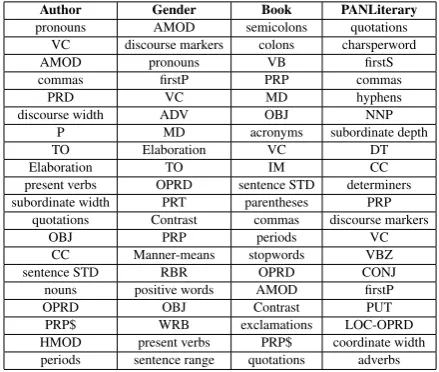
Table 3 displays the 20 features with the high-est information gain, ordered top-down (upper be-ing the highest) for each of the presented experi-ments.5 Syntactic features prove again to be
rele-vant in all the experiments. The table shows that there are features that work well for the majority of the experiments. This includes, e.g., the usage of verb chains (VC), syntactic objects (OBJ), com-mas, predicative complements of control verbs (OPRD), or adjective modifiers (AMOD). It is in-teresting to note that the Elaboration discourse re-lation is distinctive in the first two experiments, while the usage of Contrast relation becomes rele-vant to gender and book identification. These fea-tures are not helpful in the PANLiterary experi-ment, where discourse patterns were not found in the small dataset. The discourse tree width and the subordinate clause width are distinctive in the author identification experiment, while they are
5The features starting with a capital are discourse rela-tions; ‘sentence range’ is defined as the difference between the minimum and maximum value of words per sentence. ‘STD’: standard deviation, ‘firstP’: first person plural pro-nouns, ‘AMOD’: Adjective/adverbial modifier f(requency), ‘VC’: Verb Chain f, ‘PRD’: Predicative complement f, ‘ADV’: General Adverbial f, ‘P’: Punctuation f, ‘MD’: Modal Verb f, ‘TO’: Particletof, ‘OPRD’: Predicative Complement of raising/control verb f, ‘PRT’: Particle dependent on the verb f, ‘OBJ’: Object f, ‘PRP’: Adverbial of Purpose or Rea-son f, ‘CC’: Coordinating Conjunction f, ‘RBR’: Compara-tive Adverb f, ‘PRP$’: Possessive Pronoun f, ‘WRB’: Wh-Adverb f, ‘HMOD’: Dependent on the Head of a Hyphenated Word f., ‘NNP’: Singular proper noun f, ‘DT’: Determiner f, ‘VBZ’: 3rd person singular present verb f, ‘CONJ’: Second conjunct (dependent on conjunction) f, ‘PUT’: Complement of the verb put f, ‘LOC-OPRD’: non-atomic dependency that combines a Locative adverbial and a predicative complement of a control verb f.
Author Gender Book PANLiterary
pronouns AMOD semicolons quotations VC discourse markers colons charsperword
AMOD pronouns VB firstS
commas firstP PRP commas
PRD VC MD hyphens
discourse width ADV OBJ NNP
P MD acronyms subordinate depth
TO Elaboration VC DT
Elaboration TO IM CC
present verbs OPRD sentence STD determiners subordinate width PRT parentheses PRP
quotations Contrast commas discourse markers
OBJ PRP periods VC
CC Manner-means stopwords VBZ
sentence STD RBR OPRD CONJ
nouns positive words AMOD firstP
OPRD OBJ Contrast PUT
PRP$ WRB exclamations LOC-OPRD HMOD present verbs PRP$ coordinate width periods sentence range quotations adverbs
Table 3: 20 features with the highest information gain in all the experiments
not in the other experiments. This is likely be-cause they can serve as indicators of the structural complexity of a text and thus of the idiosyncrasy of a writing style of an individual – as punctua-tion marks such as periods and commas, which are typical stylistic features. Discourse markers, words with positive sentiment, first person plural pronouns, Wh-Adverbs and modal verbs are dis-tinctive features in the gender identification exper-iment. The fact that the usage of positive words is only relevant in the gender identification ex-periment could be caused by the differences in the expressiveness/emotiveness of the writings of men and women. Punctuation marks become very distinctive in the book identification experiment, where the usage of colons, semicolons, parenthe-ses, commas, periods, exclamations and quotation marks are among the most relevant features of the experiment. Syntactic shape features are distinc-tive in the author identification and PANLiterary experiments while not as impactful in the rest of the experiments.
5 Conclusions and Future Work
[image:5.595.75.287.62.126.2]References
Ahmed Abbasi and Hsinchun Chen. 2005. Applying authorship analysis to extremist-group web forum messages. IEEE Intelligent Systems, 20(5):67–75.
Refat Aljumily. 2015. Hierarchical and
non-hierarchical linear and non-linear clustering
meth-ods to “shakespeare authorship question”. Social
Sciences, 4(3):758–799.
Faith Amuchi, Ameer Al-Nemrat, Mamoun Alazab, and Robert Layton. 2012. Identifying cyber preda-tors through forensic authorship analysis of chat
logs. In Cybercrime and Trustworthy Computing
Workshop (CTC), 2012 Third, pages 28–37, Ballarat, Australia, October. IEEE Computer Society. Shlomo Argamon, Moshe Koppel, James W.
Pen-nebaker, and Jonathan Schler. 2009. Automatically
profiling the author of an anonymous text.
Commu-nications of the ACM, 52(2):119–123.
Bernd Bohnet. 2010. Very high accuracy and fast de-pendency parsing is not a contradiction. In Proceed-ings of the 23rd International Conference on Com-putational Linguistics, pages 89–97, Beijing, China, August. Association for Computational Linguistics. John D. Burger, John Henderson, George Kim, and Guido Zarrella. 2011. Discriminating gender on
twitter. InProceedings of the 2011 Conference on
Empirical Methods in Natural Language
Process-ing, pages 1301–1309, Edinburgh, Scotland, UK.,
July. Association for Computational Linguistics. Jill Burstein, David Marcu, and Kevin Knight. 2003.
Finding the write stuff: automatic identification of discourse structure in student essays. IEEE Intelli-gent Systems, 18(1):32–39.
Na Cheng, Xiaoling Chen, R. Chandramouli, and K. P. Subbalakshmi. 2009. Gender identification from
e-mails. InComputational Intelligence and Data
Min-ing, 2009. CIDM ’09. IEEE Symposium on, pages 154–158, Nashville, TN, USA, March. IEEE Com-puter Society.
David Crystal and Derek Davy. 1969. Investigating
English style. Indiana University Press Blooming-ton.
Chrysanne DiMarco and Graeme Hirst. 1993. A com-putational theory of goal-directed style in syntax.
Computational Linguistics, 19(3):451–499.
Michael Gamon. 2004. Linguistic correlates of style: authorship classification with deep linguistic analy-sis features. InProceedings of Coling 2004, pages 611–617, Geneva, Switzerland, Aug 23–Aug 27. COLING.
Minqing Hu and Bing Liu. 2004. Mining and summa-rizing customer reviews. InProceedings of the Tenth ACM SIGKDD International Conference on Knowl-edge Discovery and Data Mining, pages 168–177, Seattle, WA, USA, August. ACM.
Moshe Koppel, Shlomo Argamon, and Anat Rachel Shimoni. 2002. Automatically categorizing writ-ten texts by author gender. Literary and Linguistic Computing, 17(4):401–412.
William C. Mann and Sandra A. Thompson. 1988. Rhetorical structure theory: Toward a functional
the-ory of text organization. Text - Interdisciplinary
Journal for the Study of Discourse, 8(3):243–281. Pashutan Modaresi and Philipp Gross. 2014. A
lan-guage independent author verifier using fuzzy
c-means clustering. InCLEF 2014 Evaluation Labs
and Workshop – Working Notes Papers, pages 877– 897, Sheffield, UK, September. CEUR-WS.org. Frederick Mosteller and David L. Wallace. 1963.
In-ference in an authorship problem: A comparative study of discrimination methods applied to the au-thorship of the disputed federalist papers.Journal of the American Statistical Association, 58(302):275– 309.
Arjun Mukherjee and Bing Liu. 2010. Improving
gender classification of blog authors. In
Proceed-ings of the 2010 Conference on Empirical Methods in Natural Language Processing, pages 207–217, Cambridge, MA, October. Association for Compu-tational Linguistics.
Sindhu Raghavan, Adriana Kovashka, and Raymond Mooney. 2010. Authorship attribution using
prob-abilistic context-free grammars. In Proceedings of
the ACL 2010 Conference Short Papers, pages 38– 42, Uppsala, Sweden, July. Association for Compu-tational Linguistics.
Ruchita Sarawgi, Kailash Gajulapalli, and Yejin Choi. 2011. Gender attribution: Tracing stylometric
ev-idence beyond topic and genre. InProceedings of
the Fifteenth Conference on Computational Natural Language Learning, pages 78–86, Portland, Oregon, USA, June. Association for Computational Linguis-tics.
Jonathan Schler, Moshe Koppel, Shlomo Argamon, and James W. Pennebaker. 2006. Effects of age
and gender on blogging. In AAAI Spring
Sympo-sium: Computational Approaches to Analyzing We-blogs, pages 199–205, Palo Alto, California, March. AAAI.
Efstathios Stamatatos, Walter Daelemans, Ben Verho-even, Martin Potthast, Benno Stein, Patrick Juola, Miguel A. Sanchez-Perez, and Alberto Barr´on-Cede˜no. 2014. Overview of the Author
Identifica-tion Task at PAN 2014. InCLEF 2014 Evaluation
Labs and Workshop – Working Notes Papers, 15-18 September, Sheffield, UK, pages 877–897, Sheffield, UK, September. CEUR-WS.org.
Mihai Surdeanu, Richard Johansson, Adam Meyers, Llu´ıs M`arquez, and Joakim Nivre. 2008. The conll-2008 shared task on joint parsing of syntactic
Twelfth Conference on Computational Natural Lan-guage Learning, pages 159–177, Manchester, UK, August. Association for Computational Linguistics. Mihai Surdeanu, Tom Hicks, and Marco Antonio Valenzuela-Escarcega. 2015. Two practical rhetori-cal structure theory parsers. InProceedings of the 2015 Conference of the North American Chapter of the Association for Computational Linguistics: Demonstrations, pages 1–5, Denver, Colorado, June. Association for Computational Linguistics.
Hamed Zamani, Hossein Nasr Esfahani, Pariya Babaie, Samira Abnar, Mostafa Dehghani, and Azadeh Shakery. 2014. Authorship identification using dy-namic selection of features from probabilistic
fea-ture set. In CLEF 2014 Evaluation Labs and