Proceedings of the 2019 Conference on Empirical Methods in Natural Language Processing and the 9th International Joint Conference on Natural Language Processing, pages 791–802,
791
Improving Back-Translation
with Uncertainty-based Confidence Estimation
Shuo Wang†, Yang Liu†?∗, Chao Wang>, Huanbo Luan†, and Maosong Sun†
†Institute for Artificial Intelligence
State Key Laboratory of Intelligent Technology and Systems
Department of Computer Science and Technology, Tsinghua University, Beijing, China Beijing National Research Center for Information Science and Technology
?Beijing Advanced Innovation Center for Language Resources
>6ESTATES PTE LTD, Singapore
Abstract
While back-translation is simple and effec-tive in exploiting abundant monolingual cor-pora to improve low-resource neural machine translation (NMT), the synthetic bilingual cor-pora generated by NMT models trained on limited authentic bilingual data are inevitably
noisy. In this work, we propose to
quan-tify the confidence of NMT model predictions based on model uncertainty. With word- and sentence-level confidence measures based on uncertainty, it is possible for back-translation to better cope with noise in synthetic bilingual corpora. Experiments on Chinese-English and English-German translation tasks show that uncertainty-based confidence estimation sig-nificantly improves the performance of
back-translation.1
1 Introduction
The past several years have witnessed the rapid development of end-to-end neural machine
trans-lation (NMT) (Sutskever et al., 2014; Bahdanau
et al., 2015; Vaswani et al., 2017), which
lever-ages neural networks to map between natural lan-guages. Capable of learning representations from data, NMT has significantly outperformed con-ventional statistical machine translation (SMT)
(Koehn et al.,2003) and been widely deployed in
large-scale MT systems in the industry (Wu et al.,
2016;Hassan et al.,2018).
Despite the remarkable success, NMT suffers
from the data scarcity problem. For most
lan-guage pairs, large-scale, high-quality, and wide-coverage bilingual corpora do not exist. Even for the top handful of resource-rich languages, the major sources of available parallel corpora are
of-∗
Yang Liu is the corresponding author: liuyang2011@ tsinghua.edu.cn.
1The source code is available at https://github.
com/THUNLP-MT/UCE4BT
Bush hold a talks and Sharon
… …
bushi yu shalong jvxing le huitan y
<latexit sha1_base64="oyl3CDdc4pKXMbwMXulNjWZ+gQY=">AAAB8XicbVBNS8NAFHypX7V+VT16WSyCp5KooMeiF48VbC22oWy2m3bpZhN2X4QS+i+8eFDEq//Gm//GTZuDtg4sDDPvsfMmSKQw6LrfTmlldW19o7xZ2dre2d2r7h+0TZxqxlsslrHuBNRwKRRvoUDJO4nmNAokfwjGN7n/8MS1EbG6x0nC/YgOlQgFo2ilx15EcRSE2WTar9bcujsDWSZeQWpQoNmvfvUGMUsjrpBJakzXcxP0M6pRMMmnlV5qeELZmA5511JFI278bJZ4Sk6sMiBhrO1TSGbq742MRsZMosBO5gnNopeL/3ndFMMrPxMqSZErNv8oTCXBmOTnk4HQnKGcWEKZFjYrYSOqKUNbUsWW4C2evEzaZ3XvvO7eXdQa10UdZTiCYzgFDy6hAbfQhBYwUPAMr/DmGOfFeXc+5qMlp9g5hD9wPn8A/2iRHw==</latexit>
ˆ
x
<latexit sha1_base64="7tb573AAnuxEhCsAMHcBVcKq+Ps=">AAAB+XicbVDLSsNAFJ3UV62vqEs3g0VwVRIVdFl047KCfUATymQ6aYdOJmHmplhC/sSNC0Xc+ifu/BsnbRbaemDgcM693DMnSATX4DjfVmVtfWNzq7pd29nd2z+wD486Ok4VZW0ai1j1AqKZ4JK1gYNgvUQxEgWCdYPJXeF3p0xpHstHmCXMj8hI8pBTAkYa2LY3JpB5EYFxEGZPeT6w607DmQOvErckdVSiNbC/vGFM04hJoIJo3XedBPyMKOBUsLzmpZolhE7IiPUNlSRi2s/myXN8ZpQhDmNlngQ8V39vZCTSehYFZrKIqJe9QvzP66cQ3vgZl0kKTNLFoTAVGGJc1ICHXDEKYmYIoYqbrJiOiSIUTFk1U4K7/OVV0rlouJcN5+Gq3rwt66iiE3SKzpGLrlET3aMWaiOKpugZvaI3K7NerHfrYzFascqdY/QH1ucPVq+UHA==</latexit>
ˆ ✓y!x
<latexit sha1_base64="8nrQv4PTgwZpETGQRGNPpnJ4wWA=">AAACHHicbVDLSsNAFJ34tr6qLt0MFsFVSVTQZdGNSwXbCk0pN9NJM3QmCTM3agn5AH/CX3Cre3fiVnDrlzitWaj1wMDhnHO5d06QSmHQdT+cmdm5+YXFpeXKyura+kZ1c6tlkkwz3mSJTPR1AIZLEfMmCpT8OtUcVCB5Oxiejf32DddGJPEVjlLeVTCIRSgYoJV61ZofAeZ+oHIfI45QFL18RH0tBhGC1sktvStsyq27E9Bp4pWkRkpc9Kqffj9hmeIxMgnGdDw3xW4OGgWTvKj4meEpsCEMeMfSGBQ33XzymYLuWaVPw0TbFyOdqD8nclDGjFRgkwowMn+9sfif18kwPOnmIk4z5DH7XhRmkmJCx83QvtCcoRxZAkwLeytlEWhgaPv7tSVQRcWW4v2tYJq0DureYd29PKo1Tst6lsgO2SX7xCPHpEHOyQVpEkbuySN5Is/Og/PivDpv39EZp5zZJr/gvH8BUcyjBA==</latexit>
[image:1.595.333.490.226.363.2]confidence
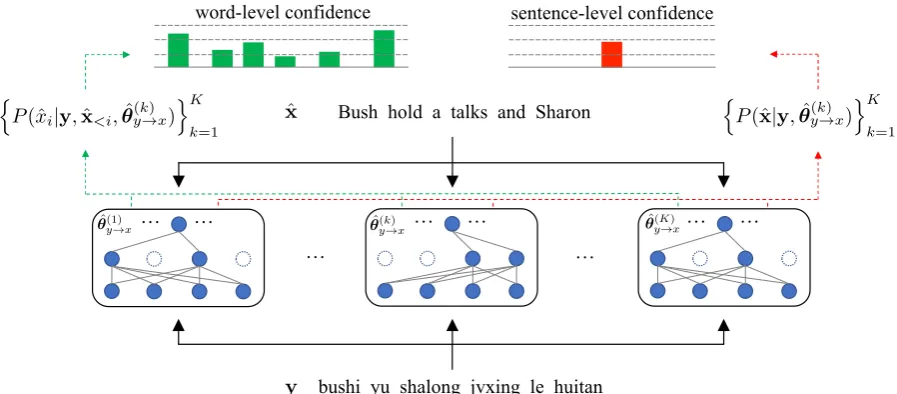
Figure 1: Confidence estimation for back-translation. Back-translation generates a source (e.g., English) sen-tence for a ground-truth target (e.g., Chinese) sensen-tence. Such synthetic sentence pairs are used to train NMT
models. As the model prediction (i.e.,ˆx) is often noisy,
our work aims to quantify the prediction confidence us-ing model uncertainty to alleviate error propagation.
ten restricted to government documents or news articles.
Therefore, improving NMT under small-data training conditions has attracted extensive
atten-tion in recent years (Sennrich et al.,2016a;Cheng
et al.,2016;Zoph et al.,2016;Chen et al.,2017;
Fadaee et al.,2017;Ren et al.,2018;Lample et al.,
2018). Among them, back-translation (Sennrich
et al., 2016a) is an important direction. Its
performance (Fadaee and Monz, 2018; Poncelas
et al.,2018).
In this work, we propose a method to quantify the confidence of NMT model predictions to en-able back-translation to better cope with
transla-tion errors. The central idea is to use model
un-certainty (Buntine and Weigend, 1991; Gal and
Ghahramani, 2016; Dong et al., 2018; Xiao and
Wang, 2019) to measure whether the model
pa-rameters can best describe the data distribution. Based on the expectation and variance of word-and sentence-level translation probabilities calcu-lated by Monte Carlo Dropout (Gal and
Ghahra-mani, 2016), we introduce various confidence
measures.
Different from most previous quality estima-tion studies that require feature extracestima-tion (Blatz
et al., 2004; Specia et al., 2009; Salehi et al.,
2014) or post-edited data (Kim et al.,2017;Wang
et al., 2018; Ive et al., 2018) to train external
confidence estimators, all our approach needs is the NMT model itself. Hence, it is easy to ap-ply our approach to arbitrary NMT models trained
for arbitrary language pairs. Experiments on
Chinese-English and English-German translation tasks show that our approach significantly im-proves the performance of back-translation.
2 Background
Letx = x1. . . xI be a source-language sentence andy = y1. . . yJ be a target-language sentence.
We useP(y|x,θx→y)to denote a source-to-target
NMT model (Sutskever et al., 2014; Bahdanau
et al., 2015;Vaswani et al., 2017) parameterized
by θx→y. Similarly, the target-to-source NMT
model is denoted byP(x|y,θy→x).
Let Db = {hx(m),y(m)i}Mm=1 be anauthentic
bilingual corpus that contains M sentence pairs
and Dm = {y(n)}Nn=1 be a monolingual corpus
that containsN target sentences. The first step of
back-translation (Sennrich et al.,2016a) is to train
a target-to-source model on the authentic bilingual
corpusDb using maximum likelihood estimation:
ˆ
θy→x= argmax
θy→x n
L(Db,θy→x)
o
, (1)
where the log-likelihood is defined as
L(Db,θy→x) = M
X
m=1
logP(x(m)|y(m),θ
y→x). (2)
The second step is to use the trained model
ˆ
θy→xto translate the monolingual corpusDm:
ˆ
x(n)= argmax x
n
P(x|y(n),θˆ
y→x)
o
, (3)
wherexˆ(n) = ˆx(n)
1 . . .xˆ (n)
I . The word-level
deci-sion rule is given by
ˆ
x(in)= argmax
x
n
P(x|y(n),xˆ(n)
<i,θˆy→x)
o . (4)
The resulting translations {xˆ(n)}N
n=1 can be
combined with Dm to generate a synthetic
bilin-gual corpusD˜b={hxˆ(n),y(n)i}Nn=1.
The third step is to train a source-to-target
model P(y|x,θx→y) on the combination of
au-thentic and synthetic bilingual corpora:
ˆ
θx→y = argmax
θx→y n
L(Db∪D˜b,θx→y)
o
. (5)
This three-step process can iterate until
conver-gence (Hoang et al.,2018;Cotterell and Kreutzer,
2018).
A problem with back-translation is that model predictions are inevitably erroneous. Translation errors can be propagated to subsequent steps and impair the performance of back-translation,
espe-cially when D˜b is much larger than Db (Pinnis
et al., 2017; Fadaee and Monz, 2018; Poncelas
et al., 2018). Therefore, it is crucial to develop
principled solutions to enable back-translation to better deal with the error propagation problem.
3 Approach
This work aims to find solutions to the two follow-ing problems:
1. How to quantify the confidence of model pre-dictions at both word and sentence levels?
2. How to leverage confidence to improve back-translation?
Section3.1introduces how to calculate model
un-certainty, which lays a foundation for designing uncertainty-based word- and sentence-level
confi-dence measures in Section 3.2. Section 3.3
… …
y<latexit sha1_base64="oyl3CDdc4pKXMbwMXulNjWZ+gQY=">AAAB8XicbVBNS8NAFHypX7V+VT16WSyCp5KooMeiF48VbC22oWy2m3bpZhN2X4QS+i+8eFDEq//Gm//GTZuDtg4sDDPvsfMmSKQw6LrfTmlldW19o7xZ2dre2d2r7h+0TZxqxlsslrHuBNRwKRRvoUDJO4nmNAokfwjGN7n/8MS1EbG6x0nC/YgOlQgFo2ilx15EcRSE2WTar9bcujsDWSZeQWpQoNmvfvUGMUsjrpBJakzXcxP0M6pRMMmnlV5qeELZmA5511JFI278bJZ4Sk6sMiBhrO1TSGbq742MRsZMosBO5gnNopeL/3ndFMMrPxMqSZErNv8oTCXBmOTnk4HQnKGcWEKZFjYrYSOqKUNbUsWW4C2evEzaZ3XvvO7eXdQa10UdZTiCYzgFDy6hAbfQhBYwUPAMr/DmGOfFeXc+5qMlp9g5hD9wPn8A/2iRHw==</latexit>
Bush hold a talks and Sharon ˆ
x
<latexit sha1_base64="7tb573AAnuxEhCsAMHcBVcKq+Ps=">AAAB+XicbVDLSsNAFJ3UV62vqEs3g0VwVRIVdFl047KCfUATymQ6aYdOJmHmplhC/sSNC0Xc+ifu/BsnbRbaemDgcM693DMnSATX4DjfVmVtfWNzq7pd29nd2z+wD486Ok4VZW0ai1j1AqKZ4JK1gYNgvUQxEgWCdYPJXeF3p0xpHstHmCXMj8hI8pBTAkYa2LY3JpB5EYFxEGZPeT6w607DmQOvErckdVSiNbC/vGFM04hJoIJo3XedBPyMKOBUsLzmpZolhE7IiPUNlSRi2s/myXN8ZpQhDmNlngQ8V39vZCTSehYFZrKIqJe9QvzP66cQ3vgZl0kKTNLFoTAVGGJc1ICHXDEKYmYIoYqbrJiOiSIUTFk1U4K7/OVV0rlouJcN5+Gq3rwt66iiE3SKzpGLrlET3aMWaiOKpugZvaI3K7NerHfrYzFascqdY/QH1ucPVq+UHA==</latexit>
… … … …
ˆ ✓(1)
y!x
<latexit sha1_base64="UsFU8kECG4kb1BLzine7E+PwyGU=">AAACInicbVDLSgNBEJz1GeMr6tHLYBDMJeyqoMegF48RTCJkY+idTLJDZnaXmV41LPsN/oS/4FXv3sST4MkvcRJz8FXQUFR1090VJFIYdN03Z2Z2bn5hsbBUXF5ZXVsvbWw2TZxqxhsslrG+DMBwKSLeQIGSXyaagwokbwXD07HfuubaiDi6wFHCOwoGkegLBmilbqnih4CZH6jMx5Aj5PlVtudV8m42or4WgxBB6/iG3ubdUtmtuhPQv8SbkjKZot4tffi9mKWKR8gkGNP23AQ7GWgUTPK86KeGJ8CGMOBtSyNQ3HSyyUs53bVKj/ZjbStCOlG/T2SgjBmpwHYqwND89sbif147xf5xJxNRkiKP2NeifiopxnScD+0JzRnKkSXAtLC3UhaCBoY2xR9bApUXbSje7wj+kuZ+1TuouueH5drJNJ4C2SY7ZI945IjUyBmpkwZh5I48kEfy5Nw7z86L8/rVOuNMZ7bIDzjvn2vppRg=</latexit>
ˆ ✓y(K!)x
<latexit sha1_base64="p01mIOpnYY+pvsvQvMl6/m3O3zI=">AAACInicbVA9SwNBEN3zM8avqKXNYhC0CXcqaBm0EWwimCjkYpjbbHKLu3fH7pwajvsN/gn/gq32dmIlWPlL3MQUxvhg4PHeDDPzgkQKg6774UxNz8zOzRcWiotLyyurpbX1holTzXidxTLWVwEYLkXE6yhQ8qtEc1CB5JfBzcnAv7zl2og4usB+wlsKepHoCgZopXZp1w8BMz9QmY8hR8jz62znbDdvZ33qa9ELEbSO7+h93i6V3Yo7BJ0k3oiUyQi1dunL78QsVTxCJsGYpucm2MpAo2CS50U/NTwBdgM93rQ0AsVNKxu+lNNtq3RoN9a2IqRD9fdEBsqYvgpspwIMzV9vIP7nNVPsHrUyESUp8oj9LOqmkmJMB/nQjtCcoexbAkwLeytlIWhgaFMc2xKovGhD8f5GMEkaexVvv+KeH5Srx6N4CmSTbJEd4pFDUiWnpEbqhJEH8kSeyYvz6Lw6b877T+uUM5rZIGNwPr8BlvmlMg==</latexit>
ˆ ✓<latexit sha1_base64="JfosC98eh4E7Og9wHTn80AK6ors=">AAACInicbVDLSgNBEJz1bXxFPXoZDIJewq4KehS9eIxgEiEbQ+9kkh0ys7vM9Kph2W/wJ/wFr3r3Jp4ET36Jk8dBEwsaiqpuuruCRAqDrvvpzMzOzS8sLi0XVlbX1jeKm1s1E6ea8SqLZaxvAjBciohXUaDkN4nmoALJ60HvYuDX77g2Io6usZ/wpoJuJDqCAVqpVTzwQ8DMD1TmY8gR8vw22+8d5K2sT30tuiGC1vE9fchbxZJbdoeg08QbkxIZo9IqfvvtmKWKR8gkGNPw3ASbGWgUTPK84KeGJ8B60OUNSyNQ3DSz4Us53bNKm3ZibStCOlR/T2SgjOmrwHYqwNBMegPxP6+RYue0mYkoSZFHbLSok0qKMR3kQ9tCc4aybwkwLeytlIWggaFN8c+WQOUFG4o3GcE0qR2WvaOye3VcOjsfx7NEdsgu2SceOSFn5JJUSJUw8kieyQt5dZ6cN+fd+Ri1zjjjmW3yB87XD8v5pVI=</latexit> (yk!)x
… …
sentence-level confidence word-level confidence
n
P(ˆx|y,✓ˆ(yk!)x) oK
k=1
n
P(ˆxi|y,xˆ<i,✓ˆy(k!)x) oK
k=1
[image:3.595.75.524.68.265.2]bushi yu shalong jvxing le huitan
Figure 2: Illustration of uncertainty calculation. Given a target sentenceyand the model predictionxˆ, our approach
treats word- and sentence-level translation probabilities as random variables and uses Monte Carlo Dropout to draw samples. These samples are used to calculate the expectations and variances of translation probabilities.
3.1 Calculating Uncertainty
Uncertainty quantification, which quantifies how confident a certain mapping is with respect to dif-ferent inputs, has made significant progress due to the recent advances in Bayesian deep learning
(Kendall et al.,2015;Gal and Ghahramani,2016;
Kendall and Gal,2017;Xiao and Wang,2019;Oh
et al.,2019;Geifman et al.,2019;Lee et al.,2019).
In this work, we aim to calculate model
uncer-tainty(Kendall and Gal,2017;Dong et al.,2018;
Xiao and Wang, 2019), which measures whether
a model can best describe the data distribution, for NMT using approximate inference methods widely used in Bayesian neural networks.
Given the authentic bilingual corpus Db,
Bayesian neural networks aim at finding the posterior distribution over model parameters
P(θy→x|Db). With a target sentence y in the
monolingual corpusDm and its translationxˆ, the
translation probability is given by
P(ˆx|y,Db)
=
Z
P(ˆx|y,θy→x)P(θy→x|Db)dθy→x. (6)
In particular, we are interested in calculating the
variance of the distributionP(ˆx|y,θy→x)that
re-flects our ignorance over model parameters, which
is referred to as model uncertainty. As exact
ference is intractable, a number of variational
in-ference methods (Graves, 2011; Blundell et al.,
2015;Gal and Ghahramani,2016) have been
pro-posed to find an approximation to P(θy→x|Db).
In this work, we leverage the widely used Monte
Carlo Dropout (Gal and Ghahramani,2016) to
ob-tain samples of word- and sentence-level transla-tion probabilities.
Figure2illustrates the key idea of our approach.
Given an authentic target sentence y, an NMT
model made its prediction xˆ via a standard
de-coding process (see Eq. (3) and Eq. (4)). To quantify how confident the model was when mak-ing the prediction, our approach treats word- and sentence-level translation probabilities as random
variables.2 Drawing samples can be done by
ran-domly deactivating part of neurons of the NMT model and re-calculating translation probabilities
while keepingyandxˆfixed. This stochastic
feed-forward is repeatedKtimes and generatesK
sam-ples for both word- and sentence-level translation
probabilities, respectively. We useθˆy(k→)xto denote
the model parameters derived fromθˆy→xby
deac-tivation in thek-th pass.
Intuitively, if the variance of translation prob-ability is low, it is highly likely that the model was confident in making the prediction. Given
K samples {P(ˆx|y,θˆy(k→)x)}Kk=1, the expectation
2
of sentence-level translation probability can be ap-proximated by
E
h
P(ˆx|y,θˆy→x)
i ≈ 1
K
K
X
k=1
P(ˆx|y,θˆ(k)
y→x). (7)
The variance of sentence-level translation prob-ability can be approximated by
VarhP(ˆx|y,θˆy→x)
i
≈ 1 K
K
X
k=1
P(ˆx|y,θˆ(k)
y→x)2−E
h
P(ˆx|y,θˆy→x)
i2 , (8)
which is also referred to asmodel uncertainty.
The expectation and variance of word-level translation probabilities can also be calculated
similarly usingKsamples.
3.2 Confidence Measures
We use C(y,xˆ<i,xˆi,θˆy→x) to denote the
word-level confidencefor the model to generatexˆi and
C(y,xˆ,θˆy→x) to the denote the sentence-level
confidencefor the model to generatexˆ.
Intuitively, when making predictions, the more confident an NMT model is, the higher expecta-tion and lower variance of translaexpecta-tion probability are. For comparison reasons, we used the follow-ing four types of confidence measures at the sen-tence level in our experiments:
1. Predicted translation probability(PTP). The translation probability of model prediction during standard decoding (Eq. (3)):
CPTP(y,xˆ,θˆy→x) =P(ˆx|y,θˆy→x). (9)
2. Expected translation probability(EXP). The expectation of translation probability:
CEXP(y,xˆ,θˆy→x) =E
h
P(ˆx|y,θˆy→x)
i .(10)
3. Variance of translation probability (VAR). The variance of translation probability:
CVAR(y,xˆ,θˆy→x)
=1−VarhP(ˆx|y,θˆy→x)
iα
. (11)
4. Combination of expectation and variance
(CEV). The combination of expectation and variance:
CCEV(y,xˆ,θˆy→x)
= 1−Var
P(ˆx|y,θˆy→x)
EP(ˆx|y,θˆy→x)
!β
. (12)
whereαandβare hyper-parameters to control the
gap between confidence values of sentences of
dif-ferent quality. Larger values of α andβ lead to
bigger gaps.3
In Eq. (12), our approach tries to combine the merits of expectation and variance by using ance divided by expectation because smaller vari-ance and bigger expectation are expected to result in higher confidence. There may exist more so-phisticated ways to estimate prediction confidence
using model uncertainty (Dong et al.,2018). As
we find that the measures mentioned above are easy-to-implement and prove to be effective in our experiments, we leave the investigation of more complex confidence measures for future work.
The word-level confidence measures can be de-fined similarly.
3.3 Confidence-aware Training for NMT
We propose confidence-aware training for NMT to enable NMT to make better use of noisy data. Word- and sentence-level confidence measures are complementary: while word-level confidence can provide more fine-grained information than the sentence-level counterpart, it is unable to cope with word omission errors that can only be ctured at the sentence level. As a result, our ap-proach incorporates both word- and sentence-level
confidence measures into the training process.4
Using Sentence-level Confidence
It is easy to integrate sentence-level confidence into back-translation by modifying the likelihood function in Eq. (5):
L(Db∪D˜b,θx→y)
=
M
X
m=1
logP(y(m)|x(m),θx→y) +
N
X
n=1
C(y(n),xˆ(n),θˆ
y→x)×
logP(y(n)|xˆ(n),θx→y). (13)
3Note that all confidence measures are between 0 and 1.
Clearly, both the expectation and variance of a probability are between 0 and 1. It can be proved that the variance of a probability is no greater than the corresponding expectation. As a result,CCEV(·)is also between 0 and 1.
4Instead of applying confidence estimation to the second
original attention weights word-level confidence modified attention weights
Bush hold a talks and Sharon Bush hold a talks and Sharon Bush hold a talks and Sharon
[image:5.595.77.531.73.140.2](a) (b) (c)
Figure 3: Using word-level confidence in confidence-aware training. The basic idea is to use confidence to modify attention weights to pay less attention to erroneous words highlighted in underline. (a) The original attention weights of the NMT model; (b) the word-level confidence of the noisy source sentence; (c) the attention weights
modified by the word-level confidence, which focus more on words with high confidence.is a broadcast product.
See Eq. (15) for details.
Serving as a weight assigned to each synthetic sentence pair, sentence-level confidence is ex-pected to help to minimize the negative effect of estimating parameters on sentences with lower confidence. Note that the confidence of an
authen-tic sentence pair inDbis 1.
Using Word-level Confidence
As the source side instead of the target side of the synthetic bilingual corpus is noisy, word-level confidence cannot be integrated into back-translation in a similar way to sentence-level con-fidence. This is because the word-level confidence associated with each source word does not get in-volved in backpropagation during training.
Alternatively, we build a real-valued word-level confidence vector:
c=nC y(n),xˆ<i(n),xˆi,θˆy→x
oI
i=1. (14)
Due to the wide use of attention (Bahdanau
et al.,2015;Vaswani et al.,2017) in NMT, we use
the confidence vectorc ∈ R1×I to modify
atten-tion weights and enable the model to focus more
on words with high confidence. Figure 3 shows
an example. Figure3(a) gives a source sentence
in the synthetic bilingual corpus, in which erro-neous words “hold”, “talks”, and “and” receive high attention weights, deteriorating the parame-ter estimation on this sentence pair. By
multiply-ing with word-level confidence (Figure3(b)), the
weights are modified to pay less attention to
erro-neous words (Figure3(c)).
More formally, the modified attention function is given by
Attention(Q,K,V,c)
=
softmaxQK
> √
D
c
V, (15)
whereQ ∈ RI×D,K ∈ RI×D, andV ∈ RI×D
are query, key, and value matrices and D is the
hidden size.is a broadcast product.
Since the integration of sentence- and word-level confidence measures are independent of each other, it is easy to use both of them in back-translation.
4 Experiments
4.1 Setup
We evaluated our approach on Chinese-English and English-German translation tasks. The
evalu-ation metric is BLEU (Papineni et al.,2001) as
cal-culated by themulti-bleu.perl script. We
use the paired bootstrap resampling (Koehn,2004)
for significance testing.
For the Chinese-English task, the training
set contains 1.25M sentence pairs from LDC5
with 27.8M Chinese words and 34.5M English words. To build the monolingual corpus for back-translation, we extracted the English side of the training set of the WMT 2017 Chinese-English news translation task. After removing sentences longer than 256 words, we randomly selected 10M English sentences as the monolingual cor-pus. NIST06 is used as the development set and NIST02, 03, 04, 05, and 08 datasets as test sets.
For the English-German task, we used the dataset of the WMT 2014 English-German trans-lation task. The training set consists of 4.47M sen-tence pairs with 116M English words and 110M German words. We randomly selected 4.5M Ger-man sentences from the 2012 News Crawl corpus of WMT 2014 to construct the monolingual cor-pus for back-translation. We use newstest 2013 as
5The training set includes LDC2002E18, LDC2003E07,
Measure BLEU ∆
- 46.23
-PTP 45.41 -0.82
EXP 45.22 -1.01
VAR 46.77 +0.54
[image:6.595.333.500.63.147.2]CEV 47.05 +0.82
Table 1: Comparison of confidence measures.
the development set and newstest 2012, 2014, and 2015 as test sets.
Chinese sentences were segmented by an
open-source toolkit THULAC6 . German and English
sentences were tokenized by the tokenizer in
Moses (Koehn et al., 2007). We used byte pair
encoding (Sennrich et al.,2016b) to perform
sub-word segmentation with 32k merge operations for Chinese-English and 35k merge operations for English-German. Sentence pairs are batched to-gether by approximate length and each batch has roughly 25,000 source and target tokens. We dis-tinguish between three kinds of translations of the monolingual corpus:
1. NONE: there is no translation and only the
authentic bilingual corpus is used;
2. SEARCH: the translations are generated by
beam search (Sennrich et al.,2016a);
3. SAMPLE: the translations are generated by
sampling (Edunov et al.,2018).
As neural quality estimation (Kim et al.,2017;
Wang et al., 2018) can also give word- and
sentence-level confidences for the output of NMT models when labeled data is available, we distin-guish between two kinds of confidence estimation methods:
1. NEURALQE: the confidences are given by an external neural quality estimator;
2. UNCERTAINTY: the proposed uncertainty-based confidence estimation method.
For NEURALQE, we used the
Predictor-Estimator architecture (Kim et al., 2017)
im-plemented by OpenKiwi (Kepler et al., 2019),
6https://github.com/thunlp/
THULAC-Python
Word Sentence BLEU ∆
× × 46.23
-× √ 46.42 +0.19
√
× 46.98 +0.75
√ √
47.05 +0.82
Table 2: Comparison between word- and sentence-level CEV confidence measures.
which is an open source software officially recom-mended by the QE shared task of WMT.
Follow-ing the guide ofOpenKiwi, we used a
German-English parallel corpus containing 2.09M sentence pairs to train the predictor and a post-edited cor-pus containing 25k sentence triples to train the estimator. All the data used to train QE models are provided by WMT. As there are no post-edited
corpora for the Chinese-English task, NEURALQE
can only be used in the English-German task in
our experiments. For NEURALQE, both word- and
sentence- level quality scores were considered. We implemented our method on the top of
THUMT(Zhang et al.,2017). The NMT model we
use is Transformer (Vaswani et al.,2017). We used
the base model for the Chinese-English task and the big model for the English-German task. We
used the Adam optimizer (Kingma and Ba,2015)
withβ1 = 0.9,β2 = 0.98and = 10−9 to
opti-mize model parameters. We used the same
warm-up strategy for learning rate as Vaswani et al.
(2017) with warmup steps = 4,000. During
training, the hyper-parameter of label smoothing
was set asls= 0.1(Szegedy et al.,2016;Pereyra
et al.,2017). During training and the Monte Carlo
Dropout process, the hyper-parameter of dropout was set to 0.1 and 0.3 for Transformer base and big
models, respectively. K was set to 20. Through
experiments, we find our method works best when
the α and β are set to 2. All experiments were
conducted on 8 NVIDIA GTX 1080Ti GPUs.
4.2 Comparison of Confidence Measures
Table1shows the comparison of confidence
[image:6.595.115.245.63.161.2]Data CE MT06 MT02 MT03 MT04 MT05 MT08 All
NONE - 45.05 45.09 44.79 46.07 44.34 35.52 43.50
SEARCH - 46.23 45.85 45.37 46.77 46.28 37.69 44.76
U 47.05++ 48.06++ 46.44++ 47.59++ 47.03++ 38.02+ 45.72++
SAMPLE - 46.69 46.98 45.62 46.97 46.29 37.28 44.96
U 46.78 46.75 46.53‡‡ 47.70‡‡ 47.48‡‡ 36.99 45.37‡‡
Table 3: BLEU scores on the NIST Chinese-English translation task. The ratio of authentic data to synthetic data
is 1:1. NONE: only the authentic bilingual corpus is used. SEARCH: the translations of the monolingual corpus
are generated by beam search (Sennrich et al.,2016a). SAMPLE: the translations of the monolingual corpus are
generated by sampling (Edunov et al.,2018). “CE”: confidence estimation method. “U”: the proposed
uncertainty-based confidence estimation. “All”: the combination of all test sets. “+”: significantly better than SEARCHwithout
CE (p < 0.05). “++”: significantly better than SEARCHwithout CE (p <0.01). “‡‡”: significantly better than SAMPLEwithout CE (p <0.01).
In contrast, using the variance or model uncer-tainty (i.e., “VAR”) increases translation quality. Combining variance and expectation (i.e., “CEV”) leads to a further improvement. In the following experiments, we use CEV as the default setting.
4.3 Comparison between Word- and Sentence-level Confidence Measures
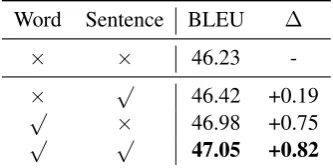
Table 2 shows the comparison between
word-and sentence-level CEV (i.e., combination of ex-pectation and variance) confidence measures on the Chinese-English development set. It is clear that using either sentence-level or word-level con-fidence measures improves the translation
per-formance. Thanks to more fine-grained
quan-tification of uncertainty, using word-level confi-dence achieves a higher BLEU score than
us-ing sentence-level confidence. Combining the
sentence- and word-level of confidences leads to a further improvement, suggesting that they are complementary to each other. In the following ex-periments, we use the combination of word- and sentence-level confidences as the default setting.
4.4 Main Results
The Chinese-English Task
Table3 shows the results of the Chinese-English
task. Back-translation, either generating
transla-tions using beam search (i.e., SEARCH) or using
sampling (i.e., SAMPLE), does lead to significant
improvements over using only the authentic
bilin-gual corpus (i.e., NONE). We find that SAM
-PLE is more effective than SEARCH, which
con-firms the finding of Edunov et al.(2018). Using
uncertainty-based confidence (i.e., “U”)
signifi-cantly improves over both SEARCHand SAMPLE
on the combination of all test sets (p < 0.01). As
there is no Chinese-English labeled data to train neural quality estimation models, we did not
re-port the result of NEURALQEin this experiment.
The English-German Task
Table4 shows the results of the English-German
task. We find that using quality estimation,
ei-ther NEURALQE (i.e., “N”) or UNCERTAINTY
(i.e., “U”), improves over SEARCHand SAMPLE.
UNCERTAINTYeven achieves better performance
than NEURALQE, although NEURALQEuses
ad-ditional labeled training data. As NEURALQE
heavily relies on post-edited corpora and labeled data to train QE models, it can only be used in a handful of language pairs. In contrast, it is easier to apply our approach to arbitrary language pairs since it does not need any labeled data to estimate confidence.
4.5 Effect of Training Corpus Size
Figure4shows the effect of training corpus size.
The X-axis is the size of the total training data (i.e.,
Db∪D˜bin Eq. (5)). The BLEU scores were
calcu-lated on the Chinese-English development set. We
find that the translation performance of SEARCH
rises with the increase of monolingual corpus size in the beginning. However, further enlarging the monolingual corpus hurts the translation perfor-mance. In contrast, our approach can still obtain further improvements when adding more synthetic bilingual sentence pairs. Similar findings are also
Data CE news2013 news2012 news2014 news2015 All
NONE - 26.57 22.09 28.42 30.26 26.31
SEARCH
- 27.09 23.10 29.45 30.10 27.04
N 27.58 23.91 30.61 31.87 28.18
U 27.89++∗ 23.75++ 31.00++∗ 31.98++ 28.28++
SAMPLE
- 27.30 23.37 30.11 31.51 27.70
N 27.55 23.53 30.13 31.87 27.87
[image:8.595.73.287.326.526.2]U 27.71‡‡ 23.80‡ 30.54‡‡†† 32.01‡ 28.15‡‡††
Table 4: BLEU scores on the WMT14 English-German translation task. The ratio of authentic data to synthetic
data is 1:1. NONE: only the authentic bilingual corpus is used. SEARCH: the translations of the monolingual
corpus are generated by beam search (Sennrich et al.,2016a). SAMPLE: the translations of the monolingual corpus
are generated by sampling (Edunov et al.,2018). “CE”: confidence estimation method. “U”: uncertainty-based
confidence estimation. “N”: NEURALQE. “All”: the combination of all test sets. “++”: significantly better than
SEARCH without CE (p < 0.01). “∗”: significantly better than “SEARCH + N” (p < 0.05). “‡”: significantly
better than SAMPLEwithout CE (p <0.05). “‡‡”: significantly better than SAMPLEwithout CE (p <0.01). “††”:
significantly better than “SAMPLE+ N” (p <0.01).
1.25M
2.50M
3.75M
6.25M 11.25M
Training Corpus Size
45
46
47
48
BLEU
Search+U
Sample+U
Sample
Search
Figure 4: Effect of training corpus size.
4.6 Effect of Data Selection
Instead of randomly selecting monolingual sen-tences to generate synthetic data, we also used
the method proposed by (Fadaee and Monz,2018)
to select monolingual data by targeting difficult words. In this series of experiments, we used the same amount of monolingual data that was derived from a larger monolingual corpus using different data selection methods.
Results on NIST06 show that targeting difficult words improves over randomly selecting
mono-lingual data (46.23 → 46.60 BLEU), confirming
the finding of Fadaee and Monz (2018).
Us-ing uncertainty-based confidence can further
im-prove the translation performance (46.60→47.18
BLEU), indicating that our approach can be com-bined with advanced data selection methods.
4.7 Case Study
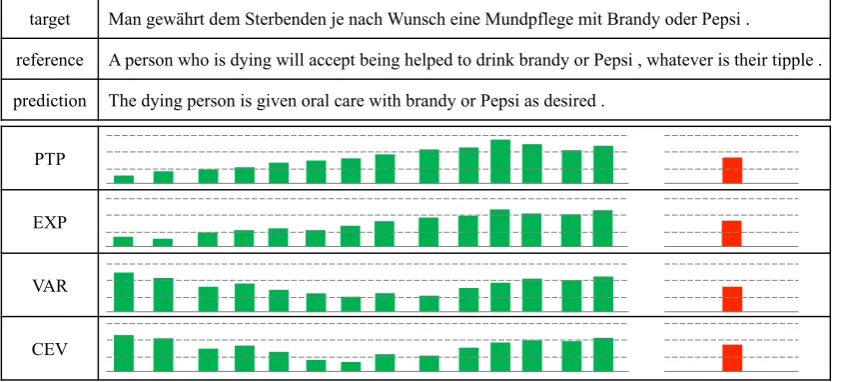
Figure 5 shows an example of model prediction
and its corresponding word- and sentence-level confidence measures for the English-German task. We observe that the PTP and EXP measures are unable to give low confidence to erroneous words. In contrast, variance-based measures such as VAR and CEV can better quantify how confident the model is to make its prediction.
5 Related work
Our work is closely related to three lines of re-search: (1) back-translation, (2) confidence esti-mation, and (3) uncertainty quantification.
5.1 Back-translation
Back-translation is a simple and effective ap-proach to leveraging monolingual data for NMT
(Sennrich et al.,2016a). There has been a
grow-ing body of literature that analyzes and extends
back-translation recently. Currey et al. (2017)
show that low-resource NMT can benefit from the synthetic data generated by simply copying
tar-get monolingual data to the source side. Imamura
et al. (2018) and Edunov et al. (2018)
demon-strate that it is more effective to generate source sentences via sampling rather than beam search.
PTP
EXP
VAR
CEV
target Man gewährt dem Sterbenden je nach Wunsch eine Mundpflege mit Brandy oder Pepsi .
reference A person who is dying will accept being helped to drink brandy or Pepsi , whatever is their tipple .
[image:9.595.89.512.67.258.2]prediction The dying person is given oral care with brandy or Pepsi as desired .
Figure 5: Example of confidence measures.
(2018) find that iterative back-translation can
fur-ther improve the performance of NMT. Fadaee
and Monz(2018) show that words with high
pre-dicted loss during training benefit most. Our
work differs from existing methods in that we propose to use confidence estimation to enable back-translation to better cope with noisy syn-thetic data, which can be easily combined with previous works. Our experiments show that both neural and uncertainty-based confidence estima-tion methods benefit back-translaestima-tion.
5.2 Confidence Estimation
Estimating the confidence or quality of the output
of MT systems (Ueffing and Ney, 2007; Specia
et al.,2009;Bach et al.,2011;Salehi et al.,2014;
Rikters and Fishel, 2017;Kepler et al., 2019) is
important for enabling downstream applications such as post-editing and interactive MT to bet-ter cope with translation mistakes. While existing methods rely on external models to estimate con-fidence, our approach leverages model uncertainty to derive confidence measures. The major benefit is that our approach does not need labeled data.
5.3 Uncertainty Quantification
Reliable uncertainty quantification is key to build-ing a robust artificial intelligent system. It has been successfully applied to many fields,
includ-ing computer vision (Kendall et al.,2015;Kendall
and Gal, 2017), time series prediction (Zhu and
Laptev, 2017), and natural language processing
(Dong et al., 2018;Xiao and Wang, 2019). Our
work differs from previous work in that we are
in-terested in calculating uncertainty after the model has made the prediction rather during inference.
Ott et al.(2018) also analyze the inherent
uncer-tainty of machine translation. The difference is that they focus on the existence of multiple correct translations for a single sentence while we aim to quantify the uncertainty of NMT models.
6 Conclusions
We have presented a method for qualifying model uncertainty for neural machine translation and use uncertainty-based confidence measures to improve back-translation. The key idea is to use Monte Carlo Dropout to sample translation probabilities to calculate model uncertainty, without the need for manually labeled data. As our approach is transparent to model architectures, we plan to fur-ther verify the effectiveness of our approach on other downstream applications of NMT such as post-editing and interactive MT in the future.
Acknowledgments
We thank all anonymous reviewers for their
valuable comments. This work is supported
References
Nguyen Bach, Fei Huang, and Yaser Al-Onaizan. 2011.
Goodness: A method for measuring machine trans-lation confidence. InProceedings of the 49th An-nual Meeting of the Association for Computational Linguistics: Human Language Technologies, pages 211–219, Portland, Oregon, USA. Association for Computational Linguistics.
Dzmitry Bahdanau, Kyunghyun Cho, and Yoshua
Ben-gio. 2015. Neural machine translation by jointly
learning to align and translate. In Proceedings of
ICLR 2015.
John Blatz, Erin Fitzgerald, George Foster, Simona Gandrabur, Cyril Goutte, Alex Kulesza, Alberto
Sanchis, and Nicola Ueffing. 2004. Confidence
es-timation for machine translation. InColing 2004: Proceedings of the 20th international conference on computational linguistics, pages 315–321.
Charles Blundell, Julien Cornebise, Koray
Kavukcuoglu, and Daan Wierstra. 2015. Weight
uncertainty in neural networks. In Proceedings of
ICML 2015.
Wray Buntine and Andreas S. Weigend. 1991.
Bayesian back-propagation. Complex Systems.
Yun Chen, Yang Liu, Yong Cheng, and Victor O.K.
Li. 2017. A teacher-student framework for
zero-resource neural machine translation. In Proceed-ings of the 55th Annual Meeting of the Association for Computational Linguistics (Volume 1: Long Pa-pers), pages 1925–1935, Vancouver, Canada. Asso-ciation for Computational Linguistics.
Yong Cheng, Wei Xu, Zhongjun He, Wei He, Hua
Wu, Maosong Sun, and Yang Liu. 2016.
Semi-supervised learning for neural machine translation. InProceedings of ACL 2016.
Ryan Cotterell and Julia Kreutzer. 2018.
Explain-ing and generalizExplain-ing back-translation through
wake-sleep. CoRR, abs/1806.04402.
Anna Currey, Antonio Valerio Miceli Barone, and
Ken-neth Heafield. 2017. Copied monolingual data
im-proves low-resource neural machine translation. In
Proceedings of the Second Conference on Machine Translation, pages 148–156. Association for Com-putational Linguistics.
Li Dong, Chris Quirk, and Mirella Lapata. 2018.
Con-fidence modeling for neural semantic parsing. In
Proceedings of the 56th Annual Meeting of the As-sociation for Computational Linguistics (Volume 1: Long Papers), pages 743–753, Melbourne, Aus-tralia. Association for Computational Linguistics.
Sergey Edunov, Myle Ott, Michael Auli, and David
Grangier. 2018. Understanding back-translation at
scale. InProceedings of EMNLP 2018.
Marzieh Fadaee, Arianna Bisazza, and Christof Monz.
2017. Data augmentation for low-resource neural
machine translation. InProceedings of the 55th An-nual Meeting of the Association for Computational Linguistics (Volume 2: Short Papers), pages 567– 573, Vancouver, Canada. Association for Computa-tional Linguistics.
Marzieh Fadaee and Christof Monz. 2018.
Back-translation sampling by targeting difficult words in neural machine translation. In Proceedings of EMNLP 2018.
Yarin Gal and Zoubin Ghahramani. 2016. Dropout as a bayesian approaximation: Representing model
un-certainty in deep learning. InProceedings of ICML
2016.
Yonatan Geifman, Guy Uziel, and Ran El-Yaniv. 2019.
Bias-reduced uncertainty estimation for deep neural classifiers. InInternational Conference on Learning Representations.
Alex Graves. 2011. Practical variational inference for
neural networks. InProceedings of NeurIPS.
Hany Hassan, Anthony Aue, Chang Chen, Vishal
Chowdhary, Jonathan Clark, Christian
Feder-mann, Xuedong Huang, Marcin Junczys-Dowmunt, William Lewis, Mu Li, Shujie Liu, Tie-Yan Liu, Renqian Luo, Arul Menezes, Tao Qin, Frank Seide, Xu Tan, Fei Tian, Lijun Wu, Shuangzhi Wu, Yingce Xia, Dongdong Zhang, Zhirui Zhang,
and Ming Zhou. 2018. Achieving human parity
on automatic chinese to english news translation. arXiv:1803.05567.
Cong Duy Vu Hoang, Philipp Keohn, Gholamreza
Haffari, and Trevor Cohn. 2018. Iterative
back-translation for neural machine back-translation. In Pro-ceedings of the 2nd Workshop on Neural Machine Translation and Generation.
Kenji Imamura, Atsushi Fujita, and Eiichiro Sumita.
2018. Enhancement of encoder and attention using
target monolingual corpora in neural machine trans-lation. InProceedings of the 2nd Workshop on Neu-ral Machine Translation and Generation, pages 55– 63. Association for Computational Linguistics.
Julia Ive, Fr´ed´eric Blain, and Lucia Specia. 2018.
deepQuest: A framework for neural-based qual-ity estimation. In Proceedings of the 27th Inter-national Conference on Computational Linguistics, pages 3146–3157, Santa Fe, New Mexico, USA. As-sociation for Computational Linguistics.
Alex Kendall, Vijay Badrinarayanan, and Roberto Cipolla. 2015. Bayesian segnet: Model uncertainty in deep convolutional encoder-decoder architectures for scene understanding. arXiv:1511.02680.
Alex Kendall and Yarin Gal. 2017. What uncertainties do we need in bayesian deep learning for computer
vision? InAdvances in neural information
Fabio Kepler, Jonay Tr´enous, Marcos Treviso, Miguel
Vera, and Andr´e F. T. Martins. 2019. OpenKiwi:
An open source framework for quality estimation. In Proceedings of the 57th Annual Meeting of the Association for Computational Linguistics: System Demonstrations, pages 117–122, Florence, Italy. Association for Computational Linguistics.
Hyun Kim, Jong-Hyeok Lee, and Seung-Hoon Na.
2017. Predictor-estimator using multilevel task
learning with stack propagation for neural quality estimation. In Proceedings of the Second Con-ference on Machine Translation, pages 562–568, Copenhagen, Denmark. Association for Computa-tional Linguistics.
Diederik P. Kingma and Jimmy Ba. 2015. Adam:
A method for stochastic optimization. CoRR,
abs/1412.6980.
Philipp Koehn. 2004. Statistical significance tests for
machine translation evaluation. InProceedings of the 2004 conference on empirical methods in natural language processing, pages 388–395.
Philipp Koehn, Hieu Hoang, Alexandra Birch, Chris Callison-Burch, Marcello Federico, Nicola Bertoldi, Brooke Cowan, Wade Shen, Christine Moran, Richard Zens, Chris Dyer, Ondrej Bojar, Alexandra
Constantin, and Evan Herbst. 2007. Moses: Open
source toolkit for statistical machine translation. In
Proceedings of ACL 2007.
Philipp Koehn, Franz J. Och, and Daniel Marcu. 2003.
Statistical phrase-based translation. InProceedings of NAACL 2003.
Guillaume Lample, Myle Ott, Alexis Conneau, Lu-dovic Denoyer, and Marc’Aurelio Ranzato. 2018.
Phrase-based & neural unsupervised machine trans-lation. InProceedings of EMNLP 2018.
Gilwoo Lee, Brian Hou, Aditya Mandalika, Jeongseok
Lee, and Siddhartha S. Srinivasa. 2019. Bayesian
policy optimization for model uncertainty. In Inter-national Conference on Learning Representations.
Ngoc-Quang Luong, Laurent Besacier, and Benjamin Lecouteux. 2017. Find the errors, get the better: En-hancing machine translation via word confidence
es-timation. Natural Language Engineering, 23:617–
639.
Seong Joon Oh, Andrew C. Gallagher, Kevin P. Mur-phy, Florian Schroff, Jiyan Pan, and Joseph Roth.
2019. Modeling uncertainty with hedged instance
embeddings. InInternational Conference on Learn-ing Representations.
Myle Ott, Michael Auli, David Grangier, and
Marc’Aurelio Ranzato. 2018. Analyzing
uncer-tainty in neural machine translation. InProceedings
of ICML 2018.
Kishore Papineni, Salim Roukos, Todd Ward, and
Wei-Jing Zhu. 2001. Bleu: a method for automatic
evalu-ation of machine translevalu-ation. InProceedings of ACL 2001.
Gabriel Pereyra, George Tucker, Jan Chorowski, Lukasz Kaiser, and Geoffrey E. Hinton. 2017. Reg-ularizing neural networks by penalizing confident
output distributions. CoRR, abs/1701.06548.
M¯arcis Pinnis, Rihards Kriˇslauks, Daiga Deksne, and Toms Miks. 2017. Neural machine translation for morphologically rich languages with improved
sub-word units and synthetic data. InText, Speech, and
Dialogue, pages 237–245, Cham. Springer Interna-tional Publishing.
Alberto Poncelas, Dimitar Shterionov, Andy Way, Gideon Maillette de Buy Wenniger, and Peyman Passban. 2018. Investigating backtranslation in
neu-ral machine translation.CoRR, abs/1804.06189.
Shuo Ren, Wenhu Chen, Shujie Liu, Mu Li, Ming
Zhou, and Shuai Ma. 2018. Triangular architecture
for rare language translation. InProceedings of the 56th Annual Meeting of the Association for Compu-tational Linguistics (Volume 1: Long Papers), pages 56–65, Melbourne, Australia. Association for Com-putational Linguistics.
Matiss Rikters and Mark Fishel. 2017. Confidence
through attention. CoRR, abs/1710.03743.
Marzieh Salehi, Shahram Khadivi, and Nooshin Riahi. 2014. Confidence estimation for machine
transla-tion using context vectors. 7’th International
Sym-posium on Telecommunications (IST’2014), pages 524–528.
Rico Sennrich, Barry Haddow, and Alexandra Birch.
2016a. Improving neural machine translation
mod-els with monolingual data. InProceedings of ACL 2016.
Rico Sennrich, Barry Haddow, and Alexandra Birch.
2016b. Neural machine translation of rare words
with subword units. InProceedings of the 54th An-nual Meeting of the Association for Computational Linguistics (Volume 1: Long Papers), pages 1715– 1725.
Lucia Specia, Marco Turchi, Zhuoran Wang, John Shawe-Taylor, and Craig Saunders. 2009. Improv-ing the confidence of machine translation quality
es-timates. InTwelfth Machine Translation Summit.
Ilya Sutskever, Oriol Vinyals, and Quoc V. Le. 2014. Sequence to sequence learning with neural
net-works. InProceedings of NeurIPS 2014.
Christian Szegedy, Vincent Vanhoucke, Sergey Ioffe, Jonathon Shlens, and Zbigniew Wojna. 2016. Re-thinking the inception architecture for computer
vi-sion. 2016 IEEE Conference on Computer Vision
Nicola Ueffing and Hermann Ney. 2007. Word-level confidence estimation for machine translation.
Computational Linguistics.
Ashish Vaswani, Noam Shazeer, Niki Parmar, Jakob Uszkoreit, Llion Jones, Aidan N. Gomez, Lukasz Kaiser, and Illia Polosukhin. 2017. Attention is all
you need. InProceedings of NeurIPS 2017.
Jiayi Wang, Kai Fan, Bo Li, Fengming Zhou, Boxing
Chen, Yangbin Shi, and Luo Si. 2018. Alibaba
sub-mission for WMT18 quality estimation task. In Pro-ceedings of the Third Conference on Machine Trans-lation: Shared Task Papers, pages 809–815, Bel-gium, Brussels. Association for Computational Lin-guistics.
Yonghui Wu, Mike Schuster, Zhifeng Chen, Quoc V. Le, Mohammad Norouzi, Wolfgang Macherey,
Maxim Krikun, Yuan Cao, Qin Gao, Klaus
Macherey, Jeff Klingner, Apurva Shah, Melvin Johnson, Xiaobing Liu, Lukasz Kaiser, Stephan
Gouws, Yoshikiyo Kato, Taku Kudo, Hideto
Kazawa, Keith Stevens, George Kurian, Nishant Patil, Wei Wang, Cliff Young, Jason Smith, Ja-son Riesa, Alex Rudnick, Oriol Vinyals, Greg Cor-rado, Macduff Hughes, and Jeffrey Dean. 2016. Google’s neural machine translation system: Bridg-ing the gap between human and machine translation. arXiv:1609.08144v2.
Yijun Xiao and William Yang Wang. 2019. Quanti-fying uncertainties in natural language processing
tasks. InProceedings of AAAI 2019.
Jiacheng Zhang, Yanzhuo Ding, Shiqi Shen, Yong Cheng, Maosong Sun, Huan-Bo Luan, and Yang
Liu. 2017. THUMT: an open source toolkit for
neu-ral machine translation.CoRR, abs/1706.06415.
Lingxue Zhu and Nikolay Laptev. 2017. Deep and
con-fident prediction for time series at uber. In
Proceed-ings of ICDM 2017.
Barret Zoph, Deniz Yuret, Jonathan May, and Kevin
Knight. 2016. Transfer learning for low-resource