T h e P r o b l e m of C o m p u t i n g the Most Probable Tree in
D a t a - O r i e n t e d Parsing and Stochastic Tree G r a m m a r s
Rens Bod
Institute for Logic, Language and Computation
Department of Computational Linguistics
University of Amsterdam
Spuistraat 134, 1012 VB Amsterdam
The Netherlands
[email protected]
Abstract
We deal with the question as to whether there exists a polynomial time algorithm for computing the most probable parse tree of a sentence generated by a data-oriented parsing (DOP) model. (Scha, 1990; Bod, 1992, 1993a). Therefore we describe D O P as a stochastic tree-substitution grammar (STSG). In STSG, a tree can be generated by exponentially many derivations involving different elementary trees. The probability of a tree is equal to the s u m of the probabilities of all its derivations.
We show that in STSG, in contrast with stochastic context-free grammar, the Viterbi algorithm cannot be used for computing a most probable tree of a string. We propose a simple modification of Viterbi which allows by means of
a " s e l e c t - r a n d o m " search to e s t i m a t e the most probable tree of a string in polynomial time.
Experiments with DOP on ATIS show that only in 68% of the cases, the most probable derivation of a string generates the most probable tree of that string. Therefore, the parse accuracy obtained by the m o s t probable trees (96%) is dramatically higher than the parse accuracy obtained by the most probable derivations (65%).
It is still an open question whether the m o s t p r o b a b l e tree of a string can be
deterministically computed in polynomial time.
1
Data-Oriented Parsing
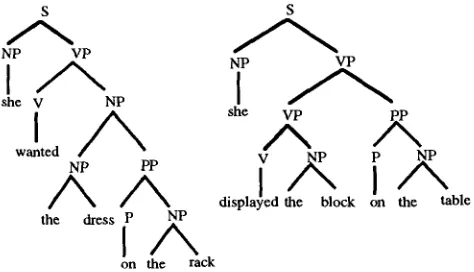
A Data-Oriented Parsing model (Scha, 1990; Bod, 1992, 1993a) is characterized by a corpus of analyzed language utterances, together with a set of operations that combine sub-analyses from the corpus into new analyses. We will limit ourselves in this paper to corpora with purely syntactic annotations. For the semantic dimension of DOP, the reader is referred to (van den Berg et al., 1994). Consider the imaginary example corpus consisting of only two trees in figure 1. We will assume one operation for combining subtrees. This operation is called "composition", and is indicated by the infix operator o. The composition
of t and u, tou, yields a copy o f t in which its leftmost nonterminal leaf node has been identified
with the r o o f node of u (i.e., u is s u b s t i t u t e d on the leftmost nonterminal leaf node of t). For reasons of simplicity we will write in the following (tou)ov as:
louov.
S S
A
NP VP
I A
uP
,hov
I
I
,.o
w
w = .
A
v / : , ; A
A A
i. ,Loo.oc o.oo
o . othe dress P NP
I / N
on the rackFigure 1. Example corpus of two trees.
Now the (ambiguous) sentence "She d i s p l a y e d the dress on the table" can be parsed by combining subtrees from the corpus. For instance:
S o N P o
A
/<,
" A
i p V ~ the dress on I the table
she VP PP
A
V NP
I
displayed
NP VP
she Via pp
/
displa~ the dress on the table
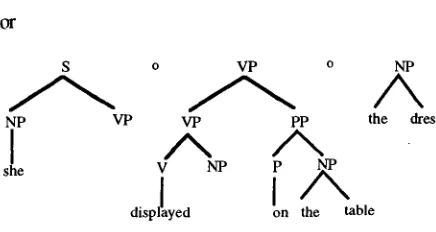
[image:1.596.326.563.291.427.2]As the reader m a y easily ascertain, a different derivation may yield a different parse tree. However, a different derivation may also very well yield the same parse tree; for instance:
S o VP o NP
NP VP the dress
displayed
she VP PP p NP on the table
Figure 3. Different derivation generating the same parse tree for "She displayed the dress on the table"
Or
S o VP o NP
NP VP VP pp the dress
I
/ x
/ x ,
she V NP p I ~ P displ!yed !n the t a b l e / N
Figure 4. Another derivation generating the same parse tree for "She displayed the dress on the table"
Thus, a parse tree can have several derivations involving different subtrees. Using the corpus for our stochastic estimations, we estimate the probability of substituting a certain subtree on a specific node as the p r o b a b i l i t y of selecting this subtree among all subtrees in the corpus that could be substituted on that node. 1 The probability of a derivation can be computed as the product of the probabilities of the substitutions that it involves. The probability of a parse tree is equal to the probability that any of its derivations occurs, which is the sum o f the probabilities of all derivations of that parse tree. Finally, the probability of a word string is equal to the sum of the probabilities of all its parse trees.
2 D O P as a S t o c h a s t i c T r e e - S u b s t i t u t i o n G r a m m a r
In order to deal with the problem of computing the most probable parse tree of a string, it is convenient to describe D O P as a "Stochastic Tree-Substitution G r a m m a r " (STSG). S T S G can be seen as a generalization over DOP, where the elementary tree S of S T S G are the subtrees of DOP, and the probabilities of the e l e m e n t a r y trees are the
1Very small frequencies are smoothed by Good-Turing.
substitution-probabilities o f the c o r r e s p o n d i n g subtrees o f D O P (Bod, 1993c).
A Stochastic Tree-Substitution G r a m m a r G is a five- tuple < VN, VT-, S, R, P> where
Vu is a finite set of nonterminal symbols. Vr is a finite set of terminal symbols. S ~ VN is the distinguished symbol.
R is a finite set of elementary trees whose top nodes and interior nodes are labeled by nonterminal symbols and whose yield nodes are labeled by terminal or nonterminal symbols.
P is a function which assigns to every elementary tree t ~ R a probability p ( t ) . For a tree t with a root a, p ( t ) is interpreted as the probability of substituting t on a. We require, therefore, that 0 < p ( t ) <- 1 and
~-~t:root(t)=Ct
p(t) = 1.If t l and t2 are trees such that the l e f t m o s t nonterminal yield node of t l is equal to the root of t2, then tlot 2 is the tree that results from substituting t 2 for this leftmost nonterminal yield node in t l . T h e partial function o is called leftmost s u b s t i t u t i o n . For reasons of conciseness we will use the term substitution for leftmost substitution.
A leftmost derivation generated by an STSG G is a tuple of trees <t 1 ... tn> such that t I ... t n a r e elements of R, the root of t I is labeled by S and the yield of t l .... otn is labeled by terminal symbols. The set of leftmost derivations generated by G is thus given by D e r i v a t i o n s ( G ) = { <t I ... tn> I tl ... tn ~ R ^ r o o t ( t 1 ) = S A y i e l d ( t l o . . . o t n ) ~ Vr +}. For convenience we will use the term derivation for leftmost derivation. A derivation < t l ... tn> is called a derivation of tree T, iff tlo...ot n = T. A derivation < t l ... t n > is called a derivation o f string s, iff yield(t1 .... °tn) = s. T h e probability of a derivation
<t I ... in> is defined as p ( t l ) • ... • p ( t n ) .
A p a r s e tree generated by an STSG G is a tree T such that there is a derivation < t l ... t n > D e r i v a t i o n s ( G ) for which t l . . . tn = T. T h e set of parse trees, or tree language, generated by G is given b y P a r s e s ( G ) = { T I 3 <t I ... tn> ~ D e r i v a t i o n s ( G ) : t l . . . tn = T}. For reasons of conciseness we will often use the terms p a r s e or tree for a parse tree. A parse whose yield is equal to string s, is called a parse of s. The probability of a parse is defined as the sum of the probabilities of all its derivations.
[image:2.596.53.271.280.396.2]3
For the input string a b c d , the following derivation forest is then obtained:C o m p u t i n g a m o s t p r o b a b l e p a r s e t r e e in S T S G
In order to deal with the problem of computing the most probable parse tree of a sentence, we will distinguish between parsing and disambiguation. By parsing we mean the creation of a parse forest for an input sentence. By disambiguation we mean the selection of the most probable parse 2 from the forest. The creation of a parse forest is an intermediate step for computing the most probable parse.
3.1 Parsing
From the way STSG combines elementary trees by means of substitution, it follows that an input sentence can be parsed by the same algorithms as (S)CFGs. E v e r y elementary tree t is used as a context-free rewrite rule root(t) --~ yield(t). Given a chart parsing algorithm, an input sentence of length n can be parsed in n 3 time.
In order to obtain a chart-like forest for a sentence parsed in STSG, we need to label the well- formed substrings in the chart not only with the syntactic categories of that substring but with the full elementary trees t that correspond to the use of the derived rules root(t) ---~yield(t). Note that in a chart- like forest generated by an STSG, different derivations that generate a same tree do not collapse. We will therefore talk about a derivation forest generated by an STSG (cf. Sima'an et al., 1994).
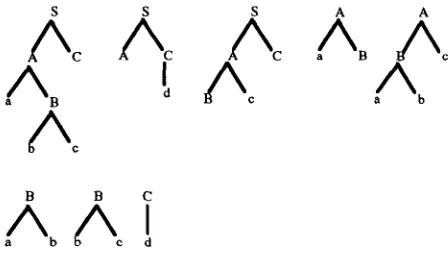
The following formal example illustrates what a derivation forest of a string may look like. In the example, we leave out the probabilities, which are needed only in the disambiguation process. The visual representation comes from (Kay, 1980): every entry
(i,j) in the chart is indicated by an edge and spans the words between the i-th and the j - t h position of a sentence. Every edge is labeled with the elementary trees that denote the underlying phrase. The example- STSG consists of the following elementary trees:
S
/Xc
AB
/Xc
S S A A
A
d c a b
B B C
A A I
a b d
Figure 5. Elementary trees of an example-STSG
2 Although theoretically there can be more than one most probable parse for a sentence, in practice a system that employs a non-trivial treebank tends to generate exactly one most probable parse for a given input sentence.
s
/k
Ac.A A/k
• ~ X . c C.
/ ~ .: • I
• ~ " .
tt a 1 b 2 ¢ 3 4 4
Figure 6. Derivation forest for abed
Note that different derivations in the forest generate the same tree. By exhaustively unpacking the forest, four different derivations generating two different trees are obtained. We may ask whether we can pack the f o r e s t by c o l l a p s i n g s p u r i o u s d e r i v a t i o n s . Unfortunately, no efficient procedure is known that accomplishes this ( r e m e m b e r that there can be exponentially many derivations for one tree).
3.2 Disambiguation
Cubic time parsing does not guarantee cubic time disambiguation, as a sentence may have exponentially m a n y parses and any such p a r s e m a y h a v e exponentially many derivations. Therefore, in order to find the most probable parse of a sentence, it is not efficient to compare the probabilities of the parses by e x h a u s t i v e l y u n p a c k i n g the chart. E v e n for determining the probability of one parse, it is not efficient to add the probabilities of all derivations of that parse.
3.2.1 Viterbi optimization is not feasible for finding the most probable parse
There exists a heuristic optimization algorithm, known as Viterbi optimization, which selects on the basis of an SCFG the most probable derivation of a sentence in cubic time (Viterbi, 1967; Fujisaki et al., 1989; Jelinek et al., 1990). In STSG, however, the most probable derivation does not necessarily generate the most probable parse, as the probability of a parse is defined as the sum of the probabilities of all its derivations. Thus, there is an important question as to whether we can adapt the Viterbi algorithm for finding the most probable parse.
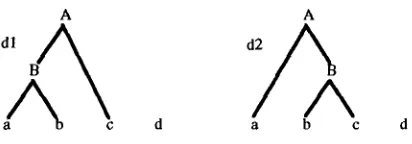
[image:3.596.327.574.105.288.2] [image:3.596.87.311.532.659.2]subparses have the same root can both be developed (if at all) to derivations of the whole sentence in the s a m e ways. T h e r e f o r e , if one o f these two subderivations has a lower probability, then it can be eliminated. This is illustrated by a formal example in figure 7. Suppose that during bottom-up parsing of the string abcd the following two subderivations dl and d2 have been generated for the substring abc.
(Actually represented are their resulting subparses.)
A A
A \ ,
a b e
Figure 7. Two subparses for the string abcd
If the probability of dl is higher than the probability of d2, we can eliminate d2 if we are only interested in finding the most probable derivation of abcd. But if we are interested in finding the most probable parse of
abcd (generated by STSG), we are not allowed to eliminate d2. This can be seen by the following. Suppose that we have the additional elementary tree given in figure 8.
S
a
Figure 8. Elementary tree.
This elementary tree may be developed to the same tree that can be developed by d2, but not to the tree that can be developed by dl. And since the probability of a parse tree is equal to the sum of the probabilities of all its derivations, it is still possible that d 2 contributes to the generation of the most probable parse. Therefore we are not allowed to eliminate d2.
This counter-example does not prove that there is no heuristic optimization that allows polynomial time selection of the most probable parse. But it makes clear that a "select-best" search, as accomplished by Viterbi, is not adequate for finding the m o s t probable parse in STSG. So far, it is unknown whether the problem of finding the most probable parse in a deterministic way is inherently exponential or not (cf. Sima'an et al., 1994). One should of course ask how often in practice the most probable derivation produces the most probable parse, but this can only be answered by means of experiments on real life corpora. Experiments on the ATIS corpus (see session 4) show that only in 68% of the cases the most probable derivation of a sentence generates the most probable parse of that sentence. Moreover, the parse accuracy obtained by the most probable parse is dramatically higher than the parse
accuracy obtained by the parse generated by the most probable derivation.
3.2.2 Estimating the most probable parse by Monte Carlo search
We will leave it as an open question whether the most probable parse can be deterministically derived in polynomial time. Here we will ask whether there exists a polynomial time approximation procedure
that estimates the most probable parse with an
estimation error that can be made arbitrarily small. We have seen that a "select-best" search, as accomplished by Viterbi, can be used for finding the most probable derivation but not for finding the most probable parse. If we apply instead of a select-best search, a "select-random" search, we can generate a random derivation. By iteratively generating a large number of random derivations we can estimate the most probable parse as the parse which results most often from these random derivations (since the probability of a parse is the probability that any of its derivations occurs). The most probable parse can be estimated as accurately as desired by making the number of random samples as large as desired. According to the Law of Large Numbers, the most often generated parse converges to the most probable parse. Methods that estimate the probability of an event by taking random samples are known as Monte Carlo methods (Hammersley & Handscomb, 1964). 3
The selection of a random derivation is accomplished in a bottom-up fashion analogous to Viterbi. Instead of selecting the m o s t probable subderivation at each node-sharing in the chart, a random subderivation is selected (i.e. sampled) at each node-sharing (that is, a subderivation that has n times as large a probability as another subderivation should also have n times as large a chance to be chosen as this other subderivation). Once sampled at the S-node, the random derivation of the whole sentence can be retrieved by tracing back the choices made at each node-sharing. Of course, we m a y postpone sampling until the S-node, such that we sample directly from the distribution o f all S-derivations. But this would take e x p o n e n t i a l time, since there m a y be exponentially m a n y derivations for the whole sentence. By sampling bottom-up at every node where ambiguity appears, the maximum number of different subderivations at each node-sharing is bounded to a constant (the total number of rules of that node), and therefore the time complexity of generating a random derivation of an input sentence is equal to the time complexity of finding the most probable derivation,
O(n3). This is e x e m p l i f i e d b y the following algorithm.
[image:4.596.61.267.179.251.2]Sampling a random 0¢riva~ion from a derivation forest Given a derivation forest, of a sentence of n words, consisting of labeled entries (i,j) that span the words between the i-th and the j-th position of the sentence. Every entry is labeled with linked elementary trees, together with their probabilities, that constitute s u b d e r i v a t i o n s o f the underlying subsentence. Sampling a derivation from the chart consists of choosing at every labeled entry (bottom-up, breadth- fu'st) a random subderivation of each root-node:
f o r k := 1 t o n d o f o r i := 0 to n-k do
for chart-entry (i,i+k) do for each root-node X do
select 4 a random subderivation of root X eliminate the other subderivations
We now have an algorithm that selects a random derivation from a derivation forest. Converting this derivation into a parse tree gives a first estimation for the most probable parse. Since one random sample is not a reliable estimate, we sample a large number of random derivations and see which parse is generated most frequently. This is exemplified by the following algorithm. (Note that we might also estimate the m o s t probable d e r i v a t i o n by random sampling, namely by counting which derivation is sampled most often; however, the most probable derivation can be more effectively generated by Viterbi.)
Eslimating the most probable parse (MPP) Given a derivation forest for an input sentence:
repeat until the MPP converges
sample a random derivation from the forest store the parse generated by the random derivation MPP := the most frequently occurring parse
There is an important question as to how long the convergence of the most probable parse may take. Is there a tractable upper bound on the number of derivations that have to be sampled from the forest before stability in the top of the parse distribution occurs? The answer is yes: the worst case time complexity of achieving a maximum estimation error e by m e a n s o f r a n d o m sampling is O(e-2),
independently of the probability distribution. This is a classical result from sampling theory (cf. Hammersley and Handscomb, 1964), and follows directly from Chebyshev's inequality. In practice, it means that the
4 Let { (e 1, P l ) , (e2, P2) . . . (en, Pn) } be a probability distribution of events e l , e2, ..., en; an event e i is said to be randomly selected iff its probability of being selected is equal to Pi. In order to allow for "direct sampling", one must convert the probability distribution into a corresponding sample space for which holds that the frequency of occurrence 3] of each event e i is a positive
integer equal to Npi, where N is the size of the sample space.
error e is inversely proportional to the square-root of the number of random samples N and therefore, to reduce e by a factor of k, the number of samples N needs to be increased k2-fold. In practical experiments (see §4), we will limit the number of samples to a pre-determined, sufficiently large bound N.
What is the theoretical worst case time complexity of parsing and disambiguation together? That is, given an STSG and an input sentence, what is the maximal time cost of finding the most probable parse of a sentence? I f we use a CKY-parser, the creation of a derivation forest for a sentence of n words takes O(n 3) time. Taking also into account the size G of an STSG (defined as the sum of the lengths of the yields of all its elementary trees), the time c o m p l e x i t y o f creating a derivation forest is proportional to Gn 3. The time c o m p l e x i t y of disambiguation is both proportional to the cost of sampling a derivation, i.e. Gn 3, and to the cost of the convergence by means of iteration, which is e -2. Tiffs
means that the time complexity of disambiguation is given by O(Gn3e-2). The total time complexity o f
parsing and disambiguation is equal to O(Gn 3) +
O(Gn3e -2) = O(Gn3e'2). Thus, there exists a tractable procedure that estimates the most probable parse o f an input sentence.
Notice that although the M o n t e Carlo d i s a m b i g u a t i o n a l g o r i t h m e s t i m a t e s the m o s t probable parse of a sentence in polynomial time, it is not in the class of p o l y n o m i a l time decidable
algorithms. The Monte Carlo algorithm cannot decide
in polynomial time what is the most probable parse; it can only make the error-probability of the estimated most probable parse arbitrarily small. As such, the Monte Carlo algorithm is a probabilistic algorithm belonging to the class of Bounded error Probabilistic
Polynomial time (BPP) algorithms.
W e h y p o t h e s i z e t h a t M o n t e C a r l o disambiguation is also relevant for other stochastic grammars. It turns out that all stochastic extensions of CFGs that are stochastically richer than S C F G need exponential time algorithms for finding a most probable parse tree (cf. Briscoe & Carroll, 1992; Black et al., 1993; Magerman & Weir, 1992; Schabes & Waters, 1993). To our knowledge, it has never been studied whether there exist BPP-algorithms for these models. Alhough it is beyond the scope of our research, we conjecture that there exists a Monte Carlo disambiguation algorithm for at least Stochastic Tree-Adjoining Grammar (Schabes, 1992).
3.2.3 P s y c h o l o g i c a l r e l e v a n c e of M o n t e Carlo d i s a m b i g u a t i o n
human sentence perception. The following lists some properties of Monte Carlo disambiguation that may be of psychological interest:
1. As mentioned above, Monte Carlo never provides 100% confidence about the best analysis. This corresponds to the psychological observation that people never have absolute confidence about their interpretation of an ambiguous sentence.
2. Although conceptually Monte Carlo uses the total space of possible analyses, it tends to sample only the most likely ones. Very unlikely analyses may only be sampled after considerable time, but it is not guaranteed that all analyses are found in finite time. This matches with experiments on human sentence perception where very implausible analyses are only perceived with great difficulty and after considerable time.
3. Monte Carlo does not necessarily give the same results for different sequences of samples, especially if different analyses in the top of the distribution are almost equally likely. In the case there is more than one most probable analysis, Monte Carlo does not converge to one analysis but keeps alternating, however large the number of samples is made. In experiments with human sentence perception, it has often been shown that different analyses can be perceived for one sentence. And in case these analyses are equally plausible, people perceive so-called fluctuation effects. This fluctuation phenomenon is also well-known in the perception of ambiguous visual patterns.
4. Monte Carlo can be made parallel in a very straightforward way: N samples can be computed by N processing units, where equal outputs are reinforced. The more processing units are employed, the better the estimation. However, since the number of processing units is finite, there is never absolute confidence. This has some similarity with the Parallel Distributed Processing paradigm for haman (language) processing (Rumelhart & McClelland, 1986).
4
Experiments
In this section, we report on experiments with an implementation of DOP that parses and disambiguates part-of-speech strings. In (Bod, 1995) it is shown how DOP is extended to parse word strings that possibly contain unknown words.
4.1 The test environment
For our experiments, we used a manually corrected version of the Air Travel Information System (ATIS) spoken language corpus (Hemphill et al., 1990) annotated in the Pennsylvania Treebank (Marcus et al., 1993). We employed the "blind testing" method, dividing the corpus into a 90% training set and a 10% test set by randomly selecting sentences. The 675 trees from the training set were converted into their subtrees together with their relative frequencies, yielding roughly 4"105 different subtrees. The 75 part-of-speech sequences from the test set served as
input strings that were parsed and disambiguated using the subtrees from the training set. As motivated in
(Bed, 1993b), we use the notion of parse accuracy as
our accuracy metric, defined as the percentage of the test strings for which the most probable parse is
identical to the parse in the test set.
4.2 Accuracy as a function of subtree-depth
It is one of the most essential features of DOP, that arbitrarily large subtrees are taken into consideration to estimate the probability of a parse. In order to test the usefulness of this feature, we performed different
experiments constraining the depth of the subtrees.
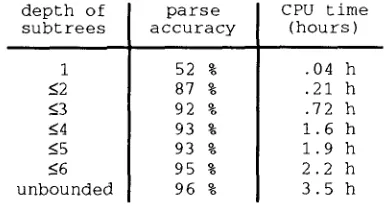
The following table shows the results o f seven experiments for different maximum depths o f the training set subtrees. The accuracy refers to the parse accuracy at 400 randomly sampled parses, and is rounded off to the nearest integer. The CPU time refers to the average CPU time per string employed by a Spark II.
d e p t h of s u b t r e e s
1 _<2 _<3 <4 <5 <6 u n b o u n d e d
p a r s e a c c u r a c y
52 % 87 % 92 % 93 % 93 % 95 % 96 %
C P U t i m e (hours)
.04 h
.21 h .72 h 1.6 h 1.9 h 2.2 h 3.5 h
Table 1. Parse results on the ATIS corpus
The table shows a dramatic increase in parse accuracy when enlarging the maximum depth of the subtrees from 1 to 2. (Remember that for depth one, DOP is equivalent to a stochastic context-free grammar.) The accuracy keeps increasing, at a slower rate, when the depth is enlarged further. The highest accuracy is obtained by using all subtrees from the training set: 72 out of the 75 sentences from the test set are parsed correctly. Thus, the accuracy increases if larger subtrees are used, though the CPU time increases considerably as well.
4.3 Does the most probable derivation generate the most probable parse?
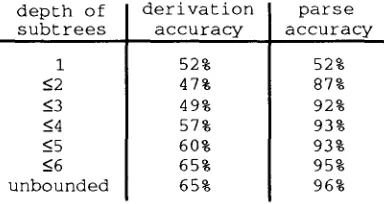
Another important feature o f DOP is that the probability of a resulting parse tree is computed as the sum o f the probabilities of all its derivations. Although the most probable parse of a sentence is not necessarily generated by the most probable derivation of that sentence, there is a question as to how often these two coincide. In order to study this, we also
calculated the derivation accuracy, defined as the
[image:6.596.301.494.318.421.2]d e p t h o f s u b t r e e s
1 -<2 -<3 -<4 -<5 -<6 u n b o u n d e d
d e r i v a t i o n a c c u r a c y
5 2 % 4 7 % 4 9 % 5 7 % 6 0 % 6 5 % 6 5 %
p a r s e a c c u r a c y
5 2 % 8 7 % 9 2 % 9 3 % 9 3 % 9 5 % 9 6 %
Table 2. Derivation accuracy vs. parse accuracy
The table shows that the derivation accuracy is equal to the parse accuracy if the depth of the subtrees is constrained to 1. This is not surprising, as for depth 1, DOP is equivalent with SCFG where every parse is generated by exactly one derivation. What is remarkable, is, that the derivation accuracy decreases if the depth of the subtrees is enlarged to 2. If the depth is enlarged further, the derivation accuracy increases again. The highest derivation accuracy is obtained by using all subtrees from the corpus (65%), but remains far behind the highest parse accuracy (96%). From this table we conclude that if we.are interested in the most probable analysis of a string we must not look at the probability of the process of achieving that analysis but at the probability of the result of that process.
4.4 The significance of once-occurring subtrees
There is an important question as to whether we can reduce the "grammar constant" of DOP by eliminating very infrequent subtrees, without affecting the parse accuracy. In order to study this question, we start with a test result. Consider the test set sentence "Arrange
the f l i g h t code of the flight from D e n v e r to D a l l a s W o r t h in d e s c e n d i n g order", which
has the following parse in the test set:
(s (NP *)
(VP VB/Arrange
(NP (NP DT/the NN/flight NN/code) (PP IN/of
(NP (NP DT/the NN/flight) (PP (PP IN/from
(NP NP/Denver)) (PP TO/to
(NP NP/Dallas NP/Worth)))))) (PP IN/in
(NP (VP VBG/descending) NN/order)))
.))
The corresponding p-o-s sequence of this sentence is
the test set string "vB DT NN NN IN DT NN IN NP
TO NP NP IN V B G NN". A t subtree-depth < 2, the
following most probable parse was estimated for this string (where for reasons of readability the words are added to the p-o-s tags):
(s (NP *)
(VP V B / A r r a n g e
(NP (Np DT/the N N / f l i g h t NN/code) (PP IN/of
(NP (NP DT/the NN/flight) (PP (PP IN/from
(NP NP/Denver)) (PP TO/to
(NP N P / D a l l a s NP/Worth))) (PP IN/in
(NP (VP VBG/descending) NN/order))))))
.))
In this parse, we see that the prepositional phrase " i n descending order" is incorrectly attached to the NP "the f l i g h t " instead of to the verb " a r r a n g e " . This wrong attachment may be explained by the high relative frequencies of the following subtrees of depth 2 (that appear in structures of sentences like "Show me
the t r a n s p o r t a t i o n from SFO to d o w n t o w n San F r a n c i s c o in August", w h e r e the P P "in A u g u s t "
is attached to the N P "the t r a n s p o r t a t i o n " , and not to the verb "show"):
NP NP NP NP
PP PP PP
PP IN PP
NP PP IN
NP
Only if the maximum depth was enlarged to 4, subtrees like the following were available, which led to the estimation of the correct tree.
VP VB NP NP
PP PP IN
NP VP VBG NN
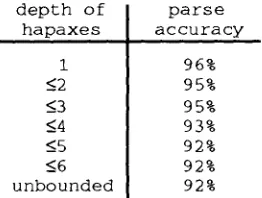
It is interesting to note that this subtree occurs only once in the training set. Nevertheless, it induces the correct parsing of the test string. This seems to contradict the fact that probabilities based on sparse data are not reliable. Since many large subtrees are once-occumng events (hapaxes), there seems to be a preference in DOP for an occurrence-based approach if enough context is provided: large subtrees, even if they occur once, tend to contribute to the generation of the correct parse, since they provide much contextual information. Although these subtrees have low probabilities, they tend to induce the correct parse because fewer subtrees are needed to construct a parse.
[image:7.596.99.291.89.191.2]d e p t h o f h a p a x e s
1
<2
_<3
_<4 <_5
<_6 u n b o u n d e d
p a r s e a c c u r a c y
[image:8.596.98.229.93.192.2]9 6 % 9 5 % 9 5 % 9 3 % 9 2 % 9 2 % 92%
Table 3. Parse accuracy after eliminating once-occurring subtrees
Conclusions
We have shown that in DOP and STSG the Viterbi algorithm cannot be used for computing a most probable tree of a string. We developed a modification of Viterbi which allows by means of an iterative Monte Carlo search to estimate the most probable tree of a string in polynomial time. Experiments on ATIS showed that only in 68% of the cases, the most probable derivation of a string generates the most probable tree of that string, and that the parse accuracy is dramatically higher than the derivation accuracy. We conjectured that the Monte Carlo algorithm can also be applied to other stochastic grammars for computing the most probable tree of a string. The question as to whether the most probable tree of a
string can also be deterministically derived in
polynomial time is still unsolved.
Acknowledgments
The author is indebted to Remko Scha for valuable comments on an earlier version of this paper, and to Khalil Sima'an for useful discussions.
References
M. van den Berg, R. Bod & R. Scha, 1994. "A Corpus-Based Approach to Semantic Interpretation", Proceedings Ninth Amsterdam Colloquium, Amsterdam.
E. Black, R. Garside and G. Leech, 1993. Statistically-Driven Computer Grammars o/English: The IBM/Lancaster Approach, Rodopi: Amsterdam- Atlanta.
R. Bod, 1992. "A Computational Model of Language Performance: Data Oriented Parsing", Proceedings COLING'92, Nantes.
R. Bod, 1993a. "Using an Annotated Corpus as a Stochastic Grammar", Proceedings European Chapter fo the ACL'93, Utrecht.
R. Bod, 1993b. "Monte Carlo Parsing", Proceedings Third International Workshop on Parsing Technologies, Tilburg/Durbuy.
R. Bod, 1993c. "Data Oriented Parsing as a General Framework for Stochastic Language Processing", in:
K.Sikkel & A. Nijholt (eds.), Parsing Natural
Language, TWLT6, Twente University.
R. Bod, 1995. Enriching Linguistics with Statistics: Performance Models of Natural Language. PhD-thesis, University of Amsterdam (forthcoming).
T. Briscoe and J. Carroll, 1993. "Generalized Probabilistic LR Parsing of Natural Language (Corpora) with Unification-Based Grammars", Computational Linguistics 19(1), 25-59.
T. Fujisaki, F. Jelinek, J. Cocke, E. Black and T. Nishino, 1989. "A Probabilistic Method for Sentence Disambiguation", Proceedings 1st Int. Workshop on Parsing Technologies, Pittsburgh.
J.M. Hammersley and D.C. Handscomb, 1964. Monte Carlo Methods, Chapman and Hall, London.
C.T. Hemphill, J.J. Godfrey and G.R. Doddington, 1990. "The ATIS spoken language systems pilot
corpus". Proceedings DARPA Speech and Natural
Language Workshop, Hidden Valley, Morgan Kaufmann.
F. Jelinek, J.D. Lafferty and R.L. Mercer, 1990. Basic Methods of Probabilistic Context Free Grammars, Technical Report IBM RC 16374 (#72684), Yorktown Heights.
M. Kay, 1980. Algorithmic Schemata and Data Structures in Syntactic Processing. Report CSL-80-
12, Xerox PARC, Palo Alto, Ca.
D. Magerman and C. Weir, 1992. "Efficiency, Robustness and Accuracy in Picky Chart Parsing", Proceedings A CL'92, Newark, Delaware.
M. Marcus, B. Santorini and M. Marcinkiewicz, 1993. "Building a Large Annotated Corpus of
English: the Penn Treebank", Computational
Linguistics 19(2).
D. Rumelhart and J. McClelland, 1986. Parallel Distributed Processing, The MIT Press, Cambridge, Mass.
R. Scha, 1990. "Language Theory and Language Technology; Competence and Performance" (in Dutch), in Q.A.M. de Kort & G.L.J. Leerdam (eds.), Computertoepassingen in de Neerlandistiek, Almere: Landelijke Vereniging van Neerlandici (LVVN- jaarboek).
Y. Schabes, 1992. "Stochastic Lexicalized Tree-
Adjoining Grammars", Proceedings COLING'92,
Nantes.
Y. Schabes and R, Waters, 1993. "Stochastic Lexicalized Context Free Grammars", Proceedings Third International Workshop on Parsing Technologies, Tilburg/Durbuy.
K. Sima'an, R. Bod, S. Krauwer and R. Scha, 1994. "Efficient Disambiguation by means of Stochastic Tree Substitution Grammars", Proceedings International Conference on New Methods in Language Processing, UMIST, Manchester.