Improving Statistical Machine Translation with a
Multilingual Paraphrase Database
Ramtin Mehdizadeh Seraj, Maryam Siahbani, Anoop Sarkar School of Computing Science
Simon Fraser University Burnaby BC. Canada
rmehdiza,msiahban,[email protected]
Abstract
The multilingual Paraphrase Database (PPDB) is a freely available automatically created resource of paraphrases in mul-tiple languages. In statistical machine translation, paraphrases can be used to provide translation for out-of-vocabulary (OOV) phrases. In this paper, we show that a graph propagation approach that uses PPDB paraphrases can be used to im-prove overall translation quality. We pro-vide an extensive comparison with previ-ous work and show that our PPDB-based method improves the BLEU score by up to 1.79 percent points. We show that our approach improves on the state of the art in three different settings: when faced with limited amount of parallel training data; a domain shift between training and test data; and handling a morpho-logically complex source language. Our PPDB-based method outperforms the use of distributional profiles from monolin-gual source data.
1 Introduction
Translation coverage is a major concern in statis-tical machine translation (SMT) which relies on large amounts of parallel, sentence-aligned text. In (Callison-Burch et al., 2006), even with a training data size of 10 million word tokens, source vocab-ulary coverage in unseen data does not go above
90%. The problem is worse with multi-word OOV phrases. Copying OOVs to the output is the most common solution. However, even noisy transla-tions of OOVs can improve reordering and lan-guage model scores (Zhang et al., 2012). Translit-eration is useful but not a panacea for the OOV problem (Irvine and Callison-Burch, 2014b). We find and remove the named entities, dates, etc. in
the source and focus on the use of paraphrases to help translate the remaining OOVs. In Sec. 5.2 we show that handling such OOVs correctly does im-prove translation scores.
In this paper, we build on the following re-search: Bilingual lexicon induction is the task of learning translations of words from monolin-gual data in source and target languages (Schafer and Yarowsky, 2002; Koehn and Knight, 2002; Haghighi et al., 2008). The distributional pro-file (DP) approach uses context vectors to link words as potential paraphrases to translation can-didates (Rapp, 1995; Koehn and Knight, 2002; Haghighi et al., 2008; Garera et al., 2009). DPs have been used in SMT to assign translation can-didates to OOVs (Marton et al., 2009; Daum´e and Jagarlamudi, 2011; Irvine et al., 2013; Irvine and Callison-Burch, 2014a). Graph-based semi-supervised methods extend this approach and propagate translation candidates across a graph with phrasal nodes connected via weighted para-phrase relationships (Razmara et al., 2013; Saluja et al., 2014; Zhao et al., 2015). Saluja et al. (2014) extend paraphrases for SMT from the words to phrases, which we also do in this work. Bilin-gual pivoting uses parallel data instead of con-text vectors for paraphrase extraction (Mann and Yarowsky, 2001; Schafer and Yarowsky, 2002; Bannard and Burch, 2005; Burch et al., 2006; Zhao et al., 2008; Callison-Burch, 2008). Ganitkevitch and Callison-Burch (2014) published a large-scale multilingual Para-phrase Database (PPDB) http://paraphrase. orgwhich includes lexical, phrasal, and syntactic paraphrases (available for 22 languages with up to 170 million paraphrases each).
To our knowledge, this paper is the first com-prehensive study of the use of PPDB for statistical machine translation model training. Our frame-work has three stages: 1) a novel graph con-struction approach for PPDB paraphrases linked
with phrases from parallel training data. 2) Graph propagation that uses PPDB paraphrases. 3) An SMT model that incorporates new translation can-didates. Sec. 3 explains these three stages in detail. Using PPDB has several advantages: 1) Re-sources such as PPDB can be built and used for many different tasks including but not limited to SMT. 2) PPDB contains many features that are useful to rank the strength of a paraphrase con-nection and with more information than distribu-tional profiles. 3) Paraphrases in PPDB are often better than paraphrases extracted from monolin-gual or comparable corpora because a large-scale multilingual paraphrase database such as PPDB can pivot through a large amount of data in many different languages. It is not limited to using the source language data for finding paraphrases which distinguishes it from previous uses of para-phrases for SMT.
PPDB is a natural resource for paraphrases. However, PPDB was not built with the specific ap-plication to SMT in mind. Other apap-plications such as text-to-text generation have used PPDB (Gan-itkevitch et al., 2011) but SMT brings along a specific set of concerns when using paraphrases: translation candidates should be transferred suit-ably across paraphrases. There are many cases, e.g. when faced with different word senses where transfer of a translation is not appropriate. Our proposed methods of using PPDB use graph prop-agation to transfer translation candidates in a way that is sensitive to SMT concerns.
In our experiments (Sec. 5) we compare our approach with the state-of-the-art in three differ-ent settings in SMT: 1) when faced with limited amount of parallel training data; 2) a domain shift between training and test data; and 3) handling a morphologically complex source language. In each case, we show that our PPDB-based approach outperforms the distributional profile approach.
2 Paraphrase Extraction
Our goal is to produce translations for OOV phrases by exploiting paraphrases from the mul-tilingual PPDB (Ganitkevitch and Callison-Burch, 2014) by using graph propagation. Since our ap-proach relies on phrase-level paraphrases we com-pare with the current state of the art approaches that use monolingual data and distributional pro-files to construct paraphrases and use graph prop-agation (Razmara et al., 2013; Saluja et al., 2014).
2.1 Paraphrases from Distributional Profiles
Adistributional profile(DP) of a word or phrase was first proposed in (Rapp, 1995) for SMT. Given a wordf, its distributional profile is:
DP(f) ={hA(f, wi)i |wi ∈V}
V is the vocabulary and the surrounding words
wi are taken from a monolingual corpus using a
fixed window size. We use a window size of 4 words based on the experiments in (Razmara et al., 2013). DPs need an association measureA(·,·)to compute distances between potential paraphrases. A comparison of different association measures appears in (Marton et al., 2009; Razmara et al., 2013; Saluja et al., 2014) and our preliminary ex-periments validated the choice of the same asso-ciation measure as in these papers, namely Point-wise Mutual Information (Lin, 1998) (PMI). For each potential context wordwi:
A(f, wi) =log2P(fP(f, w)P(wi)
i) (1)
To evaluate the similarity between two phrases we use cosine similarity. The cosine coefficient of two phrasesf1andf2is:
S(f1, f2P) =cos(DP(f1), DP(f2)) =
wi∈V A(f1, wi)A(f2, wi)
qP
wi∈V A(f1, wi)2
qP
wi∈V A(f2, wi)2 (2)
whereV is the vocabulary. Note that in Eqn. (2)
wi’s are the words that appear in the context off1 orf2, otherwise the PMI values would be zero.
Considering all possible candidate paraphrases is very expensive. Thus, we use the heuristic ap-plied in previous works (Marton et al., 2009; Raz-mara et al., 2013; Saluja et al., 2014) to reduce the search space. For each phrase we keep candidate paraphrases which appear in one of the surround-ing context (e.g. Left Right) among all occur-rences of the phrase.
2.2 Paraphrases from bilingual pivoting
Bilingual pivoting uses parallel corpora between the source language, F, and a pivot languageT. If two phrases,f1 andf2, in a same language are paraphrases, then they share a translation in other languages withp(f1|f2)as a paraphrase score:
S(f1, f2) =p(f1|f2) =
X
t
جرﺧ تﺑھذ بھذ بھذﻟا بھذ بھذ بھذ بھذ gold went be left کرﺗ کرﺗ کرﺗ کرﺗ
Phrase table كرﺗ
اوﺑھذ
دﻟوﺟ
دﻟوﻏ
Paraphrase pairs list
0.5 0.2 0.1 0.2 leave left drop dropped 0.5 0.2 0.1 0.2
Source Target P (e | f)
بھذ بھذ بھذ بھذ بھذ جرﺧ تﺑھذ اوﺑھذ بھذﻟا دﻟوﺟ 0.4 0.2 0.1 0.1 0.2
Source1 Source 2 Score
[image:3.595.81.526.63.189.2]جرﺧ جرﺧ کرﺗ بھذ 0.5 0.4 دﻟوﺟ دﻟوﺟ بھذ دﻟوﻏ 0.2 0.3 ... 0.4 0.2 0.5 0.1 0.3 0.1 ... 1 2 3 4 5 6 7 8 (trk) (xrj) (jwld) (gwld) (*hb) (Al*hb) (*hb&) (*hbt)
Figure 2:A small sample of the real graph constructed from the Arabic PPDB for Arabic to English translation. Filled nodes (1 and 6) are phrases from the SMT phrase table (unfilled nodes are not). Edge weights are set using a log-linear combination of scores from PPDB. Phrase #6 has different senses (‘gold’ or ‘left’); and it has a paraphrase in phrase #7 for the ‘gold’ sense and a paraphrase in phrase #2 for the ‘left’ sense. After propagation, phrase #2 receives translation candidates from phrase #6 and phrase #1 reducing the probability of translation from unrelated senses (like the ‘gold’ sense). Phrase #8 is a misspelling of phrase #7 and is also captured as a paraphrase. Phrase #6 propagates translation candidates to phrase #8 through phrase #7. Morphological variants of phrase #6 (shown in bold) also receive translation candidates through graph propagation giving translation candidates for morphologically rich OOVs.
Figure 1: English paraphrases extracted by pivot-ing over German shared translation (Bannard and Callison-Burch, 2005).
where t is a phrase in language T. p(f1|t) and
p(t|f2) are taken from the phrase table extracted from parallel data for languagesFandT. In Fig. 1 from (Bannard and Callison-Burch, 2005) we see that paraphrase pairs like (in check, under con-trol) can be extracted by pivoting over the German phraseunter kontrolle.
The multilingual Paraphrase Database (PPDB) (Ganitkevitch and Callison-Burch, 2014) is a published resource for paraphrases extracted using bilingual pivoting. It leverages syntactic information and other resources to filters and scores each paraphrase pair using a large set of features. These features can be used by a log linear model to score paraphrases (Zhao et al., 2008). We used a linear combination of these fea-tures using the equation in Sec. 3 of (Ganitkevitch and Callison-Burch, 2014) to score paraphrase pairs. PPDB version 1 is broken into different levels of coverage. The smaller sizes contain only better-scoring, high-precision paraphrases, while larger sizes aim for high coverage.
Algorithm 1PPDB Graph Propagation for SMT PhrTable = PhraseTableGeneration();
ParaDB = ParaphraseExtraction(); (Sec. 2) InitGraph = GraphConstruct(PhrTable, ParaDB); (Sec. 3.1) PropGraph = GraphPropagation(InitGraph); (Sec. 3.2) for phrase∈ {OOVs}do
newTrans = TranslationFinder(PropGraph, phrase); Augment(PhrTable, newTrans); (Sec. 3.3) TuneMT(PhrTable);
3 Methodology
After paraphrase extraction we have paraphrase pairs, (f1, f2) and a score S(f1, f2) we can in-duce new translation rules for OOV phrases us-ing the steps in Algo. (1): 1) A graph of source phrases is constructed as in (Razmara et al., 2013); 2) translations are propagated as labels through the graph as explained in Fig. 2; and 3) new trans-lation rules obtained from graph-propagation are integrated with the original phrase table.
3.1 Graph Construction
We construct a graphG(V, E, W)over all source phrases in the paraphrase database and the source language phrases from the SMT phrase table ex-tracted from the available parallel data. V cor-responds to the set of vertices (source phrases),
E is the set of edges between phrases and W is weight of each using the score functionSdefined in Sec. 2.V has two types of nodes: seed (labeled) nodes, Vs, from the SMT phrase table, and
regu-lar nodes,Vr. Note that in this step OOVs are part
[image:3.595.71.297.306.379.2]we do not know which phrasal nodes correspond to OOVs in the dev and test set. Fig. 2 shows a small slice of the actual graph used in one of our experiments; This graph is constructed using the paraphrase database on the right side of the figure. Filled nodes have a distribution over translations (the possible “labels” for that node). In our setting, we consider the translationeto be the “label” and so we propagate the labeling distribution p(e|f)
which is taken from the feature function for the SMT log-linear model that is taken from the SMT phrase table and we propagate this distribution to unlabeled nodes in the graph.
3.2 Graph Propagation
Considering the translation candidates of known phrases in the SMT phrase table as the “labels” we apply a soft label propagation algorithm in order to assign translation candidates to “unlabeled” nodes in the graph, which include our OOV phrases. As described by the example in Fig. 2 we wish two outcomes: 1) transfer of translations (or “bels”) to unlabeled nodes (OOV phrases) from la-beled nodes, and 2) smoothing the label distribu-tion at each node. We use the Modified Adsorpdistribu-tion (MAD) algorithm (Talukdar and Crammer, 2009) for graph propagation. Suppose we havem dif-ferent possible labels plus onedummy label, a soft labelYˆ ∈ ∆m+1 is am+ 1dimension probabil-ity vector. The dummy label is used when there is low confidence on correct labels. Based on MAD, we want to find soft label vectors for each node by optimizing the objective function below:
min
ˆ
Y µ1
X
v∈Vs
P1,v||Yv−Yˆ||22+
µ2
X
v∈V,u∈N(v)
P2,vWv,u||Yˆv−Yˆu||22 +
µ3
X
v∈V
P3,v||Yˆv−Rv||22
(4)
In this objective function, µi andPi,v are
hyper-parameters (∀v : ΣiPi,v = 1). Rv ∈ ∆m+1 is
our prior belief about labeling. First component of the function tries to minimize the difference of new distribution to the original distribution for the seed nodes. The second component insures that nearby neighbours have similar distributions, and the final component is to make sure that the dis-tribution does not stray from a prior disdis-tribution. At the end of propagation, we wish to find a la-bel distribution for our OOV phrases. We describe
in Sec. 4.2.2 the reasons for choosing MAD over other graph propagation algorithms. The MAD graph propagation generalizes the approach used in (Razmara et al., 2013). The Structured Label Propagation algorithm (SLP) was used in (Saluja et al., 2014; Zhao et al., 2015) which uses a graph structure on the target side phrases as well. How-ever, we have found that in our diverse experimen-tal settings (see Sec. 5) MAD had two properties we needed compared to SLP: one was the use of graph random walks which allowed us to control translation candidates and MAD also has the abil-ity to penalize nodes with a large number of edges (also see Sec. 4.2.2).
3.3 Phrase Table Integration
After propagation, for each potential OOV phrase we have a list of possible translations with corre-sponding probabilities. A potential OOV is any phrase which does not appear in training, but could appear in unseen data. We do not look at the dev or test data to produce the augmented phrase ta-ble. The original phrase table is now augmented with new entries providing translation candidates for potential OOVs; Last column in Table 2 shows how many entries have been added to the phrase table for each experimental settings. A new fea-ture is added to the standard SMT log-linear dis-criminative model and introduced into the phrase table. This new feature is set to either 1.0 for the phrase table entries that already existed; or`i
which is the log probability (from graph propaga-tion) for the translation candidate i for potential OOVs. In case the dummy label exists with high probability or the label distribution is uniform, an identity rule is added to the phrase table (copy over source to target).
4 Analysis of the Framework
4.1 Propagation of poor translations
Size Nodes Edges Max
Neigh. AveNeigh.
S 23K 31K 32 1.38
M 41K 69K 33 1.69
L 74K 199K 67 2.69
XL 103K 548K 330 5.33
[image:5.595.328.508.63.203.2]XXL 122K 2073K 1231 16.968 XXXL 125K 7558K 5255 60.27
Table 1: Statistics of the graph constructed using the English lexical PPDB. We have built similar graphs for French and Arabic.
In graph propagation, these errors may be propa-gated and result in poor translations for OOVs.
We could address this issue by aggressively pruning the potential paraphrase candidates to im-prove the precision. However, this results in a dra-matic drop in coverage and many OOV phrases do not obtain any translation candidates. We use a combination of the following three steps to aug-ment our graph propagation framework.
4.1.1 Graph pruning and PPDB sizes
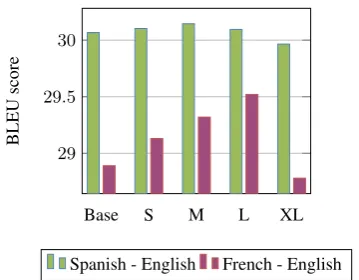
Pruning the graph avoids error propagation by re-moving unreliable edges. Pruning removes edges with an edge weight lower than a minimum thresh-old or by limiting the number of neighbours to the top-Kedges (Talukdar, 2009). PPDB has different sizes with different levels of accuracy and cover-age. We can do graph pruning simply by choosing to use different sizes of PPDB. As we can see in Fig. 3 results vary from language to language de-pending on the pruning used. For instance, the L size results in the best score for French-English. We choose the best size of PPDB for each lan-guage based on a separate held-out set and inde-pendently from each of the SMT-based tasks in our experimental results. Our conclusion from our ex-periments with the different sizes of PPDB is that removing phrases (or nodes in our graph) is not desirable. However, removing unreliable edges is useful. As seen in Table 1, increasing the size of PPDB leads to a rapid increase in nodes fol-lowed by a larger number of edges in the very large PPDB sizes.
4.1.2 Pruning the translation candidates
Another solution to the error propagation issue is to propagate all translation candidates but when providing translations to OOVs in the final phrase
Base S M L XL
29 29.5 30
BLEU
score
Spanish - English French - English
Figure 3: Effect of PPDB size on improving BLEU score for Spanish and French
table to eliminate all but the top L translations for each phrase (which is the usualttablelimit in phrase-based SMT (Koehn et al., 2003)). Based on a development set, separate from the test sets we used, we found that the best value ofLwas 10.
4.1.3 External Resources for Filtering
Applying more informative filters can be also used to improve paraphrase quality. This can be done through additional features for paraphrase pairs. For example, edit distance can be used to capture misspelled paraphrases. We use a Named Entity Recognizer to exclude names, numbers and dates from the paraphrase candidates. Even after remov-ing these tokens, 3.32% of tokens of test set are still OOVs . In addition, we use a list of stop words to remove nodes which have too many connec-tions. These two filters improve our results (more in Sec. 5).
4.2 Path sensitivity
[image:5.595.72.297.63.179.2]para-stock bank margin majority stock
Lager
[image:6.595.80.285.69.126.2]iter1 iter2 iter3
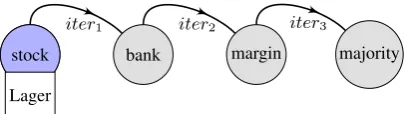
Figure 4: Sensitivity issue in graph propagation for translations. “Lager” is a translation candidate for “stock”, which is transferred to “majority” af-ter 3 iaf-terations.
phrase graph. After three iterations, German trans-lation “Lager” reaches “majority” which is totally irrelevant as a translation candidate. Transfer of translation candidates should prefer close neigh-bours and only with a very low probability to other nodes in the graph.
4.2.1 Pre-structuring the graph
Razmara et al. (2013) avoid a fully connected graph structure. They pre-structure the graph into bipartite graphs (only connections between phrases with known translation and OOV phrases) and tripartite graphs (connections can also go from a known phrasal node to an OOV phrasal node through one node that is a paraphrase of both but does not have translations, i.e. it is an unla-beled node). In these pre-structured graphs there are no connections between nodes of the same type (known, OOV or unlabeled). We apply this method in our low resource setting experiments (Sec. 5.3) to compare our bipartite and tripartite results to Razmara et al. (2013). In the rest of the experiments we use the tripartite approach since it outperforms the bipartite approach.
4.2.2 Graph random walks
Our goal is to limit the number of hops in the prop-agation of translation candidates preferring closely connected and highly probable edge weights. Op-timization for the Modified Adsorption (MAD) objective function in Sec. 3.2 can be viewed as a controlled random walk (Talukdar et al., 2008; Talukdar and Crammer, 2009). This is formal-ized as three actions: inject, continue and aban-donwith corresponding pre-defined probabilities
Pinj, Pcont and Pabnd respectively as in
(Taluk-dar and Crammer, 2009). A random walk through the graph will transfer labels from one node to an-other node, and probabilitiesPcontandPabnd
con-trol exploration of the graph. By reducing the val-ues ofPcont and increasingPabnd we can control
the label propagation process to optimize the qual-ity of translations for OOV phrases. Again, this is done on a held-out development set and not on the test data. The optimal values in our experiments for these probabilities are Pinj = 0.9, Pcont =
0.001, Pabnd = 0.01.
4.2.3 Early stopping of propagation
In Modified Adsorption (MAD) (see Sec. 3.2) nodes in the graph that are closely linked will tend to similar label distributions as the number of it-erations increase (even when the path lengths in-crease). In our setting, smoothing the label distri-bution helps in the first few iterations, but is harm-ful as the number of iterations increase due to the factors shown in Fig. 4. We use early stopping which limits the number of iterations. We varied the number of iterations from 1 to 10 on a held-out dev set and found that 5 iterations was optimal. 5 Evaluation
We first show the effect of OOVs on translation quality, then evaluate our approach in three dif-ferent SMT settings: low resource SMT, domain shift, and morphologically complex languages. In each case, we compare results of using para-phrases extracted by Distributional Profile (DP) and PPDB in an end-to-end SMT system.
Important: no subset of the test data sentences are used in the bilingual corpora for paraphrase ex-traction process.
5.1 Experimental Setup
We use CDEC1 (Dyer et al., 2010) as an
end-to-end SMT pipeline with its standard features2.
fast align (Dyer et al., 2013) is used for word alignment, and weights are tuned by minimizing BLEU loss on the dev set using MIRA (Cram-mer and Singer, 2003). This setup is used for most of our experiments: oracle (Sec. 5.2), do-main adaptation (Sec. 5.4) and morphologically complex languages (Sec. 5.5). But as we wish to fairly compare our approach with Razmara et al. (2013) on low resource setting, we follow their setup in Sec. 5.3: Moses (Koehn et al., 2007) as SMT pipeline, GIZA++ (Och and Ney, 2003) for word alignment and MERT (Och, 2003) for tun-ing. We add our own feature to the SMT log-linear model as described in Sec. 3.3.
1http://www.cdec-decoder.org
Experiments OOV type/token Rules added Case 1 1830 / 2163 7.0K Case 2 - Med. 2294 / 4190 7.8K Case 2 - Sci. 5272 / 14121 10.4K Case 3 1543 / 1895 8.1K Table 2: Statistics of settings in Sec. 5. Last col-umn shows how many rules added in the phrase table integration step.
KenLM (Heafield, 2011) is used to train a 5-gram language model on English Gigaword (V5: LDC2011T07). For scalable graph propagation we use the Junto framework3. We use maximum
phrase length 10. For our experiments we use the Hadoop distributed computing framework ex-ecuted on a cluster with 12 nodes (each node has 8 cores and 16GB of RAM). Each graph propaga-tion iterapropaga-tion takes about 3 minutes.
For French, we apply a simple heuristic to de-tect named entities: words that are capitalized in the original dev/test set that do not appear at the beginning of a sentence are named entities. Based on eyeballing the results, this works very well in our data. For Arabic, AQMAR is used to exclude named-entities (Mohit et al., 2012). For each of the experimental settings below we show the OOV statistics in Table 2.
5.2 Impact of OOVs: Oracle experiment
This oracle experiment shows that translation of OOVs beyond named entities, dates, etc. is poten-tially very useful in improving output translation. We trained a SMT system on 10K French-English sentences from the Europarl corpus(v7) (Koehn, 2005). WMT 2011 and WMT 2012 are used as dev and test data respectively. Table 4 shows the results in terms of BLEU on dev and test. The first row is baseline which simply copies OOVs to output. The second and third rows show the re-sult of augmenting phrase-table by adding transla-tions for single-word OOVs and phrases contain-ing OOVs. The last row shows the oracle result where dev and test sentences exist inside the train-ing data and all the OOVs are known (Fully ob-servers cannot avoid model and search errors).
5.3 Case 1: Limited Parallel Data
In this experiment we use a setup similar to (Raz-mara et al., 2013). To have fair comparison,
3Junto : https://github.com/parthatalukdar/junto
Fr-En Dev Test
Baseline 27.90 28.08 + Lexical OOV 28.10 28.31 + Phrasal OOV 28.50 28.85 Fully observed 46.88 49.21
Table 4: The impact of translating OOVs.
we use 10K French-English parallel sentences, randomly chosen from Europarl to train trans-lation system, as reported in (Razmara et al., 2013). ACL/WMT 20054is used for dev and test
data. We re-implement their paraphrase extraction method (DP) to extract paraphrases from French side of Europarl (2M sentences). We use unigram nodes to construct graphs for both DP and PPDB. In bipartite graphs, each node is connected to at most20nodes. For tripartite graphs, each node is connected to15labeled and5unlabeled nodes.
For intrinsic evaluation, we use Mean-Reciprocal-Rank (MRR) and Recall. MRR is the mean of reciprocal rank of the candidate list compared to the gold list (Eqn. 5). Recall shows percentage of gold list covered by the candidate list (Eqn. 6). Gold translations for OOVs are given by concatenating the test data to training and running a word aligner.
MRR= |O|1
|O|
X
i=1
1
ranki forO={OOVs} (5)
Recall= |{gold list} ∩ {candidate list}| |{gold list}| (6)
Table 5 compares DP and PPDB in terms of BLEU, MRR and Recall. It indicates that PPDB (large size) outperforms DP in both intrinsic and extrinsic evaluation measures. Although tripartite graph did not improve the results for DP, it results in statistically significantly better BLEU score for PPDB in comparison to DP (evaluated by MultE-val (Clark et al., 2011)). Thus we use tripartite graph in the rest of experiments. The last row in the table shows the result of combining DP and PPDB by multiplying the normalized scores of both paraphrase lists.
This setting is included for three reasons: 1) we exploit the small data size to explore differ-ent choices in our approach such as, e.g. choos-ing bipartite versus tripartite graph structures; 2)
[image:7.595.72.299.61.137.2]OOV PPDB NNs DP NNs Reference sentence PPDB output DP output proc´ed´es processus m´ethodes
outils mat´eriaux
... an agreement on proce-dures in itself is a good thing ...
... an agreement on the
procedureis a good ... ...productsan agreement onis a good ... quantique quantiques - ... allowed us to achieve
quantumdegeneracy ... ... allowedgeneracy ...quantumde- ...degeneracy ...quantique allowed mlzm mlzmA ADTr ... voted 97-0 last week for
[image:8.595.73.533.61.148.2]a non-bindingresolution ... ... voted 97 last week onnot bindingresolution ... ... voted 97 last week onhavingresolution ... Table 3: Examples comparing DP versus PPDB outputs on the test sets. NNs refer to nearest neighbours in the graph for OOV phrase. Each row respectively corresponds to experimental settings (cases 1 to 3).
System MRR Recall BLEU
baseline - - 28.89
DP-bipartite 5.34 11.90 29.27 DP-tripartite 5.34 11.95 29.27 PPDBfr(L)-bipartite 12.05 22.08 29.46
PPDBfr(L)-tripartite 10.22 22.87 29.52
[image:8.595.75.296.201.306.2]Combined-tripartite - - 29.28
Table 5: Results of PPDB and DP techniques.
to show how well our PPDB approach does com-pared to the DP approach in terms of MRR and recall; and 3) to show applicability of our ap-proach for a low-resource language. However we used French instead of a language which is truly resource-poor due to the lack of available para-phrases for a true resource poor language, e.g. Malagasy.
5.4 Case 2: Domain Adaptation
Domain adaptation is another case that suffers from massive number of OOVs. We compare our approach with Marginal Matching (Irvine et al., 2013), a state of the art approach in SMT domain adaptation. We use their setup and data and com-pare our results to their reported results (Irvine et al., 2013). 250K lines of Hansard parliamentary proceeding are used for training MT. Dev and test sets are available for two different domains: Medi-cal and Science domains. For mediMedi-cal domain ran-dom subset of EMEA corpus (Tiedemann, 2009) and for the science domain a corpus of scientific articles (Carpuat et al., 2012) has been used. Un-igram paraphrases using DP are extracted from French side of Europarl.
Table 6 compares the results in terms of BLEU score. In both medical and science domains, graph-propagation approach using PPDB (large) performs significantly better than DP (p < 0.02), and has comparable results to Marginal Matching.
Systems Science Medical baseline 22.20 25.32 DP-tripartite 22.76 25.81 PPDBfr(L)-tripartite 22.97 27.11
Marginal Matching 23.62 26.97
Table 6: BLEU scores for domain adaptation.
Systems BLEU
baseline 29.59
DP-tripartite 30.08
PPDBarabic(L)-tripartite 31.12
Table 7: BLEU score results for Arabic-English.
Marginal Matching performs better in science do-main but graph-propagation approach with PPDB outperforms it in medical domain getting a+1.79
BLEU score improvement over the baseline.
5.5 Case 3: Morphologically Rich Languages
Both Distribution Profiling and Bilingual Pivot-ing propose morphological variants of a word as paraphrase pairs. Even more so in PPDB due to pivoting over English. We choose Arabic-English task for this experiment. We train the SMT system on 685K sentence pairs (randomly selected from LDC2007T08 and LDC2008T09) and use NIST OpenMT 2012 for dev and test data. Arabic side of 1M sentences of LDC2007T08 and LDC2008T09 is used to extract unigram paraphrases for DP. Ta-ble 7 shows that PPDB (large; with phrases) re-sulted in +1.53 BLEU score improvement over DP which only slightly improved over baseline.
6 Related Work
[image:8.595.336.497.314.373.2]para-phrases (Bond et al., 2008; Nakov, 2008; Mirkin et al., 2009). Phrase level paraphrasing was done ing crowdsourcing (Resnik et al., 2010) or by us-ing paraphrases in lattice decodus-ing (Onishi et al., 2010; Du et al., 2010).
Daum´e and Jagarlamudi (2011) apply a genera-tive model to domain adaptation based on canon-ical correlation analysis Haghighi et al. (2008). However, they use artificially created monolingual corpora very related to the same domain as test data. Irvine and Callison-Burch (2014a) gener-ate a large, noisy phrase table by composing un-igram translations which are obtained by a super-vised method (Irvine and Callison-Burch, 2013). Comparable monolingual data is used to re-score and filter the phrase table. Zhang and Zong (2013) use a large manually generated lexicon for do-main adaptation. In contrast to these methods, our method is unsupervised.
Alexandrescu and Kirchhoff (2009) use a graph-based semi-supervised model determine similarities between sentences, then use it to re-rank the n-best translation hypothesis. Liu et al. (2012) extend this model to derive some features to be used during decoding. These approaches are orthogonal to our approach. Saluja et al. (2014) use Structured Label Propagation (Liu et al., 2012) in two parallel graphs constructed on source and target paraphrases. In their case the graph con-struction is extremely expensive. Leveraging a morphological analyzer, they reach significant im-provement on Arabic. We can not directly com-pare our results to (Saluja et al., 2014) because they exploit several external resources such as a morphological analyzer and also had different sizes of training and test. In experiments (Sec. 5) we obtained comparable BLEU score improve-ment on Arabic-English by using bilingual pivot-ing only on source phrases. (Saluja et al., 2014) also use methods similar to (Habash, 2008) that expand the phrase table with spelling and morpho-logical variants of OOVs in test data. We do not use the dev/test data to augment the phrase table.
Using comparable corpora to extract parallel sentences and phrases (Munteanu and Marcu, 2006; Smith et al., 2010; Tamura et al., 2012) are orthogonal to the approach we discuss here.
Bilingual and multilingual word and phrase rep-resentation using neural networks have been ap-plied to machine translation (Zou et al., 2013; Mikolov et al., 2013a; Zhang et al., 2014).
How-ever, most of these methods focus on frequent words or an available bilingual phrase table (Zou et al., 2013; Zhang et al., 2014; Gao et al., 2014). Mikolov et al. (2013a) learn a global linear projec-tion from source to target using representaprojec-tion of frequent words on both sides. This model can be used to generate translations for new words, but a large amounts of bilingual data is required to cre-ate such a model. (Mikolov et al., 2013b) also uses bilingual data to project new translation rules. Zhao et al. (2015) extend Mikolov’s model to learn one local linear projection for each phrase. Their model reaches comparable results to Saluja et al. (2014) while works faster. Alkhouli et al. (2014) use neural network phrase representation for para-phrasing OOVs and find translation for them using a phrase-table created from limited parallel data. Our experimental settings is different from the ap-proaches in (Alkhouli et al., 2014; Mikolov et al., 2013a; Mikolov et al., 2013b).
7 Conclusion and Future work
In future work, we would like to include transla-tions for infrequent phrases which are not OOVs. We would like to explore new propagation meth-ods that can directly use confidence estimates and control propagation based on label sparsity. We also would like to expand this work for mor-phologically rich languages by exploiting other resources like morphological analyzer and cam-pare our approach to the current state of art ap-proaches which are using these types of resources. In conclusion, we have shown significant improve-ments to the quality of statistical machine transla-tion in three different cases: low resource SMT, domain shift, and morphologically complex lan-guages. Through the use of semi-supervised graph propagation, a large scale multilingual paraphrase database can be used to improve the quality of sta-tistical machine translation.
Acknowledgments
References
Andrei Alexandrescu and Katrin Kirchhoff. 2009. Graph-based learning for statistical machine trans-lation. InNAACL 2009.
Tamer Alkhouli, Andreas Guta, and Hermann Ney. 2014. Vector space models for phrase-based
ma-chine translation. InEMNLP 2014: Eighth
Work-shop on Syntax, Semantics and Structure in Statisti-cal Translation.
Colin Bannard and Chris Callison-Burch. 2005. Para-phrasing with bilingual parallel corpora. In ACL 2005.
Francis Bond, Eric Nichols, Darren Scott Appling, and Michael Paul. 2008. Improving statistical machine translation by paraphrasing the training data. In IWSLT 2008.
Chris Callison-Burch, Philipp Koehn, and Miles Os-borne. 2006. Improved statistical machine transla-tion using paraphrases. InNAACL 2006.
Chris Callison-Burch. 2008. Syntactic constraints on paraphrases extracted from parallel corpora. In EMNLP 2008.
Marine Carpuat, H Daum´e III, Alexander Fraser, Chris Quirk, Fabienne Braune, Ann Clifton, Ann Irvine, Jagadeesh Jagarlamudi, John Morgan, Majid Raz-mara, Aleˇs Tamchyna, Katharine Henry, and Rachel Rudinger. 2012. Domain adaptation in machine translation: Final report. In 2012 Johns Hopkins Summer Workshop.
Jonathan H. Clark, Chris Dyer, Alon Lavie, and Noah A. Smith. 2011. Better hypothesis testing for statistical machine translation: controlling for opti-mizer instability. InACL 2011.
Koby Crammer and Yoram Singer. 2003. Ultracon-servative online algorithms for multiclass problems. The Journal of Machine Learning Research. Hal Daum´e, III and Jagadeesh Jagarlamudi. 2011.
Do-main adaptation for machine translation by mining unseen words. InACL 2011.
Jinhua Du, Jie Jiang, and Andy Way. 2010. Facili-tating translation using source language paraphrase lattices. InEMNLP 2010.
Chris Dyer, Adam Lopez, Juri Ganitkevitch, Johnathan Weese, Ferhan Ture, Phil Blunsom, Hendra Seti-awan, Vladimir Eidelman, and Philip Resnik. 2010. cdec: A decoder, alignment, and learning framework for finite-state and context-free translation models. InACL 2010.
Chris Dyer, Victor Chahuneau, and Noah A Smith. 2013. A Simple, Fast, and Effective
Reparameter-ization of IBM Model 2. InNAACL HLT 2013.
Juri Ganitkevitch and Chris Callison-Burch. 2014. The multilingual paraphrase database. InLREC 2014.
Juri Ganitkevitch, Chris Callison-Burch, Courtney Napoles, and Benjamin Van Durme. 2011. Learn-ing sentential paraphrases from bilLearn-ingual parallel corpora for text-to-text generation. InNAACL HLT 2011.
Jianfeng Gao, Xiaodong He, Wen-tau Yih, and Li Deng. 2014. Learning continuous phrase rep-resentations for translation modeling. InACL 2014. Nikesh Garera, Chris Callison-Burch, and David Yarowsky. 2009. Improving translation lexicon in-duction from monolingual corpora via dependency contexts and part-of-speech equivalences. InCoNLL 2009.
Nizar Habash. 2008. Four Techniques for Online Handling of Out-of-Vocabulary Words in
Arabic-English Statistical Machine Translation. In ACL
2008.
Aria Haghighi, Percy Liang, Taylor Berg-Kirkpatrick, and Dan Klein. 2008. Learning bilingual lexicons from monolingual corpora. InACL 2008.
Kenneth Heafield. 2011. KenLM: faster and smaller
language model queries. InWMT 2011.
Ann Irvine and Chris Callison-Burch. 2013. Su-pervised bilingual lexicon induction with multiple
monolingual signals. InNAACL 2013.
Ann Irvine and Chris Callison-Burch. 2014a. Hal-lucinating phrase translations for low resource MT. CoNLL-2014.
Ann Irvine and Chris Callison-Burch. 2014b. Using comparable corpora to adapt mt models to new
do-mains. ACL 2014.
Ann Irvine, Chris Quirk, and Hal Daum´e III. 2013. Monolingual marginal matching for translation
model adaptation. InEMNLP 2013.
David Kauchak and Regina Barzilay. 2006. Paraphras-ing for automatic evaluation. InNAACL 2008. Philipp Koehn and Kevin Knight. 2002. Learning a
translation lexicon from monolingual corpora. In ACL 2002 workshop on unsupervised lexical acqui-sition.
Philipp Koehn, Franz Josef Och, and Daniel Marcu.
2003. Statistical phrase-based translation. In
NAACL 2003.
Philipp Koehn, Hieu Hoang, Alexandra Birch, Chris Callison-Burch, and et al. 2007. Moses: open source toolkit for statistical machine translation. In ACL 2007.
Philipp Koehn. 2005. Europarl: A parallel corpus for statistical machine translation. InMT summit 2005, volume 5.
Shujie Liu, Chi-Ho Li, Mu Li, and Ming Zhou. 2012. Learning translation consensus with structured label propagation. InACL 2012.
Nitin Madnani, Necip Fazil Ayan, Philip Resnik, and Bonnie J Dorr. 2007. Using paraphrases for pa-rameter tuning in statistical machine translation. In WMT 2007.
Gideon S. Mann and David Yarowsky. 2001. Mul-tipath translation lexicon induction via bridge
lan-guages. InNAACL 2001.
Yuval Marton, Chris Callison-Burch, and Philip Resnik. 2009. Improved statistical machine trans-lation using monolingually-derived paraphrases. In EMNLP 2009.
Tomas Mikolov, Quoc V. Le, and Ilya Sutskever. 2013a. Exploiting similarities among languages for machine translation. CoRR.
Tomas Mikolov, Ilya Sutskever, Kai Chen, Gregory S. Corrado, and Jeffrey Dean. 2013b. Distributed rep-resentations of words and phrases and their compo-sitionality. InNIPS 2013.
Shachar Mirkin, Lucia Specia, Nicola Cancedda, Ido Dagan, Marc Dymetman, and Idan Szpektor. 2009. Source-language entailment modeling for
translat-ing unknown terms. InACL-IJCNLP 2009.
Behrang Mohit, Nathan Schneider, Rishav Bhowmick,
Kemal Oflazer, and Noah A Smith. 2012.
Recall-oriented learning of named entities in arabic wikipedia. InEACL 2012, pages 162–173.
Dragos Stefan Munteanu and Daniel Marcu. 2006. Ex-tracting parallel sub-sentential fragments from non-parallel corpora. InACL 2006.
Preslav Nakov. 2008. Improved statistical machine translation using monolingual paraphrases. InECAI 2008: 18th European Conference on Artificial Intel-ligence. IOS Press.
Franz Josef Och and Hermann Ney. 2003. A sys-tematic comparison of various statistical alignment models. Comput. Linguist.
Franz Josef Och. 2003. Minimum error rate training for statistical machine translation. InACL 2003.
Takashi Onishi, Masao Utiyama, and Eiichiro Sumita. 2010. Paraphrase lattice for statistical machine translation. InACL 2010.
Reinhard Rapp. 1995. Identifying word translations in non-parallel texts. InACL 1995.
Majid Razmara, Maryam Siahbani, Reza Haffari, and Anoop Sarkar. 2013. Graph propagation for para-phrasing out-of-vocabulary words in statistical ma-chine translation. InACL 2013.
Philip Resnik, Olivia Buzek, Chang Hu, Yakov Kron-rod, Alex Quinn, and Benjamin B Bederson. 2010. Improving translation via targeted paraphrasing. In EMNLP 2010.
Avneesh Saluja, Hany Hassan, Kristina Toutanova, and Chris Quirk. 2014. Graph-based semi-supervised learning of translation models from monolingual data. InACL 2014.
Charles Schafer and David Yarowsky. 2002. Inducing translation lexicons via diverse similarity measures and bridge languages. InCoNLL 2002.
Jason R. Smith, Chris Quirk, and Kristina Toutanova. 2010. Extracting parallel sentences from compa-rable corpora using document level alignment. In NAACL 2010.
Partha Pratim Talukdar and Koby Crammer. 2009. New Regularized Algorithms for Transductive
Learning. In European Conference on Machine
Learning.
Partha Pratim Talukdar, Joseph Reisinger, Marius Pas¸ca, Deepak Ravichandran, Rahul Bhagat, and Fernando Pereira. 2008. Weakly-supervised acqui-sition of labeled class instances using graph random
walks. InEMNLP 2008.
Partha Pratim Talukdar. 2009. Topics in graph con-struction for semi-supervised learning. Technical Report MS-CIS-09-13, University of Pennsylvania, Dept of Computer and Info. Sci.
Akihiro Tamura, Taro Watanabe, and Eiichiro Sumita. 2012. Bilingual lexicon extraction from comparable
corpora using label propagation. InEMNLP-CoNLL
2012.
J¨org Tiedemann. 2009. News from OPUS-A collec-tion of multilingual parallel corpora with tools and interfaces. InRecent advances in natural language processing.
Jiajun Zhang and Chengqing Zong. 2013. Learning a phrase-based translation model from monolingual data with application to domain adaptation. InACL 2013.
Jiajun Zhang, Feifei Zhai, and Chengqing Zong. 2012. Handling unknown words in statistical ma-chine translation from a new perspective. In Natu-ral Language Processing and Chinese Computing. Springer.
Jiajun Zhang, Shujie Liu, Mu Li, Ming Zhou, and Chengqing Zong. 2014. Bilingually-constrained phrase embeddings for machine translation. InACL 2014.
Kai Zhao, Hany Hassan, and Michael Auli. 2015. Learning translation models from monolingual con-tinuous representations. InNAACL 2015.