Narrative Schema as World Knowledge for Coreference Resolution
Joseph Irwin Nara Institute of Science and Technology
Nara Prefecture, Japan [email protected]
Mamoru Komachi Nara Institute of Science and Technology
Nara Prefecture, Japan [email protected]
Yuji Matsumoto Nara Institute of Science and Technology
Nara Prefecture, Japan [email protected]
Abstract
In this paper we describe the system with which we participated in the CoNLL-2011 Shared Task on modelling coreference. Our system is based on a cluster-ranking model proposed by Rahman and Ng (2009), with novel semantic features based on recent re-search on narrative event schema (Chambers and Jurafsky, 2009). We demonstrate some improvements over the baseline when using schema information, although the effect var-ied between the metrics used. We also explore the impact of various features on our system’s performance.
1 Introduction
Coreference resolution is a problem for automated document understanding. We say two segments of a natural-language documentcorefer when they re-fer to the same real-world entity. The segments of a document which refer to anentityare called men-tions. In coreference resolution tasks, mentions are usually restricted to noun phrases.
The goal of the CoNLL-2011 Shared Task (Prad-han et al., 2011) is to model unrestricted coreference using the OntoNotes corpus. The OntoNotes cor-pus is annotated with several layers of syntactic and semantic information, making it a rich resource for investigating coreference resolution (Pradhan et al., 2007).
We participated in both the “open” and “closed” tracks. The “closed” track requires systems to only use the provided data, while the “open” track al-lows use of external data. We created a baseline
system based on the cluster-ranking model proposed by Rahman and Ng (2009). We then experimented with adding novel semantic features derived from co-referring predicate-argument chains. These nar-rative schemawere developed by Chambers and Ju-rafsky (2009). They are described in more detail in a later section.
2 Related Work
Supervised machine-learning approaches to corefer-ence resolution have been researched for almost two decades. Recently, the state of the art seems to be moving away from the early mention-pair classifica-tion model toward entity-based models. Ng (2010) provides an excellent overview of the history and re-cent developments within the field.
Both entity-mention and mention-pair models are formulated as binary classification problems; how-ever, ranking may be a more natural approach to coreference resolution (Ng, 2010; Rahman and Ng, 2009). Rahman and Ng (2009) in particular pro-pose the cluster-ranking model which we used in our baseline. In another approach, Daum´e and Marcu (2005) apply their Learning as Search Optimization framework to coreference resolution, and show good results.
Feature selection is important for good perfor-mance in coreference resolution. Ng (2010) dis-cusses commonly used features, and analyses of the contribution of various features can be found in (Daum´e and Marcu, 2005; Rahman and Ng, 2011; Ponzetto and Strube, 2006b). Surprisingly, Rahman and Ng (2011) demonstrated that a system using al-most exclusively lexical features could outperform
systems which used more traditional sets of features. Although string features have a large effect on performance, it is recognized that the use of seman-tic information is important for further improvement (Ng, 2010; Ponzetto and Strube, 2006a; Ponzetto and Strube, 2006b; Haghighi and Klein, 2010). The use of predicate-argument structure has been ex-plored by Ponzetto and Strube (2006b; 2006a).
3 Narrative Schema for Coreference
Narrative schema are extracted from large-scale cor-pora using coreference information to identify pred-icates whose arguments often corefer. Similarity measures are used to build up schema consisting of one or moreevent chains – chains of typically-coreferring predicate arguments (Chambers and Ju-rafsky, 2009). Each chain corresponds to arole in the schema.
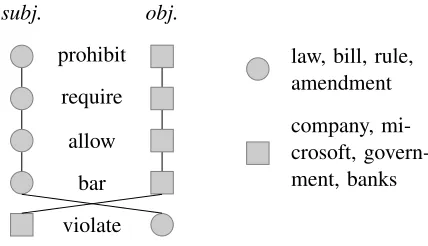
A role defines a class of participants in the schema. Conceptually, if a schema is present in a document, than each role in the schema corresponds to an entity in the document. An example schema is shown with some typical participants in Figure 1. In this paper the temporal order of events in the schema is not considered.
prohibit
require
allow
bar
violate
subj. obj.
law, bill, rule, amendment
[image:2.612.81.295.417.540.2]company, mi-crosoft, govern-ment, banks
Figure 1: An example narrative schema with two roles.
Narrative schema are similar to the script con-cept put forth by Schank and Abelson (1977). Like scripts, narrative schema can capture complex struc-tured information about events described in natural language documents (Schank and Abelson, 1977; Abelson, 1981; Chambers and Jurafsky, 2009).
We hypothesize that narrative schema can be a good source of information for making coreference decisions. One reason they could be useful is that
they can directly capture the fact that arguments of certain predicates are relatively more likely to refer to the same entity. In fact, they can capture global information about verbs ranging over the entire doc-ument, which we expect may lead to greater accu-racy when combined with the incremental clustering algorithm we employ.
Additionally, the information that two predicates often share arguments yields semantic information about the argument words themselves. For exam-ple, if the subjects of the verbseatand drinkoften corefer, we may be able to infer that words which occur in the subject position of these verbs share some property (e.g., animacy). This last conjec-ture is somewhat validated by Ponzetto and Strube (2006b), who reported that including predicate-argument pairs as features improved the perfor-mance of a coreference resolver.
4 System Description
4.1 Overview
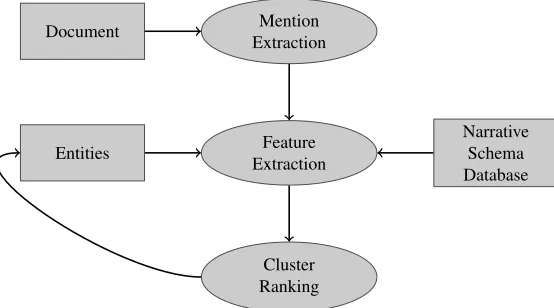
We built a coreference resolution system based on the cluster-ranking algorithm proposed by Rahman and Ng (2009). During document processing main-tains a list of clusters of coreferring mentions which are created iteratively. Our system uses a determin-istic mention-detection algorithm that extracts can-didate NPs from a document. We process the men-tions in order of appearance in the document. For each mention a ranking query is created, with fea-tures generated from the clusters created so far. In each query we include a null-cluster instance, to al-low joint learning of discourse-new detection, fol-lowing (Rahman and Ng, 2009).
For training, each mention is assigned to its cor-rect cluster according to the coreference annota-tion. The resulting queries are used to train a classification-based ranker.
In testing, the ranking model thus learned is used to rank the clusters in each query as it is created; the active mention is assigned to the cluster with the highest rank.
Document Mention Extraction
Feature Extraction Entities
Narrative Schema Database
[image:3.612.183.460.59.213.2]Cluster Ranking
Figure 2: System execution flow
4.2 Cluster-ranking Model
Our baseline system uses a cluster-ranking model proposed by Rahman and Ng (2009; 2011). In this model, clusters are iteratively constructed after con-sidering each active mention in a document in order. During training, features are created between the ac-tive mention and each cluster created so far. A rank is assigned such that the cluster which is coreferent to the active mention has the highest value, and each non-coreferent cluster is assigned the same, lower rank (The exact values are irrelevant to learning a ranking; for the experiments in this paper we used the values 2 and 1). In this way it is possible to learn to preferentially rank correct clustering deci-sions higher.
For classification, instances are constructed ex-actly the same way as for training, except that for each active mention, a query must be constructed and ranked by the classifier in order to proceed with the clustering. After the query for each active men-tion has been ranked, the menmen-tion is assigned to the cluster with the highest ranking, and the algorithm proceeds to the next mention.
4.3 Notation
In the following sections,mkis the active mention
currently being considered, mj is a candidate
an-tecedent mention, andcj is the cluster to which it
belongs. Most of the features used in our system ac-tually apply to a pair of mentions (i.e.,mkandmj) or to a single mention (eithermk or mj). To cre-ate a training or test instance usingmk andcj, the
features which apply tomjare converted to
cluster-level features by a procedure described in 4.6.
4.4 Joint Anaphoric Mention Detection
We follow Rahman and Ng (2009) in jointly learn-ing to detect anaphoric mentions along with resolv-ing coreference relations. For each active mention
mk, an instance for a ‘null’ cluster is also created,
with rank 2 if the mention is not coreferent with any preceding mention, or rank 1 if it has an an-tecedent. This allows the ranker the option of mak-ingmkdiscourse-new. To create this instance, only the features which involve justmkare used.
4.5 Features
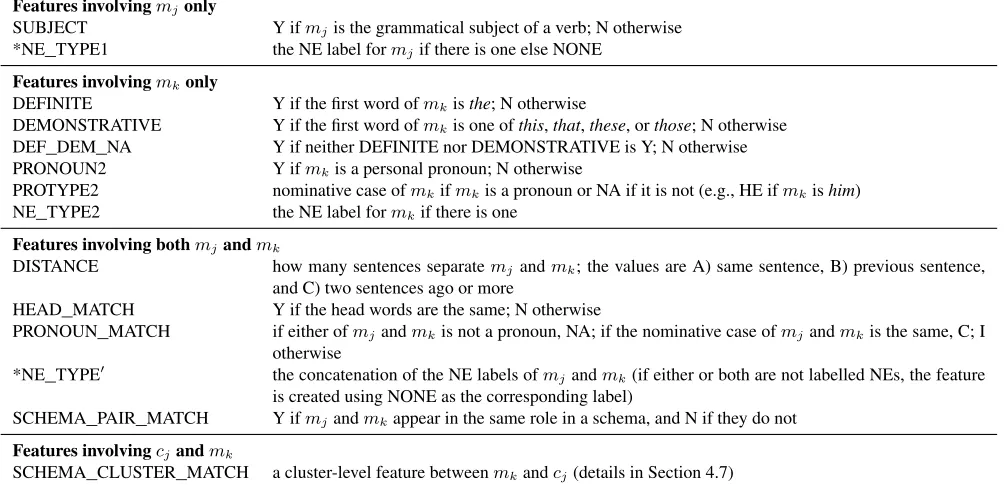
The features used in our system are shown in Table 1. For the NE features we directly use the types from the OntoNotes annotation.1
4.6 Making Cluster-Level Features
Each feature which applies tomjmust be converted
to a cluster-level feature. We follow the proce-dure described in (Rahman and Ng, 2009). This procedure uses binary features whose values corre-spond to being logically true or false. Multi-valued features are first converted into equivalent sets of binary-valued features. For each binary-valued fea-ture, four corresponding cluster-level features are created, whose values are determined by four logical
1
Features involvingmjonly
SUBJECT Y ifmjis the grammatical subject of a verb; N otherwise
*NE_TYPE1 the NE label formjif there is one else NONE
Features involvingmkonly
DEFINITE Y if the first word ofmkisthe; N otherwise
DEMONSTRATIVE Y if the first word ofmkis one ofthis,that,these, orthose; N otherwise
DEF_DEM_NA Y if neither DEFINITE nor DEMONSTRATIVE is Y; N otherwise PRONOUN2 Y ifmkis a personal pronoun; N otherwise
PROTYPE2 nominative case ofmkifmkis a pronoun or NA if it is not (e.g., HE ifmkishim)
NE_TYPE2 the NE label formkif there is one
Features involving bothmjandmk
DISTANCE how many sentences separatemjandmk; the values are A) same sentence, B) previous sentence,
and C) two sentences ago or more
HEAD_MATCH Y if the head words are the same; N otherwise
PRONOUN_MATCH if either ofmjandmkis not a pronoun, NA; if the nominative case ofmjandmkis the same, C; I
otherwise
*NE_TYPE0 the concatenation of the NE labels ofmjandmk(if either or both are not labelled NEs, the feature
is created using NONE as the corresponding label)
SCHEMA_PAIR_MATCH Y ifmjandmkappear in the same role in a schema, and N if they do not
Features involvingcjandmk
[image:4.612.74.577.65.309.2]SCHEMA_CLUSTER_MATCH a cluster-level feature betweenmkandcj(details in Section 4.7)
Table 1: Features implemented in our coreference resolver. Binary-valued features have values ofYES orNO. Multi-valued features are converted into equivalent sets of binary-Multi-valued features before being used to create the cluster-level features used by the ranker.
predicates: NONE, MOST-FALSE, MOST-TRUE, and ALL.
To be precise, a featureF may be thought of as a function takingmj as a parameter, e.g.,F(mj). To
simplify notation, features which apply to thepair mj,mktakemk as an implicit parameter. The
log-ical predicates then compare the two counts n =
|{mj | F(mj) = true}| and C = |cj|. The
re-sulting features are shown in Table 2.
NONE F TRUE iffn= 0
MOST-FALSE F TRUE iffn <C
2
MOST-TRUE F TRUE iffC2 ≤n < C ALL F TRUE iffn=C
Table 2: Cluster-level features created from binary-valued featureF
The two features marked with * are treated differently. For each value of NE_TYPE1 and NE_TYPE0, a new cluster-level feature is cre-ated whose value is the number of times that fea-ture/value appeared in the cluster (i.e., if there were two PERSON NEs in a cluster then the feature NE_TYPE1_PERSON would have the value 2).
4.7 SCHEMA_CLUSTER_MATCH
The SCHEMA_CLUSTER_MATCH feature is ac-tually three features, which are calculated over an entire candidate antecedent clustercj. First a list is
created of all of the schema roles which the men-tions in cj participate in, and sorted in decreasing
order according to how many mentions in cj
par-ticipate in each. Then, the value of the feature SCHEMA_CLUSTER_MATCHn is Y if mention
mk also participates in the nth schema role in the
list, forn = 1,2,3. If it does not, or if the corre-spondingnthschema role has fewer than two
partic-ipants incj, the value of this feature is N.
4.8 Implementation Details
Our system was implemented in Python, in order to make use of the NLTK library2. For the ranker we used SVMrank, an efficient implementation for train-ing ranktrain-ing SVMs (Joachims, 2006)3.
2
http://www.nltk.org/
3
R P F1
MUC 12.45% 50.60% 19.98 CLOSED B3 35.07% 89.90% 50.46 CEAF 45.84% 17.38% 25.21 Overall score: 31.88
MUC 18.56% 51.01% 27.21 OPEN B3 38.97% 85.57% 53.55
CEAF 43.33% 19.36% 26.76 Overall score: 35.84
Table 3: Official system results
5 Experiments and Results
5.1 CoNLL System Submission
We submitted two results to the CoNLL-2011 Shared Task. In the “closed” track we submitted the results of our baseline system without the schema features, trained on all documents in both the train-ing and development portions of the OntoNotes cor-pus.
We also submitted a result in the “open” track: a version of our system with the schema features added. Due to issues with the implementation of this second version, however, we were only able to sub-mit results from a model trained on just the WSJ por-tion of the training dataset. For the schema features, we used a database of narrative schema released by Chambers and Jurafsky (2010) – specifically the list of schemas of size 12.4
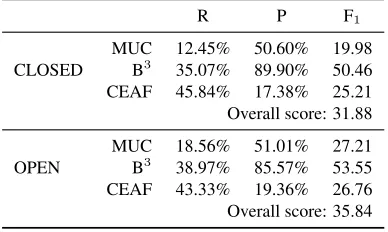
The official system scores for our system are listed in Table 3. We can attribute some of the low performance of our system to features which are too noisy, and to having not enough features compared to the large size of the dataset. It is likely that these two factors adversely impact the ability of the SVM to learn effectively. In fact, the features which we in-troduced partially to provide more features to learn with, the NE features, had the worst impact on per-formance according to later analysis. Because of a problem with our implementation, we were unable to get an accurate idea of our system’s performance until after the submission deadline.
4
Available at http://cs.stanford.edu/people/nc/schemas/
R P F1
MUC 12.77% 57.66% 20.91 Baseline B3 35.1% 91.05% 50.67 CEAF 47.80% 17.29% 25.40
[image:5.612.90.284.59.175.2]MUC 12.78% 54.84% 20.73 +SCHEMA B3 35.75% 90.39% 51.24 CEAF 46.62% 17.43% 25.38
Table 4: Schema features evaluated on the development set. Training used the entire training dataset.
5.2 Using Narrative Schema as World Knowledge for Coreference Resolution
We conducted an evaluation of the baseline without schema features against a model with both schema features added. The results are shown in Table 4.
The results were mixed, with B3 going up and MUC and CEAF falling slightly. Cross-validation using just the development set showed a more posi-tive picture, however, with both MUC and B3scores increasing more than 1 point (p = 0.06 and p <
0.01, respectively), and CEAF increasing about 0.5 points as well (although this was not significant at
p >0.1). 5
One problem with the schema features that we had anticipated was that they may have a problem with sparseness. We had originally intended to ex-tract schema using the coreference annotation in OntoNotes, predicting that this would help alleviate the problem; however, due to time constraints we were unable to complete this effort.
5.3 Feature Analysis
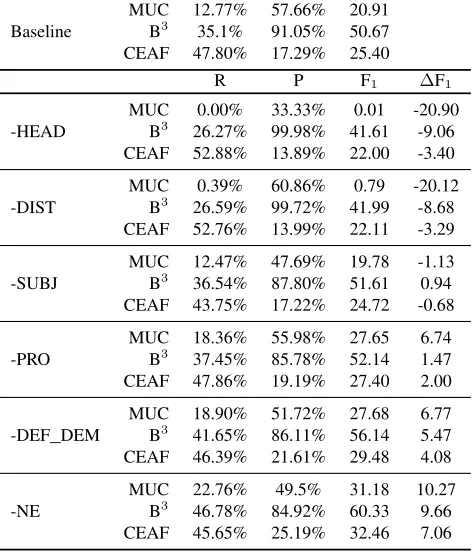
We conducted a feature ablation analysis on our baseline system to better understand the contribu-tion of each feature to overall performance. The results are shown in Table 5. We removed fea-tures in blocks of related feafea-tures; -HEAD removes HEAD MATCH; -DIST removes the DISTANCE feature; -SUBJ is the baseline system without SUB-JECT; -PRO is the baseline system without PRO-NOUN2, PROTYPE2, and PRONOUN MATCH; -DEF DEM removes DEFINITE, DEMONSTRA-TIVE, and DEF DEM NA; and -NE removes the named entity features.
5All significance tests were performed with a two-tailed
[image:5.612.325.527.59.151.2]MUC 12.77% 57.66% 20.91 Baseline B3 35.1% 91.05% 50.67
CEAF 47.80% 17.29% 25.40
R P F1 ∆F1
MUC 0.00% 33.33% 0.01 -20.90 -HEAD B3 26.27% 99.98% 41.61 -9.06
CEAF 52.88% 13.89% 22.00 -3.40
MUC 0.39% 60.86% 0.79 -20.12 -DIST B3 26.59% 99.72% 41.99 -8.68 CEAF 52.76% 13.99% 22.11 -3.29
MUC 12.47% 47.69% 19.78 -1.13 -SUBJ B3 36.54% 87.80% 51.61 0.94
CEAF 43.75% 17.22% 24.72 -0.68
MUC 18.36% 55.98% 27.65 6.74
-PRO B3 37.45% 85.78% 52.14 1.47
CEAF 47.86% 19.19% 27.40 2.00
MUC 18.90% 51.72% 27.68 6.77 -DEF_DEM B3 41.65% 86.11% 56.14 5.47 CEAF 46.39% 21.61% 29.48 4.08
MUC 22.76% 49.5% 31.18 10.27
-NE B3 46.78% 84.92% 60.33 9.66
[image:6.612.75.313.63.339.2]CEAF 45.65% 25.19% 32.46 7.06
Table 5: Effect of each feature on performance.
The fact that for three of the features, removing the feature actually improved performance is trou-bling. Possibly these features were too noisy; we need to improve the baseline features for future ex-periments.
6 Conclusions
Semantic information is necessary for many tasks in natural language processing. Most often this infor-mation is used in the form of relationships between words – for example, how semantically similar two words are, or which nouns are the objects of a verb. However, it is likely that humans make use of much higher-level information than the similarity between two concepts when processing language (Abelson, 1981). We attempted to take advantage of recent de-velopments in automatically aquiring just this sort of information, and demonstrated the possibility of making use of it in NLP tasks such as coreference. However, we need to improve both the implementa-tion and data for this approach to be practical.
For future work, we intend to investigate avenues for improving the aquisition and use of the
tive schema information, and also compare narra-tive schema with other types of semantic informa-tion in coreference resoluinforma-tion. Because coreference information is central to the extraction of narrative schema, the joint learning of coreference resolution and narrative schema is another area we would like to explore.
References
Robert P. Abelson. 1981. Psychological status of the script concept. American Psychologist, 36(7):715– 729.
Nathanael Chambers and Dan Jurafsky. 2009. Unsuper-vised Learning of Narrative Schemas and their Partic-ipants. InProceedings of the Joint Conference of the 47th Annual Meeting of the ACL and the 4th Interna-tional Joint Conference on Natural Language
Process-ing of the AFNLP, pages 602–610, Suntec, Singapore.
Nathanael Chambers and Dan Jurafsky. 2010. A database of narrative schemas. InProceedings of the Seventh International Conference on Language
Re-sources and Evaluation (LREC 2010), Malta.
Hal Daum´e and Daniel Marcu. 2005. A large-scale ex-ploration of effective global features for a joint en-tity detection and tracking model. InProceedings of the Conference on Human Language Technology and Empirical Methods in Natural Language Processing
-HLT ’05, pages 97–104, Morristown, NJ, USA.
Aria Haghighi and Dan Klein. 2010. Coreference reso-lution in a modular, entity-centered model. InHuman Language Technologies: The 2010 Annual Conference of the North American Chapter of the Association for
Computational Linguistics, pages 385–393.
Thorsten Joachims. 2006. Training linear SVMs in lin-ear time. InProceedings of the 12th ACM SIGKDD In-ternational Conference on Knowledge Discovery and
Data Mining KDD 06, pages 217–226.
Vincent Ng. 2010. Supervised noun phrase coreference research: the first fifteen years. InProceedings of the 48th Annual Meeting of the Association for
Computa-tional Linguistics, pages 1396–1411.
Simone Paolo Ponzetto and Michael Strube. 2006a. Exploiting semantic role labeling, WordNet and Wikipedia for coreference resolution. InProceedings of the main conference on Human Language Technol-ogy Conference of the North American Chapter of the
Association of Computational Linguistics, pages 192–
199.
Linguistics - EACL ’06, pages 143–146, Morristown, NJ, USA.
Sameer Pradhan, Lance Ramshaw, Ralph Weischedel, Jessica MacBride, and Linnea Micciulla. 2007. Unre-stricted Coreference: Identifying Entities and Events in OntoNotes. InInternational Conference on
Seman-tic Computing (ICSC 2007), pages 446–453.
Sameer Pradhan, Lance Ramshaw, Mitchell Marcus, Martha Palmer, Ralph Weischedel, and Nianwen Xue. 2011. CoNLL-2011 Shared Task: Modeling Unre-stricted Coreference in OntoNotes. In Proceedings of the Fifteenth Conference on Computational Natural
Language Learning (CoNLL 2011), Portland, Oregon.
Altaf Rahman and Vincent Ng. 2009. Supervised Mod-els for Coreference Resolution. In Proceedings of the 2009 Conference on Empirical Methods in
Natu-ral Language Processing, pages 968–977, Singapore.
Altaf Rahman and Vincent Ng. 2011. Narrowing the Modeling Gap: A Cluster-Ranking Approach to Coreference Resolution. Journal of Artificial
Intelli-gence Research, 40:469–521.
Roger C. Schank and Robert P. Abelson. 1977. Scripts, plans, goals and understanding: An inquiry into
hu-man knowledge structures. Lawrence Erlbaum,