Simulation based Analysis of AODV Routing Protocol in
Ad Hoc Network under different Mobility and
Propagation Loss Models using NS-3
Vineet Kumar Singh
M.Tech Scholar SHUATS Allahabad
Rajeev Paulus
Assistant Professor SHUATS AllahabadAditi Agrawal
Assistant Professor SHUATS AllahabadNeelesh Agrawal
Assistant Professor SHUATS AllahabadABSTRACT
Mobile ad hoc network is an infrastructure-less network, that consist of mobile nodes, with the ability to communicate with each other without any centralized unit. The main features of MANETs are, wireless medium, dynamic topology, distributed cooperation, vulnerable to many security attacks and data loss because of the mobility of nodes.
Many routing protocols have been developed for MANET, but ad hoc on Demand Distance Vector (AODV) routing protocol is preferred as the best routing protocol for MANET, because it minimizes the routing overhead more than the other protocols and hence improves the performance of the network. In this article, we have analyzed and evaluated the performance of Nakagami propagation loss model and Friis propagation loss model under different mobility scenario at different speeds to measure the performance parameter such as Packet Delivery Ratio (PDR), Throughput and Packet loss, the routing protocol used in are research is AODV. [1][2].
Keywords
AODV, MANET, NS3, Friis Propagation Loss Model, Nakagami Propagation Loss Model, RWP, Constant Position Mobility Model.
1.
INTRODUCTION
Mobile Adhoc Network consist of mobile nodes which communicate to each other through wireless links. The mobile nodes that are in radio range to each other can directly communicate, whereas the other node needs some intermediate nodes to route their packets to a particular designation [15]. These types of networks and can communicatewithout the helpof any fixed infrastructure such as access points or base stations. For this purpose MANET is very useful because of its important characteristics such asunique operation, Multi hop routing, dynamic topology, Shared Physical medium. MANET can face many problems, such as security attacks and data loss because of mobility of nodes, which causes the network topology to change very frequently and as a result the data loss may be very high.
In this article we have compared two prominent propagation loss models with AODV routing protocol in two different mobility schemes with various node speed i.e. in static environment and dynamic environment by using constant position mobility and random way point (RWP) mobility model.
2.
MOTIVATION
During the review of our research in MANET for past few years we came across few important areas such as routing, propagation loss models, mobility models, and performance of routing protocols at different nodes speed etc. Among which routing and mobility models has been widely used by
the researchers. In our paper we have focused on the two different propagation loss models, which are Nakagami and Friis propagation loss models. We compared the propagation loss models for different parameters.
3.
ROUTING PROTOCOLS IN MANET
Routing is basically the process of transmitting data or packets from source node to the Destination node. In Ad-Hoc network the topology changes very frequently in this manner making packet routing is very challenging. Routing protocol controls the stream of information in systems and furthermore chooses the efficient way to achieve the goal. [18] Routing protocols can be categorized on various bases such as on the topology of network for routing that is proactive and reactive routing protocols, on the basis of communication strategy used for transmitting the information from source to destination that is unicast, broadcast and multicast routing. [8]
3.1 AODV Routing Protocol
AODV [19] is an on demand routing protocol which is basically designed for use in MANET, it is intended for networks that contains large number of nodes. The source, destination and next hop nodes are addressed by using IP addressing, and each nodes in the network maintains a routing table that consists the information about neighboring nodes. AODV has both on demand and table driven routing protocol features, AODV supports multicasting as well as unicasting within a uniform framework. Each route has a lifetime after which the route expires if it is not used. [9]
4.
NAKAGAMI PROPAGATION LOSS
MODEL
This radio propagation loss model is based on mathematical general modeling of a radio channel with fading. In comparison to the existing propagation loss models such as shadowing and two ray ground, Nakagami propagation loss model has more justified parameters which allow a closer representation to a realistic ideology of the wireless communication channel. [20][3]
5.
FRIIS PROPAGATION LOSS MODEL
Friis propagation loss model was basically described by Harald T. Friis. This was initially used for the modeling the Line-of-sight (LOS) path loss incurred in a particular channel. The mathematical formula is established and based on the inverse square of the distance which states that the received power (Pr) decays by a factor of square of the distance (d) from the transmitter
.
23
Where Pr(d) is equals to Received signal power in Watts expressed as a function of separation –d meters between the transmitter and receiver.
Pt is equals to Power at which the signal was transmitted in Watts.
Gt and Gr are equals to the Gains of transmitter & receiver antennas when compared to an isotropic radiating antenna with unit gain of λ.
Where λ is equal to the wavelength of carrier in meters. Lis equals to all the other Losses that are not associated with propagation loss. This includesthe other losses like loss at the antenna, transmission line attenuation, loss at various filters etc. The factor is usually greater than or equal to 1.
λ is calculated by , where C = 299792458m/s considered as the speed of light in vacuum, and fis the frequency in Hz. [4]
6.
MOBILITY MODELS
Mobility models are used describe the movement pattern of mobile nodes in an ad hoc network.As the location, velocity and acceleration change over time with the change in movement of the nodes. Since mobility patterns play a vital role in determining the protocol performance, it is important for mobility models to simulate the movement pattern of targeted network in a reasonable way. Otherwise, the observations made and the conclusions drawn from the simulation result may be not justified. Thus, when evaluation of protocols is done, it is necessary to choose a proper and justified mobility model. [10]
6.1 Random Way Point Mobility Model
Random Waypoint Mobility (RWP) [13] Model includes pause times between changes in direction and/or speed. Mobile Nodes (MN) starts to move in one location for some period of time (i.e., a pause time), once this time expires, the MN picks another destination randomly in the simulation area and a speed that is uniformly distributed between (min. speed / max. speed). The MN then travels toward the newly chosen destination at the selected speed. Upon arrival, the MN stops for a specific time period before starting the process again. [15]
6.2
Constant Position Mobility Model
NS-3 [11] has considered constant position mobility model [12] for static network where the movement of nodes are not allowed. This is mobility model is particularly designed by the ns-3 developers for no movement networks, i.e. mobility is not allowed.
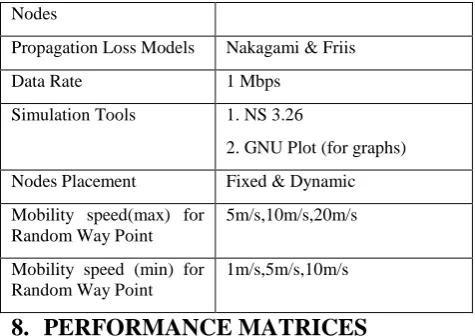
[image:2.595.310.548.71.239.2]7.
PARAMETERS FOR SIMULATION
SETUP
Table 1
Parameters Values
No. of Nodes 25
Simulation Time 100,200,300,400,500 seconds
Routing Protocol AODV
Mobility Models Constant Position & Random Way Point
Distance Between Two 500 Meters
Nodes
Propagation Loss Models Nakagami & Friis
Data Rate 1 Mbps
Simulation Tools 1. NS 3.26
2. GNU Plot (for graphs)
Nodes Placement Fixed & Dynamic
Mobility speed(max) for Random Way Point
5m/s,10m/s,20m/s
Mobility speed (min) for Random Way Point
1m/s,5m/s,10m/s
8.
PERFORMANCE MATRICES
According to the simulation parameters, the considered protocols AODV have been compared on the basis of their performance in Packet Loss, Throughput and packet delivery ratio.
8.1
Throughput
Throughput is defined as the successful delivery of numbers of bits that can be transmitted from a source node to the destination node.
8.2
Packet Delivery Ratio
Packet delivery ratio is defined as the ratio of successful packets received by the destination node to the data packet generated by the source node. It can also be defined by formula:
8.3
Packet Loss
Packet loss refers to the amount of data (number of packets) that fails to arrive at its intended destination. Network administrators consider this metric when looking at the efficacy and performance of data systems.
9.
SIMULATION SETUP
Our simulation starts with 25 nodes placed in constant position mobility and random waypoint mobility at a distance of 500 meters between the nodes in the simulation area. Once our simulation runs we have checked the performance of the propagation loss model for both constant mobility and random way point mobility. For the comparison we have analyzed Nakagami & Friis propagation loss model with AODV as the main routing protocol. We have used NS-3.26 simulator to simulate the results.
10.
RESULTS
On comparing Nakagami and Friis Propagation Loss Models for Random Way Point Mobility at various speeds the simulation results are as follows:
10.1
Packet Loss
Fig: 1 Packet loss Vs Simulation time (speed 1-5 m/sec)
Fig: 2 Packet loss Vs Simulation time (speed is 5-10 m/sec)
10.2
Packet Delivery Ratio
In the graphs below we have considered random way point mobility model with different speeds, 1m/s (min) and 5m/s (max) in fig 4, 5m/s (min) and 10m/s (max) in fig 5, and 10m/s (min) and 20m/s (max) in fig 6.
We have compared the Performance of Nakagami and Friis propagation loss model for AODV to measure Packet delivery ratio for all the three considered speeds.The graph is between simulation time and packet delivery ratio. From the graphs it is clear that the PDR is less in Friis than in Nakagami.
Fig: 4 PDR Vs Simulation Time (speed is 1-5 m/sec)
Fig: 5 PDR Vs Simulation time (speed is 5-10 m/sec)
Fig: 6 PDR Vs Simulation time (speed 10-20 m/sec)
10.3
Throughput
25
Fig: 7 Throughput Vs simulation time (speed 1-5 m/sec)
Fig: 8 Throughput Vs Simulation time (speed 5-10 m/sec)
Fig: 9 Throughput Vs Simulation time (speed 10-20 m/sec)
11.
FOR CONSTANT POSITION
MOBILITY
In the graphs below we have considered constant position mobility model. We have compared the Performance of Nakagami and Friis propagation loss model for AODV to measure Packet loss, PDR, and Throughput respectively in fig 10,fig 11 and fig 12 .In fig 10 The graph is between simulation time and Packet Loss, in fig 11 the graph is between PDR and simulation time, in fig 12 the graph is between Throughput and simulation time.
From the fig 10 it is clear that packet loss is more in Friis than in Nakagami while nakagami has considerably less lost packets.From the fig 11 it is clear that the PDR is more in Nakagami and less in Friis. In fig 12 the Throughput is also greater in Nakagami than in Friis.
Fig:10 Packet Loss Vs Simulation time
Fig: 11 PDR Vs Simulation time
12.
CONCLUSION
During our Simulation we compared the performance of AODV routing protocol with two Prominent Propagation Loss Models that are Friis and Nakagami on various performance matrices. From the results of the simulation we observed that the Nakagami propagation loss model performance was better than the Friis propagation loss model in both the mobility model and various node speed for the AODV routing protocol.
This article analyzes the performance of Propagation Loss models under different mobility scenario using ns-3. Comparison of Nakagami Propagation Loss model and Friis Propagation Loss model is done for better performance for the performance Parameters that are Packet Loss, Packet Delivery Ratio, and Throughput.
So after analyzing all the values we can conclude that the Nakagami propagation loss model outperforms the Friis propagation loss model in all the mobility scenarios, various node speeds.
MANET is widely growing field of research nowadays, therefore extensive research is also going on by many researchers in this filed. Form our research we would like to propose that still good and important research can be focused on the propagation loss and delay models, to make the routing protocols more efficient in the field of MANET.
13.
REFERENCES
[1] Anil Lamba, Dr. Sohan Garg,”A study on the behavior of MANET: Along with research challenges, Application and Security attacks” 2015.
[2] Mr. L. Raja, ”An Overview of MANET: Application, Attacks and Challenges” 2014.
[3] Mr Pranav Kumar Singh ,” Influences of Two ray ground and Nakagami propagation model for the performance of ad hoc routing protocol in VANET “ 2012.
[4] https://www.gaussianwaves.com/2013/09/friss-free-space-propagation-model/
[5] C. Bettstetter, G. Resta, and P. Santi,“The node distribution of the random waypoint mobility model for wireless ad hoc networks” 2003.
[6] Aniket Pramanik, Wasim Arif, Mehedi, Biplav Choudhury, “Behavioral Study of Random Waypoint Mobility based Energy Aware MANET” 2016.
[7] http://epgp.inflibnet.ac.in/epgpdata/uploads/epgp_content /S000305IT/P001487/M022003/ET/1503895868Module 30_etext.pdf
[8] Dimpy Grover, Sunil Saini, “A Survey on Unicast Routing Protocols in Mobile Ad-Hoc Networks” Volume 5, pp. 697-702, 2015.
[9] AODV documents available at URL http://www.olsr.org/docs/report_html/node16.html.
[10]Fan Bai, Ahmed Helmy. “A survey of Mobility Models”.https://www.cise.ufl.edu/~helmy/papers/Survey -Mobility-Chapter-1.pdf.
[11]https://www.nsnam.org/
[12]https://www.nsnam.org/doxygen/classns3_1_1_constant_ position_mobility_model.html
[13]I. Chakeres and C. Perkins, Dynamic MANET on demand (DYMO) routing protocol, Internet- Draft Version 06, IETF, October 2006.
[14]A.A Robert, A.X Das, “Comparison of performance Parameters of Reactive, Proactive and Hybrid Routing Protocols in RWP Mobility Model through QualNet”. Journal of Advances in Computer Network, Vol. 1, No. 3, September 2013 JACN 2013 Vol.1(3): 234-237 ISSN: 1793-8244 DOI: 10.7763/JACN.2013.V1.46.
[15]R. Ranjan, A. X Das “Performance Evaluation of FSR, LAR1, and ZRP Routing Protocols in MANET based on RWP Mobility model”. International Journal of computer application (0975-8887, Vol-71 No-3 2013).
[16]R.K Verma, A.X Das “Effective Performance of Location Aided routing protocol on Random walk mobility model with constant bit rate”. International Journal of computer application (0975-8887, Vol- 122, No-14 2015).
[17]C.Singh, A, X Das “Performance of routing protocols in health care scenario”. International Journal of current Engineering and technology. (2277-4106, Vol-4 No-3 2014).
[18]A.K Yadav, A.X Das, “Performance Comparison of MANET Routing Protocols in Battlefield Disaster Management using QualNet 6.1 Simulator”. (2277-4106, Vol-6 No4, 2016).
[19]C. Perkins “Adhoc On Demand Distance Vector Routing rfc”. https://www.ietf.org/rfc/rfc3561.txt. 2003.