Summarization of Multi-Document Topic Hierarchies using Submodular
Mixtures
Ramakrishna B Bairi
IITB-Monash Research Academy IIT Bombay
Mumbai, 40076, India
Rishabh Iyer
University of Washington Seattle, WA-98175, USA
Ganesh Ramakrishnan
IIT Bombay Mumbai, 40076, India
Jeff Bilmes
University of Washington Seattle, WA-98175, USA
Abstract
We study the problem of summarizing DAG-structured topic hierarchies over a given set of documents. Example appli-cations include automatically generating Wikipedia disambiguation pages for a set of articles, and generating candidate multi-labels for preparing machine learn-ing datasets (e.g., for text classification, functional genomics, and image classi-fication). Unlike previous work, which focuses on clustering the set of documents using the topic hierarchy as features, we directly pose the problem as a submodular optimization problem on a topic hierarchy using the documents as features. Desirable properties of the chosen topics include document coverage, specificity, topic diversity, and topic homogeneity, each of which, we show, is naturally modeled by a submodular function. Other information, provided say by unsupervised approaches such as LDA and its variants, can also be utilized by defining a submodular function that expresses coherence between the chosen topics and this information. We use a large-margin framework to learn convex mixtures over the set of submodular components. We empirically evaluate our method on the problem of automatically generating Wikipedia disambiguation pages using human generated clusterings as ground truth. We find that our frame-work improves upon several baselines according to a variety of standard evalua-tion metrics including the Jaccard Index, F1 score and NMI, and moreover, can be scaled to extremely large scale problems.
1 Introduction
Several real world machine learning applications involve hierarchy based categorization of topics for a set of objects. Objects could be, e.g., a set of documents for text classification, a set of genes in functional genomics, or a set of images in computer vision. One can often define a natural topic hierarchy to categorize these objects. For example, in text and image classification problems, each document or image is assigned a hierarchy of labels — a baseball page is assigned the labels “baseball” and “sports.” Moreover, many of these applications, naturally have an existing topic hierarchy generated on the entire set of objects (Rousu et al., 2006; Barutcuoglu et al., 2006; ling Zhang and hua Zhou, 2007; Silla and Freitas, 2011; Tsoumakas et al., 2010).
Given a DAG-structured topic hierarchy and a subset of objects, we investigate the problem of finding a subset of DAG-structured topics that are induced by that subset (of objects). This problem arises naturally in several real world applications. For example, consider the problem of identifying appropriate label sets for a collection of articles. Several existing text collection datasets such as 20 Newsgroup1, Reuters-215782work with a prede-fined set of topics. We observe that these topic names are highly abstract3for the articles catego-rized under them. On the other hand, techniques proposed by systems such as Wikipedia Miner (Milne, 2009) and TAGME (Ferragina and Scaiella, 2010) generate several labels for each article in the dataset that are highly specific to the article. Col-lating all labels from all articles to create a label
1http://qwone.com/˜jason/20Newsgroups/
2http://www.daviddlewis.com/resources/
testcollections/reuters21578/
3TopicConceptis more abstract than the topicScience
which is more abstract than the topicChemistry
... … … ... … … ... … … ... … …
Populated place
Malus(Eudicot genera, Plants and Pollinators,… )
Cashew Apple (Edible nuts,Trees of Brazil,…)
Hedge Apple (Trees of US, Maclura,..)
Apple Corps(Companies of UK, Companies establisted in 1968,…)
Apple Inc(Companies in California, Companies establisted in 1996, Hardware Companies,…)
Apple Bank (Banks in New Your, Banks of USA,…)
The Apple (1980 films, English language films,…)
Apple Albums (1990 debut Albums, English language albums, Mercury records,…)
Apple Band (English rock music groups, Musical groups from London,…)
Apple Records
(Scotish music groups)
Apple Oklahoma
(Unincorporated communities)
Apple River (Villages in Illions)
Apple Valley (Cities in California)
Apple Store (Electronic companies of Us, Video game retailers,…)
HP Apple (HP microprocessors, HP calculators)
Apple Daily (Next media, Publications established in 1995)
Apple Novel (2007 novels, Novels of England, debut novel)
Apple Key (Mac OS, Computer keys)
Apple Card Game
(Point trick games)
Companies Places Films
Technology Music
Root
Plants
Plants and Pollinators Edible Nuts Trees of Brazil
Companies of UK Banks in New York
1980 films Apple Hardware
HP Microprocessors
Tropical Trees Computer Hardware
Companies by year Films by country Operating Systems HP Products
Publications Books Apple Computer (Apple hardware, Microelectronics,…) ... … … ... … …
Trees by country
Trees of US
Retail Companies
Companies ofCalifornia
Cities in California Albums by language
English Albums
... … … ... … … ... … … ... … … ... … … ... … … ... … … ... … … ... … … ... … … ... … … ... … … ... … … ... … … ... … … ... … … ... … … ... … … ... … … ... … … ... … …
... … … ... … … ... … …
Documents associated with fine-grained (near leaf level) topics Novels Technology Apple computer Apple Key Apple Store HP Apple Plants Malus Cashew Apple Hedge Apple Companies Apple corps Apple Inc. Apple bank Places Apple Oklahoma Apple River Apple Valley
Music Films The Apple
Other Apple Card game Apple Daily Apple Novel Apple Albums Apple Band Apple Records
Input documents on 'Apple' with fine grained
(near leaf level) topic assignment Topic DAG Output Disambiguation page for 'Apple' with documents grouped under summary topics
... … … Topic ... … … Summary Topic Parent-Child relation Ancestor-Descendant relation Topic-Object association
Documents not grouped under any summary topic
[image:2.595.97.508.67.281.2]Document Name Fine-grained topics
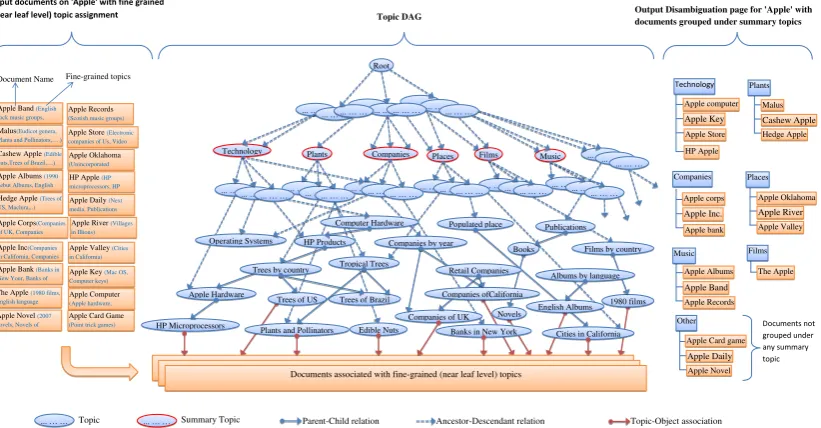
Figure 1: Topic Summarization overview. On the left, we show many documents related to Apple. In the middle, a Wikipedia category hierarchy shown as a topic DAG, links these documents at the leaf level. On the right, we show the output of our summarization process, which creates a set of summary topics (Plants, Technology, Companies, Films, Music and Places in this example) with the input documents classified under them.
set for the dataset can result in a large number of labels and become unmanageable. Our proposed techniques can summarize such large sets of labels into a smaller and more meaningful label sets using a DAG-structured topic hierarchy. This also holds for image classification problems and datasets like ImageNet (Deng et al., 2009). We use the term summarizeto highlight the fact that the smaller la-bel set semantically covers the larger lala-bel set. For example, the topicsPhysics,Chemistry, and Math-ematicscan be summarized into a topicScience.
A particularly important application of our work (and the one we use for our evaluations in Section 4) is the following: Given a collection of articles span-ning different topics, but with similar titles, auto-matically generate a disambiguation page for those titles using the Wikipedia category hierarchy4 as a topic DAG. Disambiguation pages5on Wikipedia are used to resolve conflicts in article titles that oc-cur when a title is naturally associated with multi-ple articles on distinct topics. Each disambiguation page organizes articles into several groups, where the articles in each group pertain only to a specific topic. Disambiguations may be seen as paths in a hierarchy leading to different articles that arguably could have the same title. For example, the title Apple6 can refer to a plant, a company, a film, a
4http://en.wikipedia.org/wiki/Help:Categories 5http://en.wikipedia.org/wiki/Wikipedia:Disambiguation
6http://en.wikipedia.org/wiki/Apple_
(disambiguation)
television show, a place, a technology, an album, a record label, and a newspaper daily. The problem then, is to organize the articles into multiple groups where each group contains articles of similar nature (topics) and has an appropriately discerned group heading. Figure 1 describes the topic summariza-tion process for creasummariza-tion of the disambiguasummariza-tion page for “Apple”.
learn-ing weighted mixtures of submodular functions to summarize topics for a collection of objects us-ing DAG-structured topic hierarchies. Throughout this paper we use the terms “topic” and “category” interchangeably.
1.1 Related Work
To the best of our knowledge, the specific problem we consider here is new. Previous work on identi-fying topics can be broadly categorized into one of the following types: a) cluster the objects and then identify names for the clusters; or b) dynamically identify topics (including hierarchical) for a set of objects. LDA (Blei et al., 2003) clusters the docu-ments and simultaneously produces a set of topics into which the documents are clustered. In LDA, each document may be viewed as a mixture of var-ious topics and the topic distribution is assumed to have a Dirichlet prior. LDA associates a group of high probability words to each identified topic. A name can be assigned to a topic by manually inspecting the words or using additional algorithms like (Mei et al., 2007; Maiya et al., 2013). LDA does not make use of existing topic hierarchies and correlation between topics. The Correlated Topic Model (Blei and Lafferty, 2006) induces a correla-tion structure between topics by using the logistic normal distribution instead of the Dirichlet. An-other extension is the hierarchical LDA (Blei et al., 2004), where topics are joined together in a hierarchy by using the nested Chinese restaurant process. Nonparametric extensions of LDA include the Hierarchical Dirichlet Process (Teh et al., 2006) mixture model, which allows the number of top-ics to be unbounded and learnt from data and the Nested Chinese Restaurant Process which allows topics to be arranged in a hierarchy whose structure is learnt from data. In each of these approaches, unlike our proposed approach, an existing topic hierarchy is not used, nor is any additional object-topic information leveraged.
The pachinko allocation model (PAM)(Li and McCallum, 2006) captures arbitrary, nested, and possibly sparse correlations between topics using a DAG. The leaves of the DAG represent individual words in the vocabulary, while each interior node represents a correlation among its children, which may be words or other interior nodes (topics). PAM learns the probability distributions of words in a topic, subtopics in a topic, and topics in a document. We cannot, however, generate a subset of topics from a large existing topic DAG that can act as summary topics, using PAM.
HSLDA (Perotte et al., 2011) introduces a
hierar-chically supervised LDA model to infer hierarchi-cal labels for a document. It assumes an existing label hierarchy in the form of a tree. The model infers one or more labels such that, if a labellis inferred as relevant to a document, then all the la-bels fromlto the root of the tree are also inferred as relevant to the document. Our approach differs from HSLDA since: (1) we use the label hierarchy to infer a set of labels for agroup of documents; (2) we do not enforce the label hierarchy to be a tree as it can be a DAG; and (3) generalizing HSLDA to use a DAG structured hierarchy and infer labels for agroupof documents (e.g., combining into one big document) also may not help in solving our problem. HSLDA will applyallthe relevant labels to the documents as per the classifier that it learns for every label. Moreover, the “root” label is al-ways applied and it is very likely that many labels near the top level of the label hierarchy are also classified as relevant to the group of documents.
Wei and James (Bi and Kwok, 2011) present a hierarchical multi-label classification algorithm that can be used on both tree and DAG structured hierarchies. They formulate a search for the opti-mal consistent multi-label as the finding of the best subgraph in a tree/DAG. In our approach, we as-sume, individual documents are already associated with one or more topics and we find a consistent label set for a group of documents using the DAG structured topic hierarchy.
Medelyan et al. (Medelyan et al., 2008) and Ferragina et al. (Ferragina and Scaiella, 2010) de-tect topics for a document using Wikipedia article names and category names as the topic vocabulary. These systems are able to extract signals from a text document and identify Wikipedia articles and/or categories that optimally match the document and assign those article/category names as topics for the document. When run on a large collection of docu-ments, these approaches generate enormous num-bers of topics, a problem our proposed approach addresses.
1.2 Our Contributions
naturally incorporate outputs from many of the aforementioned algorithms. Our approach is based on submodular maximization and mixture learning, which has been successfully used in applications such as document summarization (Lin, 2012) and image summarization (Tschiatschek et al., 2014), but has never been applied to topic identification tasks or, more generally, DAG summarization.
We introduce a family of submodular functions to identify an appropriate set of topics from a DAG structured hierarchy of topics for a group of docu-ments. We characterize this topic appropriateness through a set of desirable properties such as cov-erage, diversity, specificity, clarity, and relevance. Each of the submodular function components we consider are monotone, thereby ensuring a near op-timal performance obtainable via a simple greedy algorithm for optimization.7. We also show how our technique naturally embodies outputs of other algorithms such as LDA, clustering, and classifi-cations. Finally, we utilize a large margin formu-lation for learning mixtures of these submodular functions, and show how we can optimally learn them from training data.
Our approach demonstrates how to utilize the features collectively in the document space and the topic space to infer a set of topics. From an em-pirical perspective, we introduce and evaluate our approach on a dataset of around 8000 disambigua-tions that was extracted from Wikipedia and subse-quently cleaned using the methods described in the experimentation section. We show that our learn-ing framework outperforms many of the baselines, and is practical enough to be used on large corpora.
2 Problem Formulation
LetG(V, E)be the DAG structured topic hierarchy withV topics. These topics are observed to have a parent child (isa) relationship forming a DAG. Let
Dbe the set of documents that are associated with one or more of these topics. The middle portion of Figure 1 depicts a topic hierarchy with associ-ated documents. The association links between the documents and topics can be hard or soft. In case of a hard link, a document is attached to a set of topics. Examples include multi-labeled documents. In case of a soft link, a document is associated with a topic with some degree of confidence (or prob-ability). Furthermore, if a document is attached to a topic t, we assume that all the ancestor top-ics oftare also relevant for that document. This
7A simple greedy algorithm (Nemhauser et al., 1978)
ob-tains a1−1/eapproximation guarantee for monotone sub-modular function maximization
assumption has been employed in earlier works (Blei et al., 2004; Bi and Kwok, 2011; Rousu et al., 2006) as well. Given a budget ofK, our objec-tive is to choose a set ofKtopics fromV, which best describe the documents inD. The notion of best describing topics is characterized through a set of desirable properties - coverage, diversity, speci-ficity, clarity, relevance and fidelity - that K topics have to satisfy. The submodular functions that we introduce in the next section ensure these proper-ties are satisfied. Formally, we solve the following discrete optimization problem:
S∗ ∈ argmax
S⊆V:|S|≤K X
i
wifi(S) (1)
where,fiare monotone submodular mixture
com-ponents andwi≥0are the weights associated with
those mixture components. SetS∗is the summary
topics scored best.
It is easy to find massive (i.e., size in the order of million) DAG structured topic hierarchies in prac-tice. Wikipedia’s category hierarchy consists of more than 1M categories (topics) arranged hierar-chically. In fact, they form a cyclic graph (Zesch and Gurevych, 2007). However, we can convert it to a DAG by eliminating the cycles as described in the supplementary material. YAGO (Suchanek et al., 2007) and Freebase (Bollacker et al., 2008) are other instances of massive topic hierarchies. The association of the documents with the existing topic hierarchy is also well studied. Systems such as WikipediaMiner (Milne, 2009), TAGME (Fer-ragina and Scaiella, 2010) and several annotation systems such as (Dill et al., 2003; Mihalcea and Csomai, 2007; Bunescu and Pasca, 2006) attach topics from Wikipedia (and other catalogs) to the documents by establishing the hard or soft links mentioned above.
Our goal is the following: Given a (ground set) collectionV of topics organized in a pre-existing hierarchical DAG structure, and a collectionDof documents, chose a sizeK ∈ Z+representative
subset of topics. Our approach is distinct from earlier work (e.g., (Kanungo et al., 2002; Blei et al., 2003)) where typically only a set of documents is classified and categorized in some way. We next provide a few definitions needed later in the paper.
Definition 1: Transitive CoverΓ):A topictis
said to cover a set of documentsΓ(t), called the transitive cover of the topict, if for all documents
i∈Γ(t), eitheriis associated directly with topic
Definition 2: Truncated Transitive Cover(Γα):
This is a transitive cover of topic t, but with the limitation that the path length between a docu-ment and the topictis not more than α. Hence,
|Γα(t)| ≤ |Γ(t)|.
While our problem is closely related to cluster-ing approaches, which consider the set of docu-ments directly, there are some crucial differences. In particular, we focus on producing a clustering of documents where clusters are encouraged to honor a pre-defined DAG structured topic hierarchy. Ex-isting agglomerative clustering algorithms focusing on the coverage of documents may not produce the desired clustering. To understand this, consider six documents d1, d2 . . . d6 to be grouped into three clusters. There may be multiple ways to do this de-pending upon multiple aggregation paths present in the topic DAG: ((d1, d2), (d3, d4), (d5, d6)) or ((d1, d2, d3), (d4, d5), (d6)) or ((d1, d2, d3, d4), (d5), (d6)) or something else. Hence, we need more stringent measures to prefer one clustering over the others. Our work addresses this with a variety of quality criteria (coverage, diversity, specificity, clarity, relevance and fidelity, which are explained later in this paper) that are organically derived from well established submodular functions. And, most importantly, we learn the right mixture of these qualities to be enforced from the data itself. Fur-thermore, our approach also generalizes these clus-tering approaches, since one of the components in our mixture of submodular functions is defined via these unsupervised approaches, and maps a given clustering to a set of topics in the hierarchy.
3 Submodular Components and Learning
Summarization is the task of extracting information from a source that is both small in size but still representative. Our problem is different from traditional summarization tasks since we have an underlying DAG as a topic hierarchy that we wish to summarize in response to a subset of documents. Thus, a critical part of our problem is to take the graph structure into account while creating the summaries. Below, we identify properties we wish our summaries to posses.
Coverage: A summary set of topics should
cover most of the documents. A document is said to be covered by a topic if there exists a path from the topic, going through intermediary descendant topics, to the document, i.e., the document is within the transitive cover of the topic.
Diversity: Summaries should be as diverse as
possible, i.e., each summary topic should cover
a unique set of documents. When a document is covered by more than one topic, that document is redundantly covered, e.g., “Finance” and “Banking” would be unlikely members of the same summary.
Summary qualities also involve “quality” notions, including:
Specificity/Clarity/Relevance/Coherence:
These quality measures help us choose a set of topics that are neither too abstract nor overly specific. They ensure that the topics are clear and relevant to the documents that they represent. When additional information such as clustering (from LDA or other sources) and tagging (manual) documents is available, these quality criteria encourage the chosen topics to show resemblance (coherence) to those clustering/tagging in terms of transitive cover of documents they produce.
In the below, we define a variety of submodular functions that capture the above properties, and we then describe a large margin learning framework for learning convex mixtures of such components.
3.1 Submodular Components 3.1.1 Coverage Based Functions
Coverage components capture “coverage” of a set of documents.
Weighted Set Cover Function: Given a set of
categories,S ⊆V, defineΓ(S)as the set of docu-ments covered — for each topics∈S,Γ(s)⊆D
represents the documents covered by topicsand
Γ(S) = ∪s∈SΓ(s). The weighted set cover
func-tion, defined asf(S) = Pd∈Γ(S)wd =w(Γ(S)),
assigns weights to the documents based on their relative importance (e.g., in Wikipedia disambiguation, the different documents could be ranked based on their priority).
Feature-based Functions: This class of
function represents coverage in feature space. Given a set of categories S ⊆ V, and a set of featuresU, definemu(S)as the score associated
3.1.2 Similarity based Functions
Similarity functions are defined through a simi-larity matrix S = {sij}i,j∈V. Given categories
i, j∈V, similaritysij in our case can be defined
assij =|Γ(i)∩Γ(j)|, i.e the number of documents
commonly covered by bothiandj.
Facility Location: The facility location
func-tion, defined as f(S) = Pi∈V maxj∈Ssij, is a
natural model for k-medoids and exemplar based clustering, and has been used in several summariza-tion problems (Tschiatschek et al., 2014; Wei et al., 2014a).
Penalty based diversity: A similarity
ma-trix may be used to express a form of coverage of a set S but that is then penalized with a re-dundancy term, as in the following difference:
f(S) = Pi∈V,j∈Ssij −λPi∈SPj∈S,si,j (Lin
and Bilmes, 2011)). Hereλ∈[0,1]. This function is submodular, but is not in general monotone, and has been used in document summarization (Lin and Bilmes, 2011), as a dispersion function (Borodin et al., 2012), and in image summarization (Tschi-atschek et al., 2014).
3.1.3 Quality Control (QC) Functions
QC functions ensure a quality criteria is met by a setSof topics. We define the quality score of the setS as Fq(S) = Ps∈Sfq(s), where fq(s) is
the quality score of topicsfor qualityq. Therefore,
Fq(S)is a modular function inS. We investigate
three types of quality control functions: Topic Specificity, Topic Clarity, and Topic Relevance.
Topic Specificity: The farther a topic is from
the root of the DAG, the more specific it becomes. Topics higher up in the hierarchy are abstract and less specific. We therefore prefer topics low in the DAG, but lower topics also have less coverage. We definefspecificity(s) =sh whereshis the height of
topicsin the DAG. The root topic has height zero and the “height” increases as we move down the DAG in Figure 1.
Topic Clarity: Topic clarity is the fraction of
descendant topics that cover one or more docu-ments. If a topic has many descendant topics that do not cover any documents, it has less clarity. For-mally,fclarity(s) =
P
t∈descendants(s)JΓ(t)>0K
|descendants(s)| , whereJK
is the indicator function.
Topic Relevance: A topic is considered to be
better related to a document if the number of hops needed to reach the document from that topic is lower. Given any setA ⊆ Dof document, and any topics ∈V, we can definefrelevance(s|A) =
argminα{α:A⊆Γα(s)}.
QC Functions As Barrier Modular Mixtures:
We introduce a modular function for every QC function as follows
fα
specificity(s) =
1 if the height of topicsis at leastα 0 otherwise
for every possible value ofα. This creates a sub-modular mixture with as many components as the number of possible values ofα. In our experiments with Wikipedia, we hadαvarying from1to120
stepping by1, adding120modular mixture compo-nents. Similarly, we define,
fβ
clarity(s) =
1 if the clarity of topicsis at leastβ
0 otherwise
for every possible (discretized to make it count-ably finite) value ofβ. And,
frelevanceγ (s) = fcov(s|Γγ(s)), wherefcov()is the coverage submodular function ands|X indi-cates coverage of a topicsover a set of documents
X. All these functions (modular and submodular terms) are added as mixture components in our learning framework to learn suitable weights for them. We then use these weights in our inference procedure to obtain a subset of topics as described in 3.2. We show from our experiments that this approach performs better than all other approaches and baselines.
3.1.4 Fidelity Functions
A function representing the fidelity of a setS to another reference setRis one that gets a large value when the setSrepresents the setR. Such a function scores inferred topics high when it resembles a reference set of topics and/or item clusters. The reference set in this case can be produced from other algorithms such as k-means, LDA and its variants or from a manually tagged corpus. Next we describe one such fidelity function.
Topic Coherence: This function scores a set
of topics S high when the transitive cover (Def-inition 1) produced by the topics inS resembles the clusters of documents produced by an external source (k-means, LDA or manual). Given an exter-nal source that clusters the documents, producingT
clustersL1, L2, ..., LT (forT topics), topic
coher-ence is defined as: f(S) = Pt∈T maxk∈Swk,t
where wk,t = harmonic mean(wk,tp , wk,tr ) and
wpk,t = |Γ(k)∩Lt|
|Γ(k)| andwk,tr = |Γ(k)|L∩t|Lt|. Note that,
wpk,t≥0andwr
k,t ≥0are the precision on recall
of the resemblance andwk,tis the F1 measure. If
the transitive cover of topics inS resembles the reference clustersLtexactly, we attain maximum
coherence (or fidelity). As the resemblance dimin-ishes, the score decreases. The above functionf(S)
3.1.5 Mixture of Submodular Components:
Given the different classes of submodular functions above, we construct our submodular scoring func-tionsFw(·)as a convex combinations of these dif-ferent submodular functionsf1, f2, . . . , fm, above.
In other words,
Fw(S) = m X
i=1
wifi(S), (2)
where w = (w1, . . . , wm), wi ≥ 0,Piwi = 1.
The componentsfiare submodular and assumed to
be normalized: i.e.,fi(∅) = 0, andfi(V) = 1for
monotone functions andmaxA⊆V fi(A) ≤ 1for
non-monotone functions. A simple way to normal-ize a monotone submodular function is to define the component asfi(S)/fi(V). This ensures that
the components are compatible with each other. Obviously, the merit of the scoring functionFw(·)
depends on the selection of the components.
3.2 Large Margin Learning
We optimize the weights w of the scoring func-tionFw(·)in a large-margin structured prediction
framework. In this setting, we assume we have training data in the form of pairs of a set of docu-ments, and a human generated summary as a set of topics. For example, in the case of Wikipedia disambiguation, we use the human generated dis-ambiguation pages as the ground truth summary. We represent the set of ground-truth summaries as
S ={S1, S2,· · · , SN}. In large margin training,
the weights are optimized such that ground-truth summariesSare separated from competitor sum-maries by a loss-dependent margin:
Fw(S)≥Fw(S0) +L(S0), ∀S∈ S, S0∈ Y \ S, (3) where L(·) is the loss function, and where Y
is a structured output space (for example Y
is the set of summaries that satisfy a certain budget B, i.e., Y = {S0 ⊆ V : |S0| ≤ B}).
We assume the loss to be normalized,
0 ≤ L(S0)≤ 1,∀S0 ⊆V, to ensure that mixture
and loss are calibrated. Equation (3) can be stated asFw(S)≥maxS0∈Y[Fw(S0) +L(S0)],∀S ∈ S
which is called loss-augmented inference. We introduce slack variables and minimize the regularized sum of slacks (Lin and Bilmes, 2012):
min w≥0,kwk1=1
X
S∈S
max S0∈Y
Fw(S0) +L(S0)−Fw(S)
+λ2kwk2
2, (4)
where the non-negative orthant constraint,w≥0, ensures that the final mixture is submodular. Note a 2-norm regularizer is used on top of a 1-norm constraintkwk1= 1which we interpret as a prior
to encourage higher entropy, and thus more diverse mixture distributions. Tractability depends on the choice of the loss function. The parameters w
are learnt using stochastic gradient descent as in (Tschiatschek et al., 2014).
3.3 Loss Functions
A natural choice of loss functions for our case can be derived from cluster evaluation metrics. Every inferred topic s induces a subset of documents, namely the transitive coverΓ (s)ofs. We compare these clusters with the clusters induced from the true topics in the training set and compute the loss.
In this paper, we use the Jaccard Index (JI) as a loss function. LetSbe the inferred topics andT
be the true topics. The Jaccard loss is defined as
Ljaccard(S, T) = 1− 1kPs∈Smaxt∈T ||Γ(s)Γ(s)∩∪Γ(t)Γ(t)||,
where k = |S| = |T| is the number of topics. When the clustering produced by the inferred and the true topics are similar, Jaccard loss is0. When they are completely dissimilar, the loss is maxi-mum, i.e.,1. Jaccard loss is a modular function.
3.4 Inference Algorithm: Greedy
Having learnt the weights for the mixture components, the resulting function Fw(S) = Pm
i=1wifi(S) is a submodular function. In the
case when the individual components are them-selves monotone (all our functions in fact are),
Fw(S)can be optimized by the accelerated greedy
algorithm (Minoux, 1978). Thanks to submodu-larity, we can obtain near optimal solutions very efficiently. In case the functions are all monotone submodular, we can guarantee that the solution is within1−1/efactor from the optimal solution. 4 Experimental Results
4.1 Datasets
We parsed the contents of Wikipedia disambigua-tion pages and extracted disambiguadisambigua-tion page names, article groups and group names. We col-lected about 8000 disambiguation pages that had at least four groups on them. Wikipedia category structure is used as the topic DAG. We eliminated few administrative categories such as “Hidden Cat-egories”, “Articles needing cleanup”, and the like. The final DAG had about 1M topics and 3M links.
4.2 Evaluation Metrics
Every group of articles on the Wikipedia disam-biguation page is assigned a name by the editors. Unfortunately, these names may not correspond to the Wikipedia category (topic) names. For exam-ple, one of the groups on the “Matrix” disambigua-tion page has a name “Business and government” and there is no Wikipedia category by that name. However, the group names generated by our (and baseline) method are from the Wikipedia categories (which forms our topic DAG). In addition, there can be multiple relevant names for a group. For example, a group on a disambiguation page may be called “Calculus”, but an algorithm may rightly generate “Vector Calculus”. Hence we cannot eval-uate the accuracy of an algorithm just by matching the generated group names to those on the disam-biguation page. To alleviate this problem, we adopt cluster-based evaluation metrics. We treat every group of articles generated by an algorithm under a topic for a disambiguation page as a cluster of arti-cles. These are considered asinferredclusters for a disambiguation page. We compare them against the actual grouping of articles on the Wikipedia disam-biguation page by treating those groups astrue clus-ters. We can now adopt Jaccard Index, F1-measure, and NMI (Normalized Mutual Information) based cluster evaluation metrics described in (Manning et al., 2008). For each disambiguation page in the test set, we compute every metric score and then average it over all the disambiguation pages.
4.3 Methods Compared
We validated our approach by comparing against several baselines described below. We also com-pared two variations of our approach as described next. For each of these cases (baselines and two variations) we generated and compared the metrics (Jaccard Index, F1-measure and NMI) as described in the previous section.
KMdocs: K-Means algorithm run on articles as
TF-IDF vectors of words. The number of clus-tersK is set to the number of true clusters on the
Wikipedia disambiguation page.
KMeddocs: K-Medoids algorithm with articles
as TF-IDF vectors of words. The number of clus-ters are set as in KMdocs.
KMedtopics: K-Medoids run on topics as
TF-IDF vectors of words. The words for each topic is taken from the articles that are in the transitive cover of the topic.
LDAdocs: LDA algorithm with the number of
topics set to the number of true clusters on the Wikipedia disambiguation page. Each article is then grouped under the highest probability topic.
SMMLcov: This is the submodular mixture
learning case explained in section 3.1.5. Here we consider a mixture of all the submodular functions governing coverage, diversity, fidelity and QC func-tions. However, we exclude the similarity based functions described in section 3.1.2. Coverage based functions have a time complexity ofO(n)
whereas similarity based functions areO n2. By
excluding similarity based functions, we can com-pare the quality of the results with and without
O(n2) functions. We learn the mixture weights
from the training set and use them during infer-ence on the test set to subsetKtopics through the submodular maximization (Equation 1).
SMMLcov+sim:This case is similar to SMMLcov except that, we include similarity based submodu-lar mixture components. This makes the inference time complexityO n2.
We do not compare against HSLDA, PAM and few other techniques cited in the related work sec-tions because they do not produce a subset ofK
summary topics — these are not directly compara-ble with our work.
4.4 Evaluation Results
We show that the submodular mixture learning and maximization approaches, i.e., SMMLcovand SMMLcov+simoutperform other approaches in vari-ous metrics. In all these experiments, we performed 5 fold cross validation to learn the parameters from
80%of the disambiguation pages and evaluated on the rest of the20%, in each fold.
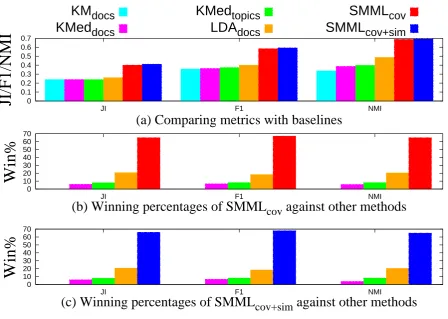
In Figure 2a we summarize the results of the comparison of the methods mentioned above on Jaccard Index, F1 measure and NMI. Our pro-posed techniques SMMLcovand SMMLcov+sim out-perform other techniques consistently.
0 0.1 0.2 0.3 0.4 0.5 0.6 0.7
JI F1 NMI
JI/F1/NMI
(a) Comparing metrics with baselines
0 10 20 30 40 50 60 70
JI F1 NMI
Win%
(b) Winning percentages of SMML
covagainst other methods
0 10 20 30 40 50 60 70
JI F1 NMI
Win%
(c) Winning percentages of SMML
cov+simagainst other methods
KM
docsKMed
docsKMed
topicsLDA
docsSMML
cov [image:9.595.74.523.60.379.2]SMML
cov+simFigure 2: Comparison of techniques
produce higher JI, F1 and NMI than all other meth-ods. This indicates that the clusters of articles pro-duced by our technique resembles the clusters of articles present on the disambiguation page better than other techniques.
From Figures 2b and 2c it is clear thatO(n)time complexity based submodular mixture functions (SMMLcov) perform on par with O n2 based
functions (SMMLcov+sim), but at a greatly reduced execution time, demonstrating the sufficiency of
O(n)functions for our task. On the average, for each disambiguation query, SMMLcovtook around 40 seconds (over 1M topics and 3M edges DAG) to infer the topics, whereas SMMLcov+simtook around 35 minutes. Both these experiments were carried on a machine with 32 GB RAM, Eight-Core AMD Opteron(tm) Processor 2427.
5 Conclusions
We investigated a problem of summarizing topics over a massive topic DAG such that the summary set of topics produced represents the objects in the collection. This representation is characterized through various classes of submodular (and mono-tone) functions that captured coverage, similarity, diversity, specificity, clarity, relevance and fidelity
of the topics. Currently we assume that the number of topicsKis given as an input to our algorithm. It would be an interesting future problem to estimate the value ofKautomatically in our setting. As fu-ture work, we also plan to extend our techniques to produce a hierarchical summary of topics and scale it across heterogeneous collection of objects (from different domains) to bring all of them under the same topic DAG and investigate interesting cases thereon.
Acknowledgements: This material is based
upon work supported by the National Science Foun-dation under Grant No. IIS-1162606, and by a Google, a Microsoft, and an Intel research award. Rishabh Iyer acknowledges support from the Mi-crosoft Research Ph.D Fellowship.
References
Zafer Barutcuoglu, Robert E. Schapire, and Olga G. Troyanskaya. 2006. Hierarchical multi-label pre-diction of gene function. Bioinformatics, 22(7):830– 836, April.
David M. Blei and John D. Lafferty. 2006. Correlated topic models. InIn Proceedings of the 23rd Interna-tional Conference on Machine Learning, pages 113– 120. MIT Press.
David M. Blei, Andrew Y. Ng, and Michael I. Jordan. 2003. Latent dirichlet allocation. J. Mach. Learn. Res., 3:993–1022, March.
David M. Blei, Thomas L. Griffiths, Michael I. Jordan, and Joshua B. Tenenbaum. 2004. Hierarchical topic models and the nested chinese restaurant process. In Advances in Neural Information Processing Systems, page 2003. MIT Press.
Kurt Bollacker, Colin Evans, Praveen Paritosh, Tim Sturge, and Jamie Taylor. 2008. Freebase: A collaboratively created graph database for structur-ing human knowledge. InProceedings of the 2008 ACM SIGMOD International Conference on Man-agement of Data, SIGMOD ’08, pages 1247–1250, New York, NY, USA. ACM.
Allan Borodin, Hyun Chul Lee, and Yuli Ye. 2012. Max-sum diversification, monotone submodular functions and dynamic updates. In Proceedings of Principles of Database Systems, pages 155–166. ACM.
Razvan Bunescu and Marius Pasca. 2006. Using en-cyclopedic knowledge for named entity disambigua-tion. In Proceedings of the 11th Conference of the European Chapter of the Association for Computa-tional Linguistics (EACL-06), Trento, Italy, pages 9– 16, April.
Jia Deng, Wei Dong, Richard Socher, Li-Jia Li, Kai Li, and Li Fei-Fei. 2009. Imagenet: A large-scale hi-erarchical image database. InComputer Vision and Pattern Recognition, 2009. CVPR 2009. IEEE Con-ference on, pages 248–255. IEEE.
Stephen Dill, Nadav Eiron, David Gibson, Daniel Gruhl, R. Guha, Anant Jhingran, Tapas Kanungo, Sridhar Rajagopalan, Andrew Tomkins, John A. Tomlin, and Jason Y. Zien. 2003. Semtag and seeker: Bootstrapping the semantic web via auto-mated semantic annotation. In Proceedings of the 12th International Conference on World Wide Web, WWW ’03, pages 178–186, New York, NY, USA. ACM.
Paolo Ferragina and Ugo Scaiella. 2010. Tagme: On-the-fly annotation of short text fragments (by wikipedia entities). In Proceedings of the 19th ACM International Conference on Information and Knowledge Management, CIKM ’10, pages 1625– 1628, New York, NY, USA.
R. Iyer, S. Jegelka, and J. Bilmes. 2013. Fast semidifferential-based submodular function opti-mization. ICML.
Tapas Kanungo, David M. Mount, Nathan S. Ne-tanyahu, Christine D. Piatko, Ruth Silverman, An-gela Y. Wu, Senior Member, and Senior Mem-ber. 2002. An efficient k-means clustering algo-rithm: Analysis and implementation. IEEE Transac-tions on Pattern Analysis and Machine Intelligence, 24:881–892.
D. Kempe, J. Kleinberg, and E. Tardos. 2003. Maxi-mizing the spread of influence through a social net-work. InSIGKDD.
Katrin Kirchhoff and Jeff Bilmes. 2014. Submodular-ity for data selection in machine translation. Octo-ber.
A. Krause and C. Guestrin. 2005. Near-optimal non-myopic value of information in graphical models. In Proceedings of Uncertainity in Artificial Intelli-gence. UAI.
Wei Li and Andrew McCallum. 2006. Pachinko allo-cation: Dag-structured mixture models of topic cor-relations. In Proceedings of the 23rd International Conference on Machine Learning, ICML ’06, pages 577–584, New York, NY, USA. ACM.
H. Lin and J. Bilmes. 2010. Multi-document summa-rization via budgeted maximization of submodular functions. InNAACL.
Hui Lin and Jeff Bilmes. 2011. A class of submodular functions for document summarization. InThe 49th Meeting of the Assoc. for Comp. Ling. Human Lang. Technologies (ACL/HLT-2011), Portland, OR, June. H. Lin and J. Bilmes. 2012. Learning mixtures of
sub-modular shells with application to document summa-rization. InConference on Uncertainty in Artificial Intelligence (UAI), page 479490.
Hui Lin. 2012. Submodularity in Natural Language Processing: Algorithms and Applications. Ph.D. thesis, University of Washington, Dept. of EE. Min ling Zhang and Zhi hua Zhou. 2007. Ml-knn: A
lazy learning approach to multi-label learning. PAT-TERN RECOGNITION, 40:2007.
Arun S. Maiya, John P. Thompson, Francisco Loaiza-Lemos, and Robert M. Rolfe. 2013. Exploratory analysis of highly heterogeneous document collec-tions. In Proceedings of the 19th ACM SIGKDD International Conference on Knowledge Discovery and Data Mining, KDD ’13, pages 1375–1383, New York, NY, USA. ACM.
Christopher D. Manning, Prabhakar Raghavan, and Hinrich Sch¨utze. 2008. Introduction to Information Retrieval. Cambridge University Press, New York, NY, USA.
Qiaozhu Mei, Xuehua Shen, and ChengXiang Zhai. 2007. Automatic labeling of multinomial topic mod-els. InProceedings of the 13th ACM SIGKDD Inter-national Conference on Knowledge Discovery and Data Mining, KDD ’07, pages 490–499, New York, NY, USA. ACM.
Rada Mihalcea and Andras Csomai. 2007. Wikify!: Linking documents to encyclopedic knowledge. In Proceedings of the Sixteenth ACM Conference on Conference on Information and Knowledge Manage-ment, CIKM ’07, pages 233–242, New York, NY, USA. ACM.
David Milne. 2009. An open-source toolkit for min-ing wikipedia. InIn Proc. New Zealand Computer Science Research Student Conf, page 2009.
Michel Minoux. 1978. Accelerated greedy algo-rithms for maximizing submodular set functions. In J. Stoer, editor,Optimization Techniques, volume 7 of Lecture Notes in Control and Information Sci-ences, chapter 27, pages 234–243. Springer Berlin Heidelberg, Berlin/Heidelberg.
Mukund Narasimhan and Jeff Bilmes. 2004. PAC-learning bounded tree-width graphical models. In Uncertainty in Artificial Intelligence: Proceedings of the Twentieth Conference (UAI-2004). Morgan Kaufmann Publishers, July.
George L Nemhauser, Laurence A Wolsey, and Mar-shall L Fisher. 1978. An analysis of approximations for maximizing submodular set functionsi. Mathe-matical Programming, 14(1):265–294.
Adler J. Perotte, Frank Wood, Noemie Elhadad, and Nicholas Bartlett. 2011. Hierarchically supervised latent dirichlet allocation. In John Shawe-Taylor, Richard S. Zemel, Peter L. Bartlett, Fernando C. N. Pereira, and Kilian Q. Weinberger, editors, NIPS, pages 2609–2617.
Juho Rousu, Craig Saunders, Sndor Szedmk, and John Shawe-Taylor. 2006. Kernel-based learning of hier-archical multilabel classification models. Journal of Machine Learning Research, 7:1601–1626.
Jr. Silla, CarlosN. and AlexA. Freitas. 2011. A survey of hierarchical classification across different applica-tion domains. Data Mining and Knowledge Discov-ery, 22(1-2):31–72.
Fabian M. Suchanek, Gjergji Kasneci, and Gerhard Weikum. 2007. Yago: A core of semantic knowl-edge. InProceedings of the 16th International Con-ference on World Wide Web, WWW ’07, pages 697– 706, New York, NY, USA. ACM.
Yee Whye Teh, Michael I. Jordan, Matthew J. Beal, and David M. Blei. 2006. Hierarchical dirichlet pro-cesses. Journal of the American Statistical Associ-ation, 101(476):1566–1581.
Sebastian Tschiatschek, Rishabh Iyer, Hoachen Wei, and Jeff Bilmes. 2014. Learning Mixtures of Sub-modular Functions for Image Collection Summariza-tion. In Neural Information Processing Systems (NIPS).
Grigorios Tsoumakas, Ioannis Katakis, and Ioannis Vlahavas. 2010. Mining multi-label data. In Oded Maimon and Lior Rokach, editors,Data Mining and Knowledge Discovery Handbook, pages 667–685. Springer US.
Kai Wei, Rishabh Iyer, and Jeff Bilmes. 2014a. Fast multi-stage submodular maximization. InICML. Kai Wei, Yuzong Liu, Katrin Kirchhoff, Chris Bartels,
and Jeff Bilmes. 2014b. Submodular subset selec-tion for large-scale speech training data. Proceed-ings of ICASSP, Florence, Italy.