Simulation of Countercurrent Multi-Effect
Drying System
Hong Li, Lianying Wu, Xianli Wu, Yangdong Hu
Department of Chemical Engineering, Ocean University of China, Qingdao 266000, China Email: [email protected]
Received 2012
ABSTRACT
The paper bulids a countercurrent multi-effect drying process model which can be expressed as a linear programming(LP) problem with the minimum total energy consumption as target function. Based on the model it can be conventient to solve the heat load , de-gree of drying and other drying parameters of each effect. And it realizes the mathematical simulation an analysis of multi-effect drying process. Such process not only reuses the secondary steam but also utilizes the high energy grade. Drying silica sand using 1-effect drying to 5-effect drying is presented as an example. The energy consumption and energy saving rate are compared by using co-current multi-effect drying and countercurrent multi-effect drying. As a summary, the countercurrent multi-effect drying is better than co-current drying. Considered the equipment investment and energy conservation, the study also concluded that the countercur-rent 4-effect drying is the optimum selection, and it can save 57.6% energy compared to countercurcountercur-rent 1-effect drying.
Keywords: Countercurrent Drying; Multi-Effect Drying; Secondary Steam; LP
1. Introduction
Among many process operations in industry, drying is probably one of the most important, as it is common to all sectors of solids processing. Many investigations have shown that drying is an energy intensive operation, which involves complex processes of heat and mass transfer between the product and the drying medium[1-4]. Nowadays, with the situation of energy shortage becoming more and more serious, how to improve the energy utilization efficiency has become a research hot spot. Although a large number of works have been devoted to ex-ploring different features and applications of the thermal drying system, most of those changed the high grade energy to lower grade energy when utilized the waste gas, so a large number of high quality stream latent heat is wasted.
A promising alternative to improve the problem is the use of multi-effect dying system based on the process integration as formulated by Linnhoff[5] and is directed on the efficient use of energy for drying [6-7]. Such a system consists of a number of dryers. By directly utilizing the secondary steam resulting from energy degradation in the drying system, the drying process imports the secondary steam produced by the former effect as the heat source of the following effect thereby reducing energy consumption.
2. Description the Process of the Countercurrent
Multi-Effect Drying
The countercurrent multi-effect drying process is designed by follow postulated:
(1) Multi-effect drying is a typical batch process.
(2) The dryer is vacuum tray drier. The material is heated by conduction heating(3) The secondary steam is water vapor. In actual operation, it can be recycled by draught fan. Thedraught
fan has the function of also dust removal.
(4) Apply secondary steam to heat the wet material indirect-ly.
(5) The drying materials are not flowing, but by controlling the flowing of secondary steam, the drying materials can be regarded as flowing. It can be operated by simulated moving bed in actual operation.
(6) Dried material is distributed very thinly in the dryers, which increases the heating surface area, giving the drying system better heat transfer effect and efficiency.
(7) Best fit for the drying process that water evaporation process occurs in small particle materials surface.
2.1. Technological Process
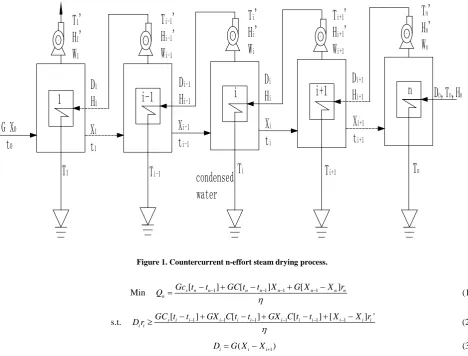
The countercurrent multi-effect steam drying flowchart is shown in Figure 1. Set the number of total effect asn. Hot fresh vapor enters the last drying room to heat the solid materials in it, while secondary steam discharged from the last drying room n enters the front drying room n-1 to heat the solid materials there. Taking the i-1, i, i+1 effect drying for example, the secondary steam produced by the i+1 effect drying enters the i effect dry-ing room, while the secondary steam produced by the i effect drying enters the i-1effect drying room, as so on until the 1 effect drying, the secondary steam produced by the 1 effect drying enters the condenser. The drying materials are not flow-ing, after the drying material of the i effect drying dried by the secondary steam of the i+1 effect drying room produced, this drying room and drying material is regarded as i+1 effect dry-ing in the next batch process production cycle.
2.2. Mathematic Model
G X
0t
0T
1'
H
1'
W
1T
i'
H
i'
W
iT
i+1'
H
i+1'
W
i+1T
n'
H
n'
W
nT
i-1'
H
i-1'
W
i-1D
n,T
n,H
nD
1H
1X
1t
1D
i-1H
i-1X
i-1t
i-1D
iH
iX
it
iD
i+1H
i+1X
i+1t
i+1T
1T
i-1T
iT
i+1T
n1
i-1
i
i+1
n
[image:2.595.65.534.95.451.2]condensed
water
Figure 1. Countercurrent n-effort steam drying process.
Min s[n n1] [n n1] n1 [ n1 n]n n
Gc t t GC t t X G X X r
Q
η
− − − −
− + − + −
= (1)
s.t. s[i i1] i1 [i i1] i1 [i i1] [ i1 i] 'i i i
GC t t GX C t t GX C t t X X r
D r
η
− − − − − −
− + − + − + −
≥ (2)
1
( )
i i i
D =G X −X+ (3)
' i i
r=r (4)
0
0≤Xi<X (5)
0< <i n (6)
The constraint conditions are the moisture material balances and energy balances of each effect drying and the total drying system. The decision variable is Xi.
2.3. Solving the LP Problem
The pressure of the countercurrent multi-effect drying system is designed by method of same pressure drop.
1' n P P P n −
∆ = (7)
Pn and P1’ are selected according to the actual conditions.
Then the temperature and steam enthalpy can be checked from the literature. This paper is in the Matlab environment to solve the linear programming(LP) problem.
3. Case Study
This article simulates silica sand n-effect (1≤n≤5) drying as example. The parameters of silica sand of n-effect drying is shown in Table 1. The physical parameters of steam are taken
from literature[8].
3.1. Discussion on the Relationship of Drying Effect and Drying Minimum Energy Consumption of n-Effect Drying
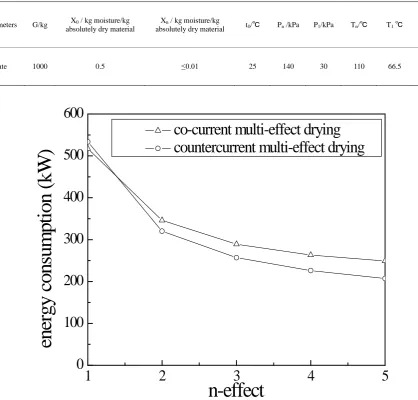
This study simulates the minimum energy consumption from countercurrent 1-effect to 5-effect drying under the same initial and terminal operation conditions. The minimum energy con-sumption and energy saving rate of n-effect drying compared to 1-effect drying are analyzed. Afterwards the results are com-pared with the co-current multi-effect drying in the same initial and terminal operation conditions which was calculated in our previous study[9]. All the results are shown in Figure 2 and
Figure 3.
for co-current n-effect drying does not increase as dramatically as it does for countercurrent multi-effect drying. Many scholars have concluded that countercurrent drying had the advantage that while the material humidity decreases, the steam’s temperature used as heat source increase, the driving force is equilibrium distribution. As a summary, if allowed, the countercurrent mul-ti-effect drying is the best choice.
Got through the countercurrent drying curve of Figure 2 and
Figure 3, the minimum energy consumption of countercurrent 1-effect drying is 533.5 kW, 2-effect is 320 kW, and compared to 1-effect the 2-effect energy saving rate is of 40%. However when the number of effect is more than 4, the energy consump-tion and energy saving rate curves tend to smooth. Generally, the multi-effect systems are most effective for 3-4 effects, above this number the energy consumption reduction is mar-ginal and probably not sufficient to justify the increase of sys-tem complexity. The energy consumption of countercurrent 4-effect drying is 257 kW and co-current 4-effect drying is 289
57.6 % and co-current 4-effect drying is 49% compared to 1-effect drying.
3.2. Drying Effect of Countercurrent n- Effect Drying
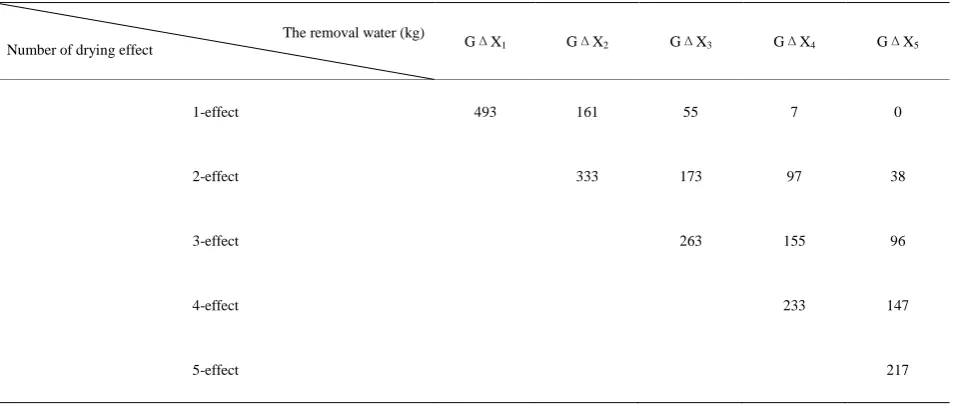
This article calculates the removal water of each effect of countercurrent n-effect drying. The energy of countercurrent n-effect drying is provided according to the calculation from
Figure 2. Countercurrent 1-effect drying to 5-effect drying are simulated. The results are shown in Table 2.
4. Conclusions
[image:3.595.90.509.321.721.2]The process of countercurrent multi-effect drying is designed by using linear programming method. Both co-current and countercurrent 1-effect to 5-effect drying are simulated by the method. The minimum energy consumption of such mul-ti-effect drying system is less than that of conventional 1-effect drying system. The energy consumption decreases with
Table 1. The parameters of silica sand of countercurrent n-effect drying.
parameters G/kg X0 / kg moisture/kg
absolutely dry material
Xn / kg moisture/kg
absolutely dry material t0/℃ Pn /kPa P1/kPa Tn/℃ T1℃ η
date 1000 0.5 ≤0.01 25 140 30 110 66.5 1
1
2
3
4
5
0
100
200
300
400
500
600
n-effect
ene
rgy c
ons
um
pt
ion (
kW
)
co-current multi-effect drying
countercurrent multi-effect drying
1
2
3
4
5
0
10
20
30
40
50
60
70
n-effect
ene
rgy s
avi
ng r
at
e (
%
)
co-current multi-effect drying
countercurrent multi-effect drying
[image:4.595.61.539.421.624.2]Figure 3. The energy saving rate of n-effect drying.
Table 2. The removal water of each effect of countercurrent n-effect drying.
The removal water (kg)
Number of drying effect GΔX1 GΔX2 GΔX3 GΔX4 GΔX5
1-effect 493 161 55 7 0
2-effect 333 173 97 38
3-effect 263 155 96
4-effect 233 147
5-effect 217
the number of effects. Generally, the multi-effect systems are most effective for 3-4 effects; above this number the energy consumption reduction is marginal and probably not sufficient to justify the increase of system complexity.
Compared with co-current multi-effect drying, the counter-current multi-effect drying consuming less energy. The energy saving rate of countercurrent 4-effect drying is 57.6% and co-current 4-effect drying is 49% compared to 1-effect drying. In other words, the energy consumption is halved, which is
regarded as a significant step ahead in saving energy.
REFERENCES
[1] S.K. Chou, K.j. Chua, S.M. Lee, 2003, On the Use of Contact Factor Parameter to Optimize Drying Operations. Energy Con-version and Management. Vol. 44, 1451-1464
into the Moisture Diffusion Equation. International Communica-tions in Heat and Mass Transfer. Vol. 31, 109-119
[4] C.Strumillo,1998, Developments in Drying. Report in Jinan Conference on Drying Technology
[5] Linnhoff, B, 1994, User Guide on Process Integration for the Efficient Use of Energy. The Institution of Chemical Engineering. Rugby, UK
[6] Djaeni, M. Bartels, P. Sanders, J. Straten, G. van. Van Boxtel,
humidified by Zeolites. Drying Technology. 25, 1, 225-239
[7] Krokida, M.K. Bisharat, G. I, 2004, Heat Recovery from Dryer Exhaust Air. Drying Technology, 22, 7, 1661-1674
[8] Yuying Yao, 1999, Principles of Chemical Engineering. Volume one. Tianjing University Press. In Chinese
Nomenclature
C —— specific heat capacity of water, kJ/(kg·℃) Cs —— specific heat capacity of solid, kJ/(kg·℃)
Di —— the amount of secondary steam which is put
into the i-effect drying, kg
G —— the absolutely dry material feed, kg Pn —— the pressure of the fresh vapor, kPa
Pi’ —— the pressure of the countercurrent i-effect
drying, kPa
ti —— the solid temperature of the countercurrent
i-effect drying, ℃
Tn —— the temperature of fresh vapor, ℃
Ti —— the steam temperature of the countercurrent
i-effect drying import, ℃
Ti’ —— the secondary steam temperature of the
coun-tercurrent i-effect drying produces, ℃
Qn —— the external energy, kW
r —— evaporation heat of heating steam, kJ/kg r’ —— evaporation heat of secondary steam, kJ/kg Wi —— the amount of secondary steam that the
i-effect drying produces, kg
Xi —— dry basis water content of i-effect drying, kg
moisture /kg absolute dry materials
η —— the heat transfer efficiency of each effect drier i —— the i effect