Original citation:
Cosma, G. and Joy, Mike (2006) Source-code plagiarism: a UK academic perspective. Coventry, UK: Department of Computer Science, University of Warwick. CS-RR-422
Permanent WRAP url:
http://wrap.warwick.ac.uk/61520
Copyright and reuse:
The Warwick Research Archive Portal (WRAP) makes this work by researchers of the University of Warwick available open access under the following conditions. Copyright © and all moral rights to the version of the paper presented here belong to the individual author(s) and/or other copyright owners. To the extent reasonable and practicable the material made available in WRAP has been checked for eligibility before being made available.
Copies of full items can be used for personal research or study, educational, or not-for-profit purposes without prior permission or charge. Provided that the authors, title and full bibliographic details are credited, a hyperlink and/or URL is given for the original metadata page and the content is not changed in any way.
A note on versions:
Source-code plagiarism: A UK academic perspective
Georgina Cosma and Mike Joy
May 2006
Department of Computer Science, The University of Warwick
ABSTRACT
In computing courses, students are often required to complete tutorial and laboratory exercises asking them to produce source-code. Academics may require students to submit source-code produced as part of such exercises in order to monitor their students’ understanding of the material taught on that module, and submitted source-code may be checked for similarities in order to identify instances of plagiarism. In exercises that require students to work individually, source-code plagiarism can occur between students or students may plagiarise by copying material from a book or from other sources.
We have conducted a survey of UK academics who teach programming on computing courses, in order to establish what is understood to constitute source-code plagiarism in an undergraduate context. In this report, we analyse the responses received from 59 academics.
This report presents a detailed description of what can constitute source-code plagiarism from the perspective of academics who teach programming on computing courses, based on the responses to the survey.
Contents
ABSTRACT... 2
CONTENTS... 3
1.0 INTRODUCTION... 5
2.0 HISTORY OF SOURCE-CODE PLAGIARISM DETECTION SYSTEMS ... 6
3.0 SURVEY METHODOLOGY AND ETHICS... 8
4.0 SURVEY PART ONE... 9
4.1 QUESTION 1... 9
4.2 QUESTION 2... 11
4.3 QUESTION 3... 14
4.4 QUESTION 4... 17
4.5 QUESTION 5... 19
4.6 QUESTION 6... 21
4.7 QUESTION 7... 22
4.8 SUMMARY OF PART ONE: DESCRIPTION OF WHAT CAN CONSTITUTE SOURCE-CODE PLAGIARISM... 25
4.8.1 Source-Code Plagiarism... 25
4.8.1.1 Re-use ... 25
4.8.1.2 Obtaining... 25
4.8.1.3 Not properly acknowledging... 26
4.9 CONCLUSION... 26
5.0 SURVEY PART TWO... 27
5.1 STATISTICS FOR QUANTITATIVE ANALYSIS... 27
5.1.1 Skewness ... 27
5.1.2 Box and whisker plot ... 28
5.1.3 Histogram ... 28
5.1.4 Statistics for comparing pairs of values ... 28
5.2 QUESTIONS 8 AND 9 ... 29
5.3 QUESTION 10... 33
5.4 QUESTION 11... 37
5.5 AN INVESTIGATION INTO THE VARIABILITY OF SIMILARITY VALUES INQUESTIONS 10 AND 11 ... 40
5.5.1 Responses to actions... 40
5.5.2 Factors influencing the similarity values provided by academics ... 42
5.6 COMPARISON OF THE PAIRED VALUES IN QUESTIONS 10 AND 11 PROVIDED BY ACADEMICS... 44
5.6.1 Spearman’s Rank Correlation Coefficient test ... 47
5.6.2 Wilcoxon signed-ranks Test... 48
5.7 QUESTION 12... 52
5.8 SUMMARY OF PART TWO... 56
6.0 CONCLUSION... 56
REFERENCES... 58
APPENDICES ... 60
APPENDIX A: SOURCE-CODE PLAGIARISM SURVEY... 60
FIGURES
Figure 1: Question 1 ... 9
Figure 2: Chart shows the results from the responses to Question 1... 10
Figure 3: Question 2 ... 11
Figure 4: Chart shows the results from the responses for Question 2 ... 12
Figure 5: Question 3 ... 15
Figure 6: Chart shows the results from the responses for Question 3 ... 16
Figure 7: Question 4 ... 17
Figure 8: Chart shows the results from the responses for Question 4 ... 18
Figure 9: Question 5 ... 19
Figure 10: Chart shows the results from the responses for Question 5 ... 20
Figure 11: Question 6 ... 21
Figure 12: Chart shows the results from the responses for Question 6 ... 22
Figure 13: Question 7 ... 23
Figure 14: Chart shows the results from the responses for Question 7 ... 24
Figure 15: Question 8 ... 29
Figure 16: Question 9 ... 30
Figure 17: Chart shows the results from the responses for questions 8 and 9 ... 31
Figure 18: Question 10 ... 33
Figure 19: Box plot comparing the responses for each of the actions in question 10 ... 35
Figure 20: Skewness values of actions in question 10. The actions are sorted in order of skewness. The higher the skewness value, the higher is the degree of asymmetry in the dataset. ... 36
Figure 21: Question 11 ... 37
Figure 22: Box plot comparing the responses for each of the actions in question 11 ... 38
Figure 23: Skewness values of actions in question 11. The actions are sorted in order of skewness. The higher the skewness value, the higher is the degree of asymmetry in the dataset. ... 40
Figure 24: Number of responses for each action in question 10 ... 41
Figure 25: Responses for question 10a... 42
Figure 26: Responses for question 10b... 42
Figure 27: Responses for question 10c ... 43
Figure 28: Box plot compares the datasets containing paired-values for questions 10 and 11 ... 45
Figure 29: Skewness of the new datasets created for paired-value comparison ... 46
Figure 30: Bar chart shows the number of negative ranks, positive ranks and ties for each pair of actions ... 50
Figure 31: Question 12 ... 52
Figure 32: Chart shows the grouped results from the responses for Question 12 ... 54
TABLES Table 1: Frequency table of answers to questions 8 and 9 ... 30
Table 2: Wilcoxon Signed-ranks Test... 32
Table 3: Test statistics for the Wilcoxon signed-ranks test ... 32
Table 4: Statistics for figure 10... 35
Table 5: Statistics for figure 16... 39
Table 6: Statistics for figure 43... 45
Table 7: Descriptive statistics ... 46
Table 8: Spearman’s Rank correlation coefficient for paired samples... 47
Table 9: Wilcoxon Signed-ranks Test... 49
Table 10: Test Statistics for the Wilcoxon signed-ranks Test... 50
Table 11: Spearman’s Rank correlation coefficient for graded and non-graded pairs of values ... 51
Table 12: Wilcoxon signed-ranks Test ... 51
Table 13: Test Statistics for the Wilcoxon signed-ranks Test... 51
Table 14: Table shows the results from question 12 ... 53
1.0 Introduction
Plagiarism in programming assignments is an inevitable issue for most academics teaching programming. The Internet, the rising number of essay banks, and text-books are common sources used by students to obtain material, and these facilities make it easier for students to plagiarise. A recent article revealed that some students use the internet to hire expert coders to implement their programming assignments (Gomes 2006).
Bull et al. (2001) and Culwin et al. (2001) have carried out surveys on academics to determine the prevalence of plagiarism and have evaluated the performance of free-text plagiarism detection software and source-code plagiarism detection software respectively. The surveys have shown that both free-text and source-code plagiarism are significant problems in academic institutions, and the study by Bull et al. (2001), indicated that 50% of the 293 academics that participated in their survey felt that in recent years there has been an increase in plagiarism. Many software tools have been developed for detecting source-code plagiarism, the most popular being Plague (Whale, 1990a), YAP3 (Wise, 1996), and JPlag (Prechelt et al. 2000, 2002).
A review of the current literature on source-code plagiarism in student assignments reveals that there is no commonly agreed description of what constitutes source-code plagiarism from the perspective of academics who teach programming on computer courses. Some definitions on source-code plagiarism exist, but these appear to be very limited. For example, according to Faidhi and Robinson (1987), plagiarism occurs when programming assignments are “copied and transformed” with very little effort from the students, whereas Joy and Luck (1999) define plagiarism as “unacknowledged copying of documents and programs.”
Furthermore, a book on academic misconduct written by Decoo (2002), discusses various issues surrounding academic plagiarism. Decoo briefly discusses software plagiarism and the level of user-interface, content and source-code.
Sutherland-Smith (2005) carried out a survey to gather the views of 11 academics in the faculty of Business and Law at South-Coast University in Australia. The findings revealed varied perceptions on plagiarism between academics teaching the same subject, and the author suggests that a “collaborative, cross-disciplinary re-thinking of plagiarism is needed.”
2.0 History of source-code plagiarism detection systems
The literature classifies source-code plagiarism detection software into two types: attribute-counting systems and structure-metric systems. The first known plagiarism detection system was an attribute counting program developed by Ottenstein (1976a, b) for detecting identical and nearly-identical student work. The program used Halstead’s software science metrics to detect plagiarism by counting operators and operands for ANSI-FORTRAN modules. The metrics suggested by Halstead (1972, 1977) were:
n1 = number of unique operators n2 = number of unique operands N1 = total number of operators N2 = total number of operands
Program pairs were considered as plagiarisms if all four values were identical.
Robinson and Soffa (1980) developed a plagiarism detection program that combined new metrics with Halstead’s metrics in order to improve plagiarism detection. Their system, called ITPAD, consisted of three steps: lexical analysis, analysis of program structure for characteristics, and analysis of the characteristics.
The system by Robinson and Soffa (1980) breaks each program into blocks and builds two graphs to represent the structure of each student’s program. It then generates a list of attributes based on the lexical and structural analysis and compares pairs of programs by counting these characteristics.
Structure metric systems were initially proposed by Donaldson et al. (1981). These systems use attribute-counting metrics but they also compare the program structure in order to improve plagiarism detection. Donaldson et al. (1981) identified simple techniques that novice programming students use to disguise plagiarism - “The problem of students handing in programs which are not their own….” These methods are: renaming variables, reordering statements that will not affect the program result, changing format statements, and breaking up statements such as multiple declarations and output statements (Donaldson et al.1981).
The program developed by Donaldson et al.(1981) scans source-code files and stores information about certain types of statements. Then, statement types significant in describing the structure are assigned a single code character. Each assignment is then represented as a string of characters. If the string representations are identical or similar, then the pair of programs is returned as similar. The most well known recent structure metric systems are YAP3 (Wise, 1996), Plague (Whale, 1990a), and JPlag (Prechelt et al.2000, 2002).
Plague first creates a sequence of tokens for each file, and structure files comprising of structure metrics. Then the structure profiles are compared and similar profiles are matched. It then finds and compares the token sequences of similar files. Wise (1996) developed a token matching algorithm called Running-Karp-Rabin Greedy-String-Tiling algorithm (RKS-GST) and used it in Yap3. This algorithm was developed mainly to detect breaking of code functions into multiple functions (and vice-versa) and to detect the reordering of independent code segments.
JPlag’s (Prechelt et al. 2001) comparison algorithm is a token-string based algorithm combined with the “Greedy String Algorithm” that was introduced by Wise (1996). Basically, JPlag parses files, converts them into token strings and then applies the “Greedy String Algorithm” to find similarities between the files (Prechelt et al.2000, 2002).
be replaced by the same token name regardless whether their loop type (e.g. while loop, for loop). Each source-code document is then represented as a series of token strings. The tokens of each document are compared to determine similar source-code segments.
3.0 Survey Methodology and Ethics
An on-line questionnaire was distributed to a list of academics supplied by the Higher Education Academy Subject Centre for Information and Computing Sciences (HEA-ICS). The mailing list consisted of 120 names, many of whom can be assumed to have expertise in teaching programming. The people on the list were contacted in November 2005 by e-mail asking them to complete the questionnaire. Furthermore, the instructions for the survey specified that only academics who are currently teaching (or have previously taught) at least one programming subject should respond.
The survey was anonymous, but included a section in which the academics could optionally provide personal information. Of 59 responses, the 43 who provided the name of their academic institution were employed at 37 departments in 34 different institutions, of which 31 were English universities and three were Scottish universities.
The questionnaire contained mostly closed questions requiring multiple-choice responses. The questions were in the form of small scenarios describing various ways students have obtained, used, and acknowledged material. The respondents were required to select from a choice of responses the type of academic offence (if any) that in their opinion applied to each scenario. A comments box was placed below each question in order for academics to provide any comments they have about issues surrounding the question asked. It was very important to gather the comments of academics on the various issues regarding plagiarism due to the variety of academic regulations and the academics’ opinions on such a sensitive issue.
It was not the purpose of this survey to address in depth subjective issues, such as plagiarism intent and plagiarism penalties, that could depend on student circumstances and university policies.
The instructions for completing the survey emphasised that all the information provided by the respondents is to be kept confidential. Further, neither the respondents nor their institution will be identified in the thesis or in any report or publication based on this research. The survey is included in Appendix A.
4.0 Survey Part One
Part one of the report is concerned with an analysis of the issue of what constitutes source-code plagiarism from the perspective of academics. The questions analysed in this section are on the subject of source-code use and acknowledgement. These questions were in the form of small scenarios describing different ways students have used and acknowledged material from sources such as books. The respondents were required to select the type of academic offence (from a choice of responses) that in their opinion applies to each scenario.
4.1 Question 1
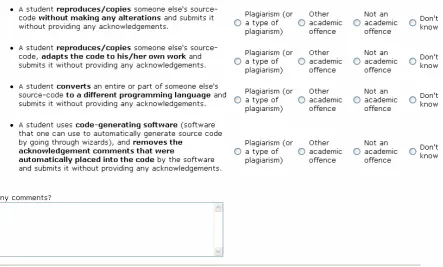
The process of proving whether source-code plagiarism occurred may involve looking at other parts of a programming assignment since in some circumstances source-code alone may not be sufficient for identifying and proving plagiarism. A programming assignment may include design diagrams, source-code and other documentation. Question 1 is shown in Figure 1.
Figure 1: Question 1
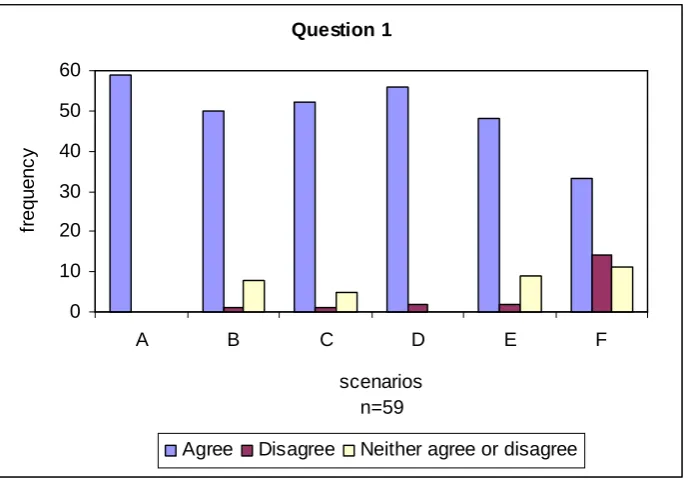
The results of question 1 are presented in Figure 2 below. The figure below corresponds to the following:
A. Source-code of a computer program B. Comments within the source-code C. Design material of a computer program D. Documentation of a computer program E. User interface of a computer program
Question 1
0 10 20 30 40 50 60
A B C D E F
scenarios n=59
fr
e
q
u
e
n
c
y
[image:11.595.75.420.58.300.2]Agree Disagree Neither agree or disagree
Figure 2: Chart shows the results from the responses to Question 1
All academics agreed that in a programming assignment source-code can be plagiarised. Regarding ‘comments within a source-code’, the majority of the academics agree that comments can be plagiarised and that comments may also help identify source-code plagiarism cases, “comments are not in themselves a ‘code plagiarism’ issue but may help identify a case.”
Regarding whether ‘program input data’ can be subject to plagiarism, the academic responses somehow varied. The majority of academics, 40 out of 59, agreed that program input data can be involved in plagiarism. On this issue, academics commented that program input alone cannot contribute to the identification of plagiarism and whether program input can be part of plagiarism depends on the assignment specification.
Furthermore, three academics commented that copying input data is an issue if students are assessed on the testing strategies they have used to test their program. In this case, assessment for plagiarism would be done by observing the testing strategy including the datasets used for testing the program, and the test plan (User Acceptance Testing material, i.e., test plan, system design documentation, technical documentation, user manuals, etc). One academic specified:
“The input data are not necessarily plagiarism, but a testing strategy can be (i.e. what and how to perform the testing, datasets used, any UAT forms, etc.) The UI is not necessarily generated by the user, but by the development tool, so it cannot be considered plagiarism in this case.”
Academics commented that whether a user-interface can be subject to plagiarism depends on the assignment requirements, and if a user-interface is required from the students then it can be subject to plagiarism, “The item on user-interface is really dependent on the task: if the UI was not the essence of the program, then I wouldn't think this is an issue.”
The majority of academics agreed that any material that is unreferenced can constitute plagiarism. One academic observed:
able to claim the safe-harbour provision. The permitted sources are explicitly identified for the project.”
Although the majority of academics agreed that any unreferenced source-code can constitute plagiarism, one academic expressed some uncertainties as to whether code re-use can constitute plagiarism,
“I agree that plagiarism could include those areas mentioned above [refers to the choices in question 1], but in o-o environments where re-use is encouraged, obviously elements of re-use are not automatically plagiarism. I think I'd be clear on the boundaries and limits in any given circumstance, and would hope to be able to communicate that clarity to my students, but obviously there will potentially be problems.”
4.2 Question 2
[image:12.595.78.522.439.706.2]Academics were presented with four small scenarios on copying, adapting, converting source-code from one programming language to another, and using software for automatically generating source-code. The question is shown in Figure 3.
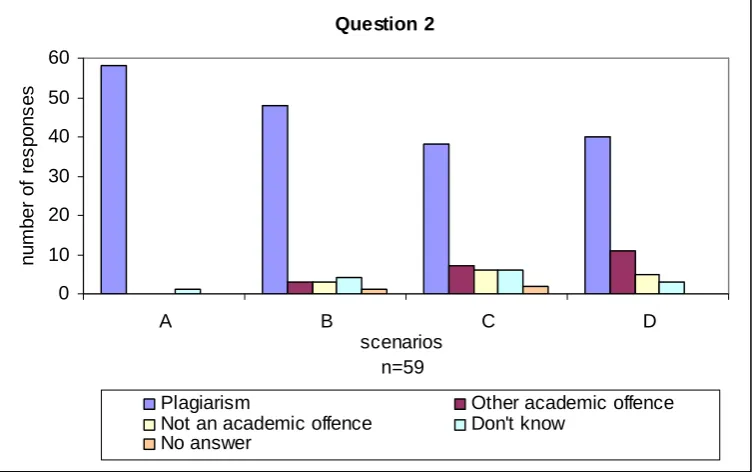
The results of question 2 are presented in Figure 4 below which corresponds to the following:
A. A student reproduces/copies someone else's source-code without making any alterations and submits it without providing any acknowledgements.
B. A student reproduces/copies someone else's source-code, adapts the code to his/her own work and submits it without providing any acknowledgements.
C. A student converts an entire or part of someone else's source-code to a different programming language and submits it without providing any acknowledgements.
D. A student uses code-generating software (software that one can use to automatically generate source-code by going through wizards), and removes the acknowledgement comments that were automatically placed into the code by the software and submits it without providing any acknowledgements.
Question 2
0 10 20 30 40 50 60
A B C D
scenarios n=59
n
u
m
b
e
r
o
f
re
s
p
o
n
s
e
s
Plagiarism Other academic offence Not an academic offence Don't know
[image:13.595.75.452.254.490.2]No answer
Figure 4: Chart shows the results from the responses for Question 2
For the first scenario, ‘a student reproduces/copies someone else’s source-code without making any alterations and submits it without providing any acknowledgements’, there was a wide agreement between academics (58 out of 59) that this scenario constitutes plagiarism. One academic provided a ‘don’t know’ response justified by the following comment.
“Please see comments on code reuse [refers to the comment provided in question 1 -In O-O environments where re-use is encouraged, obviously elements of re-use are not automatically plagiarism. I think I’d be clear on the boundaries and limits in any given circumstance, and would hope to be able to communicate that clarity to my students, but obviously there will potentially be problems]. Use of the API would be legitimate without acknowledgement – or with only the implicit acknowledgement.”
adaptation of the source-code, i.e., how much code is a copy of someone else’s work and the extent to which that code has been adapted without acknowledgement. One academic provided a ‘don’t know’ justified by the following comment:
“[The second scenario] depends on the adaptation. If the student changes the original beyond all recognition so that there was nothing left of the original to acknowledge, then it wouldn't be plagiarism. Or if the original was part of some material provided in lectures, then the acknowledgement wouldn't be needed, it would almost be taking it as "implicit", particularly if the lecturer encouraged the students to start with the provided code and then adapt it. If the adaptation involves just changing a few variable names (e.g.) then that would be plagiarism.”
However, two respondents were not clear on these points. The first, who did not provide an answer, noted that there were “some grey areas here as software reuse is often encouraged.” The second regarded the scenario as not being an academic offence, commenting:
“This is difficult – as code copied from a website that assists in a specific task is potentially good practice. However, code that is a 100% copy is a different issue. I would also be concerned about the context of this copying. If the only deliverable were to be code and documentation the offence is clear. In this sense I suppose it is an issue of how much of the overall assignment is actually a copy of other work (without acknowledgement).”
For scenario C, ‘A student converts an entire or part of someone else's source-code to a different programming language, and submits it without providing any acknowledgements’, several academics remarked that if the code is converted automatically without any or much effort from the student then this can constitute plagiarism. However, if a student takes the ideas or inspirations from code written in another programming language, and creates the source-code entirely “from scratch”, then this is not likely to constitute plagiarism.
Furthermore, in their comments academics pointed out that whether the conversion constitutes plagiarism depends on the programming languages, i.e., taking source-code written in one programming language and converting it to a similar programming language can constitute plagiarism, such as from C++ to Java, because the languages are too similar. However, converting from Prolog to C or Java can still constitute plagiarism depending on the amount of work involved in the conversion. In addition, one academic who responded ‘don’t know’, observed:
“The key question is whether the student is being misleading about how much work is theirs or not. I can imagine examples where the translation was definitely plagiarism, and I can imagine examples where the student has taken legitimate inspiration from someone else's example code, and has rewritten it in a different language.”
A code-generator is an application that takes as input meta-data (i.e. a database schema) and creates source-code that is compliant with design patterns. An example of shareware code-generator software is JSPMaker (2006), which, given a database, this software quickly and easily creates complete source-code and a full set of JavaServer Pages (2006) that have database connectivity.
code by the software, and submits it without providing any acknowledgements.’ Academics commented that this scenario may constitute plagiarism if the assignment specification instructs students to write the source-code themselves without the use of such software, or it may not constitute plagiarism if permission for use of code-generating software is described in an assignment specification. The majority of the academics considered unacknowledged use of such software as plagiarism. One academic who considered this scenario to be ‘plagiarism’ provided the following comment:
“In each case there must be some presumed benefit to the student in doing so (why did they do it otherwise?) and disruption to the assessment system. Even where the advantage might be minimal – e.g. from Prolog to C – a good student would almost certainly acknowledge the issue and use it to discuss the differences.”
The findings suggest that whether or not source-code reuse is allowed in programming assignments, students should always indicate which parts of the source-code were not authored by them, and that using material created by other persons or by software without providing acknowledgement can constitute plagiarism.
In conclusion, students should be required to acknowledge any material they use that is not their own original work regardless of the licensing permissions of that material (e.g. open source, free-use, fair-use), and as one academic commented, “I require the students to acknowledge their dependence on these sources of code even when it is permitted.”
4.3 Question 3
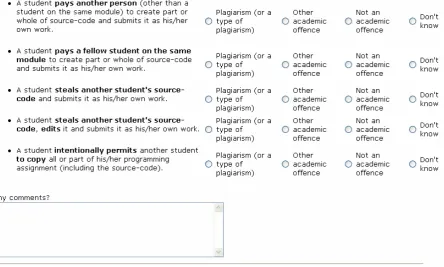
Figure 5: Question 3
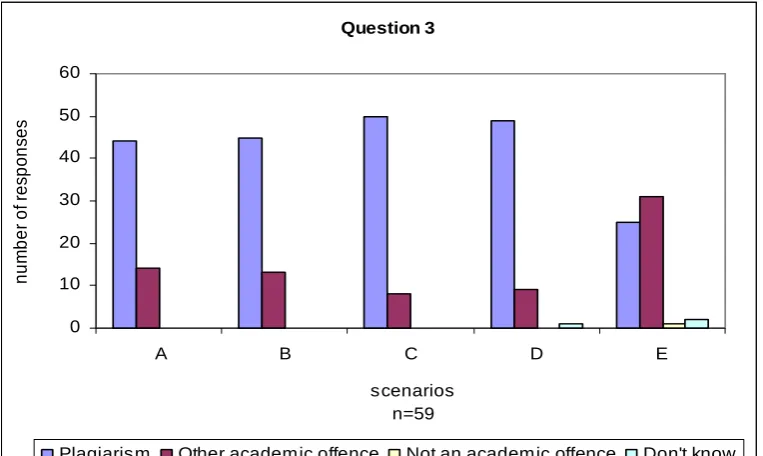
Figure 6corresponds to the following:
A. A student pays another person (other than a student on the same module) to create part or whole of source-code and submits it as his/her own work.
B. A student pays a fellow student on the same module to create part or whole of source-code and submits it as his/her own work.
C. A student steals another student's source-code and submits it as his/her own work.
D. A student steals another student's source-code, edits it and submits it as his/her own work.
Question 3 0 10 20 30 40 50 60
A B C D E
scenarios n=59 n u m b e r o f re s p o n s e s
[image:17.595.74.456.59.287.2]Plagiarism Other academic offence Not an academic offence Don't know
Figure 6: Chart shows the results from the responses for Question 3
In scenarios A to D, plagiarism was committed alongside another academic offence (s) such as cheating and stealing, hence some academics chose ‘plagiarism’ and others ‘other academic offence’. Many academics commented that these scenarios constitute plagiarism as well as other offences. One academic who considered scenarios A and B as ‘other academic offence’ and scenarios C and D as ‘plagiarism’ commented that “... paying someone or deliberately letting someone else use your code would both infringe the no-plagiarism declaration a student signs on submitting coursework - so would be plagiarism”. Another academic who considered scenarios A and B as ‘other academic offence’ and scenarios C and D as ‘plagiarism’ commented that “Serious cheating or deliberate plagiarism, a ‘red-card offence’. I tell the students I am assessing them, not their sources, and this is an attempt to gain a qualification by fraud.” A third academic considered all scenarios to be ‘plagiarism’ justified by the following comment.
“The act of submitting somebody else's work as your own without acknowledgment is generally plagiarism - in some of these cases other academic offences have been committed too. In particular stealing another student's work is an academic offence (and potentially a criminal or civil offence) in its own right.”
Regarding scenario E, comments received indicate that some of the academics consider this scenario to be collusion and some consider it plagiarism. Some of the academics that have considered this scenario as collusion commented, “‘intentionally permits...’ is collusion.”, “It's a moot point what the name is, but I think I'd call the last one collusion.”, and some of the academics that considered this scenario as ‘plagiarism’ provided comments such as, “I would see the last case as colluding in plagiarism - still an offence.”, “The last is complicity in plagiarism, which is a form of academic misconduct”, “At my University plagiarism and collusion are regarded as, and treated as, the same offence, so I'm not used to making any distinction between the two.”
4.4 Question 4
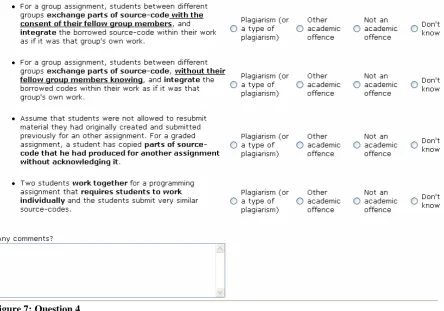
[image:18.595.78.523.244.555.2]In this question, the academics were asked to provide their opinion as to which academic offence applies to given scenarios regarding group actions, self-plagiarism and collusion. The purpose of this question is to determine which student actions can indicate plagiarism. Question 4 is shown in Figure 7.
Figure 7: Question 4
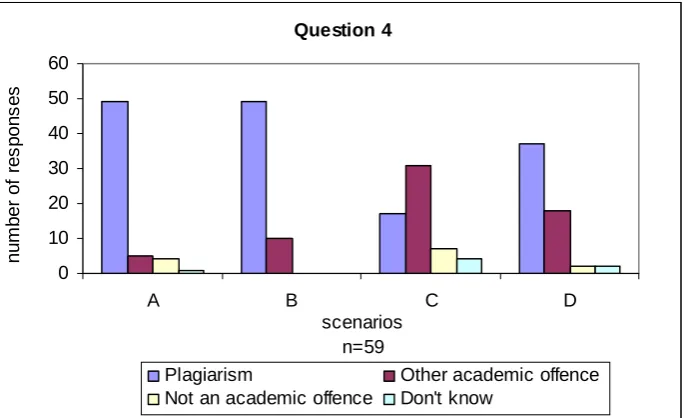
The results of question 4 are presented in Figure 8, which corresponds to the following:
A. For a group assignment, students between different groups exchange parts of source-code with the consent of their fellow group members, and integrate the borrowed source-code within their work as if it was that group's own work.
B. For a group assignment, students between different groups exchange parts of source-code, without their fellow group members knowing, and integrate the borrowed codes within their work as if it was that group's own work.
C. Assume that students were not allowed to resubmit material they had originally created and submitted previously for another assignment. For a graded assignment, a student has copied parts of source-code that he had produced for another assignment without acknowledging it.
Question 4 0 10 20 30 40 50 60
A B C D
scenarios n=59 n u m b e r o f re s p o n s e s
[image:19.595.76.421.59.268.2]Plagiarism Other academic offence Not an academic offence Don't know
Figure 8: Chart shows the results from the responses for Question 4
The majority of the academics consider scenarios A, and B as plagiarism. Considering the comments given by academics to previous questions, these scenarios can constitute plagiarism, collusion or another academic offence depending on university regulations. Scenario B can constitute plagiarism, collusion as well as another academic offence since material was obtained without permission (the type of academic offence depends on the academic regulations of each university).
Regarding scenarios A and B, some academics expressed some concerns on the issue of plagiarism in group assignments. One academic commented, “I avoid group assignments for just these reasons. I permit students to work together as long as they individually write their own code and documentation. I regard this as pedagogically valuable”, while another academic observed “… Some students learn better while working in groups but they must ensure that the work submitted is original and their own. The tell tale here is the comments (and spelling mistakes) are identical.”
The majority of academics considered scenario D as an academic offence, ‘plagiarism’ or ‘another academic offence’. However, as mentioned above the name depends on university regulations. Academics commented, “the last one [scenario D] is very tricky to decide; I'm very happy for students to work together, but very unhappy when I have to make this kind of decision. I'd be inclined to say ‘plagiarism’, but treat a first offence leniently”, another academic considered this scenario as “very common and usually accompanied with denials that they had submitted the same code and/or they didn't know they weren't allowed to work together”.
assignment. The comments and responses provided by the academics who did not describe this scenario as ‘plagiarism’ or ‘another academic offence’ point to the controversial issue on source-code reuse aforementioned. One academic who replied ‘don't know’ remarked that ‘Students should reuse code for assessments where possible!’ and another was clear that it was ‘not an academic offence’, and emphasised “I find it hard to assume that students were not allowed to resubmit material.” A third academic, who also stated that it was ‘not an academic offence’, commented: “would this ever happen in a programming oriented module when we behove students not to reinvent the wheel?”
In conclusion, since 48 out of 59 academics characterised the action of resubmitting source-code produced as part of another assessment as a type of academic offence (plagiarism or other) we can conclude that resubmitting source-code without providing appropriate acknowledgements may lead to an academic offence if this is not allowed for the particular assignment.
4.5 Question 5
Question 5 consists of brief scenarios about intentional and unintentional plagiarism in graded and non-graded assignments. In this question, academics were asked to provide their opinions as to which academic offence applies to given scenarios. The purpose of this question is to determine whether intentions and assignment importance influence the decision as to whether plagiarism has occurred. Question 5 is shown in the figure below.
The responses from question 5 are shown in Figure 10, which corresponds to the following:
A. For a graded assignment, a student has copied source-code from a book and has intentionally not provided any acknowledgements.
B. For a graded assignment, a student has copied source-code from a book and has unintentionally not provided any acknowledgements.
C. For a non-graded assignment, a student has copied source-code from a book and has intentionally not provided any acknowledgements.
D. For a non-graded assignment, a student has copied source-code from a book and has unintentionally not provided any acknowledgements.
Question 5 0 10 20 30 40 50 60
A B C D
scenarios n=59 n u m b e r o f re s p o n s e s
Plagiarism Other academic offence Not an academic offence Don't know
Figure 10: Chart shows the results from the responses for Question 5
The survey included questions regarding plagiarism in graded and non-graded assignments. By non-graded assignments, we refer to assignments that do not contribute to the overall module mark (such as some laboratory and tutorial exercises).
The results show that plagiarism can occur regardless of whether or not the student intended to provide acknowledgements to the sources they used. Academics commented that the degree of intent determines the seriousness of the plagiarism and consequently the penalty applied to the students work. Hence, plagiarism can occur intentionally or unintentionally, and the penalty imposed to the student will depend on the degree of the student’s intention to commit plagiarism,“It is a case of degree here. Typically students do not just fail to reference one source but many. For non graded work (presumably being used formatively) it would be better to highlight the error without formal censure.”
The results also suggest that plagiarism can occur regardless of whether an assignment is graded or non-graded. Two academics commented that plagiarism punishments for graded and non-graded assignments may vary. The first academic who provided a ‘don’t know’ response for scenarios C and D commented that “[for scenarios C and D] it depends on what the rules were for that non-graded assignment. If they plagiarise then it's plagiarism irrespective of whether the assignment is graded, it just means that the penalty may be different”, and the second academic who provided a ‘plagiarism’ response for both scenarios C and D commented that“the act of plagiarism should be related to whether an assignment is graded or not. The intention also would have to do with the amount of penalty applied to.”
approached and informed or warned about plagiarism implications on graded assignments:“If the assignment is not contributing towards the mark for the module then the correct protocol should be brought to the attention of the student.” In addition one academic who considered scenarios C and D as ‘not and academic offence’ commented: “My logic here is that you can't penalise someone for an assignment they didn't have to do. The last two questions are still plagiarism in my view but you couldn't take any action against the student for it.”
Furthermore, some of the academics commented that their university regulations on plagiarism would only apply to graded work and plagiarism is only an academic offence if it concerns work submitted for credit. One academic stated: “last two *are* cases of plagiarism but academic regulations might define ‘offence’ in terms of intention to gain higher grades”, and another academic observed that the “last two are not offences but morally incorrect and could lead to the practice being repeated for assessed work when it will be plagiarism”.
In conclusion, copying without providing any acknowledgements can constitute plagiarism whether this is done intentionally or unintentionally. Plagiarism can occur in both graded and non-graded assignments. The degree of intent determines the seriousness of the plagiarism. The penalty imposed from plagiarism in graded and non-graded assignments may differ and may depend on the degree of intent to commit plagiarism.
4.6 Question 6
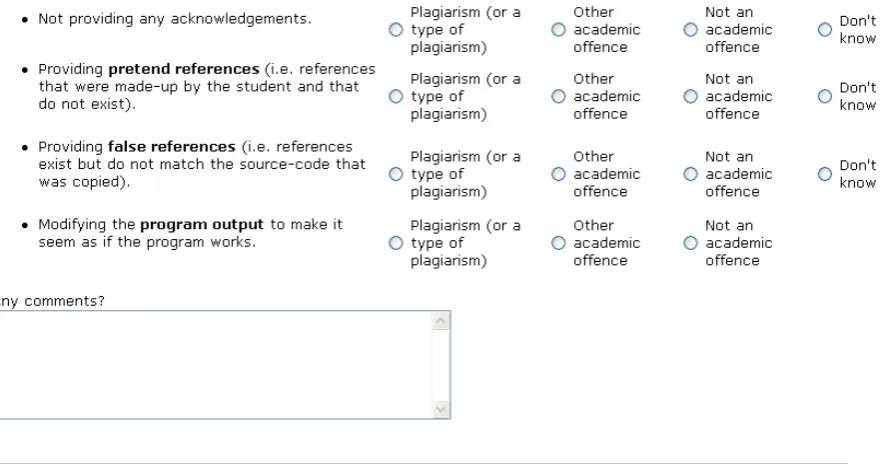
[image:22.595.78.521.495.727.2]Question 6 consists of brief scenarios regarding source-code referencing and plagiarism. In this question, academics were asked to provide their opinions as to which academic offence applies to the given scenarios. The purpose of this question is to determine whether inappropriate referencing can suggest plagiarism. Question 6 is shown in the figure below.
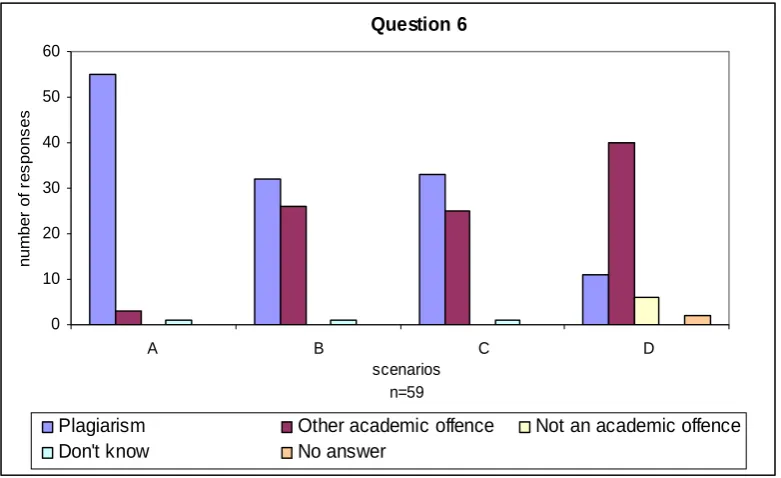
The results of question 6 are presented in Figure 12, which corresponds to the following:
A. Not providing any acknowledgements
B. Providing pretend references (i.e. references that were made-up by the student and that do not exist).
C. Providing false references (i.e. references exist but do not match the source-code that was copied)
D. Modifying the program output to make it seem as if the program works
Question 6
0 10 20 30 40 50 60
A B C D
scenarios n=59
n
u
m
b
e
r
o
f
re
s
p
o
n
s
e
s
[image:23.595.74.465.183.422.2]Plagiarism Other academic offence Not an academic offence Don't know No answer
Figure 12: Chart shows the results from the responses for Question 6
The results show that academics consider copying source-code from a book or a website, and not providing any acknowledgements as source-code plagiarism. For scenario A, one academic commented that there is a difference between poor referencing and plagiarism, and that the difference between poor referencing and plagiarism is one that it is not easily determined.
For scenarios B and C, academics commented that these scenarios show intent by the student to plagiarise. Regarding scenario D, if source-code was copied and unacknowledged this can constitute plagiarism as well as other academic offences characterised by academics as ‘plagiarism’, “falsification”, “fraud”, “cheating” and as “an act that it raises ethical, scientific and academic integrity issues”.
The findings show that there was a wide agreement between academics that scenarios B, C, and D suggest an academic offence, however whether these are regarded as ‘plagiarism’ or ‘another academic offence’ seems to depend on university regulations.
4.7 Question 7
Figure 13: Question 7
The results of question 7 are presented in Figure 14, which corresponds to the following:
A. Have a brief discussion about the program design, (i.e. what classes, attributes, methods they need) without taking any notes.
B. Have a detailed discussion about the program design, (i.e. what classes, attributes, methods they need) and take notes and use these notes when designing the program. C. Work together and share ideas while producing the design of the program.
D. Have a brief discussion about the program functionality and source-code without taking any notes.
E. Have a detailed discussion about the program functionality and source-code and take notes and use these notes when coding the program.
F. Work together and share ideas while coding the program.
Question 7 0 10 20 30 40 50 60
A B C D E F G
scenarios n=59 n u m b e r o f re s p o n s e s
High Medium Low No ans wer
Figure 14: Chart shows the results from the responses for Question 7
The results show that in the experiences of academics there is low likelihood of plagiarism occurring when students have a brief discussion about the program design, (i.e. what classes, attributes, methods they need) or about the program functionality and source-code without taking any notes. Many academics commented that they have “no objections to students sharing ideas”, and commented that it is “pedagogically valuable” for students to engage actively in sharing ideas while discussing content and assignments as long as they do not copy each others work and hence “write their own code and documentation”.
Two academics who encourage students to share ideas commented, “I have no problem with sharing ideas. Given the restricted types of programs undergrads write, it is inevitable that certain design decisions lead to similar code”, “I am personally not too worried about students discussing their work, it is the outright copying that I find most offensive and educationally pointless”. A third academic observed:
“Important to remember that we often expect people to discuss, engage actively in discussing content and assignments - also preparation for future working in teams. Often we need to be much clearer in what we require of students - and what we don't.”
Regarding scenario G, academics commented that it would be an academic offence if two students help each other with the coding of the program (i.e., collusion). Furthermore, the likelihood of plagiarism occurring for scenario G depends on the type of testing being carried out. The likelihood of plagiarism occurring during black box testing tends to be low and the likelihood of plagiarism occurring during white box testing tends to be high. Note that with black box testing the tests are conducted at the software interface level, and with white box testing the tests on the code’s procedural detail are carried out. Furthermore, the comments for scenario G are that the source-code similarities are likely to be low in such a scenario, but if documentation of testing is required for the assignment submission, and plagiarism occurs in the testing part of the documentation due to the students using the same test cases then the likelihood of plagiarism is high. However, if the students are not asked for their test cases then the probability of plagiarism is low.
4.8 Summary of Part One: Description of what can constitute source-code plagiarism
The information that was collected from the survey responses was analysed and collated to create a description of what constitutes source-code plagiarism from a wide academic perspective. All of the information presented in this section was gathered from the responses to questions in the survey.
4.8.1 Source-Code Plagiarism
Source-code plagiarism in programming assignments can occur when a student re-uses (4.8.1.1) source-code authored by someone else by obtaining (4.8.1.2) the source-code either with or without the permission of the original author and intentionally or unintentionally not properly acknowledging (4.8.1.3) the borrowed source-code and submits it as his/her own work.
If a student reuses (4.8.1.1) source-code that s/he produced as part of another assessment (in which s/he has gained academic credit) without properly acknowledging (4.8.1.3) this fact, it can constitute self-plagiarism or another academic offence (name of academic offence depends on university regulations).
If a student reuses (4.8.1.1) source-code authored by someone else (or produced by that student as part of another assessment) and provides acknowledgements then this can constitute to breach of assignment regulations, and not plagiarism (or self-plagiarism).
4.8.1.1 Re-use
Re-use includes the following:
a. Reproducing/copying without making any alterations.
b. Reproducing/copying and minimally or moderately adapting it. Minimal or moderate adaptation occurs when the work submitted by the student still contains some of the original source-code.
c. Converting the whole or part of someone else’s source-code to a different programming language. Whether this constitutes plagiarism depends on the similarity between the languages and the effort required by the student to do the conversion. If the student takes ideas and inspirations from source-code written in another programming language and the source-code is entirely authored by the student it may not constitute plagiarism.
d. Automatically generating source-code using code-generating software can constitute plagiarism if the use of such software is not explicitly allowed in the assignment specification.
4.8.1.2 Obtaining
Obtaining the source-code either with or without the permission of the original author includes the following:
b. A student steals another student's source-code.
c. Two or more students collaborate (work together) on a programming assignment that requires students to work individually and the students submit similar source-codes. This can constitute plagiarism or collusion (name of academic offence depends on the academic regulations).
d. Students between different groups carrying out the same assignment, exchange parts of source-code with or without the consent of their fellow group members.
In the above list, source-code plagiarism can co-occur with other academic offences (such as theft, cheating, and collusion) depending on academic regulations. This is a very limited list since there are numerous ways that students can obtain source-code written by other authors.
4.8.1.3 Not properly acknowledging
Not properly acknowledging includes the following:
a. Not acknowledging the source and authorship of the source-code, within the program source-code (in the format of a comment) and in the appropriate documentation.
b. Providing “pretend” references (i.e. references that were made-up by the student and that do not exist) is a form of academic misconduct, often referred to as fabrication, and it can co-occur with plagiarism.
c. Providing “false” references (i.e. the references exist but do not match the source-code that was copied) is a form of academic misconduct, often referred to as falsification, and it can co-occur with plagiarism.
d. Modifying the program output to make it seem as if the program works when it is not working is a form of academic misconduct (i.e., falsification), and it can co-occur with plagiarism.
4.9 Conclusion
An important issue addressed in the first part of the report is that of source-code reuse. Some academics have expressed uncertainties whether reuse without acknowledgement constitutes plagiarism, however, the majority of academics suggest that when reuse is permitted in assignments students should provide acknowledgement of the parts of the source-code written by other authors.
The issue on whether it constitutes plagiarism when students reuse (without providing acknowledgements) source-code they have produced as part of other assignments has received different opinions. The majority of academics consider resubmission of source-code without acknowledgement as an academic offence, however a small but significant number of academics disagree that this action constitutes an academic offence since source-code reuse is encouraged in object-oriented programming languages.
5.0 Survey Part Two
This section is concerned with analysing the information gathered from the responses to questions 8 to 12 in the survey. Questions 8 and 9, are concerned with the importance of an assignment in terms of its contribution to the overall module mark for academics to consider proceeding with investigation into possible plagiarism. Questions 10 and 11, are concerned with the amount of similarity that two pieces of source-code must contain in order for academics to take certain actions on plagiarism. Question 12 consists of two similar pieces of source-code and the academics were asked to provide ratings as to how similar are the pieces of source-code, and the likelihood that plagiarism occurred.
During the design of the questionnaire, it was suspected that some academics might be reluctant to provide answers to questions asking for quantitative information due to the subjectivity issues surrounding the topic of similarity thresholds and source-code plagiarism. However, for research purposes, such questions were considered as important because they could provide an insight into similarity thresholds between source-codes for certain actions to be taken, that would be important during the development of software to detect source-code plagiarism.
5.1 Statistics for quantitative analysis
Due to the subjective nature of providing similarity thresholds it was suspected that the values provided by academics for questions asking for quantitative information would vary. Therefore, it was important that appropriate statistics were selected and used in order to analyse and describe as accurately as possible the quantitative information gathered from the survey.
Statistics such as the mean and standard deviation may only be appropriate for datasets with symmetric distributions because such statistics assume that the datasets have a normal distribution. Statistics such as median and the range are appropriate for datasets that may or may not have a normal distribution. Therefore, as a starting point of analysing the data, it was important to employ some statistics that describe the distribution of the data in order to determine beforehand which statistics to use.
To measure the variability in the values provided by academics, the skewness of each dataset was measured. Box-and-whisker plots were used to compare the distribution of data, and histograms were produced for comparing the distribution of frequencies.
5.1.1 Skewness
5.1.2 Box and whisker plot
A box and whisker plot is a graph that presents information about a dataset in terms of the median value, upper and lower-quartile values, range value, and inter-quartile value of a dataset. The median value (also called 50th percentile) is the middle value (centre value) in a dataset. The lower-quartile (also called 25th percentile) is the median value of the lower part of the dataset set, where 25% of the values are smaller than the median value of the dataset; and the upper-quartile value (also called 75th percentile) is the median value of the second part of the dataset, where 25% are larger than the median.
The range is the difference between the maximum and minimum values of a dataset. The inter-quartile range (IQR) is the difference between the upper-quartile and the lower-quartile. The IQR is the range of the middle 50% of the data set, and eliminates the influence of outliers because the highest and lowest quarters are removed. The IQR is a measure of the spread and also indicates the dispersion of a data set. Dispersion measures how close are values are to the mean value of a dataset.
The box and whisker plot is useful in indicating whether a distribution is skewed and whether outliers (unusually high values) exist in a dataset. Box and whisker plots are useful for comparing more than one dataset, and for comparing the distributions between datasets. The box itself contains the middle 50% of the data. The horizontal line across each box represents the median. The median is the number in the middle of a set of numbers; half the values are smaller than the median and half the values are larger than the median. If the median is not located in the middle of the box, then the distribution is skewed. The whiskers extend from the lower-quartile to the lowest number in the data set and from the upper-quartile to the greatest number in the data set. Hence, the ends of the whiskers indicate the minimum and maximum data values. The whiskers extend to at most 1.5 times the box width (the IQR) from both ends of the box.
Outliers are unusually high values. A mild outlier is a value that is more than 1.5 times the IQR and an extreme outlier is a value that is more than 3 times the IQR. In the box-and-whisker plot the mild outliers are marked with a small circle (o) and the extreme outliers are marked with an asterisk (*).
Box-and-whisker plots seem to be appropriate for analysing the quantitative data from this survey. These plots are particularly good when comparing distributions between datasets, they show variations in the data, unusual values and they also provide statistics about each fourth of the data. Statistics about different parts of a dataset are very important because each value describes a specific part of a dataset. For example, some academics have provided values at the low end of a scale, others values at the high end of a scale, and others values in the middle of the scale. The box-and whisker plot clearly shows where most variation exists in the data and are ideal for comparing more than one dataset.
5.1.3 Histogram
A histogram is a graph that consists of vertical bars showing the distribution of frequencies within certain ranges (or intervals) of values. The histogram can provide information such as the distribution of the data (symmetric or skewed), the most common responses, outliers in the data, and the variation of the data.
5.1.4 Statistics for comparing pairs of values
that the distribution of the data is normal. A dataset with normal distribution is symmetrical (i.e. not skewed). Examples of parametric tests are the Pearson’s correlation coefficient and the paired-samples T-test.
Nonparametric tests do not follow the assumption of normal distribution, and these tests are ideal for datasets with skewed distributions. The nonparametric tests for two related samples test for differences between paired values without making the assumptions required by the paired-samples T-test. Examples of nonparametric tests are the Spearman’s rho correlation and the Wilcoxon signed-ranks test.
5.2 Questions 8 and 9
Questions 8 and 9 are concerned with the importance of an assignment, in terms of its weight towards the overall module mark, when investigation into possible plagiarism is to be carried out. The purpose of questions 8 and 9 was to gather some values as to what must be the minimum contribution of an assignment towards the overall module mark for academics to proceed with investigation into possible plagiarism. Questions 8 and 9 are shown in figures 15 and 16 respectively.
Figure 16: Question 9
Questions 8 and 9 are very similar with their only difference being that in question 8 a student has taken source-code from a book, and in question 9 two students have submitted very similar source-code. The responses for the two questions were analysed and compared. Table 1shows the responses for each question.
Question 8 Question 9 Responses Frequency Frequency
0 7 8
1 18 18
2 1 0
5 5 6
10 6 7
12,5 1 1
15 2 2
20 5 5
25 4 3
30 0 1
35 1 0
40 1 0
No answer 8 8
Total 59 59
Table 1: Frequency table of answers to questions 8 and 9
Responses to questions 8 & 9
0 5 10 15 20 25 30 35
0-5 10-15 20-25 30-40 No answer
assignment weight
fr
e
q
u
e
n
c
y
[image:32.595.76.429.59.278.2]Question 8 (n=59) Question 9 (n=59)
Figure 17: Chart shows the results from the responses for questions 8 and 9
The majority of academics who have provided a response to this question have given a value in the range of 0-5, suggesting a “zero tolerance” policy, and many commented that any assignment (even unmarked assignments) should be investigated for possible plagiarism regardless of their contribution to the overall module mark and appropriate action should be taken (whether penalties, or warning). The rationale for this is clear: “If they cheat on a 5% assignment they’ll cheat on a larger one. A short, sharp shock can prevent the full offence.”
In some instances, the severity of the offence is considered by the institution to vary depending on the contribution of the assignment:
“Any contribution would bring the same investigation. However, for the full range of penalties to be applied a minimum contribution to the degree award of 7%, or a second or subsequent upheld accusation, is required. This is University policy.”
There was agreement that regardless of the assignment’s contribution towards the overall module mark, investigation into possible plagiarism should always be pursued and appropriate action should be taken (whether penalties, or warning). The actions taken by academics when they suspect plagiarism in both graded and non-graded assignments may depend on the university regulations as well as the academics themselves, and some actions (such as warning students) may not appear in university regulations. One academic emphasised, “All plagiaristic work should be investigated as it has reached such epidemic proportions that the only control is draconian measures for any offence.”
The majority (42 out of 50) of academics have provided the same answer for both question 8 and 9. A pair-wise comparison on the values provided by the eight academics who have provided a different answer for questions 8 and 9 shows that the average for question 9 (average=11.38) is much lower that that of question 8 (average=18.5). This suggests that after considering the assignments contribution towards the overall module mark, some academics would consider proceeding with investigation into possible plagiarism if plagiarism between students was suspected, that they may not otherwise have done if they suspected that a student copied from a book. The statistical significance of this finding was tested using the Wilcoxon signed-ranks Test and it is described below.
was to examine in more detail the types of responses provided by academics for questions 8 and 9 rather than just the mean differences. The Wilcoxon signed-ranks method tests the null hypothesis that two related medians are the same.
The hypotheses tested are:
H0: There is no significant difference between the values provided by academics for question 8 and question 9
HA: There is a significant difference between the values provided by academics for question 8 and question 9
Conclusion: Reject null hypothesis if test statistic is less than 0.05.
Table 2 shows the number of ranks, mean rank, and the sum of positive and negative ranks. The number of negative ranks is the number of academics who have provided higher values for question 8. The number of positive ranks is the number of academics who have provided higher values for question 9. The number of ties is the number of academics who have provided the same values for questions 8 and 9. The notes below Table 2 indicate what the positive and negative ranks relate to.
Ranks
N Mean Rank Sum of Ranks question9 - question8 Negative Ranks 7(a) 4.14 29.00
Positive Ranks 1(b) 7.00 7.00
Ties 42(c)
Total 50
a question9 < question8 b question9 > question8 c question9 = question8
Table 2: Wilcoxon Signed-ranks Test
[image:33.595.70.467.322.451.2]Eight academics have provided different responses for questions 8 and 9. Seven academics have provided a higher value for question 8 and one academic has provided a higher value for question 9. The majority of the academics (42 out of 50) have provided the same values for both questions, and hence the large number of ties.
Table 3below shows the test statistics of the Wilcoxon signed-ranks test. In Table 3 if the asymptomatic significance value falls below 0.05 then there is a significant difference in the values provided by academics, and if the value is above 0.05 then there is no significant difference between the values given for questions 8 and 9.
Test Statistics(b)
question9 - question8
Z -1.544(a)
Asymp. Sig. (2-tailed) 0.123
a Based on positive ranks b Wilcoxon Signed-ranks Test
Table 3: Test statistics for the Wilcoxon signed-ranks test
Since the symptomatic significance value is more than 0.05, we can conclude the null hypothesis holds “there is no significant difference between the values provided by academics for questions 8 and 9”.
[image:33.595.73.317.594.685.2]plagiarism was suspected due to inappropriate collaboration between students or because students may have used source-code from a book without referencing. In addition, the results show that there is a general agreement between academics that a ‘zero tolerance’ plagiarism policy is appropriate, investigation into possible plagiarism should always be pursued and any case of plagiarism should be dealt with regardless of the assignment’s contribution towards the overall module mark.
5.3 Question 10
[image:34.595.72.523.357.630.2]The purpose of question 10 is to provide information about the amount of similarity that source-code submitted by two students must have in order for academics to take no action or another form of action. The differences between the values provided by academics for actions corresponding to graded and non-graded assignments were also investigated. The academics were asked to provide threshold values for actions corresponding to graded and for non-graded assignments by completing the relevant blanks in question 10(see Figure 18).
This and the next paragraph apply to question 10 as well as to question 11 (seeSection 5.4). The design of questions 10 and 11 was such that the minimum in one action could serve as the maximum in another action, for example, ‘no action’ could be 0-60, and ‘give warning’ could be 60-100. Academics who have answered questions 10 and 11 have provided similarity values that follow on from each other, for the actions they take. Hence, it was only necessary to use the minimum amount provided by academics for each of the actions, in order to avoid extra unnecessary statistical analysis.
In the statistical analysis, ms refers to minimum similarity value (i.e. the minimum amount provided by academics). During statistical analysis of questions 10 and 11, the minimum values were used instead of the maximum values because these are considered as more meaningful, since ms values indicate that if a similarity starts at a certain value then the relevant action is taken.
The instructions for questions 10 and 11 asked academics not to provide any values for actions that they would not take and to describe any other actions that they would take in the comments box provided. The number of responses for each action vary, because not all academics take all of the actions listed (i.e. some academics do not give warnings, they proceed with the university procedure when they detect source-code plagiarism; other academics give warnings if similarity is below certain thresholds, and proceed with the university procedure if plagiarism exceeds these thresholds).
A total of 44 out of 59 have responded to question 10 and the majority of those academics who did not respond have provided useful comments explaining their reasons for not completing this question. These are discussed in “Section 5.5.2: Factors influencing the similarity values provided by academics”.
For action ‘No action for graded assignments’ a total of 27 academics provided a ms valueof zero, and three academics provided ms values2, 5, and 30; and for action ‘No action for non-graded assignments’, 21 academics provided a ms value of zero, and 1 academic provided ms value of 2. The responses for action A “Take no action” will not be included in the comparison that follows, because the majority of the academics have provided the value of zero as the ms value for taking no action.
BG BNG CG CNG DG DNG 0
20 40 60 80 100
10
20
BG – Graded assignments: Note the student names for future checks BNG – Non-graded assignments: Note the student names for future checks CG – Graded assignments: Give warning to the students
CNG – Non-graded assignments: Give warning to the students
DG – Graded-assignments: Proceed with the university’s formal plagiarism procedure
[image:36.595.70.412.65.370.2]DNG –Non-graded assignments: Proceed with the university’s formal plagiarism procedure
Figure 19: Box plot comparing the responses for each of the actions in question 10
Statistics
BG BNG CG CNG DG DNG
N 21 13 33 24 40 20
Range 30 50 50 50 75 100
Minimum 0 0 0 0 0 0
Maximum 30 50 50 50 75 100
25th 5 5 5 8.75 8.75 10
50th 10 10 10 23 20 22.5
Percentiles
75th 11 20 30 30.25 50 50
IQR 6 15 25 21.5 41.25 40
Table 4: Statistics for figure 10