638
https://doi.org/10.1107/S2056989018005182 Acta Cryst.(2018). E74, 638–641research communications
Received 8 February 2018 Accepted 2 April 2018
Edited by E. V. Boldyreva, Russian Academy of Sciences, Russia
Keywords:synthesis; aggregation-induced emission; pyrene; crystal structure.
CCDC reference:1834096
Supporting information:this article has supporting information at journals.iucr.org/e
Synthesis, crystal structure and
aggregation-induced emission of a new pyrene-based
compound,
3,3-diphenyl-2-[4-(pyren-1-yl)phenyl]-acrylonitrile
Bao-Xi Miao, Xin-Xue Tang and Li-Fang Zhang*
School of Chemical Engineering and Technology, China University of Mining and Technology, Xuzhou 221116, People’s Republic of China. *Correspondence e-mail: [email protected]
The title organic compound, C37H23N, crystallizing in the triclinic space group
P1, has been designed, synthesized and characterized by single-crystal X-ray diffaction, MS, NMR and elemental analysis. There are alternating relatively strong and weak intermolecular–interactions between adjacent pyrene ring systems, forming a one-dimensional supramolecular structure. The compound is weakly fluorescent in THF solution, but it is highly emissive in the condensed phase, revealing distinct aggregation-induced emission (AIE) characteristics.
1. Chemical context
Over the last several decades, research on organic fluorescent materials has gained important momentum because of their wide range of applications in organic light-emitting diodes (OLED), organic field-effect transistors (OFET), organic lasers, fluorescent sensors and solar cells and so on (Indumathi
materials have attracted considerable attention (Srinivasanet al., 2009; Zhanget al., 2018). Herein, we report the synthesis and crystal structure of a new pyrene-based triphenylacrylo-nitrile, 2-[4-(1-pyrenyl)phenyl]-3,3-diphenylacrylonitrile, using a Suzuki cross-coupling reaction between 2-(4-bromo-phenyl)-3,3-diphenylacrylonitrile and 1-pyrenylboronic acid, which may exhibit both AIE and mechanochromic char-acteristics.
2. Structural commentary
The single X-ray diffraction analysis agrees well with the expected structure of the title compound, as shown in Fig. 1. The 2,3,3-triphenylacrylonitrile unit, which exhibits the typical propeller-shaped structure, is linked by a planar pyrenyl unit at one phenyl segment. The length of the central C2—C3 bond is 1.3623 (14) A˚ , which is typical for a double C C bond. The C—N bond length is 1.1479 (14) A˚ , which is comparable with those of other cyanide-containing organic or inorganic compounds, showing the existence of a cyanide group. The pyrenyl ring system is almost strictly planar, with the largest derivation from the mean plane being 0.027 (3) A˚ for atom C31.
3. Supramolecular features
In the crystal, there are alternating relatively strong and weak intermolecular–interactions between adjacent pyrene ring systems with shortest interatomic distances C26 C37(1x,
y, 2 z) = 3.511 (3) and C31 C31(2 x, y, 2 z) = 3.306 (3) A˚ , which link the molecules into a one-dimensional supramolecular structure. In addition, there are C6—H6 N1 interactions with a C N distance of 3.3563 (17) A˚ (Table 1) between the cyanide nitrogen atom and a benzene carbon atom, which link the above one-dimensional supramolecular structures into two-dimensional supramolecular networks parallel to (010), as shown in Fig. 2. These intermolecular interactions can be compared with those in 1-pyrenyl-based triarylamines (Zhanget al., 2016c).
4. Aggregation-induced emission
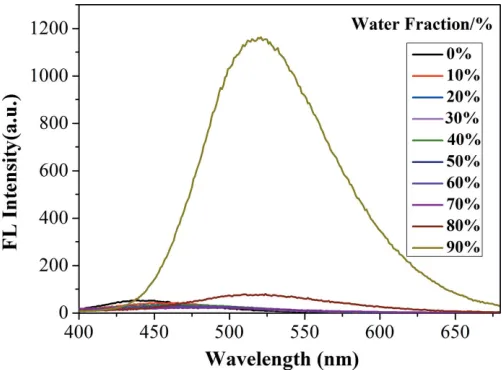
The corresponding emission spectra of the title compound in aqueous THF with different water/THF ratios at a concen-tration of 5105Mare shown in Fig. 3. It can be seen that the title compound shows weak fluorescence when the water fraction is below 70%, which is ascribed to the active intra-molecular rotations of the genuinely dissolved luminogens in these mixtures. The yellow fluorescence starts to increase gradually at a water content of 80%, at which the luminogens begin to aggregate, and reaches a maximum, which is nearly 50 times stronger than that in the pure THF solution, when the water content is 90%. The title compound therefore exhibits typical aggregation-induced emission (AIE) activity.
research communications
Acta Cryst.(2018). E74, 638–641 Miaoet al. C
[image:2.610.80.262.182.374.2]37H23N
639
Figure 2
The supramolecular structure of the title compound built up through–
[image:2.610.275.556.579.712.2]and C—H N interactions. Figure 1
The molecular structure of the title complex, with 30% probability displacement ellipsoids.
Table 1
Hydrogen-bond geometry (A˚ ,).
D—H A D—H H A D A D—H A
C6—H6 N1i 0.93 2.73 3.3563 (17) 125
[image:2.610.46.307.589.717.2]5. Database Suvey
The structure of the title compound can be compared with our previously reported seriors of pyrenyl-based triarylamines in which two compounds crystallize in the sameP1 space group (Zhang et al., 2016c). In these compounds, the substituent groups are all at the 1-position of the pyrene ring system. Importantly, because of the existence of the relatively larger planar pyrene ring system, there are intermolecular –
interactions between adjacent pyrene ring systems, providing evidence that the presence of a pyrene ring system is favorable for the formation of strong intermolecular interactions.
6. Synthesis and crystallization
The starting material 2-(4-bromophenyl)-3,3-diphenylacrylo-nitrile was synthesized according to the literature (Wanget al., 2000). All other chemicals were purchased from commercial sources and used as received without further purification. A mixture of 2-(4-bromophenyl)-3,3-diphenylacrylonitrile (1.8013 g, 5 mmol), 1-pyrenylboronic acid (1.2304 g, 5 mmol), catalyst Pd(PPh3)4 (0.1156 g, 2 mol%), K2CO3 (2.7642 g, 20 mmol, dissolved in 5 mL of water) and 20 mL of MeOH in 80 mL of toluene was stirred at 353 K for 16 h. The reaction mixture was then cooled down and extracted with methylene dichloride. The combined organic layer was dried over anhy-drous MgSO4and filtered. The solvent was removed and the residue was purified by silica gel chromatography using hexane/methylene dichloride (v/v= 1:1) as eluent to afford the title compound (2.0683 g; yield 86%). Light-yellow block-shaped crystals were obtained by slow evaporation of a hexane/methylene dichloride solution (v/v= 1:1)
1
H NMR (600 MHz, chloroform-d) 8.27–8.18 (m, 3H), 8.16–8.10 (m, 3H), 8.09–8.02 (m, 2H), 7.97 (d,J= 7.8 Hz, 1H), 7.59–7.46 (m, 9H), 7.40–7.29 (m, 3H), 7.21–7.15 (m, 2H). MALDI–TOF MS: m/z calculated for C37H23N 481.5853,
found 481.5806 [M]+. Elemental analysis calculated for C37H23N: C, 92.18%; H, 4.86%; N, 2.85%; found: C, 92.28%, H, 4.81%; N, 2.91%.
7. Refinement
Crystal data, data collection and structure refinement details are summarized in Table 2. Hydrogen atoms were placed in calculated positions C—H = 0.93 A˚ ) and refined using a riding model withUiso(H) = 1.2Ueq(C).
Acknowledgements
The work was supported by the Fundamental Research Funds for the Central Universities (No. 2017BSCXA05).
References
Brandenburg, K. (2005).DIAMOND. Crystal Impact GbR, Bonn, Germany.
Bruker (2001).APEX2andSAINT-Plus. Bruker AXS Inc., Madison, Wisconsin, USA.
Figueira-Duarte, T. M. & Mu¨llen, K. (2011).Chem. Rev.111, 7260– 7314.
Han, F. F., Zhang, R., Zhang, Z. M., Su, J. G. & Ni, Z. H. (2016).RSC Adv.6, 68178–68184.
Hirata, S. & Watanabe, T. (2006).Adv. Mater.18, 2725–2729. Indumathi, C., Sabari Girisun, T. C., Anitha, K. & Alfred Cecil Raj, S.
(2017).J. Phys. Chem. Solids,106, 37–43.
Jadhav, T., Dhokale, B., Mobin, S. M. & Misra, R. (2015).J. Mater. Chem. C,3, 9981–9988.
640
Miaoet al. C37H23N Acta Cryst.(2018). E74, 638–641
[image:3.610.45.296.70.255.2]research communications
Table 2
Experimental details.
Crystal data
Chemical formula C37H23N
Mr 481.51
Crystal system, space group Triclinic,P1 Temperature (K) 123
a,b,c(A˚ ) 9.2277 (2), 10.6445 (3), 14.639 (2)
,,() 105.169 (2), 94.806 (2), 113.255 (2) V(A˚3) 1246.38 (18)
Z 2
Radiation type MoK
(mm1) 0.07
Crystal size (mm) 0.120.120.10
Data collection
Diffractometer Bruker APEXII CCD area-detector
Absorption correction Multi-scan (SADABS; Sheldrick, 2015)
Tmin,Tmax 0.981, 0.995
No. of measured, independent and observed [I> 2(I)] reflections
22549, 5093, 4402
Rint 0.026
(sin /)max(A˚
1
) 0.625
Refinement
R[F2> 2(F2)],wR(F2),S 0.035, 0.104, 1.04
No. of reflections 5093 No. of parameters 343
H-atom treatment H-atom parameters constrained max,min(e A˚
3
) 0.22,0.19
[image:3.610.313.555.90.365.2]Computer programs:APEX2andSAINT-Plus(Bruker, 2001),SHELXS2014(Sheldrick, 2008),SHELXL2014(Sheldrick, 2015) andDIAMOND(Brandenburg, 2005). Figure 3
Lu, Q. Y., Li, X. F., Li, J., Yang, Z. Y., Xu, B. J., Chi, Z. G., Xu, J. R. & Zhang, Y. (2015).J. Mater. Chem. C,3, 1225–1234.
Luo, J. D., Xie, Z. L., Lam, J. W. Y., Cheng, L., Chen, H. Y., Qiu, C. F., Kwok, H. S., Zhan, X. W., Liu, Y. Q., Zhu, D. P. & Tang, B. Z. (2001).Chem. Commun.18, 1740–1741.
Mishra, A., Uhrich, C., Reinole, E., Pfeiffer, M. & Bauerle, P. (2011).
Adv. Enery Mater.2, 265–273.
Nie, J., Li, N., Ni, Z. H., Zhao, Y. & Zhang, L. F. (2017).Tetrahedron Lett.58, 1980–1984.
Sasabe, H. & Kido, J. (2011).Chem. Mater.23, 621–630. Sheldrick, G. M. (2008).Acta Cryst.A64, 112–122. Sheldrick, G. M. (2015).Acta Cryst.C71, 3–8.
Srinivasan, S., Babu, P. A., Mahesh, S. & Ajayaghosh, A. (2009).J. Am. Chem. Soc.131, 15122–15123.
Tasso, T. T., Furuyama, T. & Kobayashi, N. (2015).Chem. Eur. J.21, 4817–4824.
Wang, S. J., Oldham, W. J., Hudack, R. A. Jr & Bazan, G. C. (2000).J. Am. Chem. Soc.122, 5695–5709.
Yuan, W. Z., Tan, Y. Q., Gong, Y. Y., Lu, P., Lam, J. W. Y., Shen, X. Y., Feng, C. F., Sung, H. Y., Lu, Y. W., Williams, L. D., Sun, J. Z., Zhang, Y. M. & Tang, B. Z. (2013).Adv. Mater.25, 2837–2843.
Zhang, Z. M., Han, F. F., Zhang, R., Li, N. & Ni, Z. H. (2016a).
Tetrahedron Lett.57, 1917–1920.
Zhang, R., Zhang, T. F., Xu, L., Han, F. F., Zhao, Y. & Ni, Z. H. (2017).
J. Mol. Struct.1127, 237–246.
Zhang, T. F., Zhang, R., Zhao, Z. M. & Ni, Z. H. (2016b).RSC Adv.6, 79871–79878.
Zhang, T. F., Zhang, R., Zhao, Y. & Ni, Z. H. (2018).Dyes Pigm.148, 276–285.
Zhang, R., Zhao, Y., Li, G. L., Yang, D. S. & Ni, Z. H. (2016c).RSC Adv.6, 9037–9048.
Zhang, R., Zhao, Y., Zhang, T. F., Xu, L. & Ni, Z. H. (2016d).Dyes Pigm.130, 106–115.
Zhao, Z. J., Chen, S. M., Lam, J. W. Y., Lu, P., Zhong, Y. C., Wong, K. S., Kwok, H. S. & Tang, B. Z. (2010).Chem. Commun.46, 2221– 2223.
research communications
Acta Cryst.(2018). E74, 638–641 Miaoet al. C
supporting information
sup-1 Acta Cryst. (2018). E74, 638-641
supporting information
Acta Cryst. (2018). E74, 638-641 [https://doi.org/10.1107/S2056989018005182]
Synthesis, crystal structure and aggregation-induced emission of a new
pyrene-based compound, 3,3-diphenyl-2-[4-(pyren-1-yl)phenyl]acrylonitrile
Bao-Xi Miao, Xin-Xue Tang and Li-Fang Zhang
Computing details
Data collection: APEX2 (Bruker, 2004); cell refinement: SAINT-Plus (Bruker, 2001); data reduction: SAINT-Plus (Bruker,
2001); program(s) used to solve structure: SHELXS2014 (Sheldrick, 2008); program(s) used to refine structure:
SHELXL2014 (Sheldrick, 2015); molecular graphics: DIAMOND (Brandenburg, 2005); software used to prepare material
for publication: SHELXL2014 (Sheldrick, 2015).
3,3-Diphenyl-2-[4-(pyren-1-yl)phenyl]acrylonitrile
Crystal data
C37H23N Mr = 481.51
Triclinic, P1 a = 9.2277 (2) Å b = 10.6445 (3) Å c = 14.639 (2) Å α = 105.169 (2)° β = 94.806 (2)° γ = 113.255 (2)° V = 1246.38 (18) Å3
Z = 2
F(000) = 504 Dx = 1.283 Mg m−3
Mo Kα radiation, λ = 0.71073 Å Cell parameters from 2445 reflections θ = 3.0–26.4°
µ = 0.07 mm−1 T = 123 K Block, yellow
0.12 × 0.12 × 0.10 mm
Data collection
Bruker APEXII CCD area-detector diffractometer
Radiation source: fine-focus sealed tube φ and ω scans
Absorption correction: multi-scan (SADABS; Sheldrick, 2015) Tmin = 0.981, Tmax = 0.995
22549 measured reflections
5093 independent reflections 4402 reflections with I > 2σ(I) Rint = 0.026
θmax = 26.4°, θmin = 3.7° h = −11→11
k = −13→13 l = −17→18
Refinement
Refinement on F2
Least-squares matrix: full R[F2 > 2σ(F2)] = 0.035 wR(F2) = 0.104 S = 1.04 5093 reflections 343 parameters 0 restraints
Hydrogen site location: inferred from neighbouring sites
H-atom parameters constrained w = 1/[σ2(F
o2) + (0.0589P)2 + 0.2438P]
where P = (Fo2 + 2Fc2)/3
(Δ/σ)max = 0.001
Δρmax = 0.22 e Å−3
supporting information
sup-2 Acta Cryst. (2018). E74, 638-641
Special details
Geometry. All esds (except the esd in the dihedral angle between two l.s. planes) are estimated using the full covariance matrix. The cell esds are taken into account individually in the estimation of esds in distances, angles and torsion angles; correlations between esds in cell parameters are only used when they are defined by crystal symmetry. An approximate (isotropic) treatment of cell esds is used for estimating esds involving l.s. planes.
Fractional atomic coordinates and isotropic or equivalent isotropic displacement parameters (Å2)
x y z Uiso*/Ueq
supporting information
sup-3 Acta Cryst. (2018). E74, 638-641
C24 0.62136 (12) 0.37253 (11) 1.07996 (7) 0.0239 (2) H24 0.5815 0.4142 1.1296 0.029* C25 0.64954 (11) 0.25348 (11) 1.08188 (7) 0.0205 (2) C26 0.62014 (12) 0.19169 (12) 1.15898 (7) 0.0254 (2) H26 0.5804 0.2318 1.2094 0.031* C27 0.64880 (13) 0.07757 (12) 1.15974 (8) 0.0275 (2) H27 0.6296 0.0412 1.2110 0.033* C28 0.70848 (12) 0.01052 (11) 1.08316 (8) 0.0242 (2) C29 0.73803 (13) −0.10905 (12) 1.08179 (9) 0.0306 (3) H29 0.7200 −0.1470 1.1324 0.037* C30 0.79388 (14) −0.17187 (12) 1.00585 (9) 0.0327 (3) H30 0.8124 −0.2516 1.0061 0.039* C31 0.82237 (13) −0.11705 (12) 0.92967 (9) 0.0287 (2) H31 0.8589 −0.1607 0.8790 0.034* C32 0.79652 (12) 0.00371 (11) 0.92856 (8) 0.0227 (2) C33 0.83002 (12) 0.06669 (11) 0.85275 (8) 0.0233 (2) H33 0.8716 0.0273 0.8032 0.028* C34 0.80244 (12) 0.18199 (11) 0.85180 (7) 0.0214 (2) H34 0.8242 0.2193 0.8011 0.026* C35 0.74010 (11) 0.24854 (10) 0.92750 (7) 0.0182 (2) C36 0.70957 (11) 0.19041 (11) 1.00497 (7) 0.0187 (2) C37 0.73828 (11) 0.06826 (11) 1.00549 (7) 0.0205 (2)
Atomic displacement parameters (Å2)
U11 U22 U33 U12 U13 U23
supporting information
sup-4 Acta Cryst. (2018). E74, 638-641
C22 0.0154 (4) 0.0203 (5) 0.0196 (5) 0.0042 (4) 0.0009 (4) 0.0071 (4) C23 0.0213 (5) 0.0206 (5) 0.0260 (5) 0.0089 (4) 0.0048 (4) 0.0071 (4) C24 0.0215 (5) 0.0254 (5) 0.0201 (5) 0.0078 (4) 0.0057 (4) 0.0034 (4) C25 0.0153 (4) 0.0222 (5) 0.0170 (5) 0.0024 (4) 0.0008 (4) 0.0054 (4) C26 0.0197 (5) 0.0317 (6) 0.0163 (5) 0.0033 (4) 0.0028 (4) 0.0070 (4) C27 0.0211 (5) 0.0332 (6) 0.0207 (5) 0.0010 (4) 0.0005 (4) 0.0149 (4) C28 0.0168 (5) 0.0236 (5) 0.0252 (5) 0.0010 (4) −0.0032 (4) 0.0113 (4) C29 0.0230 (5) 0.0263 (6) 0.0361 (6) 0.0013 (4) −0.0045 (5) 0.0180 (5) C30 0.0257 (6) 0.0203 (5) 0.0477 (7) 0.0062 (4) −0.0038 (5) 0.0137 (5) C31 0.0230 (5) 0.0202 (5) 0.0377 (6) 0.0072 (4) 0.0003 (4) 0.0062 (5) C32 0.0169 (5) 0.0194 (5) 0.0259 (5) 0.0046 (4) −0.0015 (4) 0.0053 (4) C33 0.0207 (5) 0.0239 (5) 0.0216 (5) 0.0087 (4) 0.0038 (4) 0.0033 (4) C34 0.0206 (5) 0.0243 (5) 0.0169 (5) 0.0070 (4) 0.0039 (4) 0.0072 (4) C35 0.0147 (4) 0.0185 (5) 0.0170 (5) 0.0037 (4) 0.0007 (4) 0.0050 (4) C36 0.0142 (4) 0.0191 (5) 0.0169 (5) 0.0025 (4) −0.0005 (3) 0.0051 (4) C37 0.0147 (5) 0.0192 (5) 0.0212 (5) 0.0021 (4) −0.0027 (4) 0.0069 (4)
Geometric parameters (Å, º)
supporting information
sup-5 Acta Cryst. (2018). E74, 638-641
C16—C17 1.3994 (14) C34—C35 1.4417 (14) C17—C18 1.3868 (14) C34—H34 0.9300 C17—H17 0.9300 C35—C36 1.4254 (13) C18—C19 1.3967 (14) C36—C37 1.4275 (15) C18—H18 0.9300
supporting information
sup-6 Acta Cryst. (2018). E74, 638-641
C10—C15—H15 119.8 C33—C34—C35 121.57 (9) C21—C16—C17 118.43 (9) C33—C34—H34 119.2 C21—C16—C2 119.78 (9) C35—C34—H34 119.2 C17—C16—C2 121.76 (9) C22—C35—C36 119.10 (9) C18—C17—C16 120.43 (9) C22—C35—C34 122.76 (9) C18—C17—H17 119.8 C36—C35—C34 118.13 (9) C16—C17—H17 119.8 C25—C36—C35 120.14 (9) C17—C18—C19 121.18 (9) C25—C36—C37 119.75 (9) C17—C18—H18 119.4 C35—C36—C37 120.11 (9) C19—C18—H18 119.4 C32—C37—C28 119.74 (10) C20—C19—C18 118.26 (9) C32—C37—C36 120.13 (9) C20—C19—C22 120.70 (9) C28—C37—C36 120.13 (10) C18—C19—C22 121.04 (9)
supporting information
sup-7 Acta Cryst. (2018). E74, 638-641
C16—C17—C18—C19 −0.35 (17) C33—C32—C37—C28 −178.18 (9) C17—C18—C19—C20 1.73 (16) C31—C32—C37—C36 −179.31 (9) C17—C18—C19—C22 −179.10 (10) C33—C32—C37—C36 1.87 (14) C18—C19—C20—C21 −0.91 (15) C29—C28—C37—C32 0.18 (14) C22—C19—C20—C21 179.93 (9) C27—C28—C37—C32 −179.68 (9) C19—C20—C21—C16 −1.31 (16) C29—C28—C37—C36 −179.88 (9) C17—C16—C21—C20 2.68 (15) C27—C28—C37—C36 0.26 (14) C2—C16—C21—C20 −179.22 (9) C25—C36—C37—C32 179.33 (8) C20—C19—C22—C23 93.06 (12) C35—C36—C37—C32 −0.34 (14) C18—C19—C22—C23 −86.08 (13) C25—C36—C37—C28 −0.61 (14) C20—C19—C22—C35 −87.00 (12) C35—C36—C37—C28 179.71 (8) C18—C19—C22—C35 93.85 (12)
Hydrogen-bond geometry (Å, º)
D—H···A D—H H···A D···A D—H···A
C6—H6···N1i 0.93 2.73 3.3563 (17) 125