Original citation:
Shaw, Paul Anthony, Phillips, Jessica Margaret, Clarkson, Guy J. and Rourke, Jonathan P.. (2016) Trapping five-coordinate platinum(IV) intermediates. Dalton Transactions .
Permanent WRAP URL:
http://wrap.warwick.ac.uk/80016
Copyright and reuse:
The Warwick Research Archive Portal (WRAP) makes this work of researchers of the University of Warwick available open access under the following conditions. Copyright © and all moral rights to the version of the paper presented here belong to the individual author(s) and/or other copyright owners. To the extent reasonable and practicable the material made available in WRAP has been checked for eligibility before being made available.
Copies of full items can be used for personal research or study, educational, or not-for-profit purposes without prior permission or charge. Provided that the authors, title and full bibliographic details are credited, a hyperlink and/or URL is given for the original metadata page and the content is not changed in any way.
Publisher statement:
First published by Royal Society of Chemistry 2016 http://dx.doi.org/10.1039/C6DT02088G
A note on versions:
The version presented here may differ from the published version or, version of record, if you wish to cite this item you are advised to consult the publisher’s version. Please see the ‘permanent WRAP url’ above for details on accessing the published version and note that access may require a subscription.
Trapping Five-Coordinate Platinum(IV) Intermediates
Paul A Shaw, Jessica M Phillips, Guy J Clarkson and Jonathan P Rourke*
Department of Chemistry, Warwick University, Coventry. UK CV4 7AL.
Email: [email protected]
Abstract
The oxidation of three different complexes of the doubly cycloplatinated
2,6-di(4-fluorophenyl)pyridine ligand (namely DMSO, PPh3 and PPr3 derivatives, 1a, 1b and 1c, respectively) with the electrophilic oxidant iodobenzenedichloride was studied. In each case
oxidation can yield a simple trans-dichloro platinum(IV) complex (2(t)), which subsequently isomerises to the cis isomer (2(c)). However, by changing the solvent, or performing the reaction in the presence of an additional ligating species, a five-coordinate intermediate can
be trapped out and isolated. Thus, cationic species with additional DMSO or pyridine
coordinated could be collected for the DMSO and PPh3 derivatives. The PPr3 derivative traps out the reactive five-coordinate species with an agostic interaction that subsequently induces a
transcyclometallation reaction to give a complex with a singly cyclometallated pyridine and a
Introduction
As part of the effort to realise a practical method of selective C-H functionalisation of
hydrocarbons,1 organometallic platinum complexes have been extensively studied.2 In part this is due to their amenability to study, but it is also due to their relevance to actual processes
and their ability to activate methane.3 Probably the most important complexes to study are those that are coordinatively unsaturated, as these are often the most reactive. In the context
of platinum chemistry, this means three coordinate platinum (II)4 and five-coordinate
platinum (IV) complexes.5
In particular, the importance of five-coordinate intermediates in the concerted reductive
elimination process from six coordinate octahedral complexes is well known and is directly
relevant to platinum. The rapid reductive elimination from an unsaturated intermediate has
been rationalised theoretically,6 with the argument hinging on the fact that the coupling process results in the population of a metal orbital that is only non-bonding in the
five-coordinate complex, but anti-bonding in a six-five-coordinate complex. This analysis also suggests
stereochemical consequences for the reaction and can be used to rationalise which groups end
up coupling,7 with this factor over-riding the perceived kinetic preference for elimination of sp2 carbons rather than sp3.8 Computational work has suggested that, under certain
circumstances, i.e. with vinyl groups coupling, the intermediacy of a five-coordinate complex
is not necessary for a reductive elimination reaction to occur, though this appears to be an
isolated example.9 Five-coordinate Pd(IV) complexes have also been shown to activate C-H bonds.10
Typically, five-coordinate complexes are generated via the abstraction of a halide, usually
with a silver salt, from a six-coordinate platinum (IV) starting material, but in principle, could
also be generated via the addition of a single group to a four-coordinate platinum (II) complex,
as part of a electrophilic oxidative addition process.11 Though bona fide stable five-coordinate platinum complexes have been identified under a variety of circumstances,5b they have not been successfully characterised during the process of halogen oxidation.12 Here, we report on
the trapping of the five-coordinate complexes that arise through oxidative addition and the
Results and Discussion
Starting from the previously13 reported C^N^C DMSO complex (1a), we were able to synthesise two further derivatives with the fourth ligand being PPr3 or PPh3 (1b and c, respectively), Scheme 1.
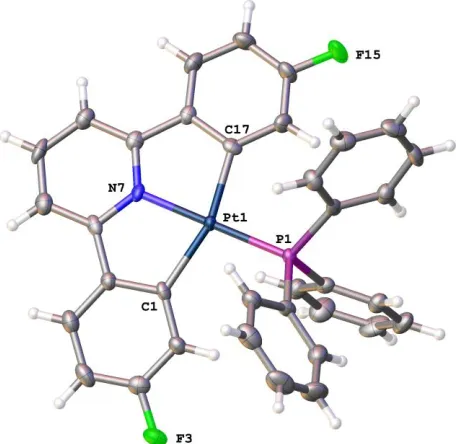
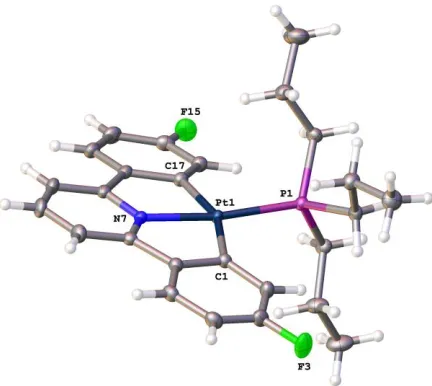
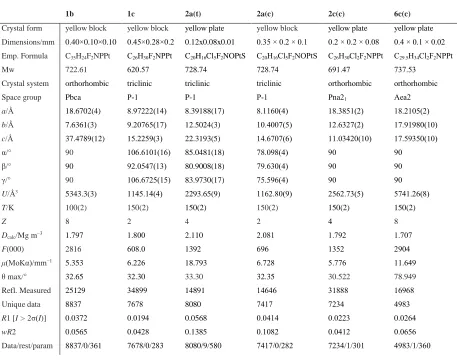
The single crystal Xray structures of 1b and 1c are reported here for the first time, Table 1 and Figures 1 and 2. The oxidation of each of the complexes 1 with iodobenzenedichloride is rapid, taking place in less than one minute, even at temperatures as low as -60 °C. In each
case the mechanism of oxidation appears to be the same, that is the expected SN2 type process
[image:4.595.125.353.395.617.2]for electrophilic reagents.11-12 This process takes place via a two step mechanism: the initial delivery of a Cl+ to give a five-coordinate complex, with subsequent addition of a sixth ligand (normally Cl–). By changing the fourth ligand in complexes 1, we are able to trap the five-coordinate intermediate and hence change the course of the reaction.
Figure 1: The solid-state structure of 1b, thermal ellipsoids drawn at 50% probability level. Selected bond
lengths (Å) and angles (°): Pt(1)-N(7) 2.018(3); Pt(1)-C(1) 2.067(3); Pt(1)-C(17) 2.072(3); Pt(1)-P(1)
2.2294(8); C(1)-C(6) 1.424(4); C(6)-C(7) 1.464(5); N(7)-C(11) 1.350(4); N(7)-C(7) 1.360(4);
C(11)-C(12) 1.474(4); C(11)-C(12)-C(17) 1.420(4); N(7)-Pt(1)-C(1); 80.40(12); N(7)-Pt(1)-C(17) 79.90(11);
C(1)-Pt(1)-C(17) 159.24(12); N(7)-Pt(1)-P(1) 178.57(7); C(1)-Pt(1)-P(1) 99.71(9); C(17)-Pt(1)-P(1) 100.15(9);
Figure 2: The solid-state structure of 1c, thermal ellipsoids drawn at 50% probability level. Selected bond
lengths (Å) and angles (°): C1-Pt1 2.0758(19); P1-Pt1 2.2288(5); Pt1-N7 2.0204(17); Pt1-C17
2.0771(19); C7-N7-Pt1 118.31(13); C7-N7-C11 122.82(18); C6-C1-Pt1 112.20(14); C11-N7-Pt1
118.36(13); C1-Pt1-P1 102.99(6); C1-Pt1-C17 159.00(8); N7-Pt1-C1 79.72(7); N7-Pt1-P1-171.97(5);
N7-Pt1-C17-79.96(7); C17-Pt1-P1 97.86(6); C12-C17-Pt1 112.04(14); C16-C17-Pt1 132.48(15).
When the fourth ligand is DMSO, i.e. complex 1a, the reaction proceeds smoothly and cleanly at -40 °C giving the trans product, 2a(t), Scheme 2.
The product was identified as this isomer on the basis of solution NMR data (in particular
NOE measurements indicated close proximity of the DMSO hydrogens and the H ortho to
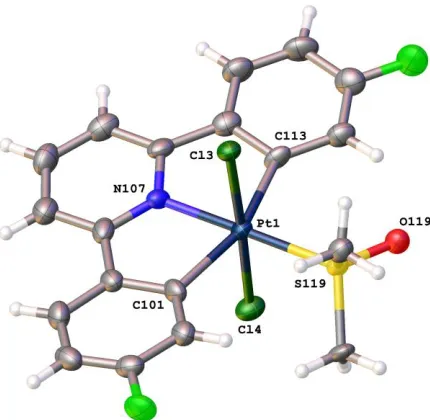
both Pt and F), and the solving of the single crystal Xray structure, Figure 3. Solutions of
2a(t) slowly isomerise to the cis isomer, Scheme 3, taking around a week for the reaction to go to completion, at room temperature; we were able to crystalise this isomer too, Figure 4.
DFT calculations indicate a small (~4 kJmol-1) thermodynamic preference for the cis over the
trans, presumably related to the reduction in steric crowding around the DMSO that
Figure 3: The solid-state structure of 2a(t), thermal ellipsoids drawn at 50% probability level. Selected
bond lengths (Å) and angles (°): Pt(1)-N(107) 2.012(7); Pt(1)-C(113) 2.082(8); Pt(1)-C(101) 2.148(8);
Pt(1)-S(119) 2.2891(19); Pt(1)-Cl(3) 2.3265(19); Pt(1)-Cl(4) 2.339(2); N(107)-Pt(1)-C(113) 80.2(3);
N(107)-Pt(1)-C(101) 80.8(3); C(101) 160.9(3); N(107)-Pt(1)-S(119) 178.1(2);
C(113)-Pt(1)-S(119) 99.2(2); C(101)-Pt(1)-C(113)-Pt(1)-S(119) 99.9(3); Cl(3)-Pt(1)-Cl(4) 177.72(7).
Figure 4: The solid-state structure of 2a(c), thermal ellipsoids drawn at 50% probability level. Selected
bond lengths (Å) and angles (°): C1-Pt1 2.084(5); Cl1-Pt1 2.3367(11); C7-N7 1.353(5); O1-S1-1.465(3);
Pt1-S1-2.2752(11); N7-C11 1.364(6); Pt1-Cl6 2.3381(11); Pt1-N7 1.988(4); Pt1-C17 2.080(5); S1-C18
1.766(5); S1-C19 1.772(5); C1-Pt1-Cl1 88.64(13); C1-Pt1-S1 90.83(12); C1-Pt1-Cl6 98.86(13);
Cl1-Pt1-Cl6 91.32(4); S1-Pt1-Cl1 178.98(4); S1-Pt1-Cl1-Pt1-Cl6 89.63(4); N7-Pt1-C1 81.03(16); N7-Pt1-Cl1 89.69(11);
N7-Pt1-S1 89.36(11); N7-Pt1-Cl6 178.98(10); N7-Pt1-C17 81.24(16); C1 162.13(19);
C17-Pt1-Cl1 89.14(13); C17-Pt1-S1 91.10(13); C17-Pt1-Cl6 98.91(13).
We can account for the initial formation of a trans product on the basis of an initial delivery
to trap out a derivative of this five-coordinate intermediate. When we perform the oxidation
of 1a in acetone, in the presence of additional DMSO, a significant (>30%) proportion of the sample precipitates as a salt, identified as containing two DMSO ligands, 4a, Scheme 4.
Complex 4a can be redissolved in chloroform and characterised in solution whereupon the formulation depicted can be deduced (in particular ESI mass-spectrometry clearly identifies
the composition of the cation, and 1H NMR clearly identifies two different DMSO molecules coordinated the same Pt centre), but we were unable to fully characterise or crystalise the
complex as it converts to a mixture of cis and trans2a on a timescale of hours at room temperature.
Turning to the triphenylphosphine complex 1b, oxidation at -40 °C in acetone results in the clean formation of the trans complex 2b(t) which we were able to isolate and fully
characterise. Like its DMSO analogue, this trans complex also isomerised to a cis complex
2b(c) on a timescale of days at room temperature, Scheme 5. It is possible to assign cis and
trans geometries to the isomers of 2b on the basis of spectroscopic data, in particular NMR
data that relates to the 1H signal of the hydrogen ortho to both the F and the Pt. Thus this signal is substantially shielded by the proximal PPh3 group in the trans isomer, resonating at 6.58 ppm in 2b(t) (compare with 5.80 ppm for 1c) but deshielded and resonating at 7.73 ppm in 2b(c) when it this located away from the PPh3 group. NOE measurements also confirm the assignment of cis and trans geometries.
However, oxidation of the triphenylphosphine complex 1b at -40 °C in chloroform results in clean formation of a different platinum(IV) complex, one that we were unable to isolate.
Upon warming up towards room temperature, this new complex began to transform into the
trans complex 2b(t) and thence into the cis complex 2b(c).
This initial product of oxidation is clearly a Pt(IV) species (195Pt shift of -2339 ppm, a 31 P-195Pt coupling constant of 2806 Hz) and symmetrical (a single 19F resonance, with satellites,
the evidence points to it being the five-coordinate cationic intermediate, 3b, potentially stabilised by solvent or water. It should be noted that we found no evidence for coordinated
solvent or water by NMR, even when we cooled to -60 °C, a temperature at which we might
expect any fluxionality or ligand exchange to have been frozen out.14 We can justify the identification of this complex in chloroform, but not in acetone, as arising from the superior
solvation of the chloride anion by chloroform.15 Coupling this factor with the large steric bulk of the triphenylphosphine ligand, which will hinder the combination of the platinum centre
with the final chloride, suggests why we were able to identify this intermediate.
The intermediate 3b will persist in chloroform solution for a matter of hours at low
temperature and we thus sought to trap it out as a cation with another neutral ligand to give a
complex like 4a. We unable to do so with acetonitrile or DMSO but successful when excess pyridine was added, Scheme 6.
Thus another new complex, with the same pattern of NMR resonances, but with the addition
of pyridine signals (including clear satellites on the hydrogens adjacent to the nitrogen), could
be isolated. The relative positions of the pyridine and phosphine ligands could be determined
by NOE measurements and its cationic nature was apparent from the intensity of the ion in
the electrospray mass spectrometry. Addition of excess pyridine to a solution of 1b in
chloroform before oxidation gives rise to the same pyridine adduct directly. We also sought to
generate this pyridine complex by the treatment of 2b(c) and 2b(t) (separately) with AgBF4 in acetone solution, in the presence of pyridine, and indeed we were able to isolate the same
material in both cases, Scheme 7.
Finally, the oxidation of the tripropylphosphine complex 1c is more complicated than that of either the DMSO complex 1a or the triphenylphosphine complex 1b, but again a
trans Pt(IV) product 2c(t), with none of the cis isomer 2c(c) to which it subsequently slowly isomerises to, Scheme 8.
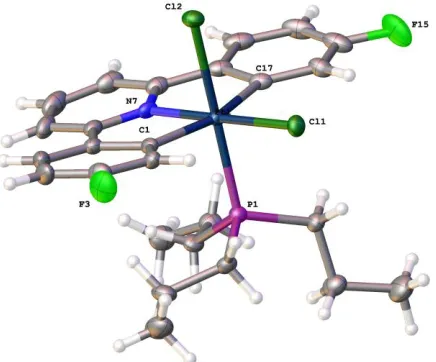
Both cis and trans2c products were characterised in solution, and 2c(c) was further fully characterised, including by crystalography, Figure 5. Heating of 2c(c) does not result in further reaction. A trace amount of another product is also observed at -40 °C in acetone, and
[image:9.595.127.345.269.450.2]the formation of this can be favoured with the use of a different solvent.
Figure 5: The solid-state structure of 2c(c), thermal ellipsoids drawn at 50% probability level. Selected
bond lengths (Å) and angles (°): Pt1-P1 2.2944(11); Pt1-Cl2 2.4116(10); Pt1-C1 2.069(4); Pt1-C17
2.083(4); Pt1-N7 1.981(3); Pt1-Cl1 2.3282(10); C11-N7 1.352(6); C7-N7 1.364(6); P1-Pt1-Cl2 175.49(4);
P1-Pt1-Cl1 85.53(4); C1-Pt1-P1 91.42(11); C1-Pt1-Cl2 85.48(10); C1-Pt1-C17 162.32(17); C1-Pt1-Cl1
97.86(12); C17-Pt1-P1 93.94(11); C17-Pt1-Cl2 89.98(11); C17-Pt1-Cl1 99.34(13); N7-Pt1-P1 95.28(10);
N7-Pt1-Cl2 87.51(10); N7-Pt1-C1 81.56(15); N7-Pt1-C17 81.18(16); N7-Pt1-Cl1 179.01(10); Cl1-Pt1-Cl2
91.65(4).
Thus, when the oxidation is carried out in chloroform at -60 °C, other products, representing
around 40% of the sample, form; the remaining 60% is 2c(t). Again this pattern of behaviour was observed with the tributylphosphine derivative. The first product that we assume to form
is the agostic complex 5c which transforms into 6c(t) in a matter of minutes, even at -60 °C, Scheme 9. We were only able to obtain limited spectroscopic data on 5c, but the 31P shift of 51.0 in particular suggests that the phosphine is now part of a chelating ring,17 and calls to
mind the agostic complex that the tributylphosphine forms under equivalent reaction
form a five-membered metalacycle containing the phosphine. With the propyl complex 5c it is presumably again the terminal methyl that interacts with the metal but now it does not need to
rearrange before it reacts to give the five-membered metalacycle, and this is presumably the
reason it reacts more quickly than the butyl analogue. The new complex formed at -60 °C,
6c(t), is reasonably stable at room temperature and in air, but does convert to another species if it is simply left in solution for more than a few days at room temperature and it proved
difficult to purify via chromatography; thus we were unable to completely characterise it.
Certain pieces of spectroscopic data could be identified and confirm an unsymmetrical
diphenylpyridine system (two 19F resonances, one with satellites, one without), a 31P shift
(47.86 ppm) indicative of chelate ring formation,17 the platinum still in oxidation state +4 (195Pt shift of -2667) and a direct platinum bond to one of the alkyl groups of the phosphine. Spectroscopic data suggests, but is not definitive, that the phosphine is trans to the pyridine
nitrogen. We were, however, able to purify by chromatography and fully characterise the new
species that 6c(t) transforms to and the identity of this final species helps to confirm our suggestions, Scheme 9. This final species is stable in air and at room temperature.
All the salient features of the structure of this final complex can be deduced from the NMR
data, particularly when compared with the analogous tributylphosphine complex16 (a Pt chemical shift of -2780 indicating Pt(IV); a 31P chemical shift of 42.68 indicating one of the propyl chains has reacted to form a cyclometallated ring, no visible coupling of this P to the
protons in the cyclometallated aryl ring, suggesting the P is cis to the pyridine; two 19F
resonances, one with Pt satellites, one without; two alkyl proton resonances, each integral one,
coupling strongly to each other and to the a Pt with a large coupling constant; the close
proximity of one of these two in space to the aryl proton adjacent to Pt and F on the
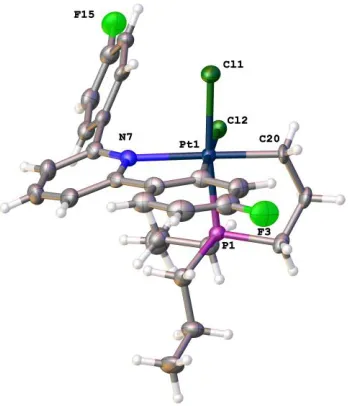
cyclometallated fluorophenyl ring) and we believe it to be 6c(c) in Scheme 9. Mass spectral data suggests the complex is not cationic and therefore has the sixth site of its octahedral
Xray structure, Figure 6, which does indeed show a singly cyclometallated diphenyl pyridine
ring system, a singly cyclometallated phosphine, with the P cis to the N, and finally two
[image:11.595.125.299.121.324.2]further chlorides.
Figure 6: The solid-state structure of 6c(c), thermal ellipsoids drawn at 50% probability level. Selected
bond lengths (Å) and angles (°): Pt1-Cl1 2.3953(15); Pt1-Cl2 2.4072(16); Pt1-C1 2.030(7); Pt1-N7
2.246(5); Pt1-P1 2.2650(15); Pt1-C20 2.076(6); C18-P1 1.828(6); C18-C19 1.480(16); Cl1-Pt1-Cl2
91.68(6); Pt1-Cl1 89.54(19); Pt1-Cl2 178.72(19); Pt1-N7 79.7(3); Pt1-P1 87.46(19);
C1-Pt1-C20 96.2(3); N7-Pt1-Cl1 91.74(14); N7-Pt1-Cl2 100.66(15); N7-Pt1-P1 95.20(14); P1-Pt1-Cl1
171.83(5); P1-Pt1-Cl2 91.29(6); Pt1-Cl1 87.93(19); Pt1-Cl2 83.4(2); Pt1-N7 175.9(3);
C20-Pt1-P1 84.84(19).
The formation of this tripropylphosphine complex can be thought of as exactly like that of the
DMSO and triphenylphosphine compexes, but with the agostic interaction of the alkyl chain
internally trapping the five-coordinate intermediate. The subsequent reaction of the
agostically trapped five-coordinate complex to give 6c(t) and ultimately 6c(c) is an example of a transcyclometallation reaction.18 Such reactions involve the exchange of one
cyclometallated ligand by another and have been known for some time,19 and used to
considerable effect, for instance to induce multiple20 or chiral21 cyclometallations. The effect
of the reaction 5c to 6c(t) is to exchange one five-membered cyclometallated ring containing an aryl group with another five-membered ring containing an alkyl chain. We saw the same
chemistry with the tributyl phosphine and rationalised the exchange as replacing two
adjoining five membered metallacycles which strain and distort the coordinating pyridine ring
in 5c with two independent five membered metallacycles without any cumulative strain in complex 6c(t), even though there has been an exchange of an aryl-Pt bond for a notionally weaker alkyl-Pt bond. We have previously noted a similar type of exchange in
mono-cyclometallated complexes.22 The subsequent isomerisation of 6c(t) to 6c(c), is presumably
from a relatively congested central position to a less congested one above the plane of the
diphenylpyridine. The crystal structure of 6c(c) provides evidence for its relatively unstrained nature: the three angles through the central platinum, N-Pt-C, P-Pt-Cl, Cl-Pt-Cl are 175.9(3),
171.83(5) and 178.72(19) ° respectively, Figure 6.
Once again we can account for the differing behaviour in chloroform and acetone as arising
from the superior solvation of the chloride anion by chloroform.15 Thus, by keeping the chloride which is released from the iodobenzene dichloride oxidant away from the platinum it
allows the alkyl chain of the phosphine to coordinate and hence react.
Conclusions
The oxidation reactions of our three platinum (II) complexes with iodobenzenedichloride all
proceed via a two step reaction giving a five-coordinated intermediate. In each case we have
been able to trap out the intermediate with another ligating species and temporarily stabilise it.
When an external ligand is added (e.g. DMSO with the DMSO complexes, or pyridine with
the triphenyl phosphine) a cationic species is generated and, if the counter ion is
non-coordinating (e.g. BF4–), it is possible to isolate new species. When the trapping agent is the internal alkyl chain of a previously coordinated ligand (i.e. the propyl chain of PPr3) the intermediate complex is an agostic one and, rather than the agostic interaction being displaced
by another ligating group, a reaction occurs. This reaction results in the cleavage of a C-H
bond with the formation of a new Pt-C bond. It is therefore possible, by careful choice of
ligands and conditions, to trap out the reactive five-coordinate and exert some degree of
Table 1
1b 1c 2a(t) 2a(c) 2c(c) 6c(c)
Crystal form yellow block yellow block yellow plate yellow block yellow plate yellow plate
Dimensions/mm 0.40×0.10×0.10 0.45×0.28×0.2 0.12x0.08x0.01 0.35 × 0.2 × 0.1 0.2 × 0.2 × 0.08 0.4 × 0.1 × 0.02
Emp. Formula C35H24F2NPPt C26H30F2NPPt C20H16Cl5F2NOPtS C20H16Cl5F2NOPtS C26H30Cl2F2NPPt C29.5H34Cl2F2NPPt
Mw 722.61 620.57 728.74 728.74 691.47 737.53
Crystal system orthorhombic triclinic triclinic triclinic orthorhombic orthorhombic
Space group Pbca P-1 P-1 P-1 Pna21 Aea2
a/Ǻ 18.6702(4) 8.97222(14) 8.39188(17) 8.1160(4) 18.3851(2) 18.2105(2)
b/Ǻ 7.6361(3) 9.20765(17) 12.5024(3) 10.4007(5) 12.6327(2) 17.91980(10)
c/Ǻ 37.4789(12) 15.2259(3) 22.3193(5) 14.6707(6) 11.03420(10) 17.59350(10)
α/° 90 106.6101(16) 85.0481(18) 78.098(4) 90 90
β/° 90 92.0547(13) 80.9008(18) 79.630(4) 90 90
γ/° 90 106.6725(15) 83.9730(17) 75.596(4) 90 90
U/Ǻ3 5343.3(3) 1145.14(4) 2293.65(9) 1162.80(9) 2562.73(5) 5741.26(8)
T/K 100(2) 150(2) 150(2) 150(2) 150(2) 150(2)
Z 8 2 4 2 4 8
Dcalc/Mg m−3 1.797 1.800 2.110 2.081 1.792 1.707
F(000) 2816 608.0 1392 696 1352 2904
μ(MoKα)/mm−1 5.353 6.226 18.793 6.728 5.776 11.649
θmax/° 32.65 32.30 33.30 32.35 30.522 78.949
Refl. Measured 25129 34899 14891 14646 31888 16968
Unique data 8837 7678 8080 7417 7234 4983
R1 [I > 2σ(I)] 0.0372 0.0194 0.0568 0.0414 0.0223 0.0264
wR2 0.0565 0.0428 0.1385 0.1082 0.0412 0.0656
Data/rest/param 8837/0/361 7678/0/283 8080/9/580 7417/0/282 7234/1/301 4983/1/360
Supporting Information
Full details and discussions of the Xray structures are available. CIF files are also available to download from the CCDC, reference numbers:1481768-1481773. DFT optimized structures of 2a(t) and 2a(c) are available as is the variable temperature 1H NMR spectrum of 6c(c).
Acknowledgements
We thank EPSRC for a DTG award to PAS and support from Advantage West Midlands
(AWM) (part funded by the European Regional Development Fund) for the purchase of a
high resolution mass spectrometer and the XRD system that was used to solve the crystal
Experimental
General
All chemicals were used as supplied, unless noted otherwise. All NMR spectra were obtained
on a Bruker Avance 400, 500 or 600 MHz spectrometers and were recorded at room
temperature, in chloroform, unless stated otherwise. 1H and 13C signals are referenced to external TMS, assignments being made with the use of decoupling, GOESY and COSY pulse
sequences. 19F and 31P chemical shifts are quoted from the directly observed signals
(referenced to external CFCl3 and 85% H3PO4, respectively). 1H-195Pt correlation spectra were recorded using a variant of the HMBC pulse sequence and the 195Pt chemical shifts reported
are taken from these spectra (referenced to external Na2PtCl6). All elemental analyses were performed by Warwick Analytical Service. Starting platinum complex 1a was prepared as previously reported.13
The following labelling scheme was used for all symmetrical C^N^CPt complexes:
Synthesis of complexes 1b, 1c.
The following general method was used for both derivatives: to a solution of
[(2,6-di(4-fluorophenyl)pyridine)Pt(DMSO)] 1a (54 mg, 1.00×10⁻⁴ mol) in chloroform (1 ml) at room temperature was added a chloroform solution of 1 equivalent of the appropriate phosphine
(26.3 mg, 16.1 mg, respectively). The mixture was stirred for five minutes before solvent and
liberated DMSO were removed under high vacuum. If necessary, column chromatography
(chloroform on silica) was used to purify the products. Yields: 1b 68 mg, 9.41×10⁻⁵ mol, 94%,
1c 57 mg, 9.19×10⁻⁵ mol, 92 %.
1b PPh3
δH = 7.80 (6H, m, P(CH)2(CH)2CH), 7.60 (1H, t, 3JH-H = 8 Hz, Ha), 7.42 (3H, m,
P(CH)2(CH)2CH), 7.40 (2H, dd, 3JH-H = 8.5, 4JH-F = 5 Hz, He), 7.39 (6H, m, P(CH)2(CH)2CH), 7.18 (2H, d, 3JH-H = 8 Hz, Hb), 6.54 (2H, td, 3JH-H = 3JH-F = 8.5, 4JH-H = 2.5 Hz, Hf), 5.80 (2H, dd, 3JH-F = 10, 4JH-H = 2.5, 3JH-Pt = 42 Hz Hh).
δC = 167.58 (m, Ci), 164.39 (Cg), 163.07 (d 2JC-F = 254 Hz, Cc), 146.72 (Cd), 140.44 (Ca),
135.43 (d, 3JC-P = 12 Hz, o-PPh3), 131.45 (d, 3JC-P = 58 Hz, ipso-PPh3), 130.84 (p-PPh3), 128.33 (d, 3JC-F = 11 Hz, Ce), 125.38 (d, 2JC-P = 8 Hz, m-PPh3), 124.57 (d 2JC-F = 18 Hz, Ch), 114.40 (Cb), 110.46 (d 2JC-F = 23 Hz, Cf).
δF = -110.11 (4JF-Pt = 29 Hz). δF (233K, acetone-d6) : -111.02 (4JF-Pt = 27.2 Hz).
Elemental Analysis. Found (expected for C35H24F2NPPt): C 57.9 (58.17), H 3.6 (3.35), N 1.9 (1.94)
HR-MS (ESI): found m/z 722.1318, calc for C35H25F2NP194Pt = 722.1319 (MH+)
Crystals suitable for Xray analysis were grown by the slow evaporation of solvent from a
chloroform solution, Fig 1 and Table 1; full details are in the SI.
1c PPr3
δH = 7.58 (1H, t, 3J= 8 Hz, Ha), 7.47 (2H, dd, 3J= 8.5, 4JH-F = 6 Hz, He), 7.22 (4H, m, Hb,h),
6.73 (2H, dt, 3JH-F = 3JH-H = 8.5 Hz, 3JH-H = 2.7 Hz, Hf), 2.09 (6H, m, PCH2), 1.66 (6H, m, Hk PCH2CH2), 1.05 (9H, t, 3JH-H = 7.5 Hz, CH3).
δC = 15.72 (d, 3JC-P = 16 Hz, CH3), 17.61 (s, 3JC-Pt = 31.5 Hz, PCH2CH2), 26 (d, 1JC-P = 35 Hz, 2J
C-Pt = 34 Hz, PCH2), 109.34 (d, 2JC-F = 23 Hz, Cf), 113.46 (d, 6JC-F = 3 Hz, 3JC-Pt = 27 Hz, Cb), 123.12 (d, 2JC-F = 17 Hz, 2JC-Pt = 64, Ch), 124.88 (d, 3JC-F = 8.5 Hz, 3JC-Pt = 31 Hz, Ce), 139 (s, Ca), 146.07 (m, 2JC-Pt = 26 Hz, Cd), 163.34 (d, 1JC-F = 255 Hz, 3JC-Pt = 54 Hz, Cg), 163.98 (s, 2J
C-Pt = 67 Hz, Cc), 167.80 (d, 3JC-F = 8 Hz, 1JC-Pt = 718 Hz, Ci).
δF = -111.44 (4JF-Pt = 28 Hz). δP = 1.34 (1JP-Pt = 3712 Hz). δPt = -4212 (1JPt-P = ~3700 Hz).
Elemental Analysis. Found (expected for C26H30F2NPPt) C 50.04 (50.32), H 4.84 (4.87), N 2.27 (2.26)
HR-MS (ESI): found m/z 620.1783, calc for C26H30F2NP194Pt, [M]+ = 620.1782.
Crystals suitable for Xray analysis were grown by the slow evaporation of solvent from a
chloroform solution, Fig 2 and Table 1; full details are in the SI.
Oxidation of complexes 1a, 1b, 1c
In a typical procedure, 10mg of complex 1 (1.86×10⁻⁵ mol, 1.38 ×10⁻⁵ mol, 1.61×10⁻⁵ mol, respectively) was dissolved in chloroform (1 ml) and the solution cooled to -40 °C. One
equivalent of solid PhICl2 (5.1 mg, 3.5 mg, 4.4 mg, respectively) was added and the mixture thoroughly mixed by shaking. After allowing to warm to room temperature the solvent was
removed under vacuum, the resulting solid washed with hexane and then recrystallised from
chloroform, or purified by column chromatography (chloroform on silica). Yields: 1a 9.5 mg, 1.76×10⁻⁵ mol, 95%; 1b 8.3 mg, 1.14×10⁻⁵ mol, 83%; 1c 9.1 mg, 1.47×10⁻⁵ mol, 91%.
DMSO complexes 2a(t) and 2a(c)
Oxidation of 1a gave 2a(t) directly.
2a(t) δH : 7.87 (1H, t, 3JH-H = 8Hz, Ha), 7.73 (2H, dd, 3JH-F = 8 Hz, 4JH-H = 2 Hz, 3JH-Pt = 36 Hz, Hh), 7.56 (2H, 3JH-H = 9, 4JH-F = 5 Hz, He), 7.52 (2H, d, JH-H = 8 Hz, Hb), 6.92 (2H, td, 3JH-H = 3J
ppm.
Elemental Analysis. Found (expected for C19H15Cl2F2NOPtS): C 36.9 (37.45), H 2.2 (2.48), N 2.6 (2.30).
HR-MS (ESI): found m/z 607.9924, calc for C19H16F235Cl2NO194PtS = 607.9913 (MH+). Crystals of 2a(t) suitable for Xray analysis were grown from the evaporation of solvent from a chloroform solution, Fig 3 and Table 1; full details are in the SI.
The trans isomer 2a(t) slowly (over the course of several days) converted to the cis isomer
2a(c).
2a(c) δH 7.85 (1H, t, 3JH-H = 8 Hz, Ha), 7.77 (2H, dd, 3JH-F = 7.5 Hz, 4JH-H = 2.5 Hz, 3JH-Pt = 32 Hz, Hh), 7.74 (2H, dd, 3JH-H = 9, 4JH-F = 5 Hz, He), 7.50 (2H, d, 3JH-H = 8 Hz, Hb), 6.99 (2H, td, 3JH-F = 3JH-H = 8.5, 4JH-H = 2.5 Hz Hf), 3.26 (6H, s, 3JH-Pt = 17 Hz, DMSO). NOE: No visible enhancement of Hh when DMSO protons irradiated and vice versa.
δF (CDCl3): -105.27 (4JF-Pt = 12 Hz), δF (acetone d6) = -108.21 (4JF-Pt = 13 Hz). δPt = -2126
ppm.
HR-MS (ESI): found m/z 607.9926 calc for C19H16F235Cl2NO194PtS = 607.9913 (MH+). Crystals of 2a(c) suitable for Xray analysis were grown from the evaporation of solvent from a chloroform solution, Fig 4 and Table 1; full details are in the SI.
double-DMSO 4a
δH (acetone-d6) = 7.87 (1H, dd, 3JH-F = 9 Hz, 4JH-H = 2.5 Hz, 3JH-Pt = 26Hz), 4.13 (6H, t, 3JH-Pt
=14 Hz, Hj), 3.36 (6H, t, 3JH-Pt =20 Hz, Hk).
δF (CDCl3) = -102.42 (4JF-Pt = 13 Hz), δF (acetone d6) = -105.39 (4JF-Pt = 15 Hz). δPt = -2098
ppm.
HR-MS (ESI): found m/z 650.0289, calc for C21H2135ClF2NO2194PtS2 [M+] 650.0297.
PPh3 complexes 2b(t), 2b(c), 3b and pyridine adduct 4b(NP)t
Oxidation of 1b in acetone gave 2b(t) directly.
2b(t) δH = 7.94 (6H, dd, 3JH-P = 12 Hz, 4JH-H = 8 Hz, P(CH)2(CH)2CH)), 7.85 (1H, t, 3JH-H = 8 Hz, Ha), 7.70 (2H, dd, 3JH-H = 8.5 Hz, 4JH-F = 5.5 Hz He), 7.56 (2H, d, 3JH-H = 8 Hz, Hb), 7.51 (3H, tt, P(CH)2(CH)2CH)), 7.44 (6H, td , 3JH-H = 8 Hz, 4JH-P = 3 Hz, P(CH)2(CH)2CH)), 6.78 (2H, td, 3JH-H = 3JH-F = 8.5 Hz, 4JH-H = 2.5 Hz, Hf), 6.58 (2H, dd, 3JH-F = 9 Hz, 4JH-H = 2 Hz, Hh).
δF (CDCl3) = -107.91 (4JF-Pt = 16 Hz), δF (acetone d6) = -108.87 (4JF-Pt = 17 Hz). δP : -4.09
(1J
P-Pt = 2470 Hz). δPt : -2323 ppm (d, ~2450 Hz).
Anal. Found (expected for C35H24Cl2F2NPPt): C 52.4 (52.98), H 3.1 (3.05), N 1.6 (1.77)
The trans isomer 2b(t) slowly (over the course of several days) converted to the cis isomer
2b(c).
2b(c) δH : 7.73 (2H, dd, 3JH-F = 9, 4JH-H = 2, 3JH-Pt = 32Hz Hh), 7.43 (1H, t, 3JH-H = 8 Hz, Ha) 7.41 (2H, dd, 3J
H-H = 8.5, 4JH-F = 5 Hz, He), 7.36 (9H, m, P(CH)2(CH)2CH)), 7.18 (6H, m, P(CH)2(CH)2CH)), 7.05 (2H, d, 3JH-H = 8 Hz, Hb), 6.77 (2H, td, 3JH-H = 3JH-F = 8.5 Hz, 4JH-H = 2.5Hz, Hf).
δF -106.25 (4JF-Pt = 14 Hz). δP : -7.95 (1JP-Pt = 2460 Hz). δPt : -2573 (d, 2460 Hz).
Elemental Analysis. Found (expected for C35H24Cl2F2NPPt): C 52.6 (52.98), H 3.2 (3.05), N 1.8 (1.77)
HR-MS (ESI): found m/z 756.0928, calc for C35H2435ClF2NP194Pt = 756.0930 (M-Cl+) Oxidation of 1b in chloroform gave five-co-ordinate 3b
3b δH (233 K) = 8.08 (1H, t, 3JH-H = 8 Hz, Ha), 7.80 (6H, br dd, 3JH-H = 8Hz, o-PPh3), 7.60 (2H, dd, 3JH-H = 9 Hz, 4JH-F = 6Hz, He), 7.57 (3H, br t, 3JH-H = 8 Hz, p-PPh3), 7.51 (2H, d, 3JH-H = 8 Hz, Hb), 7.47 (6H, td, 3JH-H = 8 Hz, 4JH-P = 2 Hz, m-PPh3), 6.87 (2H, br dt, 3JH-F = 10, 4JH-H = 4J
H-P = 2 Hz Hz, Hh), 6.84 (2H, td, 3JH-H = 3JH-F = 8 Hz, 4JH-H = 2 Hz, Hf).
δF (233 K) = -108.27 (4JF-Pt = 17 Hz). δP (233 K) = 9.44 (1JP-Pt = 2806Hz). δPt (233 K) = -2339
ppm (d, 1JP-Pt ≈ 2900Hz)
Pyridine complexes 4b(NP) were made either by addition of excess pyridine directly to 3b, or by treating 2b(c) and 2b(t) with AgBF4 in acetone solution, in the presence of excess pyridine.
4b(NP)t
δH = 8.41 (2H, ddd, 3JH-H = 7 Hz, 4JH-P = 5.5 Hz, 4JH-H = 1 Hz, 3JH-Pt = 24 Hz, o-py), 7.98 (2H,
m, Ha and p-py), 7.94 (2H, 3JH-H = 8.5 Hz, 4JH-F = 5 Hz, He), 7.75 (2H, 3JH-H = 8 Hz, 4JH-Pt = 8 Hz, Hb), 7.64 (2H, 3JH-F = 7.5 Hz, 4JH-H =2.5 Hz, 3JH-Pt = 24 Hz, Hh), 7.59 (3H, t, 3JH-H = 7.5 Hz, p-PPh3), 7.55 (6H, dd, 3JH-P = 12.5, 3JH-H = 7.5 Hz, o-PPh3), 7.45 (2H, td, 3JH-H = 3JH-H = 7 Hz, 4J
H-P = 1 Hz, m-py), 7.40 (6H, td, 3JH-H = 3JH-H = 7.7 Hz, 4JH-P = 3.5 Hz, m-PPh3), 7.08 (2H, 3J
H-H = 3JH-F = 8.5, 4JH-H = 2.5 Hz, Hf) ppm. NOE: no real effects on each other upon irradiation of o-PPh3, o-py or Hh.
δF = -106.26 (4JF-Pt = 14 Hz). δP = -11.23 (1JP-Pt = 2395 Hz). δPt = -2362 (d, 1JPt-P = ~2500 Hz)
ppm.
HR-MS (ESI): found m/z 756.0935, calc for C35H2435ClF2NP194Pt = 756.0930 (M-py+) found m/z 836.1350, calc for C40H29ClF2N2P194Pt = 835.1346 (M+)
PPr3 complexes 2c(t) and 2c(c)
2c(t) δH = 7.81 (1H, t, 3JH-H = 8 Hz, Ha), 7.73 (2H, dd, 3JH-H = 8 Hz, 4JH-F = 5 Hz, He), 7.53 (2H, dd, 3JH-H = 8 Hz, 5JH-P = 2 Hz, Hb), 7.26 (2H, dd, 3JH-F = 9 Hz, 4JH-H = 2 Hz, 3JH-Pt = 20 Hz, Hh), 6.88 ((2H, td, 3JH-H = 3JH-F = 8 Hz, 4JH-H = 2 Hz, Hf), 2.47 (6H, m, PCH2), 1.81 (6H, m, PCH2CH2), 1.12 (9H, td, 3JH-H = 7 Hz, 4JH-P = 1.5 Hz, CH3) ppm.
δC = 15.26-15.55 (m, CH3), 17.85 (d, 2JC-P = 5 Hz, PCH2CH2), 24.10 (d, 1JC-P = 36 Hz, 2JC-Pt =
18 Hz, PCH2), 112.09 (d, 3JC-F = 22 Hz, Cf), 116.86 (d, 4JC-P = 4 Hz, Cb), 121.71 (d, 2JC-F = 19 Hz, 2J
C-Pt = 21 Hz, Ch), 128.01 (d, 3JC-F = 8 Hz, Ce), 140.42 (s, Ca), 144.15 (t, 4JC-F = 3JC-P = 3 Hz, Cd), 159.63 (m, 1JC-Pt = 512 Hz, Ci), 161.58 (m, 3JC-Pt = 30 Hz, Cc), 163.20 (d, 1JC-F = 258 Hz, 3J
C-Pt = 28 Hz, Cg) ppm.
δF = -108.06 (s, 4JF-Pt = 14 Hz) ppm. δP = -13.96 (s, 1JP-Pt = 2310 Hz) ppm. δPt = -2282 (d, 1JPt-P
= ~2300 Hz) ppm.
The trans isomer 2c(t) converted to the cis isomer 2b(c) over several hours at room temp.
2c(c) δH = 7.83 (3H, m, Ha,h), 7.71 (2H, dd, 3JH-H = 8 Hz, 4JH-F = 4 Hz, He), 7.51 (2H, d, 3JH-H = 8 Hz, Hb), 6.94 (2H, td, 3JH-H = 3JH-F = 8 Hz, 4JH-H = 2 Hz, Hf), 1.71 (6H, m, PCH2), 1.10 (6H, m, PCH2CH2), 0.76 (9H, td, 3JH-H = 7 Hz, CH3) ppm.
13C (500 MHz) δ = 15.40-15.58 (m, CH
3), 16.72 (d, 2JC-P = 6 Hz, PCH2CH2), 24.30 (d, 1JC-P = 37 Hz, 2JC-Pt = 24 Hz, PCH2), 112.88 (d, 3JC-F = 24 Hz, Cf), 116.35 (d, 4JC-Pt = 31.5 Hz, Cb), 120.98 (d, 2JC-F = 19 Hz, 2JC-Pt = 19 Hz, Ch), 127.63 (d, 3JC-F = 8 Hz, 3JC-Pt = 22 Hz, Ce), 141.10 (s, Ca), 141.70 (d, 4JC-F = 2 Hz, 2JC-Pt = 28 Hz Cd), 162.67 (m, 3JC-Pt = 35 Hz, Cc), 163.78 (m, 1J
C-Pt = 512 Hz, Ci),164.90 (d, 1JC-F = 260 Hz, 3JC-Pt = 28 Hz, Cg) ppm.
δF = -105.57 (s, 4JF-Pt = 15 Hz) ppm. δP = -1.42 (s, 1JP-Pt = 2342 Hz) ppm. δPt = -2625 (d, 1JPt-P
= ~2300 Hz) ppm.
Elemental Analysis. Found (expected for C26H30F2PNPt): C 44.32 (45.16); H 4.12 (4.37); N 1.93 (2.03).
HR-MS (ESI): found m/z 654.1382, calculated = 654.1393 = C26H30F2PN194Pt [M-Cl]+; 712.0978, calculated = 712.0979 = C26H30F2PNNa194Pt [M+Na]+
Crystals of 2c(c) suitable for Xray analysis were grown from the evaporation of solvent from a chloroform solution, Fig 5 and Table 1; full details are in the SI.
Complexes 5c, 6c(t) and 6c(c)
Oxidation of 1c in chloroform gave agostic 5c for which has a 31P shift of 51.0 ppm at -60 °C. Proton signals could be observed, but could not be assigned.
6c(t)
δH = 7.93 (1H, t, 3JH-H = 8Hz, He), 7.84 (1H, d, 3JH-H = 8Hz, Hd/f), 7.31 (1H, d, 3JH-H = 8Hz,
Hd/f), 7.07 (1H, dt, 3JH-F, 10 Hz, 4JH-H = 4JH-P = 2 Hz, Ha), 3.09 (1H, dt, 2JH-H = 3JH-H = 6.5 Hz, 2J
H-H = 102 Hz, Hj), 2.37 (1H, m, 2JH-Pt = 56 Hz, Hj), 1.09 (3H, td, 3JH-H = 7.5 Hz, 4JH-P = 1 Hz, HMe), 0.98 (3H, td, 3JH-H = 8 Hz, 4JH-P = 1.5 Hz, HMe) ppm.
δF = -109.54 (4JF-Pt = 45 Hz), -111.90 ppm. δP = 47.86 (1JP-Pt = 3129 Hz) ppm. δPt = -2667
(1JPt-P = ~3300 Hz) ppm.
6c(c) was collected from the reaction solution after allowing to stand at room temperature overnight. The solvent was removed, the product washed with hexane and recrystallised from
chloroform.
6c(c)
δH = 7.94 (2H, m, Hf,h), 7.87 (2H, m, Hc)*, 7.79 (1H, dd, 3JH-H = 9 Hz, 4JH-F = 6 Hz, Hk), 7.63
(1H, dd, 3JH-H = 5.5, 3 Hz, Hg), 7.30 (1H, 3JH-F = 10 Hz, 4JH-H = 3 Hz, 3JH-Pt = 47 Hz, Hn), 7.19 (2H, dd, 3JH-F = 3JH-H = 8.5 Hz, Hb)**, 7.01 (1H, td, 3JH-H = 3JH-F = 8.5 Hz, 4JH-H = 2.5 Hz, Hl), 3.70 (1H, m, 2J
H-Pt = 95 Hz, Hs), 3.10 (1H, m, 2JH-Pt = 65 Hz, Ht)***, 2.06 (2H, m, HP-CH2), 1.64 (2H, m, Hq), 1.36 – 1.17 (2H, m, Hp), 0.99 (4H, m, MeCH2), 0.94 – 0.79 (5H, m, Me,PCH2), 0.64 (3H, t, 3JH-H = 7 Hz, Me) ppm.
δC = 15.52 (d, 3JC-Pt = 8 Hz, CMe), 15.65 (d, 3JC-P = 6 Hz, CMe), 16.29 (d, 2JC-P = 6 Hz, 3JC-Pt =
24 Hz, MeCH2), 16.53 (d,2JC-P = 5 Hz, 3JC-Pt = 11 Hz, MeCH2), 21.88 (d, 1JC-P = 33 Hz, 2JC-Pt = 42 Hz, PCH2), (d, 1JC-P = 35 Hz, 2JC-Pt = 20 Hz, PCH2), 26.45 (d, 1JC-P = 40 Hz, 2JC-Pt = 86
Hz, Cp), 28.56 (d, 2JC-P = 3 Hz, Cq), 37.82 (s, 1JC-Pt = 554 Hz, Cr), 122.89 (d, 2JC-F = 23 Hz, Cl), 115.05 (d, 2JC-F = 21 Hz, Cb,b’), 116.51 (d, 2JC-F = 21 Hz, 2JC-Pt = 42 Hz, Cn), 118.12 (s, 3JC-Pt = 11 Hz, Ch), 125.90 (s, Cg), 128.00 (d, 3JC-F = 9 Hz, 3JC-Pt = 40 Hz, Ck), 135.54 (d, 4JC-F = 3 Hz, Cd), 138.60 (d, 4JC-F = 2 Hz, Cj), 139.09 (s, Cf), 140.51 (dd, 3JC-F = 7 Hz, 2JC-P = 2 Hz, 1JC-Pt = 841 Hz, Co), 162.10 (s, 3JC-Pt = 50 Hz, Ci), 163.81 (d, 1JC-F = 249 Hz, Ca), 163.88 (1JC-F = 256 Hz, 3JC-Pt = 75 Hz, Cm), 163.97 (s, Ce) ppm.
19F (376 MHz) δ
*very broad lump at 298 K. By 208 K on 400MHz spectrometer, Hc and Hc’ have become separate proton environments. Coupling to the adjacent proton, Hb, can be observed by COSY at 218 K. At 208 K the peak is now a broad triplet (JH-H = 5.3 Hz, separation of peaks = 505 Hz, centre = 7.86 ppm. Even by 328 K, the peak has not coalesced to form a single peak,
instead a broad peak remains (width at half height = 21 Hz). COSY at 328K shows Coupling
to Hb.
**At room temperature, and even down to 268 K, this peak is a triplet on a 400 MHz
spectrometer. The peak moves slightly to greater ppm with a decrease in temperature. By 208
K the triplet has decoalesced into 2 peaks. Peak positions makes it difficult to work out the
width at half height, but the peaks are separated by around 25 Hz.
***irradiation of this peak shows enhancement of Hn. The VT-NMR spectra are available as SI.
Elemental Analysis. Found (expected for C26H30Cl2F2PNPt): C 44.73 (45.16), H 4.23 (4.37), N 1.98 (2.03).
HR-MS (ESI): found m/z 654.1390, calculated = 654.1393 = C26H30ClF2PN194Pt [M-Cl]+.
DFT Calculations
All DFT calculations used the Amsterdam density functional (ADF) code version 2008.01.23 The general features available in ADF have been described.24 Here, we have used scalar zero-order regular approximation (ZORA) relativistic corrections with the OPBE functional25 and
the supplied frozen-core, triple- plus polarisation ZORA basis sets. Solvation effects were
included via the conductor-like screening model (COSMO) as implemented in ADF. Default
SCF and geometry optimisation convergence criteria were used.
References
(1) (a) Shilov, A. E.; Shul'pin, G. B., Chem. Rev. 1997,97, 2879. (b) Goldman, A. S.; Goldberg, K. I., In Activation and Functionalization of C-H Bonds, Goldberg, K. I.; Goldman, A. S., Eds. ACS: Washington DC, 2004; Vol. ACS Symposium Series vol 885.
(2) Lersch, M.; Tilset, M., Chem. Rev. 2005,105, 2471.
(3) (a) Periana, R. A.; Taube, D. J.; Gamble, S.; Taube, H.; Satoh, T.; Fujii, H., Science
1998,280, 560. (b) Caballero, A.; Perez, P. J., Chem. Soc. Rev. 2013,42, 8809. (4) (a) Roselló-Merino, M.; Rivada-Wheelaghan, O.; Ortuño, M. A.; Vidossich, P.; Dı́ez,
J.; Lledós, A.; Conejero, S., Organometallics 2014,33, 3746. (b) Rivada-Wheelaghan, O.; Roselló-Merino, M.; Díez, J.; Maya, C.; López-Serrano, J.; Conejero, S.,
Organometallics 2014,33, 5944. (c) Campos, J.; Ortega-Moreno, L.; Conejero, S.;
Peloso, R.; López-Serrano, J.; Maya, C.; Carmona, E., Chem. Eur. J. 2015,21, 8883. (d) Werlé, C.; Bailly, C.; Karmazin-Brelot, L.; Le Goff, X.-F.; Ricard, L.; Djukic, J.-P.,
(5) (a) Zhao, S. B.; Wu, G.; Wang, S., Organometallics 2008,27, 1030. (b) Grice, K. A.; Scheuermann, M. L.; Goldberg, K. I., Top. Organomet. Chem. 2011,35, 1. (c) Vigalok, A., Acc. Chem. Res. 2015,48, 238.
(6) (a) Tatsumi, K.; Hoffman, R.; Yamamoto, A.; Stille, J. K., Bull. Chem. Soc. Jpn 1981, 54, 1857. (b) Albright, T. A.; Burdett, J. K.; Whangbo, M. H., Orbital Interactions in
Chemistry. Wiley and Sons Inc: 1985.
(7) (a) Bowes, E. G.; Pal, S.; Love, J. A., J. Am. Chem. Soc. 2015,137, 16004. (b) Zucca, A.; Maidich, L.; Canu, L.; Petretto, G. L.; Stoccoro, S.; Cinellu, M. A.; Clarkson, G. J.; Rourke, J. P., Chem. Eur. J. 2014,20, 5501.
(8) Madison, B. L.; Thyme, S. B.; Keene, S.; Williams, B. S., J. Am. Chem. Soc. 2007, 129, 9538.
(9) Ariafard, A.; Ejehi, Z.; Sadrara, H.; Mehrabi, T.; Etaati, S.; Moradzadeh, A.;
Moshtaghi, M.; Nosrati, H.; Brookes, N. J.; Yates, B. F., Organometallics 2011,30, 422.
(10) (a) Racowski, J. M.; Ball, N. D.; Sanford, M. S., J. Am. Chem. Soc. 2011,133, 18022. (b) Maleckis, A.; Kampf, J. W.; Sanford, M. S., J Am Chem Soc 2013,135, 6618. (11) Rendina, L. M.; Puddephatt, R. J., Chem. Rev. 1997,97, 1735.
(12) Forniés, J.; Martín, A.; Navarro, R.; Sicilia, V.; Villarroya, P., Organometallics 1996, 15, 1826.
(13) (a) Cave, G. W. V.; Alcock, N. W.; Rourke, J. P., Organometallics 1999,18, 1801. (b) Cave, G. W. V.; Fanizzi, F. P.; Deeth, R. J.; Errington, W.; Rourke, J. P.,
Organometallics 2000,19, 1355.
(14) (a) Newman, C. P.; Deeth, R. J.; Clarkson, G. J.; Rourke, J. P., Organometallics 2007, 26, 6225. (b) Crosby, S. H.; Clarkson, G. J.; Deeth, R. J.; Rourke, J. P.,
Organometallics 2010,29, 1966.
(15) (a) Lam, S. Y.; Louis, C.; Benoit, R. L., J. Am. Chem. Soc. 1976,98, 1156. (b) Slater, J. W.; Lydon, D. P.; Alcock, N. W.; Rourke, J. P., Organometallics 2001,20, 4418. (c) Kryachko, E. S.; Zeegers-Huyskens, T., J. Phys. Chem. A 2002,106, 6832. (d) Mamtora, J.; Crosby, S. H.; Newman, C. P.; Clarkson, G. J.; Rourke, J. P.,
Organometallics 2008,27, 5559.
(16) Shaw, P. A.; Phillips, J. M.; Newman, C. P.; Clarkson, G. J.; Rourke, J. P., Chem.
Commun. 2015,51, 8365.
(17) (a) Meriwether, L. S.; Leto, J. R., J. Am. Chem. Soc. 1961,83, 3192. (b) Garrou, P. E.,
Chem. Rev. 1981,81, 229.
(18) Albrecht, M.; Dani, P.; Lutz, M.; Spek, A. L.; Koten, G. v., J. Am. Chem. Soc. 2000, 122, 11822.
(19) (a) Ryabov, A. D.; Yatsimirsky, A. K., Inorg. Chem. 1984,23, 789. (b) Ryabov, A. D.,
Inorg. Chem. 1987,26, 1252.
(20) Dijkstra, H. P.; Albrecht, M.; van Koten, G., Chem. Commun. 2002, 126. (21) Roca, F. X.; Motevalli, M.; Richards, C. J., J. Am. Chem. Soc. 2005,127, 2388. (22) (a) Thomas, H. R.; Deeth, R. J.; Clarkson, G. J.; Rourke, J. P., Organometallics 2011,
30, 5641. (b) Crosby, S. H.; Clarkson, G. J.; Rourke, J. P., Organometallics 2011,30, 3603.
(23) Baerends, E. J. B., A.; Bo, C.; Boerrigter, P. M.; Cavallo, L.; Deng, L.; Dickson, R. M.; Ellis, D. E.; Fan, L.; Fischer, T. H.; Fonseca Guerra, C.; van Gisbergen, S. J. A.; Groeneveld, J. A.; Gritsenko, O. V.; Harris, F. E.; van den Hoek, P.; Jacobsen, H.; van Kessel, G.; Kootstra, F.; van Lenthe, E.; Osinga, V. P.; Philipsen, P. H. T.; Post, D.; Pye, C. C.; Ravenek, W.; Ros, P.; Schipper, P. R. T.; Schreckenbach, G.; Snijders, J. G.; Sola, M.; Swerhone, D.; te Velde, G.; Vernooijs, P.; Versluis, L.; Visser, O.; van Wezenbeek, E.; Wiesenekker, G.; Wolff, S. K.; Woo, T. K.; Ziegler, T. ADF 2008.01, Scientific Computing and Modelling NV: Free University, Amsterdam, 2008.