International Journal for Research in Applied Science & Engineering Technology (IJRASET)
ISSN: 2321-9653; IC Value: 45.98; SJ Impact Factor: 6.887 Volume 6 Issue VII, July 2018- Available at www.ijraset.com
Performance Analysis of 16 Channel WDM System
with Modulation Formats
Princender Singh1, Kulwinder Singh2, Amit Kumar3
1
Research Scholar, ECE Department, BMSCollege of Engg., Sri Muktsar Sahib 2
Professor, ECE Department, BMS College of Engg., Sri Muktsar Sahib 3
Assistant Professor, ECE Department, BMS College of Engg., Sri Muktsar Sahib
Abstract: In this paper comparative analysis of different modulation formats is performed in 16x20 Gb/s WDM system to find the best transmission frequency. Performance parameters like bit error rate (BER) and Q-factor are analyzed with transmission frequency to compare different modulation formats. Return to zero (RZ) and non-return to zero (NRZ) formats are compared in proposed setup with 200 GHz channel spacing.
Keywords: Wavelength Division Multiplexing (WDM), Return to Zero (RZ), Non Return to Zero (NRZ), Transmission Frequency.
I. INTRODUCTION
RZ modulation is superior to NRZ signal in many respect. Firstly, it can reduce the intra-channel nonlinear effect. Secondly, it is helpful in combating FWM and XPM when these pulses are overlapping in time domain. Lastly, it is also reducing the inter channel nonlinear effects as compared with NRZ systems [1].RZ signal pulse width is much smaller than NRZ signal pulse width. Due to this reason, NRZ pulses with different wavelengths take much longer time to reach from one place to another than NRZ pulses. Due to this longer duration of pulses, a chance of producing FWM & XPM is increased. This is the reason that NRZ modulation format pulses are vulnerable to inter-channel nonlinear effects [2, 3].
However, for combating with linear cross talks amongst different channels, NRZ signal is superior due to their much narrower bandwidth as compared to RZ signal [4]. But, with the proper use of spectral filtering i.e. properly shaping the pulse at the transmitter, the unwanted components with high frequency can be removed and thus minimizing the linear cross talk among different channels in RZ system.
This further enables popularity of RZ system over NRZ system[5]. It is obvious that RZ format is much more superior than NRZ modulation format due to its numerous advantages as discussed above. But, performance of RZ systems is limited due to intra channel impairments produced due to interaction of nonlinearity and dispersion. So, to improve RZ system performance this impairment should be minimized. However, these sources and mechanism which can degrade system performance due to inter channel and intra channel are studied [6]. A large dispersion effect produces the overlapping of pulses thus broadening the spectrum. This overlapping of pulses produce intra channel interference [7].
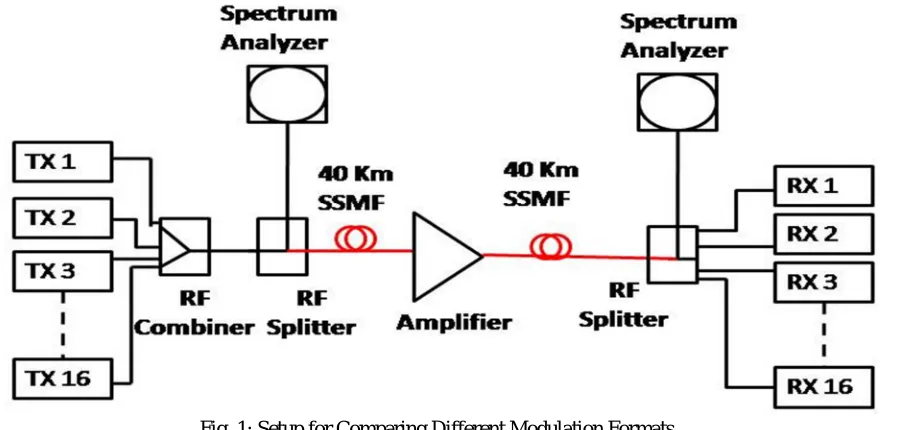
II. SYSTEM SETUP FOR NRZ & RZ FORMATS COMPARISON
Fig. 1: Setup for Comparing Different Modulation Formats
III. RESULTS & DISCUSSIONS
The performance of the present system is analyzed using different performance metrics that are measured through simulations and reported here. The simulation parameters for 16 x 20 Gb/s WDM Systemare provided in table 1.
Table 1: Simulation parameters for 16 x 20 Gb/s WDM System
Tx Power Line code Distance Bandwidth Rx Power
32.0371 mW Variable 80 Km 193 THz to195 THz 31.8752 mW
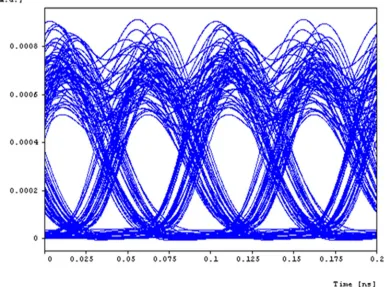
Fig. 2 describes the eye diagram derived for present system using NRZ format at modulation frequency of 193.2 THz.This eye diagram is helpful in observing performance parameters like Q-Factor, BER etc.
[image:2.612.103.506.462.715.2]International Journal for Research in Applied Science & Engineering Technology (IJRASET)
[image:3.612.110.514.82.305.2]ISSN: 2321-9653; IC Value: 45.98; SJ Impact Factor: 6.887 Volume 6 Issue VII, July 2018- Available at www.ijraset.com
[image:3.612.116.503.407.694.2]Fig. 3: Eye Diagram derived with NRZ Format at 193.8 THz Frequency
Fig. 3 describes the eye diagram derived for present system using NRZ format at modulation frequency of 193.8 THz. It is observed that improved system performance is obtainedat this frequency. Fig. 4shows the eye diagram derived for present system usingRZ format at modulation frequency of 193.2 THz.This eye diagram is helpful in observing performance parameterssuch as Q-Factor, BER etc. Fig. 5shows the eye diagram derived for present system using RZ format at modulation frequency of 193.8 THz. It is observed that improved system performance is obtainedat this frequency.
Fig. 5: Eye Diagram derived with RZ Format at 193.8 THz Frequency
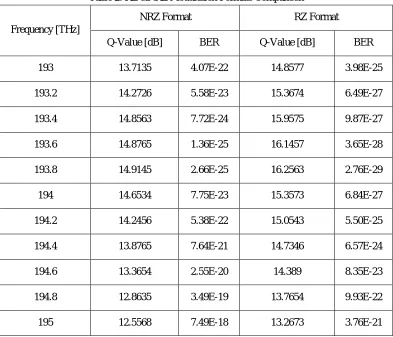
The frequency is varied between 193 to 195 THz for both RZ and NRZ modulation formats. Different results like Q-Factor and BER are obtained and summarizes in table 2.
Table 2: RZ &NRZ Modulation Formats Comparison
Frequency [THz]
NRZ Format RZ Format
Q-Value [dB] BER Q-Value [dB] BER
193 13.7135 4.07E-22 14.8577 3.98E-25
193.2 14.2726 5.58E-23 15.3674 6.49E-27
193.4 14.8563 7.72E-24 15.9575 9.87E-27
193.6 14.8765 1.36E-25 16.1457 3.65E-28
193.8 14.9145 2.66E-25 16.2563 2.76E-29
194 14.6534 7.75E-23 15.3573 6.84E-27
194.2 14.2456 5.38E-22 15.0543 5.50E-25
194.4 13.8765 7.64E-21 14.7346 6.57E-24
194.6 13.3654 2.55E-20 14.389 8.35E-23
194.8 12.8635 3.49E-19 13.7654 9.93E-22
195 12.5568 7.49E-18 13.2673 3.76E-21
[image:4.612.110.503.360.697.2]International Journal for Research in Applied Science & Engineering Technology (IJRASET)
[image:5.612.126.488.74.347.2]ISSN: 2321-9653; IC Value: 45.98; SJ Impact Factor: 6.887 Volume 6 Issue VII, July 2018- Available at www.ijraset.com
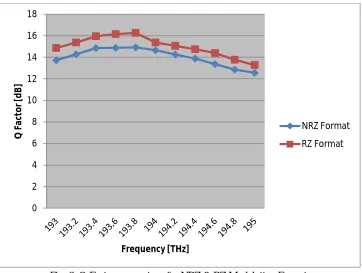
Fig. 6: Q-Factor comparison for NRZ & RZ Modulation Formats
It is observed that as the frequency is varied from 193 to 195 THz, the Q-Factor is increased for both formats up to 193.8 THz; afterwards Q-Factor again goes decreasing. Maximum Q-Factor is obtained at 193.8 THz frequency for both formats. However RZ format provides the improved Q-Factor than NRZ format at all frequencies. The BER comparison is observed in Fig. 7. It is observed that as the frequency is varied from 193 to 195 THz, the BER is decreased for both formats up to 193.8 THz; afterwards BER again goes increasing. Minimum BER is obtained at 193.8 THz frequency for both formats. However RZ format provides the lower BER values as compared to NRZ format at all frequencies.
Fig. 7: BER comparison for NRZ & RZ Modulation Formats
IV. CONCLUSIONS
Performance analysis of 16channel WDM optical fiber system is performed with 20 Gb/s data rate and 200 GHz channel spacing using RZ & NRZ modulation formats over 80 Km transmission distance. The system performance is measured using eye diagrams in terms of Q factors & Bit Error Rate values to obtain the best transmission frequency between theoretical ranges of 193 to 195 THz. The RZ format offered high Q-Factor & low BER values as compared to NRZ format.
0 2 4 6 8 10 12 14 16 18 Q F a ct o r [d B ] Frequency [THz] NRZ Format RZ Format 1.00E-29 1.00E-25 1.00E-21 1.00E-17 1.00E-13 1.00E-09 1.00E-05 1.00E-01 1 9 3 1 9 3 .2 1 9 3 .4 1 9 3 .6 1 9 3 .8 1 9 4 1 9 4 .2 1 9 4 .4 1 9 4 .6 1 9 4 .8 1 9 5
B
ER
BER for NRZ & RZ Formats
Frequencies [THz]
NRZ Format
[image:5.612.119.492.445.643.2]REFERENCES
[1] Chris Xu, Xiang Liu, Linn F. Mollenauer and Xing Wei, “Comparison of return-to-zero differential phase-shift keying and on-off keying in long-haul dispersion managed transmission,” IEEE Photonics technology letters, Vol. 15, No. 4, pp. 617-619, April 2013.
[2] Jörg-Peter Elbers, Andreas Färbert, Christian Scheerer, “Reduced model to describe SPM-limited fiber transmission in dispersion-managed lightwave systems,” IEEE journal of selected topics in quantum electronics, Vol. 6, No. 2, pp. 276-281, March/April 2014.
[3] Takashi Mizuochi, Kazuyuki Ishida and Tatsuya Kobayaashi, “A comparative Study of DPSK and OOK WDM Transmission Over Transoceanic Distances and Their Performance Degradations Due to Nonlinear Phase Noise,” Journal of Lightwave Technology, Vol. 21, No. 9, pp. 1933-1943, September 2015. [4] Hoon Kim, Alan H. Gnauck, “Experimental Investigation of the Performance Limitation of DPSK Systems due to Nonlinear Phase Noise,” IEEE Photonics
Technology Letter, Vol. 15, No. 2, pp. 320-322, February 2017.
[5] AnesHodžić, BeateKnorad and Klaus Petermann, “Alternative Modulation Formats in N×40Gb/s WDM Standard Fiber RZ-Transmission Systems,” Journal of Lightwave Technology, Vol. 20, No. 4, pp. 598-607, April 2012.
[6] Yutaka Miyamoto, Tomoyoshi Kataoka and Kazushige Yonenaga, “WDM Field Trials of 43-Gb/s/Channel Transport System for Optical Transport Network,” Journal of Lightwave Technology, Vol. 20, No. 12, pp. 2115-2128, December 2014.