Incremental Recurrent Neural Network Dependency Parser
with Search-based Discriminative Training
Majid Yazdani
Computer Science Department University of Geneva [email protected]
James Henderson
Xerox Research Center Europe [email protected]
Abstract
We propose a discriminatively trained re-current neural network (RNN) that pre-dicts the actions for a fast and accurate shift-reduce dependency parser. The RNN uses its output-dependent model struc-ture to compute hidden vectors that en-code the preceding partial parse, and uses them to estimate probabilities of parser ac-tions. Unlike a similar previous generative model (Henderson and Titov, 2010), the RNN is trained discriminatively to opti-mize a fast beam search. This beam search prunes after each shift action, so we add acorrectness probabilityto each shift ac-tion and train this score to discriminate be-tween correct and incorrect sequences of parser actions. We also speed up pars-ing time by cachpars-ing computations for fre-quent feature combinations, including dur-ing traindur-ing, givdur-ing us both faster traindur-ing and a form of backoff smoothing. The re-sulting parser is over 35 times faster than its generative counterpart with nearly the same accuracy, producing state-of-art de-pendency parsing results while requiring minimal feature engineering.
1 Introduction and Motivation
There has been significant interest recently in ma-chine learning and natural language processing community in models that learn hidden multi-layer representations to solve various tasks. Neu-ral networks have been popular in this area as a powerful and yet efficient models. For example, feed forward neural networks were used in lan-guage modeling (Bengio et al., 2003; Collobert and Weston, 2008), and recurrent neural networks (RNNs) have yielded state-of-art results in lan-guage modeling (Mikolov et al., 2010), lanlan-guage
generation (Sutskever et al., 2011) and language understanding (Yao et al., 2013).
1.1 Neural Network Parsing
Neural networks have also been popular in pars-ing. These models can be divided into those whose design are motivated mostly by inducing useful vector representations (e.g. (Socher et al., 2011; Socher et al., 2013; Collobert, 2011)), and those whose design are motivated mostly by ef-ficient inference and decoding (e.g. (Henderson, 2003; Henderson and Titov, 2010; Henderson et al., 2013; Chen and Manning, 2014)).
The first group of neural network parsers are all deep models, such as RNNs, which gives them the power to induce vector representations for com-plex linguistic structures without extensive feature engineering. However, decoding in these models can only be done accurately if they are used to re-rank the best parse trees of another parser (Socher et al., 2013).
The second group of parsers use a shift-reduce parsing architecture so that they can use search based decoding algorithms with effective pruning strategies. The more accurate parsers also use a RNN architecture (see Section 6), and use gener-ative models to allow beam search. These mod-els are accurate but are relatively slow, and accu-racy degrades when you choose decoding settings to optimize speed. Because they are generative, they need to predict the words as the parse pro-ceeds through the sentence, which requires nor-malization over all the vocabulary of words. Also, the beam search must maintain many candidates in the beam in order to check how well each one predicts future words. Recently (Chen and Man-ning, 2014) propose a discriminative neural net-work shift-reduce parser, which is very fast but less accurate (see Section 6). However, this parser uses a feed-forward neural network with a large set of hand-coded features, making it of limited
est for inducing vector representations of complex linguistic structures.
1.2 Incremental Recurrent Neural Network Architecture
In both approaches to neural network parsing, RNN models have the advantage that they need minimal feature engineering and therefore they can be used with little effort for a variety of lan-guages and applications. As with other deep neu-ral network architectures, RNNs induce complex features automatically by passing induced (hid-den) features as input to other induced features in a recursive structure. This is a particular ad-vantage for domain adaptation, multi-task ing, transfer learning, and semi-supervised learn-ing, where hand-crafted feature engineering is of-ten particularly difficult. The information that is transferred from one task to another is embedded in the induced feature vectors in a shared latent space, which is input to another hidden layer for the target model (Henderson et al., 2013; Raina et al., 2007; Collobert et al., 2011; Glorot et al., 2011). This transferred information has proven to be particularly useful when it comes from very large datasets, such as web-scale text corpora, but learning and inference on such datasets is only practical with efficient algorithms.
In this work, we propose a fast discriminative RNN model of shift-reduce dependency parsing. We choose a left-to-right shift-reduce dependency parsing architecture to benefit from efficient de-coding. It also easily supports incremental in-terpretation in dialogue systems, or incremental language modeling for speech recognition. We choose a RNN architecture to benefit from the au-tomatic induction of informative vector represen-tations of complex linguistic structures and the re-sulting reduction in the required feature engineer-ing. This hidden vector representation is trained to encode the partial parse tree that has been built by the preceding parse, and is used to predict the next parser action conditioned on this history.
As our RNN architecture, we use the neural network approximation of ISBNs (Henderson and Titov, 2010), which we refer to as an Incremental Neural Network (INN). INNs are a kind of RNN where the model structure is built incrementally as a function of the values of previous output vari-ables. In our case, the hidden vector used to make the current parser decision is connected to the
hid-den vector from previous decisions based on the partial parse structure that has been built by the previous decisions. So any information about the unbounded parse history can potentially be passed to the current decision through a chain of hidden vectors that reflects locality in the parse tree, and not just locality in the derivation sequence (Hen-derson, 2003; Titov and Hen(Hen-derson, 2007b). As in all deep neural network architectures, this chain-ing of nonlinear vector computations gives the model a very powerful mechanism to induce com-plex features from combinations of features in the history, which is difficult to replicate with hand-coded features.
1.3 Search-based Discriminative Training We propose a discriminative model because it al-lows us to use lookahead instead of word predic-tion. As mentioned above, generative word pre-diction is costly, both to compute and because it requires larger beams to be effective. With looka-head, it is possible to condition on words that are farther ahead in the string, and thereby avoid hypothesizing parses that are incompatible with those future words. This allows the parser to prune much more aggressively without losing accuracy. Discriminative learning further improves this ag-gressive pruning, because it can optimize for the discrete choice of whether to prune or not (Huang et al., 2012; Zhang and Clark, 2011).
In line with this pruning strategy, we define a score called the correctness probabilityfor every shift action. This score is trained discriminatively to indicate whether the entire parse prefix is cor-rect or not. This gives us a score function that is trained to optimize the pruning decisions during search (c.f. (Daum´e III and Marcu, 2005)). By combining the scores for all the shift actions in each candidate parse, we can also discriminate be-tween multiple parses in a beam of parses, thereby giving us the option of using beam search to im-prove accuracy in cases where bounded lookahead does not provide enough information to make a de-terministic decision. The correctness probability
is estimated by only looking at the hidden vector at its shift action, which encourages the hidden units to encode any information about the parse history that is relevant to deciding whether this is a good or bad parse, including long distance features.
1.4 Feature Decomposition and Caching Another popular method of previous neural net-work models that we use and extend in this paper is the decomposition of input feature parameters using vector-matrix multiplication (Bengio et al., 2003; Collobert et al., 2011; Collobert and We-ston, 2008). As the previous work shows, this de-composition overcomes the features sparsity com-mon in NLP tasks and also enables us to use un-labeled data effectively. For example, the param-eter vector for the featureword-on-top-of-stackis decomposed into the multiplication of a parame-ter vector representing the word and a parameparame-ter matrix representing top-of-stack. But sparsity is not always a problem, since the frequency of such features follows a power law distribution, so there are some very frequent feature combinations. Pre-vious work has noticed that the vector-matrix mul-tiplication of these frequent feature combinations takes most of the computation time during test-ing, so they cache these computations (Bengio et al., 2003; Devlin et al., 2014; Chen and Manning, 2014).
We note that these computations also take most of the computation time during training, and that the abundance of data for these feature combina-tions removes the statistical motivation for decom-posing them. We propose to treat the cached vec-tors for high frequency feature combinations as parameters in their own right, using them both dur-ing traindur-ing and durdur-ing testdur-ing.
In summary, this paper makes several contri-butions to neural network parsing by consider-ing different scales in the parse sequence and in the parametrization. We propose a discrimina-tive recurrent neural network model of depen-dency parsing that is trained to optimize an effi-cient form of beam search that prunes based on the sub-sequences of parser actions between two shifts, rather than pruning after each parser ac-tion. We cache high frequency parameter compu-tations during both testing and training, and train the cached vectors as separate parameters. As shown in section 6, these improvements signifi-cantly reduce both training and testing times while preserving accuracy.
2 History Based Neural Network Parsing
In this section we briefly specify the action se-quences that we model and the neural network ar-chitecture that we use to model them.
2.1 The Parsing Model
In shift-reduce dependency parsing, at each step of the parse, the configuration of the parser consists of a stackS of words, the queueQof words and the partial labeled dependency trees constructed by the previous history of parser actions. The parser starts with an empty stackS and all the in-put words in the queueQ, and terminates when it reaches a configuration with an empty queue Q. We use an arc-eager algorithm, which has 4 ac-tions that all manipulate the wordson top of the stackS and the wordq on the front of the queue
Q: The decisionLeft-Arcradds a dependency arc fromqtoslabeledr. Wordsis then popped from the stack. The decision Right-Arcr adds an arc fromstoq labeled r. The decisionReducepops
sfrom the stack. The decisionShiftshiftsq from the queue to the stack. For more details we refer the reader to (Nivre et al., 2004). In this paper we chose the exact definition of the parse actions that are used in (Titov and Henderson, 2007b).
Henderson, 2007b), amongst other approaches. We take a history based approach to model these sequences of parser actions, which decomposes the conditional probability of the parse using the chain rule:
P(T|S) = P(D1· · ·Dm|S)
= Y
t
P(Dt|D1· · ·Dt−1, S)
whereT is the parse tree,D1· · ·Dm is its equiva-lent sequence of shift-reduce parser actions andS
is the input sentence. The probability ofLeft-Arcr
andRight-Arcrinclude both the probability of the attachment decision and the chosen label r. But unlike in (Titov and Henderson, 2007b), the prob-ability ofShiftdoes not include a probability pre-dicting the next word, since all the words S are included in the conditioning.
2.2 Estimating Action Probabilities
To estimate each P(Dt|D1· · ·Dt−1, S), we need to handle the unbounded nature of both
D1· · ·Dt−1andS. We can divideSinto the words that have already been shifted, which are handled as part of our encoding of D1· · ·Dt−1, and the words on the queue. To condition on the words in the queue, we use a bounded lookahead:
P(T|S)≈Y
t
P(Dt|D1· · ·Dt−1, wat1· · ·wtak)
wherewt
a1· · ·wtak is the firstkwords on the front
of the queue at timet. At every Shift action the lookahead changes, moving one word onto the stack and adding a new word from the input.
To estimate the probability of a decision at time
tconditioned on the history of actionsD1· · ·Dt−1, we overcome the problem of conditioning on an unbounded amount of information by using a neu-ral network to induce hidden representations of the parse history sequence. The relevant information about the whole parse history at timetis encoded in its hidden representation, denoted by the vector
htof sized.
Y
t
P(Dt|D1· · ·Dt−1, wat1· · ·wtak) =Y t
P(Dt|ht)
The hidden representation at time t is induced from hidden representations of the relevant previ-ous states, plus pre-defined featuresF computed
from the previous decision and the current queue and stack:
ht=σ(X c∈C
htcWc
HH+
X
f∈F
WIH(f,:))
In whichCis the set of link types for the previous relevant hidden representations, htc is the hidden
representation of timetc<tthat is relevant tohtby the relationc,Wc
HH is the hidden to hidden tran-sition weights for the link typec, andWIH is the weights from featuresFto hidden representations.
σ is the sigmoid function andW(i,:) shows row
iof matrix W. F andCare the only hand-coded parts of the model.
The decomposition of features has attracted a lot of attention in NLP tasks, because it overcomes feature sparsity. There is transfer learning from the same word (or POS tag, Dependency label, etc.) in different positions or to similar words. Also unsu-pervised training of word embeddings can be used effectively within decomposed features. The use of unsupervised word embeddings in various nat-ural language processing tasks has received much attention (Bengio et al., 2003; Collobert and We-ston, 2008; Collobert, 2011). Word embeddings are real-valued feature vectors that are induced from large corpora of unlabeled text data. Using word embeddings with a large dictionary improves domain adaptation, and in the case of a small train-ing set can improve the performance of the model. Given these advantages, we use feature decom-positions to define the input-to-hidden weights
WIH.
WIH(f,:) =Wemb.(val(f),:)WHHf
Every row inWemb. is an embedding for a feature value, which may be a word, lemma, pos tag, or dependency relation. val(f) is the index of the value for feature typef, for example the particular word that is at the front of the queue. MatrixWHHf
is the transition matrix from the feature value em-beddings to the hidden vector, for the given feature type f. For simplicity, we assume here that the size of the embeddings and the size of the hidden representations of the INN are the same.
this investigation to future work since it is orthog-onal to the contributions of this paper.
Finally, the probability of each decision is nor-malized across other alternative decisions, and only conditioned on the hidden representation (softmax layer):
P(Dt=d|ht) = eh
tW HO(:,d) P
d0ehtWHO(:,d0)
whereWHOis the weight matrix from hidden rep-resentations to the outputs.
3 Discrimination of Partial Parses
Unlike in a generative model, the above formulas for computing the probability of a tree make inde-pendence assumptions in that words to the right of
wt
ak are assumed to be independent ofDt. And
even for words in the lookahead it can be diffi-cult to learn dependencies with the unstructured lookahead string. The generative model first con-structs a structure and then uses word prediction to test how well that matches the next word. If a discriminative model uses normalized estimates for decisions, then once a wrong decision is made there is no way for the estimates to express that this decision has lead to a structure that is incom-patible with the current or future lookahead string (see (Lafferty et al., 2001) for more discussion). More generally, any discriminative model that is trained to predict individual actions has this prob-lem. In this section we discuss how to overcome this issue.
3.1 Discriminating Correct Parse Chunks Due to this problem, discriminative parsers typi-cally make irrevocable choices for each individual action in the parse. We propose a method for train-ing a discriminative parser which addresses this problem in two ways. First, we train the model to discriminate between larger sub-sequences of actions, namely the actions between twoShift ac-tions, which we callchunks. This allows the parser to delay choosing between actions that occur early in a chunk until all the structure associated with that chunk has been built. Second, the model’s score can be used to discriminate between two parses long after they have diverged, making it ap-propriate for a beam search.
We employ a search strategy where we prune at each shift action, but in between shift actions we consider all possible sequences of actions, similarly to the generative parser in (Henderson,
2003). The INN model is discriminatively trained to choose between these chunks of sequences of actions.
The most straightforward way to model these chunk decisions would be to use unnormalized scores for the decisions in a chunk and sum these scores to make the decision, as would be done for a structured perceptron or conditional random field. Preliminary experiments applying this approach to our INN parser did not work as well as having lo-cal normalization of action decisions. We hypoth-esize that the main reason for this result is that updating on entire chunks does not provide a suf-ficiently focused training signal. With a locally normalized action score, such as softmax, increas-ing the score of the correct chunk has the effect of decreasing the score of all the incorrect actions at each individual action decision. This update is an approximation to a discriminative update on all incorrect parses that continue from an incor-rect decision (Henderson, 2004). Another pos-sible reason is that local normalization prevents one action’s score from dominating the score of the whole parse, as can happen with high fre-quency decisions. In general, this problem can not be solved just by using norm regularization on weights.
The places in a parse where the generative up-date and the discriminative upup-date differ substan-tially are at word predictions, where the genera-tive model considers that all words are possible but a discriminative model already knows what word comes next and so does not need to predict any-thing. We discriminatively train the INN to choose between chunks of actions by adding a new score at these places in the parse. After each shift ac-tion, we introduce a correctness probability that is trained to discriminate between cases where the chunk of actions since the previous shift is cor-rect and those where this chunk is incorcor-rect. Thus, the search strategy chooses between all possible sequences of actions between two shifts using a combination of the normalized scores for each ac-tion and thecorrectness probability.
Figure 1: INN computations for one decision
probabilityscore will drop whenever the mistake becomes evident. This means that we can not only compare two partial parses that differ in the most recent chunk, but we can also compare two partial parses that differ in earlier chunks. This allows us to use beam search decoding. Instead of deter-ministically choosing a single partial parse at each shift action, we can maintain a small beam of al-ternatives and choose between them based on how compatible they are with future lookahead strings by comparing their respective correctness proba-bilities for those future shifts.
We combine this correctness probability with the action probabilities by simply multiplying:
P(T|S)≈Y
t
P(Dt|ht)P(Correct|ht)
where we train P(Correct|ht) to be the
correct-ness probability for the cases whereDt is a shift action, and defineP(Correct|ht) = 1 otherwise. For the shift actions,P(Correct|ht)is defined us-ing the sigmoid function:
P(Correct|ht) =σ(htW Cor)
In this way, the hidden representations are trained not only to choose the right action, but also to en-code correctness of the partial parses. Figure 1 shows the model schematically.
3.2 Training the Parameters
We want to train the correctness probabilities to discriminate correct parses from incorrect parses. The correct parses can be extracted from the train-ing treebank by converttrain-ing each dependency tree into its equivalent sequence of arc-eager shift-reduce parser actions (Nivre et al., 2004; Titov
and Henderson, 2007b). These sequences of ac-tions provide us with positive examples. For dis-criminative training, we also need incorrect parses to act as the negative examples. In particular, we want negative examples that will allow us to opti-mize the pruning decisions made by the parser.
To optimize the pruning decisions made by the parsing model, we use the parsing model itself to generate the negative examples (Collins and Roark, 2004). Using the current parameters of the model, we apply our search-based decoding strat-egy to find our current approximation to the high-est scoring complete parse, which is the output of our current parsing model. If this parse differs from the correct one, then we train the parameters of all the correctness probabilities in each parse so as to increase the score of the correct parse and decrease the score of the incorrect output parse. By repeatedly decreasing the score of the incorrect best parse as the model parameters are learned, training will efficiently decreases the score of all incorrect parses.
As discussed above, we train the scores of in-dividual parser actions to optimize the locally-normalized conditional probability of the correct action. Putting this together with the above train-ing of thecorrectness probabilitiesP(Correct|ht), we get the following objective function:
argmaxφ X
T∈Tpos X
t∈T
logP(dt|ht) +logP(Correct|ht)
− X
T∈Tnegφ X
t∈T
logP(Correct|ht)
whereφis the set of all parameters of the model (namely WHH, Wemb., WHO, and WCor), Tpos is the set of correct parses, and Tnegφ is the set of incorrect parses which the model φ scores higher than their corresponding correct parses. The derivative of this objective function is the er-ror signal that the neural network learns to mini-mize. This error signal is illustrated schematically in Figure 2.
Figure 2: Positive and negative derivation branches and their training signals
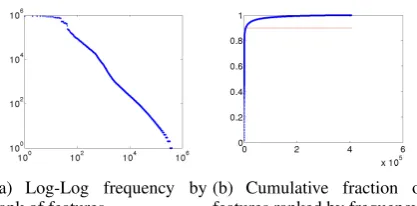
(a) Log-Log frequency by
rank of features (b) Cumulative fraction offeatures ranked by frequency
Figure 3: Feature frequency distributions
4 Caching Frequent Features
Decomposing the parametrization of input fea-tures using vector-matrix multiplication, as was described in section 2, overcomes the features sparsity common in NLP tasks and also makes it possible to use unlabeled data effectively. But it adds a huge amount of computation to both the training and decoding, since for every input fea-ture a vector-matrix multiplication is needed. This problem is even more severe in our algorithm be-cause at every training iteration we search for the best incorrect parse.
The frequency of features follows a power law distribution; there are a few very frequent features, and a long tail of infrequent features. Previous work has noticed that the vector-matrix multiplica-tion of the frequent features takes most of the com-putation time during testing, so they cache these computations (Bengio et al., 2003; Devlin et al., 2014; Chen and Manning, 2014). For example in the Figure 3(b), only 2100 features are respon-sible of 90% of the computations among ∼400k features, so cashing these computations can have a huge impact on speed. We note that these com-putations also take most of the computation time during training. First, this computation is the
dom-inant part of the forward and backward error com-putations. Second, at every iteration we need to decode to find the highest scoring incorrect parse. We propose to treat the cached vectors for high frequency features as parameters in their own right, using them both during training and during testing. This speeds up training because it is no longer necessary to do the high-frequency vector-matrix multiplications, neither to do the forward error computations nor to do the backpropagation through the vector-matrix multiplications. Also, the cached vectors used in decoding do not need to be recomputed every time the parameters change, since the vectors are updated directly by the pa-rameter updates.
Another possible motivation for treating the cached vectors as parameters is that it results in a kind of backoff smoothing; high frequency fea-tures are given specific parameters, and for low frequency features we back off to the decomposed model. Results from smoothing methods for sym-bolic statistical models indicate that it is better to smooth low frequency features with other low fre-quency features, and treat high frefre-quency features individually. In this paper we do not systemati-cally investigate this potential advantage, leaving this for future work.
In our experiments we cache features that make up to 90% of the feature frequencies. This gives us about a 20 times speed up during training and about a 7 times speed up during testing, while per-formance is preserved.
5 Parsing Complexity
[image:7.595.76.285.238.341.2]com-Figure 4: Histogram of number of candidate ac-tions between shifts
plexity isO(L×M×B×(|F|+|C|)×d2).1 If
we choose the best partial parse tree at every shift, thenB = 1. M is the total number of actions in the candidate chunks that are generated between two shifts, soL×M is the total number of can-didate actions in a parse. For shift-reduce depen-dency parsing, the total number ofchosenactions is necessarily linear inL, but because we are ap-plying best-first search in between shifts,M is not necessarily independent of L. To investigate the impact ofM on the speed of the parser, we em-pirically measure the number of candidate actions generated by the parser between 33368 different shifts. The resulting distribution is plotted in Fig-ure 4. We observe that it forms a power law distri-bution. Most of the time the number of actions is very small (2 or 3), with the maximum number be-ing 40, and the average bebe-ing 2.25. We conclude from this that the value ofMis not a major factor in the parser’s speed.
Remember that|F| is the number of input fea-ture types. Caching 90% of the input feafea-ture com-putations allows us to reasonably neglect this term. Because |C| is the number of hidden-to-hidden connection types, we cannot apply caching to re-duce this term. However, |C| is much smaller than |F| (here |C|=3). This is why caching in-put feature comin-putations has such a large impact on parser speed.
1For this analysis, we assume that the output computation is negligable compared to the hidden representation compu-tation, because the output computation grows withd while the hidden computation grows withd2.
6 Experimental Results
We used syntactic dependencies from the English section of the CoNLL 2009 shared task dataset (Hajiˇc et al., 2009). Standard splits of training, development and test sets were used. We compare our model to the generative INN model (Titov and Henderson, 2007b), MALT parser, MST parser, and the feed-forward neural network parser of (Chen and Manning, 2014) (“C&M”). All these models and our own models are trained only on the CoNLL 2009 syntactic data; they use no external word embeddings or other unsupervised training on additional data. This is one reason for choos-ing these models for comparison. In addition, the generative model (“Generative INN, large beam” in Table 1) was compared extensively to state-of-art parsers on various languages and tasks in pre-vious work (Titov and Henderson, 2007b; Titov and Henderson, 2007a; Henderson et al., 2008). Therefore, here our objective is not repeating an extensive comparison to the available parsers.
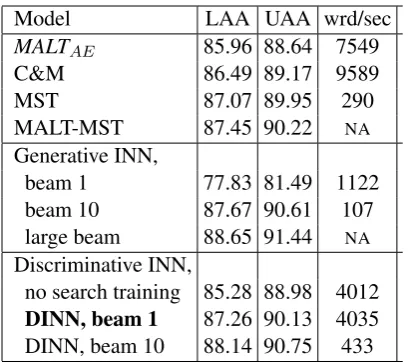
Table 1 shows the labeled and unlabeled ac-curacy of attachments for these models. The MALT and MST parser scores come from (Sur-deanu and Manning, 2010), which compared dif-ferent parsing models using CoNLL 2008 shared task dataset, which is the same as CoNLL 2009 for English syntactic parsing. The results for the generative INN with a large beam were taken from (Henderson and Titov, 2010), which uses an archi-tecture with 80 hidden units. We replicate this set-ting for the other generative INN results and our discriminative INN results. The parser of (Chen and Manning, 2014) was run with their architec-ture of 200 hidden units with dropout training (“C&M”). All parsing speeds were computed us-ing the latest downloadable versions of the parsers, on a single 3.4GHz CPU.
[image:8.595.90.283.65.242.2]Model LAA UAA wrd/sec
MALTAE 85.96 88.64 7549 C&M 86.49 89.17 9589 MST 87.07 89.95 290 MALT-MST 87.45 90.22 NA Generative INN,
beam 1 77.83 81.49 1122 beam 10 87.67 90.61 107 large beam 88.65 91.44 NA Discriminative INN,
no search training 85.28 88.98 4012
DINN, beam 1 87.26 90.13 4035
[image:9.595.71.276.60.241.2]DINN, beam 10 88.14 90.75 433 Table 1: Labelled and unlabelled attachment accu-racies and speeds on the test set.
Model LAA UAA LAA UAA LAA UAAGerman Spanish Czech C&M 82.5 86.1 81.5 85.4 58.6 70.6 MALT 80.7 83.1 82.4 86.6 67.3 77.4 MST 84.1 87.6 82.7 87.3 73.4 81.7 DINN 86.0 89.6 85.4 88.3 77.5 85.2 Table 2: Labelled and unlabelled attachment accu-racies on the test set of CoNLL 2009.
as our beam 1 model, but at the cost of significant reductions in accuracy.
To evaluate our RNN model’s ability to induce informative features automatically, we trained our deterministic model, MALT, MST and C&M on three diverse languages from CoNLL 2009, using the same features as used in the above experiments on English (model “DINN, beam 1”). We did no language-specific feature engineering for any of these parsers. Table 2 shows that our RNN model generalizes substantially better than all these mod-els to new languages, demonstrating the power of this model’s feature induction.
7 Conclusion
We propose an efficient and accurate recurrent neural network dependency parser that uses neu-ral network hidden representations to encode arbi-trarily large partial parses for predicting the next parser action. This parser uses a search strategy that prunes to a deterministic choice at each shift action, so we add acorrectness probabilityto each shift operation, and train this score to discriminate between correct and incorrect sequences of parser actions. All other probability estimates are trained
to optimize the conditional probability of the parse given the sentence. We also speed up both pars-ing and trainpars-ing times by only decompospars-ing infre-quent features, giving us both a form of backoff smoothing and twenty times faster training.
The discriminative training for this pruning strategy allows high accuracy to be preserved while greatly speeding up parsing time. The re-current neural network architecture provides pow-erful automatic feature induction, resulting in high accuracy on diverse languages without tuning.
Acknowledgments
The research leading to this work was funded by the EC FP7 programme FP7/2011-14 under grant agreement no. 287615 (PARLANCE).
References
Yoshua Bengio, R´ejean Ducharme, Pascal Vincent, and Christian Janvin. 2003. A neural probabilistic
lan-guage model. J. Mach. Learn. Res., 3:1137–1155,
March.
Danqi Chen and Christopher Manning. 2014. A fast and accurate dependency parser using neural
net-works. InProceedings of the 2014 Conference on
Empirical Methods in Natural Language Processing (EMNLP), pages 740–750. Association for Compu-tational Linguistics, October.
Michael Collins and Brian Roark. 2004.
Incremen-tal parsing with the perceptron algorithm. In
Pro-ceedings of the 42nd Annual Meeting on Association for Computational Linguistics, ACL ’04. Associa-tion for ComputaAssocia-tional Linguistics.
Ronan Collobert and Jason Weston. 2008. A uni-fied architecture for natural language processing: Deep neural networks with multitask learning. In
Proceedings of the 25th International Conference on Machine Learning, ICML ’08, pages 160–167. ACM.
Ronan Collobert, Jason Weston, L´eon Bottou, Michael Karlen, Koray Kavukcuoglu, and Pavel Kuksa. 2011. Natural language processing (almost) from
scratch. J. Mach. Learn. Res., 12:2493–2537,
November.
Ronan Collobert. 2011. Deep learning for efficient discriminative parsing. InProceedings of the Four-teenth International Conference on Artificial Intel-ligence and Statistics (AISTATS-11), volume 15, pages 224–232. Journal of Machine Learning Re-search - Workshop and Conference Proceedings. Hal Daum´e III and Daniel Marcu. 2005. Learning
as search optimization: Approximate large margin
of the 22nd International Conference on Machine Learning, pages 169–176.
Jacob Devlin, Rabih Zbib, Zhongqiang Huang, Thomas Lamar, Richard Schwartz, and John Makhoul. 2014. Fast and robust neural network joint models for sta-tistical machine translation. In Proceedings of the 52nd Annual Meeting of the Association for Compu-tational Linguistics (Volume 1: Long Papers). Asso-ciation for Computational Linguistics.
Xavier Glorot, Antoine Bordes, and Yoshua Bengio. 2011. Domain adaptation for large-scale sentiment
classification: A deep learning approach. In
Pro-ceedings of the 28th International Conference on Machine Learning (ICML-11), ICML ’11, pages 513–520. ACM, June.
Jan Hajiˇc, Massimiliano Ciaramita, Richard Johans-son, Daisuke Kawahara, Maria Ant`onia Mart´ı, Llu´ıs M`arquez, Adam Meyers, Joakim Nivre, Sebastian Pad´o, Jan ˇStˇep´anek, Pavel Straˇn´ak, Mihai Surdeanu, Nianwen Xue, and Yi Zhang. 2009. The conll-2009 shared task: Syntactic and semantic dependencies
in multiple languages. InProceedings of the
Thir-teenth Conference on Computational Natural Lan-guage Learning: Shared Task, CoNLL ’09, pages 1–18. Association for Computational Linguistics. James Henderson and Ivan Titov. 2010. Incremental
sigmoid belief networks for grammar learning. J.
Mach. Learn. Res., 11:3541–3570, December. James Henderson, Paola Merlo, Gabriele Musillo, and
Ivan Titov. 2008. A latent variable model of syn-chronous parsing for syntactic and semantic
depen-dencies. In Proceedings of the Twelfth
Confer-ence on Computational Natural Language Learning, CoNLL ’08, pages 178–182. Association for Com-putational Linguistics.
James Henderson, Paola Merlo, Ivan Titov, and Gabriele Musillo. 2013. Multilingual joint parsing of syntactic and semantic dependencies with a latent
variable model. Comput. Linguist., 39(4):949–998,
December.
James Henderson. 2003. Inducing history representa-tions for broad coverage statistical parsing. In Pro-ceedings of the 2003 Conference of the North Amer-ican Chapter of the Association for Computational Linguistics on Human Language Technology - Vol-ume 1, NAACL ’03, pages 24–31. Association for Computational Linguistics.
James Henderson. 2004. Discriminative training of a neural network statistical parser. InProceedings of the 42nd Meeting of the Association for Compu-tational Linguistics (ACL’04), Main Volume, pages 95–102, July.
Liang Huang, Suphan Fayong, and Yang Guo. 2012.
Structured perceptron with inexact search. In
Pro-ceedings of the 2012 Conference of the North Amer-ican Chapter of the Association for Computational
Linguistics: Human Language Technologies, pages 142–151. Association for Computational Linguis-tics, June.
John D. Lafferty, Andrew McCallum, and Fernando C. N. Pereira. 2001. Conditional random fields: Probabilistic models for segmenting and labeling se-quence data. InProceedings of the Eighteenth Inter-national Conference on Machine Learning, ICML ’01, pages 282–289. Morgan Kaufmann Publishers Inc.
Tom´aˇs Mikolov, Martin Karafi´at, Luk´aˇs Burget, Jan ˇCernock´y, and Sanjeev Khudanpur. 2010.
Recur-rent neural network based language model. In
Pro-ceedings of the 11th Annual Conference of the In-ternational Speech Communication Association (IN-TERSPEECH 2010), volume 2010, pages 1045– 1048. International Speech Communication Associ-ation.
Joakim Nivre, Johan Hall, and Jens Nilsson. 2004. Memory-based dependency parsing. In Hwee Tou
Ng and Ellen Riloff, editors, HLT-NAACL 2004
Workshop: Eighth Conference on Computational Natural Language Learning (CoNLL-2004), pages 49–56. Association for Computational Linguistics, May 6 - May 7.
Joakim Nivre, Johan Hall, Jens Nilsson, G¨uls¸en Eryiˇgit, and Svetoslav Marinov. 2006. Labeled pseudo-projective dependency parsing with support
vector machines. InProceedings of the Tenth
Con-ference on Computational Natural Language
Learn-ing, CoNLL-X ’06, pages 221–225. Association for
Computational Linguistics.
Rajat Raina, Alexis Battle, Honglak Lee, Benjamin Packer, and Andrew Y. Ng. 2007. Self-taught learning: Transfer learning from unlabeled data. In
Proceedings of the 24th International Conference on Machine Learning, ICML ’07, pages 759–766. ACM.
Richard Socher, Cliff Chiung-Yu Lin, Andrew Ng, and Chris Manning. 2011. Parsing natural scenes and natural language with recursive neural networks. In
Proceedings of the 28th International Conference on Machine Learning (ICML-11), ICML ’11, pages 129–136. ACM.
Richard Socher, John Bauer, Christopher D. Manning, and Ng Andrew Y. 2013. Parsing with
composi-tional vector grammars. InProceedings of the 51st
Annual Meeting of the Association for Computa-tional Linguistics (Volume 1: Long Papers), pages 455–465. Association for Computational Linguis-tics, August.
Mihai Surdeanu and Christopher D. Manning. 2010. Ensemble models for dependency parsing: Cheap
and good? In Human Language Technologies:
Ilya Sutskever, James Martens, and Geoffrey Hin-ton. 2011. Generating text with recurrent
neu-ral networks. In Proceedings of the 28th
Interna-tional Conference on Machine Learning (ICML-11), ICML ’11, pages 1017–1024. ACM, June.
Ivan Titov and James Henderson. 2007a. Fast and robust multilingual dependency parsing with a
gen-erative latent variable model. In Proceedings of
the CoNLL Shared Task Session of EMNLP-CoNLL
2007, pages 947–951. Association for
Computa-tional Linguistics, June.
Ivan Titov and James Henderson. 2007b. A latent variable model for generative dependency parsing. InProceedings of the 10th International Conference on Parsing Technologies, IWPT ’07, pages 144–155. Association for Computational Linguistics.
Kaisheng Yao, Geoffrey Zweig, Mei-Yuh Hwang, Yangyang Shi, and Dong Yu. 2013. Recurrent
neu-ral networks for language understanding. In
INTER-SPEECH, pages 2524–2528.